Minds On
Warm up
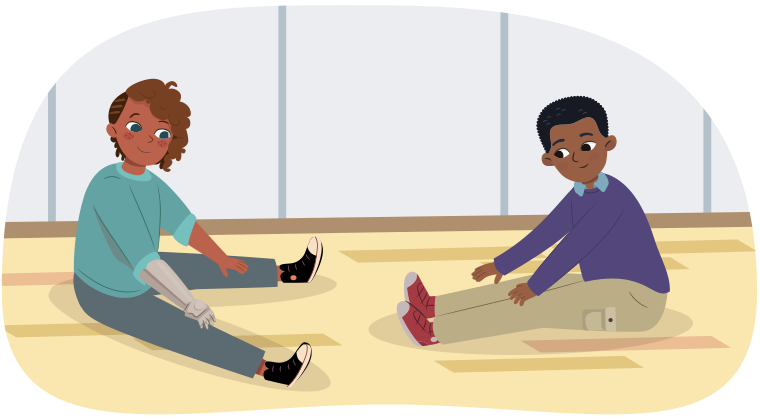
Let’s begin with a breathing activity!
Don’t forget to do your safety check!

Warm Up
Breathing activity
Find a comfortable position. Focus your attention on one part of the body at a time.
How does that part of your body feel? If possible, take a deep breath and allow your lungs to expand.
Focus your attention on one part of your body. Allow that part to relax before moving on to the next.
As you scan through your body, keep breathing deeply.
Once you have completed the scan, take a moment to stretch.
Access the following audio recording “Breathing Activity” to follow this exercise.
Breathing Activity
Drama game
Let’s create something new out of everyday objects.
Select three objects (such as a chair, a scarf, or a book), and imagine that they are something else entirely!
For example, a book might become a bird with its wings flapping. Use your imagination!
Using your three objects, create a short drama story. Record your ideas using a method of your choice.
Let’s get started
Lighting, sound effects, and visuals
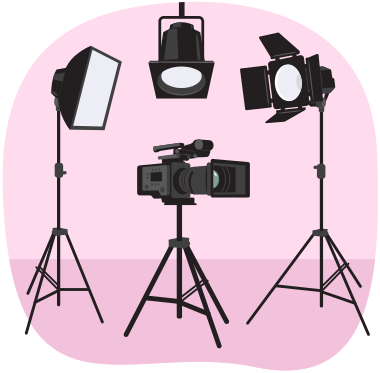
- How might lighting, sound effects, or other visuals be used to enhance a drama production?
- How could lighting and/or sound communicate mood in a drama production?
Complete the Lighting, Sound Effects, and Visuals Mind Map in your notebook or using the following fillable and printable document. You can also use another method of your choice to record your ideas.
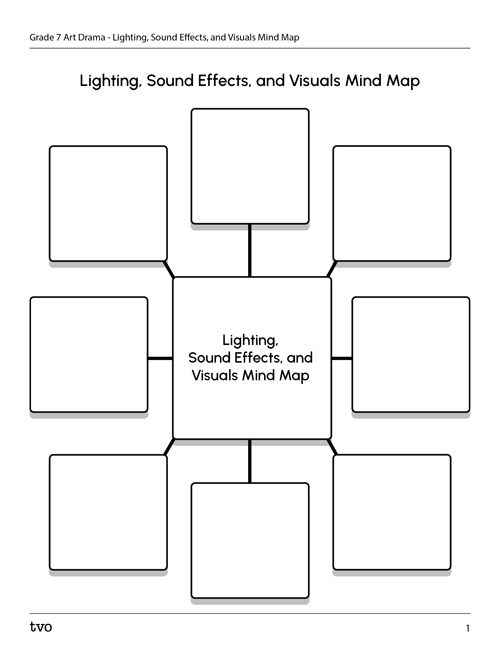
Press the Activity button to access the Lighting, Sound Effects, and Visuals Mind Map.
Activity (Open PDF in a new tab)Action
Get ready, get set…
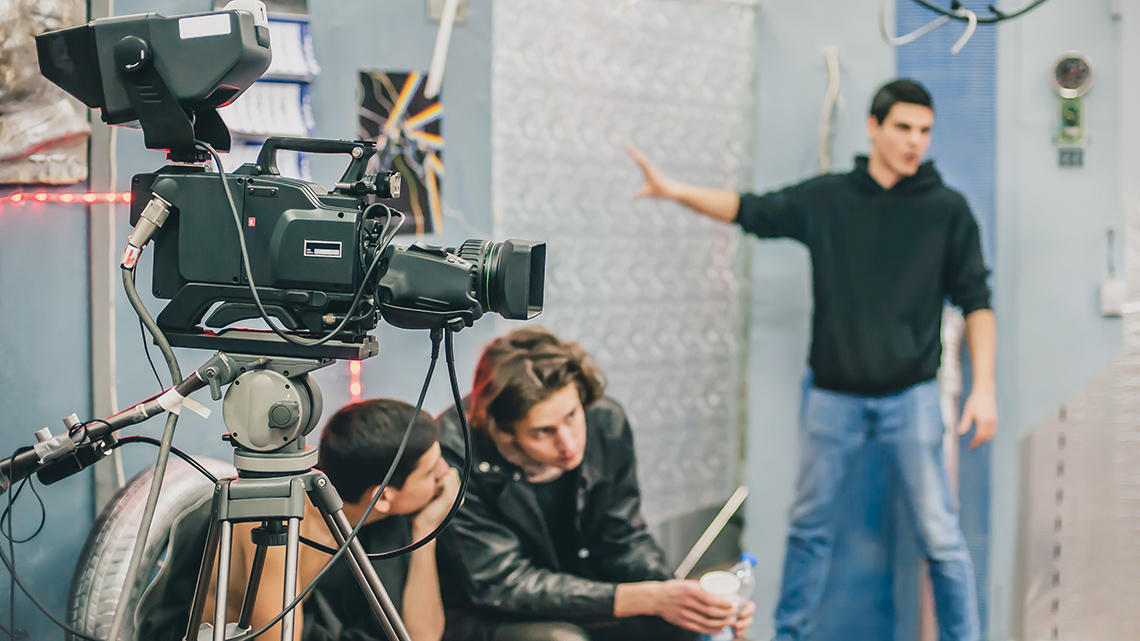
In a dramatic production, there are many pieces that come together to tell a story.
The director and playwright begin discussing their visions for how the story will be told but there are other important decisions that also need to be made.
Costume designers, lighting designers, projection designers, and scenic designers all work together with the director of a drama production to collaborate and exchange ideas to create the overall vision.
Every member of a production crew is important. Without everyone working together in their specific roles, the show cannot go on.
Explore the following theatre organizational chart. How are the sounds, lights, and visuals linked together?
Press ‘Hint’ to access a clue to help you get started.
The lines that connect one position to the next show the direct links.
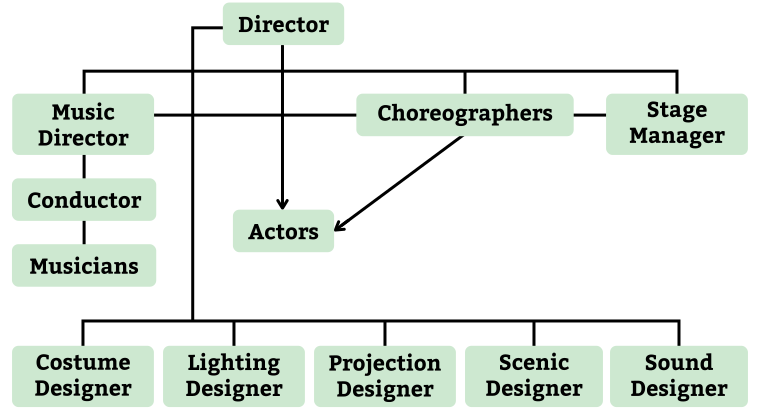
This is the organizational flow chart showcasing the importance of a production crew. At the top of the chart, you have the director with an arrow pointing down to actors. The director also has another arrow point down to the very end listing other roles. These roles include; costume designer, lighting designer, projection designer, scenic designer, and sound designer. Then you have the music director, choreographers, and stage manager. The music director has an arrow pointing down listing other roles in the following order: conductor and musician. The role of the choreographer has an arrow point down to actors.
Press ‘Answer’ to reveal a possible response.
The lighting designer, sound designer, and scenic designer are all linked on the same line and attached to the director.
There are many other roles someone can take in the theatre company. They might work on the performance design or technical parts of a drama production.
Explore the following table to learn about the various roles in a theatre company.
|
Performance |
Design |
Tech |
|---|---|---|
|
Producer Production manager Director Music director Chorographers Stage/deck manager Actors |
Costume designer Lighting designer Projection designer Scenic designer Sound designer |
Technical director Costumer Master electrician Media programmer Master painter Master carpenter sound engineer Props master/designer Build crew |
Sound, light, and visuals
In order to create a specific mood and help communicate specific themes, ideas and feelings to the audience, lighting, scenic, and sound designers work to help enhance different parts of a drama production.
Sound design
The sound designer plans and actions the sound effects, including the music for the production. Sound and music cues require very precise timing of the onstage action. They can only be set after the blocking has already been decided for the play.
Explore the following video, which outlines how sound designers work with visuals and/or staged productions to create convincing sound effects.

Pause and Reflect
Reflect
How could someone use sound effects to help the audience understand:
- change of weather
- an actor’s movements and/or actions
Press ‘Let’s Check’ to reveal a possible response.
Feet stomping in sand can become snowshoes in the snow, rattling plants can actually make the sound of rain.
Lighting and projection design
The lighting designer creates lighting scenes and paints a picture using the lighting on stage to create a mood. They work with the other designers to collaborate on the mood that they are trying to create.
The projection designer creates all the projections shown on stage, including photos and filmed footage. They work with other scenic design elements to create the setting for a story to unfold.
Check out the following video to learn more about lighting and projection.
Pause and Reflect
Reflect
- What is the purpose of the lights on a stage?
- How does the lighting help the audience understand the story?
- How does the lighting help the actors tell the story?
- How might projection be a part of that?
Press ‘Let’s Check’ to reveal a possible response.
The lights frame the stage. The lighting tells the audience where to look, the time of day, what is the mood and atmosphere. The lighting designers help the actor tell the story by keeping them highlighted on stage and keeping the audience drawn to them. The projection designer projects images onto the stage that help with the extra details that lights alone cannot accomplish, such as images, movement or patterns.
Scenic design
This scenic designer needs to set the story’s time and place and get from point A to point B in a way that helps tell the story well. The scenic designer needs to understand how the audience can engage with the story.
Explore the following video to learn more about scenic design.
Pause and Reflect
Reflect
How is a relationship with the director important for a scenic designer?
Press ‘Let’s Check’ to reveal a possible response.
The director and scenic designer should work together to communicate the director’s vision for the play.
Go!
Imagine you were a sound designer, lighting or set designer. You will be making creative decisions about your area of expertise.
Explore these possible productions and choose the one that you would like to work with.
Option 1: Production of Charlotte’s Web
Charlotte’s Web is a children’s novel written by E.B. White. It takes place on Homer Zuckerman’s farm and centres around the relationship between a pig named Wilbur and a spider named Charlotte. Charlotte lives in the doorway of Wilbur’s pigpen.
In the following scene, the Zuckermans have brought Wilbur to the county fair to try to win the prize of a Blue Ribbon. Wilbur’s animal friends, Charlotte and Templeton the rat, have joined him to keep him company while he is there. Charlotte has been weaving words into her spiderweb in the doorway in the hopes that if people understand how special he is, they will want to keep him around the farm.
Imagine that you are making design choices for this scene of the play.
Option 2: Aesop’s Fables for the stage
Aesop lived during the mid-6th century BCE and was a former enslaved person from Greece who wrote tales called fables. These 725 fables were often shared using the storytelling tradition of passing the tales orally from person to person but were also available for children to learn to read. These fables, as written, were not long stories. They would begin with a setting and a situation and then move quickly into the “punchline” or the moral (lesson) of the tale.
Imagine an adaptation of this fable is being produced on stage.
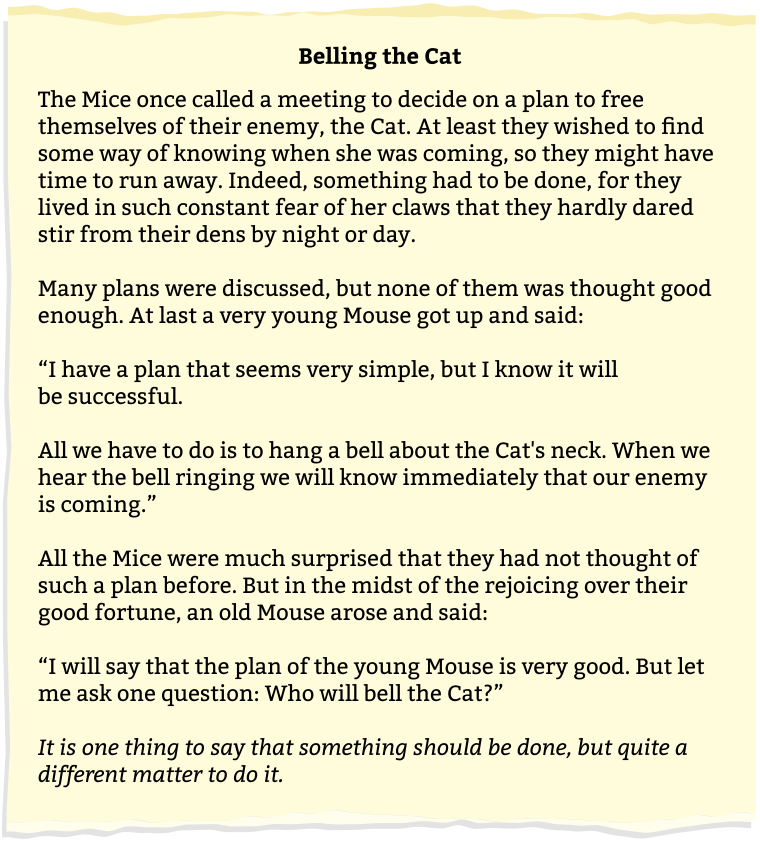
The Mice once called a meeting to decide on a plan to protect themselves, from the Cat. At least they wished to find some way of knowing when she was coming, so they might have time to run away. Indeed, something had to be done, for they lived in such constant fear of her claws that they hardly dared stir from their dens by night or day. Many plans were discussed, but none of them was thought good enough. At last a very young Mouse got up and said: "I have a plan that seems very simple, but I know it will be successful. All we have to do is to hang a bell about the Cat’s neck. When we hear the bell ringing, we will know immediately that our enemy is coming.” All the Mice were much surprised that they had not thought of such a plan before. But in the midst of the rejoicing over their good fortune, an old Mouse arose and said: "I will say that the plan of the young Mouse is very good. But let me ask one question: Who will bell the Cat?" It is one thing to say that something should be done, but quite a different matter to do it.
Option 3: Select a story of your choice
Select a story or a scene of a recorded play of your choice that will become produced on stage.
Decide which designer you want to be.
I am going to be a…
How could you use sound effects, lighting design, or props and/or visuals to help stage the story? You can return to the videos and information about the role of this designer to help you. You can also learn more information through an online search. Be sure to choose sites that are created by professionals.
Consider:
- your design choices
- materials you could use to create these designs
Complete the Planning Chart in your notebook or using the following fillable and printable document. You can also use another method of your choice to record your plans.
If possible, share your planning ideas with a partner.
Consider adding your work to your drama portfolio.
Consolidation
Subject of the lesson
Imagine you are pitching your ideas either as a sound effects, lighting design, or scenic designer. How would you create a convincing argument that you needed the equipment and the resources to complete your vision for the production?
Create a persuasive speech to convince the director of your ideas.
Step 1: record the main point of your point (needing equipment and/or resources to complete your vision for the production)
Step 2: record your main 2 or 3 reasons why these are needed to complete your vision (use examples, be specific, and include information about why you need these specific materials to complete your vision)
Step 3: your conclusion (re-state your main point of your speech)
Complete the Persuasive Speech Organizer in your notebook or using the following fillable and printable document. You can also use another method of your choice to record your speech.
Consider adding your work to your portfolio.
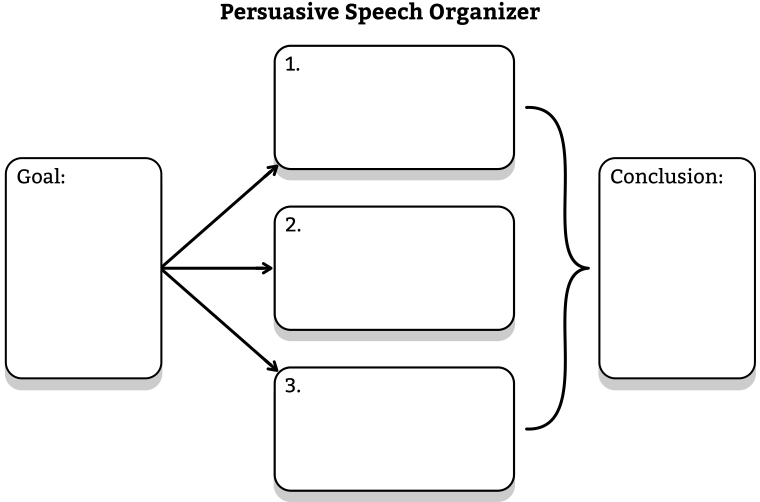
An illustration of an organizer to record ideas for a persuasive speech. There are three sections. Starting on your right there will be a square box titled ‘Goal’. This box will have three arrows pointing to three different boxes which will all be numbered. The three boxes all have the same arrow point to the last box which is titled ‘Conclusion’.
Press the ‘Activity’ button to access Persuasive Speech Organizer.
Press ‘Example’ to access an example of a speech.
Good afternoon Director,
I am coming to you today, as the lighting designer, to request a few specific pieces of equipment for this production. These pieces of equipment are the most effective solutions to communicate your vision of Charlotte’s Web to the audience.
The first piece of equipment I will need is a multi-coloured panel of lights that can be used in the fair scene. A fair is colourful and bright, and these lights will portray those colours since we do not have the ability to showcase these colours using set pieces.
The second piece of equipment I would need is a strong spotlight to showcase the moments when Charlotte is on the stage since her scenes tend to be at night. This will help to guide the audience’s attention to Charlotte. I know that with these pieces of equipment, we can create the atmosphere and mood that will help to engage the audience in the show.
Once you have completed your persuasive speech, if possible, present it to a partner or create an audio recording.
Pause and Reflect
Reflect
Was this an area of drama in which you felt confident? Why or why not?
What did you enjoy the most about this activity? Why?
What is one thing in this area of drama that you would like to continue to practise? Why?

Portfolio
Journal reflection
Reflect on the learning tasks. This reflection is a space for you to express your feelings, ask questions about what you have just done, and connect thoughts together with specific activities or exercises.
Use 2-4 of the journal prompts from the Reflection Starters list and create a written, audio, or video reflection.
|
Prompts to Start a Reflection on Drama Class Note: The following prompts begin an entire thought and can be used to develop your thoughts and ideas. Note: Try to utilize three to four of the prompts provided. If there is something else you wish to share, continue to build on your ideas. Note: Explore your thoughts and feelings with direct reference to what you learned and explored within the lesson. When I did ____________, it reminded me of… I really liked it when I did____________, because… I really want to know more about ___________, because… I’m really happy about __________, because… When I think about what I accomplished in this task, I think about… I can’t wait for the next task like this, because… When I learned about __________, it made me feel ____________, because… |
Press the ‘Activity’ button to access Reflection Starters.
Reflection
As you read the following descriptions, select the one that best describes your current understanding of the learning in this activity. Press the corresponding button once you have made your choice.

I feel...
Now, expand on your ideas by recording your thoughts using a voice recorder, speech-to-text, or writing tool.
When you review your notes on this learning activity later, reflect on whether you would select a different description based on your further review of the material in this learning activity.