Learning goals
We are learning to…
- identify themes explored in First Nations, Métis, and Inuit cultures to show an understanding of the many identities and ways of knowing, being, and doing
- share my thoughts and feelings about why learning from different people is important
- gather information about a topic using different sources
- sort and sequence ideas and information
Success criteria
I am able to…
- explore a Raven’s Quest video featuring Morgan, who is Métis and lives in East Selkirk, and take notes about Métis art and music
- share my thoughts on why learning from others is important
- record notes on Métis beading and fiddle music

Learning from others
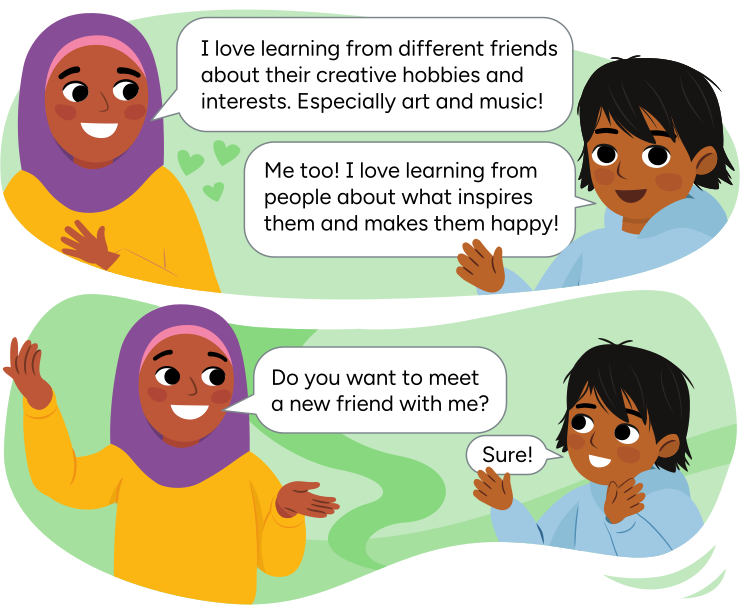
A conversation between two students, Esma and Antonio.
Esma: I love learning from different friends about their creative hobbies and interests. Especially art and music!
Antonio: Me too! I love learning from people about what inspires them and makes them happy.
Esma: Do you want to meet a new friend with me?
Antonio: Sure!
Check out the following Raven's Quest video where Morgan introduces herself.
How does Morgan introduce herself?
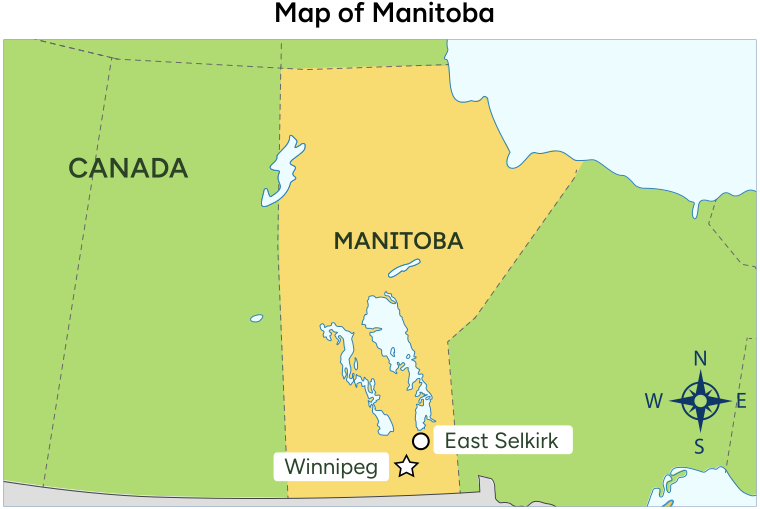
Where does Morgan live?
Press Reveal to check your answer.
Morgan is Métis and is 12 years old. She lives in East Selkirk, just outside of Winnipeg, Manitoba.

Taking notes
When we explore new information, we can take notes to help us remember different facts and ideas.

- We can take notes to help us record new information.
- We can use words, drawings, or short sentences when we take notes.
- We should try and use our own words while taking notes.
- We can record questions in our notes. Morgan is Métis and has many hobbies and interests.
Métis
It is important to remember that Métis is not used to describe any person of mixed Indigenous ancestry.
Métis means a person who self-identifies as Métis, is distinct from other Aboriginal peoples, is of historic Métis Nation ancestry, and is accepted by the Métis Nation.
The area known as the “historic Métis Nation Homeland” includes the three prairie provinces and extends into Ontario, British Columbia, Northwest Territories, and the northern United States.
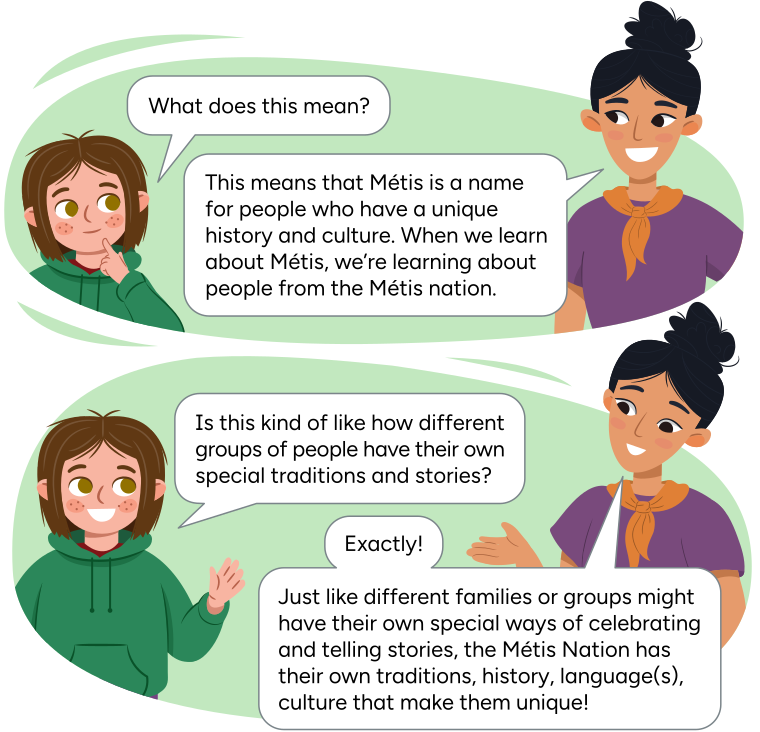
A conversation between a student and a teacher.
Student: What does this mean?
Teacher: This means that Métis is a name for people who have a unique history and culture. When we learn about Métis, we're learning about people from the Métis Nation.
Student: Is this kind of like how different groups of people have their own special traditions and stories?
Teacher: Exactly! Just like different families or groups might have their own special ways of celebrating and telling stories, the Métis Nation has their own traditions, history, language(s), culture that make them unique!

Did you know?
Did you know?
The Métis are known as the Flower Beadwork People by the Dakota and the Cree because the flower is a common symbol in their beadwork art and embroidery.
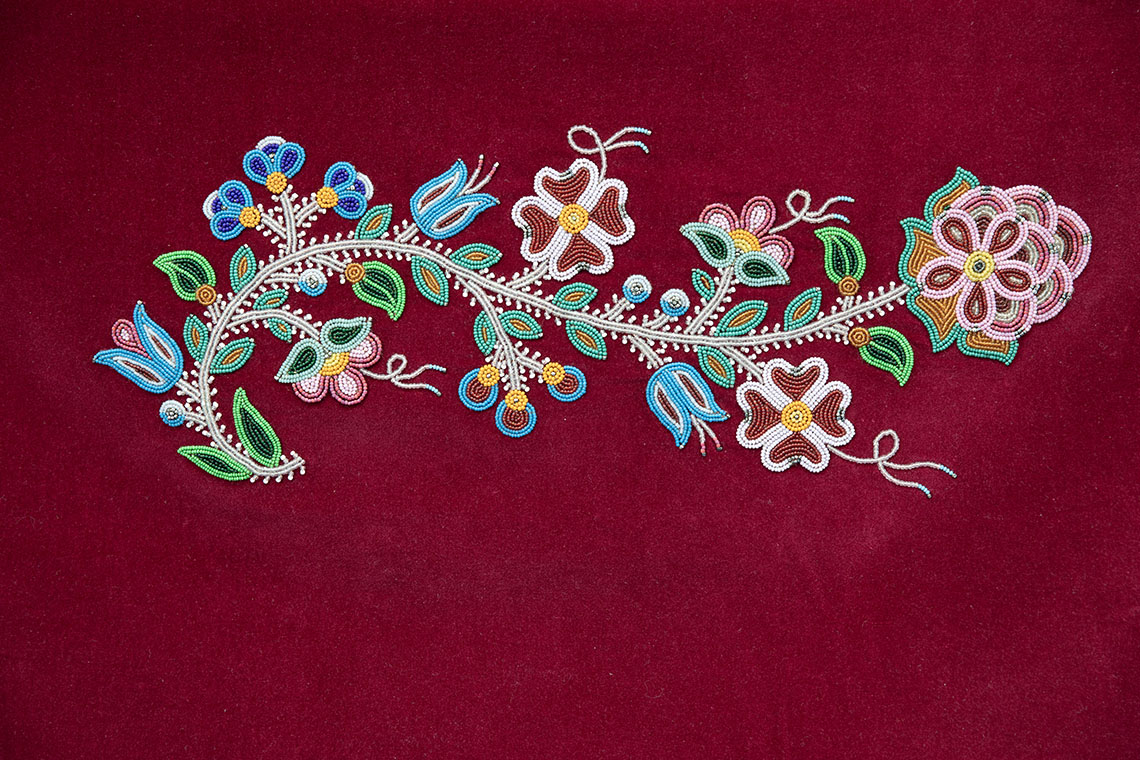
‘Abstract’ by Jennine Krauchi
Morgan is Métis and has many hobbies and interests.
She shares different parts of her community and her culture in different ways, including traditional beadwork and Métis fiddle music.
Let’s begin by learning more about Métis beadwork from Morgan!
Where did Morgan learn to bead? What does she like about it?
Press Reveal to check your answer.
Morgan learned to bead at a Métis camp. She says that it is fun because she gets to learn about her culture.
What materials does Morgan bead on? What kind of material is used traditionally?
Press Reveal to check your answer.
Traditionally, beadwork is done on leather. Morgan uses felt because it is an easier material to bead.
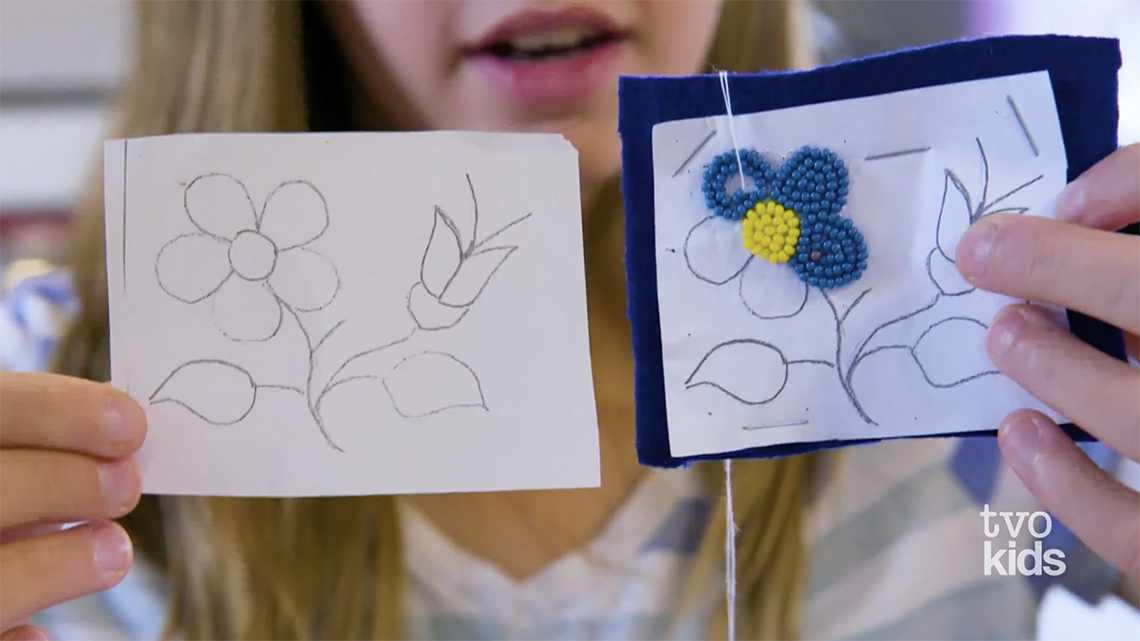
What symbol do you notice is part of Morgan’s beadwork?
Press Reveal to check your answer.
Morgan’s beadwork includes a flower.
Flowers are traditional symbols used in Métis beadwork.
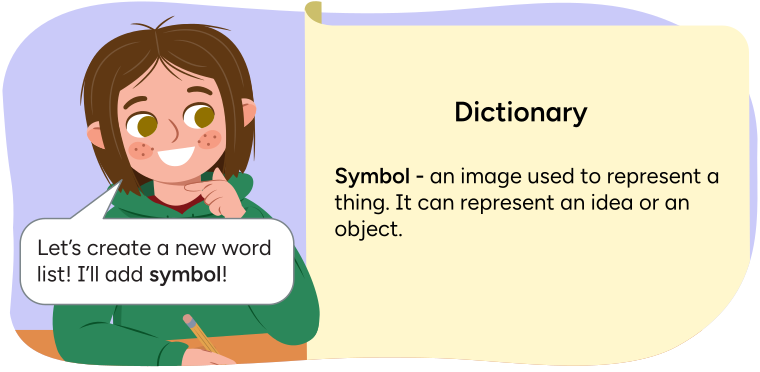
Student Clara starting a word list or dictionary with the following definition:
Symbol - an image used to represent a thing. It can represent an idea or an object.
What are the different steps Morgan follows to create her beadwork?
Press Reveal to check your answer.
- Morgan creates an outline of her design. She calls this a template.
- Next, she attaches that to a piece of felt.
- Finally, she uses the outline to help guide her beadwork.
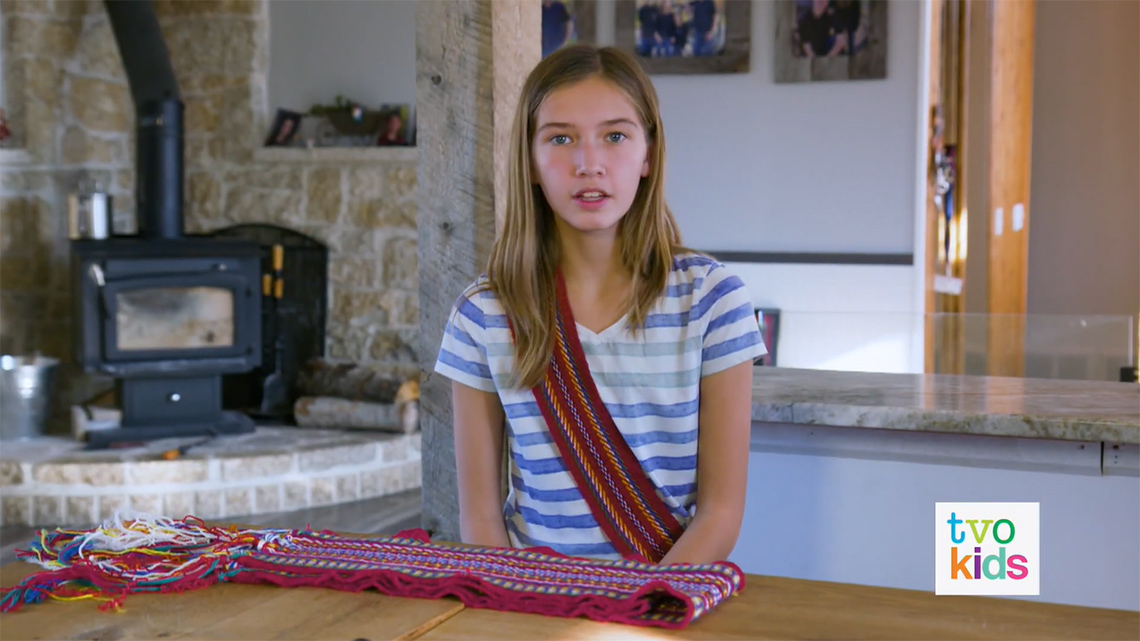
Why is the sash that Morgan wears important? What do the colours included in the sash mean?
Press Reveal to check your answer.
Morgan explains that the sash is a Métis sash. She explains that “the colour white represents the connection between us and our Earth” and “yellow represents hope and a bright future.”

Did You Know?
Did you know?
The Métis have worn sashes since the 1700s. It is an important symbol in Métis culture. The sash is also very practical.
It can be used:
- to pull canoes
- attach a bag of materials to a person’s back
- as a dog harness
- as a towel or washcloth
- to carry safety supplies.
Art forms in Métis communities, just like in First Nations and Inuit communities, are not only beautiful but used for different purposes.
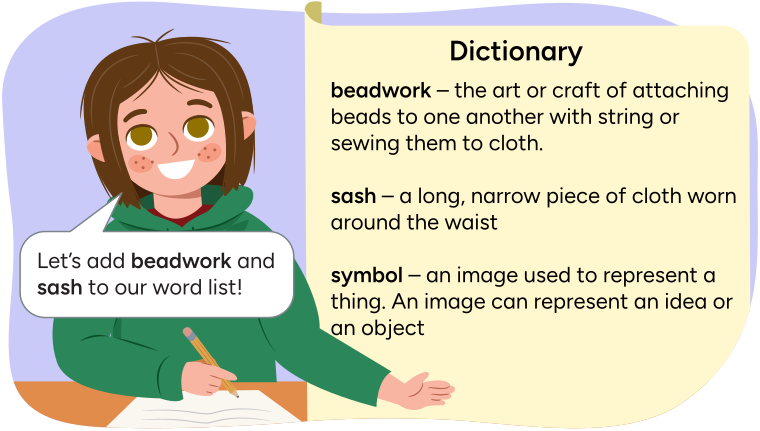
Clara adds two definitions to her word list:
Beadwork - the art or craft of attaching beads to one another with string or sewing them to cloth
Sash - a long, narrow piece of cloth worn around the waist
Symbol - an image used to represent a thing. An image can represent an idea or an object
Artists in the community
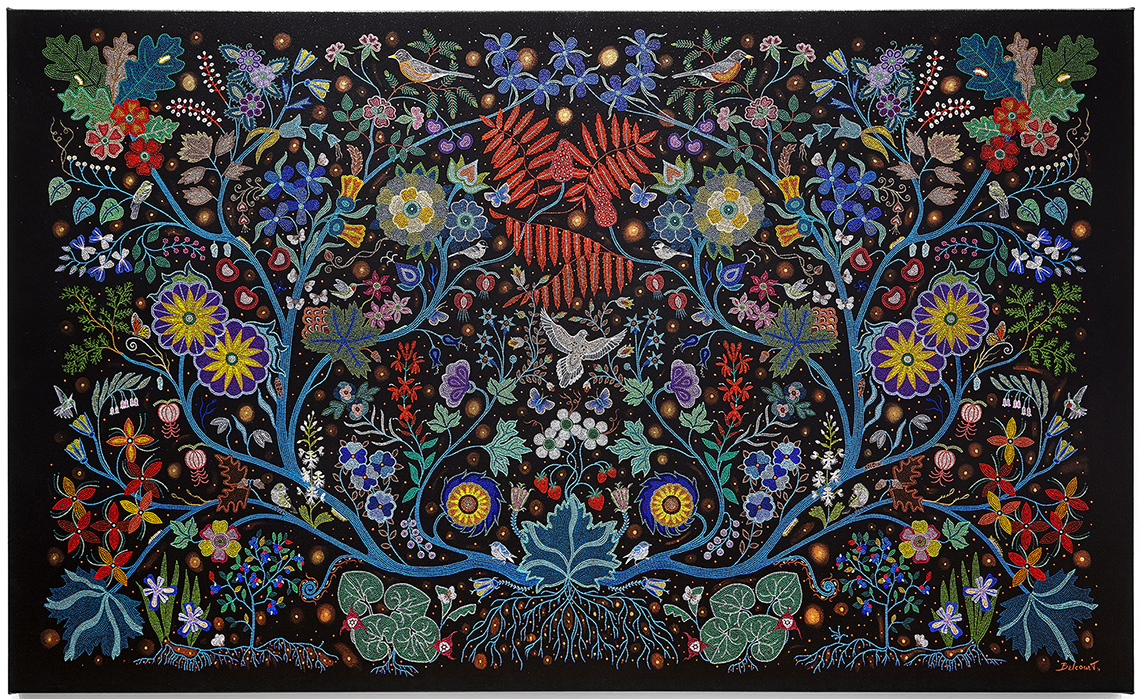
As we learned from Morgan’s story, flowers are important symbols in Métis beadwork. Beadwork creates texture, and the intricate floral designs contrast and stand out against a darker background.

Artists like Christi Belcourt reflect the style of Métis beadwork in her artwork.
Christi Belcourt is a Métis artist and author from the community of Manitou Sakhigan (Lac Ste. Anne) in Alberta, Canada.
Her artwork uses symbols to share her respect for the traditions and understandings of her culture and community.
For example, in Christi Belcourt’s piece Wisdom of the Universe, 2014 we can see many
different types of plants and flowers, as well as different types of animals.
Let’s learn more about Morgan!
Check out this clip where Morgan shares some details about her room.
What do we learn about Morgan as she shows us her room?
Press Reveal to check your answer.
Morgan has won medals doing dance, she has tap shoes, and she loves blue!
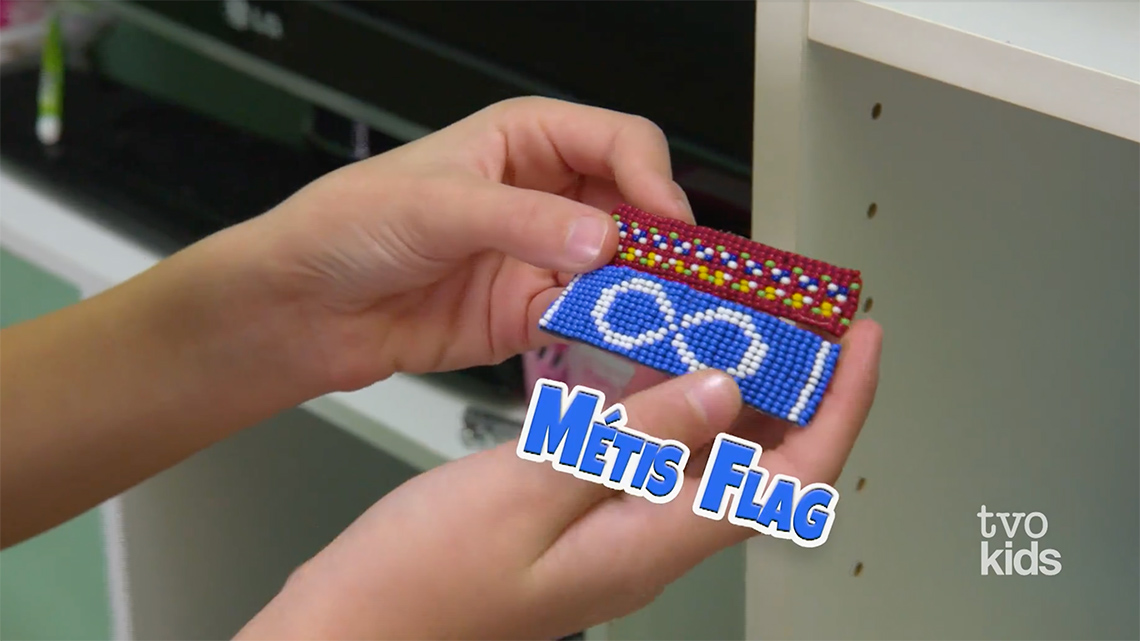
Morgan shows us beaded clips for her hair. One is of the Métis sash, and one is of the Métis flag. What do you notice about the Métis flag?
Press Reveal to check your answer.
I notice the colours blue and white and the symbol in the middle.
Did You Know?
Did you know?
The Métis flag was first introduced around 1815. The white symbol in the middle of the flag is the infinity symbol. This symbol shares the way two cultures, European and First Nation, joined to create the Métis culture.
“Our flag represents the faith that the Métis culture shall live on forever. We are Indigenous to this country because we were born of the land long before Canada was a country.”
- Audrey Poitras, President, Métis Nation of Alberta
Did You Know?
Check out this clip where Morgan shares her passion for the fiddle!
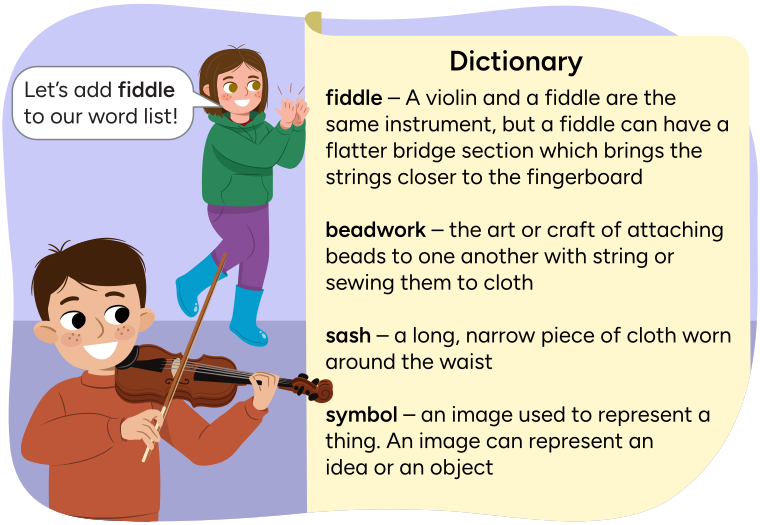
Clara adds a definition to her word list:
Fiddle - A violin and a fiddle are the same instrument, but a fiddle can have a flatter bridge section which brings the strings closer to the fingerboard.
Beadwork - the art or craft of attaching beads to one another with string or sewing them to cloth
Sash - a long, narrow piece of cloth worn around the waist
Symbol - an image used to represent a thing. An image can represent an idea or an object
Did you know?
Did you know?
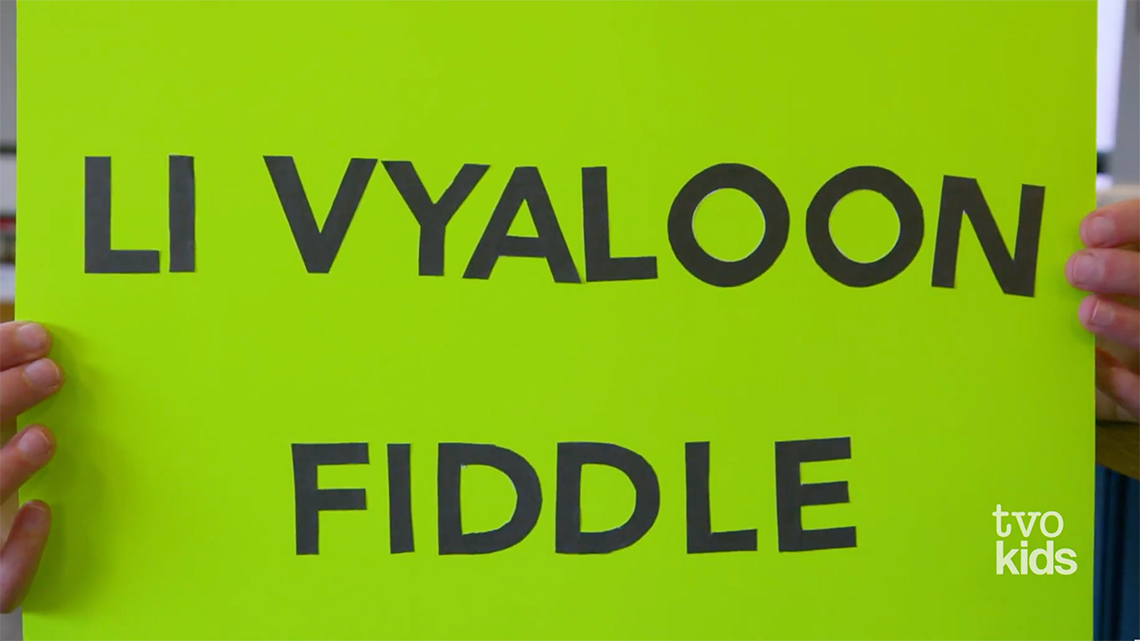
Did you know li vyaloon means fiddle in Michif?
Michif is the language of the Métis people.
What does Morgan teach us about Métis music?
Press Reveal to check your answer.
The patterns and the timing are different from other kinds of music.
How does the audience react to Morgan’s music?
Press Reveal to check your answer.
I think the audience likes Morgan’s music. They are smiling and tapping their feet or clapping their hands.
Who does Morgan enjoy playing with?
Press Reveal to check your answer.
Morgan enjoys playing with her dad.
Why does Morgan enjoy playing the fiddle?
Press Reveal to check your answer.
Morgan enjoys playing the fiddle because it’s part of her culture.
How did you feel as you listened to the music?
Share your thoughts with a partner, if possible.

Printing practice
Let’s practice writing out a few words we explored!
Use your notebook or a method of your choice to practice printing each word.
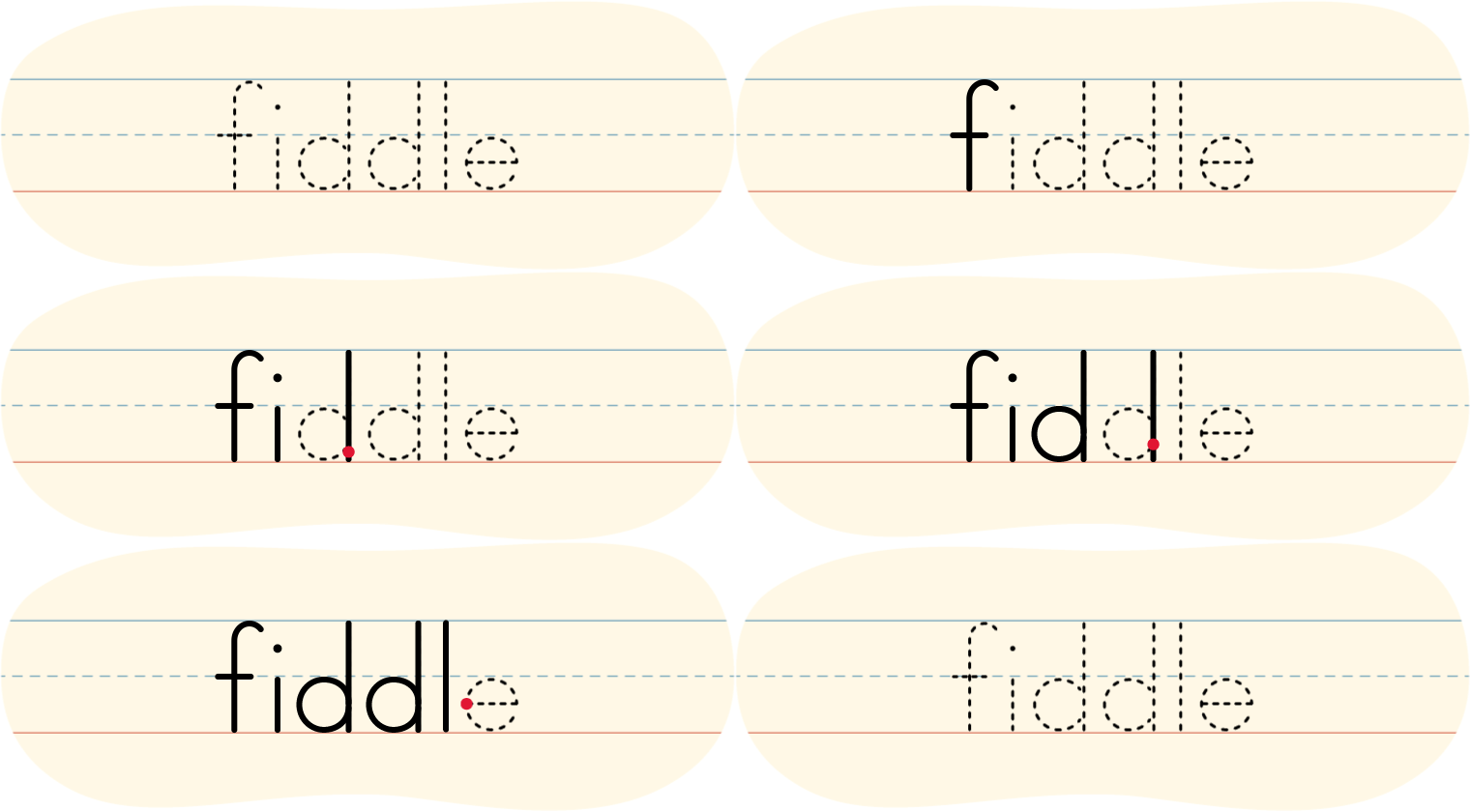
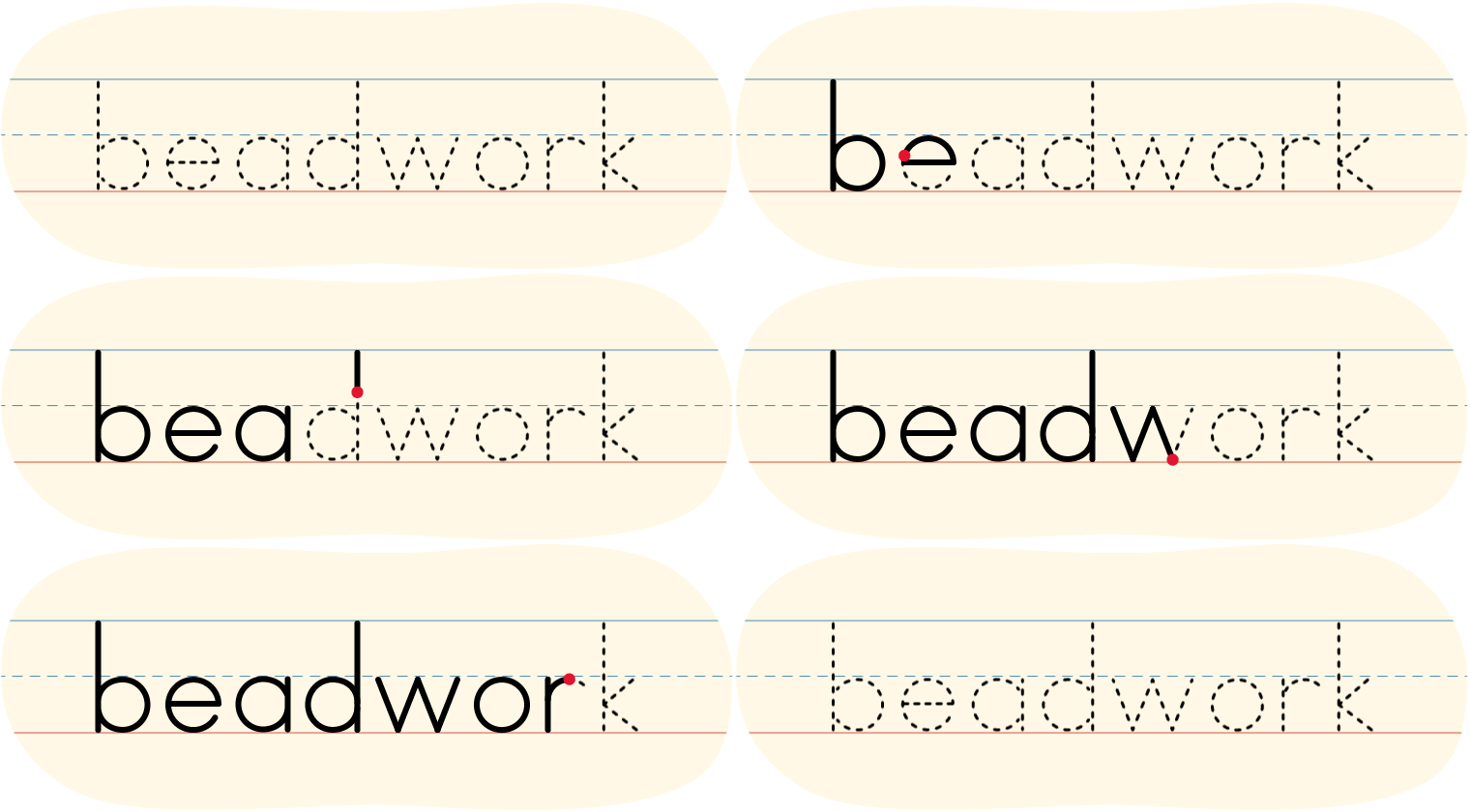
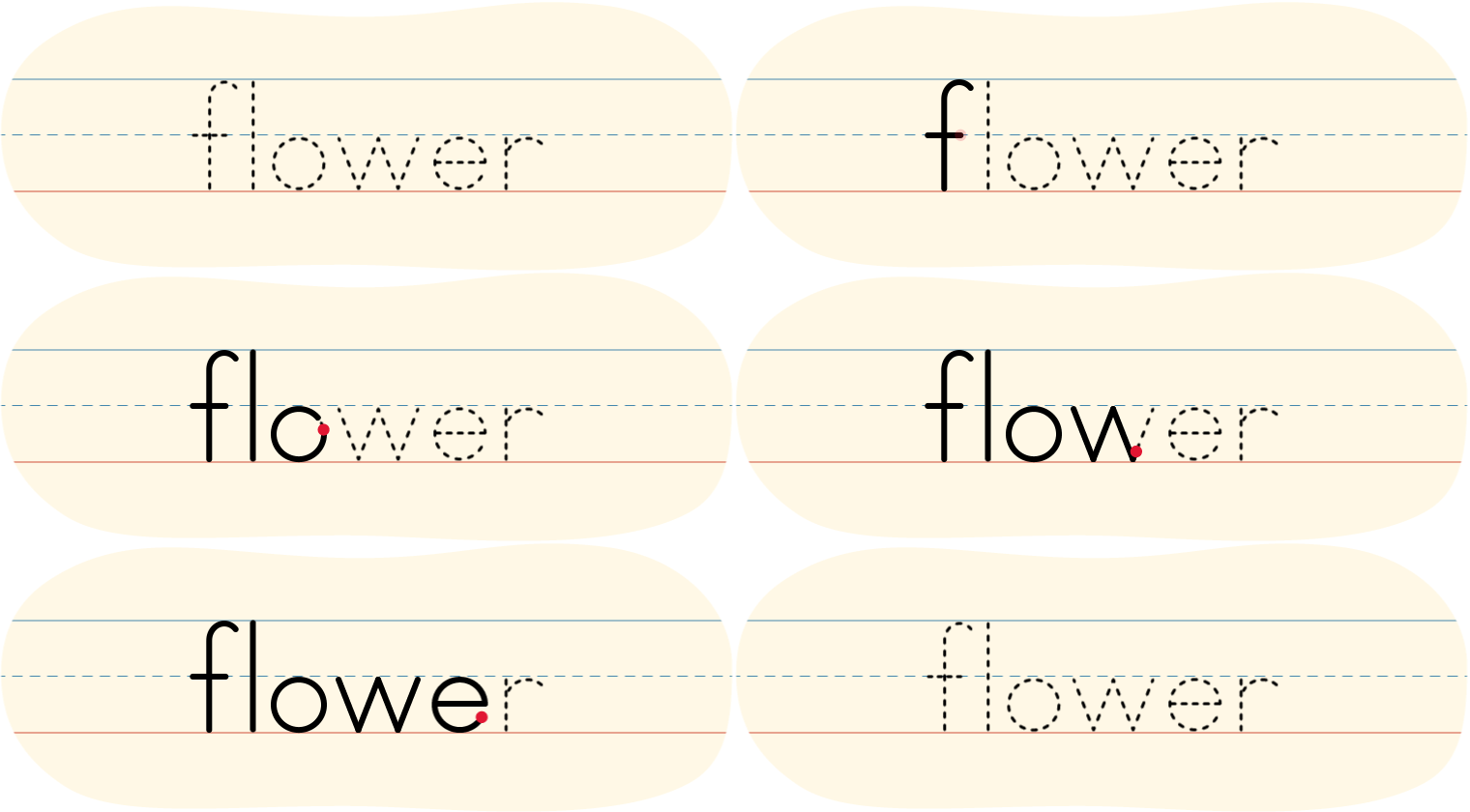
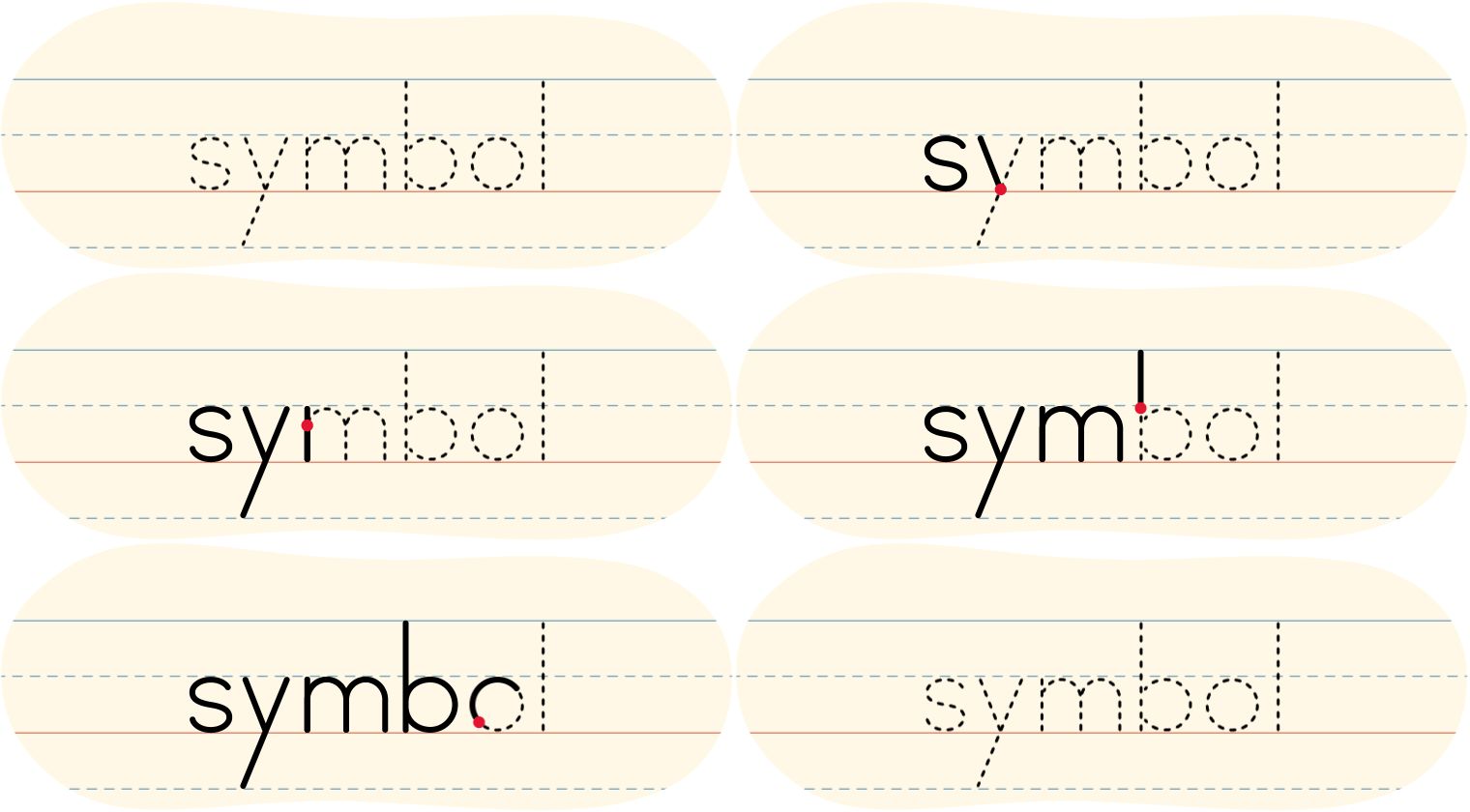
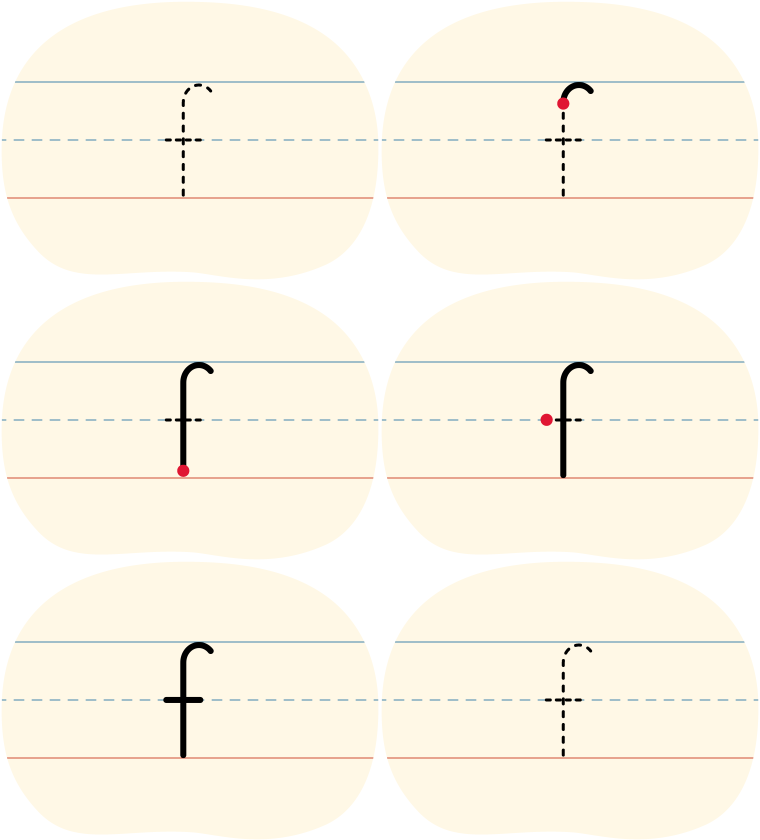
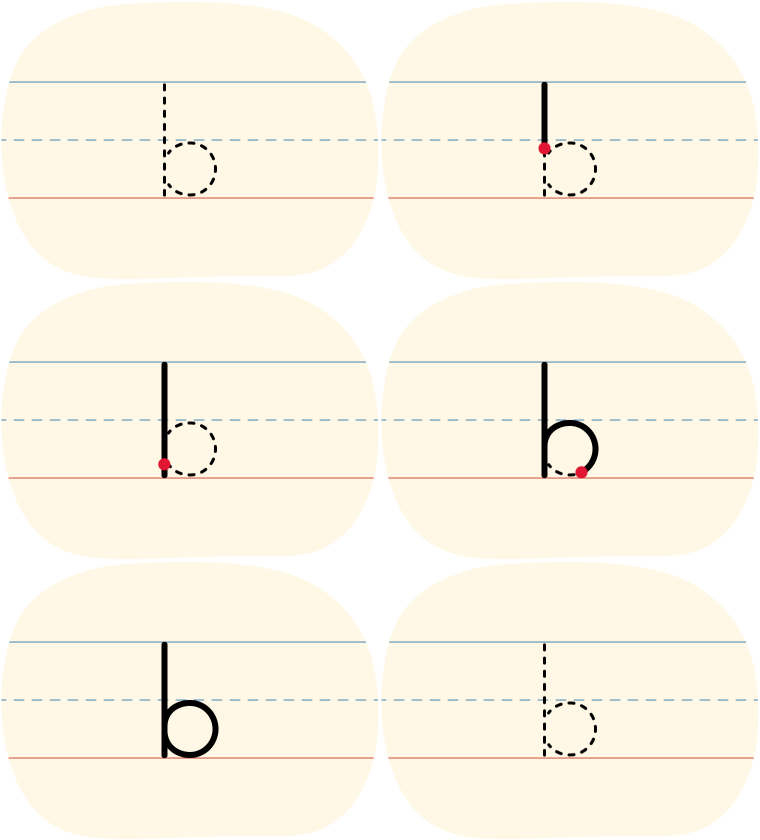
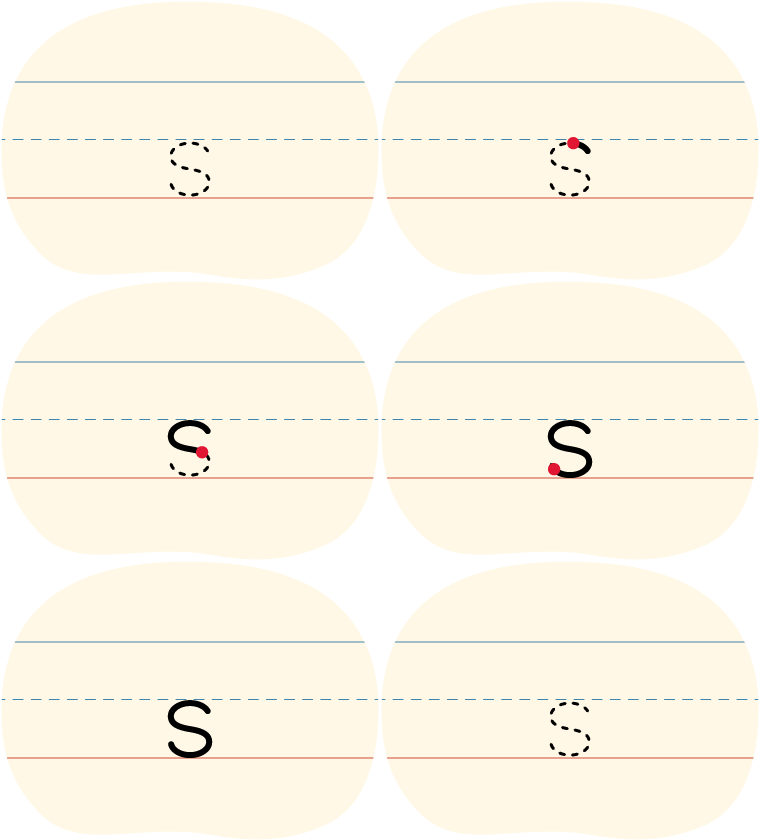
Which words begin with a tall letter and which word begins with a small letter?
Press Reveal to find out!
The words “fiddle” and “flower” begin with a tall letter “f”.
The word “beadwork” begins with a tall letter “b”.
The word “symbol” begins with a small letter “s”.
How does learning from others help us understand our own culture as well as cultures outside of our own?
Share your thoughts with a partner, if possible.

Special facts
A conversation between two students, Antonio and Esma.
Antonio: I really enjoyed learning about creative arts in Métis culture from Morgan!
Esma: Me too!
What are some of the special facts that Morgan shared?
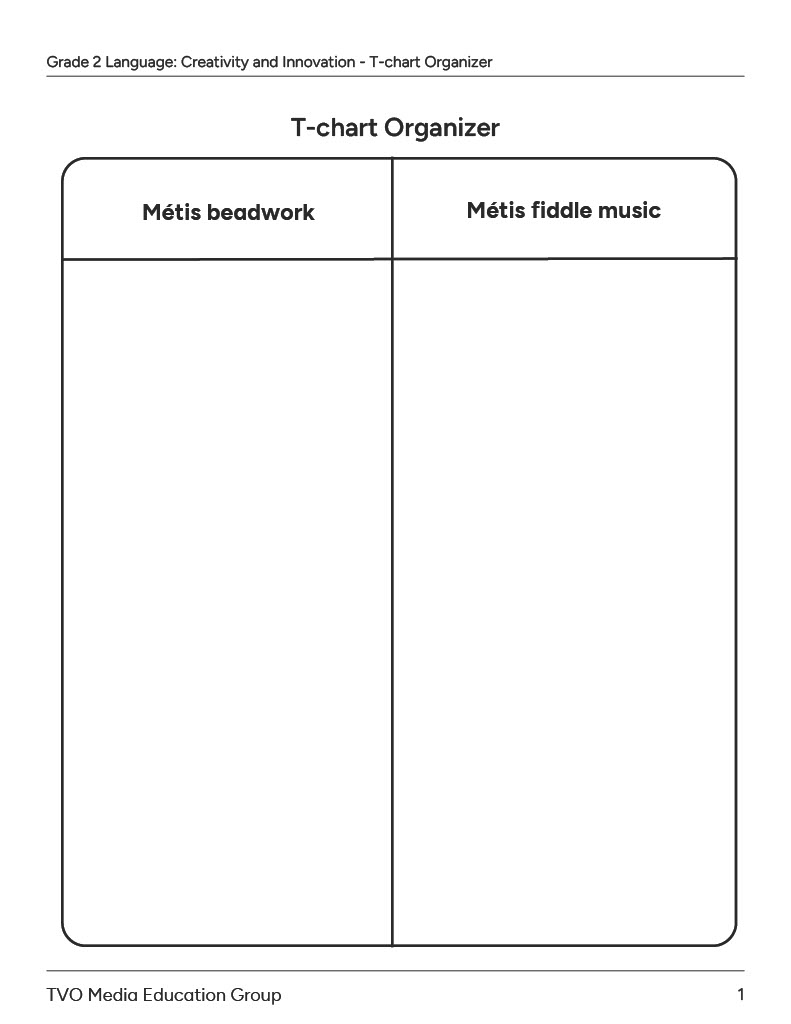
Record special facts you learned about Métis beadwork and fiddle music using the following T-chart Organizer or another method of your choice. If you would like, you can use speech-to-text or audio recording tools to record your thoughts.
Learning check!
For each word we explored select the matching definition!
Reflection
How do you feel about what you have learned in this activity? Which of the next four sentences best matches how you are feeling about your learning? Press the button that is beside this sentence.

I feel...
Now, record your ideas about your feelings using a voice recorder, speech-to-text, or writing tool.