Learning goals
We are learning to…
- identify themes explored in First Nations, Métis, and Inuit cultures to show an understanding of the many identities and ways of knowing, being, and doing
- identify and describe story (fiction) and information (non-fiction) texts
- identify how texts created by First Nations, Métis, and Inuit individuals, communities, groups, or nations share about the past and connect it to the present
- use three or more sources to gather information about a topic
- create specific types of texts using different tools and strategies
- make simple edits to draft texts using feedback from others and create a final version
Success criteria
I am able to…
- explore information texts about Inuit innovations which share how these innovations were created and still used today
- use three or more sources to gather information about Inuit innovations
- create an information paragraph about an Inuit innovation I learned about
- make simple edits to my paragraph to create a final version
Learning from Papatsie
Papatsie is a 9-year-old Inuk girl who lives in Ottawa, Ontario.
Let’s meet her and learn about her name and her family history.
Next, let’s learn a bit more about Inuit culture and traditions.
What did we learn from Papatsie?
How can we record the information we learned from Papatsie?

Summary paragraph
One way of recording information is by writing a short summary paragraph. A summary shares the most important information. A paragraph shares a main idea with supporting details.
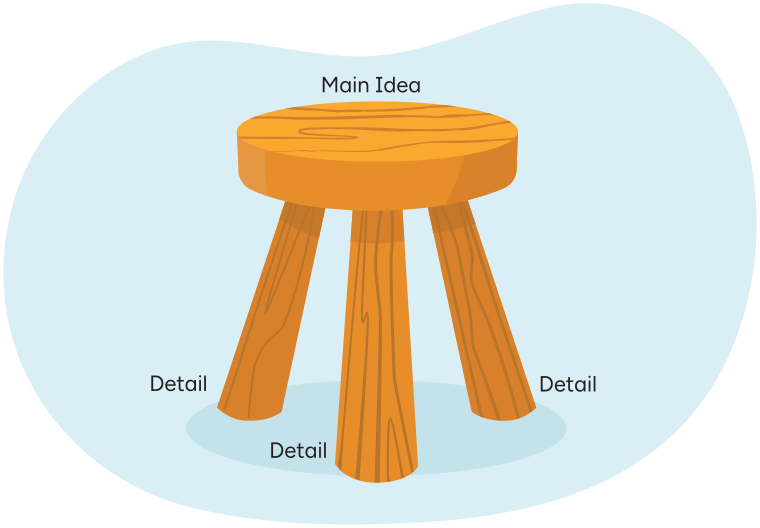
These details support the main idea like the legs of a stool.
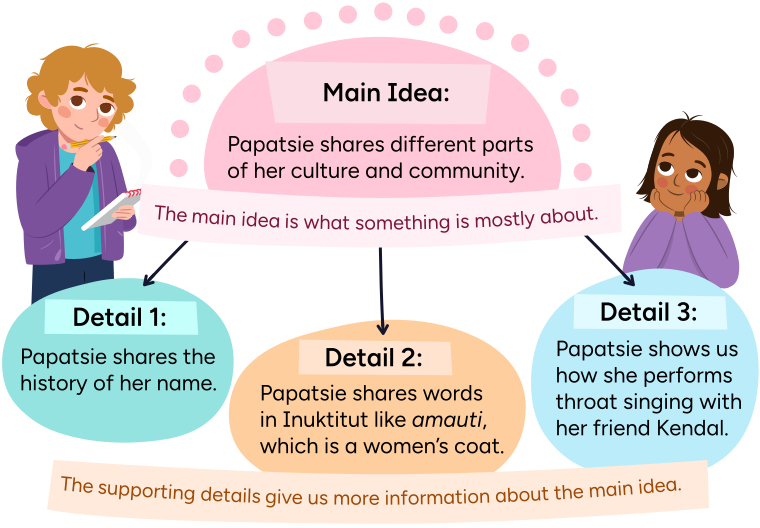
Image 2:
The main idea is what something is mostly about.
Main Idea: Papatsie shares different parts of her culture and community.
The supporting details give us more information about the main idea.
Detail 1: Papatsie shares the history of her name.
Detail 2: Papatsie shares words in Inuktitut like amauti, which is a women’s coat.
Detail 3: Papatsie shows us how she performs throat singing with her friend Kendal.
When we put the main idea together with the supporting details, we get a paragraph.
Press Paragraph to access a sample summary paragraph.
Papatsie is an Inuk girl who lives in Ottawa, Ontario. In the video, Papatsie shares parts of her culture. She shares the history of her name. It came from her great-grandfather! Papatsie shares words in Inuktitut like amauti, which is a women’s coat. Papatsie also shows us how she performs throat singing with her friend Kendal.
Inuit innovations
Let’s explore more information about Inuit cultures and communities as well as special Inuit inventions and ideas.
Taking notes
When we explore new information, we can take notes to help us remember different facts and ideas.
- We can take notes to help us record new information.
- We can use words, drawings, or short sentences when we take notes.
- We should try and use our own words while taking notes.
- We can record questions in our notes.
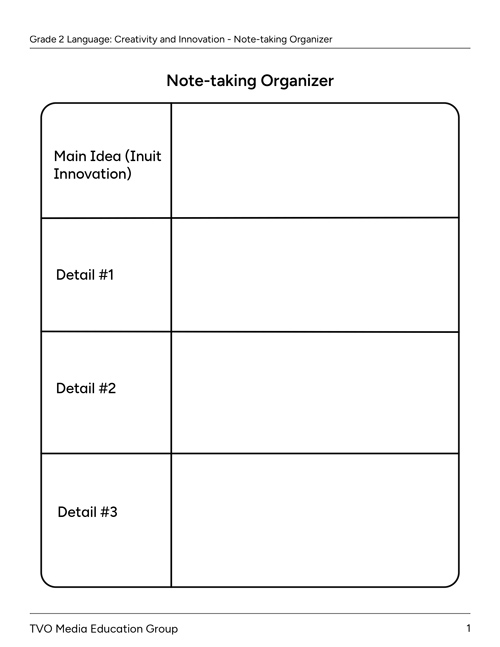
As we explore, record your thoughts using the following fillable and printable Note-taking Organizer or another method of your choice.
Once we have explored all the information, you will create your own paragraph!

Did You Know?
Did you know?
The Inuit are original people from the Arctic and northern regions of Canada, Alaska, Russia, and Greenland.
In Canada, the Inuit homeland is called Inuit Nunangat which includes:
- Nunavut
- Inuvialuit (the Northwest Territories and the Yukon)
- Nunavik (Northern Quebec)
- and Nunatsiavut (Newfoundland and Labrador).
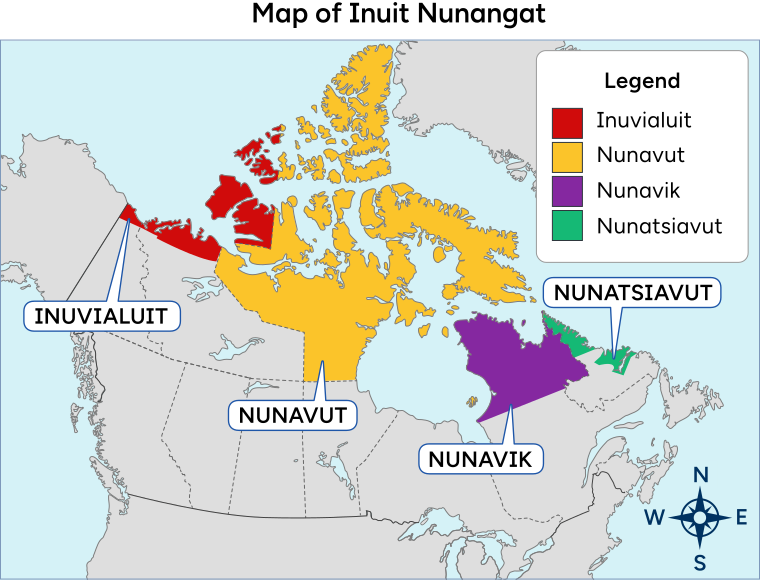
As we work towards Truth and Reconciliation, information about lands and territories is constantly being updated. This map was created using information available as of July 2021 from the Inuit Taripriit Kanatami.
The Inuit have developed many creative innovations over thousands of years and continue to do so today. Tools have been developed for hunting and trapping.
Clothes and boots are created from the skins and furs from animals that are hunted. Every part of the animal is used.
Let’s explore some of the Inuit innovations through the following information texts.
An information text shares facts and true information.
One of the many safety innovations developed were snow goggles, known as iggaak or ilgaak.
When the sun is bright and reflects off the snow, it can hurt our eyes.

Snow goggles have two thin slits which work to protect the eyes from glare created by the sun.
Snow goggles were traditionally made from:
- ivory
- bone
- antler
- and/or wood
They were tied on using hide or sinew.
Press Sinew to access a definition of the word.
Snow goggles are still created today with the same design and using some of the traditional materials as well as new materials.
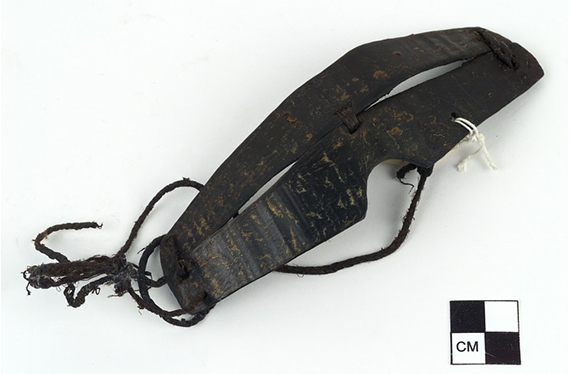
Inupiaq snow goggles carved and laced using baleen (whalebone) and sinew.
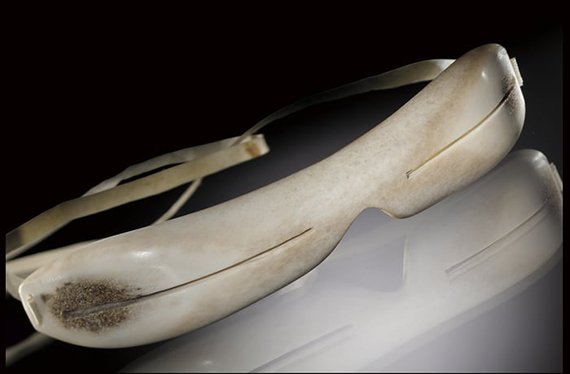
Igloolik snow goggles made from carved caribou bone with a caribou skin strap. Made by Isaac Pakak.
Inuit Nunangat is very snowy in the winter which can make it difficult to get around by boat or by walking. Inuit came up with a way to use the snow as a tool – by travelling on top of it!
They created a sled which is called a qamutiik that can be pulled by dogs or people.
The sleds have long runners on the bottom that help them glide on top of the snow. There are different runners made for different kinds of weather – for snow, ice, and even mud!
The runners can be made from many materials such as wood, polar bear skin, and the tusks of a walrus, which are called ivory.
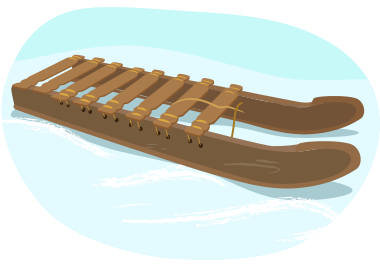
A sled called a qamutiik.
What would it feel like to run on snow and ice without shoes on? Very cold! Inuit made boots for the dogs to keep their paws in good condition. These boots can be made of seal or caribou skin. Sealskin can also be used to make rope to attach the dogs to the sled.
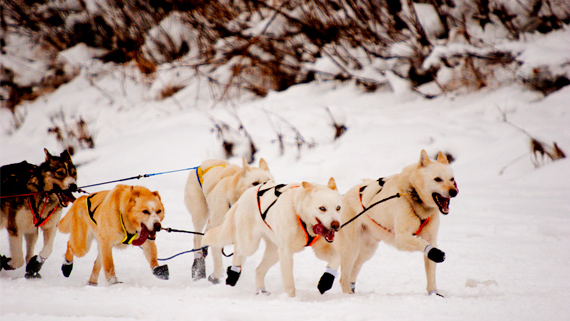
While these innovations were created in the past, they are still used today! Dog sled racing is a popular sport in Inuit Nunangat.
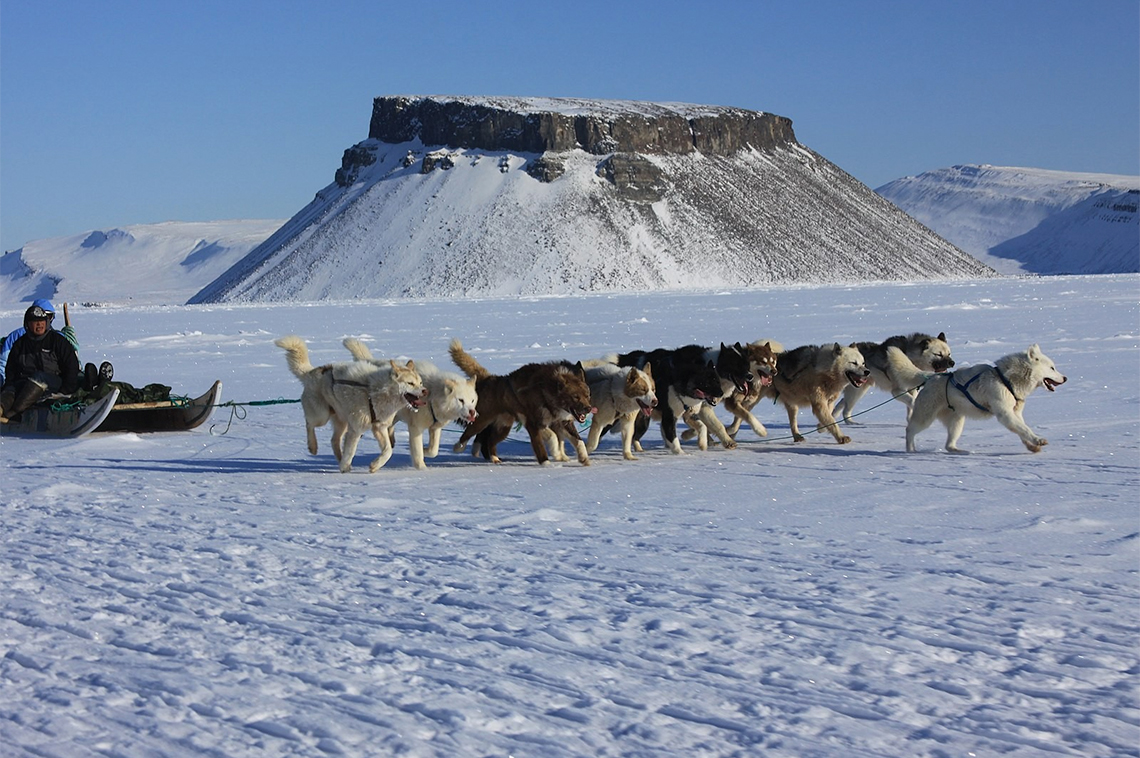
Annual Inuit dogsled race in Qaanaaq, Greenland
Today, people in Inuit Nunangat travel in many different ways like by plane, car, and boat. In the winter, many people travel by snowmobiles. These machines also have runners that help them glide on the snow, just like the qamutiik!
Igloos are the traditional home of the Inuit. They are made from blocks of snow stacked in a very precise way to create a dome shape. To make an igloo, you need to know what kind of snow to use and cut the blocks in a specific way.
Soloman Awa is a master igloo builder in Nunavut. He shares that all the information about how to build was passed down from generation to generation.
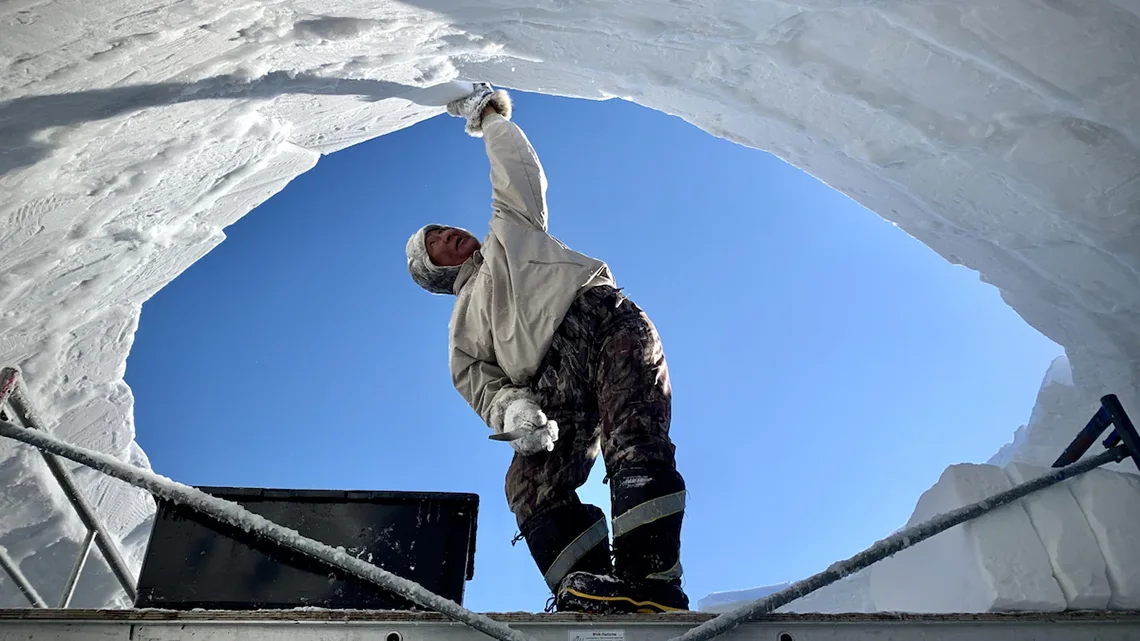
Soloman Awa building an igloo out of snow.
At the Qaggiq Festival in 2021, a giant igloo was built called a qaggiq or gathering place for artists and performers to gather and share culture as Inuit.
Today, most Inuit living in Inuit Nunangat live in houses and apartments in communities.
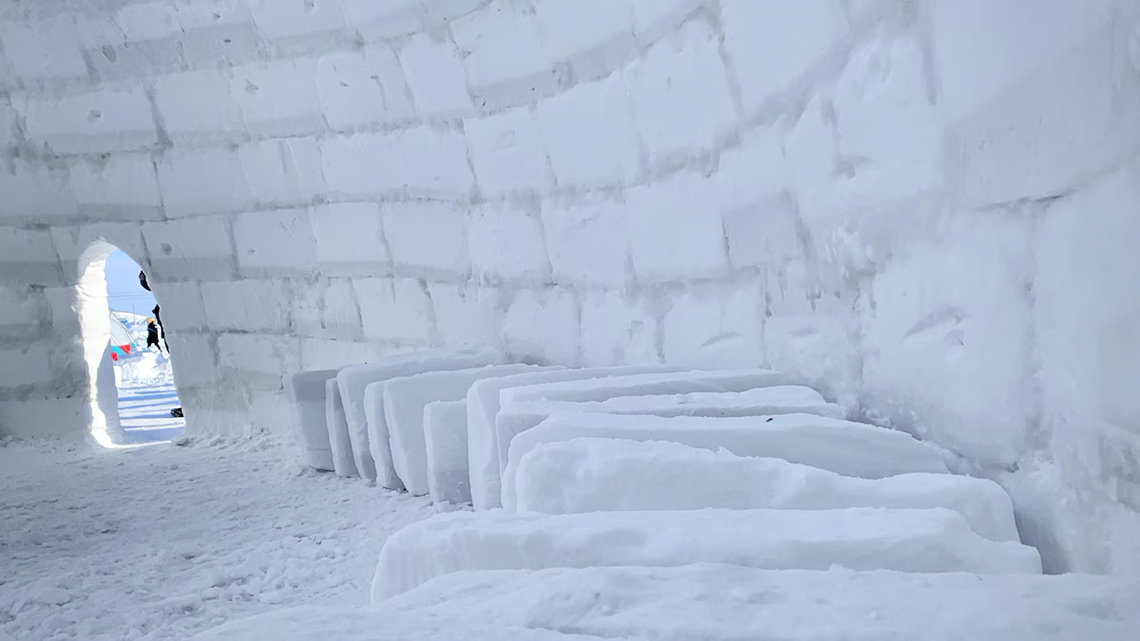
Blocks of ice inside the giant igloo at the Qaggiq Festival.

My paragraph
Step 1: Review your notes.
Step 2: Create simple sentences to share your main idea and details. You can use any types of sentences you would like to include.
Remember, to create your paragraph start with your main idea and then add your detail sentences. The details support the main idea like the legs of a stool.
Step 3: Review your paragraph using the following checklist:
- Make sure you have a main idea and three supporting details for the Inuit innovation you chose.
- Make sure each new sentence starts with a capital letter.
- Use capital letters when using proper nouns.
- Make sure to use a period, question mark, or exclamation mark depending on the sentence you create.
- Check your spelling using a dictionary.
- Read your paragraph out loud to make sure it makes sense.

Student Tips
Use a dictionary
For those really tricky words, you may want to try using a dictionary or an online dictionary. Examine the following chart for quick dictionary skill tips!
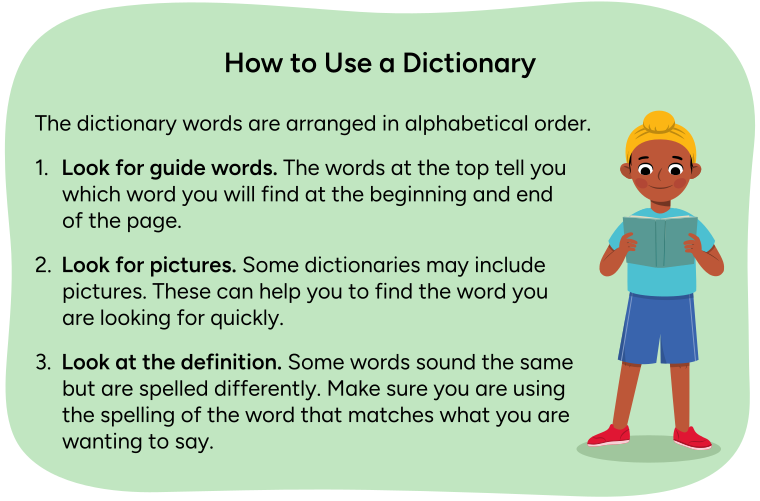
How to use a dictionary or an online dictionary
The dictionary words are arranged in alphabetical order.
- Look for Guide Words. The words at the top tell you which word you will find at the beginning and end of the page.
- Look for pictures. Some dictionaries may include pictures. These can help you to find the word you are looking for quickly.
- Look at the definition. Some words sound the same but are spelled differently. Make sure you are using the spelling of the word that matches what you are wanting to say.
Step 4: Create a good copy of your paragraph.
Reflection
How do you feel about what you have learned in this activity? Which of the next four sentences best matches how you are feeling about your learning? Press the button that is beside this sentence.

I feel...
Now, record your ideas about your feelings using a voice recorder, speech-to-text, or writing tool.