Learning goals
We are learning …
- to demonstrate an understanding of creativity and how it can be used to express ourselves
- to identify and use the poetic devices: alliteration, hyperbole, and simile
- about the purpose and form of a concrete poem.
- to develop ideas, plan, draft, revise and edit a poem about creativity
- to identify and use abstract nouns in sentences
Success criteria
I am able …
- to share my learning of how creativity can be used to express my emotions
- to identify and use the poetic devices: alliteration, hyperbole, and simile
- to create a concrete poem using the writing process of brainstorming, planning, drafting, revising, and editing
- to identify and use abstract nouns in a sentence
Expressing yourself

What are some ways that you express yourself? Imagine some of the many different emotions you might experience, such as the sunshine of happiness, the rainbows of joy, the stormy clouds of anger, or the red fire of frustration. What are some of the ways you might express or share these emotions? Could you dance, talk, write, or draw about these feelings?
Explore the following video where you meet Akin, who shares their favourite way to express their feelings when they are having a difficult day.

Pause and Reflect
Pause and reflect
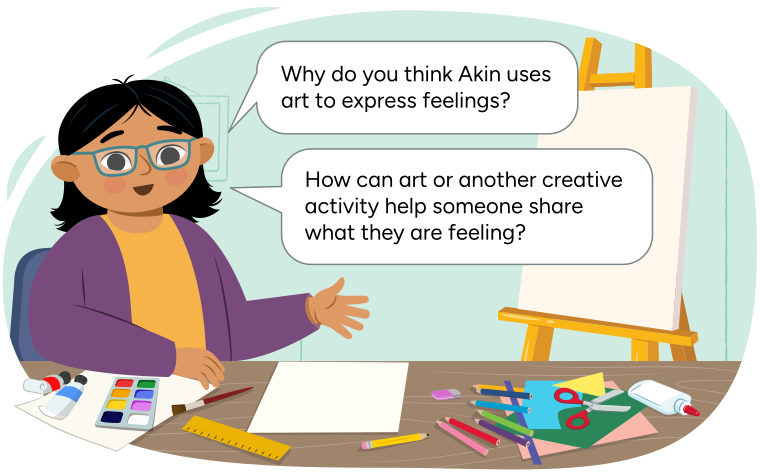
Avery asks, 'Why do you think Akin uses art to express feelings? How can art or another creative activity help someone share what they are feeling?'
Creativity
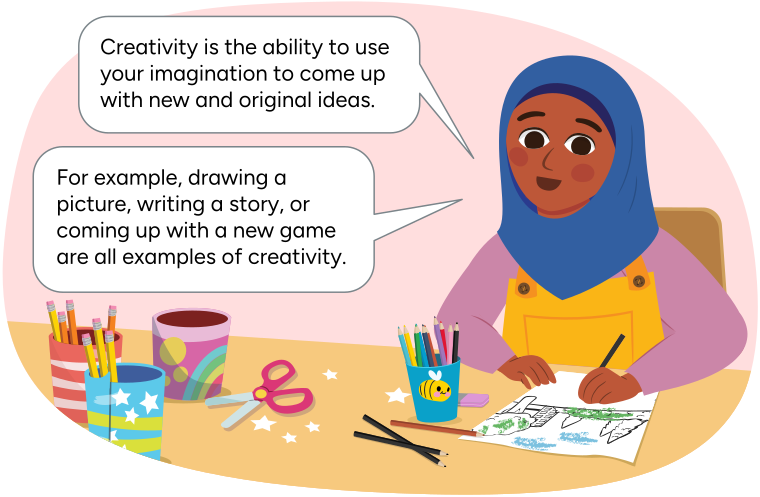
Esma says, 'Creativity is the ability to use your imagination to come up with new and original ideas. For example, drawing a picture, writing a story, or coming up with a new game are all examples of creativity.'
Creativity is important because it helps you solve problems and think in unique ways. Can you think of any creative ways that you might like to use to express emotions? How about singing a song or dancing?
Check out the following video as Teacher Jenny uses a graphic organizer to explore some of the different ways that someone can use their creativity to express how they feel.
Follow along with her and complete the graphic organizer in your notebook or in any method of your choice.
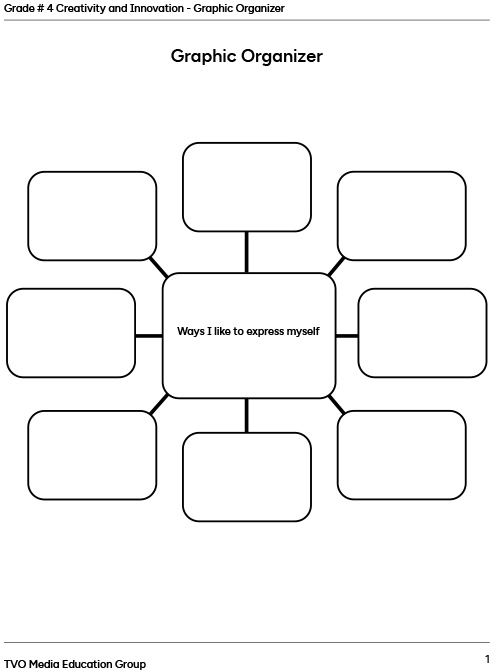
Review your completed graphic organizer. Which one of these activities do you like to do? Does the activity help you express and understand your feelings? Explain your thinking in any method of your choice.

What is an abstract noun?
You may know that nouns are words that can refer to people, places, or things.
There is also a type of noun that can refer to feelings and ideas. These nouns are called abstract nouns.
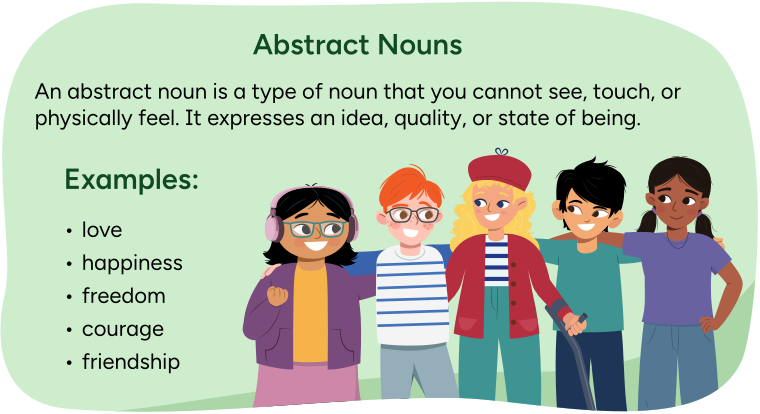
Abstract Nouns
An abstract noun is a type of noun that you cannot see, touch or physically feel. It expresses an idea, quality, or state of being.
Examples: love, happiness, freedom, courage, friendship.
Let’s practice using abstract nouns
For each sentence, select the missing abstract noun from the drop-down menu. Press Check Answer to see how you did.

Test Your Skills
Test your skills
Choose three of the abstract nouns from the list provided to create your own sentences. Record your sentences in a method of your choice.
Let’s check!
As you explored both texts in this learning activity, you encountered several vocabulary words. Check your understanding of those words by completing the fill-in-the-blanks activity below.
Use the word bank to help you. Note that not all words have been used.
Word bank:
- bravery
- love
- happiness
- wisdom
Poetry
In the video with Teacher Jenny, you explored different creative ways to express yourself, including writing poetry. Poetry is a special kind of writing that uses descriptive words and rhythms to express feelings, thoughts, and ideas.
Poetry can be about emotions like happiness or excitement, or it can be about abstract nouns like courage, friendship, or love. Poetry doesn’t always have to rhyme or follow a regular beat, but it does focus on sending a message to the audience.
Before viewing
In the following video, you are going to meet Randell Adjei, Ontario’s first Poet Laureate. A poet laureate is someone who has been appointed by the Ontario government to create poems for special events and occasions.
Did You Know?
Randell Adjei

Ontario’s first Poet Laureate is Randell Adjei. Randall grew up in Scarborough, Ontario and is a spoken word artist, and speaker. He found his love for poetry in Grade 8 with help from one of his teachers. The teacher showed him how writing could help him express his feelings and deal with challenges. This changed his life and helped him become a writer.
In 2012, inspired by his own lived experiences, Randell started R.I.S.E. Edutainment. This group helps young people in the GTA express themselves through performance arts, giving them a safe space to share their feelings and experiences.
Randell Adjei
Check out the following video to learn more.
Learning check
Select the correct answer, then press Check Answer to see how you did.
Select the correct answer, then press Check Answer to see how you did.
Select the correct answer, then press Check Answer to see how you did.

Student Wellness
Take a break!
Avery shares, 'Take a moment to focus on your breathing to relax your body and mind. Close your eyes, take a deep breath, then slowly exhale.'
Poetic devices
There are certain things that you can do to make a poem interesting and captivating to an audience. You can use poetic devices.
Press the following tabs to learn more about different poetic devices that can be used in any poem.
When words close to each other, in a sentence, start with the same sound.
For example, “Silly snakes slither silently.”
Check out the following video to learn more.
An exaggerated statement that is not meant to be taken literally.
For example, “I’m so hungry, I could eat a horse.”
Check out the following video to learn more.
A comparison between two things using the words “like” or “as.”
For example, “His smile was as bright as the sun.”
Check out the following video to learn more.
Let’s practice!
Read each sentence and place the cards into categories that best match, by identifying if it uses alliteration, simile, or hyperbole. Use the arrow buttons to navigate between cards.
Concrete poems
Concrete poems are also known as shape poems. It is a special type of poetry that uses both art and writing to express yourself. In a concrete poem, the words are arranged on the page to create a picture about the topic of the poem. Using art and pictures helps you understand what the poem is about in a fun and interesting way.
Hopscotch poem
Let’s explore an example of a concrete poem. This poem is about a playground game called “hopscotch.” In this game, connected squares are drawn on the ground in a pattern. In the poem, “Hopscotch,” the author arranges the words in a way that shows you what the game is.
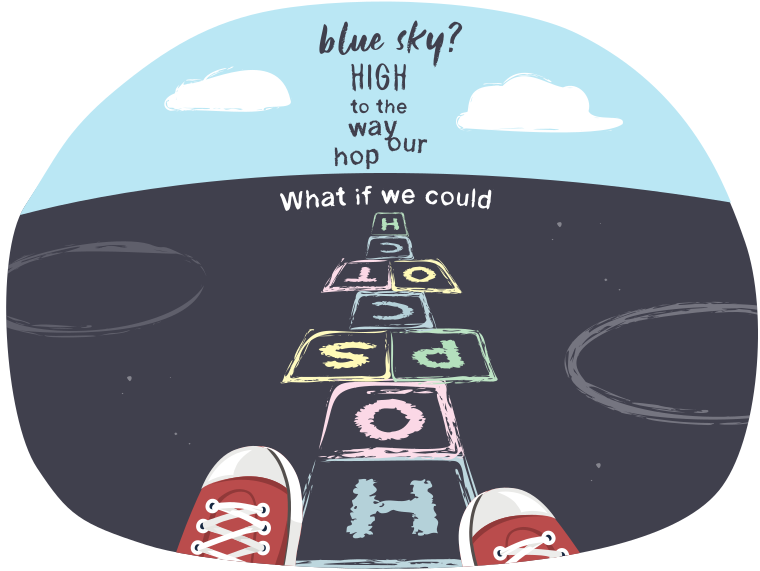
A hopscotch pattern drawn on concrete, with a blue sky in the background. The poem begins written on the pavement inside the hopscotch squares and ends with writing in the sky. There are two sneakers just visible at the start of the hopscotch squares, as if someone is standing ready to hop.
Hopscotch. What if we could hop our way to the high blue sky?
Hopscotch Poem
How does the way the author arranges the words in this poem help you understand the game of hopscotch?
Press Possible Answers to learn more.
- The picture shows you what the game of hopscotch looks like.
- The poem begins at the bottom of the page where the shoes are shown.
- As you read the poem you can follow the path of the player in the game.
Let’s explore
Explore the following concrete poem. Without reading the words, what do you think this poem is about?
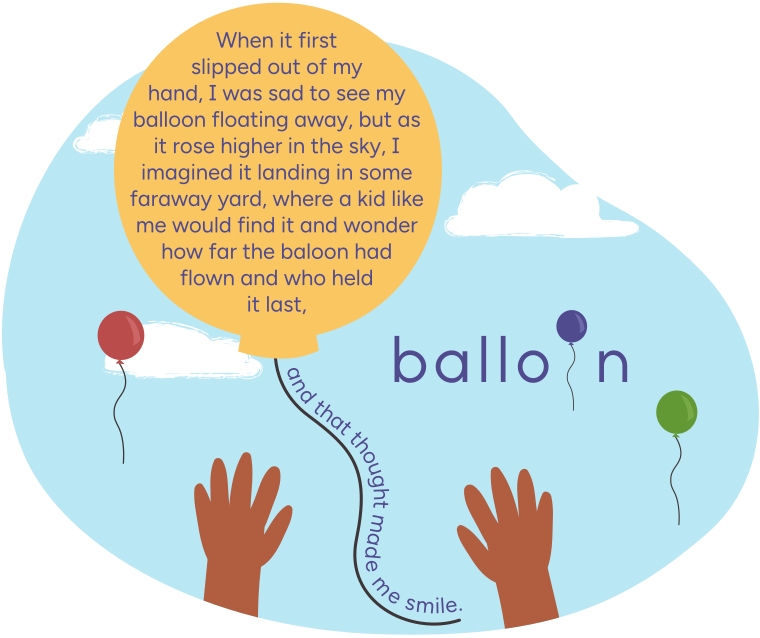
Two hands are reaching up to a balloon that is escaping into the sky. There is text inside the balloon that is the same shape as the oval balloon. The end of the final sentence is written along the balloon's string.
Balloon
When
It first slipped out
Of my hand, I was sad
To see my balloon floating
Away, but as it rose higher
In the sky, I imagined it landing
in some faraway yard,
where a kid like me would
find it and wonder how
far the balloon had
flown and who
held it
last
and that thought made me smile.
“Balloon” from Wet Cement by Bob Raczka

Brainstorm
Why do you think?
Why do you think an author might use concrete poems to express themselves?
Explain your thinking in your notebook or any other method of your choice.
Writing a concrete (shape) poem
Brainstorm
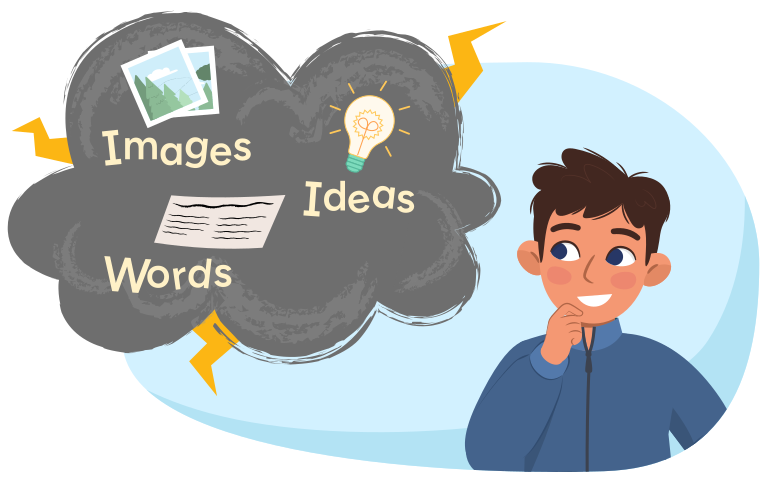
Choose a topic that you would like to write your concrete poem about. Think about what the topic means to you and your knowledge (what you know) about the topic. It may help to sit in a quiet place where you can gather some inspiration from the world around you.
What are some ideas, words, or images that come up when you think of your topic?
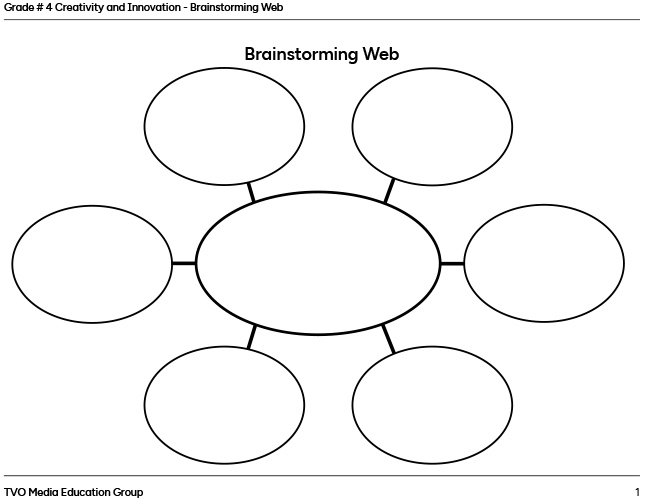
Complete the fillable and printable Brainstorming Web in your notebook or using the following document. If you would like, you can use speech-to-text or audio recording tools to record your thoughts.
Planning
Think about which poetic devices you would like to include in your poem:
- alliteration
- simile
- hyperbole
Choose at least one device to include in your poem.
Choose a shape connected to your topic. Lightly sketch out the outline of the shape of the poem. This is where the words of your poem will go!
Drafting
After brainstorming and planning it’s time to begin your draft. Think about what you want your poem to say about your topic.
The use of describing words (adjectives) will play an important role in your poem. Check out the following video to learn more.
If you find that you are struggling to find just the right descriptive word, consider using a thesaurus to help you!
How to use a Thesaurus
How to use a thesaurus
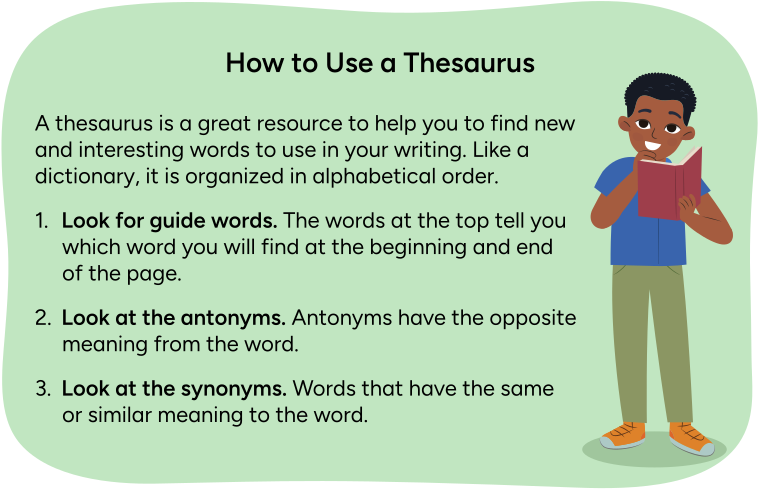
A thesaurus is a great resource to help you to find new and interesting words to use in your writing. Like a dictionary, it is organized in alphabetical order.
Look for:
Guide words: You will find the guide words at the top of the page. The guide words tell you the first and last words on each page.
Antonyms: Antonyms have the opposite meaning from the word.
Synonym: Words that have the same or similar meaning to the word.
Once you’ve come up with the words for your poem, place your words along the lines of your previously outlined shape. You can arrange the words normally or curve them to follow the outline. Consider any other creative ways you might show the shape of your poem.
Type it
Typing is a great skill to develop! When we need to use a computer or tablet keyboard, knowing how to type helps us:
- take notes
- respond to messages
- create final drafts of our work.
Explore the following image to see what fingers are used to type each letter or number.
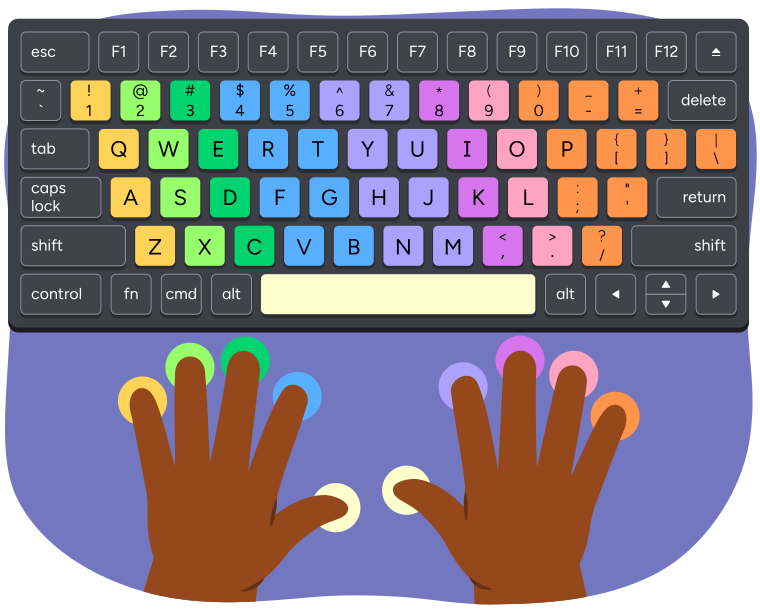
A keyboard and hands showing which fingers are used to press each key when typing.
The left pinky finger presses the keys 1, Q, A, and Z.
The left ring finger presses the keys 2, W, S, and X.
The left middle finger presses the keys 3, E, D, and C.
The left index finger presses the keys 4, 5, R, T, F, G, V, and B.
The left or right thumb presses the space bar.
The right index finger presses the keys 6, 7, Y, U, H, J, N, and M.
The right middle finger presses the keys 8, I, K, and comma.
The right ring finger presses the keys 9, O, L, and period.
The right pinky finger presses the keys 0, minus, equal, P, open bracket, closed bracket, backslash, semicolon, apostrophe, and forward slash.
We use specific muscles in our hands to type! It’s important to practice so that it becomes easier to type correctly without putting too much pressure on our hands and our wrist.
Explore the following interactive for tips you can use when typing.
Time to practice!
Revising
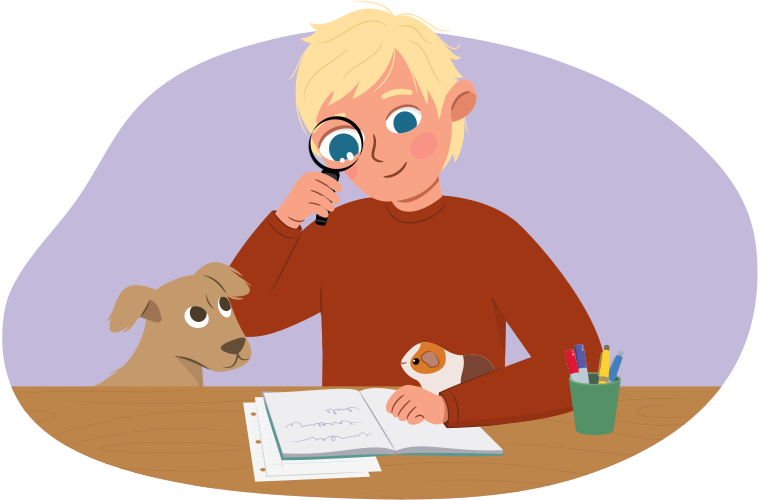
Poets read their writing over and over to see if they can make their poem even better.
Try reading your poem out loud to see if there are places where you can add additional poetry characteristics. Would your poem be better if you could add some more hyperbole? Perhaps there is a place where you might want to consider shifting a word to the next line. The way you choose to arrange your lines, the words you choose and the poetry devices you include can really change how your poem sounds and how the reader feels when they are reading it.
Once you feel you are all done revising your work, read your poem out loud to check if there is anything else you might want to change.
Use the following checklist to help your revision process.
Self-Editing Checklist
Publish your poem
It’s time for the final draft of your concrete poem. Create your concrete poem in a method of your choice. You can also create your poem by using a digital tool or app (approved by a trusted adult) or say your poem out loud and show the shape of your poem in another creative way.

Student Success
Think
- What strategies did you use to come up with ideas for your concrete poem?
- Do you think concrete poems help you to express yourself? Explain your thinking.
Record your thinking in a method of your choice.
Reflection
As you read through these descriptions, which sentence best describes how you are feeling about your understanding of this learning activity? Press the button that is beside this sentence.

I feel...
Now, record your ideas using a voice recorder, speech-to-text, or writing tool.