Learning goals
We are learning to…
- analyse different forms of texts and their features
- understand historical contexts, contributions, and lived experiences of a diversity of Canadians
- plan, develop ideas, gather information, and organize content to create texts
- use digital tools to construct texts of our own
Success criteria
I am able to…
- distinguish between fact and fiction within a historical fiction text
- identify the achievements, legacy, and historical facts about Canadian jazz legend Oscar Peterson
- take biographical notes using a graphic organizer and my own words
- choose a digital tool to create a biographical presentation on Oscar Peterson

Who was Oscar Peterson?
Do you know anything about Oscar Peterson? What about the style of music he’s known for?
Check out the following TVOkids Shorts video to begin gathering information.
What did you learn about Oscar Peterson from that video? Who was Oscar Peterson and what makes him important to Canadian culture?
Check out the following video clip from TVO’s The Agenda to gather more information about Oscar Peterson.

Brainstorm
Brainstorm
What information have you collected about Oscar Peterson?
In a notebook, or using another method of your choice, record as many facts as you can about the Canadian legend that is Oscar Peterson. If possible, share your thoughts with a partner.
In this learning activity, you will build your note-taking skills as you learn about the famous Canadian jazz musician, Oscar Peterson, and explore the language and lyrics that were set to one of his songs that inspired the world.

Oscar lives next door
Oscar Peterson was an innovative Canadian artist who is considered one of the greatest jazz pianists of all time.

Did You Know?
Did you know?

Jazz is a form of music that began in the southern United States in the early 1900s. It has elements from African and European musical traditions and combines several different genres of music. Improvisation is an important part of jazz music. Improvising is when the player makes up the notes as they play, creating new and different versions of the melody, or the main tune of a song.
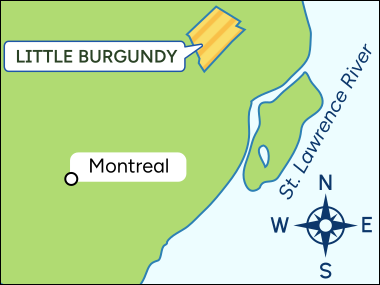
Oscar Peterson was Canada’s first jazz star. He began playing the trumpet and piano when he was six years old. He grew up in a community in Montreal once known as “Little Burgundy”.
Check out the following video clip to learn more from Oscar himself.
Revisit the list of facts you made about Oscar Peterson in the Minds On section. Can you add any new information to it?
When you are done, press the Facts About Oscar button to compare your list with some possible answers.
- famous Canadian jazz musician - Canada’s first!
- one of the greatest jazz piano players of all time
- has released over 200 songs
- started playing the piano and trumpet when he was very young (6 years old)
- he had to stop playing the trumpet because he had tuberculosis
- a celebrated Canadian - he is on a stamp and has a school and street named after him
- grew up in the Montreal, QC neighbourhood called “Little Burgundy”
- lived in Mississauga, Ontario for a lot of his life

Exploring facts through fiction
The picture book Oscar Lives Next Door by Bonnie Farmer and Marie Lafrance tells the story of the early life of Oscar Peterson. The genre of this book is historical fiction, meaning it combines true facts (history) with made-up story elements (fiction).
As you read the following excerpt from the book, try and identify which parts of the text seem like they could be facts, and which parts might be fiction, made up by the author. You will check the accuracy of your predictions later.
Access the following Excerpt from Oscar Lives Next Door to complete the activity.
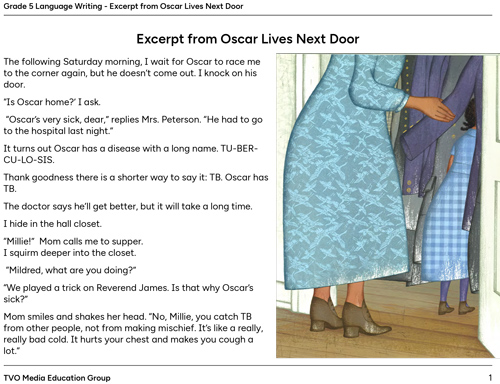
Press the Activity button to access the Excerpt from Oscar Lives Next Door.
Activity(Opens in a new tab)
Brainstorm
Brainstorm
In your notebook, or using another method of your choice, record your answers for the following tasks:
- Identify one part of the text that seems like it could be a fact.
- Identify one part of the text that seems like it could be fiction.
When you are done, check your understanding by pressing the Sample Answers button.
|
An example of a possible fact from the text is: Oscar going to the hospital with tuberculosis. |
|
An example of possible fiction from the text is: Millie waiting for Oscar to race her, or Millie hiding in the closet. |
Collecting more information
Let’s collect more information about Oscar Peterson’s life while also exploring a feature of many types of fiction and nonfiction texts: The author’s note.
An author’s note is an opportunity for the author to speak directly to their readers about what they wrote, and why.
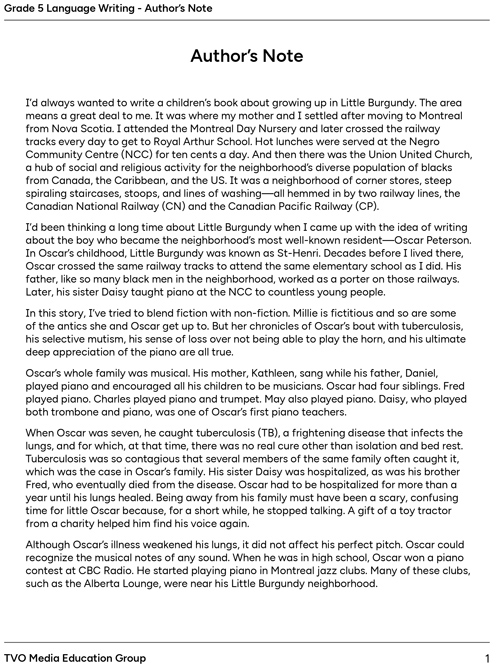
The following is the author’s note from the picture book Oscar Lives Next Door by Bonnie Farmer and Marie Lafrance. It also contains facts about Oscar Peterson’s life.
As you read the author’s note, notice:
- the author’s motivation for writing the book
- biographical facts about Oscar Peterson
Access the following Author’s Note to complete the activity.
Brainstorm
Brainstorm
In a notebook, or using another method of your choice, answer the following questions:
- What was the author’s personal motivation for writing this book?
- How did Oscar’s family influence his musical career?
- What musical instrument was Oscar’s first love? Why did he stop playing it?
When you are done, press the Possible Answers button to check your understanding.
- The author grew up in the same neighbourhood as Oscar Peterson and wanted to write a book about Little Burgundy’s (or St-Henri’s) most famous resident.
- Oscar came from a musical family. All of his siblings and his parents sang and/or played instruments. Oscar’s sister Daisy was one of his first piano teachers.
- Oscar’s first instrument was the trumpet. After his lungs were damaged by tuberculosis, he could no longer play it and focussed his musical talents only on the piano.
Next, read the author’s note a second time.
This time your purpose for reading is to identify and record specific biographical details that will help you retell the story of Oscar Peterson’s life. Add the information to the list you have been creating in your notebook or using another method of your choice.
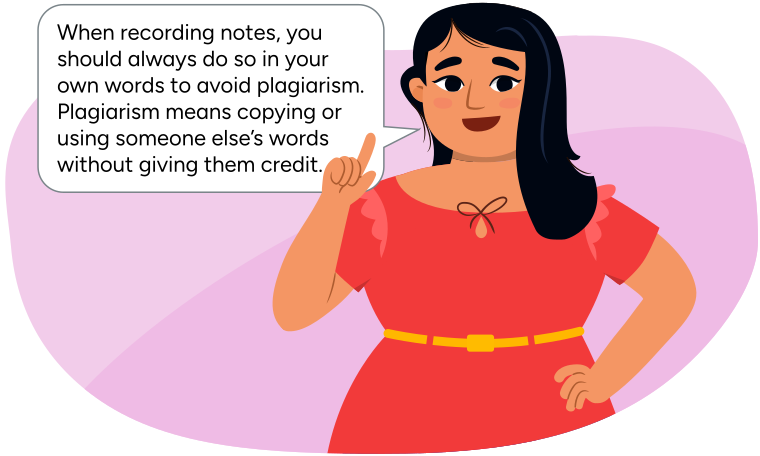
Teacher Chiara says, 'When recording notes, you should always do so in your own words to avoid plagiarism. Plagiarism means copying or using someone else's words without giving them credit.'
Let’s check out two strategies for recording notes in your own words.
Exploring Oscar’s work and impact
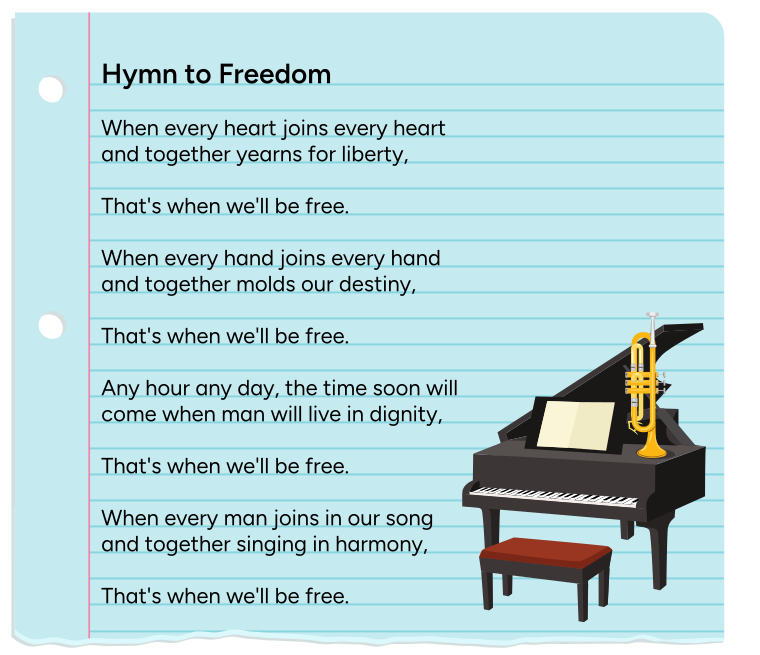
The song “Hymn to Freedom” is one of Oscar Peterson’s best-known compositions.
Check out the following clip of Oscar Peterson playing “Hymn to Freedom” on the piano from the documentary titled “Oscar Peterson: Black + White”.
Oscar wrote the song in 1962 and it quickly became the unofficial anthem of the Civil Rights Movement. The Civil Rights Movement was a series of protests and demonstrations focussed on advocating for justice and equal rights under the law for Black Canadians and Americans throughout the 1950s and 1960s. As a Black artist, Oscar persevered through and overcame racism and discrimination in his life and career.
One year after Oscar wrote the song, a lyricist named Harriette Hamilton was asked to write words for it. The Canadian Songwriters Hall of Fame quotes Harriet to say:
“All the lyrics had to do was express in very simple language the hope for unity, peace
and dignity for mankind. It was easy to write.”
(Hymn to Freedom, 2018)
Source: Hymn to freedom. Canadian Songwriters Hall of Fame. (2018, July 24). https://www.cshf.ca/song/hymn-to-freedom/
Read the lyrics to “Hymn to Freedom” aloud as if they were a poem.

Pause and reflect
Pause and reflect
In a notebook or using another method of your choice, analyze the text by answering the following questions. If possible, share your thoughts with a partner.
- What do you think the song is about? How do you know?
- What information in the lyrics communicate what the song is about?
Now listen to the following clip of “Hymn to Freedom” performed by artists Dione Taylor, Oliver Jones and Dave Young. Does listening to the performance change the meaning you get from the lyrics?
Try and explain how you feel about exploring the two different forms. Record your thinking in a notebook or using another method of your choice. If possible, share your thoughts with a partner.

Do you know why the book title Oscar Lives Next Door does not have quotation marks around it like the title “Hymn to Freedom” does?
It’s because the titles of short works (like articles, songs, poems, and short stories) are marked with quotation marks. The titles of full books are shown with italic font.
Wrap-up note taking
What new information have you collected about Oscar Peterson, his life and his work? Add any new information to the list you recorded in your notebook or using another method of your choice.
When you are done, press the List of Facts button to review some of the facts we have learned about Oscar’s life in this learning activity.
| Facts About Oscar | |
|---|---|
|
|
Getting ready to present information
You’ve collected lots of information about the innovative and creative Canadian jazz legend Oscar Peterson. In the Consolidation section of this learning activity, you will use this information to create a biographical presentation on Oscar Peterson. A biography is a nonfiction text that tells the story of a person’s life.
To prepare to present all the biographical information, let’s explore one way of sharing information that is both engaging and creative: by presenting some of the information to your audience using interrogative sentences.
Interrogative sentences are sentences that ask questions. There are many different ways to structure an interrogative sentence.
Explore the following examples.
| Interrogative Sentence Examples | Information about the Sentences |
|---|---|
|
You can start interrogative sentences with an interrogative verb such as “Do” or “Did”. |
|
You can start interrogative sentences with an interrogative pronoun such as “Who”. |
|
You can start interrogative sentences with an interrogative adjective such as “What”, “Which”, or “Whose”. Note: There are only three interrogative adjectives in the English language: what, which, and whose. Depending on how the sentence is written, they can act as either interrogative adjectives, or interrogative pronouns. |

Try it!
Try it!
In a notebook or using another method of your choice, choose two facts about Oscar Peterson and write two interrogative sentences about them following the models you just explored.

Putting it all together

Check your understanding of what you have learned by completing the following activities.
Activity 1
For each sentence, select the missing word from the drop-down menu. Press Check Answer to see how you did.
Activity 2
Which information about Oscar Peterson is fact or fiction? Use the arrow buttons to navigate between cards. Place the cards into categories that best match.
Presenting biographical information
To consolidate your learning about Oscar Peterson, you will use all the information you recorded throughout this learning activity to create a biographical presentation about him.
Your presentation should contain:

To help you organize all the information you have collected about Oscar Peterson and help guide the flow of your presentation, you can use the following graphic organizer “Biography Of Graphic Organizer”. You can also use another method of your choice to record your ideas.
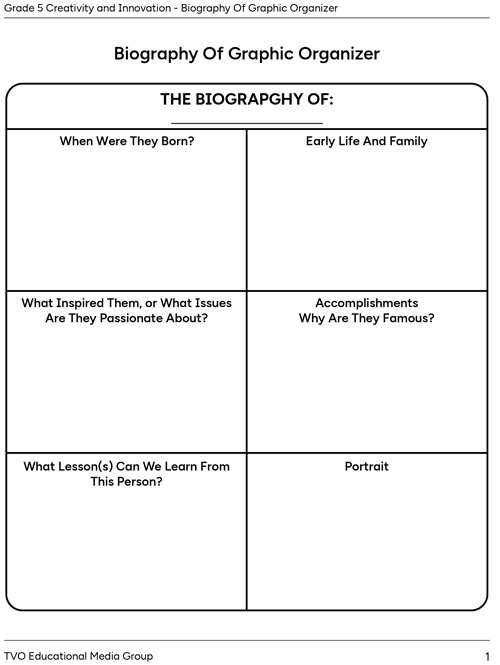
Once you have organized your information and planned your presentation, consider what digital tool you might use to create your biographical presentation. Will you create a brochure or pamphlet? Or maybe a video or podcast?
When making your choice, think about the experience you want your audience to have and connect this to your own experience exploring the lyrics to “Hymn to Freedom” in text form and in audio/video form.
When you finish your presentation, self-assess using the following success criteria, and, if possible, present it to an audience such as a partner, your class, or a trusted adult.
Success criteria
Reflection
As you read through these descriptions, which sentence best describes how you are feeling about your understanding of this learning activity? Press the button that is beside this sentence.

I feel...
Now, record your ideas using a voice recorder, speech-to-text, or writing tool.