Learning goals
We are learning to…
- explore forms and conventions of different texts
- analyze and use literary devices to enhance and create meaning in texts
- apply comprehension strategies to understand and clarify meaning of texts
- develop ideas and draft narrative texts
Success criteria
I am able to…
- identify science-fiction elements in texts and include them in my own writing
- identify and use specific sensory details in my writing
- make connections and predictions before and after reading to show my understanding of texts
- write an original science-fiction text that contains the five elements of plot
Painting pictures with words
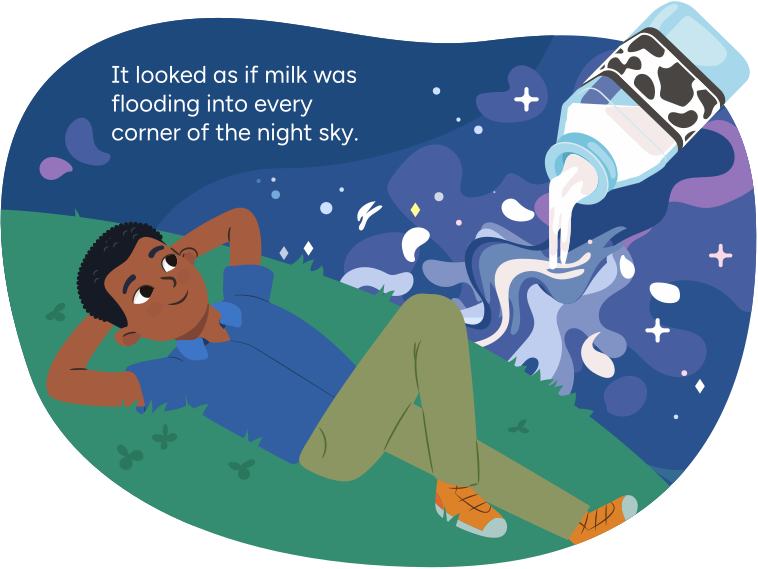
Authors – and particularly science fiction authors – create vivid descriptions for readers through their word choice and the use of sensory details.
Let’s explore an example!
Read the following passage from the sci-fi kids novel Children of Stardust by Edudzi Adodo. What do you think of when you read this passage? What pictures are created in your mind?
All around him, stony outcrops carved by the wind looked like hundreds of apple cores dropped onto the desert. Overhead, desert condors greased the skies on silent wings. As they flew directly above him, one went rigid and tumbled out of the sky, crashing into a sand dune in a puff of feathers. The others gave cries of alarm and glared at Zero.
“Sorry,” said Zero, pulling the zipper of his coat all the way up to his chin. He added to himself, “I really should do something about this cheese…”
- Chapter 1, Children of Stardust by Edudzi Adodo
In a notebook, or using a method of your choice, write, draw, or describe to someone what you visualize when you read this passage.

Pause and Reflect
Word choice
Which words stand out to you in the passage that you read?
- Reread the passage. Try reading it out loud!
- Jot down key words or phrases the author uses to create vivid descriptions.
Record your thinking in a notebook or using another method of your choice.
When you have finished, press Possible Answers to see some examples.
- stony outcrops carved by the wind
- looked like hundreds of apple cores dropped onto the desert
- desert condors greased the skies on silent wings
- tumbled out of the sky
- in a puff of feathers
A different version…
Imagine how different the passage would be if it just stated actions and events without bringing them to life by describing sights and sounds connected to them.
It might go something like Version 2:
| Original version | Version 2 |
|---|---|
|
All around him, stony outcrops carved by the wind looked like hundreds of apple cores dropped onto the desert. Overhead, desert condors greased the skies on silent wings. As they flew directly above him, one went rigid and tumbled out of the sky, crashing into a sand dune in a puff of feathers. The others gave cries of alarm and glared at Zero. “Sorry,” said Zero, pulling the zipper of his coat all the way up to his chin. He added to himself, “I really should do something about this cheese…” |
All around him there were stone walls of different sizes. Above him, birds were flying. One went stiff and fell to the ground. The others made noises and glared at him. “Sorry,” said Zero, zipping up his coat. “I really should do something about this cheese…” |
Which version allows you to create a detailed mental picture of the action? How does this impact capturing your attention and wanting to read more?
In this learning activity, you will examine how authors use descriptive word choices and sensory details to engage their readers. You will also practise applying these skills as you write your own sci-fi story!
Comparing two descriptive genres
Every genre of text benefits from powerful, well-chosen words.
For some genres, descriptive and sensory details are especially important. This is true for the genres of fantasy and science fiction (sci-fi for short).
In both of these genres, the author creates a fictional universe and draws the reader into it. This requires lots of detailed descriptions to help the reader visualize the setting and characters in these made-up worlds. Sometimes the author invents new languages, names, and words/terms specific to their fictional universe.
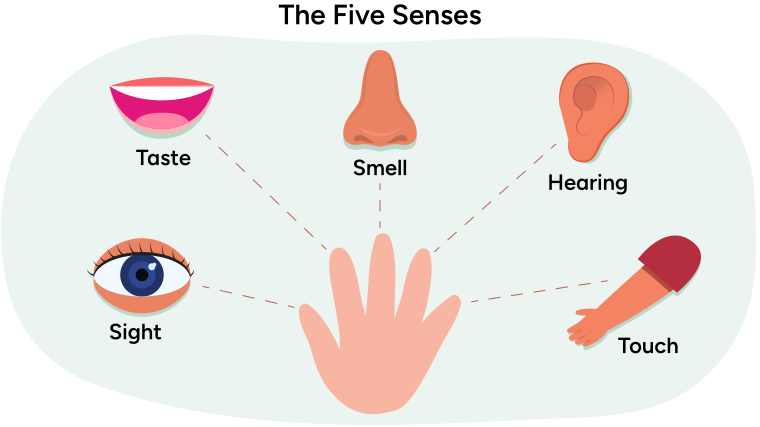
When writing descriptively, authors use the five senses to create sensory details that bring the story to life.
Science fiction versus fantasy
The genres of science fiction and fantasy have much in common. For example, both include highly imaginative stories and vivid descriptions. However, the two genres also have the following differences:
| Science fiction | Fantasy |
|---|---|
|
|
Press the following tabs to learn more about these two genres.
Science fiction (sci-fi for short) includes futuristic elements in its characters, setting, and plot. It shows things that could possibly become reality in the future.
Here’s a science fiction plot example: A character uses a car as a time machine to travel back in time and change the past.
Sci-fi worlds typically include one or more of the following elements:
- futuristic settings, post-apocalyptic settings
- multiple universes, intergalactic wars
- different rules of society and/or governments or lack of government (anarchy)
- advanced technology: time travel, teleportation, space exploration/travel
- supernatural abilities: telepathy (mind reading), morphing (changing body forms), cloaking (invisibility)
- extra-terrestrials, robots, genetically altered humans, multiple species of people, or life forms from other plants
Fantasy includes elements of magic in its characters, setting, and plot. It does not have to follow the physical laws and rules of reality.
Here’s a fantasy plot example: Students at a school for witches and wizards play a sports game using flying brooms and magical objects.
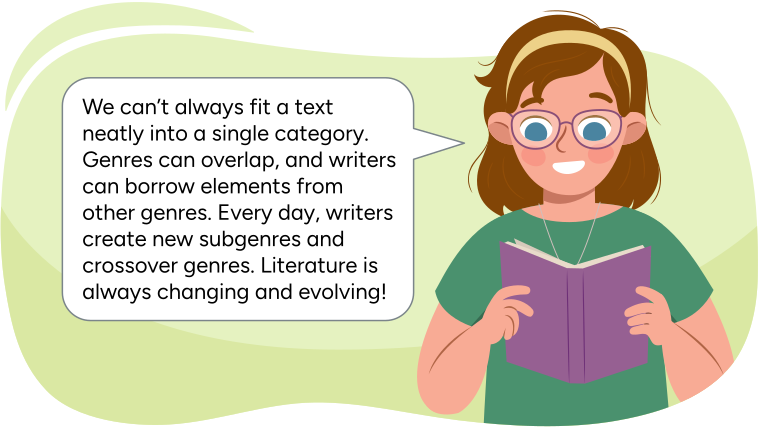
Is it always clear cut?
There isn’t always a perfectly clear line between two genres, such as science fiction and fantasy. Student Ava explains:
Exploring a sci-fi story: Children of Stardust
Let’s explore an example of a science fiction novel for kids!
In the Minds On section, you were introduced to the book Children of Stardust by Edudzi Adodo.
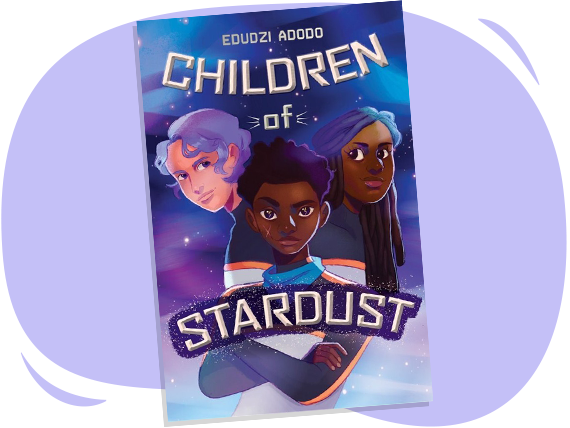
This sci-fi novel follows main character, young Zero Adedji, on an adventure through his home planet named Anansi 21. Zero makes his very minimal living by working as a guide for stranded space travellers but has always dreamed of joining one of the Saba guilds (groups of intergalactic space explorers who find lost treasures while chasing criminals). One day, Zero meets a strange creature with a strange object that gives him powers and transforms his life! Together with his two friends, Zero has to outsmart the Space Mafia and save his galaxy!
Pre-reading: Making connections

Before you begin reading an excerpt from the book Children of Stardust, consider the following questions. Record your thinking in a notebook or using another method of your choice.
- Have you read any other books or stories with fictional worlds or new and diverse cultures?
- If you had the opportunity to travel or even live in space, do you think you’d enjoy it?
- What do you think you might find or see in space?
As you read the excerpt from the book Children of Stardust, look for the following:
- Author’s craft: How does author Edudzi Adodo choose words and descriptive details to make the story exciting and capture your attention as a reader?
- Genre: What elements of the story make this a science fiction text?

Time to read!
Now read an excerpt from chapter 2 of Children of Stardust by Edudzi Adodo.
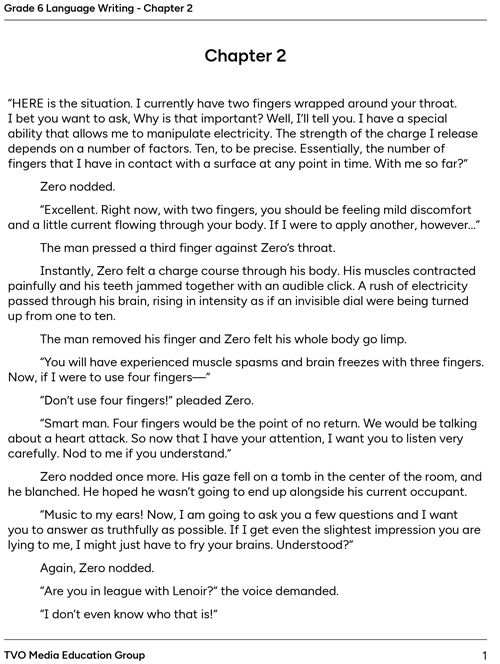
Press the Activity button to access the Chapter 2, Children of Stardust.
Activity(Opens in a new tab)
Vocabulary: Check your understanding
The excerpt contained a lot of descriptive words, advanced vocabulary, and author-created terminology. What do you think some of these words might mean? How do they contribute to the story or your ability to picture what is happening?
Let’s explore some of the advanced vocabulary.
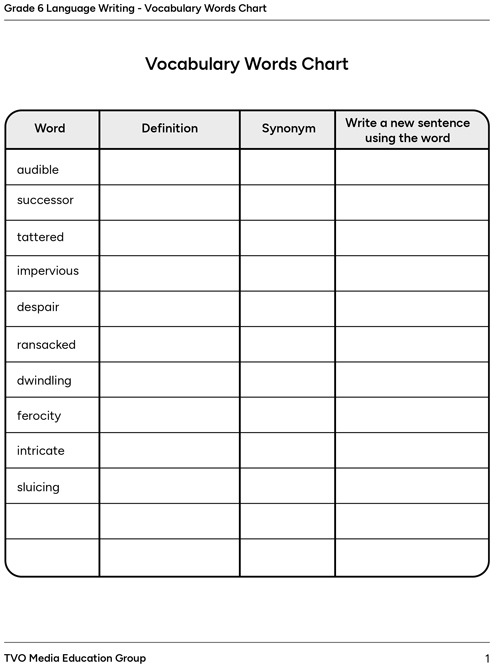
Find the words from the text listed in the following chart. You may complete the fillable and printable Vocabulary Words Chart in your notebook or using the following document. If you would like, you can use speech-to-text or audio recording tools to record your thoughts.
Once you have the listed words, consider adding other words that might have been new for you.
Analyzing vivid descriptions
Let’s take a look at some examples of vivid descriptions used in Children of Stardust to learn about the impact they have on the text and the reader’s experience.
Passage 1
The two yellow orbs of its eyes grew big like the lights of an oncoming train.
- Chapter 2, Children of Stardust by Edudzi Adodo
Did you notice that this passage contains a literary device called a simile?
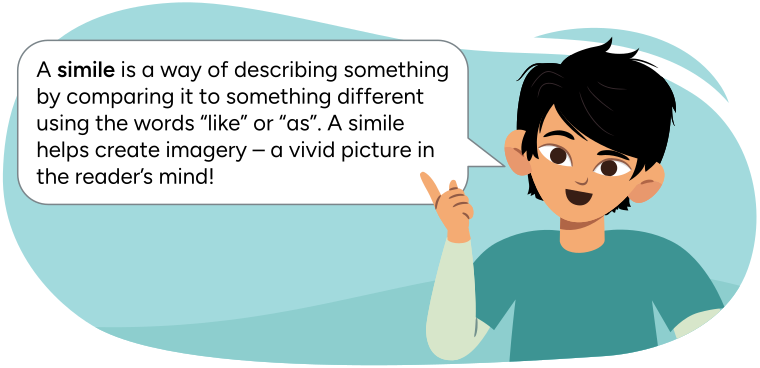
Can you explain the simile in this passage and the impact of the vivid picture it creates for the reader?
When you’re ready, press Sample Answer to review a possible response.
In this passage, the author compares the beast’s eyes to the bright lights of a train by saying one is like the other. This comparison helps the reader visualize the beast’s eyes shining bright yellow and growing in size (as if a train was coming closer). This communicates to the reader the beast’s growing surprise about what’s physically happening to Zero after touching the pyramid-shaped object.
Similes are sometimes confused with another literary device, called a metaphor. A metaphor also compares two different things, but it’s a more direct comparison.
Metaphors state that something is something else.
Similes say that something is like or is as something else.
Explore the following examples to learn more:
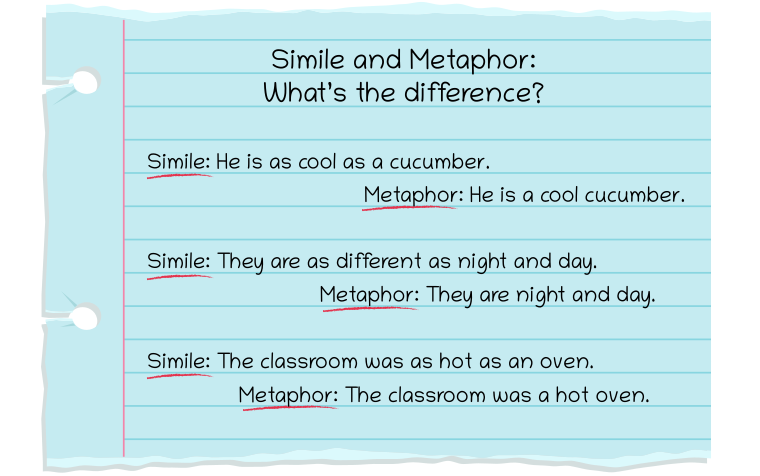
Simile and metaphor: what’s the difference?
Simile: He is as cool as a cucumber.
Metaphor: He is a cool cucumber.
Simile: They are as different as night and day.
Metaphor: They are night and day.
Simile: The classroom was as hot as an oven.
Metaphor: The classroom was a hot oven.
Can you find other examples of similes or examples of metaphors in the text? Record your answers using a method of your choice.
Passage 2
In the following passage, the author uses specific details to describe Wander, the unique beast that Zero meets in Chapter 2. Read the following passage:
Zero was staring at a tall creature the size of a bear and covered in white fur. It had a snout like a pig and two canines that jutted out from under its lower lip. It had deep-set yellow eyes with piercing blue irises, like the little crystals mined on the surface of Neptune 4. It wore a black-and-white-striped shirt like a prisoner.
- Chapter 2, Children of Stardust by Edudzi Adodo
What text details help you visualize this new character? How would you summarize the appearance of the beast?
When you are ready, press Sample Answer to review a possible response.
The author uses descriptive words and phrases to paint a mental picture of the beast. The beast:
- is large in size, like a bear
- has white fur
- has a snout like a pig
- has two fangs that stick out from under its lower lip
- has sunken-in yellow eyes with bright blue in their centre
- is wearing a black-and-white-striped shirt like a prisoner
Pause and Reflect
Pause and reflect
- Why are imagery and descriptive language so important in science fiction writing?
- What impact do they have on the reader?
- How would the experience change for the reader if authors didn’t use these techniques?
Record your thinking in a notebook or using another method of your choice.
Identifying science fiction elements
As we learned earlier in this learning activity, there are certain elements required for a text to be considered science fiction.
What elements of science fiction can you identify in what you have read so far of the novel Children of Stardust?
Match the element of science fiction with the detail from the story.
Now that you are familiar with the elements of science fiction, you can begin to plan a science-fiction story of your own!
Before you begin, let’s review the different parts that make up the structure of a story.
Structure: The five elements of plot
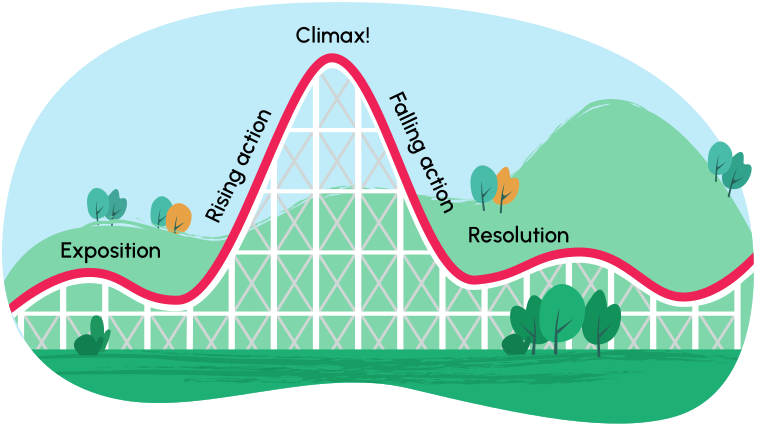
The structure of a story is made up of five plot elements. They are often represented as a hill or a rollercoaster because they lead readers through ups and downs of different emotions.
The following diagram shows the five elements of plot. Notice how the shape of the diagram shows a peak where the word “climax” is – this is where the largest emotions of the story happen!
Press the following tabs to learn more about each of the five elements of plot.
- how the story begins
- introduces the setting, characters, and theme
- hooks the reader and makes them want to keep going
- introduces the main problem or conflict in the story that the characters must face
- helps the readers get to know the characters better and builds suspense
- the “big moment” and most exciting part of the story
- the turning point when the reader needs to know what is going to happen next!
- the consequences of the climax
- the sense of relief when the characters respond to their problem and try to solve it
- how the story ends
- reveals the message that the author wants the readers to take away with them (for example, what the characters learned about themselves, others, or the world around them)
Planning your sci-fi story
It’s time to start coming up with ideas for your own sci-fi story! This is a two-step process.
Step 1: Brainstorm sci-fi elements
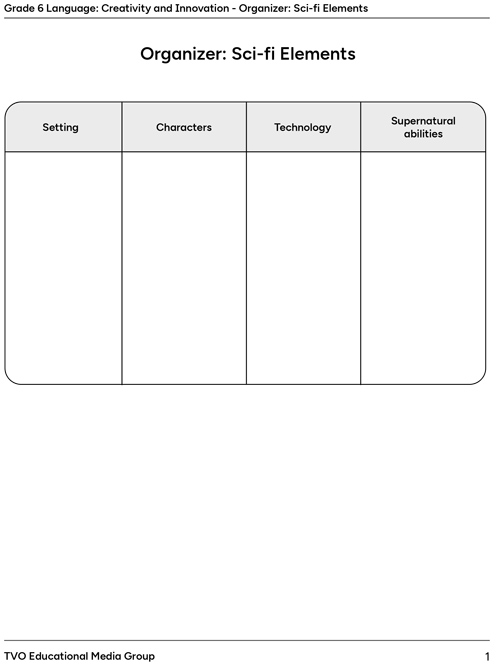
First, you will brainstorm the elements of science fiction you want to include in your story. Think of examples in these four categories:
- setting
- characters
- technology
- supernatural abilities
To record your ideas, complete the Organizer: Sci-fi Elements in your notebook or using the following fillable and printable document. If you prefer, use another method to record your ideas.
Step 2: Plan the plot
Once you have identified the sci-fi elements of your story, begin to plan out the plot.
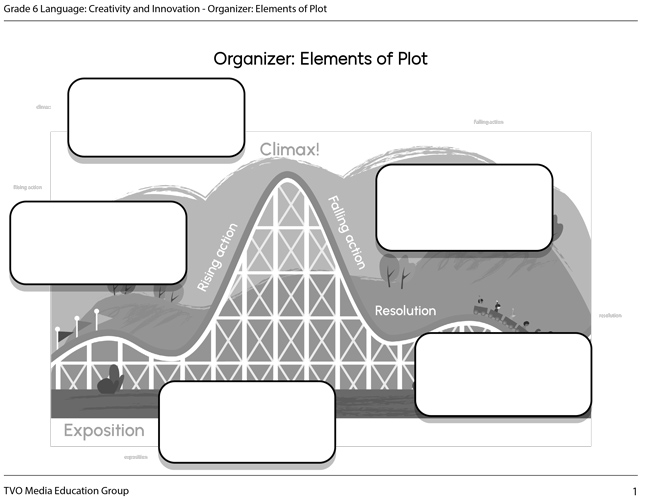
Using a tool like a graphic organizer is a great strategy for organizing your ideas and making sure you have details for all the necessary parts of a story. Complete the Organizer: Elements of Plot in your notebook or using the following fillable and printable document. If you prefer, use another method to record your thoughts.
Planning with pictures
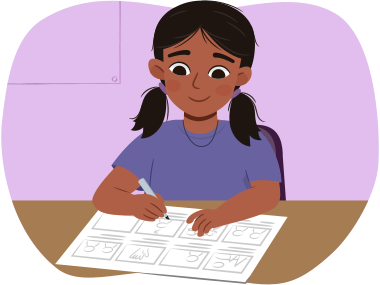
If you are a visual thinker, you may prefer to plan your story’s exposition, rising action, climax, falling action, and resolution by sketching out a storyboard.
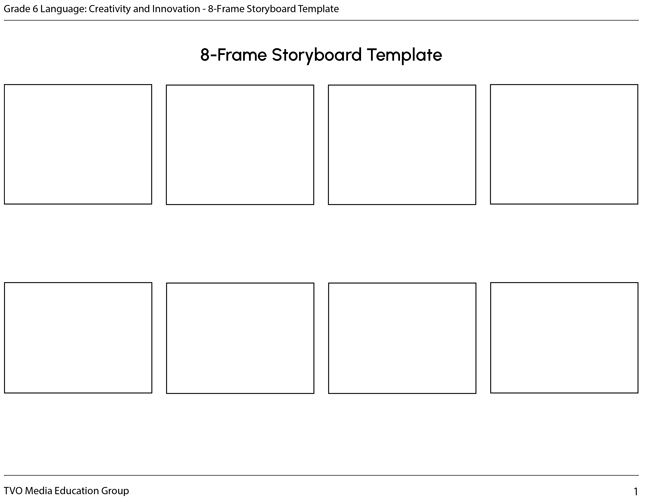
A storyboard is a visual representation of a story or film sequence. It breaks down the action into individual panels, a bit like a comic book or graphic novel.
You can create your storyboard either on paper or digitally. If you wish, use the following fillable and printable 8-Frame Storyboard Template.
Let’s check!
You have learned some important terms in this learning activity. To review them, try this matching activity.
Match game!
For each term, select the corresponding definition.
Putting it all together
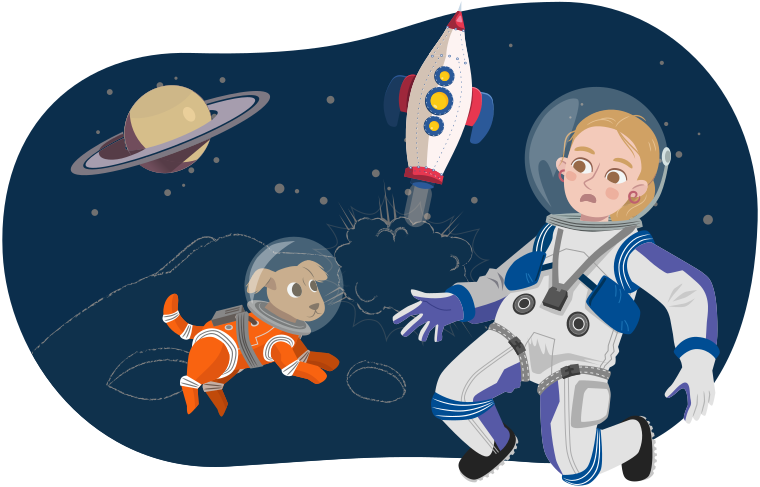
In the Action section of this learning activity, you brainstormed science-fiction elements and planned the plot of your own sci-fi story.
To consolidate your learning, you will now create a draft of that story!
To do this, you will go through the steps of the writing process. Press the following tabs to learn more.
Using your planning documents from the Action section, begin writing your story by hand or using a word-processing tool of your choice.
Once you have drafted your story, review it to check that it contains all five plot elements:
- exposition
- rising action
- climax
- falling action
- resolution
Check that your story has some elements of science fiction, such as the following:
- a futuristic or otherworldly setting
- characters such as aliens, robots, bionic beings, or different species
- technology or technological powers that do not exist in real life now, but could in the future
Lastly, check that you have used vivid descriptions to bring the story to life. Does your story have the following?
- powerful, vivid word choices
- sensory details that appeal to some or all of the five senses (sight, taste, smell, hearing, touch)

Student Tips
Write your notes in a book!
Feedback helps!
Getting feedback is a great way to improve your work. When you have completed you story, if possible, share it with someone! See if they can identify the genre of the story.
Reflecting on the creative experience
Answer the following questions in your notebook, or record your thoughts using the method of your choice. If possible, share your thoughts with a partner.
- When you were creating your story, what strategies or tools did you use to flesh out and communicate the message in your story?
- What are two actions you can take in the future to help you improve as a writer?
Reflection
As you read through these descriptions, which sentence best describes how you are feeling about your understanding of this learning activity? Press the button that is beside this sentence.

I feel...
Now, record your ideas using a voice recorder, speech-to-text, or writing tool.