Learning goals
We are learning to…
- explore issues of diversity and accessibility in texts
- understand the contributions and lived experiences of a diversity of individuals and communities
- gather and use information relevant to a topic to create texts
- select and use appropriate digital tools to support the design process
Success criteria
I am able to…
- identify and analyze messages about diversity and accessibility in literary and informational texts
- identify the lived experiences of diverse individuals, as well as their contributions to space exploration
- research and organize biographical information about an astronaut
- share the results of my research using an engaging and creative format of my choice
Experience weightlessness
Check out the following video. What do you notice? What questions do you have?

Brainstorm
Video: Brainstorming
In a notebook or using another method of your choice, brainstorm answers to the following questions. If possible, share your thoughts with a partner.
- Describe what you observed in the video.
- What are the people doing?
- What are some things that the people in this video have in common?
You may have noticed that all of the subjects in the video are experiencing weightlessness (microgravity) and that they are all having fun!
Some of the people in this video have something else in common: a physical disability. This is not obvious because zero gravity can be an equalizing factor for some forms of disability. It removes some mobility barriers that some persons with physical disabilities experience while on Earth.
The flight you observed was put on by the European Space Agency (ESA) and Novespace. It paired several children and adults with disabilities with astronauts from their home countries. The participants experienced weightlessness and engaged in different STEAM activities such as playing ping pong with water bubbles.
This flight is part of a growing push to make outer space and suborbital experiences accessible to all persons, not just astronauts.
Wonder statements

Given what you have read and watched so far, what things do you wonder about?
Consider what you might like to know about the following:
- experiencing microgravity
- children in space
- space exploration for people with disabilities
- space exploration in general
Create at least two statements that begin with “I wonder…”. Record those wonder statements using the method of your choice. If possible, share your thoughts with a partner. You will pause to reflect on these questions later on in this learning activity.
If you wish, you can write your wonder statements in cursive or type them out.

Cursive practice
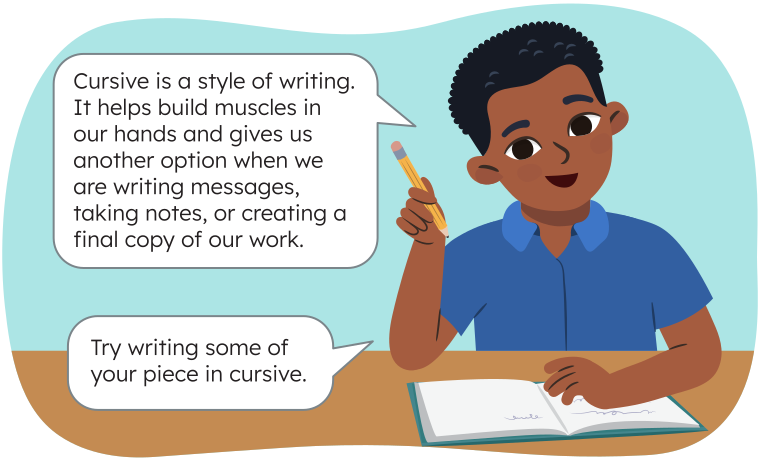
Arthur says, 'Cursive is a style of writing. It helps build muscles in our hands and gives us another option when we are writing messages, taking notes, or creating a final copy of our work.Try writing some of your piece in cursive.'
Let’s review cursive writing!
Check out the following animation of how the word “wonder” is written in cursive, then review the tips for cursive writing provided.
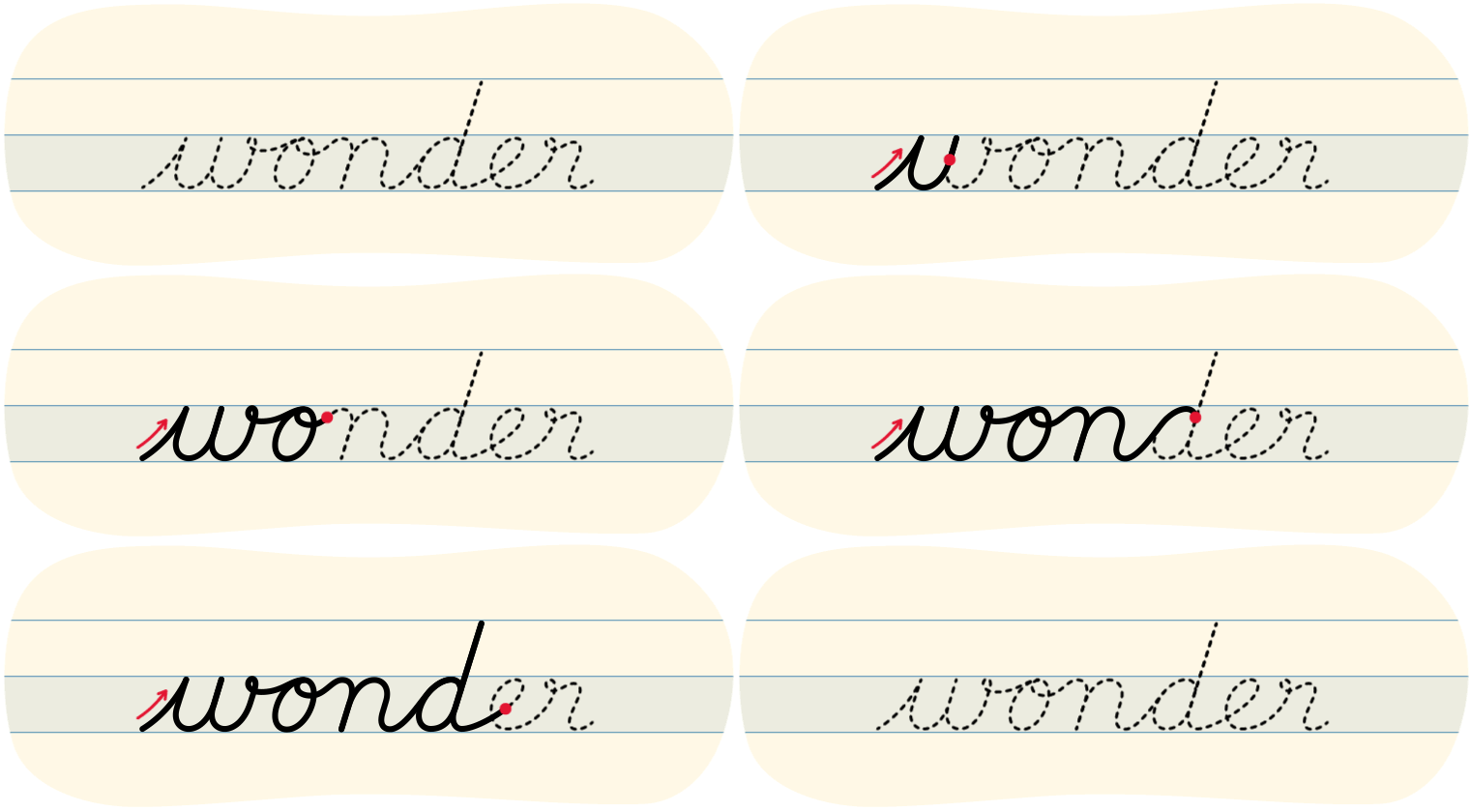
Tips for cursive letters
- When we write in lowercase, we always begin at the bottom.
- When we write in uppercase, we can start from the top or the bottom.
- Try to keep the pencil on the page until you are done the word.
- Try to press gently as you write so that your hand can move easily across the page.
- Take your time to make sure that you are writing clearly and evenly.
Left-handed tips for cursive writing

Explore the video on Left-Handed Tips to learn more.

Typing practice
Typing is a great skill to develop! When we need to use a computer or tablet keyboard, knowing how to type helps us:
- take notes
- respond to messages
- create final drafts of our work
Explore the following image to see what fingers are used to type each letter or number.
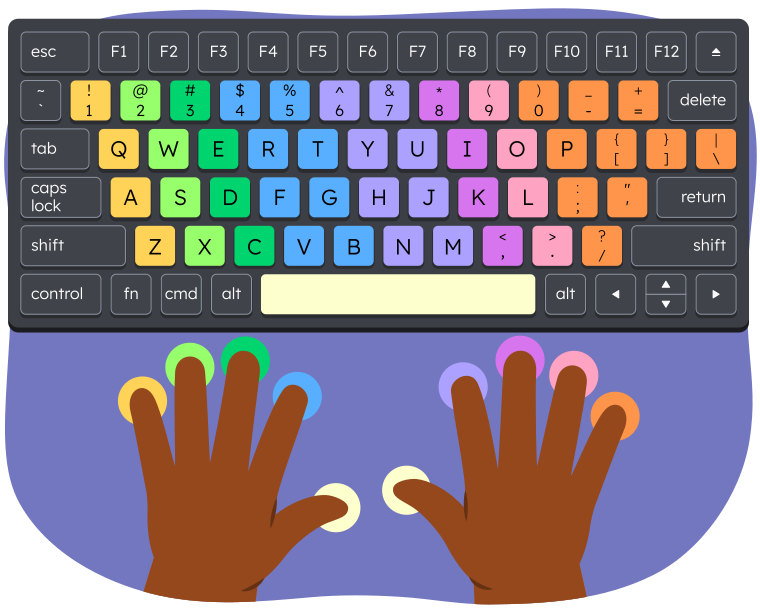
A keyboard and hands showing which fingers are used to press each key when typing.
The left pinky finger presses the keys 1, Q, A, and Z.
The left ring finger presses the keys 2, W, S, and X.
The left middle finger presses the keys 3, E, D, and C.
The left index finger presses the keys 4, 5, R, T, F, G, V, and B.
The left or right thumb presses the space bar.
The right index finger presses the keys 6, 7, Y, U, H, J, N, and M.
The right middle finger presses the keys 8, I, K, and comma.
The right ring finger presses the keys 9, O, L, and period.
The right pinky finger presses the keys 0, minus, equal, P, open bracket, closed bracket, backslash, semicolon, apostrophe, and forward slash.
We use specific muscles in our hands to type! It’s important to practise so that it becomes easier to type correctly without putting too much pressure on our hands and our wrist.
For additional typing practice, check out the game “Keyboard Climber 2”!

How to experience microgravity
Microgravity is the state or condition of feeling weightless or experiencing no gravitational pull.
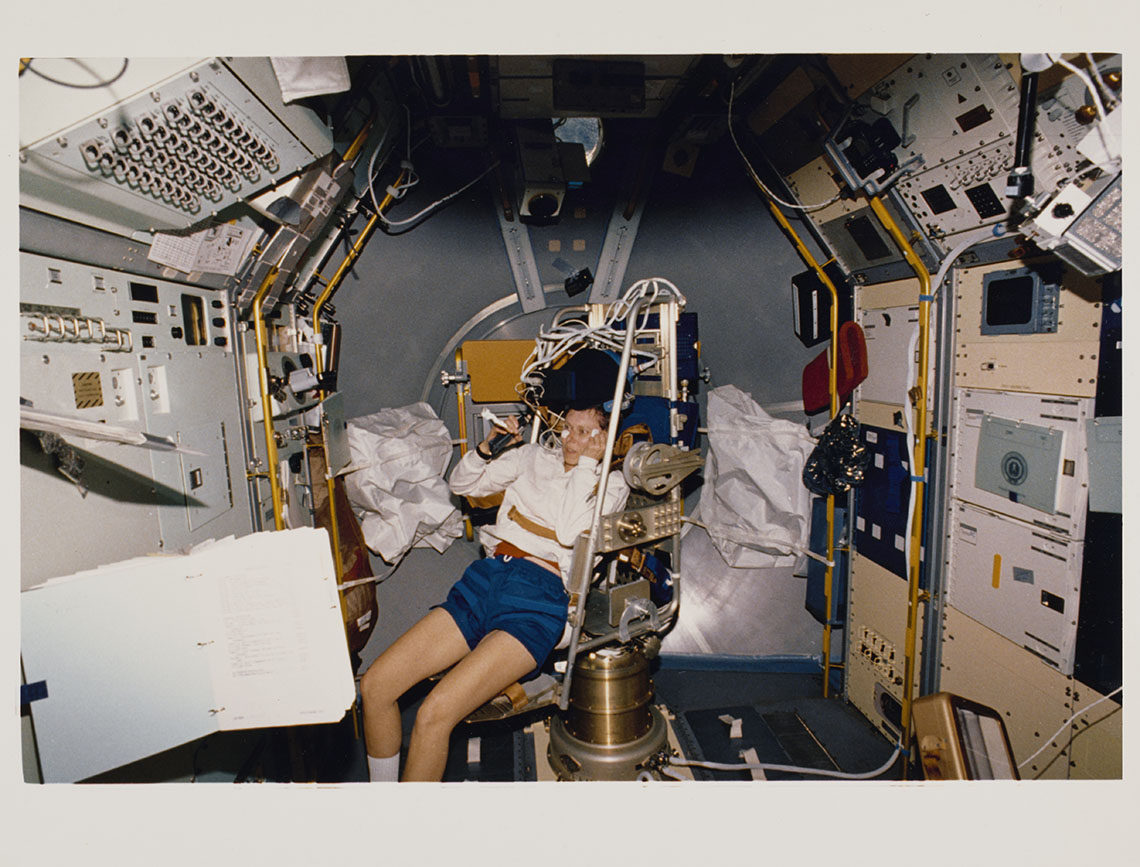
Canadian astronaut Roberta Bondar experiencing microgravity. Note the floating book in the bottom-left corner of the picture.

Did You Know?
Did you know?
People often refer to astronauts as having “zero gravity” in space. Technically speaking, no human has ever experienced true zero gravity, as you would need to be 21 million kilometres away from Earth to experience that! Even in space, astronauts experience a small amount of gravity, called “microgravity.”
Parabolic flight
In the video you explored in the Minds On section, how did the passengers on the flight experience weightlessness without going into space?
Humans can experience a sense of weightlessness on a parabolic flight. Simply put, an airplane pilot flies an airplane in giant arcs. It’s a bit like repeatedly going up and down a mountain. At the top of each arc, passengers experience weightlessness.
Parabolic flights are used for conducting experiments and training astronauts. They are also used for specialized flights, such as those designed for individuals with disabilities (like the one you explored in the Minds On section). Several companies offer parabolic flights, but the price puts them out of reach for most people.
Novel: Farther Than the Moon

Lindsay Lackey’s novel Farther Than the Moon follows its protagonist Houston, a 13-year-old boy. Houston dreams of becoming an astronaut and wishes there was a way to bring his younger brother Robbie with him. Robbie has cerebral palsy and epilepsy, and his medical needs affect the experiences and activities available to him.
Getting ready to read…
To learn more about Robbie’s medical conditions, press the following tabs.
Cerebral palsy is a condition that affects the brain and muscles. It makes it hard for someone to control their movements and muscles. This can cause difficulties with walking, talking, and other activities, but it doesn’t get worse over time. People with cerebral palsy may need special help or therapy to manage their symptoms.
Epilepsy is a medical condition that causes people to have repeated seizures. A seizure is a sudden burst of electrical activity in the brain that can make a person shake, lose control, or experience other unusual feelings or behaviours. With the right treatment, many people with epilepsy can manage their seizures and live normal lives.

Time to read!
You are going to read Chapter 4 of Farther Than the Moon. Houston is preparing to attend the Junior Astronaut Achievement Program (JARP) at the Johnson Space Centre in Houston, Texas. While there, he hopes to meet his favourite astronaut of all time – who just happens to be his estranged grandfather.
As you read the chapter, pay attention to the following elements:
- the brothers’ relationship
- Houston’s internal conflict
Now read Chapter 4 of Farther Than the Moon.
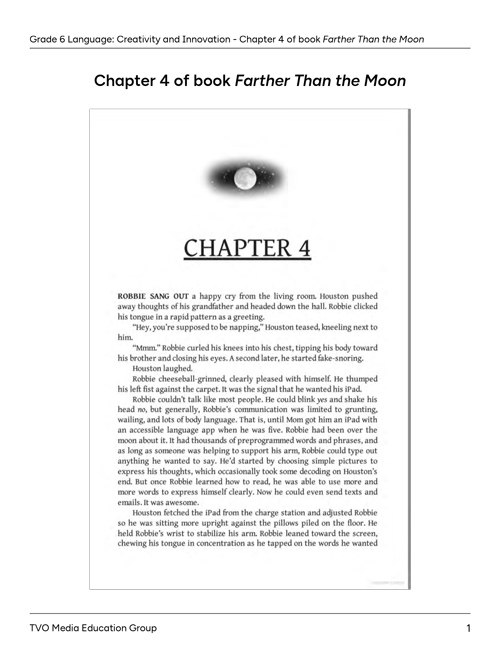
Press the Activity button to access the Chapter 4 of Farther Than the Moon.
Activity(Opens in a new tab)Post-reading: Analyzing and reflecting
In a notebook or using another method of your choice, answer the following questions.
1. Describe some of the ways that Robbie communicates with his brother Houston.
2. When Houston is trying to think of a way to meet his grandfather, what suggestion does Robbie make?
3. Summarize Houston’s internal conflict.
When you have finished, press Sample Answers to check your understanding.
1. Robbie communicates using an iPad, facial expressions, sounds, eye movements/blinks, and hand motions.
2. Robbie suggests that Houston invite their grandfather to the final presentations of the Junior Astronaut Achievement Program so he will attend and feel proud of his grandson.
3. Houston is conflicted because he can’t honour both of his goals simultaneously. He wants to be an astronaut, and leaving for the JARP is the first step. But he has also promised Robbie that they will see space together, so it pains him to leave his brother behind.
Let’s reflect…
Idioms
We’re going to look at an idiom in the chapter you read. But first things first: What is an idiom?
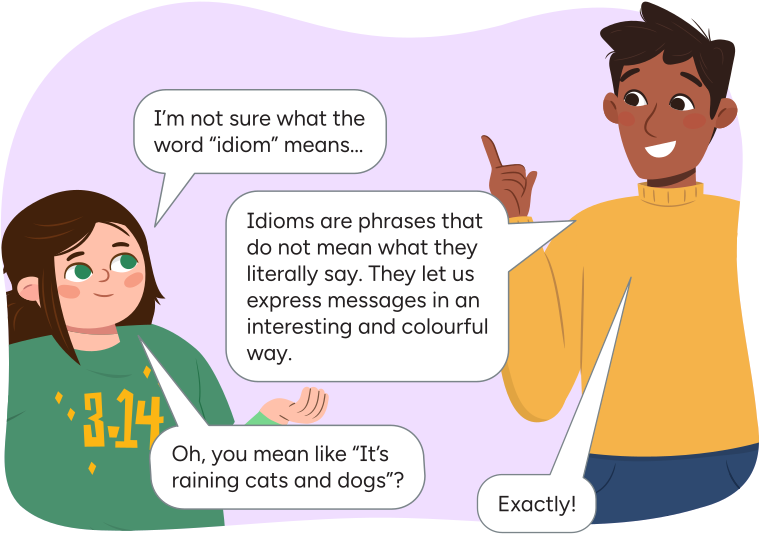
Conversation between teacher and student.
Student: I’m not sure what the word “idiom” means…
Teacher: Idioms are phrases that do not mean what they literally say. They let us express messages in an interesting and colourful way.
Student: Oh, you mean like “It’s raining cats and dogs”?
Teacher: Exactly!
Idioms are also known as idiomatic expressions.
Practice with idioms
You probably know more idioms than you think. Try the following matching activity.
For each idiom, select the corresponding explanation.
Find the idiom!
Reread the following passage from Farther Than the Moon. Can you find the idiom that means “to be really happy”? (Hint: It’s very appropriate for a novel concerned with space!)
Write you answer in your notebook, or record it using the method of your choice.
Robbie couldn’t talk like most people. He could blink yes and shake his head no, but generally, Robbie’s communication was limited to grunting, wailing, and lots of body language. That is, until Mom got him an iPad with an accessible language app when he was five. Robbie had been over the moon about it. It had thousands of preprogrammed words and phrases, and as long as someone was helping him support his arm, Robbie could type out anything he wanted to say.
When you have found the idiom that means “to be really happy,” press the Answer button to check your understanding.
The idiom that means “to be really happy” is “over the moon.”

Who can be an astronaut?
The Space Age began in 1957 when the former Soviet Union (now known as Russia) launched a satellite called Sputnik 1 into space.
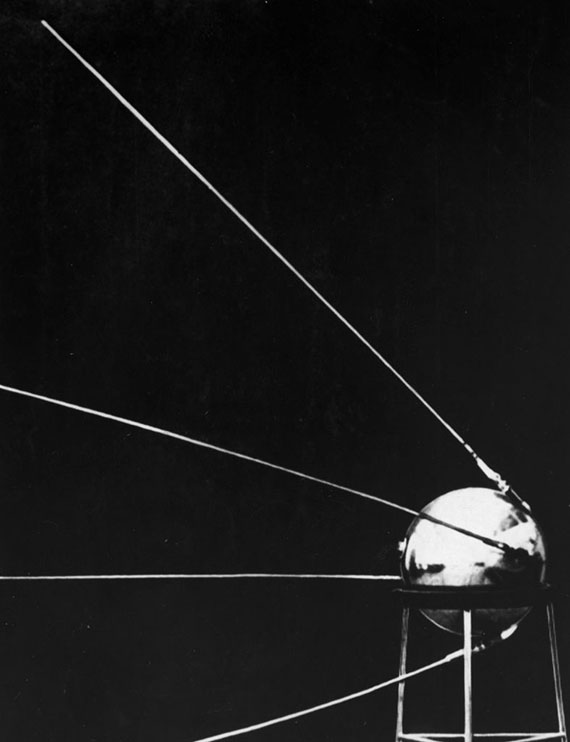
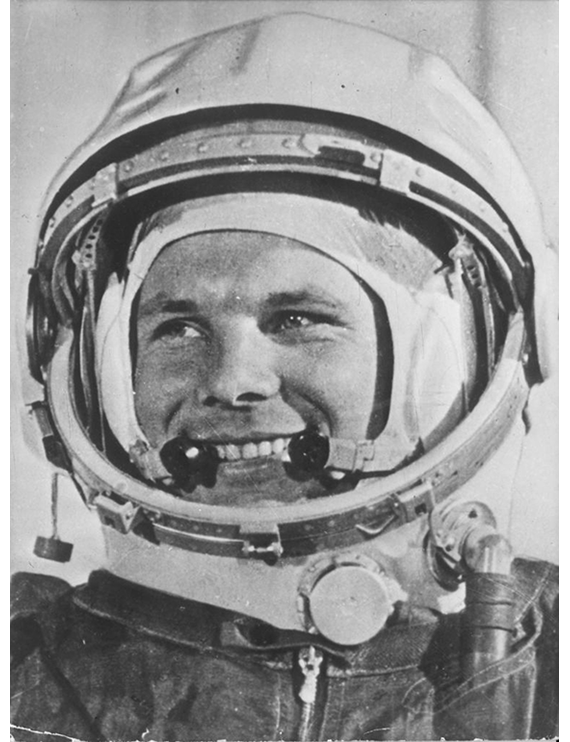
In 1958, the United States of America began its NASA space program. For the first 20 years of the American space program, all 73 of its astronauts were white males.
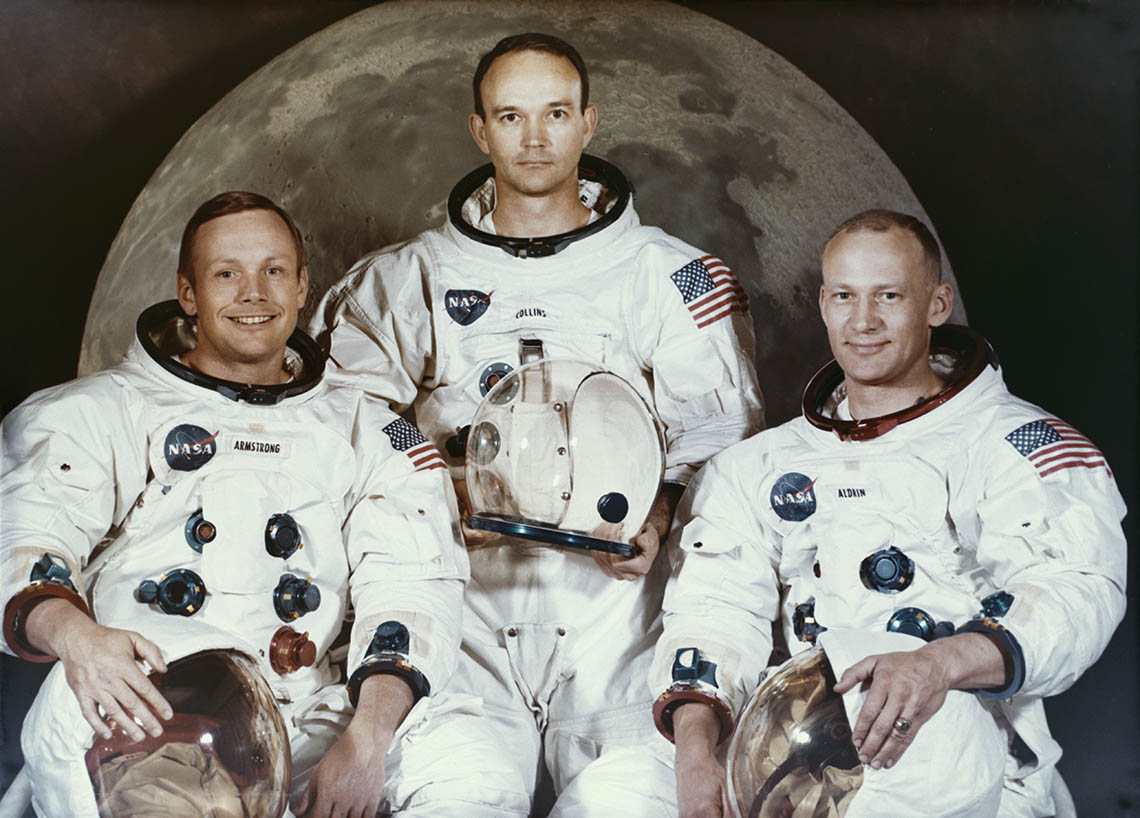
Three crew members of NASA's Apollo 11 lunar landing mission. From left to right, Neil Armstrong, Michael Collins, and Buzz Aldrin.
Increased diversity
In 1978, NASA announced a more diverse group of astronauts who were nicknamed the “Thirty-Five New Guys.” This class included the first Black American astronaut, the first Asian American astronaut and the first female astronauts. Many of this group went on to break barriers and set records.
Meet the pioneers
Examine the following images to learn more about some of the 1978 class of NASA astronauts and their groundbreaking achievements.
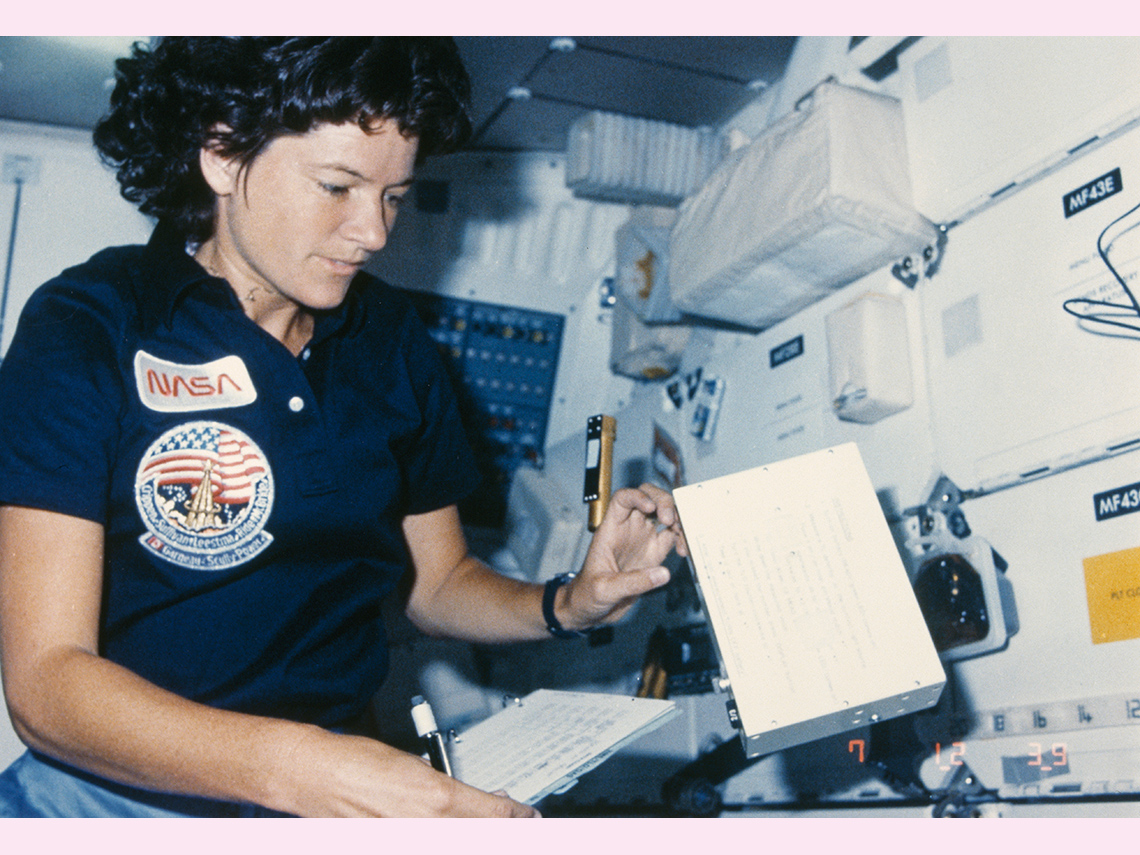
Dr. Sally Ride was the first American woman in space. After her death, it became known that she was also a member of the 2SLGBTQ+ community.
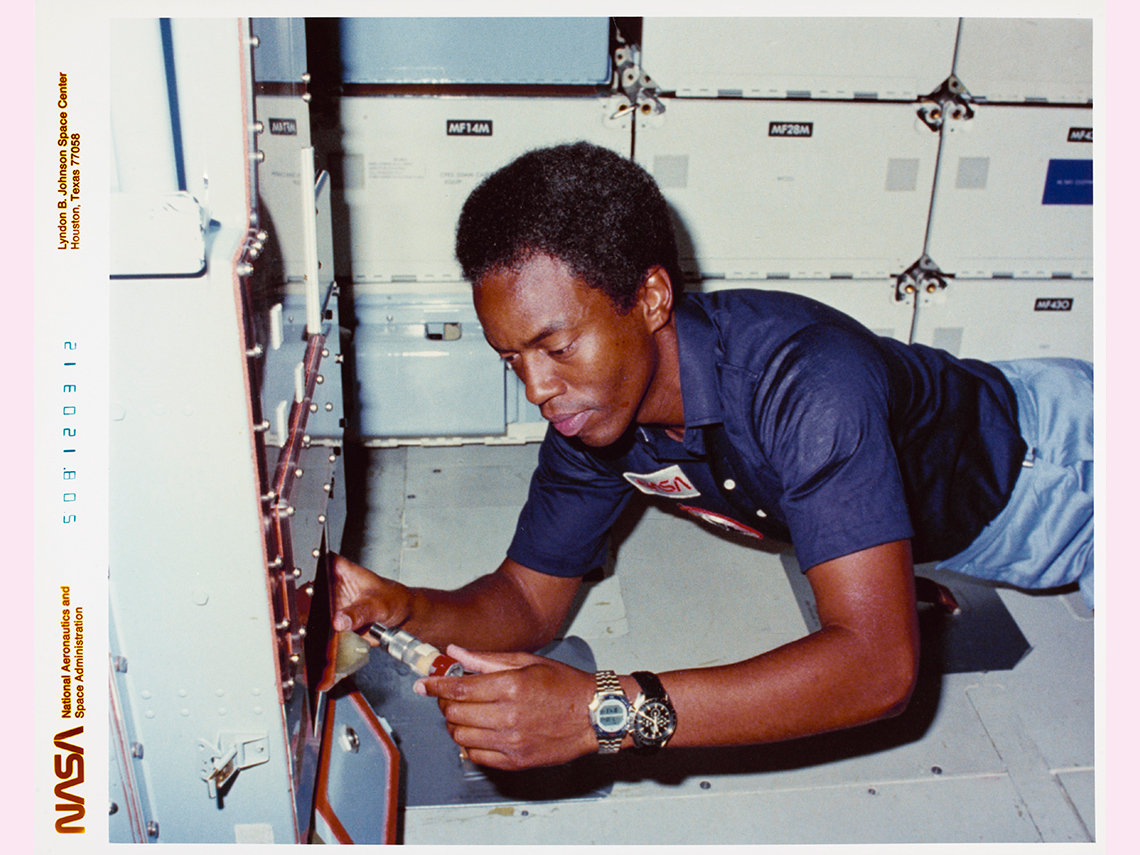
Dr. Guion “Guy” Bluford, the first Black American in space
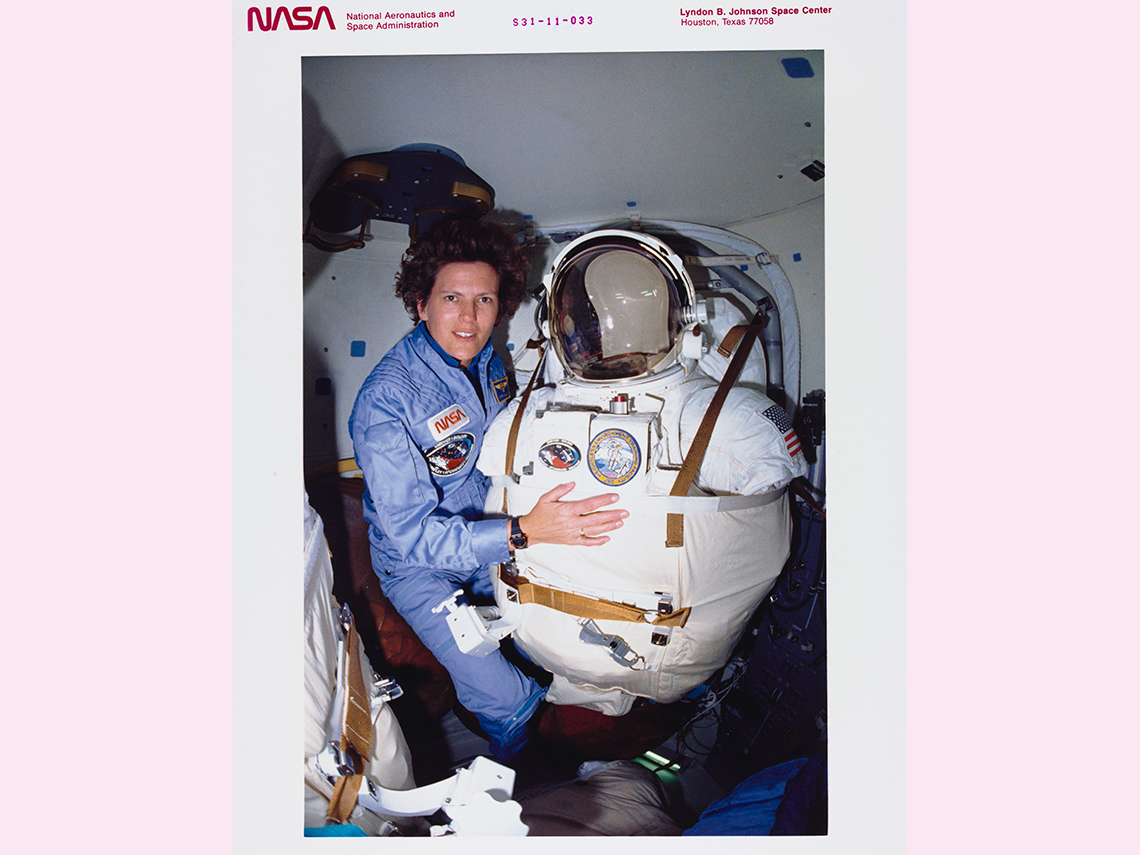
Dr. Kathryn Sullivan, the first American woman to walk in space
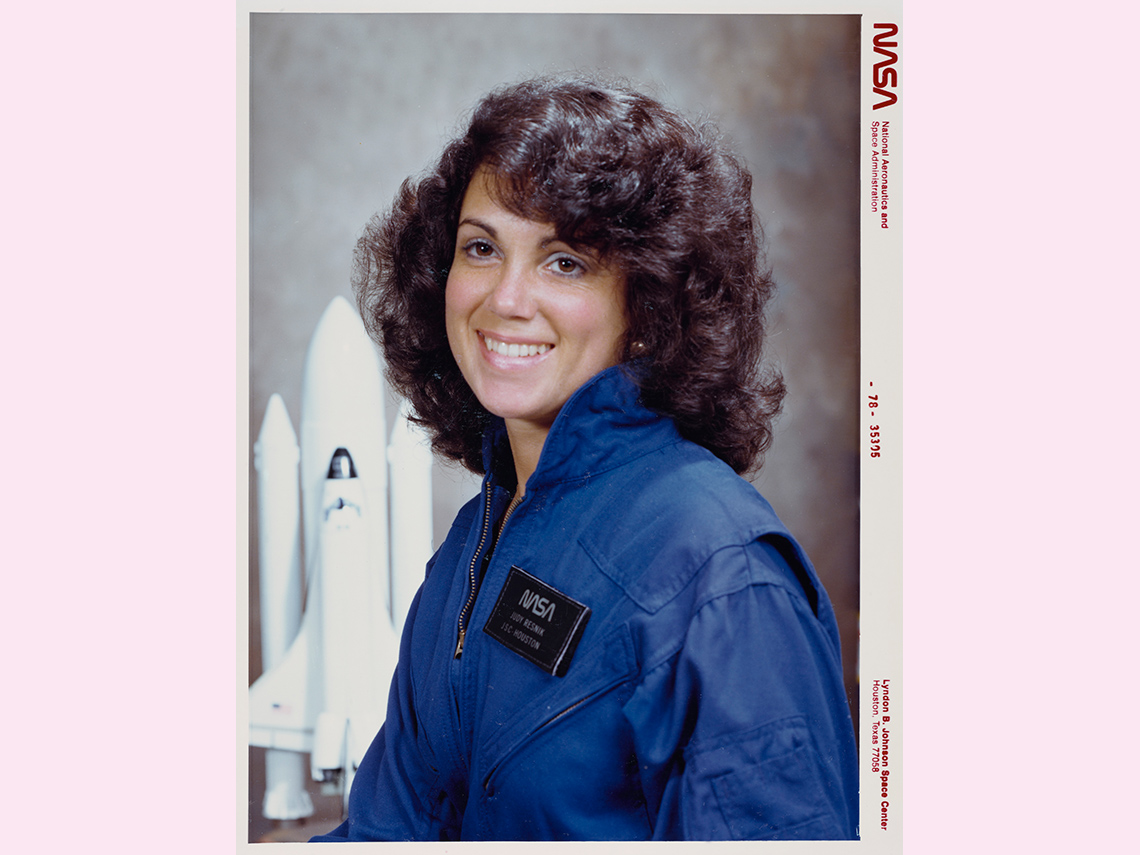
Dr. Judith Resnik, the second American woman and first Jewish person in space
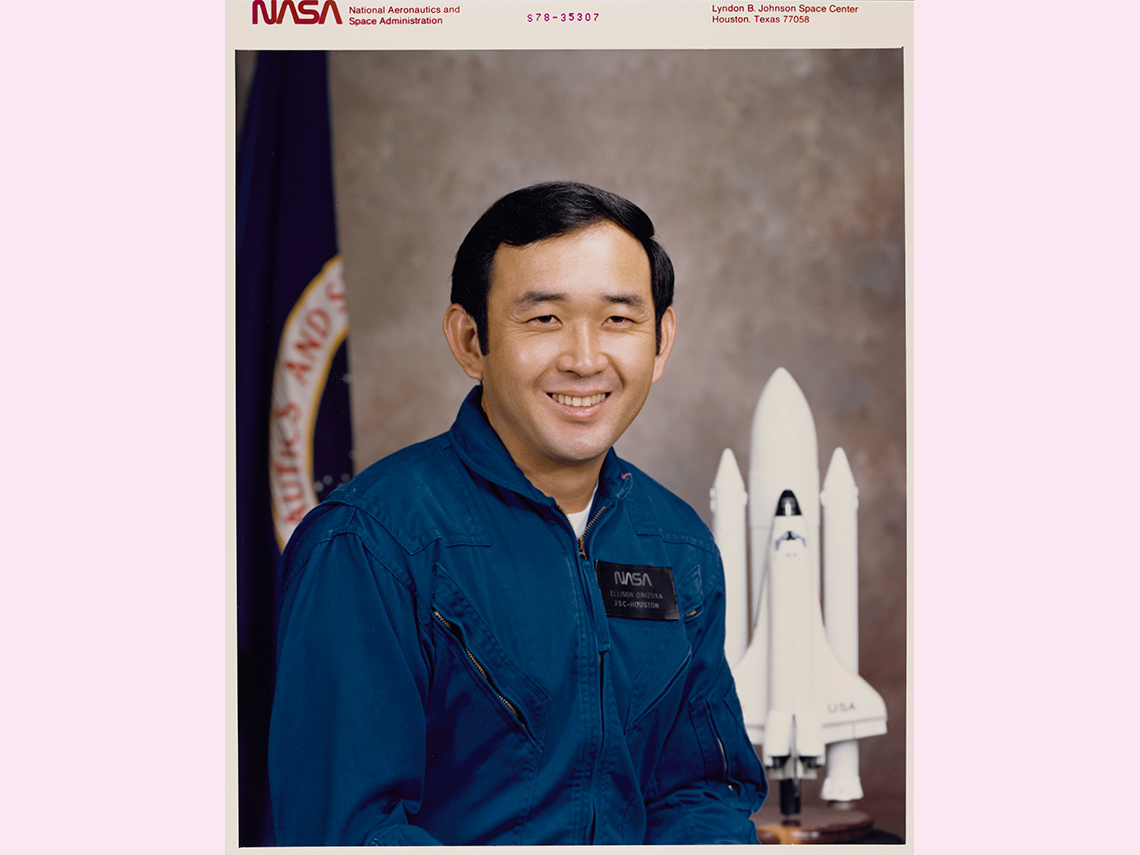
Col. Ellison Onizuka, the first Asian American in space
The space program in Canada
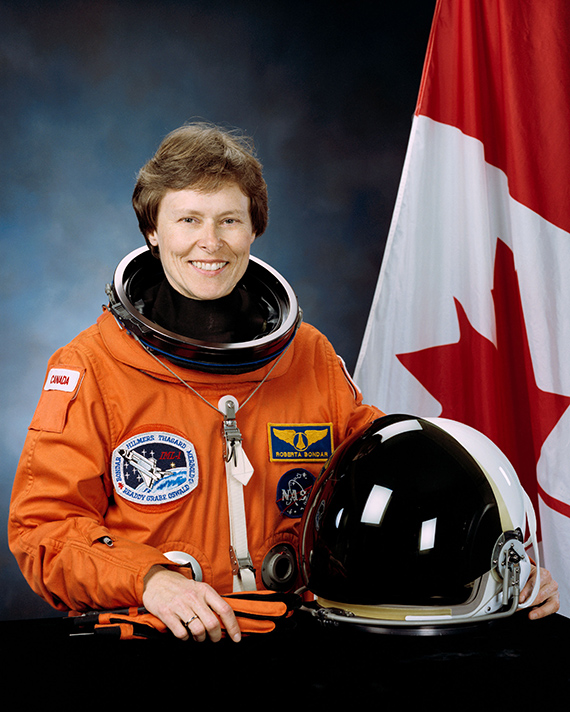
Canadian astronaut Roberta Bondar
The Canadian Space Agency (CSA) began in 1982, and its first group of six astronauts was selected in 1983. Five of the six astronauts were white males. Dr. Roberta Bondar, the sixth member of that group, became Canada’s first woman to travel to space.
Parastronauts
Today, there is greater ethnic and gender diversity in space. Many diversity advocates also want to see diverse abilities and hope to see astronauts with disabilities (sometimes referred to as parastronauts) in space.
Let’s explore the idea of diverse abilities in space. Check out the following video clip.
What was the main idea presented in the video clip? Record your thinking in a notebook or using another method of your choice.
When you have finished, press the Sample Answer button to check your understanding.
The main idea is that the physical criteria for astronauts need to change: any type of body should be able to go to space.
Breaking barriers: Meet Liam
You are going to meet someone who dreams of a future with fewer barriers and limitations. In the following episode of “Dream It to Be It,” Liam explains his goal of becoming an astronaut.
Check out the following video clip. As you watch, think about what you dream of doing.

Pause and Reflect
Disability in space
What does space expert Michael explain about wheelchairs in space? Record your thinking in a notebook or using another method of your choice. If possible, share with a partner.
When you have finished, press Sample Answer to check your understanding.
A wheelchair would not be needed in space as everyone would be floating, and they would use their upper body and momentum to move around the spacecraft.
You have done a lot of thinking about space and diversity. Now is a great time to take a break before we turn to grammar!

Student Wellness
Take a break!
Time for a body break! If possible, stretch your body and move around your space.
Grammar time!

Appositives
An appositive is a word or phrase that sits next to a noun and provides additional information about it or describes it in some way.
A sample sentence
To learn more about how appositives work, check out the following interactive sentence.
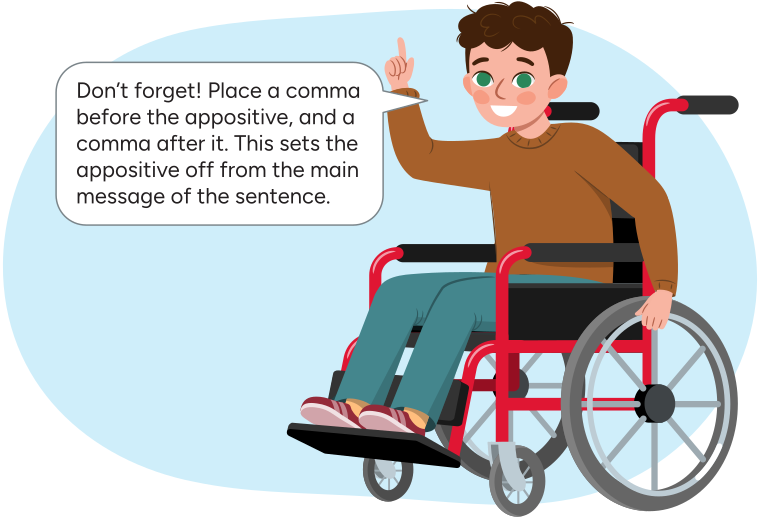
Practice with appositives
Next, you will try a matching activity.
In the following matching activity, you will examine a sample sentence and identify the noun (subject), the appositive, and the remainder of the main message.
Here is your sentence:
Dr. Sally Ride, the first American woman in space, was born in 1951.
Add the commas!
The following three sentences contain appositives but no commas. Your job is to insert commas where they belong (one before the appositive, and one after it). Do this work in your notebook or using the method of your choice.
1. Dr. Roberta Bondar the sixth member of that group became Canada’s first woman in space.
2. Dr. Guion Bluford the first Black American to fly in space travelled aboard the Challenger.
3. Dr. Judith Resnik the second American woman to travel to space was the first Jewish astronaut.
Press Sample Answers to check your work.
1. Dr. Roberta Bondar, the sixth member of that group, became Canada’s first woman in space.
2. Dr. Guion Bluford, the first Black American to fly in space, travelled aboard the Challenger.
3. Dr. Judith Resnik, the second American woman to travel to space, was the first Jewish astronaut.
Pause and Reflect
Back to the “I wonder” statements
Revisit the “I wonder” statements you created in the Minds On section of this learning activity. Have you found any answers yet? Keep them handy as you head into the Consolidation section, where you will research space explorers.

Putting it all together
In the Action section of this learning activity, you learned about several astronauts who broke barriers. You will now conduct some biographical research to learn more about an astronaut of your choice. You will explain how this individual has broken barriers to increase diversity and inclusivity in space exploration.
Before you begin, review the following research safety tips.
Research safety
When doing research on the internet, it is important to stay safe and stay focused. You can use the acronym TRUST to help guide you as you do your research.
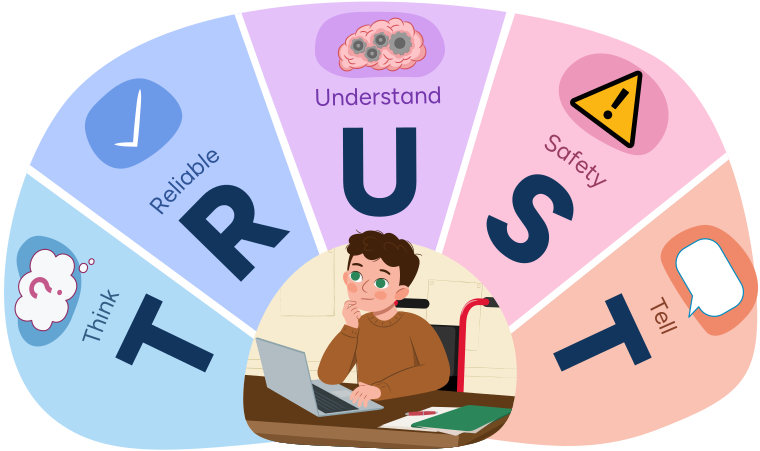
Press the following tabs to learn more.
Think about your topic and develop specific questions to get better research results.
For example, if you’re working on the topic of recycling, you might start with a general question and make it more specific before beginning your research.
- General question: Why is recycling good for the environment?
- Specific question: How does recycling help protect marine wildlife?
Be patient while doing your research. Go through each website carefully, and take notes using a graphic organizer or notebook. Record the websites used for specific information – it’s important to give credit to the creator of the content.
Consult more than one resource to help you determine if the information you gather is accurate and true.
Remember, research can take time. It helps to be focused and calm! Taking a break can refresh our thinking and help us process new information.
It’s important to use reliable sources so that you can put together accurate and up-to-date information about your topic.
Websites ending with .com, .org, and .net can be purchased and used by anyone.
The ending .org is usually used by non-profit organizations, which may be trying to persuade rather than educate.
Websites ending in .edu are reserved for colleges and universities. Canadian websites have a .ca ending.
Consider the following questions when you are doing your reliability check. You might also ask a trusted adult or a peer for help if you are uncertain about a website.
- When was the resource published? (This might help you determine if the information is current.)
- Who created the resource/website? What is their educational background or work experience?
- Who is the intended audience?
- Who benefits from this information being shared?
- Whose perspectives are represented? Whose perspectives are missing?
Do you understand all the words on the site? Can you decode their meaning?
Does what you’re reading make sense?
If not, it’s okay. Consider trying a different source. It’s important for you to understand the information that you read so that you can put it in your own words.
It’s important to stay safe while doing online research. If a website asks you for any personal information, close it and try a different website.
Personal information could include asking for your full name, email address, phone number, home address, photos, or school name. Do not provide any personal information and close the website.
Does the site have pop-up windows? These windows usually ask the user to click to “win a prize” or “check out information.” Do not click on the pop-ups and close the website.
Throughout the research process, feel free to check in with a peer or trusted adult.
If there is anything specific that makes you feel uncomfortable or worried while you are doing your research…
- pause and take a break
- speak to a trusted adult
Your research task
Press the following tabs to see the steps you’ll follow.
Choose one of the astronauts featured in the Action section, or one from the following list:
- Nicole Mann
- John Harrington
- John McFall
- Pham Tuan
- Rakesh Sharma
- Al Saud
- Mae Jemison
When you’re learning about a person, the subtopics you focus on are different than if we were researching an idea or an event. Teacher Ravi explains:
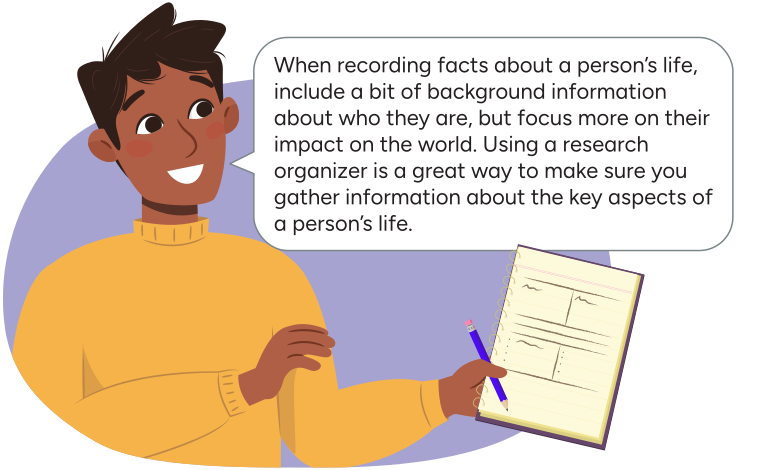
Complete the fillable and printable Organizer: Researching an Astronaut in your notebook or using the following document. You can also choose to create your own graphic organizer. If you would like, you can use speech-to-text or audio recording tools to record your thoughts.
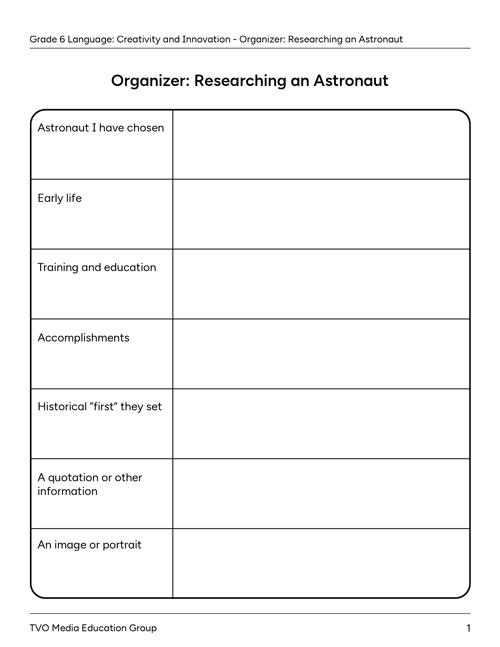
Press the Activity button to access the Organizer: Researching an Astronaut.
Activity(Opens in a new tab)Share your research findings using a format of your choice. Choose a format that allows you to share your research information in a way that engages your audience. Here are some possible formats:
- poster
- infographic
- brochure
- video
- digital presentation
Reflect on your progress as a researcher. Consider the following prompts:
- In this research activity, you used a graphic organizer to help collect biographical research notes. Was this learning strategy helpful?
- What did you enjoy about this research project?
- Consider the effectiveness of your final product. Do you feel that the format you chose was the best one for this topic?
Assessing your work
Use the following checklist to assess your work.
Checklist: My research project
Information gathering
Communicating
Presenting
Reflection
As you read through these descriptions, which sentence best describes how you are feeling about your understanding of this learning activity? Press the button that is beside this sentence.

I feel...
Now, record your ideas using a voice recorder, speech-to-text, or writing tool.