Learning goals
We are learning to…
- analyze and explain how transferable skills can be used to support communication in various cultural, social, linguistic, and domain-specific contexts, and apply them when reading, listening to, viewing, and creating texts of various forms
- summarize and record the main idea and supporting details in various texts, and draw well-supported conclusions
- explain how various topics, such as diversity, inclusion, and accessibility, are addressed in texts, analyze the insights or messages conveyed, and identify different positions presented
- draft complex texts of various forms and genres, including narrative, expository, and informational texts, using a variety of media, tools, and strategies
Success criteria
I am able to…
- analyze a fiction and non-fiction text and highlight examples of how innovation and creativity lead to accessibility, inclusion, and diversity
- summarize important details from a text in a clear and concise manner
- write a creative proposal, reflection or blog about how innovation and creativity contribute to diversity, inclusion, and accessibility
Defining words
Let’s take a moment to review some of the key vocabulary words you will be exploring in this learning activity. Explore the following flashcards with words and definitions. You may find it helpful to record these definitions in your notebook or another method of your choice so that you can refer to them throughout the learning activity.
Keep in mind that the following terms are very broad and refer to abstract concepts that can be described in different ways, depending on the context. You may have encountered slightly different definitions of some of these words, and those definitions can still be valid! The following definitions relate to how the terms are used in this specific learning activity.
Innovation and creativity in designs
As society becomes more aware of the diverse needs of people, innovative solutions and creative thinking have become even more important to make sure that everyone has equal opportunities to participate in all aspects of life.
Innovative thinking has helped to develop assistive technologies. Many products that are designed for people with disabilities are also helpful to everyone. For example, subtitles were originally developed for deaf and hard of hearing audiences, but now they are a feature that many people use.
Creative initiatives have helped create inclusive communities and celebrate diversity. Some examples include:
- art projects, like public art installations that reflect diverse cultural heritages
- community gardens
- inclusive sport programs
Let’s explore a few examples of innovative and creative solutions that promote diversity, inclusion, and accessibility in the carousel below.
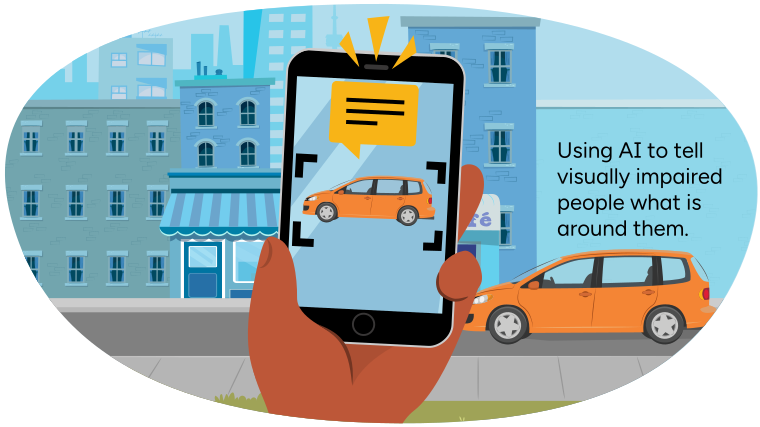
Visual description apps, such as Microsoft's more recent product Seeing AI, are designed to provide real-time descriptions of the surrounding environment for users with low vision.
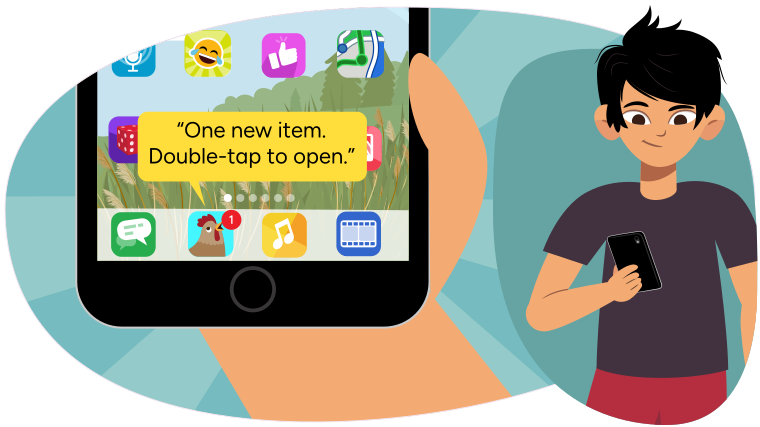
Voice over apps, like Apple’s VoiceOver feature, use voice over to assist users with vision impairments by describing what is happening on the screen.
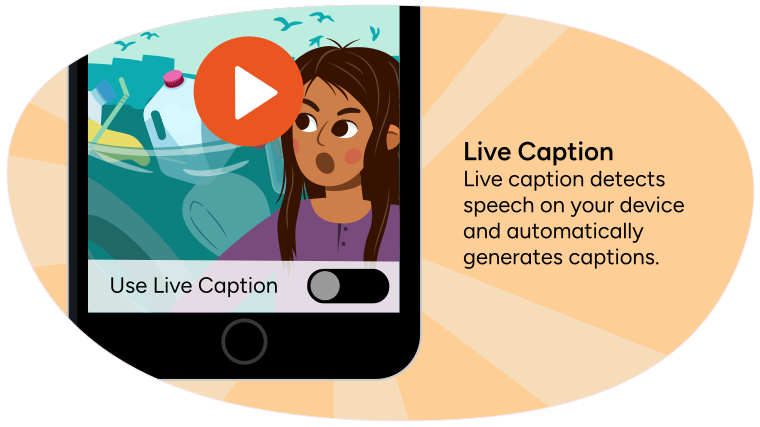
Caption generating apps, like Google’s Live Caption feature, automatically generate captions for videos and audio, making content accessible to users with hearing impairments.
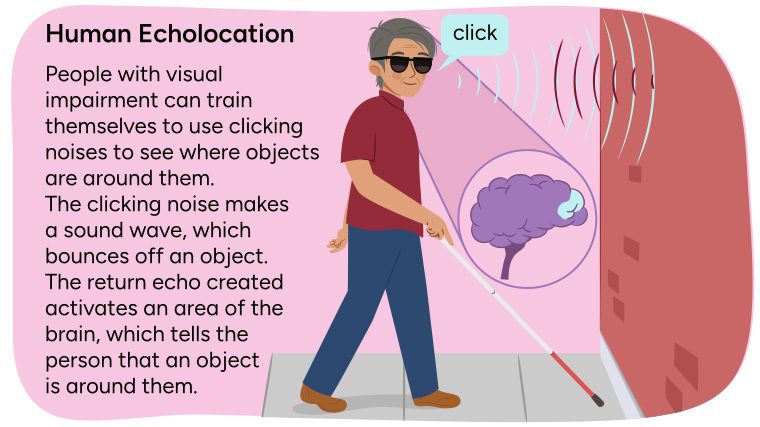
Echo-location, in conjunction with a full length cane, can be used to collect information about the environment and dimensions of materials and distance of objects for visually impaired people.
Image 1: An example of using AI to tell visually impaired people what is around them. A person aiming a camera phone at a parked car. The same car is displayed on the phone within an app that creates a visual description of the car that is read out loud by the phone.
Image 2: An example of a voice over app. A person looking at a phone displaying the notification "One new item. Double-tap to open," that is also being read out loud by the phone.
Image 3: An example of live caption detecting speech on a device and automatically generating captions. A video on a phone displaying a "Use live caption" toggle button.
Image 4: An example of human echolocation. A person wearing sunglasses and using a guide cane making a click noise that bounces off a wall back towards them.People with visual impairment can train themselves to use clicking noises to see where objects are around them. The clicking noise makes a sound wave, which bounces off an object. The return echo created activates an area of the brain, which tells the person that an object is around them.
Can you think of any examples where innovation and creativity led to a better level of inclusion or accessibility in society?
Record your ideas in method of your choice.
Analyzing and summarizing texts
In this section of the learning activity, you are going to be exploring excerpts from a novel that addresses topics of diversity, inclusion, and accessibility, as well as innovation and creativity.
As you explore the content, you will be asked to write a summary of what you have read. Before we begin, let’s review some information on writing summaries.
How to write a summary
A summary is a condensed or shorter, simplified version of the original text or passage. A summary briefly states the author’s main idea and relevant points, condensed into your own words, and does not contain your opinion or personal information.
Tips for writing a summary are:
- Identify the main idea of the text and key supporting details
- Remove minor details that are not necessary to understanding the text
- Write the summary in your own words
- Keep it brief!
Out of My Mind by Sharon Draper
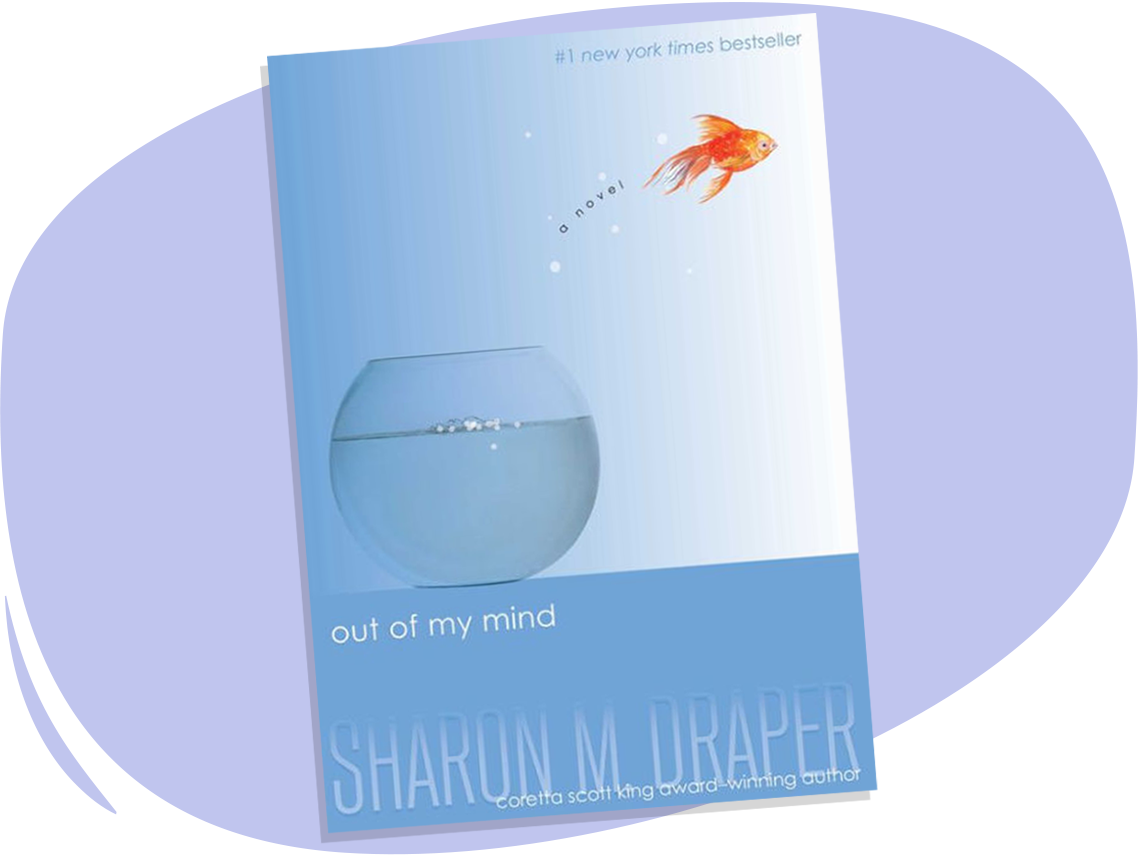
Out of My Mind by Sharon M. Draper is a fiction novel that tells the story of a young girl named Melody who has cerebral palsy. Melody has a photographic memory and is incredibly intelligent, but her condition has her confined to a wheelchair and also prevents her from being able speak. Melody refuses to be defined by these physical limitations and is determined to show others just how smart she really is.

Did you know?
Did You Know?
Cerebral palsy is a group of nervous system disorders that impact muscle and body movement.
Note: Out of My Mind includes topics related to discrimination, specifically bullying of individuals with disabilities. Please note that the portrayal of this behaviour is intended solely for the purpose of facilitating learning and understanding. The learning activity aims to explore the experiences that individuals may encounter and emphasize the benefits of inclusion for all.
As you explore the text excerpts from Out of My Mind, complete the following tasks. You can use the graphic organizer provided or another method of your choice.
- Write a short summary of each excerpt.
- Describe how diversity, inclusion, and accessibility are addressed.
- Describe different positions or perspectives presented.
- Describe how innovation and creativity can contribute to inclusion and accessibility.
Complete the fillable and printable Out of My Mind Graphic Organizer in your notebook or use the following document. If you would like, you can use speech-to-text or audio recording tools to record your thoughts.
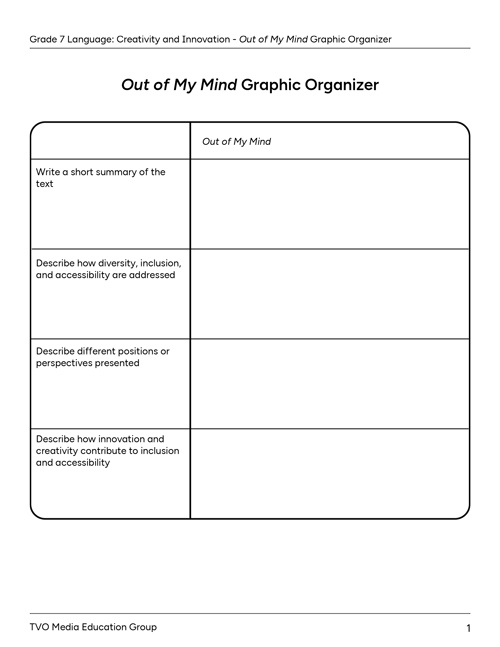
Press the Activity button to access the Out of My Mind Graphic Organizer.
Activity(Opens in a new tab)
Exploring inclusion in Out of My Mind
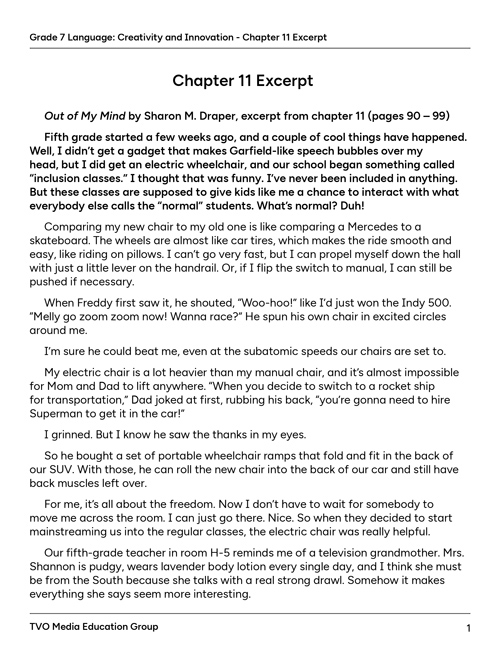
First, let’s explore an excerpt from chapter 11 to better understand Melody’s experience at school.
Access the following Chapter 11 excerpt to learn more.

Pause and Reflect
Pause and reflect
What are some of the advantages and challenges that Melody faces with inclusion and accessibility at school?
Record your ideas in a notebook or using another method of your choice. Then, fill out your graphic organizer for this excerpt.
Exploring accessibility in Out of My Mind
Next, let’s explore how assistive technology impacts experiences in Melody’s life.
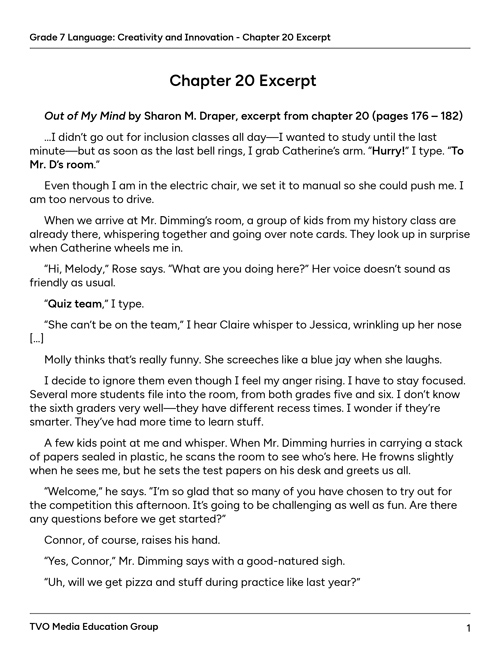
Leading up to this next excerpt, Melody has shown interest in joining an academic trivia team at school called the “Whiz Kids Team”. Even though she performed very well on a practice test in class, Melody’s classmates, and even one of her teachers, have been skeptical of her ability to be on the team.
Access the following Chapter 20 excerpt to learn more.
Pause and Reflect
Pause and reflect
- What innovative technology has helped Melody in this excerpt?
- What impact has this innovation had on her experience?
- How does assistive technology help with accessibility? Use examples from the text to support your answer.
Record your ideas in a notebook or using another method of your choice. Then, fill out your graphic organizer for the excerpt you have read.
Once you have completed your graphic organizer, check your answers using the following answer key.
Press Graphic Organizer Answer Key button to learn more.
| Out of My Mind | |
|---|---|
| Write a short summary of the text | Melody, a fifth-grade student who is bound to a wheelchair, is determined to show everyone how smart she really is. Even though she can’t walk or talk, she shows her peers and teachers that she is smart by participating in the Whiz Kids trivia competition. |
| Describe how diversity, inclusion, and accessibility are addressed | By narrating Melody’s story from her perspective, the novel provides understanding and empathy of life with a disability. It includes Melody’s journey being integrated into an inclusion classroom, and the challenges she faces from peers and teachers. Accessibility is highlighted through assistive technology (wheelchair, Medi-talker) and how she navigates physical spaces. |
| Describe different positions or perspectives presented | This text shows Melody’s perspective, her family's, the school's perspective (helpers, teachers, peers), and society’s perspective. |
| Describe how innovation and creativity contribute to inclusion and accessibility | In this text, innovative technologies, such as the Medi-talker, contribute to Melody’s ability to be more included in the classroom (and other aspects of her life) as well as provide her the tool she needs to access being on the quiz team. |

Social Emotional Learning
Social emotional
Great work! Take a break before continuing onto the next part!

Prepositional and adverbial phrases
Let’s explore prepositional and adverbial phrases!
Prepositional phrases
To begin, check out the following video as a reminder of what a preposition is.
Now that you understand a preposition, what is a prepositional phrase?
A prepositional phrase must include three things:
- A preposition (in, on, at, for, with, by, to, from, into, about)
- The object of the preposition (noun or pronoun governed by the preposition)
- Any modifiers (describes something or makes its meaning more specific)
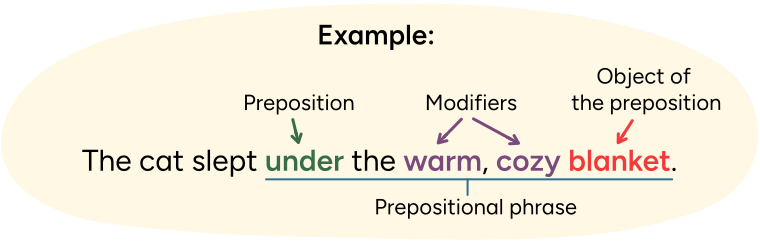
The sentence "The cat slept under the warm, cozy blanket," with the prepositional phrase, preposition, modifiers, and object of the preposition indicated. The prepositional phrase "under the warm, cozy blanket" contains the preposition "under," the modifiers "warm" and "cozy," and the object of the preposition "blanket."
Using the following sentence, match each part of the sentence to the correct identifier.
Sentence: The book on the wooden table is mine.
For each sentence part, select the corresponding description.
Adverbial phrases
Now, let’s explore adverbial phrases. An adverb is a word that modifies a verb, adjective, or another adverb. It provides additional information about how, when, or where an action occurs.
For example:
- Huan sings loudly in the shower.
- My cat waits impatiently for their food.
- I will seriously consider your suggestion.
An adverbial phrase is a group of words that functions as an adverb. Unlike an adverbial clause, an adverbial phrase does not contain a subject and a verb.
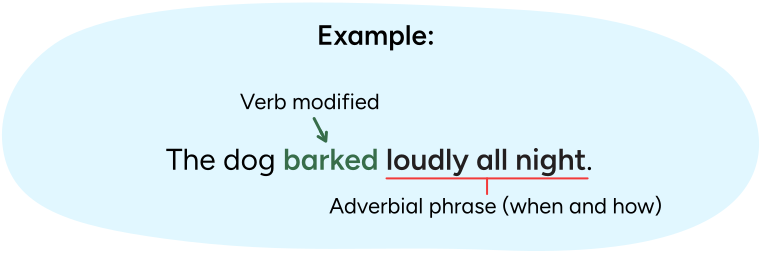
The sentence "The dog barked loudly all night," with the adverbial phrase and verb modified indicated. The adverbial phrase "loudly all night" modifies the verb "barked" by describing when the dog barked.
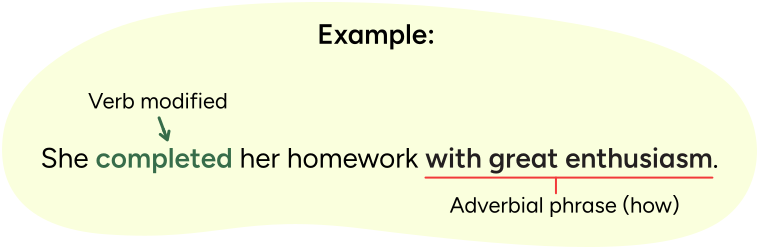
The sentence "She completed her homework with great enthusiasm," with the adverbial phrase and verb modified indicated. The adverbial phrase "with great enthusiasm" modifies the verb "completed" by describing how she completed her homework.
Identify the adverbial phrase in the sentences in the following multiple choice questions. Select the correct answer, then press Check Answer to see how you did.

Vocabulary review
In this learning activity, you have encountered some new vocabulary! Use the fill-in-the-blanks activity to check your understanding.
For each sentence, select the missing word from the drop-down menu. Press Check Answer to see how you did.
Create
Now that you’ve had a chance to explore how innovative and creative solutions can enhance diversity, inclusion, and accessibility, it is your turn to create!
For this activity, you will have three choices. Explore the following choices and choose the one that you are most interested in.
Choice 1: Creative solution proposal
Identify a real-world problem related to diversity, inclusion, or accessibility, and create a proposal for an innovative and creative solution to address the problem. Try to include at least two prepositional or adverbial phrases in your proposal.
Use the following checklist to complete your proposal.
Proposal success criteria
Your proposal should include:
Choice 2: Reflective report
Write a one-page report that reflects on how “innovative and creative solutions can address diversity, inclusion, and accessibility.” Be sure to include examples that you learned about in this learning activity. Try to include at least two prepositional or adverbial phrases in your proposal.
Use the following checklist to complete your report.
Report checklist
Your report should include:
Choice 3: Blog
Write a 500-word blog post about how innovation and creativity drive diversity, accessibility, and inclusion. Within your blog post, you should encourage others to consider new designs that address real-world problems. Try to include at least two prepositional or adverbial phrases in your proposal.
Use the following checklist to complete your blog.
Blog checklist
Your blog should include:
Reflection
As you read the following descriptions, select the one that best describes your current understanding of the learning in this activity. Press the corresponding button once you have made your choice.

I feel...
Now, expand on your ideas by recording your thoughts using a voice recorder, speech-to-text, or writing tool.
When you review your notes on this learning activity later, reflect on whether you would select a different description based on your further review of the material in this learning activity.