Learning goals
We are learning to…
- evaluate and explain how transferable skills help to express voice, be engaged in learning, and implement a plan to develop capabilities and potential
- select and use appropriate digital and media tools to support the design process and address authentic, relevant, real-world problems by developing and proposing innovative solutions
- make local and global inferences, using explicit and implicit evidence, to develop interpretations about various texts and to extend understanding
- produce final texts, selecting a variety of suitable techniques and tools, including digital design and production tools, to achieve the intended effect
Success criteria
I am able to…
- read and analyze a non-fiction text about creative and innovative solutions to real-world problems and respond to comprehension questions that require inferences
- develop an innovative solution to a real-world problem and share this solution using a media design tool, considering your audience
- share your innovative solutions, with fluency, to an audience of your choice
- write a social media post about your innovative solution

Innovation in problem solving

Dealing with challenges in our everyday world is not unusual. Innovation is needed to create solutions for addressing society’s complex challenges. From climate change to the latest developments in technology, these problems need new perspectives and “out of the box” creative thinking. These solutions can be new inventions, but they can also be new approaches to how things are done.
Creativity is about imagining possibilities and solutions that go beyond the typical or expected solutions. By using both innovation and creativity, humans can develop solutions to solve problems and make a more resilient future. This encourages people to think critically about how our actions can make a positive impact on the world.
Let’s begin by matching real-world problems to creative and innovative solutions that already exist.
For each problem, select the corresponding innovative solution.
With these in mind, can you brainstorm any other real-world problems?
- What are they?
- Do innovative solutions already exist for these problems?
Record your ideas in a method of your choice. If possible, discuss your ideas with someone else.

Reading about innovative and creative solutions
In this section of the learning activity, you will explore a non-fiction text about innovative and creative solutions to a problem. Let’s first review what a non-fiction text is.
A non-fiction text is one that relies on factual (real and accurate) information about real people, places, and events.
Inferencing
As you explore the following non-fiction text, you are going to answer comprehension questions that require inferencing.
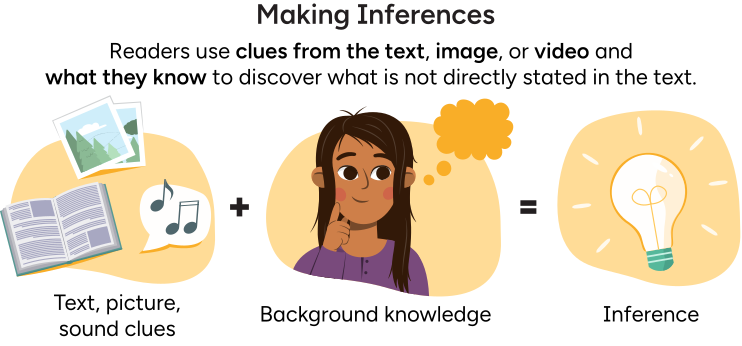
Making inferences. Readers use clues from the text, image, or video and what they know to discover what is not directly stated in the text. Text, pictures, and sound clues plus background knowledge equals inference.
When you make an inference, you are using your background knowledge and clues from the text, video, or image, to draw a conclusion about what is happening when it is not directly stated. Inferences are an educated guess, or “reading between the lines,” to reach a logical conclusion.
Consider the following steps when making an inference:
- Consider your background knowledge – what do you already know?
- Look for clues or evidence in the text, image, or video.
- Make an inference by developing an idea about the content based on your background knowledge and clues or evidence.
Next, you will be using your inferencing skills when exploring a non-fiction text about finding solutions to clean water.
“Innovative Solutions to Provide Clean Water” (non-fiction)
Access to clean water is one of the most pressing global issues that affects billions of people around the world. Water is fundamental to life, yet approximately 2 billion people lack access to safely managed drinking water, and over 4 billion lack safely managed sanitation services.
Let’s take a moment to explore the following infographic about the challenges and solutions related to clean water and sanitation from the United Nations.
Press the What is an Infographic? button to learn more.
An infographic is a “visual representation of data that is intended to make the data easy to understand and typically includes a combination of charts, diagrams, illustrations, and text, along with graphic design elements.”
Infographics contain several different text features to help viewers understand and find important information, such as pictures, titles, subheadings, bold font, illustrations, and captions.
Access the following Clean Water Infographic to learn more.
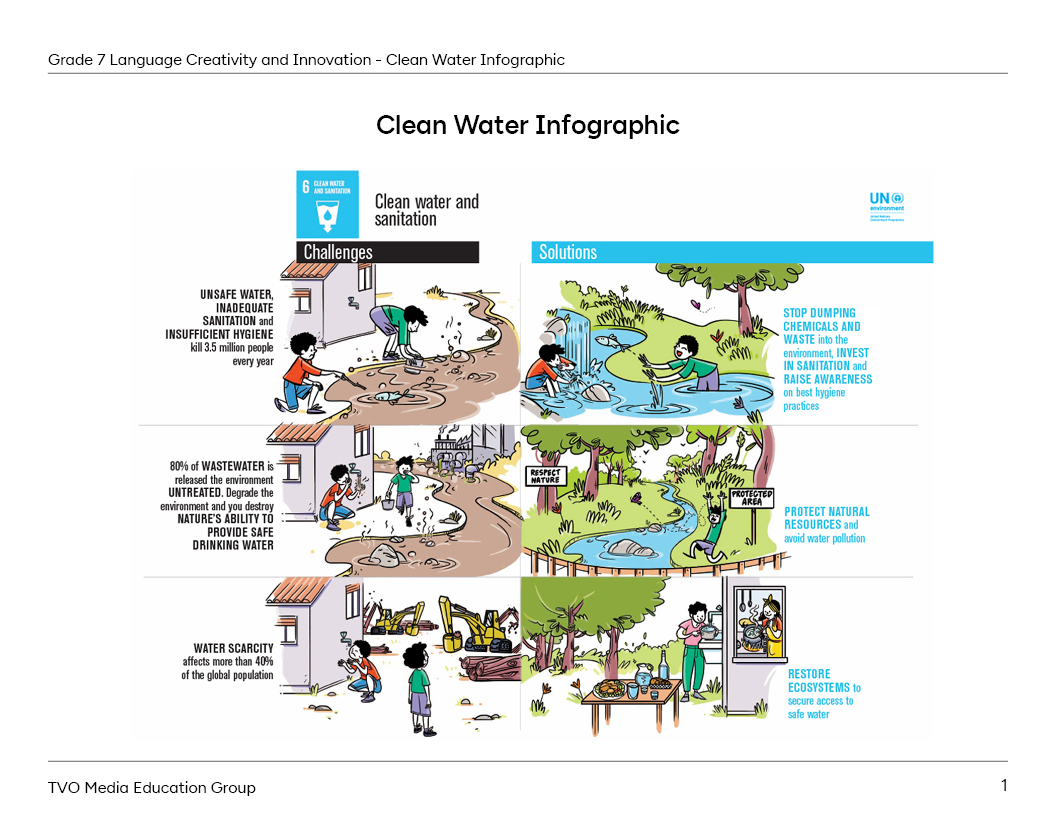
Based on this infographic, respond to the following true or false questions.
Select the correct answer, then press Check Answer to see how you did.

Pause and Reflect
Pause and reflect
What text features in this infographic (pictures, titles, subheadings, bold font, illustrations, captions, etc.) helped you to understand the information best?
Addressing this global problem requires innovative and creative solutions. Let’s explore a few of these solutions.
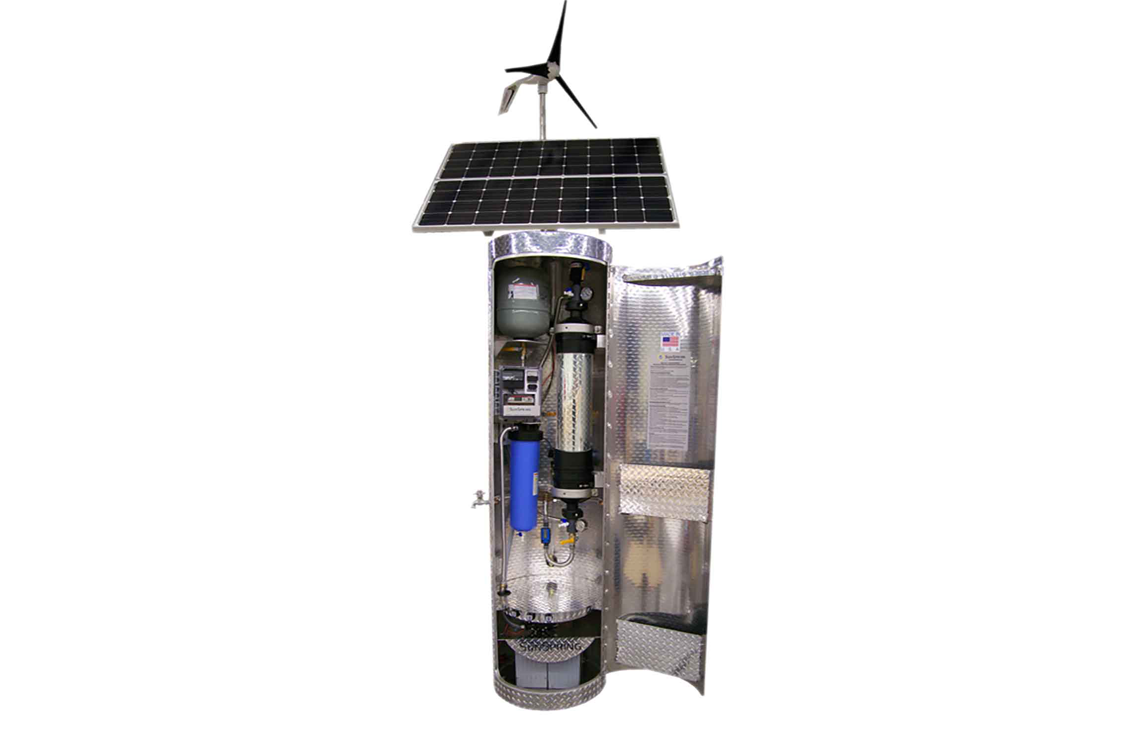
Where access to water is not an issue, but contaminated water is, solar powered filtration systems provide clean water for years.
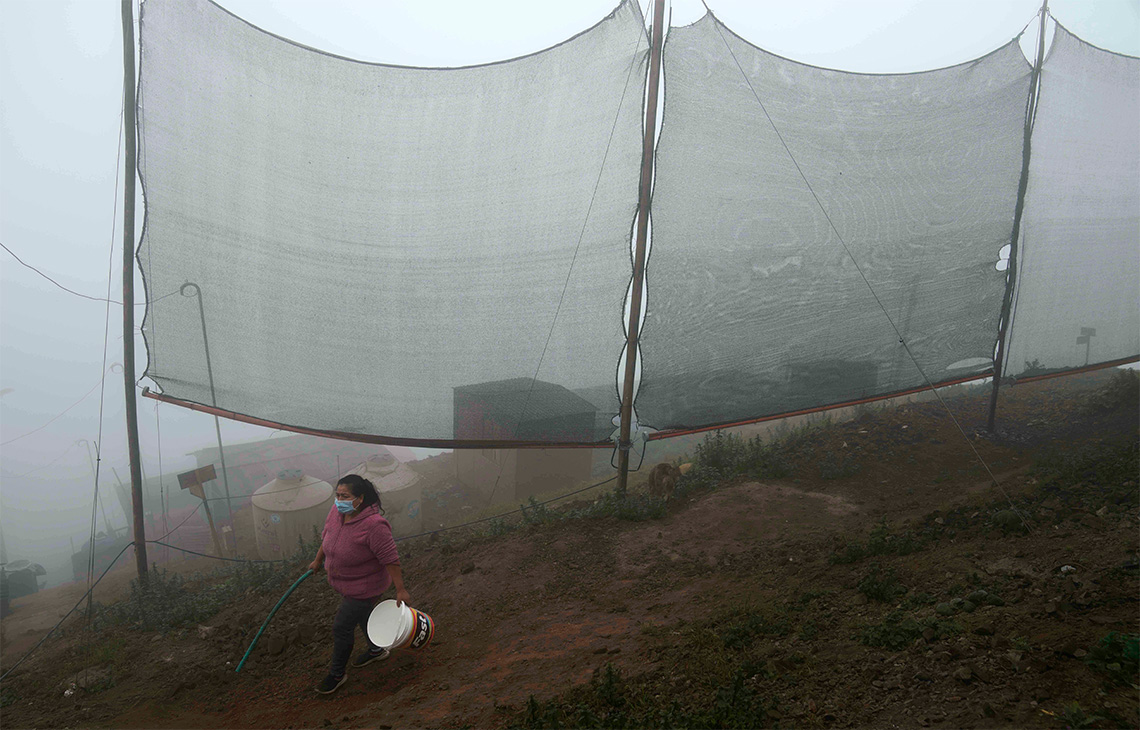
In areas with a lack of water, “fog catchers” are used to catch mist in large nets that trickle into a collection system to be filtered and provide safe and clean water.
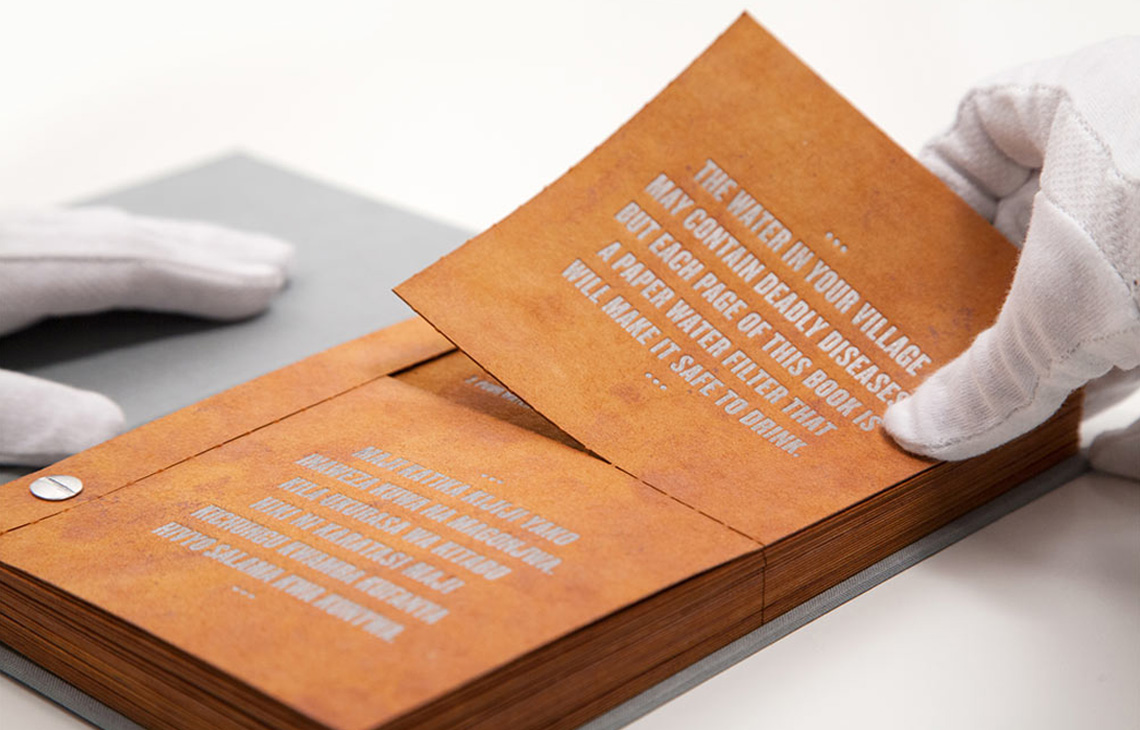
“The Drinkable Book” is a book that contains brief messages about water safety. Each page is embedded with particles that kill bacteria and act as a filter to provide safe drinking water.

“Lifestraw Sip” is a reusable steel filter straw that removes microplastics, bacteria, and parasites to provide up to 1,000 litres of clean drinking water. For every product purchased, a child in need receives clean drinking water for a year.
Respond to the following reflection questions that require you to make inferences. Record your ideas in a method of your choice.
- Why do you think so many different innovations are needed to solve one global problem? (Inference)
- How does each innovation address the problem differently?
- What role do you think creativity plays in providing innovative solutions to access to water? (Inference)

Active and passive voice
Every sentence must contain a verb and a subject. As a reminder, a verb is a word that expresses an action, occurrence, or state of being. Sentences can be written in the active or passive voice.
The active voice asserts the subject is performing an action (i.e., The chef prepared a delicious meal.)
The passive voice is when the subject is being acted upon (i.e., The delicious meal was prepared by the chef.)
The active and passive voices come in several different tenses. Explore the following visual to learn more.
| Tense | Active voice | Passive voice |
|---|---|---|
| Present simple | She writes a book. | The book is written. |
| Past simple | She wrote a book. | The bok as written. |
| Future simple | She will write a book. | The book will be written. |
| Present continuous | She is writing the book. | The book is being written. |
| Past continuous | She was writing the book. | The book was being written. |
| Going to | She is going to write the book. | The book is going to be written. |
| Present perfect | She has written the book. | The book has been written. |
| Past perfect | She had written the book. | The book had be written. |
| Infinitive | She has to write the book. | The book has to be written. |
| Modals | She must write the book. | The book must be written. |
Check your understanding of active and passive verb tenses through the following sorting activity. Sort the sentences based on whether they are using active or passive verbs.
Place the cards into categories that best match. Use the arrow buttons to navigate between cards.
Let’s check!
Now that you understand active and passive verb tenses, it is important that you are able to convert from one to another. Using the graphic organizer or another method of your choice, you will be given a sentence in either active or passive voice and will need to change it to the alternative.
Complete the fillable and printable Active and Passive Voice Table in your notebook or using the following document. If you would like, you can use speech-to-text or audio recording tools to record your thoughts.
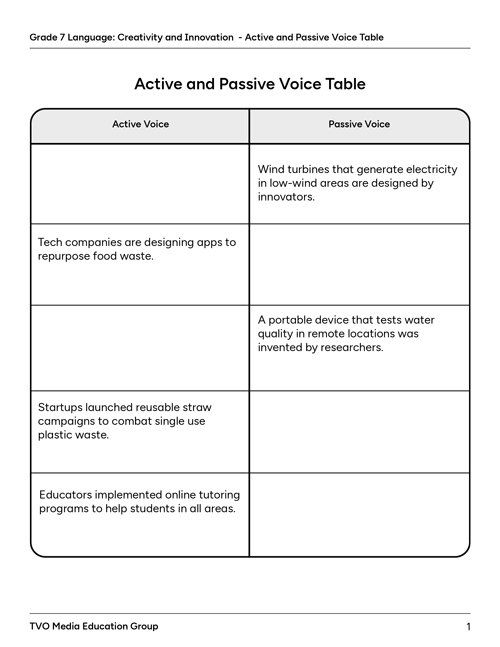
Press Answers button to check your answers.
| Active Voice | Passive Voice |
|---|---|
| Innovators designed wind turbines that generate electricity in low-wind areas. | Wind turbines that generate electricity in low-wind areas are designed by innovators. |
| Tech companies are designing apps to repurpose food waste. | Apps are being designed by tech companies to repurpose food waste. |
| Researchers invented a portable devices to test water quality in remote locations. | A portable device that tests water quality in remote locations was invented by researchers. |
| Startups launched reusable straw campaigns to combat single use plastic waste. | Reusable straw campaigns were launched by startups to combat single use plastic waste. |
| Educators implemented online tutoring programs to help students in all areas. | Online tutoring programs were implemented to help students in all areas. |

Social Emotional Learning
Social emotional

Great work! Take a break before continuing onto the next part.
Creating your own solution
Earlier in this learning activity, you explored the real-world problem of a lack of access to clean water for drinking and sanitation. You also explored innovative solutions. For this component of the learning activity, you are going to be exploring more real-world problems and then creating and proposing your own innovative and creative solution to help solve the problem.
First, let’s explore a few different real-world problems that exist. Press the following tabs to find out more.
Around the world, access to food and food security is a growing problem. Food security means having reliable access to enough safe, nutritious food to live a healthy life.
Food insecurity can happen for a few reasons:
- poverty
- limited access to fresh and affordable food
- natural disasters
- conflicts that disrupt food chains
- limited access to resources, and much more
Today’s agriculture (farming) is not designed to deliver enough food to meet the needs of the ever-growing population.
When considering creative and innovative solutions, we can explore farming, gardens, food programs, technology, training, and much more.

Oil is used in daily life as a non-renewable resource for transportation, producing products like rubber and plastic, household items, and even cooking. However, each year, large oil spills contaminate water around the world. These oil spills are dangerous to wildlife, habitats, and even humans.
Oil spills are difficult to clean up because they spread quickly in the water, which contaminates a large area. Effective oil spill response requires prevention, preparedness, and rapid clean up response to minimize environmental impacts.
Can you think of any effective tools that might be able to help?
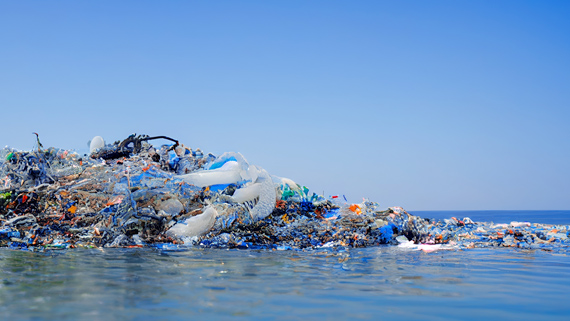
Plastic pollution is a global problem. Every day, the equivalent of 2,000 garbage trucks full of plastic pollution are dumped into the world’s oceans, lakes, and rivers. Plastics are made from fossil fuels and do not break down easily, meaning they last for hundreds of years in waterways. As they break down, they become “microplastics” (tiny plastic particles) that are consumed by marine species and wildlife, harming them and others in the food chain, including humans.
Creative and innovative recycling solutions, alternatives to plastic, and devices designed to clean up plastic from water are all required to help solve this global problem.
Climate Change refers to long-term shifts in global climate patterns, mostly caused by human activities, such as burning fossil fuels, deforestation, and industrial processes. These activities release greenhouse gases (CO2), methane (CH4), and nitrous oxide (N2O) into the atmosphere, trapping heat and leading to a slow but large increase in global temperatures.
This warming trend affects:
- weather patterns
- sea levels
- ecosystems
- biodiversity
- the frequency and extremity of weather events
Lessening the effects of climate change requires creative and innovative solutions, such as renewable energy, sustainable farming, innovative transportation methods, and other ideas that reduce greenhouse gases.
Brainstorming
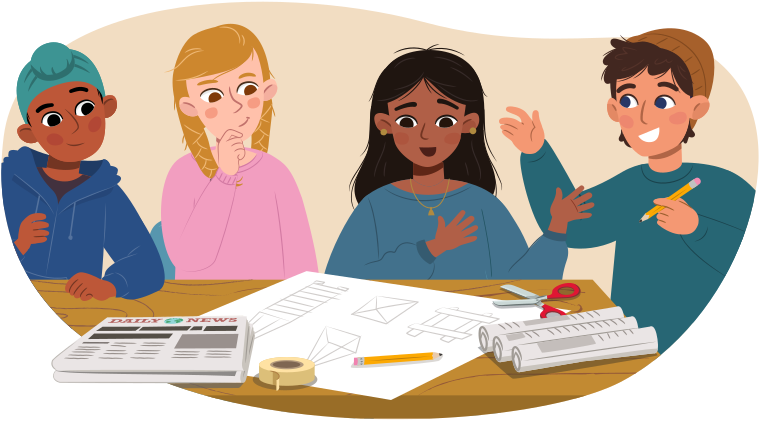
Now that you have a better understanding of a few of the global issues that exist, it is time for you to brainstorm a creative and innovative solution using digital and media tools!
Your task is to choose a global issue and design / create an innovative solution to help solve that issue. Your solution can be based on one that already exists but should be changed. It can be a solution to one of the global issues you explored or another issue that you are passionate about. Be sure to use the active voice in your writing.
Create
Once you have brainstormed your solution, you are going to design a digital media piece as well as use a digital tool to share your idea.
Forms of media you may wish to use, but are not limited to, are:
- graphic design tools
- infographic creation tools and programs
- virtual presentation maker
- digital story platform
When choosing the media tool that you’d like to use, consider the following.
Media tool considerations
Share
Once your digital media piece is created, you are going to share it with others. Before you can share it, you should create a few talking points to share. These could include:
- What is the problem you are trying to solve?
- How is it affecting others?
- What is your proposed solution?
- How will it help?
- Why do you think your solution will be effective?
Once you have created this, you should practice saying your ideas out loud with fluency. You can use the following fluency routine to practice!

Fluency
To gain confidence sharing your solution with others, practice reading it with a focus on fluency.
Fluency is the ability to identify words correctly and read a text at an appropriate rate with ease, pace, automaticity, and expression. With proper phrasing and a focus on punctuation, the reader will gain more meaning from the text.
Re-read your talking points several times, focusing on the following criteria outlined. Use the checklist provided to self-assess your own fluency. If possible, share your talking points with someone else and ask them to provide feedback on your fluency.
Use the following checklist to assess your fluency.
Fluency checklist
Based on the checklist, choose one area of fluency to focus on and set a goal for yourself. What strategies could you use to help you achieve this goal?

Putting it all together
Your task is to share your innovation on social media (i.e., a social media post, blog post) with the online community. Your social media post should be short, informative, and share how your innovative and creative design is working to solve a global issue.
Pause and Reflect
Pause and Reflect
Reflect on the media design and social media post that you’ve created in this learning activity.
- What skill(s) did you use to help you persevere in the process of using a new digital design or tool?
- What would you do differently next time?
Record your ideas in a method of your choice.
Reflection
As you read the following descriptions, select the one that best describes your current understanding of the learning in this activity. Press the corresponding button once you have made your choice.

I feel...
Now, expand on your ideas by recording your thoughts using a voice recorder, speech-to-text, or writing tool.
When you review your notes on this learning activity later, reflect on whether you would select a different description based on your further review of the material in this learning activity.