Learning goals
We are learning to…
- analyze and explain how the knowledge and skills developed in this grade support learning in various subject areas and in everyday life, and describe how they enhance understanding and communication
- summarize and record the main idea and supporting details in various texts, and draw well-supported conclusions
- classify and sequence ideas and collected information, using appropriate strategies and tools, and identify and organize relevant content, taking into account the chosen text form, genre, and medium
Success criteria
I am able to…
- explore various technological innovations (health, art, science) and determine the advantages and disadvantages of them
- summarize important information with text evidence after each technological innovation
- organize and sequence important information in preparation for a debate
- reflect on how transferrable skills used in this learning activity will apply to other subject areas or my life
- make an informed decision based on learned information about whether or not the advantages outweigh the disadvantages of technological innovation

Recent innovation
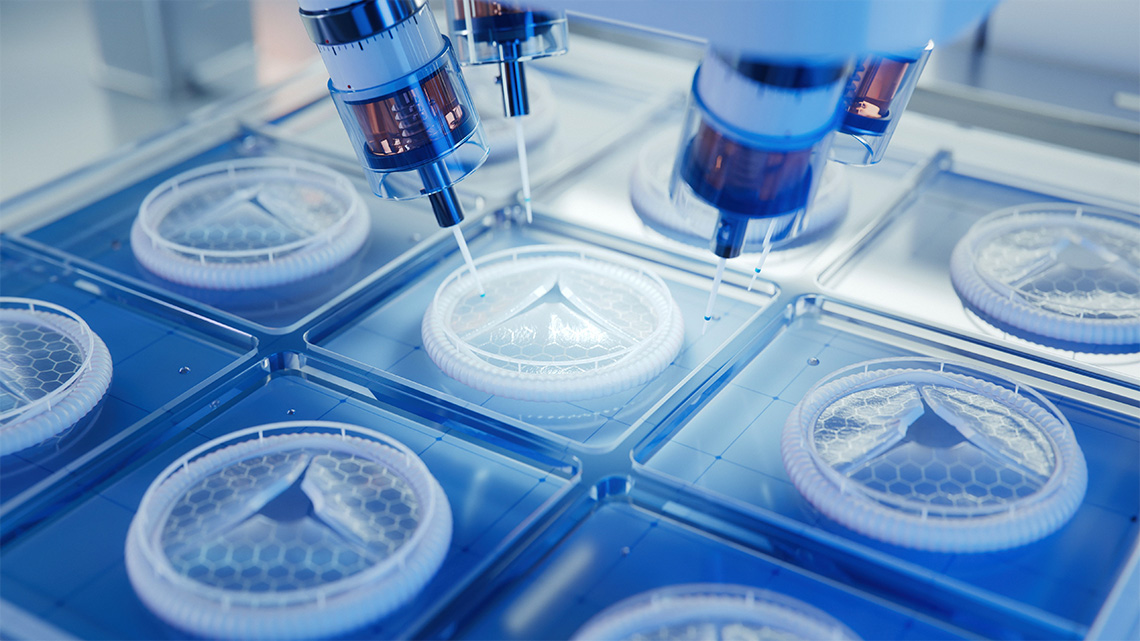
Let’s begin by exploring two videos about bioprinting. Bioprinting is a technological innovation that uses biomaterials (i.e., living cells, synthetic glue) in a 3D printer to create parts that imitate natural tissues, bones, blood vessels, and organs.
Travers, C. (2022, November 21). Bioprinting: What it is and how it’s used in medicine. Verywell Health. https://www.verywellhealth.com/bioprinting-in-medicine-4691000
Check out the following video to learn more.
After watching these videos, respond to the following reflection questions in a method of your choice.
- How would you explain bioprinting to someone else?
- What are the benefits of bioprinting? How will it impact our lives?
- What do you anticipate are the drawbacks or concerns with bioprinting?
Record your ideas in a method of your choice.

Pause and Reflect
Pause and reflect
- Can you think of any new technologies that have come out in your lifetime?
- What are they?
- How have they impacted your life or the lives of those around you?
Record your ideas in a method of your choice.

What is technological innovation?
Have you ever wondered how a smartphone can do so many amazing things, or how doctors can perform surgery without making large cuts? What about how scientists discover and explore new planets in space? These advancements are all made possible by technological innovation.
Technological innovation means creating and using new or better technologies, tools, systems, and methods to lead to major improvements or discoveries in different areas, such as healthcare, the arts, or science. It involves using the knowledge, skills, and resources we already have to develop new solutions that solve problems, promote progress, and provide value. While these technological innovations bring a lot of benefits to society and the environment, they also have downsides.
In this learning activity, you are going to be exploring the fascinating world of technological innovation and understanding its advantages and disadvantages. You will eventually prepare points for a debate.
Before exploring new technological innovations, let’s take a moment to review some new vocabulary words you may encounter in this learning activity.

Vocabulary review
Explore the definitions in the flashcards below and then check your understanding by using them in a sentence with the fill-in-the-blanks activity.
Cambridge English dictionary: Meanings & definitions. Cambridge English Dictionary. (n.d.-b). https://dictionary.cambridge.org/dictionary/english/
Check your understanding of the new vocabulary in the following fill-in-the blank activity. For each sentence, select the missing word(s) from the drop-down menu. Press Check Answer to see how you did.
Next, let’s explore how technology shapes our world and think critically about its impact on our lives.
Exploring technological innovations
Technological innovations come in many different forms. As you explore each of the following examples, you will be asked to summarize your findings.

Student Tips
Student tips
A summary is a condensed or shorter, simplified version of the original text or passage. A summary briefly states the author's main idea and relevant points, condensed into your own words.
Writing a summary improves your overall understanding of a text by requiring you to examine the material thoroughly, identify the key information, and reinforce that learning in your memory. This process develops critical thinking and writing skills while promoting active reading and better organization of thoughts.
Use the following checklist to complete your summaries.
Summary checklist
Now let’s explore technological innovations in the field of health, arts, and science! As you are learning, you may wish to record notes on the advantages and disadvantages of each innovation. You could use the graphic organizer provided or another method of your choice to record your learning.
Complete the fillable and printable Advantages and Disadvantages Table in your notebook or using the following document. If you would like, you can use speech-to-text or audio recording tools to record your thoughts.
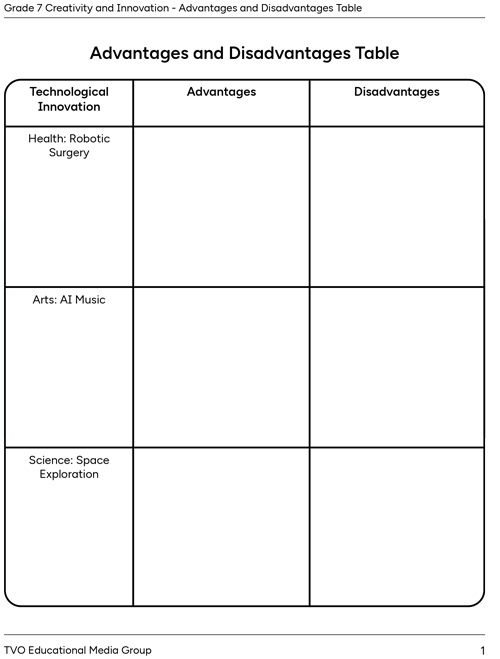
Press the Activity button to access the Advantages and Disadvantages Table.
Activity(Opens in a new tab)Health: robotic surgery
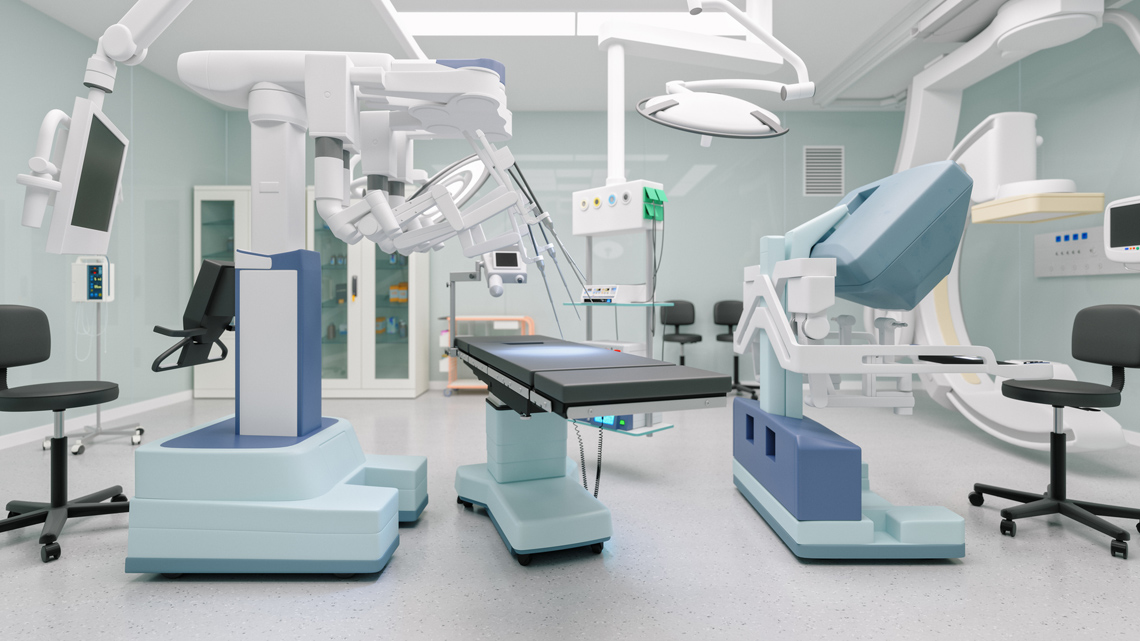
Over the years, there have been major advancements made in the healthcare industry. These innovations, including “robotic surgery,” have improved patient outcomes and transformed medical practices.
Robotic surgery systems use mechanical arms to carry out operations. At this time, robotic surgery is used as a tool to assist doctors, but over time, the hope is that this technology will perform complex procedures on their own with better precision, flexibility, and control. Like any innovation, robotic surgery comes with its own set of advantages and disadvantages.
Advantages
There are many reasons that robotic surgery is considered beneficial, including that it:
- allows for the surgery to be more precise, such as using high-definition 3D views and tools that mimic the movements of a human hand.
- has a high level of precision and accuracy that is important in difficult and delicate procedures, where even the smallest error can have significant consequences.
- supports minimally-invasive procedures, which is a type of surgery that is designed to reduce physical trauma such as pain, infection, and blood loss.
- increases the access that doctors have by using advanced cameras with clearer and more detailed views.
- helps to prevent doctor burnout by allowing surgeons to operate while seated, use additional controls, and take more breaks.
Disadvantages
Along with the advantages of robotic surgery, there are also disadvantages, including:
- systems are very expensive to purchase and maintain, and may not be affordable for smaller clinics and hospitals
- it involves lengthy training for most surgeons to become proficient, which requires significant time and resources
- it can compromise patient safety because of the possibility for robotic systems to have technical problems or malfunctions
For the time being, there still needs to be a surgeon in the room. As technology continues to evolve; however, the role that robotic surgery plays in healthcare will continue to grow.
Check your understanding of the text you explored about robotic surgery through the following true or false questions. Select the correct answer, then press Check Answer to see how you did.

Try It
Try it
Write a short summary of the article you just explored about robotic surgery in a method of your choice.
Then, record the advantages and disadvantages of robotic surgery in your graphic organizer or in another method of your choice.
Art: AI music

AI music refers to music that was created (or enhanced) by artificial intelligence (AI). AI models are “trained” by being fed specific data/information in order to build the algorithms around a “knowledge base.” In the case of AI music, AI models are fed musical data that already exists, such as song recordings and written music.
The technology then uses that information to:
- generate new musical compositions
- suggest improvements to existing pieces or scores
- create entirely new sounds or arrangements
For example, a user could tell the AI software what kind of music they want to hear, and the AI model will use its knowledge base to produce a new piece (or improvements to an existing piece).
So, what are the advantages and disadvantages? Let’s begin by exploring this news clip discussing AI music.
Check out the following video to learn more.
Disadvantages
In this video, the speakers mentioned the importance of giving credit to the original creator when an AI system bases its song on one that already exists. The speakers also discussed how an AI model can’t offer the emotion, personal passion, and storytelling ability that human beings contribute to the creative arts. They also discussed how relying on AI technology could lead to the widespread replacement of human musicians and producers altogether.
Advantages
While the news clip covered some of the risks and disadvantages of artificial intelligence, some benefits were also discussed. For example, the speakers mentioned how AI software can sometimes allow musicians to focus more on the creative aspects of music-making. AI tools are accessible to a wider range of people, including individuals without musical training. In one example discussed in the clip, someone used AI to create a tune, and then changed it to add their own lyrics and vocal melodies. In the end, it was a collaborative effort of AI and humans.
Considering the advantages and disadvantages, it seems as though AI music production will continue to grow.
Let’s check your understanding of AI music in the following true or false questions. Select the correct answer, then press Check Answer to see how you did.
Try It
Try it
Write a short summary of the content you just explored on AI-generated music in a method of your choice.
Then, record the advantages and disadvantages of AI music in your graphic organizer or in another method of your choice.
Science: space exploration

Space exploration is another type of innovation in the field of science. These missions have so many benefits to everyday life on Earth, as well as certain disadvantages.
Advantages
By exploring space, humans gain a better overall understanding of the universe. This improved understanding also helps scientists to better understand changes in the Earth’s climate and better protect the environment as a result.
Check out the following video to learn more about how space travel inspires innovation in other scientific fields.
Along with exploring the solar system and using space technology to study climate change, space exploration can also help drive new developments in tech! Explore a few of these technologies in the carousel of images and descriptions below.

Memory Foam was first developed to protect astronauts by making customizable seats to alleviate the effects of landing and taking off. Today, memory foam is found in many products, from mattresses to helmets.
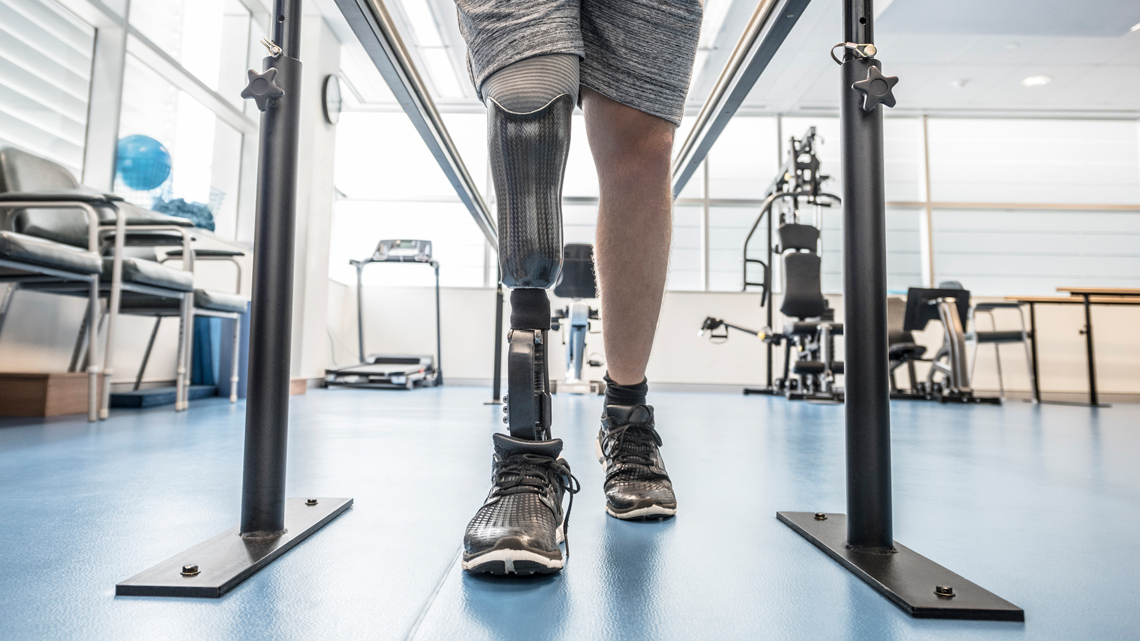
Space innovations in shock absorption materials, along with robotic activities, have been adapted to create artificial limbs that are used by humans.

Wireless headsets were initially designed to advance communication in space between astronauts. They are now used regularly throughout the world for various reasons.
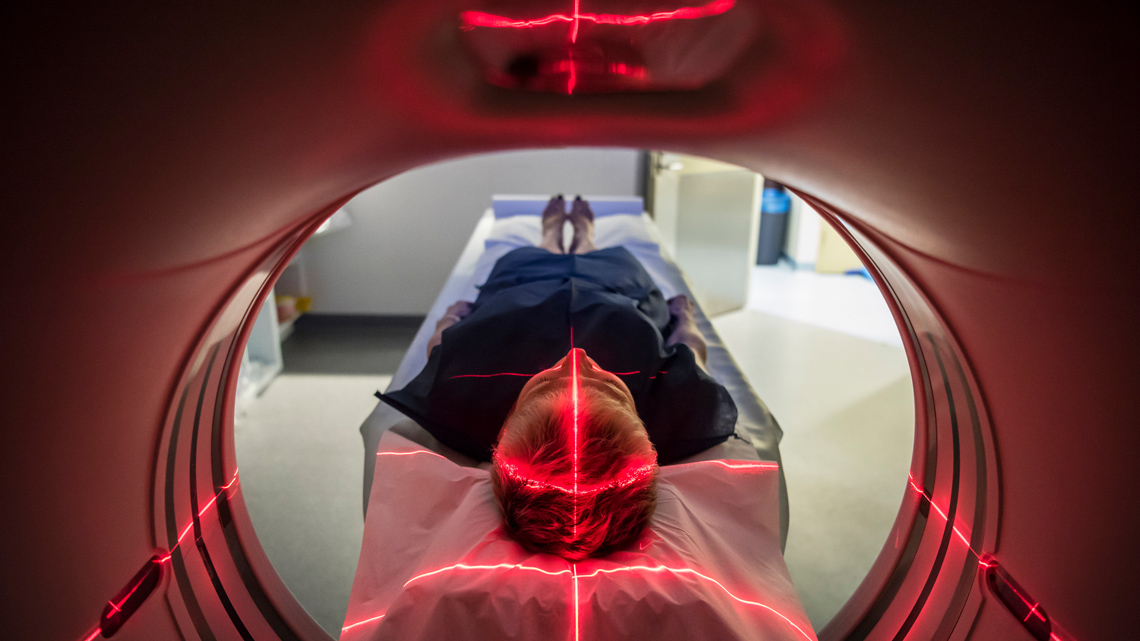
Innovations were developed to provide good digital images for astronauts in space. This technology was then used to develop CAT scan machines that are now used in today’s healthcare.
Disadvantages
There are disadvantages to space exploration as well. These include:
- high price: it can cost millions of dollars to send astronauts and their equipment to space, and that sometimes requires the removal of funding from other important causes such as healthcare or education
- harm to the environment: the launching of space crafts contributes to pollution on Earth, and when space debris from old satellites lingers in the atmosphere, it poses a risk to active satellites and future missions
In conclusion, while space exploration has advantages in terms of scientific discovery and technological innovation, it also presents challenges related to cost and environmental impact. Balancing these benefits and disadvantages is crucial as we continue to push the boundaries of our exploration efforts.
Let’s check your understanding of space exploration in the following true or false questions.
Select the correct answer, then press Check Answer to see how you did.
Try It
Try it
Write a short summary of the article you just explored on the technological innovation of space exploration in a method of your choice.
Then, record the advantages and disadvantages of space exploration in your graphic organizer or in another method of your choice.

Social Emotional Learning
Social emotional

Great work! Take a break before continuing onto the next part.

Commas in direct addressing
A comma should be used when addressing a person or thing directly. If the person or thing is at the beginning or end of the sentence, only one comma is needed. If it falls in the middle of the sentence, two commas on either side are needed.
Let’s explore a couple of examples of how commas are used when a person is being addressed directly.
Description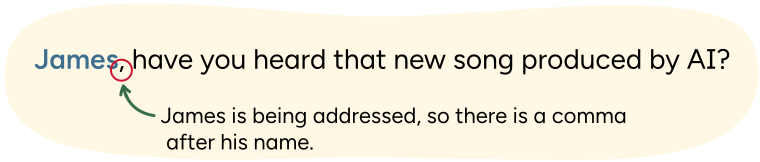
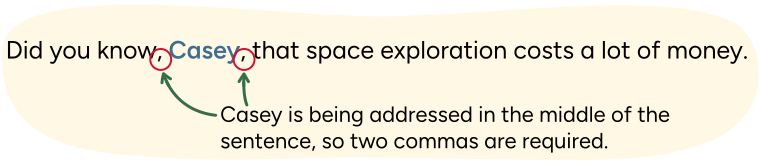
Image 2: The sentence "Did you know, Casey, that space exploration costs a lot of money." Casey is being addressed in the middle of the sentence, so two commas are required, one before and one after her name.
Check your understanding of this concept by rewriting the following sentences with commas in the correct place.
- Steven do you think the pace of technological innovation will continue to accelerate in the next decade?
- Remember to include both the advantages and disadvantages of technological innovation in your debate students.
- Advancements in artificial intelligence my friend are changing how we interact with technology.
Press the Answers button to learn more.
- Steven, do you think the pace of technological innovation will continue to accelerate in the next decade?
- Remember to include both the advantages and disadvantages of technological innovation in your debate, students.
- Advancements in artificial intelligence, my friend, are changing how we interact with technology.
Next, use what you’ve learned about commas as you prepare an argument for a debate!
Organizing and sequencing
Now that you’ve learned more about the advantages and disadvantages of technological innovations, your task is to decide which you think outweighs the other. With this, you are going to prepare for a debate.
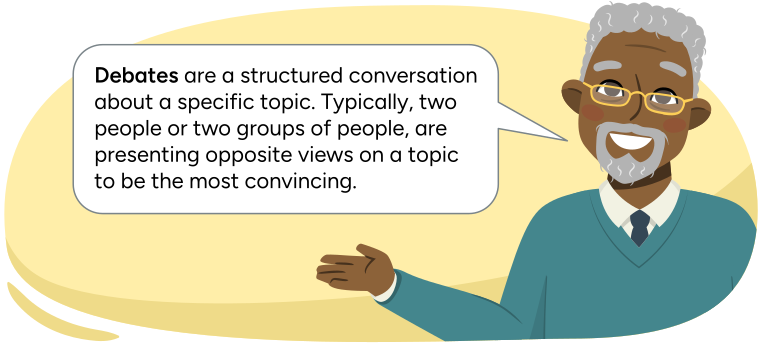
Teacher Wilfred saying: Debates are a structured conversation about a specific topic. Typically, two people or two groups of people are presenting opposite views on a topic to be the most convincing.
The debate question is: “Do the advantages of technological innovations outweigh the disadvantages in modern society?”
Before you begin, you will need to prepare the information you will use in your argument. Let’s review the writing process you will be using.
Organizing and sequencing information is an important skill when preparing for a debate. Take a moment to explore the tips and suggestions.
Student Tips
Student tips
To organize and sequence information:
- identify main ideas and supporting details
- sort information into categories or themes
- arrange the information in a logical order (for a debate, this usually means putting your strongest arguments first)
- create an outline that includes an introduction, main points with examples, and a conclusion
- use transitional words and phrases (i.e., first, next, however)
- connect ideas by showing how different pieces of information are related
Using these suggestions, organize and sequence the information you learned to prepare for a debate. Record your ideas in a method of your choice.
Preparing the debate
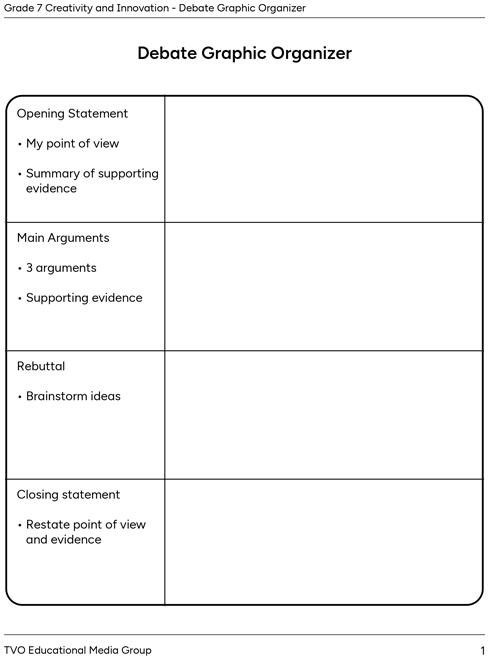
Now it’s time to plan for the debate. Remember, the topic is “Do the advantages of technological innovations outweigh the disadvantages in modern society?”
Your debate will include:
- An opening statement that presents your side and supporting argument (2 minutes)
- Main arguments that include evidence (usually three) (5 minutes each)
- Rebuttal (respond to the other team’s arguments) (3 minutes)
- Closing statement that recaps your argument and main points (2 minutes)
Complete the fillable and printable Debate Graphic Organizer in your notebook or using another method of your choice. If you would like, you can use speech-to-text or audio recording tools to record your thoughts. Be sure to reflect back on notes taken throughout the learning activity to inform your thinking.

Let’s check!
In this learning activity, you explored the advantages and disadvantages of three different technological innovations. Based on this knowledge, sort the following information into “advantages” or “disadvantages.”
Place the cards into categories that best match. Use the arrow buttons to navigate between cards.
Reflection
Choose two of the following questions to respond to in a method of your choice.
- How do the skills and knowledge you have gained about technological innovation help you understand concepts in other subjects, such as science or social studies?
- Can you describe a situation in your everyday life where understanding the advantages and disadvantages of technological innovation could be useful?
- How can understanding technological innovation’s advantages and disadvantages improve your decision-making process in daily life?
- Describe how learning about technological innovation has helped you connect with real-world issues and current events.
- How do you think the ability to analyze the advantages and disadvantages of technological innovation will be valuable in your future education and career?
Reflection
As you read the following descriptions, select the one that best describes your current understanding of the learning in this activity. Press the corresponding button once you have made your choice.

I feel...
Now, expand on your ideas by recording your thoughts using a voice recorder, speech-to-text, or writing tool.
When you review your notes on this learning activity later, reflect on whether you would select a different description based on your further review of the material in this learning activity.
Press ‘Discover More’ to extend your skills.
Discover MoreIf interested, take the time to research a technological innovation of your choice, exploring the advantages and disadvantages of the innovation.
Some possible ideas include:
- AI-generated art
- virtual reality
- NFTs
- wearable fitness/health devices
- renewable energy