Learning goals
We are learning to…
- demonstrate an understanding of the historical contexts, contributions, lived experiences, and perspectives of a diversity of individuals and communities, including those in Canada, by exploring and analyzing the concepts of identity, self, and sense of belonging in a variety of culturally responsive and relevant texts
- analyze cultural elements that are represented in various texts, including values, rituals and ceremonies, architecture, art, and dance, by investigating the meanings of these elements, making connections to their lived experience and culture, and sharing their interpretations with others
- produce final texts, selecting a variety of suitable techniques and tools, including digital design and production tools, to achieve the intended effect
Success criteria
I am able to…
- understand and explain what cultural heritage is and the importance of preserving it
- investigate specific examples of websites and technologies that preserve cultural heritage and explain what cultural elements are being preserved and the importance of it
- create a digital story to share elements of your own culture

What is cultural heritage and oral history?
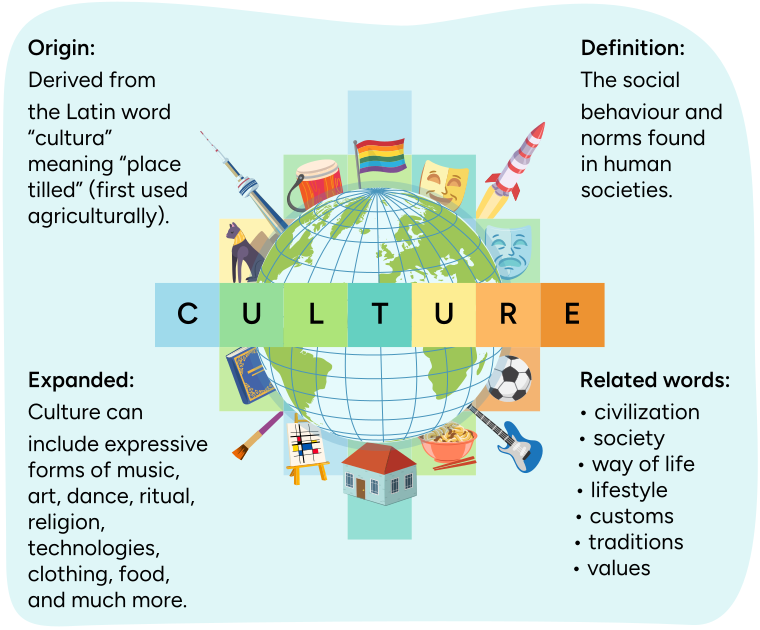
The word "culture" in front of a globe surrounded by a sculpture, buildings, musical instruments, a flag, masks, a rocket, a sports ball, a bowl of food, a painting, a book, and the following text:
Origin: Derived from the Latin word "cultura" meaning "place tilled" (first used agriculturally).
Definition: The social behaviour and norms found in human societies.
Expanded: Culture can include expressive forms of music, art, dance, ritual, religion, technologies, clothing, food, and much more.
Related words: civilization, society, way of life, lifestyle, customs, traditions, and values.
Let’s begin by exploring the words “cultural heritage.” Cultural comes from the word “culture,” which means the beliefs, social norms, and traits of different ethnic, religious, or social groups. Heritage means something that is inherited or passed down from previous generations.
Cultural heritage refers to culture, values, and traditions, as well as a shared bond and community that represents history and identity. It connects the past to the present and the past to the future.
Cultural heritage can be shared in so many ways. These include:
- artifacts (paintings, drawings, prints, mosaics, sculptures)
- historical buildings and historical monuments
- photographs and documents
- books and oral histories
- social practices
- ceremonies
- knowledge

Pause and Reflect
Pause and reflect
- Can you think of any examples of cultural heritage that have been shared with you?
- Why do you think it is important to preserve cultural heritage?
Record your ideas in a method of your choice.

Preserving cultural heritage
Why is it important to recognize, celebrate, and preserve cultural heritage? Some reasons include:
- all the factors that contribute to cultural heritage (e.g., art forms, traditional beliefs, events, experiences, etc.) act as a kind of “historical record” of identities within different communities
- protecting, preserving, and sharing aspects of cultural heritage helps to ensure future generations can benefit from and appreciate the roots of their culture
- cultural heritage, including traditions, stories, music, dance, art, etc., is often passed down through generations who are working to keep those cultural elements alive
Through preserving cultural heritage, people can learn about the culture(s) that they belong to, as well as the cultures of others. There are new digital tools and innovations that offer various methods of preserving cultural heritage, including documentation, protection, and sharing cultural elements with a bigger audience.
One example of a digital platform that is dedicated to preserving cultural heritage is called “Preserving Egypt’s Layered History” through the American Research Centre in Cairo and Google Arts and Culture.
Check out the following video to learn more about how this platform features different archeological sites using their videos, stories, and tours.
What digital tools does the website offer for users to explore the cultural heritage of Egypt? Record your ideas in a method of your choice.
Press the Answer button to learn more.
The website offers digital stories, 3D virtual experiences, and virtual tours of architecture.
Let’s explore a few different ways that cultural heritage can be preserved using digital technology.
Press the following tabs to find out more.
3D scanning is an innovative technology that plays a role in preserving cultural heritage through recordings of sites, monuments, and artifacts. These precise 3D scans of physical objects can be used for various reasons, such as preservation, research, and education.
Explore the following video to learn how 3D scanning works.
3D scanning can preserve cultural heritage in a few different ways.
- It accurately captures the exact dimensions and intricate details of artifacts with high precision.
- 3D scans can be referenced for future restoration and conservation work if the artifact is lost through deterioration or damage.
- It allows people to study the digital model, reducing the need to handle the original and, therefore, reducing potential damage.
- It aids in the creation of virtual exhibits, which allow people worldwide to explore cultural artifacts from their homes, increasing accessibility to cultural heritage.
- It allows for artifacts to be used in educational settings.
There are many different types of scanners that are used for different settings, ranges (close or far away) or types of artifact being scanned.
Digital storytelling uses technology, like computers and online software, to tell stories and share ideas. Unlike traditional storytelling, which uses physical items like books, tapes, or movies, digital stories use electronic files. Digital stories can include text, pictures, videos, and sound, as well as interactive features like maps or social media.
Digital storytelling is a method of preserving and sharing cultural heritage by combining traditional storytelling with multimedia elements.
Here are a few ways that digital storytelling can preserve cultural heritage:
- Recording oral traditions, stories, histories, and narratives ensures they can be passed on to future generations without getting lost.
- Using photos, videos, etc. digital storytelling creates an immersive experience that can bring cultural stories to life for an audience.
- Digital stories can be stored and shared online, making cultural heritage accessible to people around the world, including researchers, educators, and the public.
Virtual reality (VR) is a technology that mimics a realistic physical environment for the user to explore and interact with. VR is usually operated using a headset that fully covers a person’s eyes and ears to prevent potential distractions in the real world. The user is then immersed in a virtual environment generated by computer images and can begin to interact with their hyper-realistic surroundings.
Similar to VR, augmented reality (AR) overlays videos or images onto a display of the physical world to make connections and new experiences.
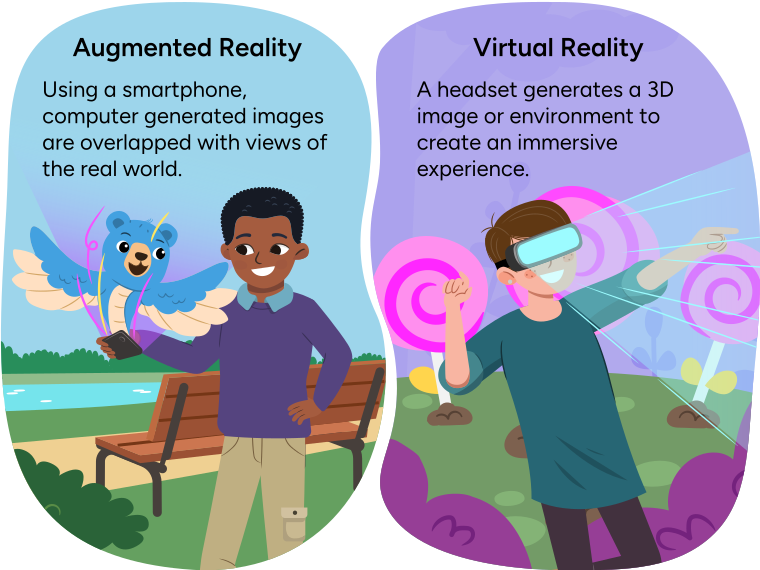
Augmented reality: Using a smartphone, computer generated images are overlapped with view of the real world. The example is learner Arthur in a park using an AR app on their phone to view a digital fantasy creature displayed over the physical surroundings.
Virtual reality: A headset generates a 3D image or environment to create an immersive experience. The example is learner Clara in a VR headset interacting virtually with a digital fantasy environment.
Now, imagine standing in front of a historical site and looking through the lens of an AR or VR headset to see the same site restored to its original state. Specialists usually work together to recreate sites to preserve their existence in time, even after their destruction. For example, a 3D model of a Roman arch that had been destroyed was recreated based on photos from archeologists and tourists, which allowed people to explore this historical site even after it had been destroyed.
Check out the following video in which Michelle Rebaleati explains how she uses virtual reality in the preservation of cultural heritage.
Case studies: preserving cultural heritage
In this section of the learning activity, you are going to be exploring specific examples of technological and creative innovations that are preserving cultural heritage. As you explore, you are going to be asked to respond to the following questions about each case study in a method of your choice.
- What cultural elements are being preserved (e.g., traditions, artifacts, stories)?
- How is technology being used to preserve these elements?
- Why do you believe it is important to preserve these cultural elements? How are they significant to the community or culture they belong to?
Case study 1: Learning with Tsítha
Learning with Tsítha is a website dedicated to helping children learn Kanyen’kéha ancestral language and culture. Kanyen’kéha is the ancestral language of the Kanyen'kehà:ka, commonly known as Mohawk. Kanyen'kehà:ka means the “People of the Flint,” and their traditional territories are in the Mohawk River Valley located in now Ontario, Quebec, and Upper-New York State. They are an original member nation of the Five Nations Confederacy, which is now referred to as, Six Nations or Haudenosaunee Confederacy.
On the website Learning with Tsítha, users are able to navigate between digital stories in video format, word games, vocabulary, and math activities for educational purposes. In the videos, Tsítha learns about and shares traditional ways of knowing, being, and doing for the Kanyen'kehà:ka.
Check out the following video to explore a portion of one of these videos.
On the website, you can further explore the creation story and learn about strawberries and wampum belts. These are digital stories shared by Tsítha about traditional ways of knowing, being, and doing.
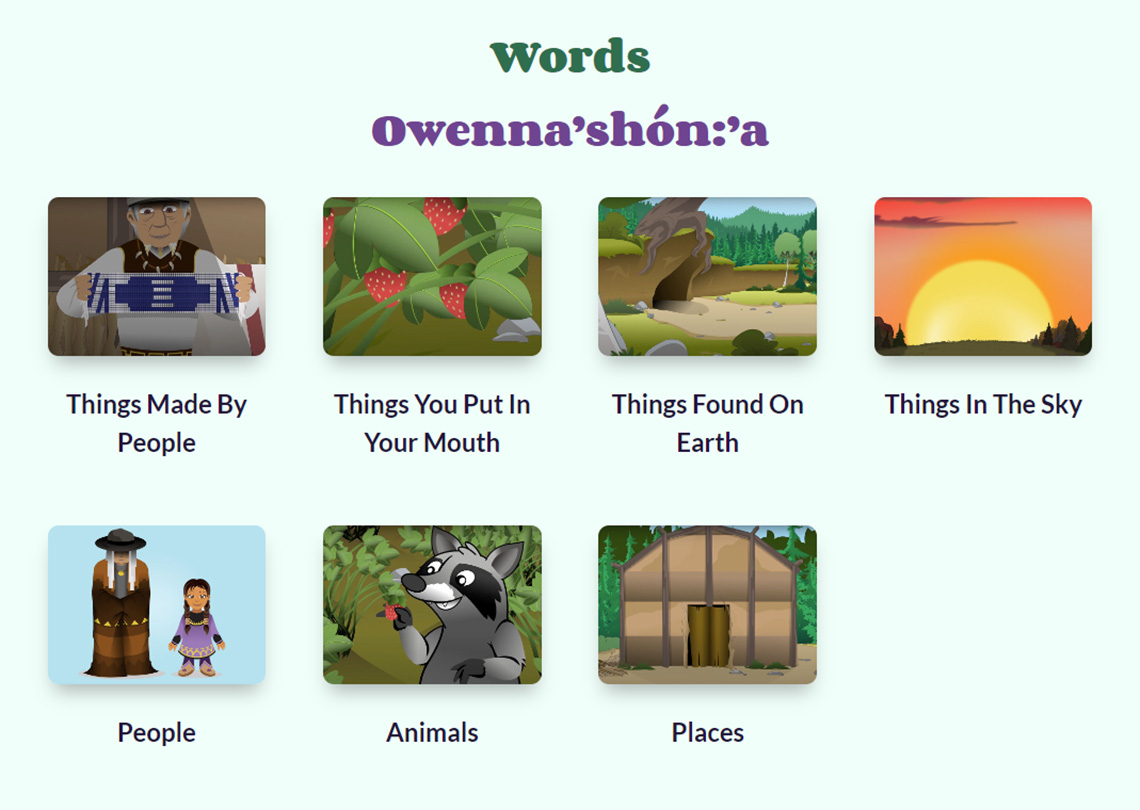
Another feature of this website is to learn more about Kanyen’kéha (the Mohawk language). The website features a page and videos where you learn how to say words in Kanyen’kéha. Check out one of these pages in the following image.
Based on the information you’ve learned, take a moment to respond to the questions from the beginning of this section.
Press the Case Study Questions button to review the questions.
- What cultural elements are being preserved (e.g., traditions, artifacts, stories)?
- How is technology being used to preserve these elements?
- Why do you believe it is important to preserve these cultural elements? How are they significant to the community or culture they belong to?
Press the Answers button to learn more.
- The Learning with Tsítha website focuses on preserving the Kanyen’kéha (Mohawk) language and culture. It provides resources like animated stories and vocabulary designed to help children and their families learn and practice the language. This initiative is crucial for maintaining the Kanyen’kéha language and cultural heritage for future generations.
- This website uses digital storytelling through animated videos with images and sound to preserve cultural heritage and share it with others.
- Preserving traditional language and culture is vital because it is a part of cultural identity. Maintaining traditional language helps to preserve unique traditions, stories, and knowledge that are passed down through generations, ensuring heritage continues.
Case study 2: Open Heritage
Open Heritage is a website dedicated to initiatives and projects that are aimed to preserve and share cultural heritage on open-access digital platforms. On the website, users can document, digitize, and make cultural artifacts, historical sites, and traditional knowledge that is used by the public.
On the website, users can explore 3D models of historical sites and buildings and learn about their history and what makes them iconic. As a user, you can turn the building or site on your own to explore different parts of angles. Explore a few of these 3D models in the carousel of images below.
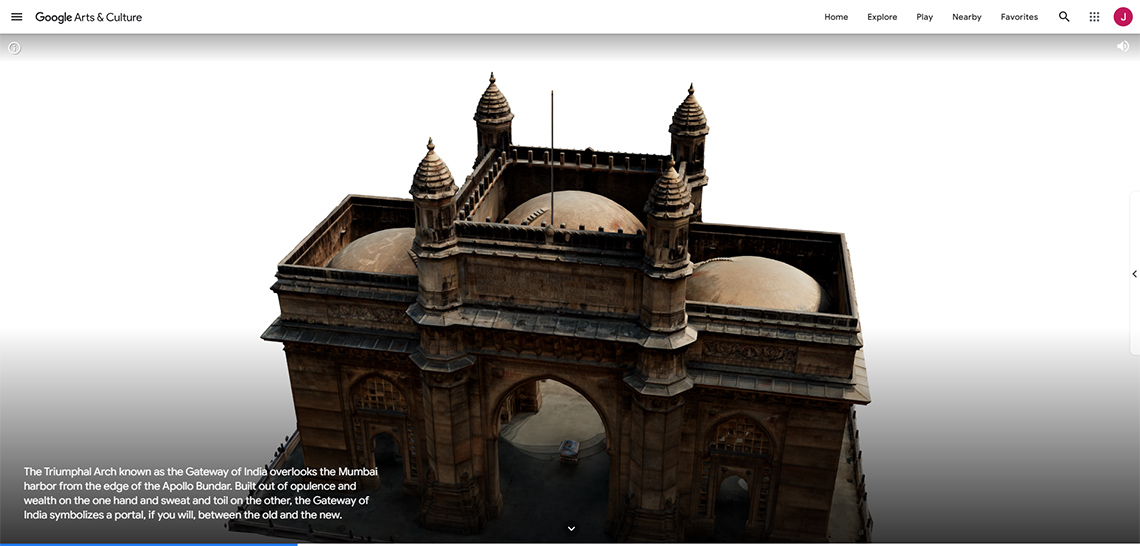
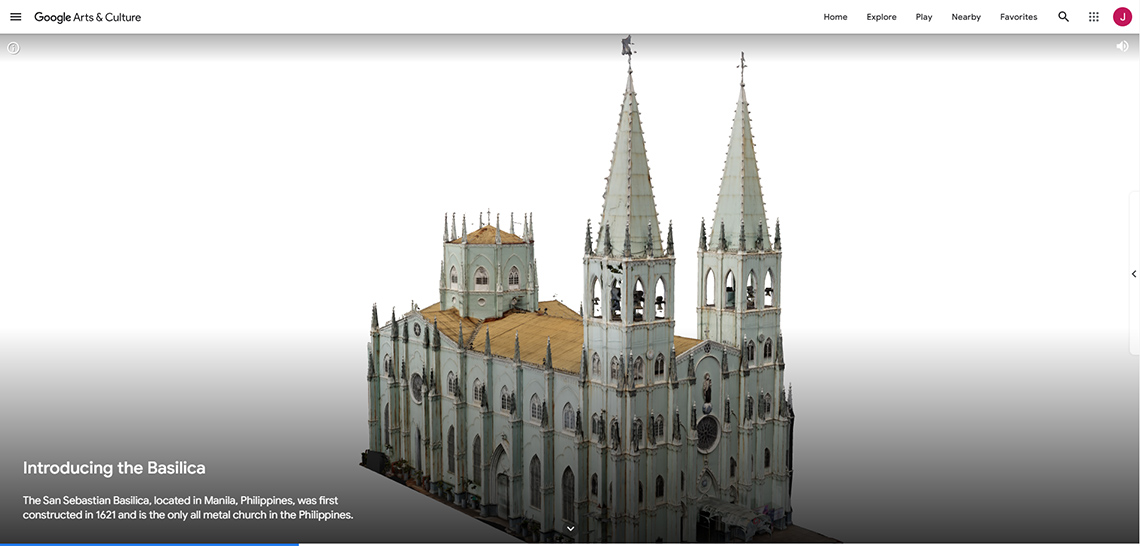
Along with these experiences, the website also offers 3D guided virtual tours narrated by someone who can explain the cultural heritage. For example, the website has a page dedicated to The Osun Osogbo Sacred Grove in Nigeria, which is home to many monumental shrines that have significant symbolism and meaning.
Let’s learn a little more about this in the following short video clip that features a 3D guided tour of the shrine, as well as stories of cultural heritage. In the clip, Nigerian writer and cultural activist Molara Wood describes the Iya Moopo shrine and how its design reflects certain beliefs in Yoruba folklore.
Based on the information you’ve learned, take a moment to respond to the questions from the beginning of this section.
Press the Case Study Questions button to review the questions.
- What cultural elements are being preserved (e.g., traditions, artifacts, stories)?
- How is technology being used to preserve these elements?
- Why do you believe it is important to preserve these cultural elements? How are they significant to the community or culture they belong to?
Press the Answers button to learn more.
- Through this platform, many different cultural elements are preserved, including traditions, artifacts, sculptures, historical sites, monuments, stories, etc.
- Technology is used to create 3D sculptures that users can explore, to make virtual tours, to share information, and much more.
- It maintains and shares the identity, history, and values of various communities to connect the past and the present. Additionally, this platform can be used for educational purposes.
Creating a digital story

Consider your own cultural heritage and how it has been passed down to you, or how you feel it should be passed down through the generations. Take a moment to first brainstorm your own cultural heritage. What elements are significant to you, your family, and/or your community? This could include traditions, holidays, food, music, stories, clothing, buildings, etc.
Complete the fillable and printable My Cultural Heritage Mind Map in your notebook or using another method of your choice. If you would like, you can use speech-to-text or audio recording tools to record your thoughts.
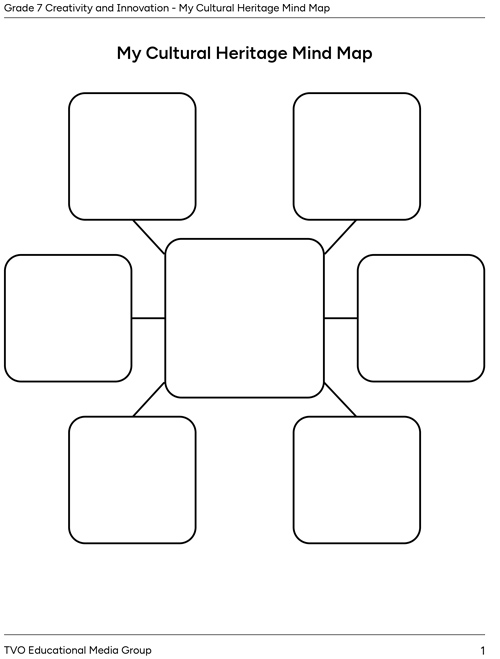
Press the My Cultural Heritage Mind Map button to access the My Cultural Heritage Mind Map.
Activity(Opens in a new tab)Based on the ideas you brainstormed, respond to the following questions in a method of your choice.
- What cultural elements are the most important to you and your family?
- How do these elements connect you to your heritage?
- What stories or traditions have been passed down in your family?
- Why is it important to preserve and share these cultural elements?

Student Tips
Student tips
It may be helpful to connect with someone who can help you answer some of these questions.
You are now going to plan, create, and reflect on a digital storythat reflects your own cultural heritage and includes text, images, and/or audio and video components.
Plan
Plan out your digital story in a method of your choice. Use the following checklist to ensure you have included all the required elements.
Digital story checklist
Create
Choose a digital software program to tell your story, such as graphic design tools, infographic creation tools and programs, virtual presentation makers, or another digital story platform.
When choosing the media tool that you’d like to use, consider the factors in the following checklist.
Media tool considerations
Next, gather the materials you are going to need to create the digital story. This could include images, photos, videos, audio recordings, etc. Then, write the text for your story and make sure it is clear and engaging.
Lastly, assemble the story by combining the text with the images, videos, and audio elements using your chosen digital tool. Be sure your story is coherent and engaging.
Reflect
Reflect on the digital story that you’ve created and respond to the following questions in a method of your choice.
- What skill(s) did you use in the process of using a new digital design or tool? What would you do differently next time?
- Write a short reflection on what you learned about your culture through this project and how creating a digital story helped you appreciate and understand your heritage better.

Social Emotional Learning
Social emotional

Great work! Take a break before continuing onto the next part.

Multisyllabic words
Throughout this learning activity, you have explored several multisyllabic complex words.
Listen to the following words and attempt to spell them in your notebook, or another method of your choice.
cultural heritage
augmented reality (AR)
traditional knowledge
deities
preservation
Now, match the words with their respective definitions in the following matching activity. For each word, select the corresponding definition.

Try It
Try it
Choose 3 words you have just explored to write in a sentence.

Conjunctive adverbs
A conjunctive adverb is a word that connects two independent clauses, showing the relationship between them, such as contrast, cause, effect, or sequence.
Conjunctive adverbs should come after a period (.) or a semicolon (;) and should be followed by a comma. If it’s in the middle of a sentence, commas are used before and after the conjunctive adverb to separate it from the rest of the sentence.
Some common conjunctive adverbs include:
- Addition: also, besides, furthermore, moreover
- Contrast: however, nevertheless, nonetheless, still
- Cause and Effect: consequently, therefore, thus, hence
- Time: meanwhile, then, afterward, subsequently
- Emphasis: indeed, certainly, undoubtedly, of course
- Comparison: similarly, likewise
- Clarification: namely, specifically, that is
Explore the examples in the following carousel.
Description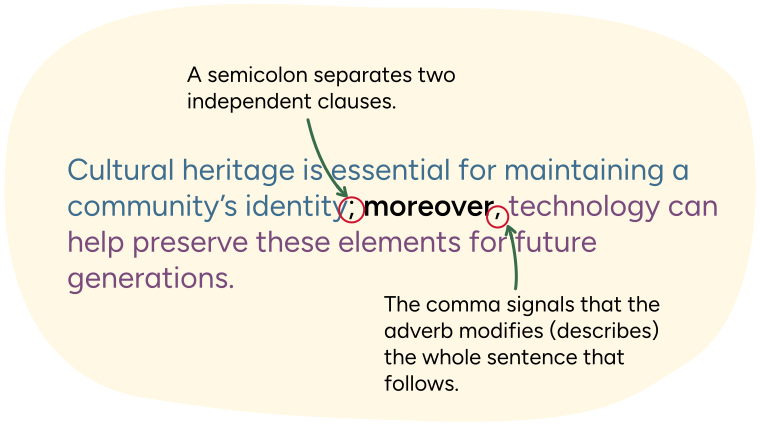
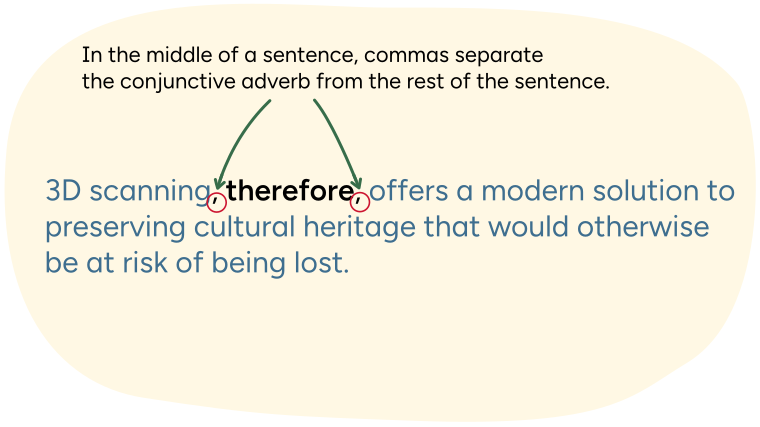
Image 1: The sentence "Cultural heritage is essential for maintaining a community's identity; moreover, technology can help preserve these elements for future generations," with the independent clauses, semicolon, adverb, and comma indicated. The independent clause "Cultural heritage is essential for maintaining a community's identity," is separated by a semicolon from the adverb "moreover," which is followed by a comma that signals that the adverb modifies (describes) the independent clause "technology can help preserve these elements for future generations."
Image 2: The sentence "3D scanning, therefore, offers a modern solution to preserving cultural heritage that would otherwise be at risk of being lost," with the commas and conjunctive adverb indicated. In the middle of the sentence, a comma before and a comma after the conjunctive adverb "therefore" separate it from the rest of the sentence.
Based on these rules, sort the following sentences into “correct” and “incorrect” use of conjunctive adverbs.
Place the cards into categories that best match. Use the arrow buttons to navigate between cards.

Let’s check!
Check your understanding of this learning activity through the following multiple choice questions.
Select the correct answer, then press Check Answer to see how you did.
Putting it all together
In a method of your choice, write a reflection on what you’ve learned about the role of digital technology in preserving cultural heritage and how it can be applied in other contexts.
Choose three additional questions below to respond to in a method of your choice.
- What did you learn about your own cultural heritage?
- How did technology help you tell your own story?
- What are the benefits and challenges of using digital tools for preserving oral history?
- What new things did you learn about other cultures through the case studies you explored?
- How has this project changed your perspective on cultural heritage?
- What new technologies could be developed in the future to aid in cultural preservation?
Reflection
As you read the following descriptions, select the one that best describes your current understanding of the learning in this activity. Press the corresponding button once you have made your choice.

I feel...
Now, expand on your ideas by recording your thoughts using a voice recorder, speech-to-text, or writing tool.
When you review your notes on this learning activity later, reflect on whether you would select a different description based on your further review of the material in this learning activity.