Learning goals
We are learning to…
- evaluate and explain how transferable skills help them to express their voice, be engaged in their learning, and implement a plan to develop their capabilities and potential
- identify and use oral and non-verbal communication strategies, including expression, gestures, and body language, and evaluate and compare the effectiveness of these strategies in supporting understanding or communication, including how their use may vary across cultures
- compare the text patterns, such as problem-solution in a letter to the editor, and text features, such as a glossary and infographics, associated with different text forms, including cultural texts, and evaluate their importance in helping readers, listeners, and viewers understand the meaning
- establish an identifiable voice in their texts, modifying language and style to suit the text’s form, genre, audience, and purpose, and express their thoughts, feelings, and opinions about the topic clearly
Success criteria
I am able to…
- explore the importance of innovation in several different fields through and article and videos
- respond to comprehension questions that require you to identify text features and patterns
- write a speech on the importance of innovation focusing on voice and fluency
- respond to a series of reflection questions to show understanding and reflect on transferable skills
Innovation

What do you think the word “innovation” means?
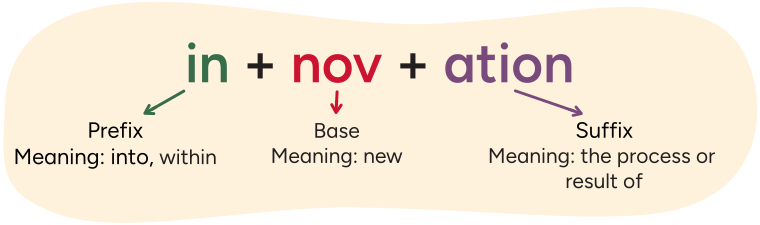
Let’s explore a break down of the word based on its prefix, base, and suffix.

Did You Know?
Did you know?
Did you know that all words are made up of morphemes?
A morpheme is “the smallest unit of meaning within words. A morpheme can be either a prefix, a suffix, or a base. Words are made up of one or more morphemes” attached to the beginning or end of a base to modify it’s meaning.
Source: Government of Ontario. (n.d.-c). Grade 8 Language Glossary. Curriculum and resources. https://www.dcp.edu.gov.on.ca/en/curriculum/elementary-language/grades/grade-8/glossary#m
Affixes are bound morphemes; they cannot stand alone. Prefixes and suffixes are both affixes.
Prefix + Base + Suffix
- Prefix is a morpheme that precedes a base to form a different word.
- Suffix is a morpheme that is added to the end of a base to create a different word.
- Base is any unit of a word to which affixes can be added.
Press Let’s Check! to explore an example.

Vocab goals
Innovation refers to a “new idea, method, or device” or “the introduction of something new.” Sometimes an innovation “can refer to something new or to a change made to an existing product, idea, or field.”
Source: Merriam-Webster. (n.d.-d). Innovations definition & meaning. Merriam-Webster. https://www.merriam-webster.com/dictionary/innovations
For example, the first ever telephone made is considered an invention, but with all of the changes made to it since, smartphones and wireless phones are innovations.
Past innovations
Explore the following images:






Brainstorm
Brainstorm
- First, brainstorm any innovations that have been developed over the past twenty years. You may use the previous photos to guide your thinking.
- Then, think about why innovations are important to society.
Record your ideas in a notebook or another method of your choice.
If possible, discuss your response with a peer.

Innovative strategies
Now, let’s explore the importance of innovation and analyze a few strategies, text features and patterns, and how they can help readers to understand meaning.

Text features
Text features are components of a text that stand out from the main body of a text, which helps to organize and highlight information for the reader. Text features often making it easier for the reader to understand and navigate the text.
Check out the following interactive to learn more.
Text patterns
Text patterns, also known as text structures, refer to ways information is organized within a text. Recognizing these patterns can help readers understand and recall information more effectively.
Check out a few common text patterns.
Learning check!
Match the text feature and pattern with the corresponding description.
Text styles
Check out three different styles of text about the importance of innovation. As you explore, notice the text features and patterns.
Article
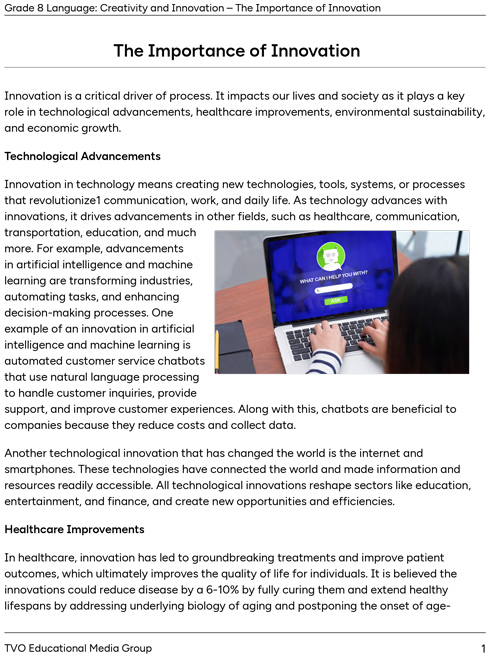
Read the following article to learn more about The Importance of Innovation.
What do you think?
What text features and text patterns did you notice? How did they help you understand the text?
Record your ideas in a notebook or another method of your choice.
Press Let’s Check! to learn more.
Text features: title, subheadings, images, captions, footnotes, and bibliography.
Text pattern: cause and effect.
Video analysis
Now that you learnt about the importance of innovation, let’s explore a few videos about how innovation is shaping our future.
Press the following tabs to learn more.
In this first video, let’s meet Brock Battochio, co-founder of Planetary Hydrogen. He was named as a top entrepreneur on Forbes Magazines “30 under 30” for innovation.
Check out the video to learn more.
Now, let’s learn about James Kennedy’s innovation in mental health through personalized medicine.
Learning check!
Select the correct answer, then press Check Answer to see how you did.

Student Success
Think

After checking out the innovations, think about the following:
- How are Battachio and Kennedy’s innovations important?
- How is each one contributing positively to society?
Record your ideas in a notebook or another method of your choice.
If possible, share your ideas with a peer.

Grammar glimpses: Active & passive voice
Every sentence must contain a verb and a subject. As a reminder, a verb is a word that expresses an action, occurrence, or state of being.
Sentences can be written in the active or passive voice.
- The active voice asserts the subject is performing an action (i.e., The chef prepared a delicious meal.)
- The passive voice is when the subject is being acted upon (i.e., The delicious meal was prepared by the chef.)
The active and passive voice comes in several different tenses.
Press Tenses Chart to learn more.
| Tense | Active Voice | Passive Voice |
|---|---|---|
| Present Simple | She writes a book. | The book is written. |
| Past Simple | She wrote the book. | The book was written. |
| Future Simple | She will write the book. | The book will be written. |
| Present Continuous | She is writing the book. | The book is being written. |
| Past Continuous | She was writing the book. | The book was being written. |
| Going to | She is going to write the book. | The book is going to be written. |
| Present Perfect | She has written the book. | The book has been written. |
| Past Perfect | She had written the book. | The book had been written. |
| Infinitive | She has to write the book. | The book has to be written. |
| Modals | She must write the book. | The book must be written. |
Active or passive?
Let’s review what we’ve learnt about active and passive verb tenses. Decide whether the following sentences are active or passive verbs.
Select the correct answer, then press Check Answer to see how you did.

Social Emotional Learning
Social emotional learning

You’re doing great! It’s time for a short break!
A speech
In this section of the learning activity, you are going to be writing and delivering a speech on the importance of innovation.
Your speech should answer the following question:
How does innovation and creativity help to drive positive change in society?
Use the following checklist to help you establish your voice while you are writing your speech.

Student Tips
Student tips
Before you write your speech, consider how you will use “voice” in your text. Voice refers to the distinctive style or character of a text arising from how the creator uses various elements and features of a text form or genre to create the mood of the work as a whole (e.g., in a written or spoken text, word choice, sentence structure, imagery, rhythm, sound, tone, etc.).
You may use the following checklist to guide your voice while writing your speech.
Word choice:
Sentence structure:
Descriptive language:
Consistency and clarity:

Strategies
Your speech should include an introduction, body, and conclusion that respond to the question, "How does innovation and creativity help to drive positive change in society?" Once your speech is written, practise reading it, focusing on oral and non-verbal communication strategies.
When speaking in front of an audience you should consider both your oral and your non-verbal communication skills.
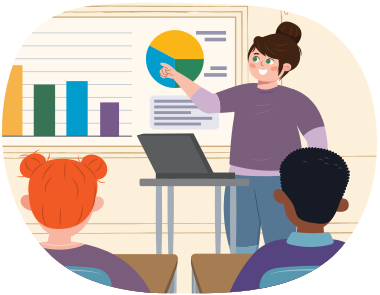
Oral communication refers to the expression of thoughts, ideas, and feelings through spoken or written language.

Non-verbal communication refers to other methods, such as body language including facial expressions, gestures, and other body movements.
Explore the following oral communication skills, then sort them as oral or non-verbal.
Once your speech is ready, practise it several times using the speaking strategies that we previously explored.
Fluency
Fluency is the ability to identify words correctly and read a text at an appropriate rate with ease, pace, automaticity, and expression. With proper phrasing and focus on punctuation, the reader will gain more meaning from the text.
A fluent reader focuses on…
After reading your speech, choose one area of fluency that you feel you should focus on and set a goal for yourself. What strategies could you use to help you achieve this goal?
Learning check!
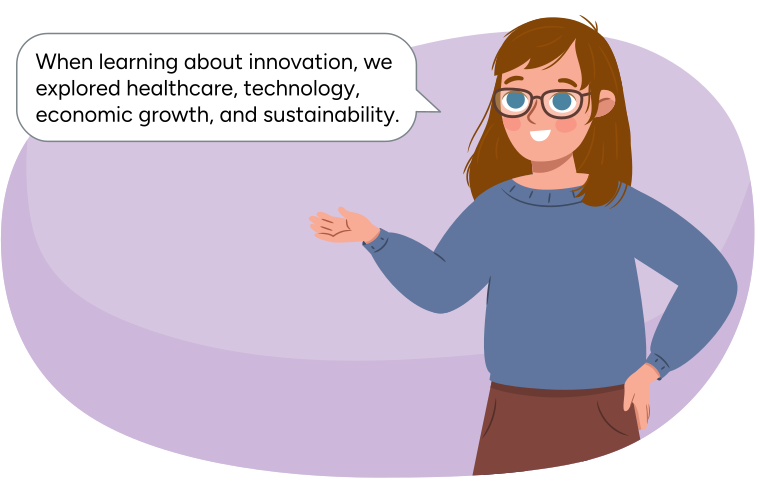
For this task, decide whether the innovation is an example of:
- healthcare
- technology
- economic growth
- sustainability

Pause and Reflect
Pause and reflect
Let’s reflect on what you’ve learned throughout the learning activity.
Choose one of the following questions to respond to. Record your ideas in a notebook or another method of your choice.
| Knowledge & Understanding | Application | Transferable Skills |
|---|---|---|
|
|
|
|
|
|

What role do you think innovation plays in your future?
Reflection
As you read the following descriptions, select the one that best describes your current understanding of the learning in this activity. Press the corresponding button once you have made your choice.

I feel...
Now, expand on your ideas by recording your thoughts using a voice recorder, speech-to-text, or writing tool.
When you review your notes on this learning activity later, reflect on whether you would select a different description based on your further review of the material in this learning activity.
Discover MoreChoose one of the innovations you sorted to explore further.
Use your preferred search engine to conduct research and explore what real-world problem or challenge this innovation addresses and how it benefits society.
Record what you’ve learnt in your notebook or another method of your choice.