Learning goals
We are learning to…
- analyze themes explored in First Nations, Métis, and Inuit cultures to demonstrate an understanding of the varied identities, perspectives, relationships, legacies, truths, and ways of knowing, being, and doing
- compare the ways in which historical periods, cultural experiences, and/or socio-political conditions and events have influenced two or more texts created by First Nations, Métis, and Inuit individuals, communities, groups, or nations, and how they relate to current lived experiences
- connect, compare, and contrast the ideas expressed in texts and their knowledges and lived experiences, the ideas in other texts, and the world around them
- draft complex texts of various forms and genres, including narrative, persuasive, expository, and informational texts, citing sources, and use a variety of appropriate media, tools, and strategies to transform information and communicate ideas
Success criteria
I am able to…
- explore The Marrow Thieves and respond to both similar and complex comprehension questions that require me to reflect on the historical context of colonization and Indigenous lived experiences
- make connections between learned historical context and Indigenous dystopian fiction
- create a podcast or book review highlighting important themes in The Marrow Thieves
- explain how post-apocalyptic and dystopian Indigenous fiction can be a creative form of Indigenous resilience

Colonization

Colonization refers to “the process in which a foreign power invades and dominates a territory or land base inhabited by indigenous peoples by establishing a colony and imposing its own social, cultural, religious, economic, and political systems and values. A colonized region is called a colony.”

Brainstorm
Brainstorm
If someone asked you to explain colonization to them, how might you put this definition into your own words? What examples could you use to help your explanation?
In what ways might colonization be connected to the residential school system in Canada?
Brainstorm and note your ideas in a method of your choice. If possible, discuss your ideas with a partner.

Indigenous history
It is important to understand the historical context that drives each of these literary pieces. This brief overview of Indigenous history in Canada is designed to provide context for the content you are about to explore. However, it does not encompass the full breadth of Indigenous histories and experiences. For a deeper understanding, you are encouraged to explore additional resources.
Since time immemorial, Indigenous Peoples have lived off the land that we know today as Canada. Connection with the land is foundational to Indigenous Peoples and each Nation holds unique worldviews, knowledge, and stories according to their environment and territories.
Press the following tabs to find out more.
Beginning in the 1600s, people from other places in the world, such as Europe, travelled to Canada in hopes to find natural resources, trade routes and partners, and a better way of living. These people were called colonizers. As colonizers arrived in Canada, they relied heavily on the experiences and expertise of Indigenous Peoples, including their use of the land. Many Indigenous Peoples welcomed colonizers and taught them how to live off the land. This included teaching them how to hunt, fish, navigate the land and waterways, and even survive in the harsh winters.
Over time, colonizers began to believe they had the right to claim the land as their own, taking it and its resources away from Indigenous communities. While there was resistance, colonizers began to take over lands and force Indigenous populations to relocate. By the 1830s, more and more land, especially land used for hunting and fishing, was lost and Indigenous communities were forced to relocate to survive. In the 1880s, residential schools were open - a network of government-funded, church-run schools for First Nations, Métis, and Inuit children, the goal of which was to eradicate Indigenous languages, traditions, knowledge, and culture and to assimilate Indigenous Peoples into mainstream settler society. During their operation (1880-1996) Indigenous children were forcibly taken from their homes and separated from their families. They were forbidden to speak their language or practice their beliefs, in theory, preparing them to assimilate into mainstream Canadian society. Some never returned.
Despite this adversity, Indigenous Peoples carried on and worked hard to continue their ways of knowing, being, and doing including their languages, cultural practices and community Knowledges.
Recently, Indigenous authors have been working to use post-apocalyptic and dystopian fiction to showcase the reality of this history and draw connections between the past and present. This is an innovative and creative form of sharing Indigenous resilience through storytelling. Within these fictions, the authors can tell their own stories about historical events, such as colonization and cultural genocide from Indigenous perspectives that allows for exploration and healing of past wounds. These words highlight the persistence of Indigenous ways of knowing, being, and doing, as characters maintain their ways despite the violent history of colonization and current apocalyptic challenges. These works of fiction focus on Indigenous characters who navigate and survive dystopian worlds and allow Indigenous voices to control their own stories, creating opportunities for Indigenous communities to relate and resonante with these lived experiences of displacement and resistance.
Authors & artists
Explore a few quotes from Indigenous authors and artists about how they are using post-apocalyptic and dystopian Indigenous fiction to share their stories.
Explore
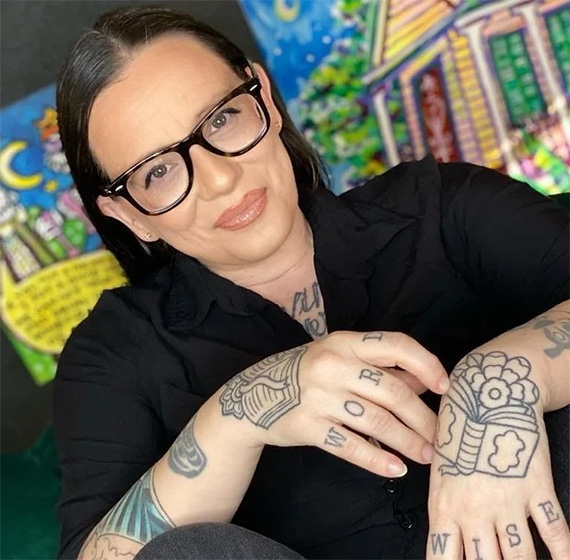
Métis author, Cherie Dimaline
Cherie Dimaline is a Métis author from the Georgian Bay Métis community in Ontario. For generations, her family has lived "across the Bay" and that is how they refer to themselves and how others refer to them across town. As a child, Cherie learned traditional Métis stories and ways of knowing, being, and doing, that have influenced her written works today. Cherie currently lives with her husband and children in Toronto and in addition to writing novels and short stories, she was the founding editor of Muskrat Magazine and has been involved in programs at the Toronto Public Library.

Reading Time
Reading time
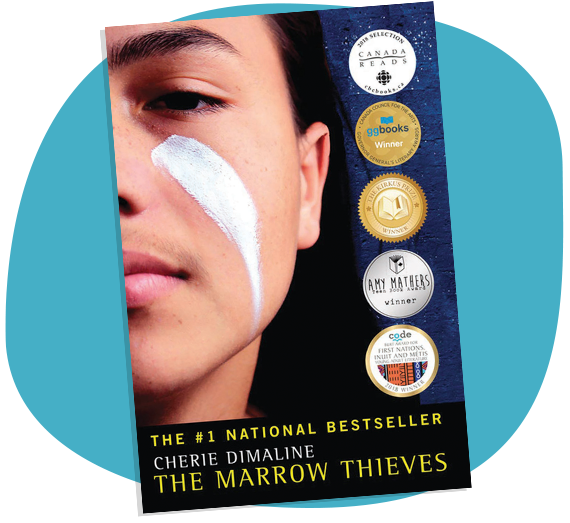
The Marrow Thieves
One novel written by Cherie Dimaline is The Marrow Thieves. This novel was published in 2017 and used the real history of residential schools to create a terrifying post-apocalyptic world where Indigenous children are hunted and harvested for their bone marrow.
In this dystopian novel, the human race is nearly destroyed due to global warming and along with this, many people have lost the ability to dream, except Indigenous Peoples.
It is believed that the bone marrow of Indigenous Peoples is the key to recovering the ability to dream. In this dark world, French and his companies struggle to survive as they make their way up north to the old lands. Survival means staying hidden and finding a way to defeat the marrow thieves. Through this, Indigenous ways of knowing, being, and doing are explored, and multiple themes in the Indigenous colonial and post-colonial history are shared.
Part 1
Now, let’s explore a few chapters of the novel, The Marrow Thieves. Before you begin, here is a little bit of background information that may be helpful.
The main character of the story is French, an 11-year-old growing up in the Métis community in Canada. Miig is a middle-aged Anishnaabe man who becomes Frenchie’s surrogate father, left to try and convince the government to close residential schools. His mother was taken by recruiters (government agents who take people to residential schools to harvest their bone marrow). They’ve been on the run from recruiters for five years with a group of people called “family”, although none of them are technically related.
Begin by exploring the following two chapters.
Read the following Chapter Readings to explore.
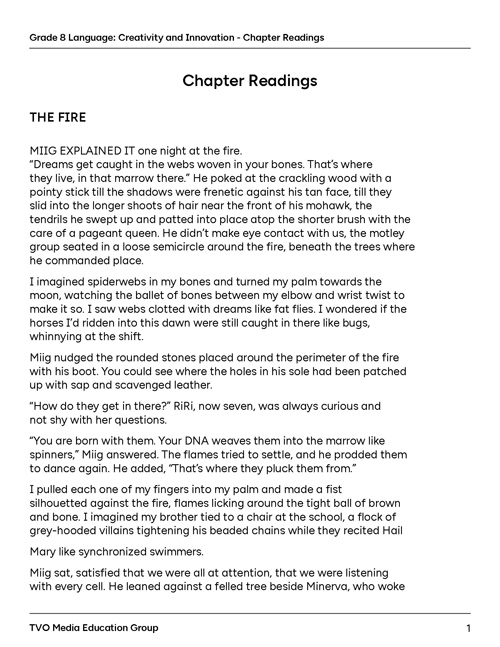
These excerpts are taken from the novel The Marrow Thieves by Cherie Dimaline, published by Cormorant Books Inc., Toronto. Copyright 2017 © Cherie Dimaline. Used with the permission of the publisher and the author.
Learning check!
Select the correct answer, then press Check Answer to see how you did.

Pause and Reflect
Pause and reflect

Respond to the following reflection questions:
- In "Story: Part One," what historical events are referenced, and how do they deepen your understanding of the characters' experiences? What references are made to current events that are affecting the environment?
- What connections can you make between the struggles depicted in these chapters and real-world issues faced by Indigenous communities today?
- How do the characters' personal stories in "The Fire" and "Story: Part One" enhance your understanding of the impact of colonialism on Indigenous identities?
Record your ideas in a notebook or another method of your choice.
Part 2
Let’s continue to explore the novel and read the next part.
Read the following Part 2 readings to explore.
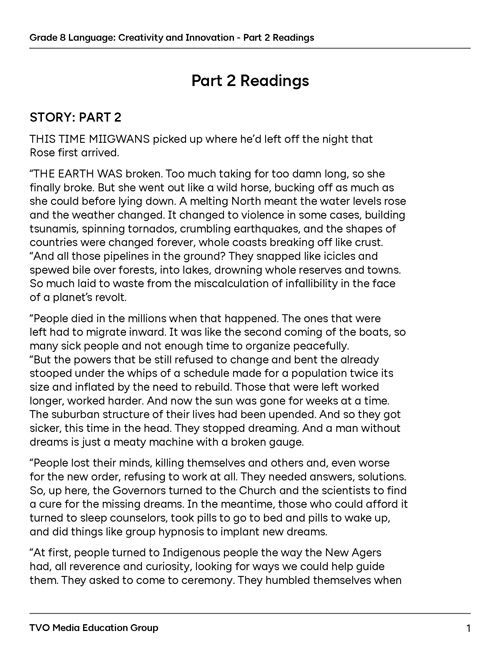
These excerpts are taken from the novel The Marrow Thieves by Cherie Dimaline, published by Cormorant Books Inc., Toronto. Copyright 2017 © Cherie Dimaline. Used with the permission of the publisher and the author.
Learning check!
Select the correct answer, then press Check Answer to see how you did.
Pause and Reflect
Pause and reflect
Respond to the following reflection questions:
- How does "Story: Part 2" use storytelling to highlight the importance of dreams in Indigenous culture and history?
- How do the characters’ responses to challenges in these chapters reflect themes of resilience and resistance?
- What connections can you make between “Story: Part 2” and modern-day events, such as climate change or current issues faced by Indigenous communities?
Record your ideas in a notebook or another method of your choice.
Part 3
Let’s check out the following chapters.
Read the following Part 3 Readings to explore.
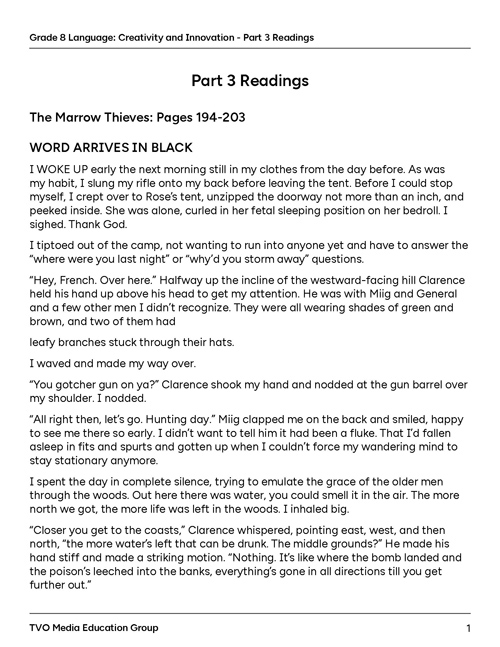
These excerpts are taken from the novel The Marrow Thieves by Cherie Dimaline, published by Cormorant Books Inc., Toronto. Copyright 2017 © Cherie Dimaline. Used with the permission of the publisher and the author.
Learning check!
Select the correct answer, then press Check Answer to see how you did.
Pause and Reflect
Pause and reflect
Respond to the following reflection questions:
- How do the events in "Word Arrives in Black" and "Locks Mean Nothing to Ghosts" affect the emotional tone of the story? How do they influence your empathy towards the characters' struggles?
- How do the events and experiences described in these chapters reflect the historical realities of Indigenous Peoples' struggles with colonialism and forced displacement?
Record your ideas in a notebook or another method of your choice.

Student Wellness
Student wellness

Before we continue onto the next section, let’s take a water break! Remember to drink water and stay hydrated during the day.
Post-reading
Let’s review some new vocabulary you may have explored in the novel, The Marrow Thieves.

Vocab goals!
Read the following quotes from The Marrow Thieves. Using the clues from the text, record what you think the vocabulary word might mean in a method of your choice. Make note of any prefixes or suffixes you notice attached to the base word.
Once finished, press the card to reveal the definition, and add it to your vocabulary notebook, personal dictionary, or portfolio.
As a bonus, try to use the same words in a different sentence to solidify your understanding.

Grammar glimpses: predicates
Let’s start with a quick review of the following terms and what they mean:
- subject
- predicate
- linking verb
Press Let’s Check! to explore the term’s definition and examples.
| Vocabulary Word | Definition | Examples |
|---|---|---|
| Subject | The person or thing that performs the action, or about which something is stated. |
|
| Predicate | The part of a sentence that makes a statement about the subject. |
|
| Linking Verb | Connects the subject of a sentence to additional information about the subject. Common linking verbs include forms of the verb “to be”: am, is, are, was, were, and sometimes they are related to the sense: feel, look, smell, sound, and taste. Lastly, they can reflect a state of being: appear, become, seem, remain. |
|
Now that you have reviewed a few definitions, you are going to explore predicate nouns and predicate adjectives.
Predicate noun
A predicate noun refers to a noun that follows a linking verb and defines, describes, or explains the subject.
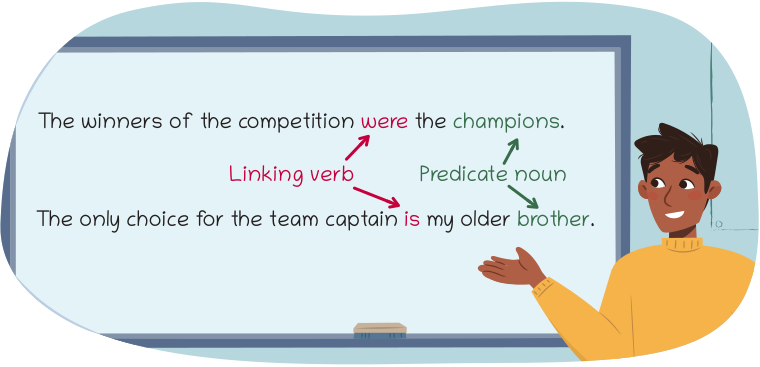 Description
The winners of the competition were champions. The only choice for team captain is my older brother. Linking verbs: were and is. Predicate nouns: champions and brother.
In this example, “champions” is the predicate noun, which renames “the winners of the competition” and “my older brother” is the predicate noun to rename “the choice for the team captain.”
Predicate adjective
A predicate adjective describes or modifies the subject and follows a linking verb.
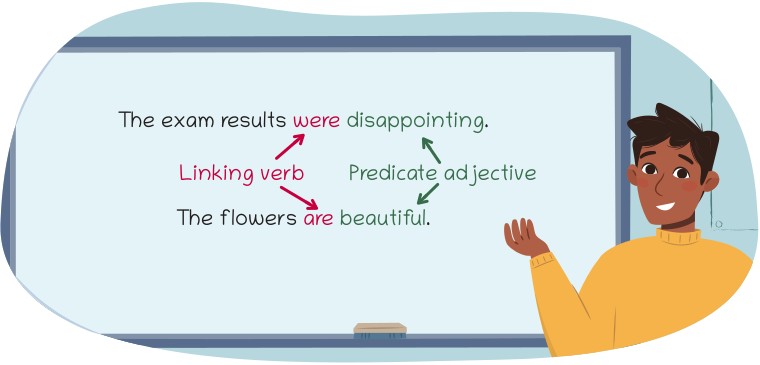 Description
The exam results were disappointing. The flowers are beautiful. Linking verbs: were and are. Predicate adjectives: disappointing and beautiful.
In this example, “disappointing” is the predicate adjective which describes “the exam result” and “beautiful” is the predicate adjective to describe “the flowers.”
Learning check!
Read each sentence, then choose whether the bolded word is a predicate noun or adjective.

Try it
Try it!
Choose 2 of the following sentences.
- The Marrow Thieves is a moving exploration of Indigenous resilience.
- Its characters are diverse and resilient.
- The novel's themes explore cultural identity and survival.
- Its narrative remains impactful and thought-provoking.
Identify and record the subject, linking verb, and predicate noun or adjective in each in a method of your choice.
When you’re ready, press Let’s Check! to learn more.
- Subject: The Marrow Thieves
Linking verb: is
Predicate noun: moving exploration of Indigenous resilience - Subject: its characters
Linking verb: are
Predicate adjective: diverse and resilient - Subject: the novel
Linking verb: explore
Predicate noun: cultural identity and survival - Subject: its narrative
Linking verb: remains
Predicate adjective: impactful and thought provoking

Wrap up

Your task is to write a book review or create a podcast about The Marrow Thieves that you explored in this learning activity.
While you did not read the entire book, create your book review or podcast based on what you did explore.
Include the following in your review or podcast:
You may also include the following:

Student Success
Think
Respond to the following questions:
- In what ways do the cultural experiences portrayed in the text reflect the resilience or challenges faced by Indigenous communities historically and today?
- How can post-apocalyptic and dystopian Indigenous fiction be a creative form for Indigenous Peoples and their resilience? Explain using examples explored in this learning activity.
Record your ideas in a notebook or another method of your choice.
Reflection
As you read the following descriptions, select the one that best describes your current understanding of the learning in this activity. Press the corresponding button once you have made your choice.

I feel...
Now, expand on your ideas by recording your thoughts using a voice recorder, speech-to-text, or writing tool.
When you review your notes on this learning activity later, reflect on whether you would select a different description based on your further review of the material in this learning activity.
Press Discover More to extend your skills.
Discover MoreSimilar to The Marrow Thieves, Mi’kmaq filmmaker Jeff Barnaby produced a film in 2019 called Blood Quantum that opened at the Toronto International Film Festival. This film is about a world that is plagued by zombies, but Indigenous Peoples are immune to the virus. Their Mi'kmaq reserve of Red Crow becomes a place where people seek shelter from the virus, leaning on Indigenous Peoples for help, while Indigenous peoples put themselves at risk to help white people.
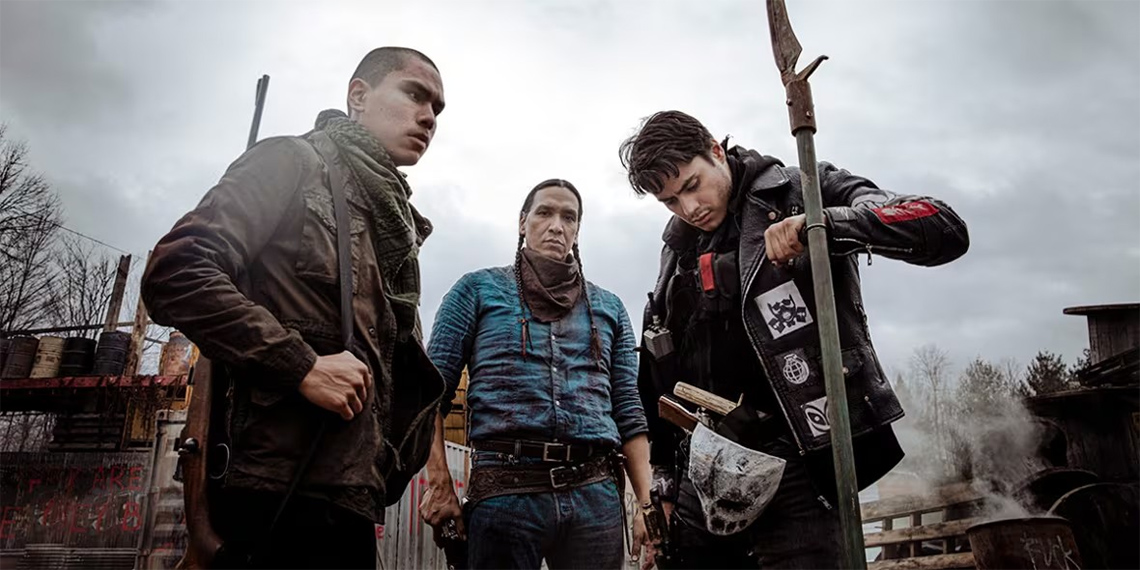
Filmmaker Jeff Barnaby hoped to take a new approach to zombie movies to retell the story of colonization. One of the first things in the movie is a natural world that has been polluted and food sources are scarce, which he believes to be a metaphor for colonization. The film begins with people taking salmon from the river, and this food source ends up poisoning them, turning them into zombies. Again, a metaphor for colonizers taking more than they need from the land. He stated “the sole inspiration for everything I do is the community I grew up in. Rez life and rez representation is what I do well.” Blood Quantum addresses white people infringing on Indigenous space, which has been and continues to be a reality in Canada.
Blood Quantum is one of many Indigenous films and stories that use an apocalyptic and dystopian fiction to draw parallels between historical context and lived experiences.
What do you think?
Indigenous dystopian fiction can be used to comment on real-world issues.
How might these fictional narratives help us understand the challenges and resilience/strength of Indigenous communities?