Learning goals
We are learning to…
- demonstrate an understanding of the historical contexts, contributions, lived experiences, and perspectives of a diversity of individuals and communities, including those in Canada, by exploring and analyzing the concepts of identity, self, and sense of belonging in a variety of culturally responsive and relevant texts
- analyze themes explored in First Nations, Métis, and Inuit cultures to demonstrate an understanding of the varied identities, perspectives, relationships, legacies, truths, and ways of knowing, being, and doing
- compare the ways in which historical periods, cultural experiences, and/or socio-political conditions and events have influenced two or more texts created by First Nations, Métis, and Inuit individuals, communities, groups, or nations, and how they relate to current lived experiences
- draft complex texts of various forms and genres, including narrative, persuasive, expository, and informational texts, citing sources, and use a variety of appropriate media, tools, and strategies to transform information and communicate ideas
Success criteria
I am able to…
- explore information via readings and videos about Tanya Tagaq’s multimodal work and how it contributes to the overall message of Indigenous resilience and cultural reclamation
- respond to a series of reflection questions about on what I have learned
- organize and draft an essay that analyzes how Tanya Tagaq uses multimodal elements in her performances to communicate her message of Indigenous resilience

Multimodal elements
Explore the following video clip.
What do you notice? What elements or features do you notice?
Access the following video entitled Teeth Agape.
This is a video clip created by Inuk artist Tanya Tagaq, who you will be exploring in this learning activity. In this video clip, she uses many different elements – music, spoken word poetry, illustrations – to convey meaning.

Brainstorm
Brainstorm
Why do you think artists make videos to accompany their music? What effect does this have?
Brainstorm your ideas in a method of your choice.
In this learning activity you will explore how Inuk artist Tanya Tagaq uses multimodal elements to convey meaning in her music.

Exploring Tanya Tagaq

Student Tips
Student tips
As you explore the following information on Tanya Tagaq, consider taking jot notes in a method of your choice to help you summarize and recall new information.

Did You Know?
Did you know?
What are jot notes?
A jot note is a brief, informal sketch or note that is made quickly when reading. Jot notes should be brief and concise and highlight key information.
As you record jot notes, you should consider the following guiding questions:
- Who is Tanya Tagaq?
- What multimodal elements does Tanya use in her work?
- Take notes on how each element contributes to the overall message of Indigenous resilience and cultural reclamation.
- What is Tanya promoting or bringing attention to through her work?
- What new perspectives did you gain about Inuit culture and history through her performances?
- How does Tanya Tagaq incorporate Inuit language and traditions into her performances?
Tanya’s origins
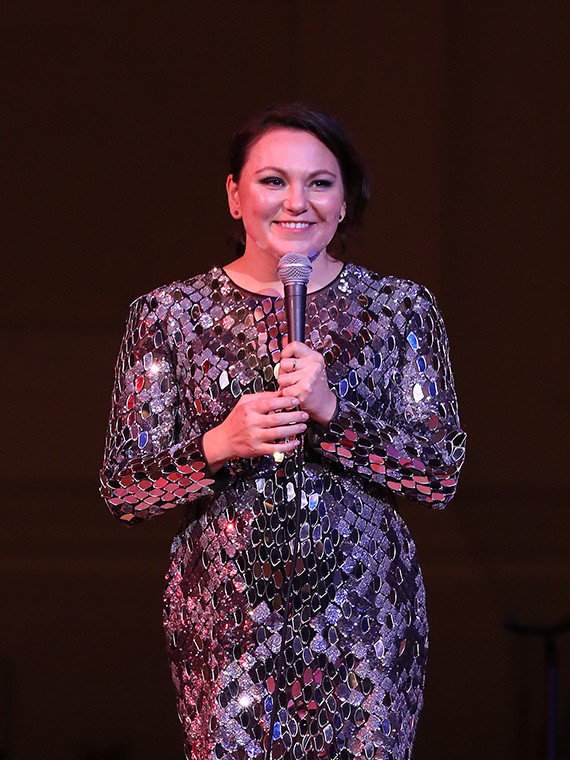
Tanya Tagaq is an award-winning Inuk artist who is world-renowned for her creative and innovative approach to traditional Inuit musical styles. Tanya grew up in Cambridge Bay, a small settlement located on Victoria Island in Nunavut, Canada.
At the time that she was growing up, a unique musical practice invented by the Inuit - throat singing- was effectively banned in an attempt to oppress and discourage Indigenous customs.
When asked about assimilationist policies such as banning throat singing in an interview with CBS News, Tanya commented that these strategies are simply:
“…part of the colonial process. Children were forbidden from speaking their language or
exercising their culture in any way whatsoever. And they told us our belief system was
wrong.”
– Tanya Tagaq
Source: Wertheim, J. (2019, May 5). The sounds of Inuit throat singer Tanya Tagaq. "60 Minutes" CBS News. https://www.cbsnews.com/news/the-sounds-of-inuit-throat-singer-tanya-tagaq-60-minutes-2019-05-05/
At the age of 15, Tanya had to leave her home community in order to attend high school because there wasn’t one based in her town. While this is not an uncommon experience for high-school students living in remote northern communities across Canada, it meant that Tanya was required to attend a residential school in Northwest Territories’ capital city Yellowknife before it was closed in 1994.
Tanya’s music
Press the following tabs to learn more about Tanya Tagaq’s music.
Tanya blends together ancient vocal techniques with contemporary music, including elements of punk rock, heavy metal, and electronica and multimedia elements to create powerful performances that highlight the resilience of Inuit culture. By blending throat singing with modern musical styles such as punk, electronica, and improvisational jazz, she bridges the gap between past and present, showcasing the enduring strength of Inuit culture. This vocal innovation not only preserves a vital cultural tradition, but also transforms it into a contemporary art form that resonates with diverse audiences.
Her work primarily addresses themes of environmentalism, feminism, and Indigenous rights, using art as a means of cultural reclamation and political resistance. Her creative innovations not only bring the rich heritage of Inuit culture to the forefront but also serve as a potent form of resistance against the lingering impacts of colonialism. Tanya encourages listeners to reconsider their perceptions of Indigenous art.
Press What is colonialism? button to learn more.
Colonialism refers to the policy of establishing political control by one nation over another nation or region, sending settlers to claim the land from the original inhabitants, and taking its resources. It is a philosophy of domination, which involves the subjugation of one or more groups of people to another. In history, European colonizers came to what we now call Canada and took over Indigenous lands and resources, attempting to take away their traditional ways of knowing, being, and doing.
Select the correct answer, then press Check Answer to see how you did.

Tanya Tagaq performing at the 2007 Polaris Music Prize.
Over recent years, Tanya has won a Juno Award, Canadian Aboriginal Music Award, and was a Polaris Music Prize Winner. She is part of what has been called “The Indigenous Music Renaissance” – a generation of innovative and creative Indigenous artists in Canada. It all began in the year 2000, when Tanya sang impromptu at a campfire when showing some of her paintings at the Great Northern Arts Festival in Inuvik, Northwest Territories, and was asked to perform at the festival.
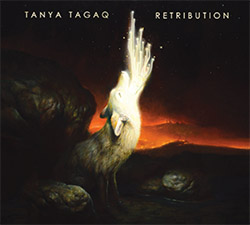
Since 2005, Tanya has released nearly 10 albums, including Retribution in 2016 which explores the harm that humans have wreaked upon the earth and issues a warning for the future consequences of these actions.
Split Tooth
Throughout releasing albums and performing, Tanya also wrote the novel Split Tooth, published in October 2018. It is a cross between fiction and memoir, telling the story of a young girl’s coming of age in Nunavut in the 1970s.
Let’s explore a small excerpt of Tanya Tagaq’s novel, Split Tooth.
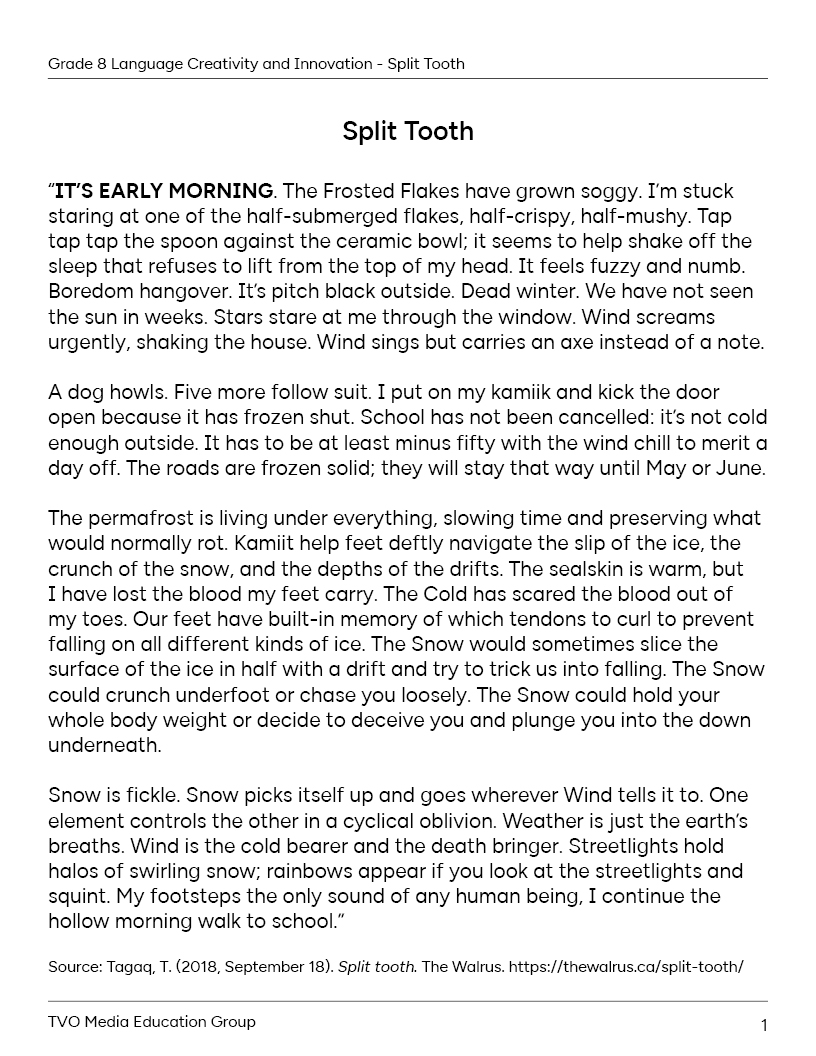
Most recently, in 2022, Tanya published another album Tongues which pulls poems from her book Split Tooth and draws upon her personal history and Inuit traditions. This book, which is dedicated to missing and murdered Indigenous women and survivors of the residential school systems, is a loose true narrative of her life story.
On this album is her song “Colonizer.” Take a listen to the following clip.
Explore the following video to learn more.
Tanya continues to share Inuit throat singing in concert. Her concerts are often improvised and there is no plan or set list. Her concerts serve as acts of resistance against the Canadian government and celebrations of Inuit culture. Her performances are a dynamic multimodal fusion of sound, visuals, and movement, creating immersive experiences that challenge and inspire audiences.
Her physical presence on stage is powerful and dynamic, as she often incorporates dance and expressive gestures into her act. These movements are not mere embellishments but are deeply connected to the music and the themes she is exploring. For example, her intense movements can evoke the struggle and resilience of her ancestors, the harsh beauty of the Arctic environment, or the pain and strength of her community.
By using her body as a vessel for storytelling, Tanya adds an additional layer of meaning to her performances, making them not just auditory or visual experiences but also kinesthetic ones.
Explore the following video clip of Tanya performing in a concert.
In conclusion, Tanya Tagaq's use of multimodal elements in her performances is a testament to her creativity and her commitment to cultural and social issues. By integrating traditional throat singing with contemporary music, visual art, movement, and narrative, she creates immersive and transformative experiences that communicate powerful messages about resilience, identity, and resistance. Her work not only revitalizes Inuit culture but also challenges audiences to think critically about the world around them, making her a pivotal figure in the landscape of contemporary art and activism.
Check your understanding
Check your understanding by responding to the following true or false questions.
Select the correct answer, then press Check Answer to see how you did.

Pause and Reflect
Pause and reflect
Respond to the following reflection questions based on what you’ve learned in a method of your choice. Be sure to include evidence from your learning in your response. If possible, discuss your ideas with someone else.
- How does Tanya Tagaq incorporate Inuit language and traditions into her performances?
- In what ways does her art challenge colonial narratives and promote cultural resilience?
- How does Tanya Tagaq use different modes (music, visuals, movement, etc.) to convey her message? Would you consider this innovative and creative? Why or why not?
- How does Tanya Tagaq’s art make you feel? What new perspectives did you gain about Inuit culture and history through the information you learned?

Social Emotional Learning
Social emotional learning

You’ve just explored Tanya Tagaq and multimodal elements. Take a break before continuing onto the next part!
Essay writing
Your task is to write a short reflective essay analyzing how Tanya Tagaq uses multimodal elements in her performances to communicate her message of Indigenous resilience.
Press the What is Indigenous resilience? button to learn more.
What is Indigenous resilience?
Indigenous resilience refers to the strength and determination of Indigenous Peoples to overcome difficulties caused by historic and ongoing colonialism. It shows how Indigenous communities can adapt, survive, and grow, even though they have faced many challenges for a long time. These challenges include unfair treatment, efforts to erase their cultures, and changes to their environment. Indigenous resilience is not just about staying strong but also about bringing back and celebrating their unique cultures, languages, and traditions.
Check out the following suggestions for some possible ideas!
Student Tips
Student tips
- Discuss how she incorporates traditional Inuit throat singing and what it represents, and explain how she blends these traditional sounds with modern music styles (e.g., punk rock, electronica) and why this is significant.
- Describe the visual aspects of her performances, such as projections of Arctic landscapes or Indigenous symbols, and analyze how these visuals reinforce her message of Indigenous resilience and cultural preservation.
- Discuss how Tagaq incorporates storytelling into her performances, both through spoken word and the overall narrative.
You can use the following graphic organizer, or another method of your choice as a suggested outline for your essay.
Access the following Graphic Organizer to download a copy for reference.
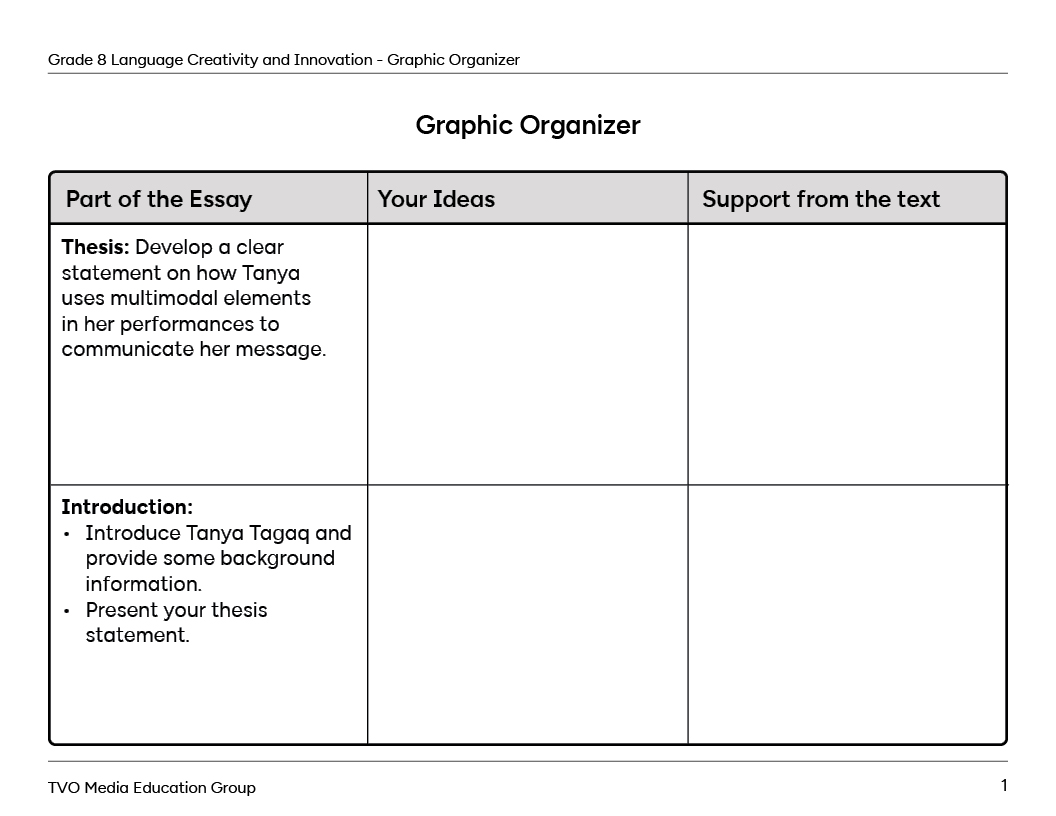
Once you have finished planning, draft your essay in proper paragraphs in a method of your choice.

Reading fluency routine!
Imagine you have been asked to share your essay with a class. To be effective when sharing, it is important that you read fluently.
Fluency is the ability to identify words correctly and read a text at an appropriate rate with ease, pace, automaticity, and expression. With proper phrasing and a focus on punctuation, the reader will gain more meaning from the text.

Re-read your essay several times, focusing on the following criteria outlined.
Use the checklist provided to self-assess your own fluency.
If possible, share your paragraph with someone else and ask them to provide feedback on your fluency.
Pause and Reflect
Pause and reflect
Based on the checklist, choose one area of fluency to focus on and set a goal for yourself. What strategies could you use to help you achieve this goal?

Grammar routine!
In this grammar routine, you are going to learn two concepts – recognizing words that adverbs modify and commas to set off conjunctive adverbs.
Both concepts focus on adverbs. An adverb is a word that describes a verb, an adjective, or another adverb.
Let’s explore these two concepts in the accordions below.
Press the following tabs to find out more.
Adverbs can modify (describe) three parts of speech: verbs, adjectives, and other adverbs. Adverbs can even modify entire sentences! Adverbs typically answer a question such as how, when, where, to what extent (how often or how much).
Explore the following flashcards to learn how adverbs can modify each part of speech.
Explore the following sentences and identify the adverb that’s modifying another part of speech (verb, adjective, adverb).
Select the correct answer, then press Check Answer to see how you did.
A conjunctive adverb sits at the start of a sentence to act like a bridge to an idea in the previous sentence. These are also known as transitional words or phrases.
Common conjunctive adverbs include:
- however
- as a result
- consequently
- therefore
- also
- accordingly
- besides
- certainly
- finally
- first (firstly), second (secondly)
- hence
When we use these conjunctive adverbs, it is followed by a comma, not introduced by one.
Example: Tanya Tagaq's music captivates audiences worldwide. Moreover, her performances celebrate and reclaim Indigenous cultural traditions.
Non-example: Tanya Tagaq's music captivates audiences worldwide, moreover, her performances celebrate and reclaim Indigenous cultural traditions.
Press Note button to learn more.
You can also use a semi-colon before the conjunctive adverb, but you still require a comma afterwards.
Example: Tanya Tagaq's music captivates audiences worldwide; moreover, her performances celebrate and reclaim Indigenous cultural traditions.

Check your understanding

Test Your Skills!
Test your skills

Let’s check your understanding! Re-write the following sentences with proper punctuation, including a comma to set off the conjunctive adverb, and underline the conjunctive adverb.
- Tanya Tagaq's innovative approach to blending traditional Inuit throat singing with contemporary music styles has garnered international acclaim consequently she continues to influence and inspire a new generation of artists
- Despite facing challenges and criticism Tanya Tagaq persistently advocates for Indigenous rights through her music hence her artistry serves as a powerful tool for social justice
- Tagaq's performances are renowned for their raw intensity and emotional depth therefore experiencing her music live is a transformative journey into the heart of Indigenous resilience
After you have rewritten the sentences, check the following for the correct answers.
- Tanya Tagaq's innovative approach to blending traditional Inuit throat singing with contemporary music styles has garnered international acclaim. Consequently, she continues to influence and inspire a new generation of artists.
- Despite facing challenges and criticism, Tanya Tagaq persistently advocates for Indigenous rights through her music. Hence, her artistry serves as a powerful tool for social justice.
- Tagaq's performances are renowned for their raw intensity and emotional depth; therefore, experiencing her music live is a transformative journey into the heart of Indigenous resilience.
Putting it all together
Pause and Reflect
Pause and reflect
Reflect on what you have learned by responding to the following reflection questions.
- How did Tanya Tagaq’s performances make you feel, and why do you think they evoked these emotions in you? Did you find any aspects of her multimodal elements particularly impactful or memorable? Explain why.
- Which multimodal element (e.g., vocal techniques, visuals, movements) did you find most effective in conveying the message of Indigenous resilience, and why? How do the different elements in Tagaq’s performances complement each other to create a unified message?
- How do Tanya Tagaq’s performances deepen your understanding of Indigenous resilience and cultural reclamation?
Reflection
As you read the following descriptions, select the one that best describes your current understanding of the learning in this activity. Press the corresponding button once you have made your choice.

I feel...
Now, expand on your ideas by recording your thoughts using a voice recorder, speech-to-text, or writing tool.
When you review your notes on this learning activity later, reflect on whether you would select a different description based on your further review of the material in this learning activity.