Learning goals
We are learning to…
- apply our learning to our everyday lives
- make predictions using our own experiences and understanding, and evidence from the text
- use strategies such as rereading, visualizing, and asking questions when exploring a simple text
- identify the main idea and important information in a simple text
- create a simple text using different tools and strategies
Success criteria
I am able to…
- use strategies such as rereading and asking questions as I explore the story The best thing ever
- make predictions about what will happen in the story The best thing ever using my own experiences and understanding, and details from the story
- identify the main idea and important information in the story The best thing ever
- record how I would create the best thing ever by reusing different items and use specific describing words or adjectives to describe my creation
- reflect on other ways I can reuse or upcycle in my everyday life
Notice and wonder
Let’s take a look at the cover art for the following story.
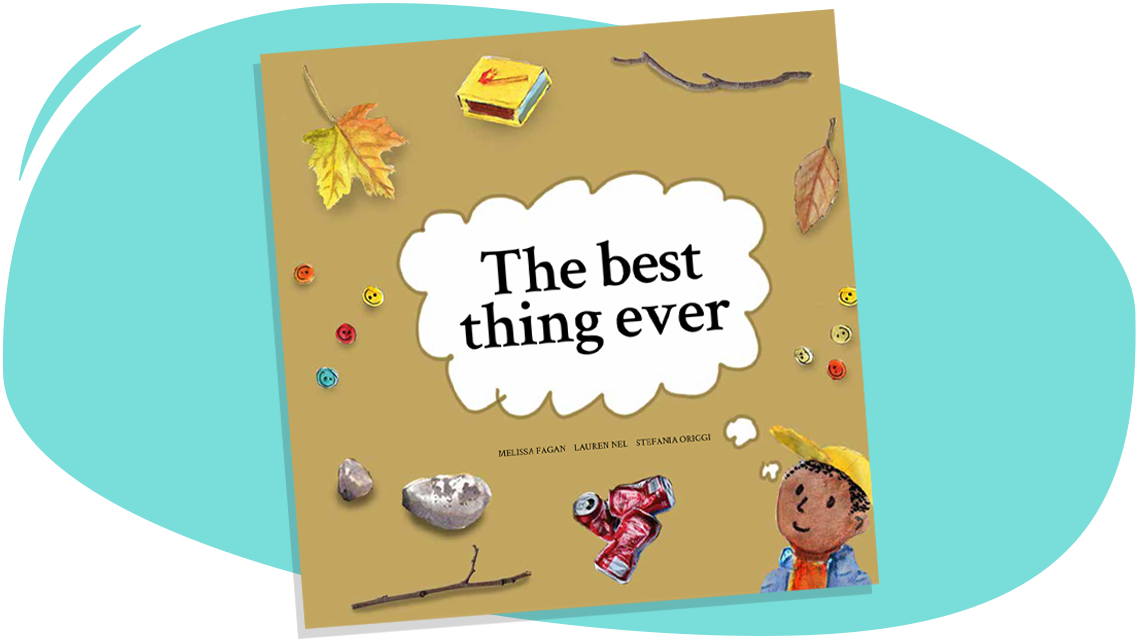
The cover of a book titled 'The best thing ever.' The art on the cover shows leaves, sticks, rocks, different colour buttons, crumpled pop cans, and a young boy with a thought bubble that goes around the title of the book.

Brainstorm
Brainstorm
The story is titled The best thing ever. Do you notice any words that you know? What do you think the title means?
What does the artwork on the cover tell us about the story?
Share your thoughts with a partner, if possible.
The best thing ever
Let’s explore the story The best thing ever. Read or listen to the story, and then answer the questions.
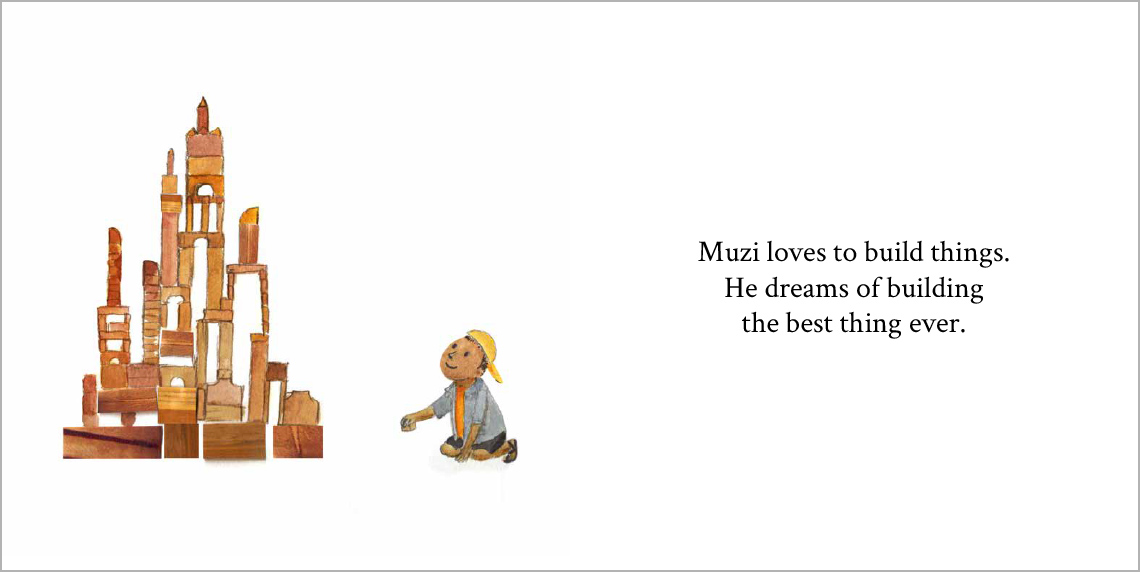
Page One

Try It
Try it
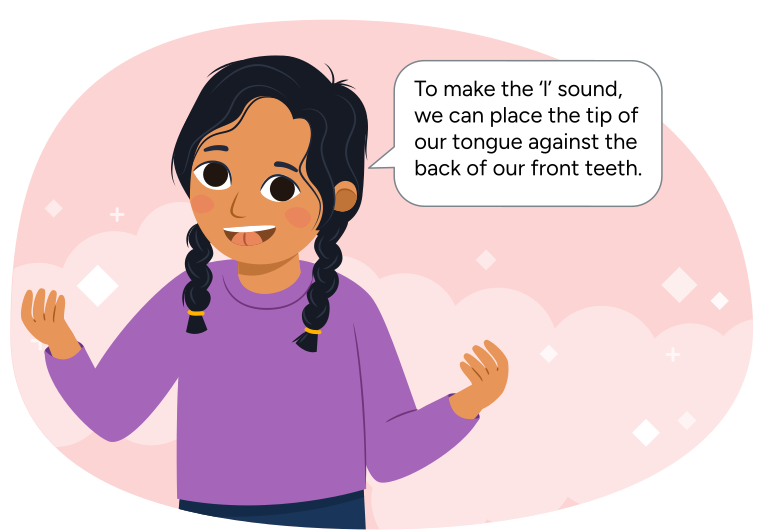
What sounds did you notice in the word build? Try saying the word build aloud.
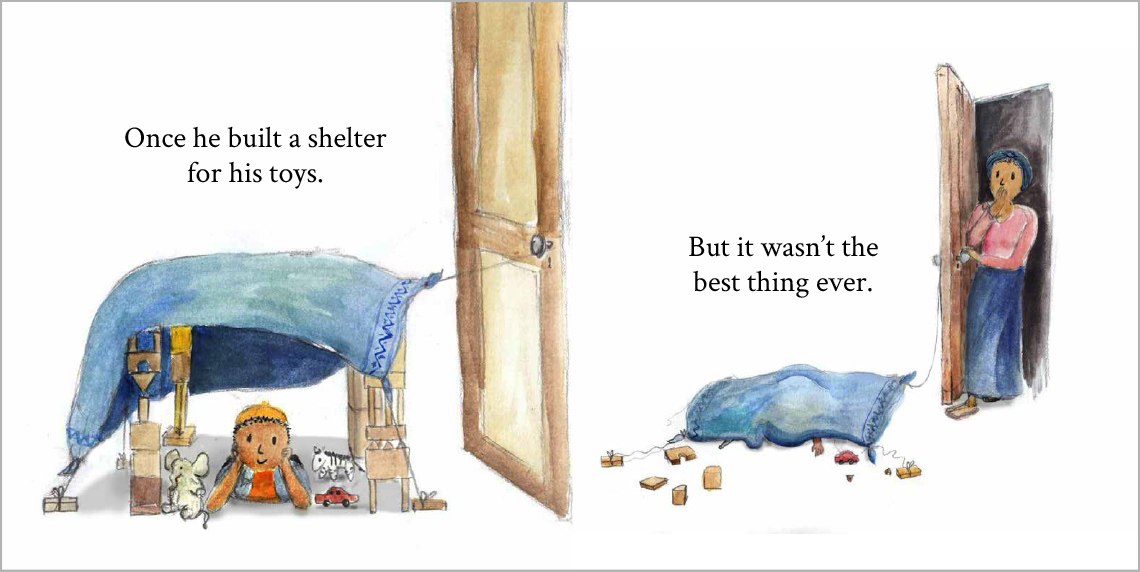
On the left side of the page, Muzi is laying with his toys under a shelter made of blocks and covered in a blanket. The blanket is tied to a doorknob. On the right side of the page, the shelter has fallen apart. There are blocks on the floor and the blanket is on top of Muzi. There is a woman opening the door that the blanket was tied to.
Page Two
Does built sound the same as build? What is the difference?
Press Reveal to find out.
The sound at the end of built is /t/.
Page Three
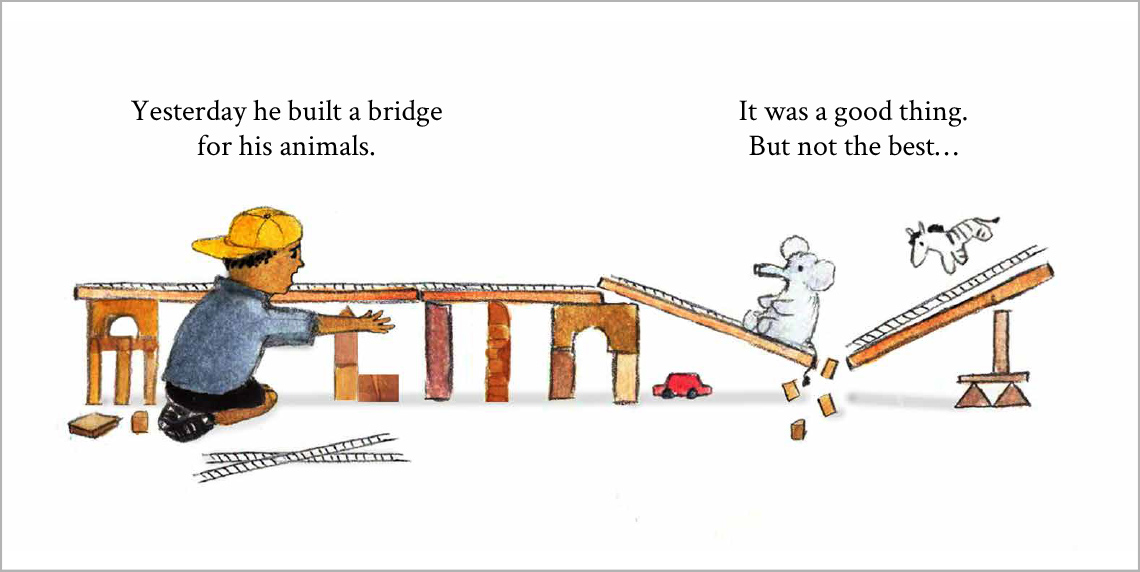
What happened to Muzi’s bridge? What would you do if this happened to you?
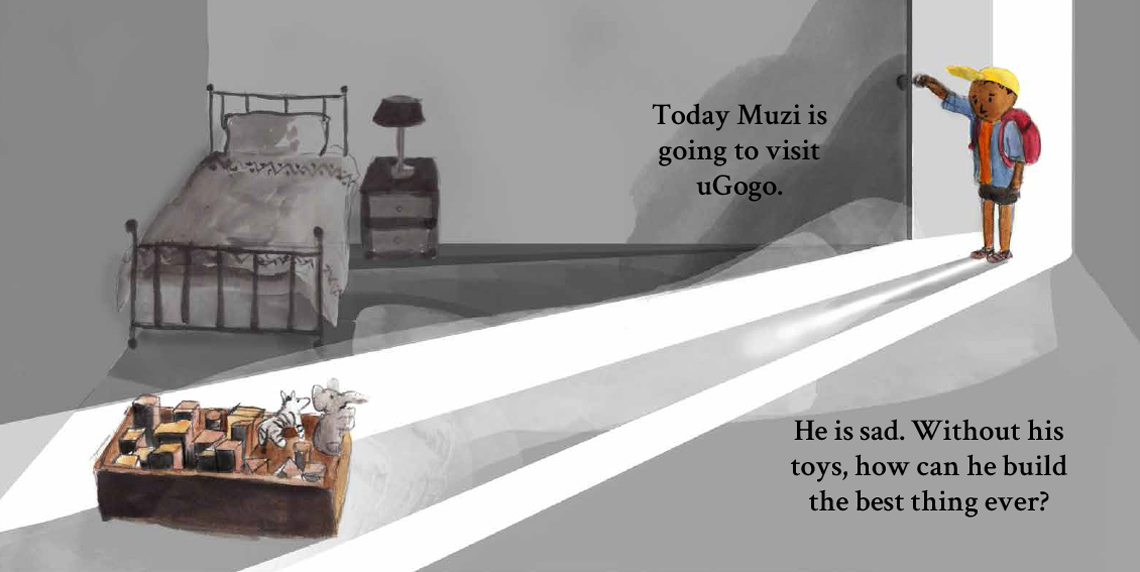
Muzi is wearing a hat and a backpack, standing at the door of his dark room, holding the doorknob. He is looking at his box of toys across the room.
Page Four
Where is Muzi going today?
How is he feeling? Why?
Press Reveal to check your answer.
Muzi is going to visit uGogo. UGogo or Gogo means grandma in the Zulu language!
He is sad because he thinks he won’t be able to build the best thing ever without his toys.
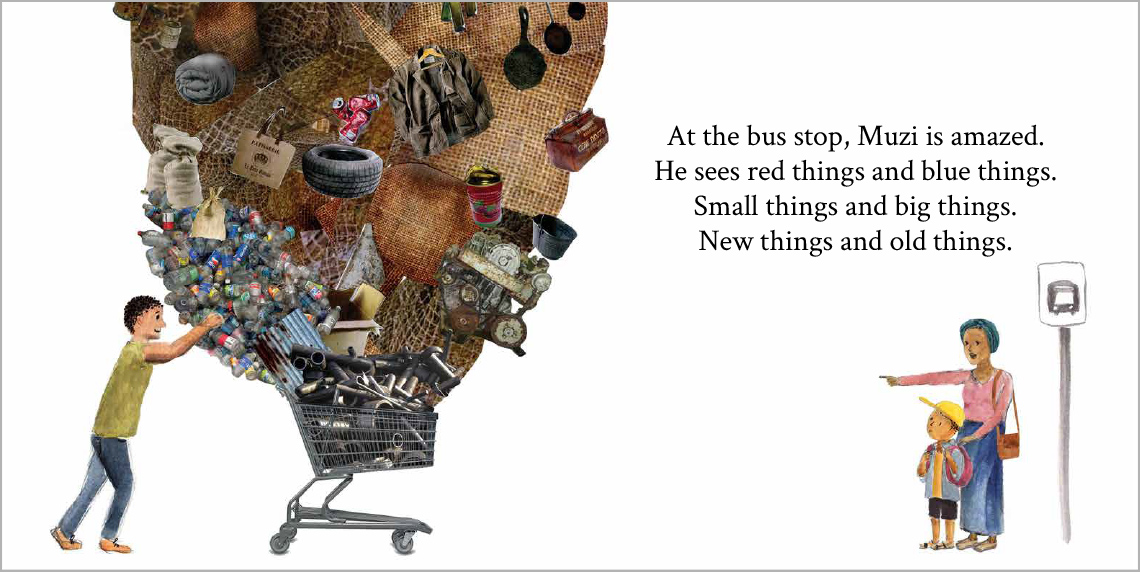
Muzi is standing with his mother who is pointing towards a man pushing a shopping cart filled with things like tires, empty plastic bottles, pipes, bags, and pans.
Page Five
What does Muzi notice at the bus stop?
Press Reveal to check your answer.
Muzi noticed:
- blue things
- red things
- small things
- big things
- new things
- old things
Blue, red, small, big, new, and old are all describing words. We also call describing words adjectives.
Page Six
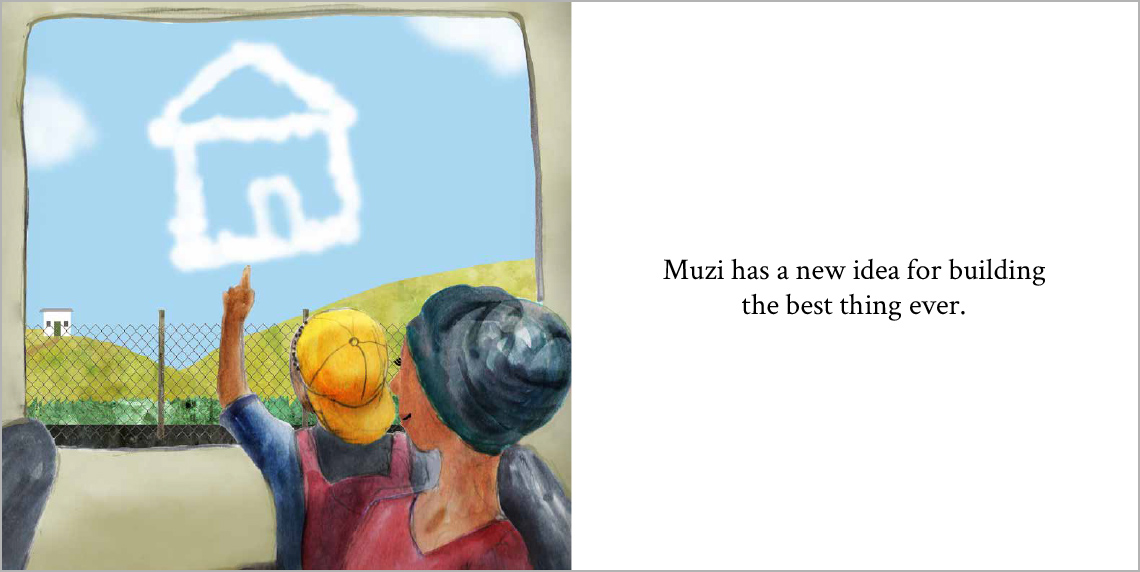
What do you think Muzi is going to build next? How do you know?
Press Reveal to for a possible answer.
I think that Muzi is going to build a house, because he is pointing to a house made of clouds in the sky.
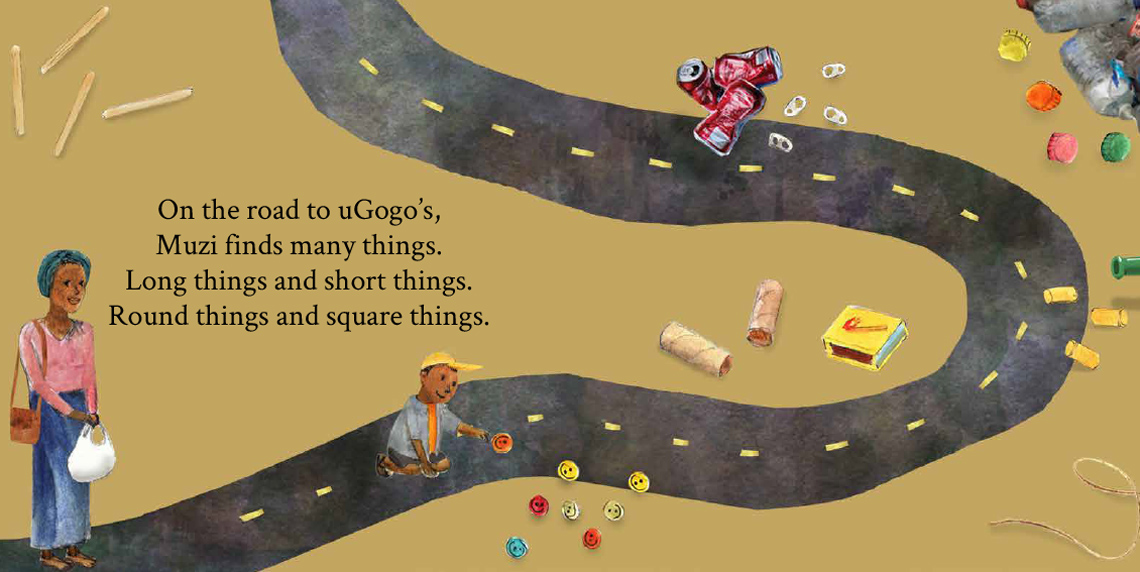
Muzi is kneeling on a road, covered in buttons, empty bottles and caps, crushed cans and tabs, corks, empty toilet paper rolls, a match box, and string. He is reaching for a round button.
Page Seven
What do you notice along the road to uGogo’s?
Press Reveal to for a possible answer.
I notice:
- buttons
- cans
- cardboard rolls and boxes
- popsicle sticks
- bottle caps
Did you notice the describing words or adjectives on this page?
Press Reveal for a possible answer.
- long
- short
- round
- square
Page Eight
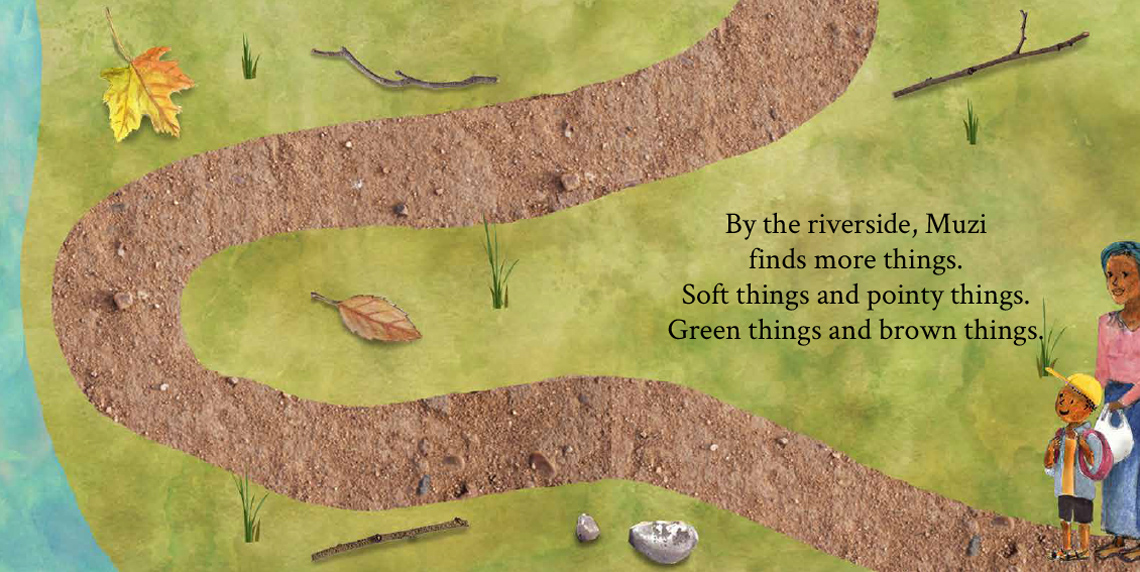
What do you notice along the riverside?
Press Reveal for a possible answer.
I notice leaves, sticks, and rocks.
Did you notice the describing words or adjectives on this page?
Press Reveal for a possible answer.
- soft
- pointy
- green
- brown
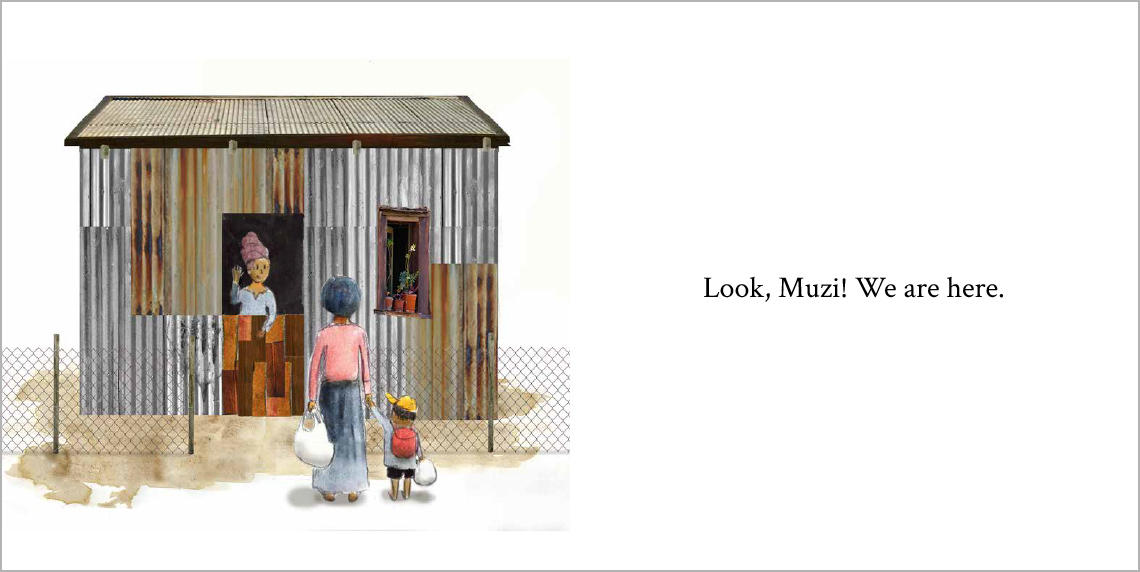
Page Nine
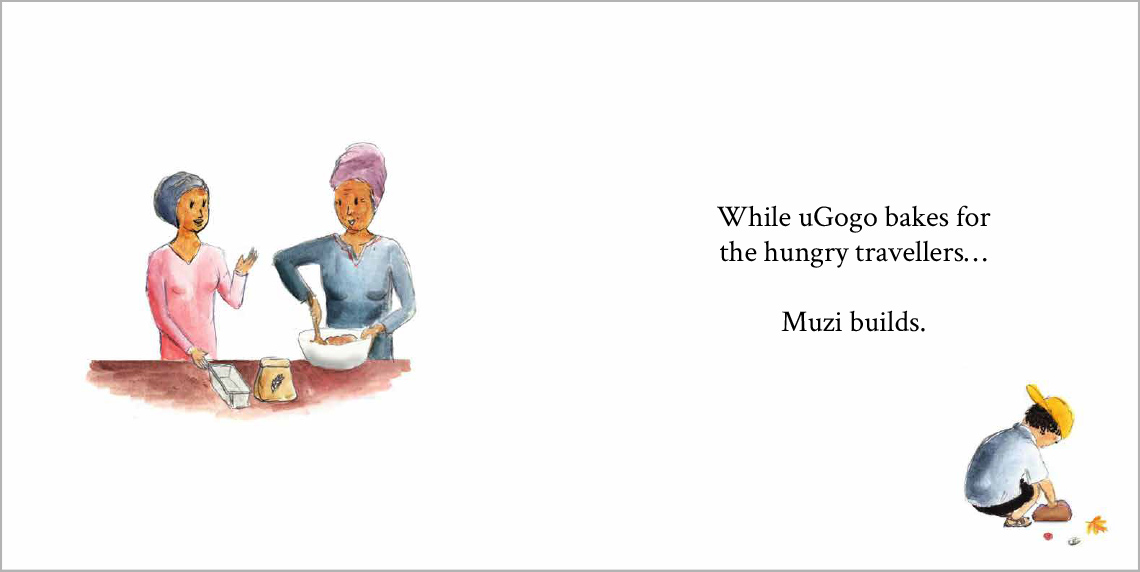
Page Ten
What do you think Muzi will build?
Press Reveal for a possible answer.
I remember that Muzi saw the house made of clouds earlier in the story, so I think he is going to make a house with everything he found.
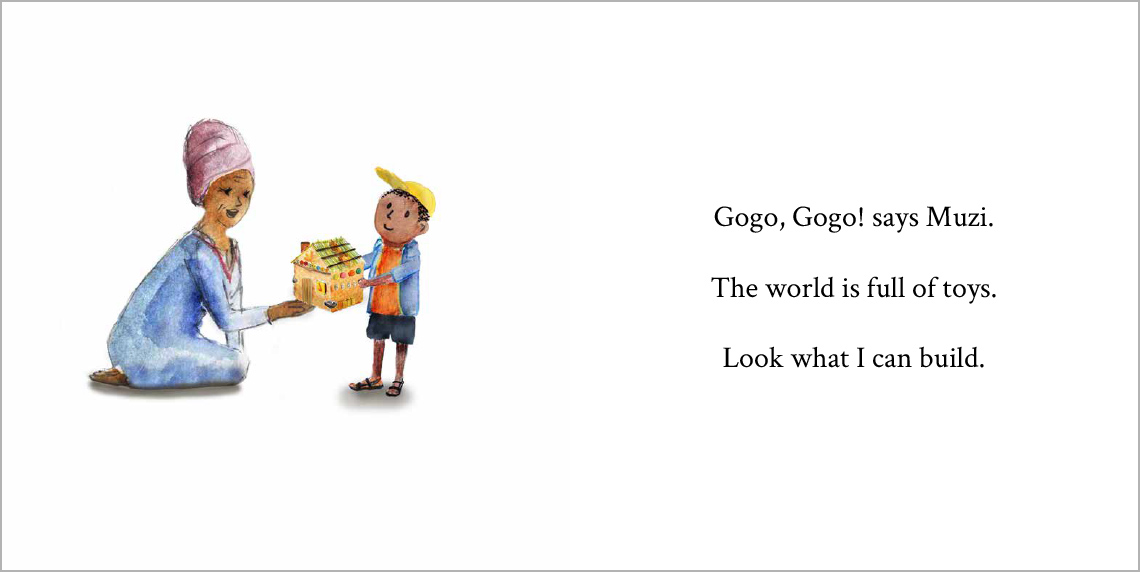
Page Eleven
What do you think Muzi means when he says, "The world is full of toys"?
Press Reveal for a possible answer.
Maybe Muzi means that there is a lot around us that we can use to play and create.
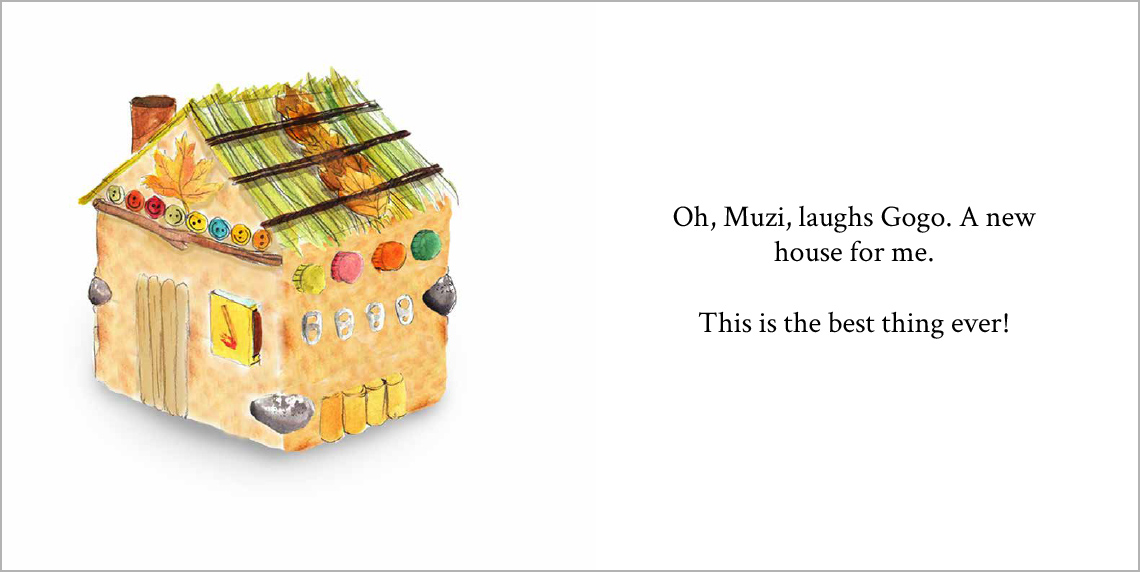
Page Twelve
How did uGogo feel when Muzi gave her the house? How do you know?
Press Reveal for a possible answer.
I think uGogo liked the house that Muzi gave her. I think this because she laughed and said, “This is the best thing ever!”
Parts of a story
Let’s explore the different parts that make The best thing ever a story.
Reuse or upcycle
In the story, Muzi used found objects to create something new!
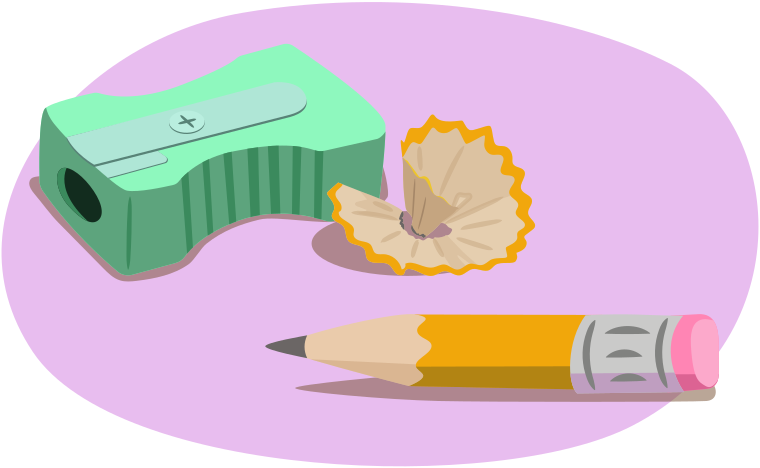
Sometimes objects wear out.
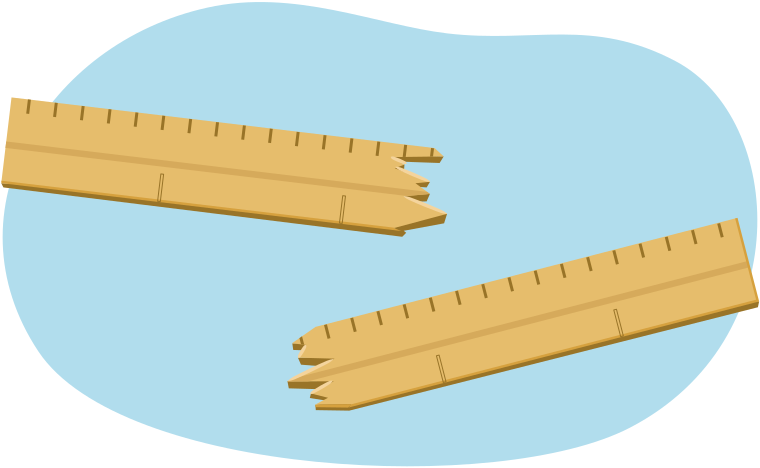
Sometimes objects break.
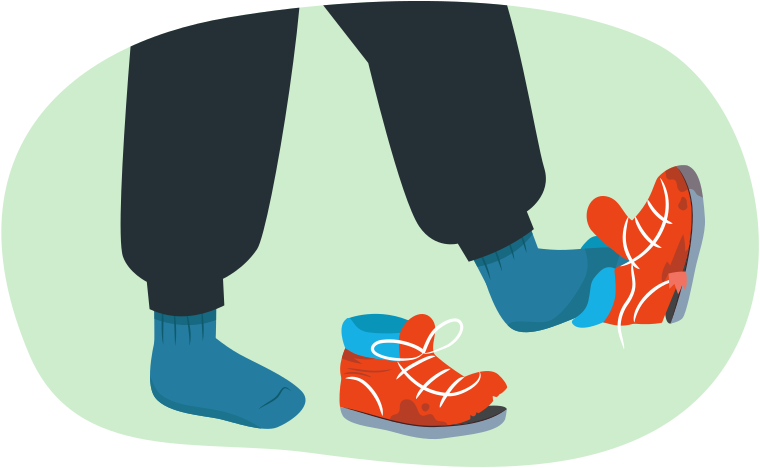
Sometimes we outgrow objects, and they are too worn down to share with someone else.
These objects could be thrown away, but they could also become something else!
To reuse means to use something more than once, or to find another purpose for something instead of throwing it away. We can also call this upcycling.
Verbs
The word reuse is a verb.
A verb is a word that describes an action.
Check out this video from Wacky Word Songs called “The Active Snail” to explore more about verbs.
Zoey shared many different examples of verbs in the present tense.
We can use verbs to describe:
- an action in the past (yesterday, last week, a few months ago) - past tense
- an action right now - present tense
- an action that will happen later (tomorrow, next week, a few months from now) - future tense
Let’s explore a few examples of the verbs in the past, present, and future tense that Zoey shared at the beginning of the video.
What do you notice?
| Past | ran | danced | spun | jumped |
|---|---|---|---|---|
| Present | run | dance | spin | jump |
| Future | will run | will dance | will spin | will jump |
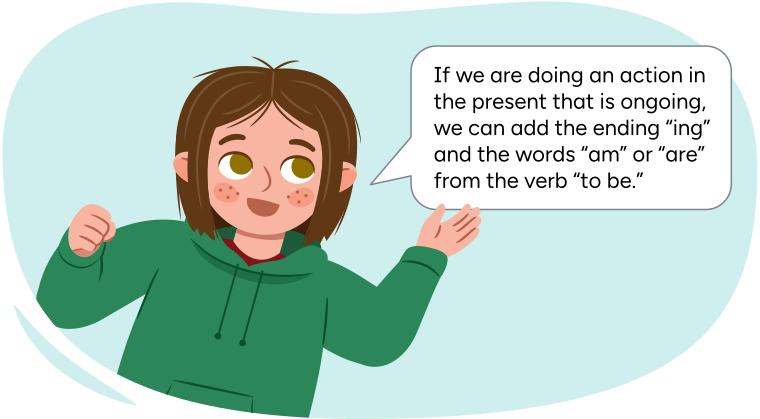
Clara says: 'If we are doing an action in the present that is ongoing, we can add the ending "ing" and the words "am" or "are" from the verb "to be."
Let’s explore the past, present, and future tenses of the verb reuse:
| Past | reused |
|---|---|
| Present | reuse |
| Future | will reuse |
Let’s check!
For each sentence, select the missing verb tense from the drop-down menu.
Press Check Answer to see how you did.
What was it?
Explore the following images. What item is being reused in each?
Putting it all together
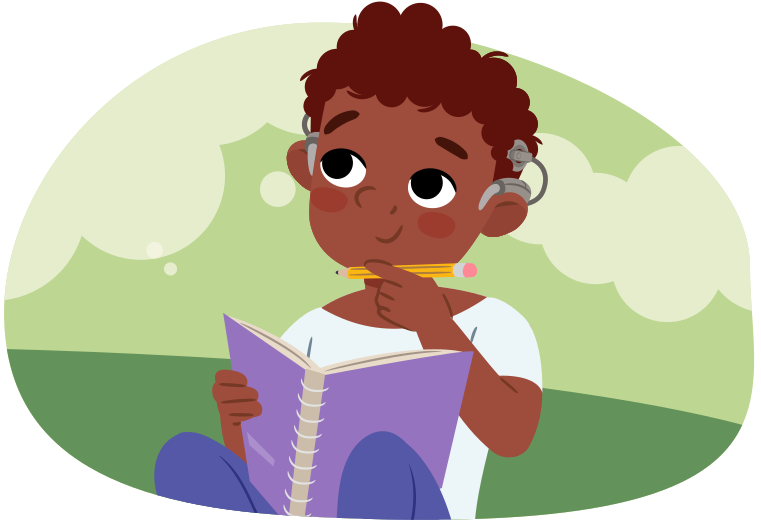
Imagine you had a few different items such as:
- a plastic water bottle
- a cardboard box
- buttons
- bottle caps
- string
- dried leaves
- sticks
- popsicle sticks
What would you make?
In your notebooks, create a drawing of "the best thing ever" you would create with found objects. If possible, share your drawing with a partner and describe what you created.
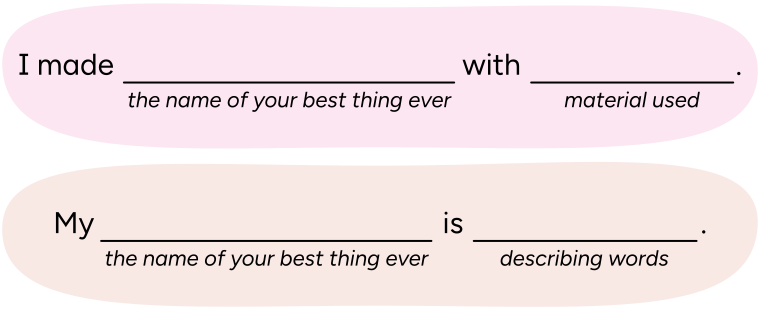
Two sentences with blank lines for responses.
The first sentence reads, "I made" followed by a blank line labeled "The name of your best thing ever" next to this is the word "with" and another blank line labeled "material used."
The second sentence starts with "My" followed by a blank line labeled "the name of your best thing ever" next to this, is the word "is" along with a final blank line labeled "describing words."
The text is in a simple, clear font, and the blanks are designed for filling in.
Press Hint to reveal some of the describing words or adjectives from the story The best thing ever.
| long | round | blue | green | small | new | soft |
| short | square | red | brown | big | old | pointy |

Pause and Reflect
Pause and reflect
How might reusing or upcycling items help the environment?
What are some ways you might reuse or upcycle items in your everyday life?
Record your ideas using a method of your choice.
Verb review
| Past | reused |
|---|---|
| Present | reuse |
| Future | will reuse |
Explore the following sentences with the verb reuse. Read each sentence carefully and choose the correct verb tense.
Reflection
How do you feel about what you have learned in this activity? Which of the next four sentences best matches how you are feeling about your learning? Press the button that is beside this sentence.
I feel...
Now, record your ideas about your feelings using a voice recorder, speech-to-text, or writing tool.