Learning goals
We are learning to…
- explore the concepts of identity, self, and sense of belonging in texts and demonstrate an understanding of the contributions, lived experiences, and perspectives of many different people, including those in Canada
- read and listen to texts by First Nations, Métis, and Inuit creators to show an understanding of different parts of First Nations, Métis, and Inuit histories, cultures, relationships, communities, groups, nations, and lived experiences
- identify some ways that texts by First Nations, Métis, and Inuit individuals, communities, groups, or nations share information about history, culture, events and how this connects to their experiences
- identify cultural elements, ask questions and share ideas on how these elements create meaning
- identify the topic, purpose, and audience for texts we plan to create
- brainstorm and develop ideas about various topics using simple strategies and resources, our own learning and our own experiences
Success Criteria
I am able to…
- read and explore the illustrations of the story Be A Good Ancestor by Leona and Gabrielle Prince, learn new words and reflect on the main message of the story
- identify ideas and teachings in Be a Good Ancestor, such as protecting and respecting land, water, animals and people to create balance in the world
- brainstorm and create a pledge to support people, animals, land and water
Notice and wonder
Explore the following cover art for the book Be a Good Ancestor.
Do you notice any words that are familiar? Are there any words that are unfamiliar?
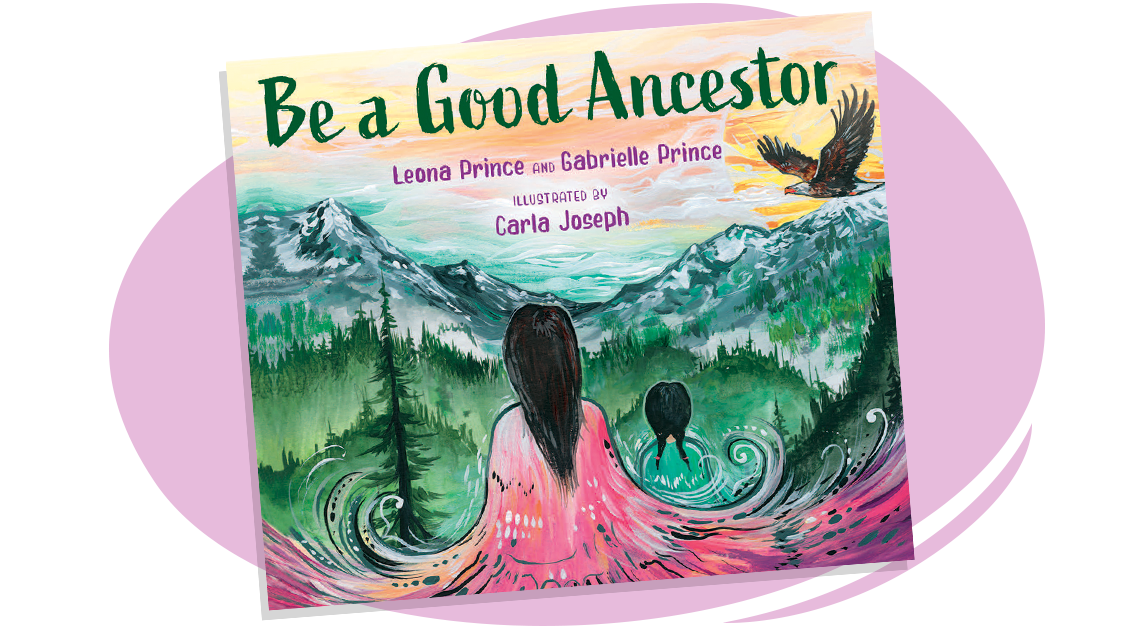
Be a Good Ancestor by Leona Prince and Gabrielle Prince
Think about the word ancestor. How would you describe what this word means?
Learning through storytelling
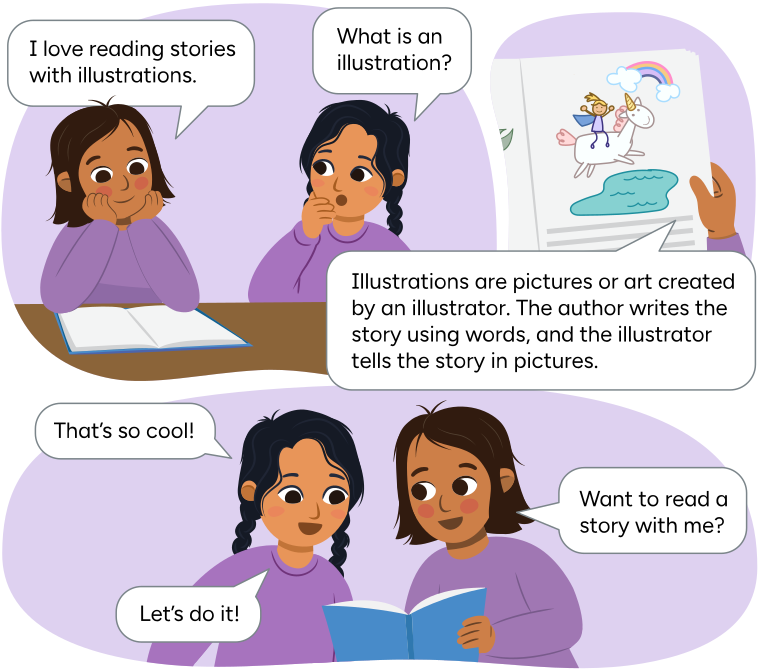
Be a Good Ancestor is a story with illustrations.
 Description
Neebin and Sora are looking at a book together.
Neebin says, ‘I love reading stories with illustrations.’
Sora says, ‘What is an illustration?’
Neebin says, ‘Illustrations are pictures or art created by an illustrator. The author writes the story using words, and the illustrator tells the story in pictures.’
Sora says, ‘That’s so cool!’
Neebin says, ‘Want to read a story with me?’
Sora says, ‘Let’s do it!’
Before we begin, let’s learn more about the authors and the illustrator of the story.
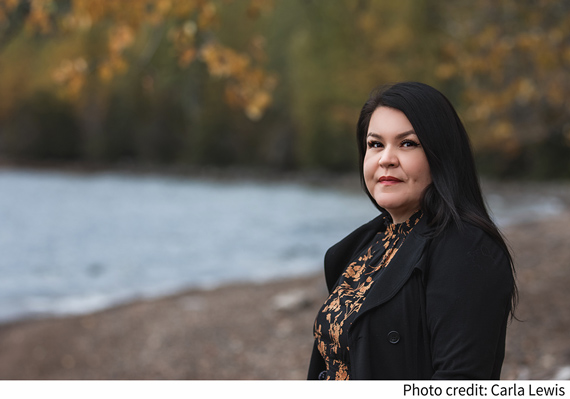
Leona Prince comes from Lake Babine Nation and Nak’azdli Whut'en. She belongs to the Lhts’umusyoo (Beaver) Clan. She is an award-winning educator and author. Leona is a Director of Instruction of Indigenous Education. She lives in Burns Lake, British Columbia.
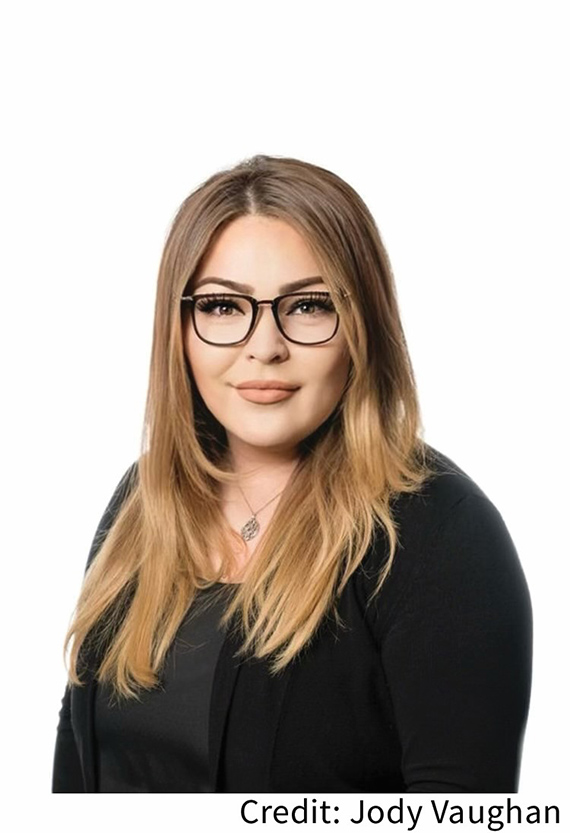
Gabrielle Prince comes from the Lake Babine Nation and Nak’azdli Whut'en. She belongs to the Lhts’umusyoo (Beaver) Clan. Gabrielle is working on a Bachelor of Science at UNBC. She uses her knowledge and her culture to inspire people with her stories.
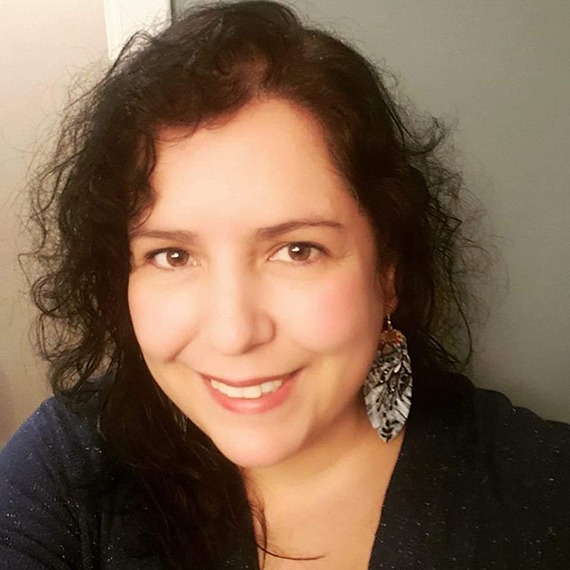
The illustrator of the book is the artist Carla Joseph.
Carla Joseph is a Métis and Cree artist from Prince George, British Columbia. Carla has made art for many organizations, including the Aboriginal Head Start Association of British Columbia, Northern Health, and the First Nations Health Authority. Carla loves that her beautiful art helps people feel different emotions. Carla now lives in Chilliwack, British Columbia.
As we read and explore the illustrations, we will check our understanding of the story by using interrogative sentences or asking questions.
Check out the following example of an interrogative sentence.
This is a question. We start a question with a capital letter and end it with a question mark.
We can ask questions to:
- help us understand
- learn new information
Some question words are:
- who
- what
- when
- where
- why
- how
We can use these words to ask questions such as:
What do you wonder about the story?
What is the main message in the story?

Student Success
Pause and record!
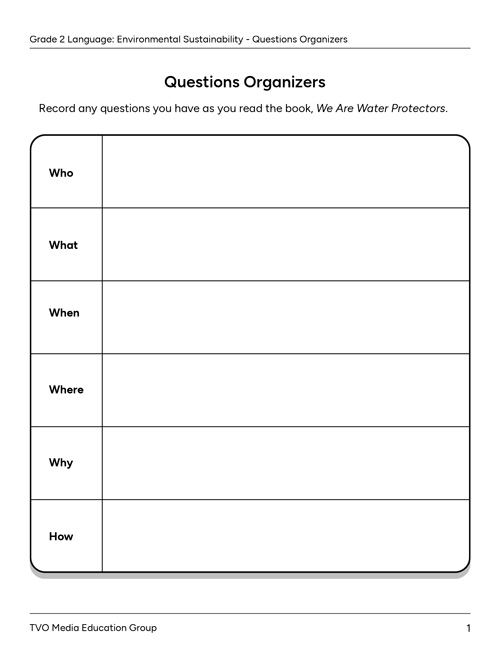
As you read, if you come across something that you don’t understand, pause and record your questions using the Questions Organizer or by using another method of your choice.
If you would like, you can use speech-to-text or audio recording tools to record your thoughts.
When you record your question, remember to use a capital letter at the beginning and a question mark at the end of your sentence!
Before we begin, let’s go over some words we may find in the story!
Try reading each new word by sounding it out with a partner, if possible. Next, take turns clapping out the syllables or parts of each word.
You may read the story and explore the illustrations with a trusted adult or a friend. As you read, share your thoughts and record any questions you have about the story.
Description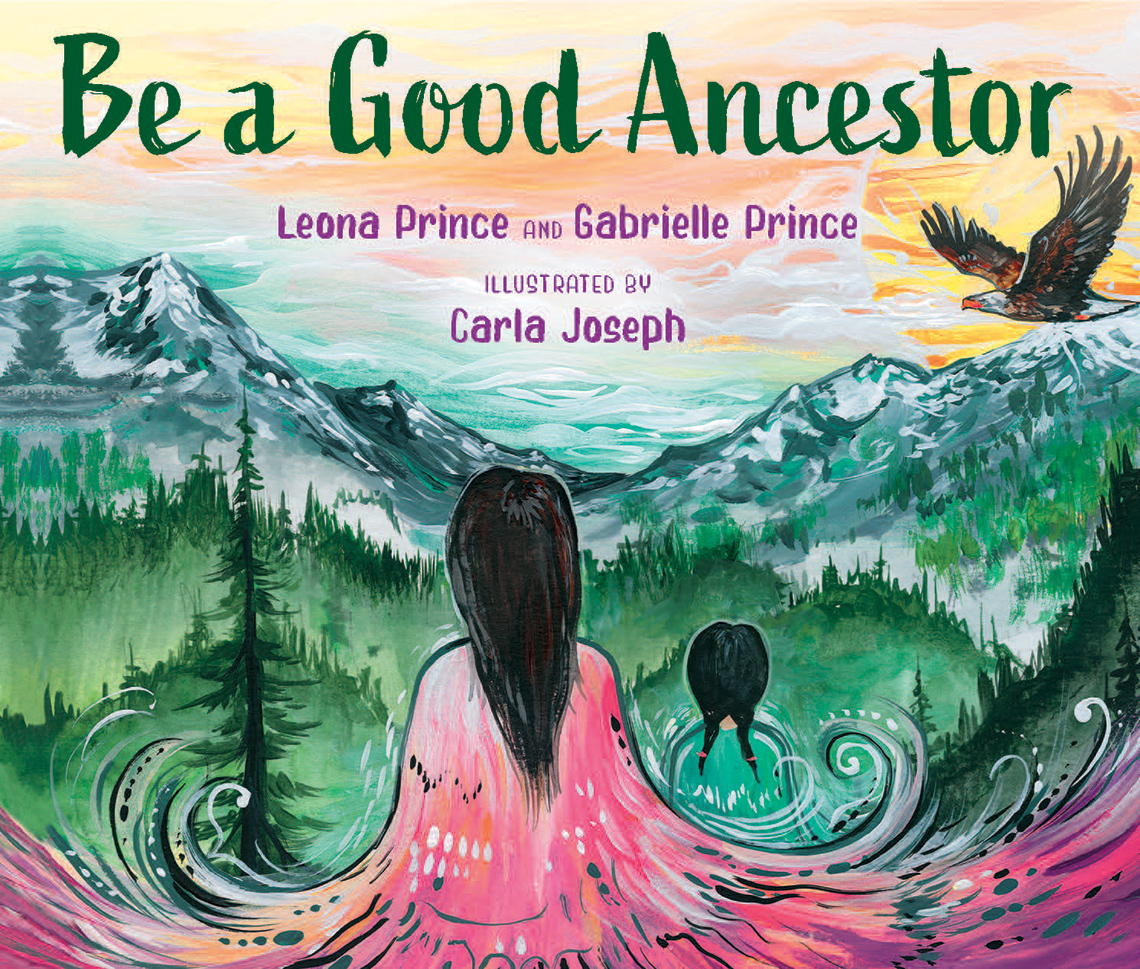
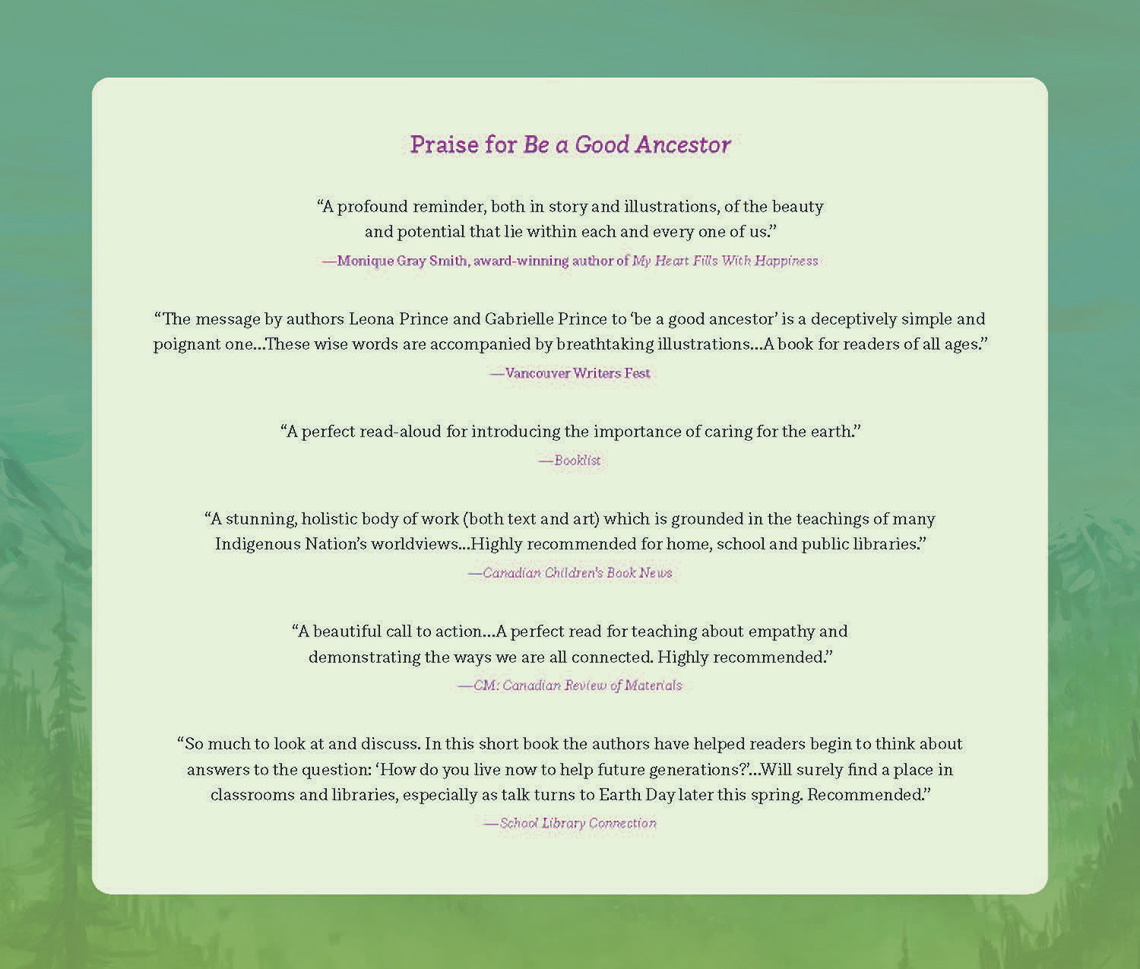
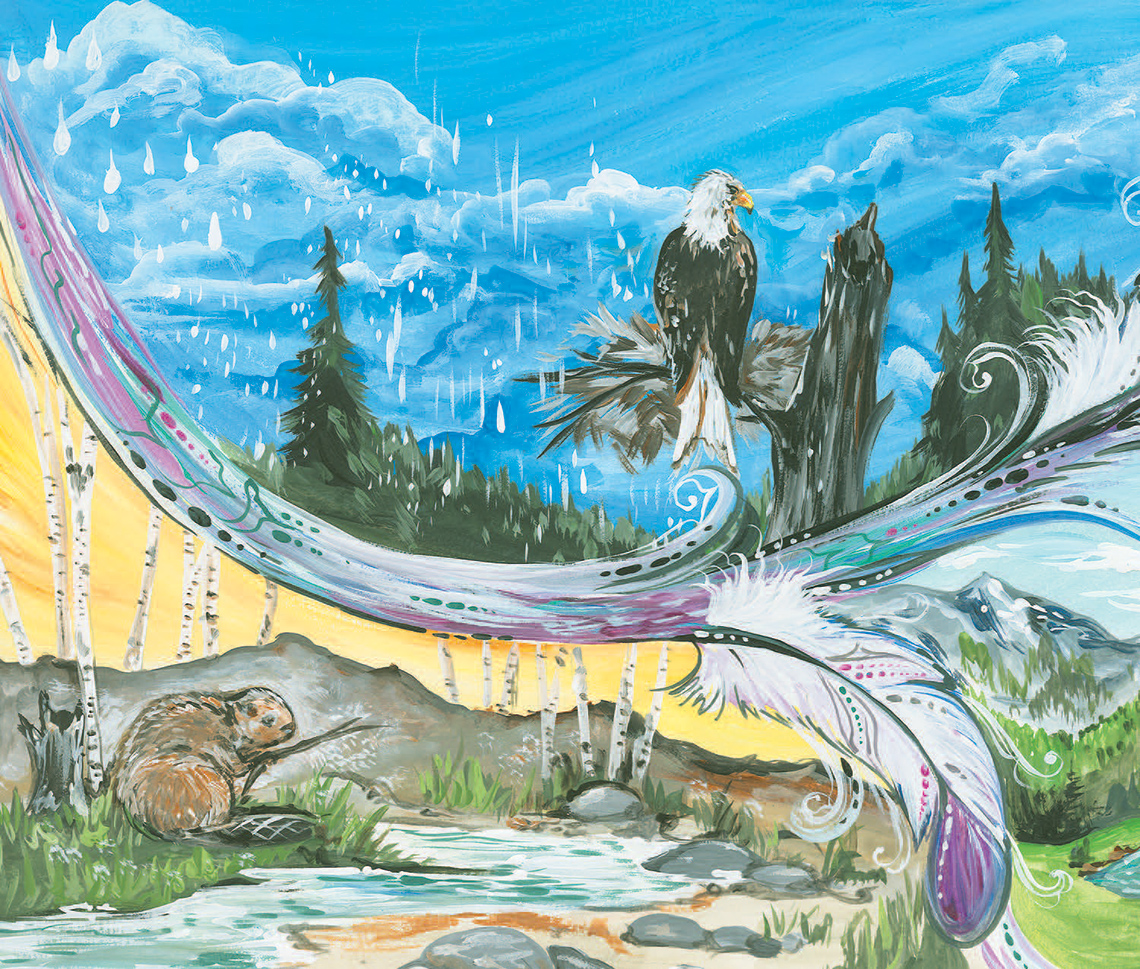
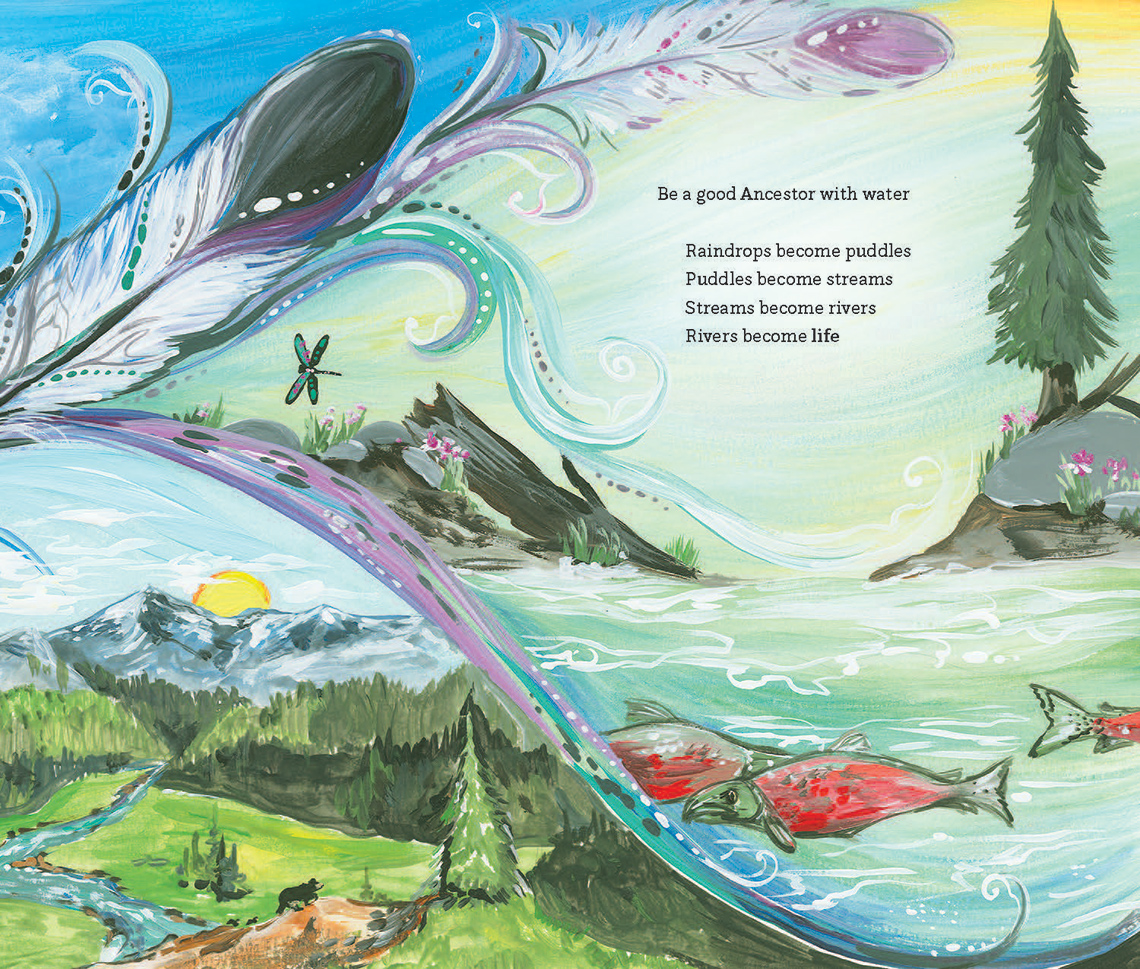
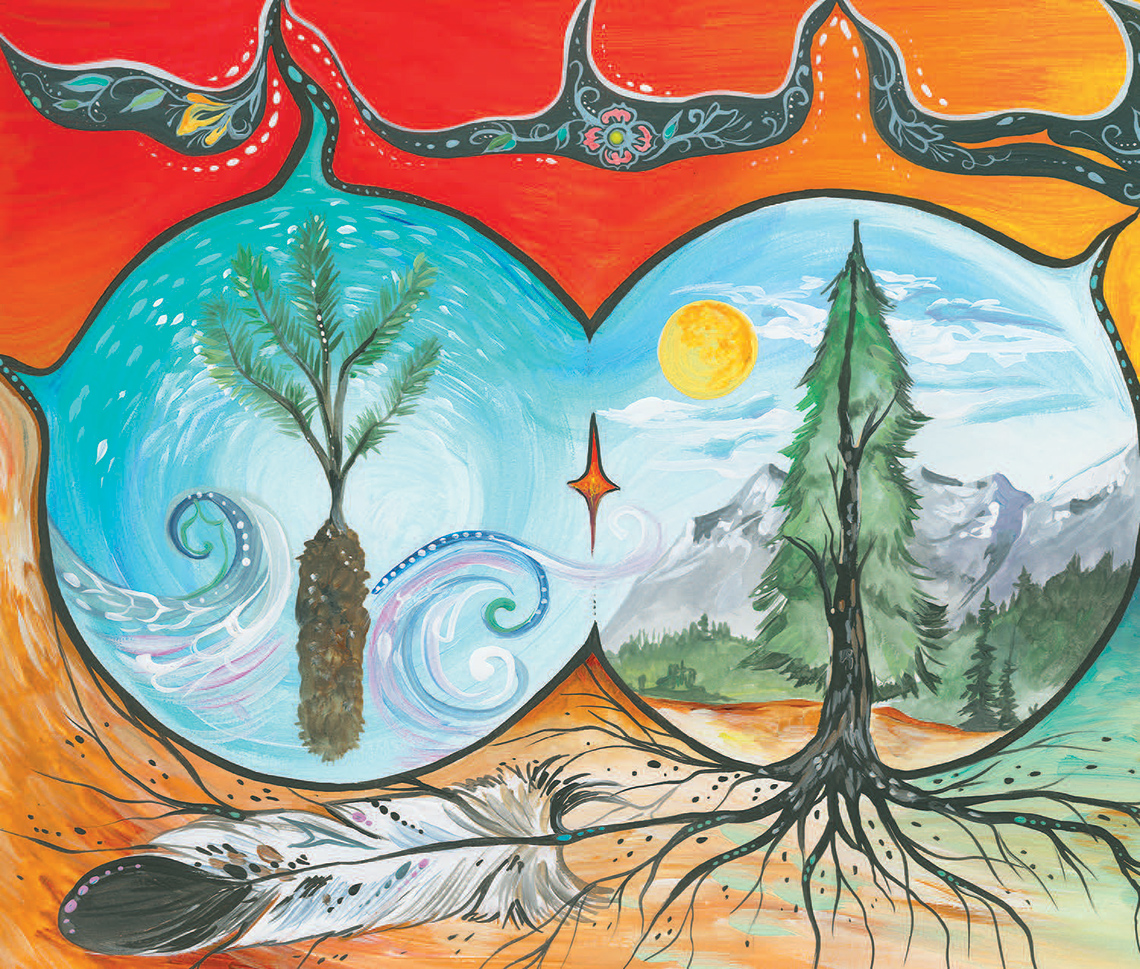
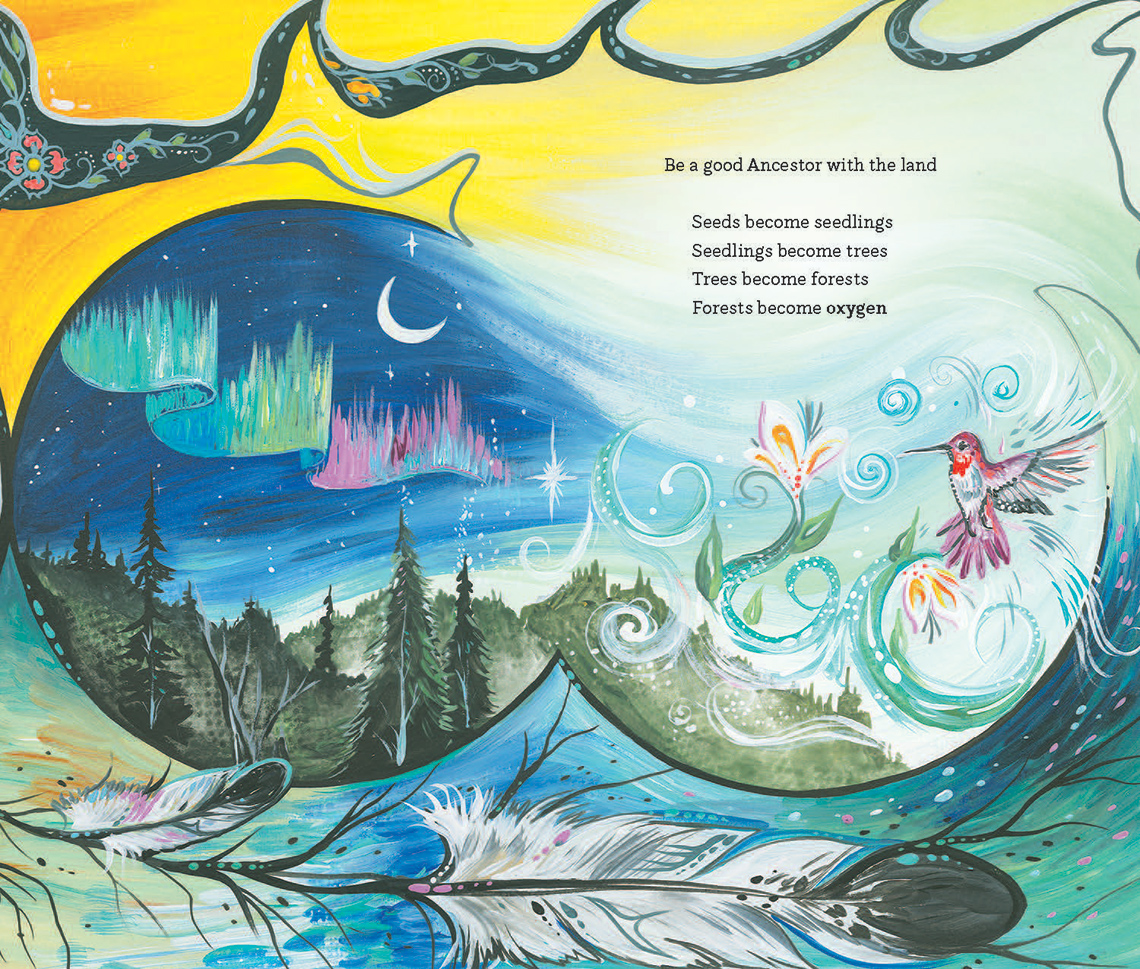
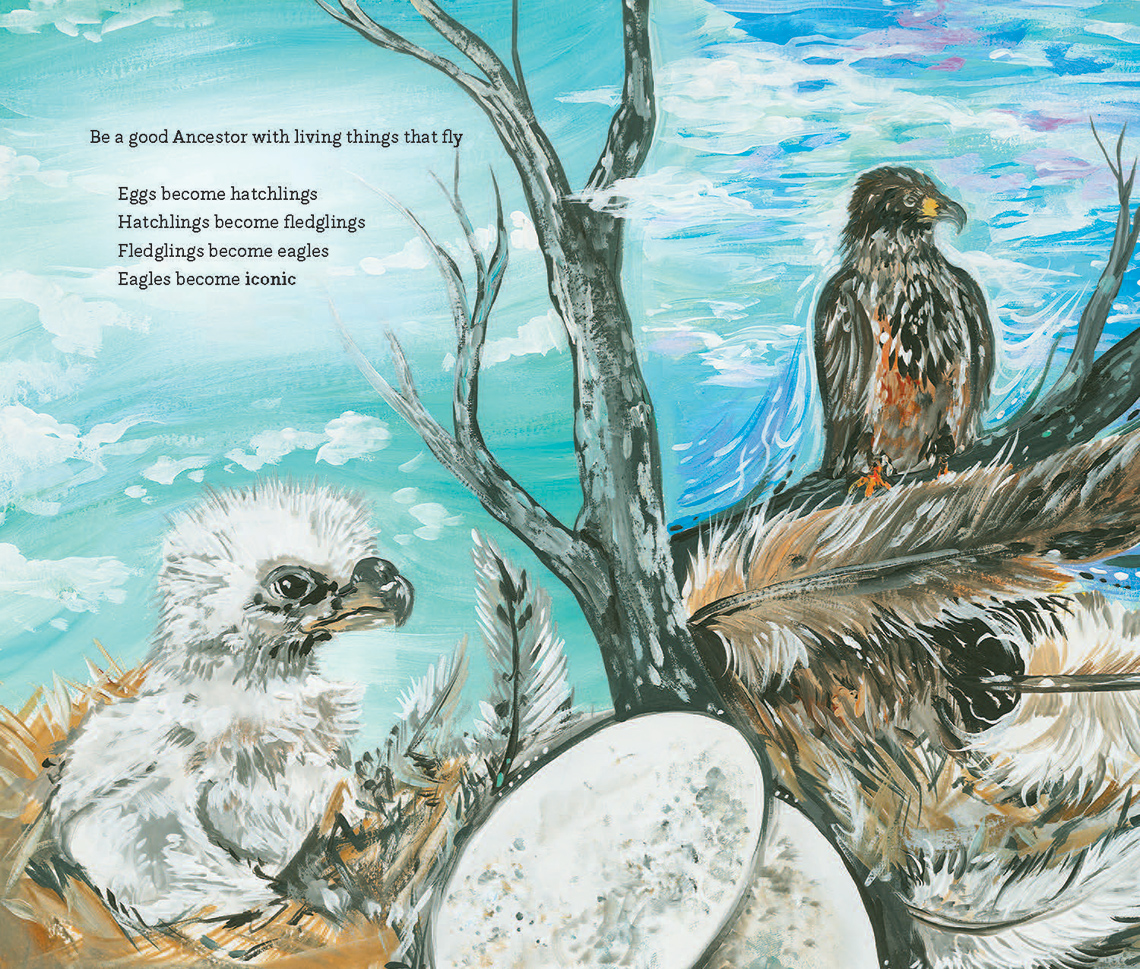
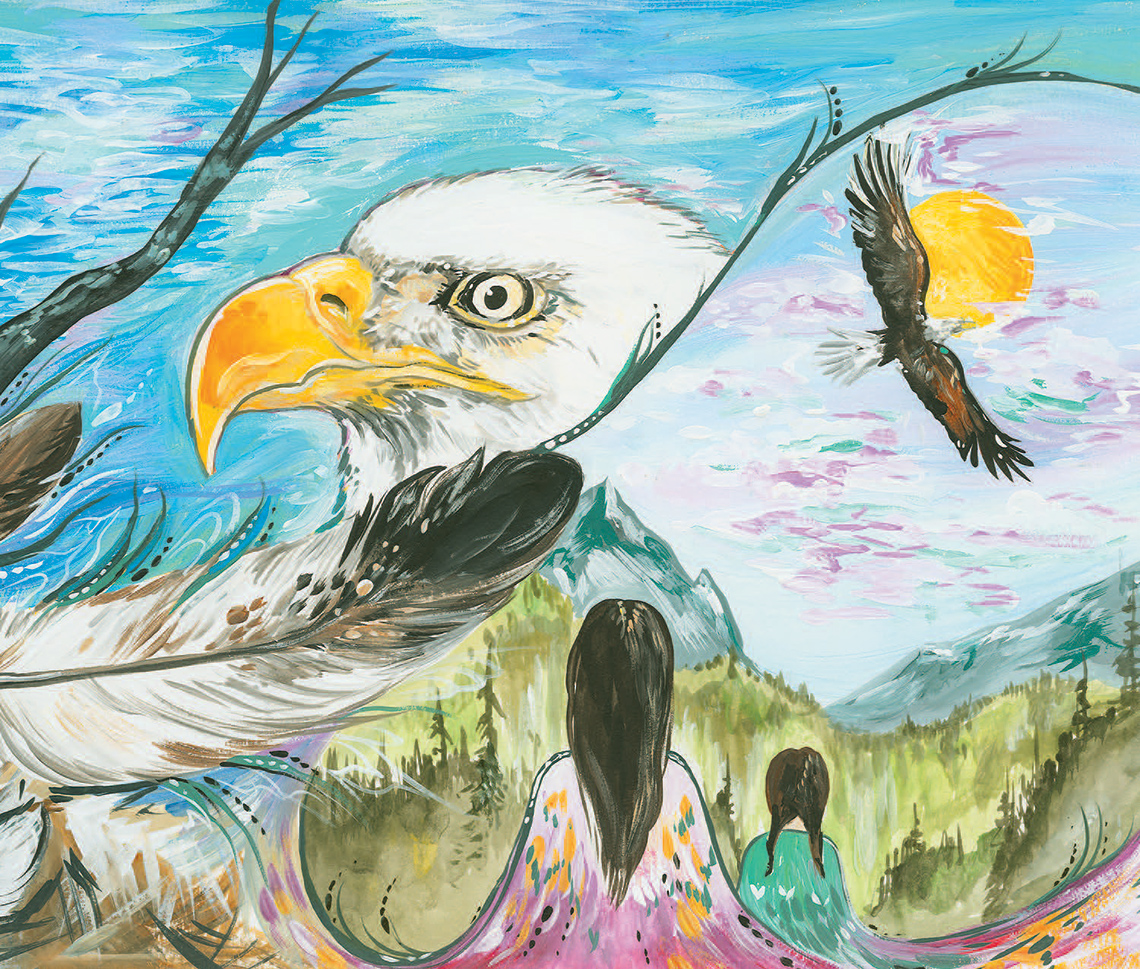
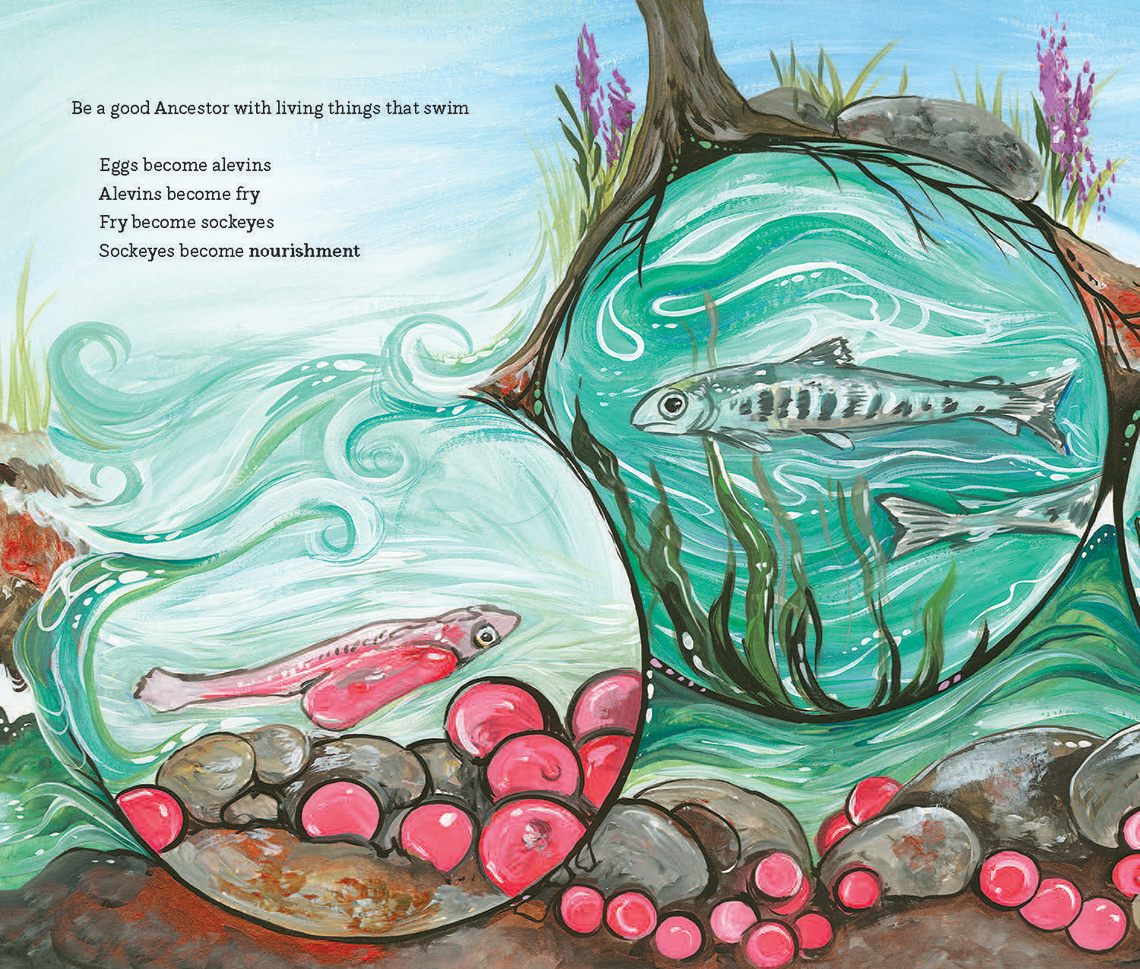
Image 1:
There is and elder person and a child looking out mountains and forest. There is an eagle flying in the sky.
Image 2:
This page consists of different advance praises for the book.
One of the praises reads:
“A perfect read-aloud for introducing the important of caring for the earth”
Image 3:
This is the title page.
This page reads:
Be a Good Ancestor
Leona Prince and Gabrielle Prince
Illustrated by Carla Joesph
Orca Book Publishers
Image 4:
There is a bever near a dam holding a piece of grass in their hands. There is an eagle sitting on a tall tree stump. In the background there is a forest of trees and a sky full of clouds. There is a feather flowing across the page.
Image 5:
The same feather is flowing in this page which splits up the images. The bottom image is a scenery of a river flowing into the forest with mountains in the background. The sun is peeking out of the mountains. There is also a small bear walking up a small hill near the river.
The top image is of fish swimming under water. Above the water there is a dragon fly and a small tree.
This page reads the following with the word life bolded:
Be a good Ancestor with water
Raindrops become puddles
Puddles become streams
Streams become rivers
Rivers become life
Image 6:
This page is split between two images that are in a shape of a circle but are connected. The first circle has a small growing tree, and the second has the tree with the roots growing out underground. One of the roots is connected to a feather.
Image 7:
The roots from the tree continue onto the bottom of this page with two feathers. On the top there is a scenery of the top of a forest in the night sky. The moon and stars are in the sky. The night sky blends into scenery of a hummingbird and small flowers.
This page reads the following with the word oxygen bolded:
Be a good Ancestor with the land
Seeds become seedlings
Seedlings become trees
Trees become forests
Forests become oxygen
Image 8:
There are two baby eagles sitting. One is sitting on a branch and the other in a nest with two eggs.
This page reads the following with the word iconic bolded:
Be a good Ancestor with living things that fly
Eggs become hatchlings
Hatchlings become fledglings
Fledglings become eagles
Eagles become iconic
Image 9:
There is an elder and a young child looking out into the forest and mountains. There is an eagle flying in the sky with the sun shining in the sky. On this page at the top left there is a large image of a side view of an eagle with a large feather underneath.
Image 10:
There are several eggs underwater with an alevins floating on top. There is also sockeyes swimming.
This page reads the following with the word nourishment bolded:
Be a good Ancestor with living things that swim
Eggs become alevins
Alveins become fry
Fry become sockeyes
Sockeyes become nourishment
Take a moment to reflect what you have read so far before you continue.
Description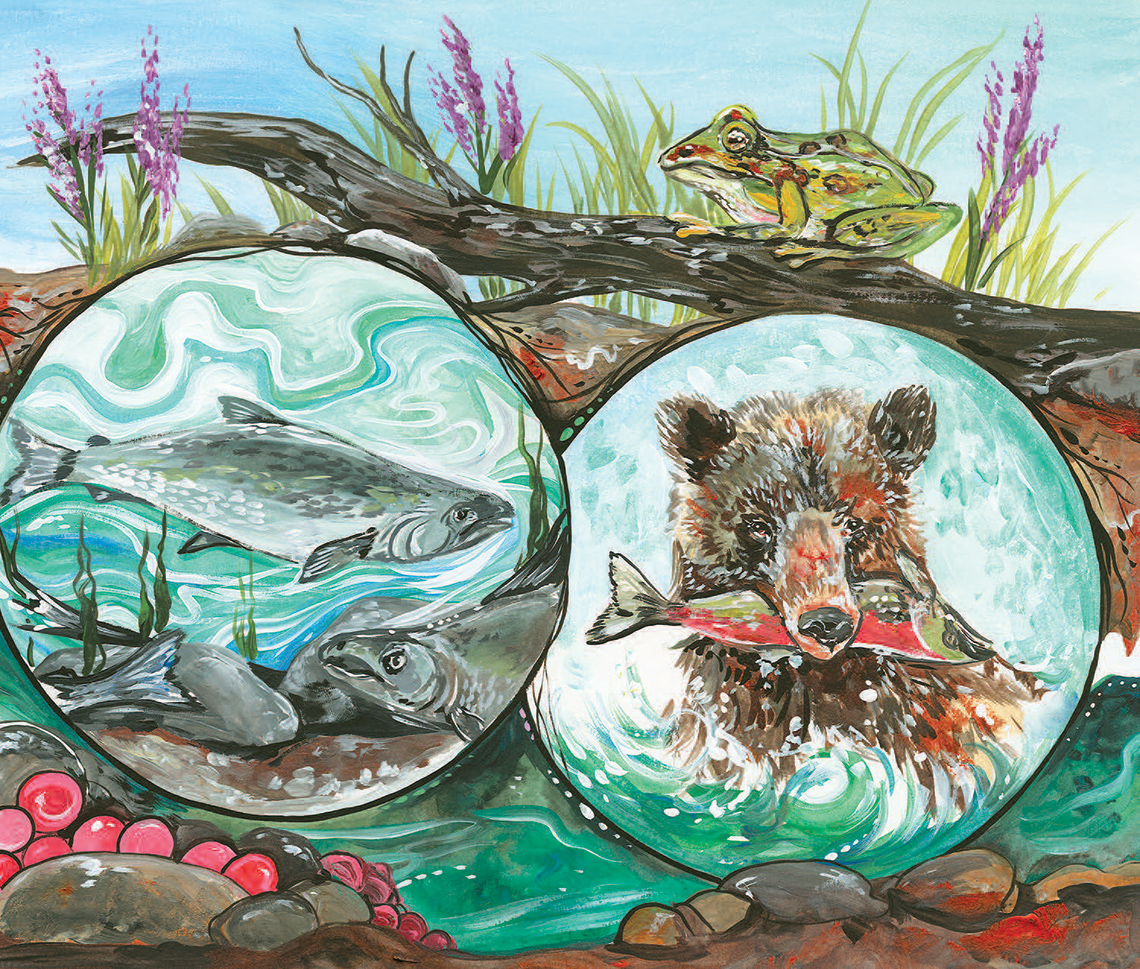
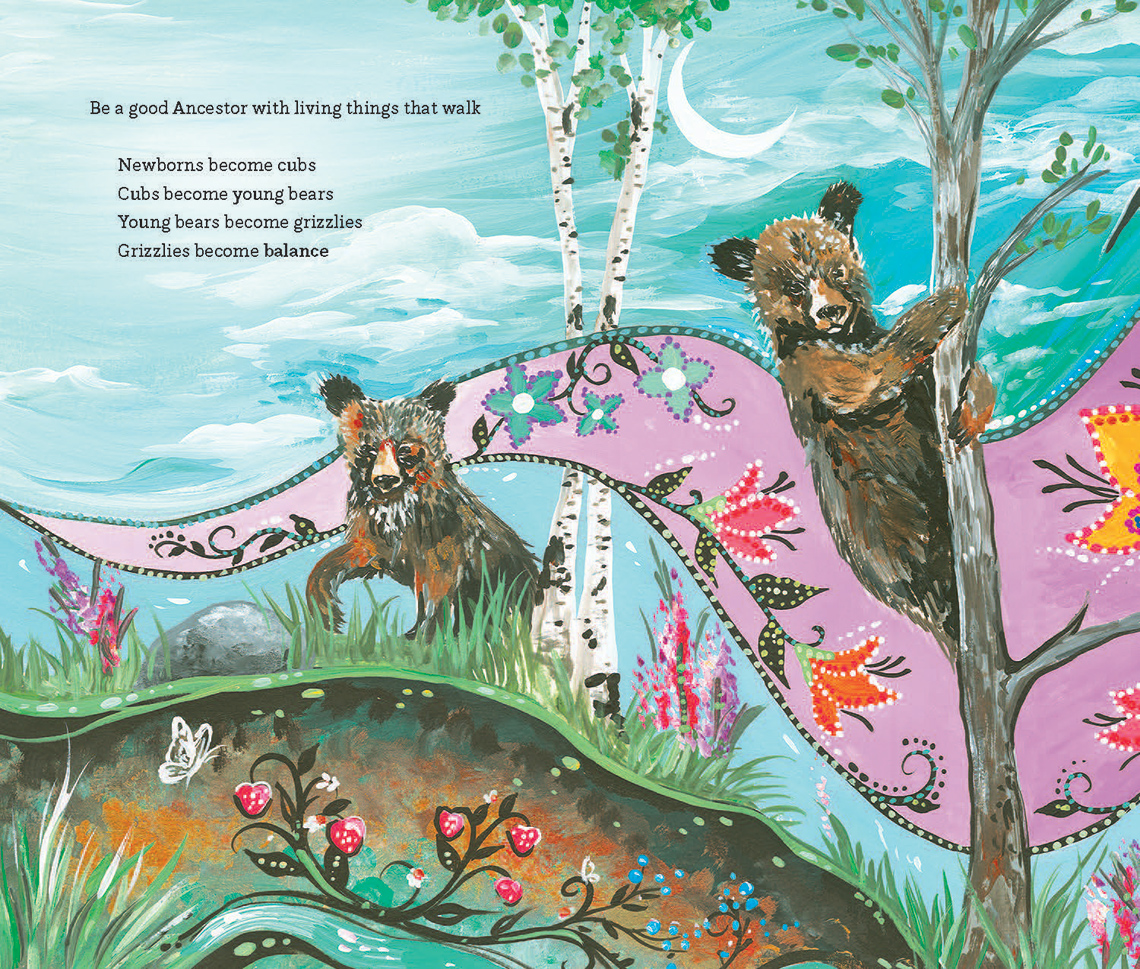
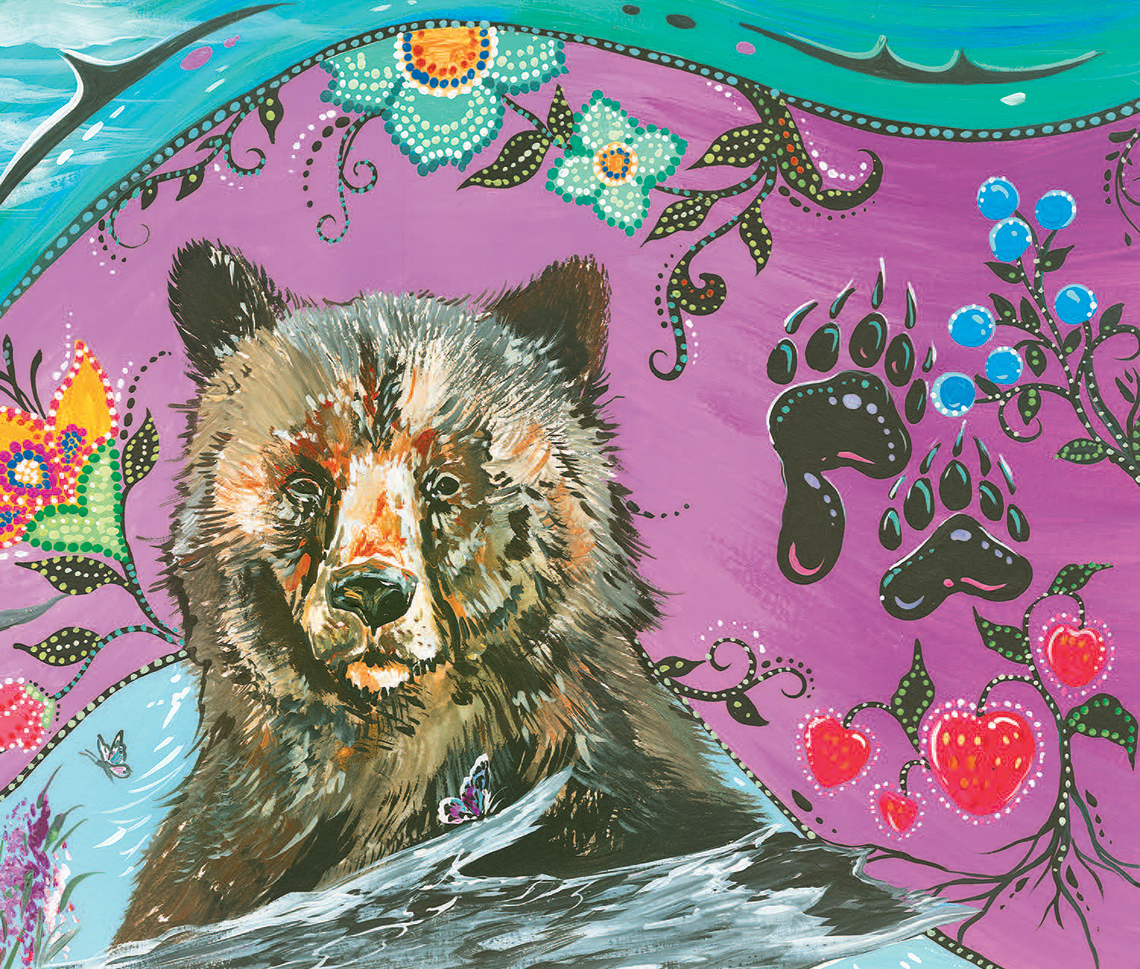
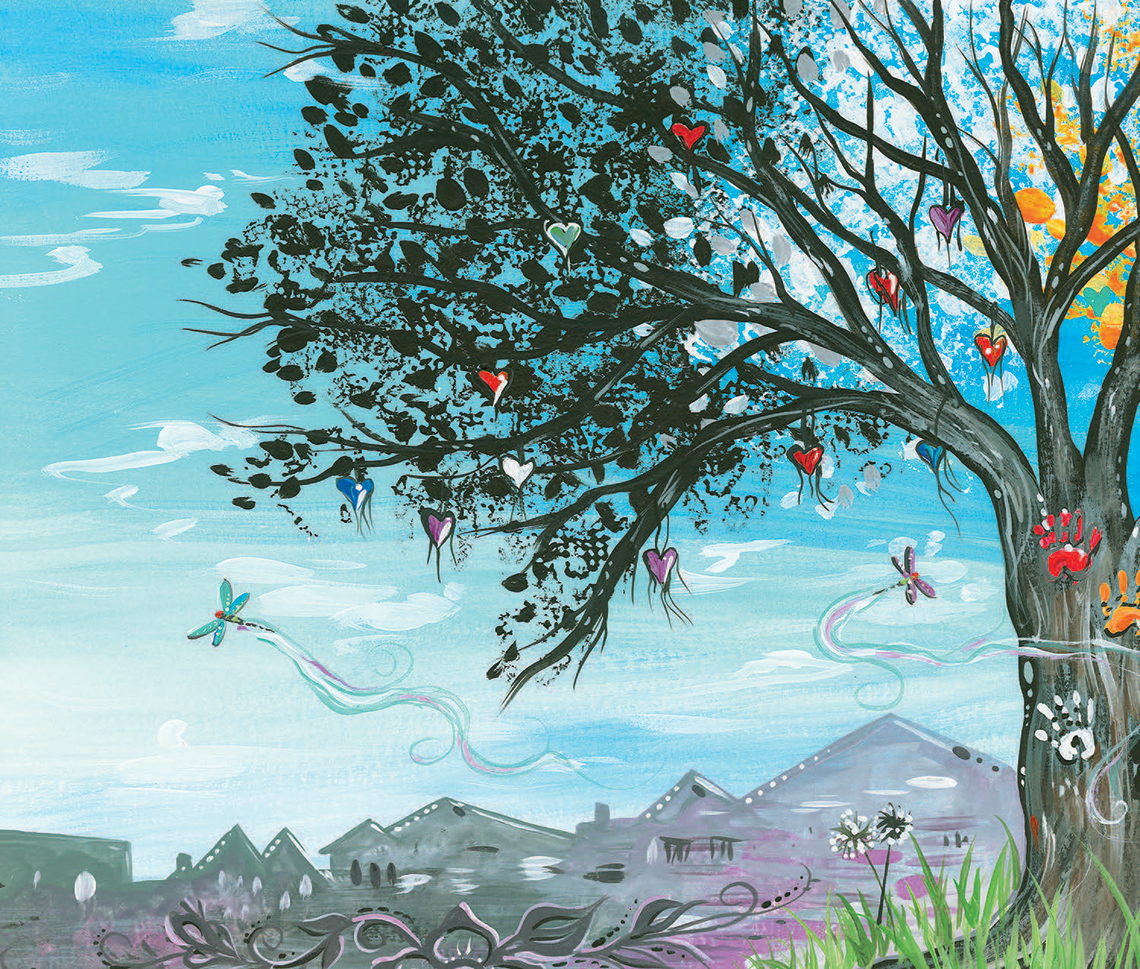
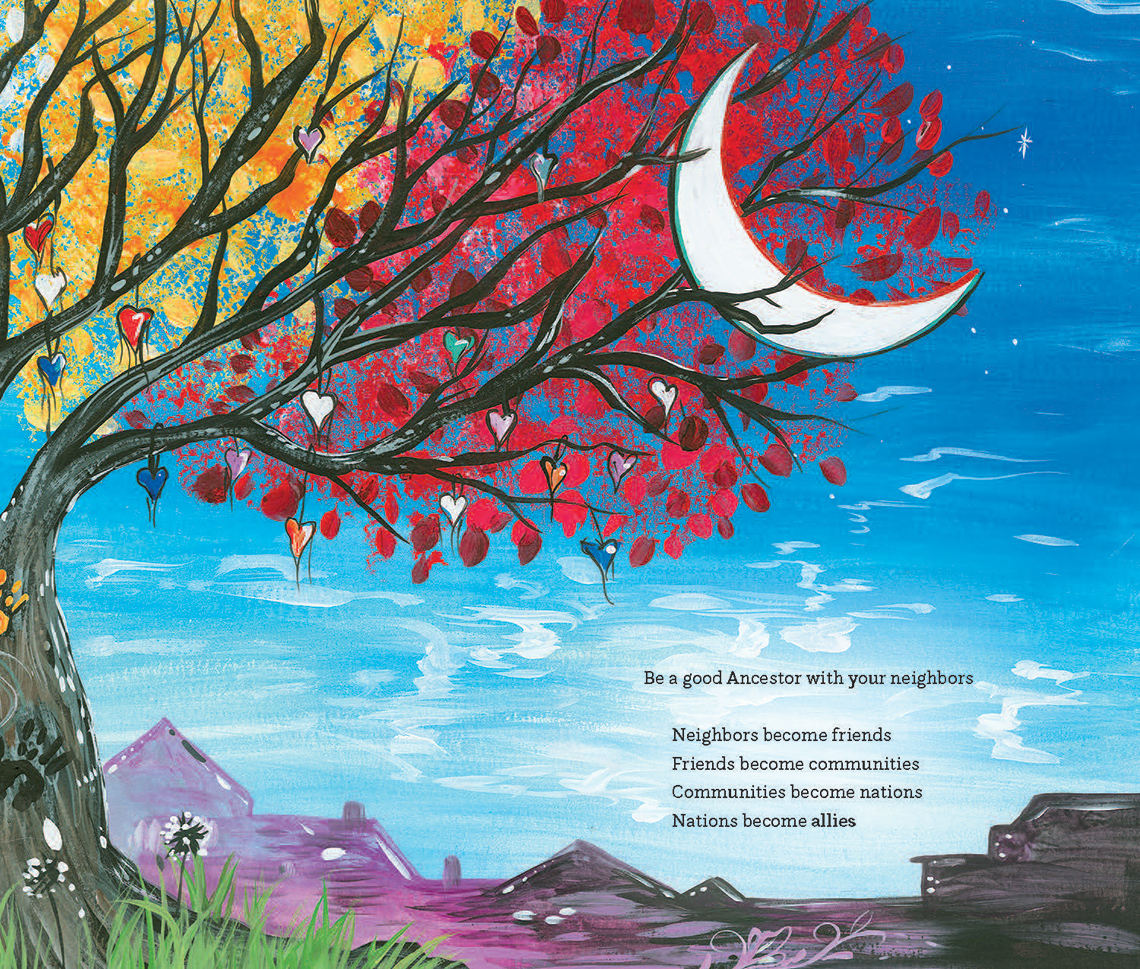
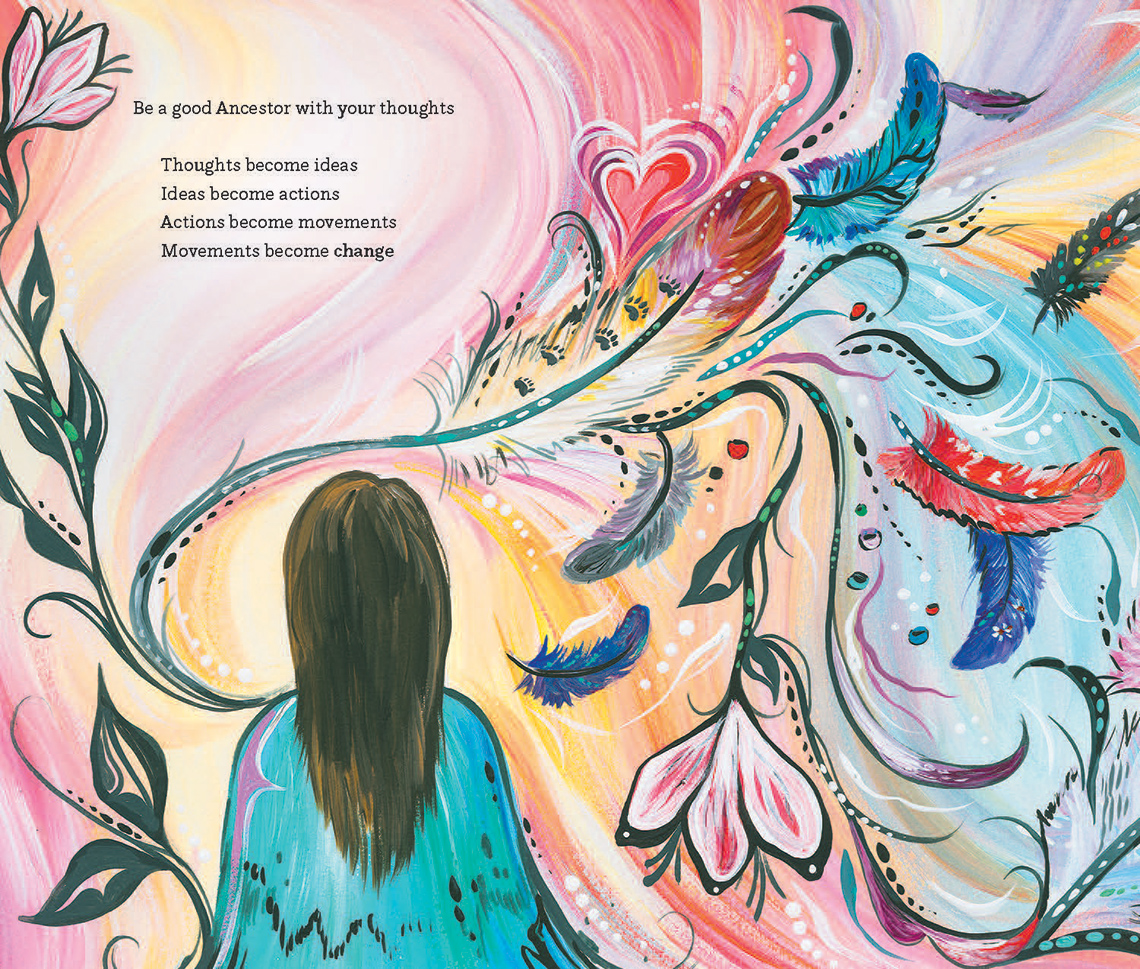
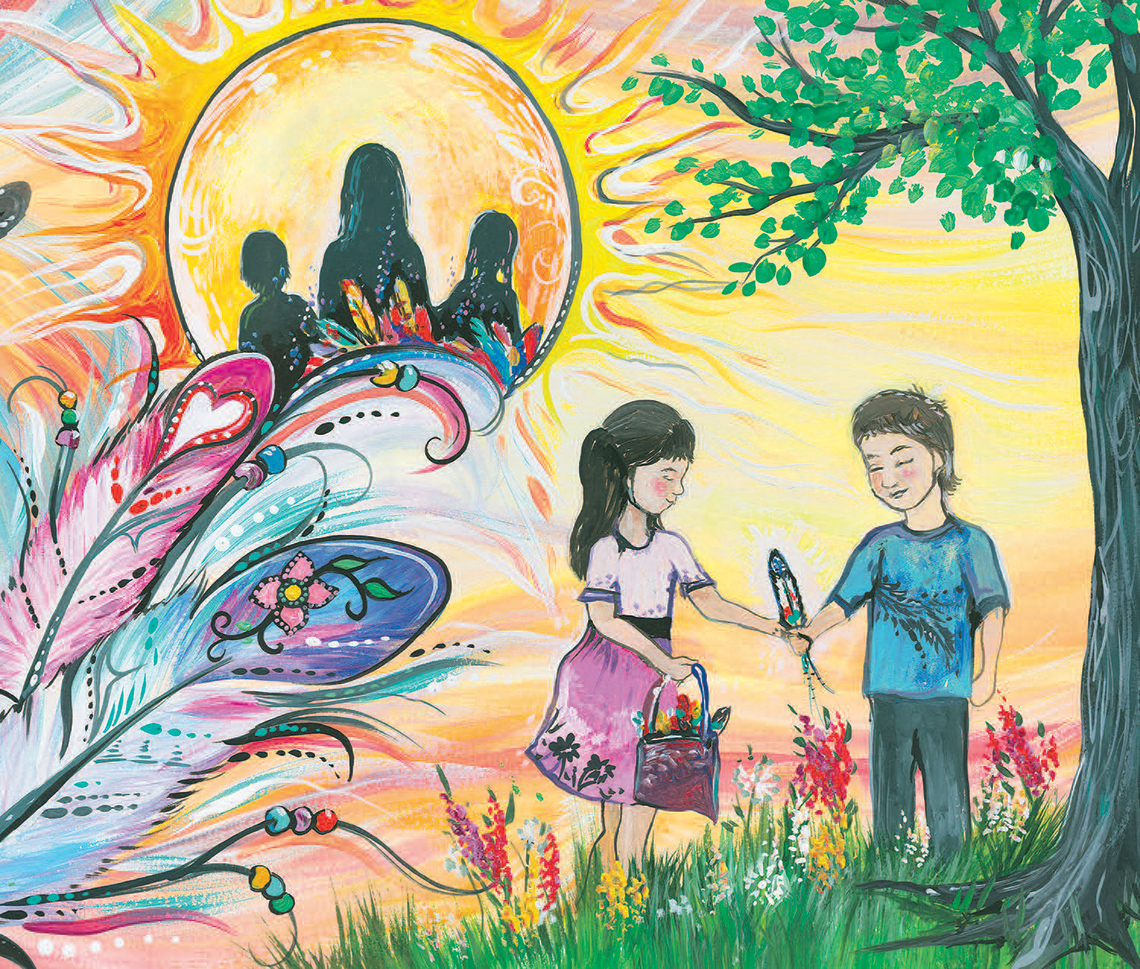
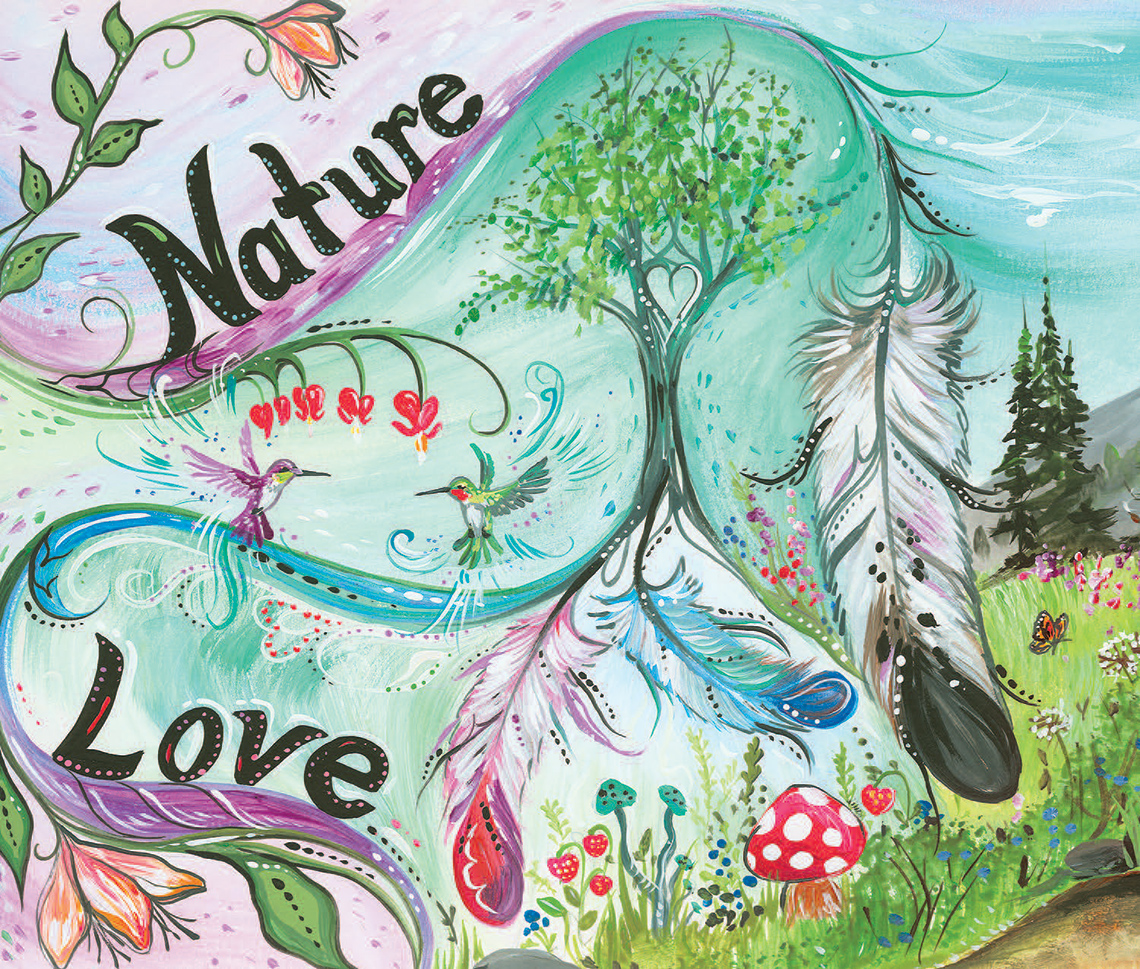
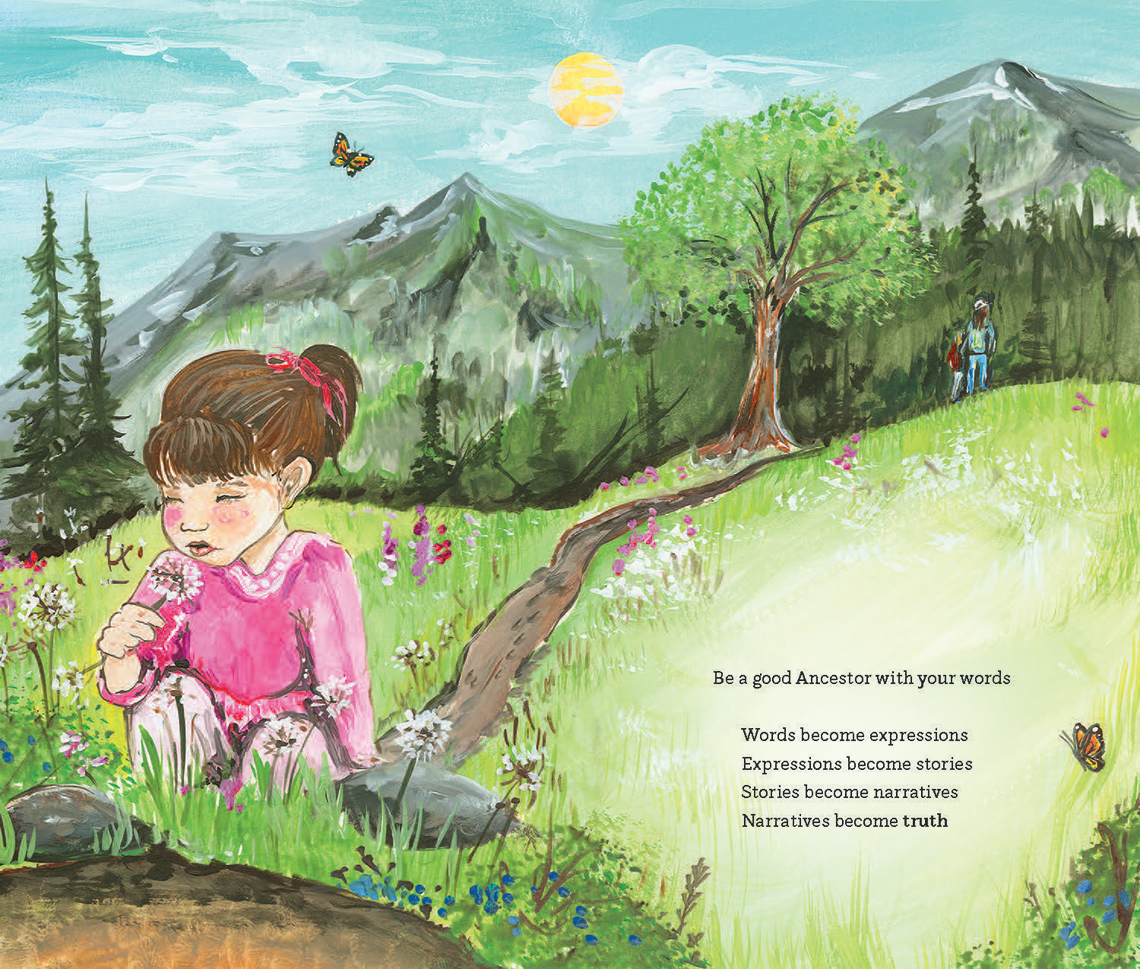
Image 1:
There is a frog sitting on top of a large branch. Under the branch there are two sets of images. The first image is underwater with three sockeyes swimming. The second image is of a bear with a fish in his mouth.
Image 2:
There is a baby bear climbing a tree an another bear in the grass.
This page reads the following with the word balance bolded:
Be a good Ancestor with living things that walk
Newborns become cubs
Cubs become young bears
Young bears become grizzlies
Grizzlies become balance
Image 3:
There is a large image of a grizzly bear with footprints and branch with different flowers in the background.
Image 4:
A large tree with branches that have leaves. There are heart shaped ornaments hanging from the branches. On the tree trunk there are three handprints. There is an outline of house roof tops in the background with a dragonfly flying away.
Image 5:
There is a tree filled with leaves and heart shaped ornaments hanging all over. There is also a moon sitting in one of the branches. The background has an outline of house rooftops.
This page reads the following with the word allies bolded:
Be a good Ancestor with your neighbours
Neighbours become friends
Friends become communities
Communities become nations
Nations become allies
Image 6:
A teenage child with different leaves and feathers flowing in the background.
This page reads the following with the word change bolded:
Be a good Ancestor with your thoughts
Thoughts become ideas
Ideas become actions
Actions become movements
Movements become change
Image 7:
The bottom left corner has large feather peaking out. There are two school aged children exchanging feathers in front of a tree. In the background there is a sun with a shadowed outline of an adult and two small children one on each side.
Image 8:
There is a medium size tree in the middle of the page. The roots are attached to feathers. One of the roots spreads out into a curved line with the words “Love” at the end of it. The word “Nature” is mentioned at the top left corner of the page with a feather at the ends.
Image 9:
There is a small child sitting in the grass at the bottom of a hill holding a dandelion in her hand.
In the background there is a forest and a mountain view. The sun is in the sky hiding behind clouds with a butterfly flying.
This page reads the following with the word truth bolded:
Be a good Ancestor with your words
Words become expressions
Expressions become stories
Stories become narratives
Narratives become truth
Continue reading Be a Good Ancestor by Leona Prince and Gabrielle Prince.
Description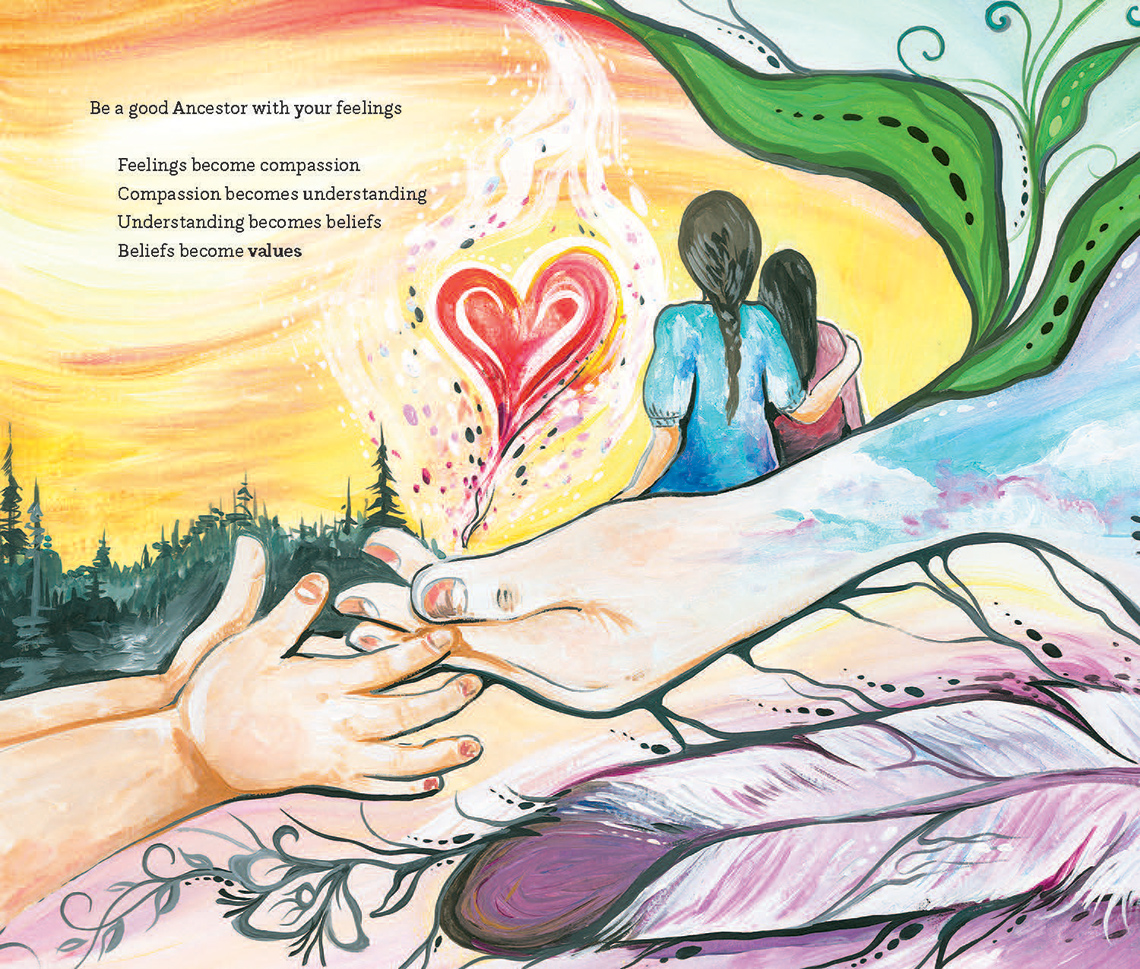
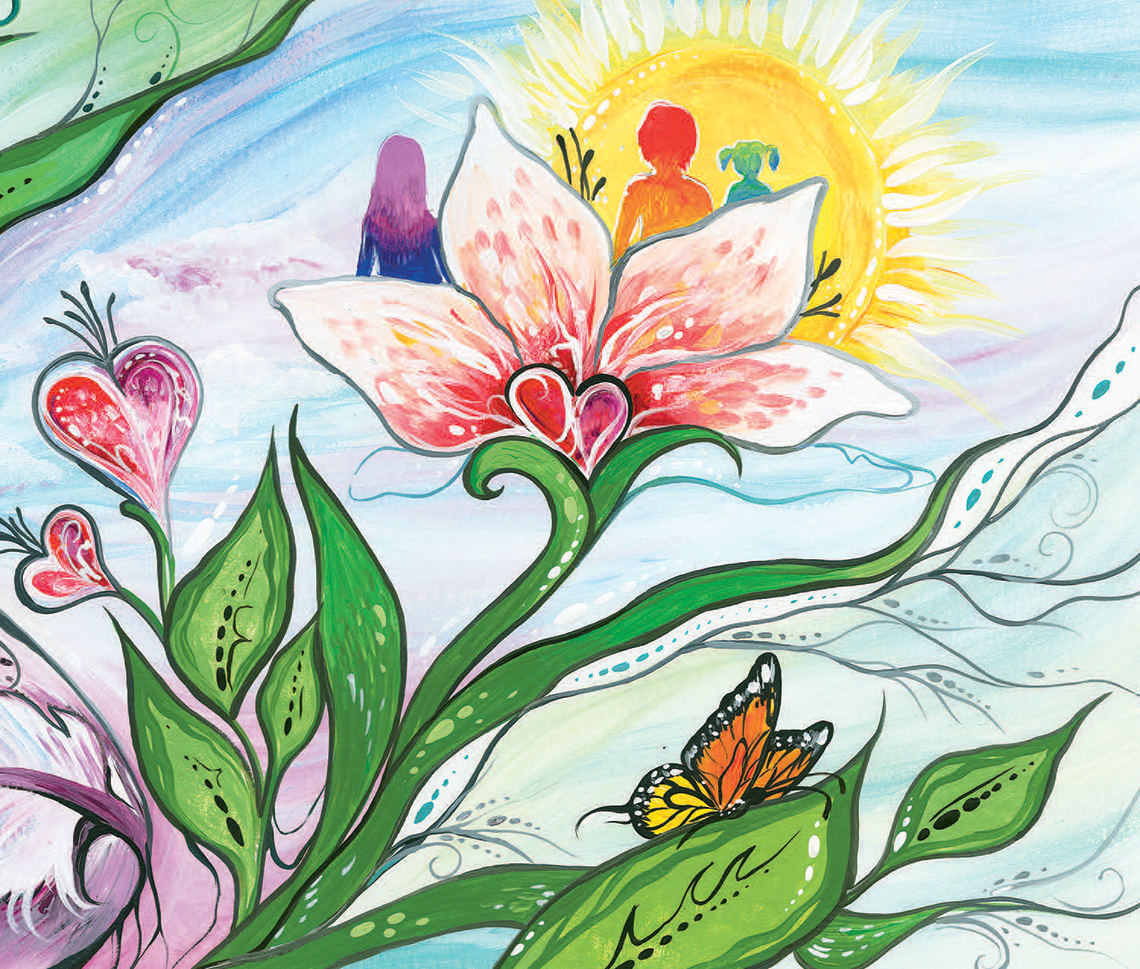
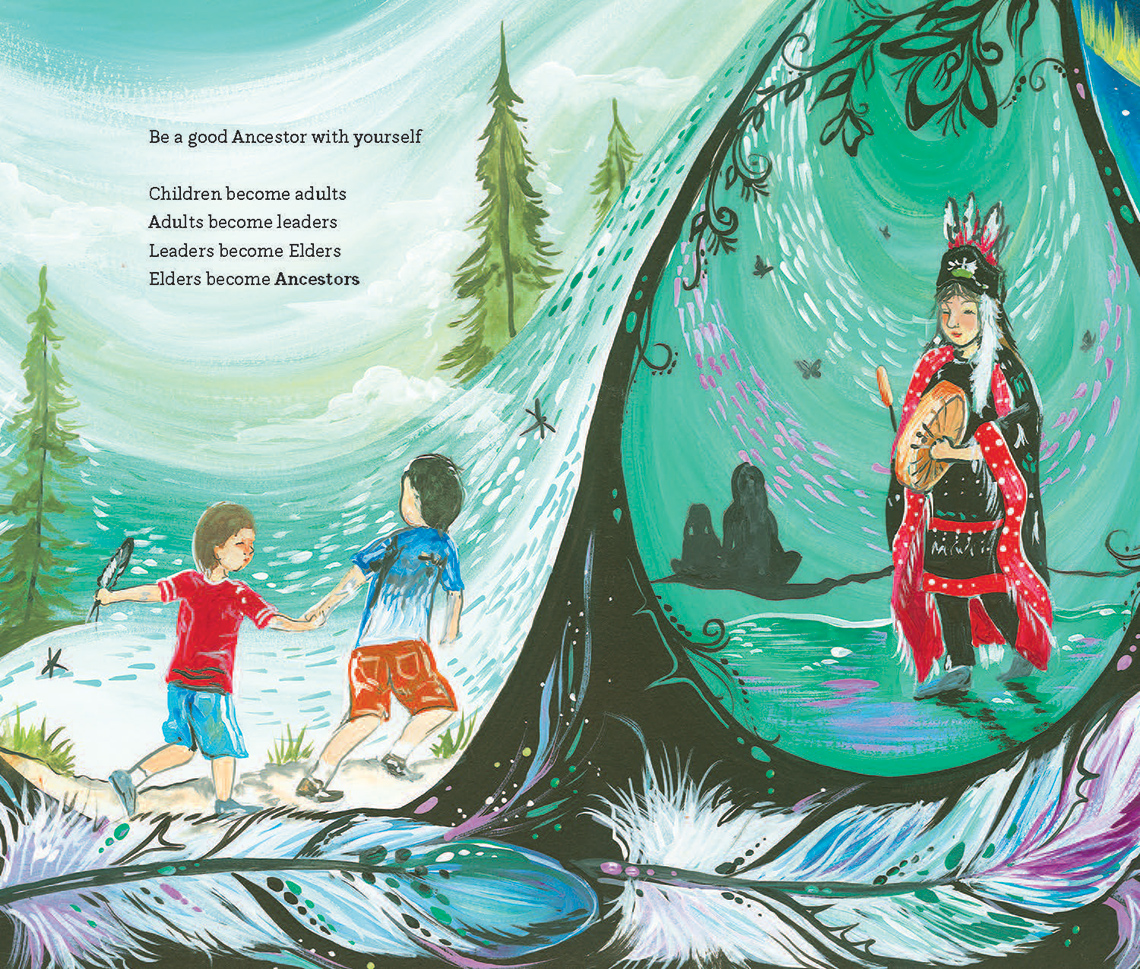
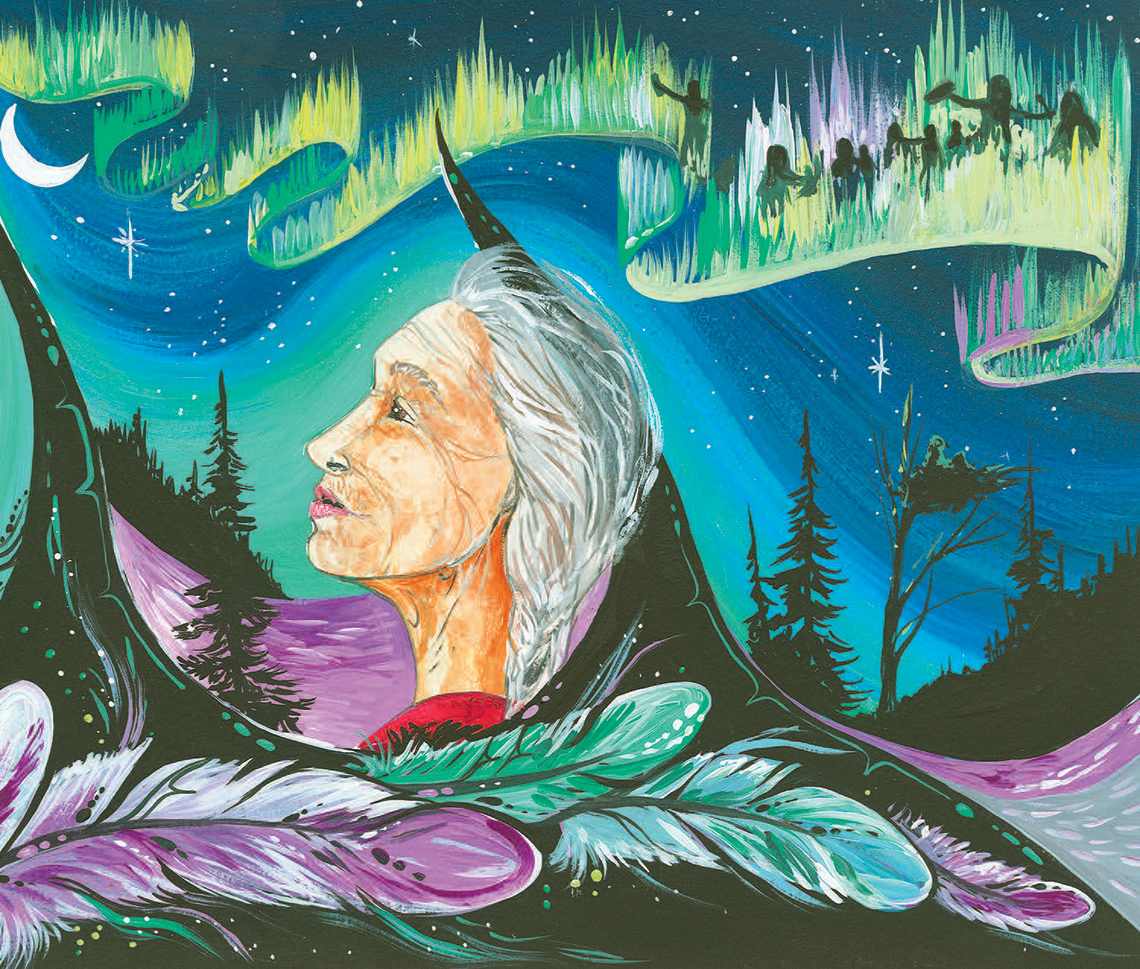
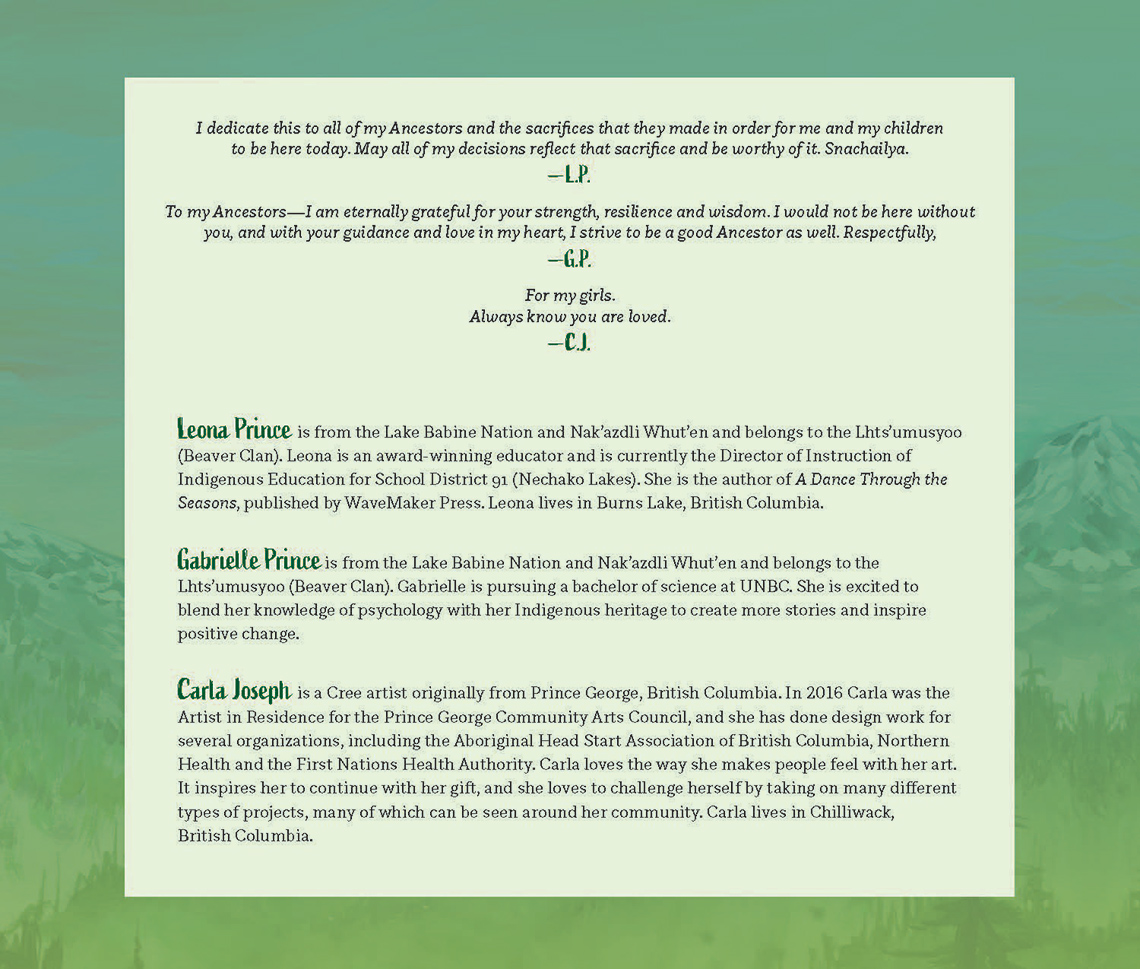
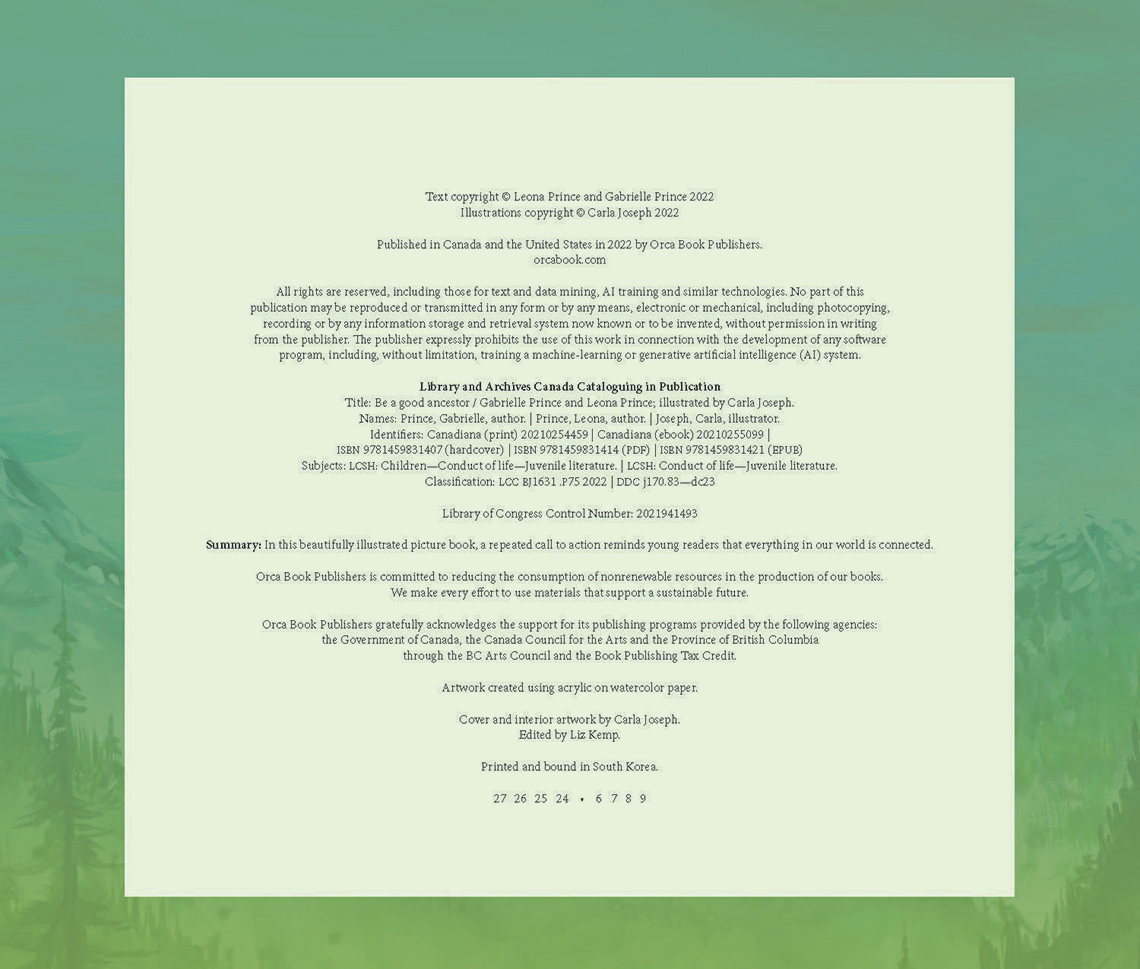
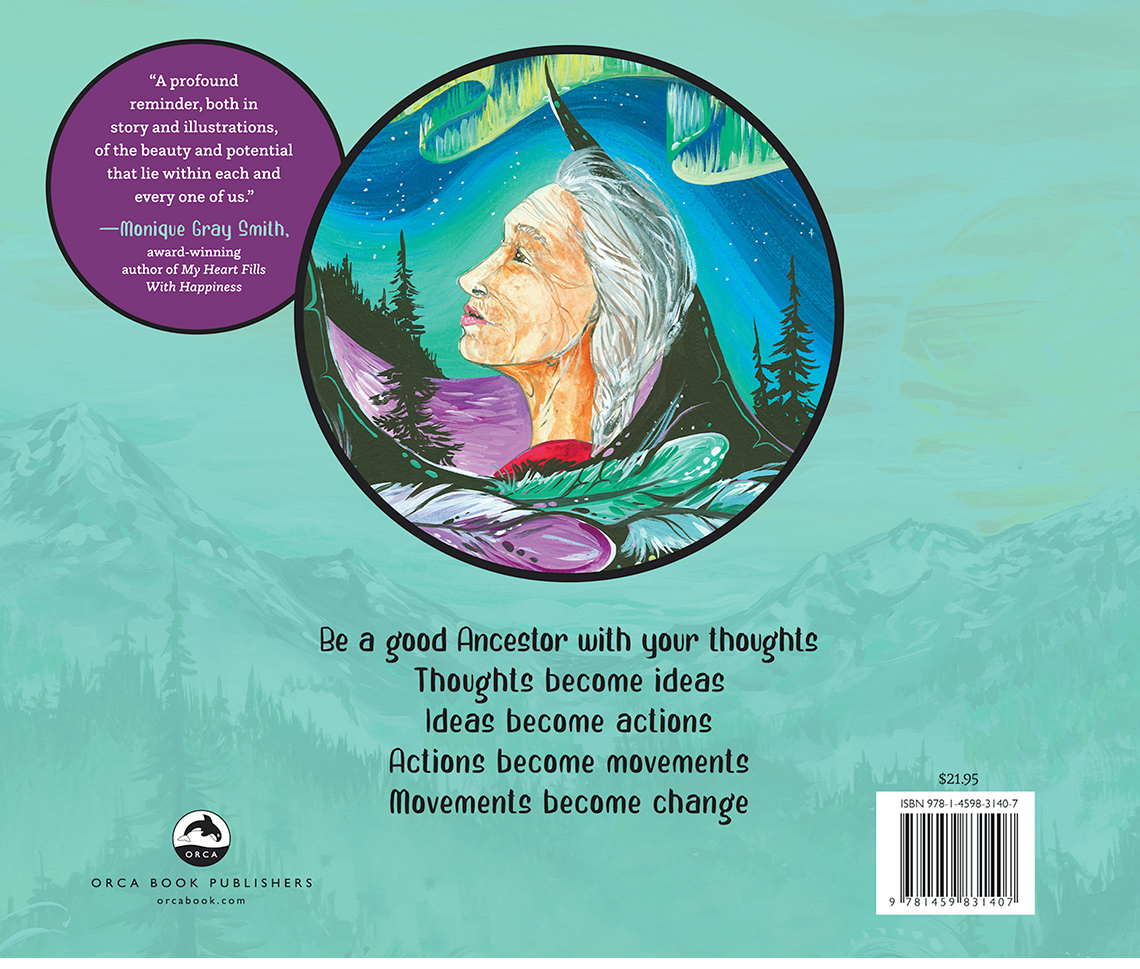
Image 1:
The center of the pages there are hands of a small child reaching towards an adult’s hand. There is a heart floating out from the palms of their hands. Sittig on the arm of the adult hands there is a mother and daughter looking out into the sky.
This page reads the following with the word values bolded:
Be a good Ancestor with your feelings
Feelings become compassion
Compassion becomes understanding
Understanding become beliefs
Beliefs become values
Image 2:
There is a large flower in the middle of the page. On the petals there are three small children sitting. There is the sun in the background.
Image 3:
There are two young boys holding hands and walking. One of them has a feather in their hands. There is also an Elder wearing their cultural clothing and holding an instrument in hands.
This page reads the following with the word Ancestors bolded:
Be a good Ancestor with yourself
Children become adults
Adults become leaders
Leaders become elders
Elders become Ancestors
Image 4:
There is a side view of an Elder looking at the moon in the night sky. In the sky there are also a small group of people holding instruments in hand. The background has trees and in the fore front there are feathers.
Image 5:
This page consists of different dedications for the book.
One of the praises reads:
I dedicate this to all my Ancestors and the sacrifices that they made in order for me and my c children to be here today. May all of my decisions reflect that sacrifices and be worthy of it. Snachailya.
Image 6:
Copyright information of the book Be a Good Ancestor by Leona Prince and Gabrielle Prince. This section of the book lists its publication, legal, copyright, and printing details.
Image 7:
Back of the cover page of the book Be a Good Ancestor by Leona Prince and Gabrielle Prince
The story shares examples of different life cycles. A life cycle is a group of stages through which an animal passes during its lifetime.
One of the life cycles is of sockeye salmon. Let’s explore their life cycle!
“Be a good Ancestor with living things that swim.
Eggs become alevins
Alevins become fry
Fry become sockeyes
Sockeyes become nourishment.”
- Be a Good Ancestor
Explore the following interactive Sockeye Salmon Lifecycle to learn more about the four parts of a salmon’s lifecycle.
The last line on the page says, ‘Sockeyes become nourishment’. Who do the sockeyes become nourishment for?
Press the Answer button to learn more.
The sockeye salmon become nourishment for grizzly bears.
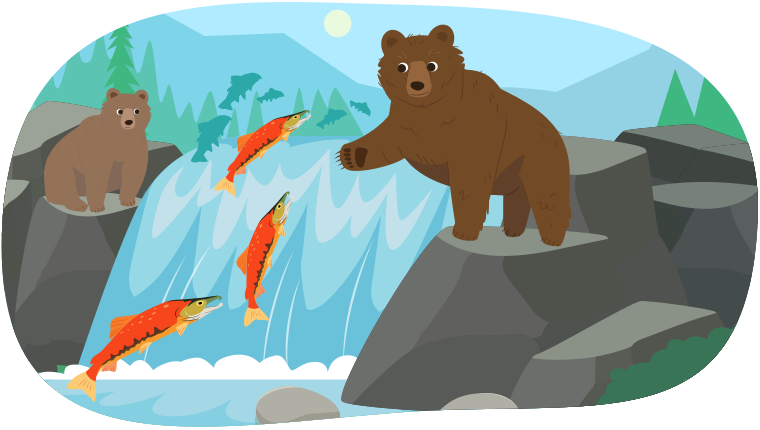
What would happen if something happened to affect the salmon, and the bears could not use them as nourishment?
Press the Answer button to learn more.
If the bears do not have the salmon, they cannot grow from cubs to grizzlies and help provide balance.
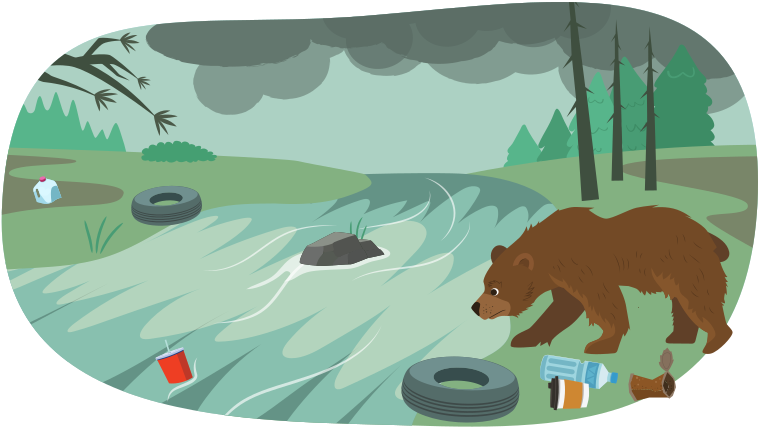
Be a good ancestor to the world around you - to the land, water, animals and people.
Being a good ancestor means that we take care of each other and our planet now so that we can share it with people, plants and animals of the future.
What small actions can you take to protect the balance in the world? How can you be a good ancestor?
Record your responses with words, audio, or pictures. Share with a partner, if possible.

Student Tips
Small action – big impact!
Land and water
- We can turn off the faucet when brushing our teeth.
- We can take short showers.
- We can be respectful of trees and plants. For example, we can try not to pick off bark or branches, flowers or plants. Instead, we can look for any that has fallen naturally.
- We can ask questions about trees, plants, and animals in the environment to learn more about them.
Animals
- We can be respectful of animal homes by keeping our distance and observing from afar.
- We can also keep our trash and recycling off the ground and away from plants and trees.
People
- We can use kind words when speaking to others.
- We can ask questions and learn about each other to understand one another better.
What can I do?
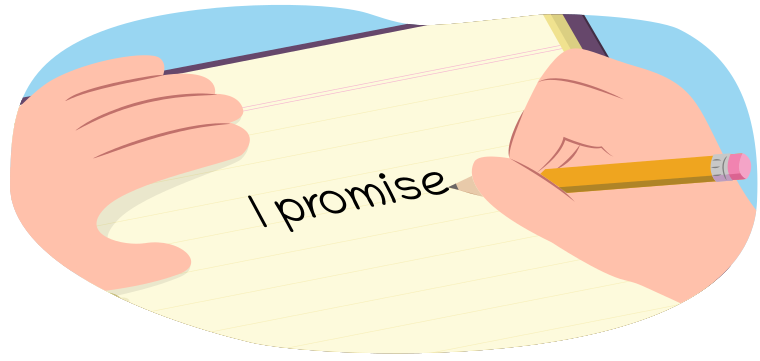
A pledge is a promise we make.
You are going to make your own promise or pledge of how you might do your part to be a good ancestor. Check out the following three steps to make your own promise!
Step 1: Gather ideas
Look back at the story and examples from the Action section to gather ideas. Record your ideas in your notebook.
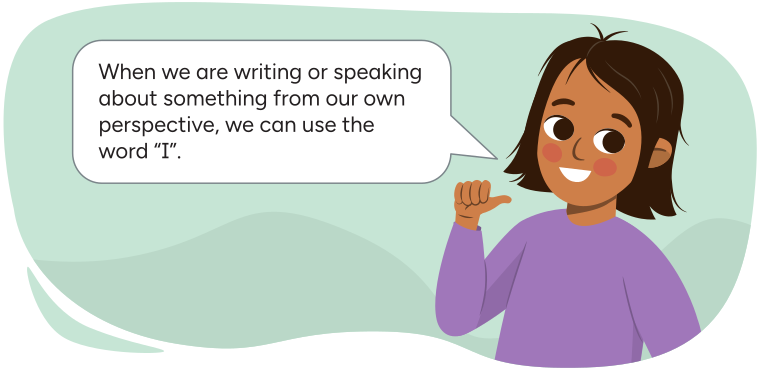
Step 2: Review commas
Let’s review the punctuation mark called a "comma".

We use commas to:
- pause or slow down in a sentence
- separate items in a list
Try reading the following sentence about how we might protect our sources of water. Pause or slow down when you get to a comma.

Listen to the following audio called Pausing with Commas to hear how a sentence with commas sounds!
Pausing with Commas
When we write, commas are added to separate items in a sentence. The previous sentence is an example of commas that are used to separate items in a pledge.
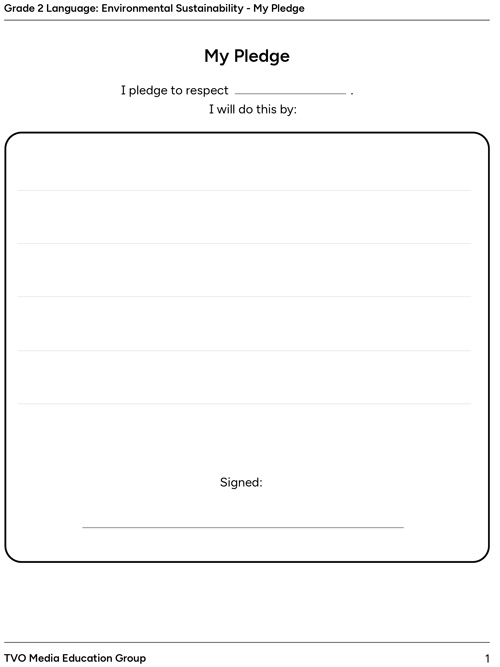
Step 3: Create your pledge
Now it’s time to create your pledge!
- Write three to five examples of how you are going to respect the land, water, animal homes and/or people in your life in your pledge.
- Separate each example with a comma.
- Decorate the border of your pledge with images and symbols.
- Sign your name at the bottom of your pledge. By writing your name, you make your promise or pledge.
Complete the following My Pledge organizer in your notebook or using the following document. If you would like, you can use speech-to-text or audio recording tools to record your thoughts.

Pause And Reflect
Pause and reflect
Why do you think creating a pledge is important?
Share your thoughts with a partner, if possible.
Life cycle review
The following stages fit together to make a salmon’s life cycle. Put the stage in each answer box in the correct order.
Reflection
How do you feel about what you have learned in this activity? Which of the next four sentences best matches how you are feeling about your learning? Press the button that is beside this sentence.
I feel...
Now, record your ideas about your feelings using a voice recorder, speech-to-text, or writing tool.
Discover More
Revisit the story Be A Good Ancestor in the Action section. What other animal life cycles do you notice?