Learning goals
We are learning to…
- identify themes explored in First Nations, Métis, and Inuit cultures to show an understanding of the many identities and ways of knowing, being, and doing
- identify ways in which specific design choices share meaning in a variety of texts
- read and listen to a text by First Nations creator to show understanding of First Nations cultures, relationships, communities, groups, nations, and lived experiences
- identify connections between ideas expressed in simple texts, and our learning, experiences, ideas in other texts and in the world around us
- sort and sequence ideas and information
Success criteria
I am able to…
- read and listen to specific parts of the story The Dancing Trees by Masiana Kelly to understand lessons through the perspective of the main character and reflect on my own experiences and learning
- identify First Nations teachings in The Dancing Trees, such as respecting the land
- identify ways in which the illustrations in the story The Dancing Trees share meaning
- sort and record my ideas about how to be respectful to the land
Notice and wonder
Explore the cover of the book The Dancing Trees by Masiana Kelly. Do you notice any words that you know? What do you think the title means?
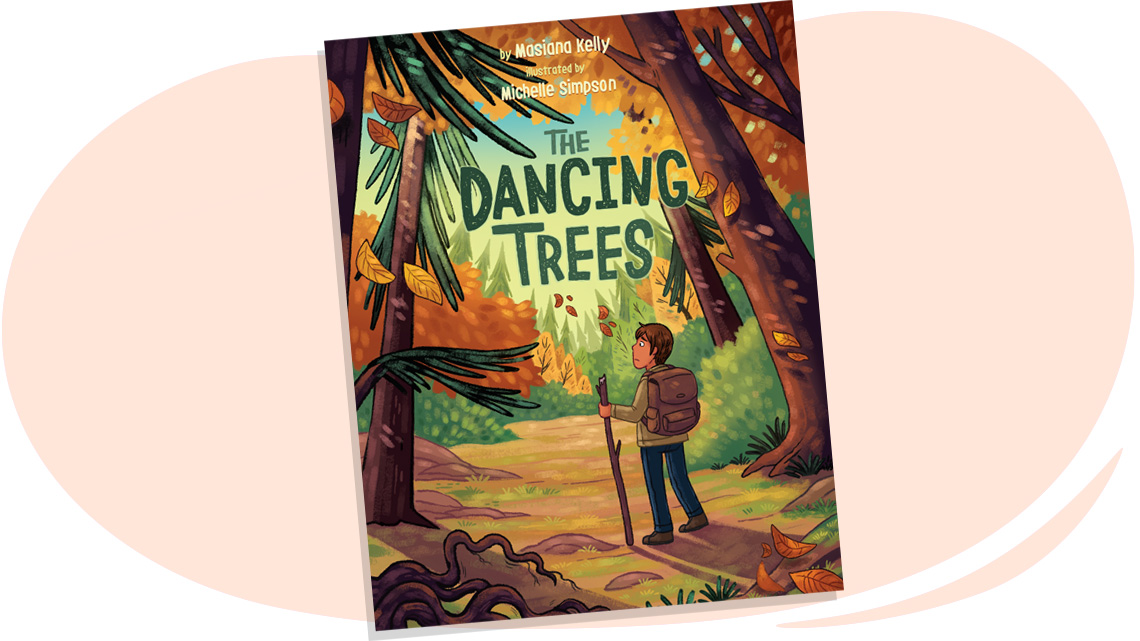
The cover of the book 'The Dancing Trees." There is a man standing on a path in a forest. He is wearing a backpack and using a large branch as a walking stick.
What does the artwork on the cover tell us about the story?
Share your thoughts with a partner, if possible.

The Dancing Trees
You might have noticed that there are two names on the cover. One of these is the author.
The author is the person who writes the words for storybooks or other types of texts. They create the story and decide what the characters say and do.
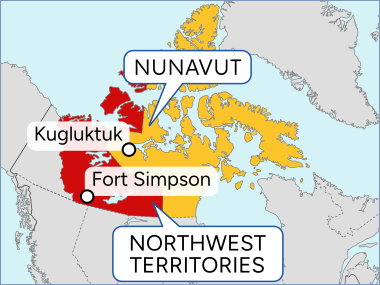
The author of The Dancing Trees is Masiana Kelly. Let’s learn a bit more about Masiana.
Masiana Kelly is an Inuk/Dene author from Kugluktuk, Nunavut, and Fort Simpson, Northwest Territories. She lives in Kugluktuk with her family.
The other name on the front of the book is the illustrator.
The illustrator is an artist that creates pictures for a story. This helps readers understand the story and visualize different parts. Illustrations can be found in many types of texts including storybooks.
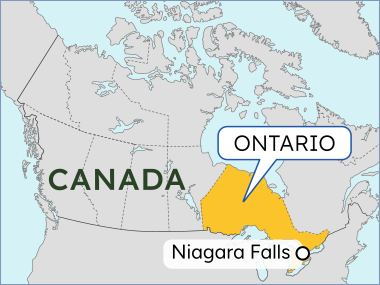
The illustrator of The Dancing Trees is Michelle Simpson. Let’s learn a bit more about Michelle.
Michelle Simpson is an illustrator and designer from Niagara Falls, Ontario. She works as an illustrator for children’s books but has also worked as an artist for kids' cartoons.
What’s it about?
A summary tells the most important parts of a text. We can read and write summaries about fiction and non-fiction text.
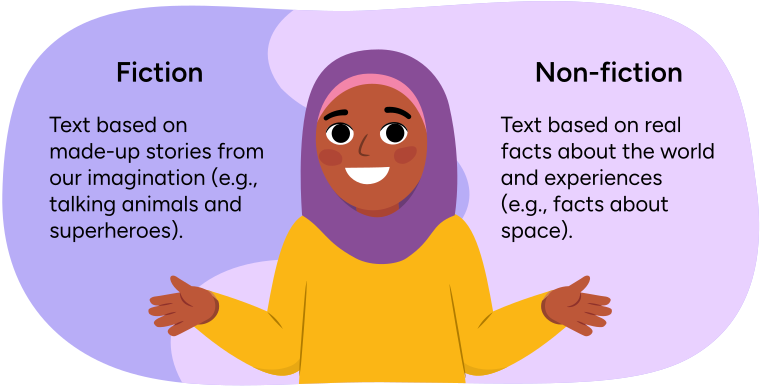
Esma standing in front of definitions of fiction and non-fiction:
Fiction - Text based on made up-stories from our imagination (e.g., talking animals and superheroes).
Non-fiction - text based on real facts about the world and experiences (e.g., facts about space).
Let’s explore a short summary of the fictional text The Dancing Trees to understand the main idea in the story.
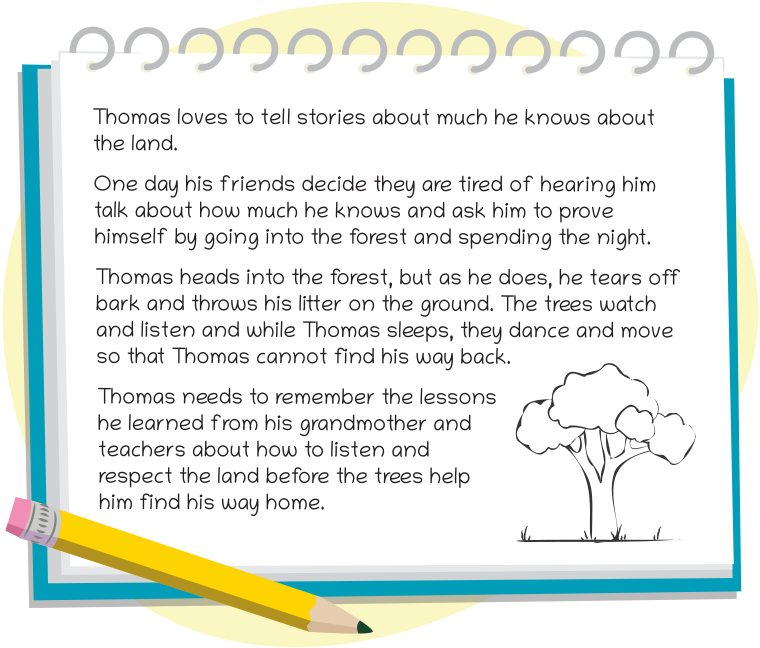
Thomas loves to tell stories about much he knows about the land. One day his friends decide they are tired of hearing him talk about how much he knows and ask him to prove himself by going into the forest and spending the night.Thomas heads into the forest, but as he does, he tears off bark and throws his litter on the ground. The trees watch and listen and while Thomas sleeps, they dance and move so that Thomas cannot find his way back.Thomas needs to remember the lessons he learned from his grandmother and teachers about how to listen and respect the land before the trees help him find his way home.
The Dancing Trees Summary
Next, let’s explore specific parts of the story book. As you explore, pay attention to Thomas’ expressions. Let’s see if his expressions give us clues on how he is feeling at different times of the story.
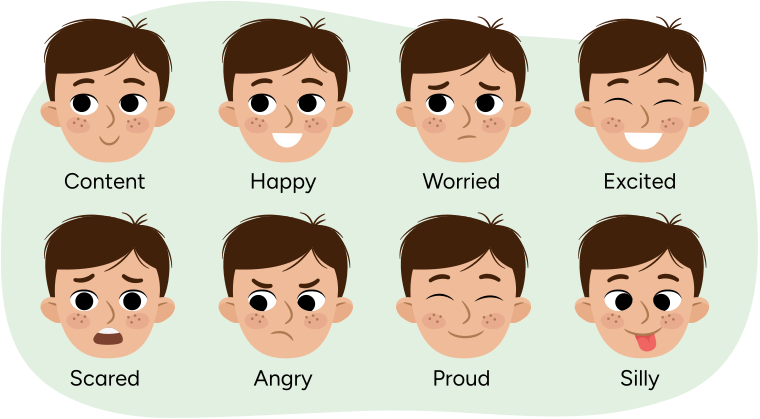
Warren with eight labeled facial expressions:
Content - Warren has a slight smile.
Happy - Warren is smiling widely.
Worried - Warren's eyebrows are slanted upward, and his mouth is curved downwards.
Excited - Warren is smiling widely with his eyes closed.
Scared - Warren's eyes are wide open, eyebrows slanted upward, and his mouth is open.
Angry - Warren is furrowed eyebrows and is frowning.
Proud - Warren is smiling with his eyes closed.
Silly - Warren is crossing his eyes and smiling while sticking his tongue out.
Let’s also pay attention to the colours that the illustrator Michelle Simpson uses on each page. How do the colours help us understand the story?
Press Reveal for a possible answer.
They could be sharing the time of day, the mood and feelings of the characters, and/or ways for us to understand the story differently.

Student Tips
Student tips
Artists use colours to express emotions and ideas. When artists discuss colours, they use words like warm and cool colours.
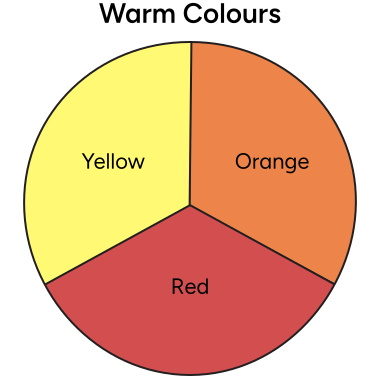
What are warm colours?
Warm colours include red, orange and yellow. These might remind people of sunshine, fires, and heat.
Warm colours are also used by some artists when they feel happy, angry, or excited.
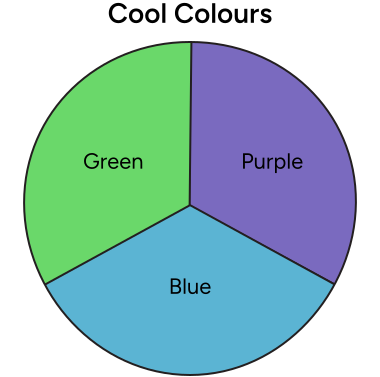
What are cool colours?
Cool colours include blue, green, and purple. These colours might remind people of cool, cold places like the winter or cold water.
Cool colours are also used by artists when they feel peaceful, calm, or sad.
Clara says: 'Try to pay attention to the colours the illustrator uses in the story to express emotions and ideas! You can also do this by paying close attention to Thomas's expressions!'
Let’s find out what happens once Thomas goes into the forest!
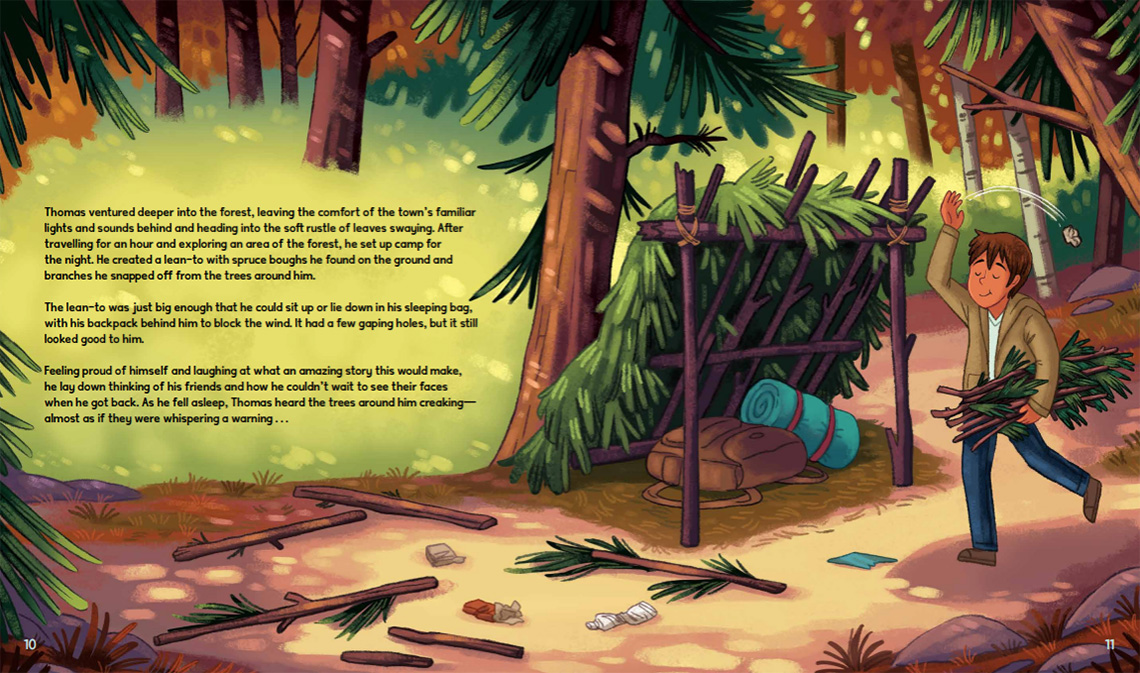
Page 10 of The Dancing Trees
Explore the illustration. What is Thomas doing?
Press Reveal to check your answer.
Thomas is carrying branches that he snapped off the trees and is throwing garbage over his shoulder.
Is Thomas being kind and respecting the forest?
Press Reveal to check your answer.
No, Thomas is not respecting the forest. In this illustration, Thomas is throwing litter around the forest and pulling branches off trees.

Pause and Reflect
Pause and reflect
What does being kind and respecting the forest look like to you?
Share your thoughts with a partner, if possible.
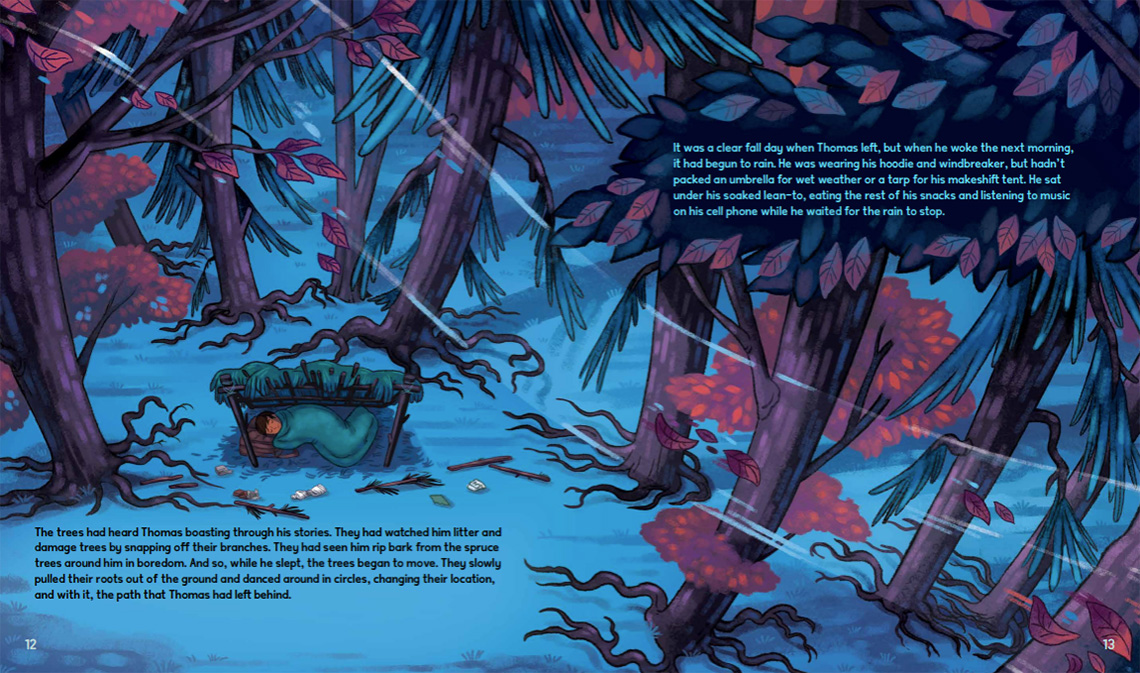
Page 12 of The Dancing Trees
How do you think the trees feel about Thomas’ actions in the forest?
Press Reveal for a possible answer.
I think the trees are upset. Thomas snapped off their branches and ripped off their bark and littered. I don’t think the trees like that.
What do the trees do?
Press Reveal to check your answer.
The trees dance in circles and move to different spots.
What do you notice about this illustration? How does it make you feel?
Press Reveal for a possible answer.
This illustration has a lot of cool colours. It makes me feel like Thomas might be cold in the forest. The colours make me feel calm.
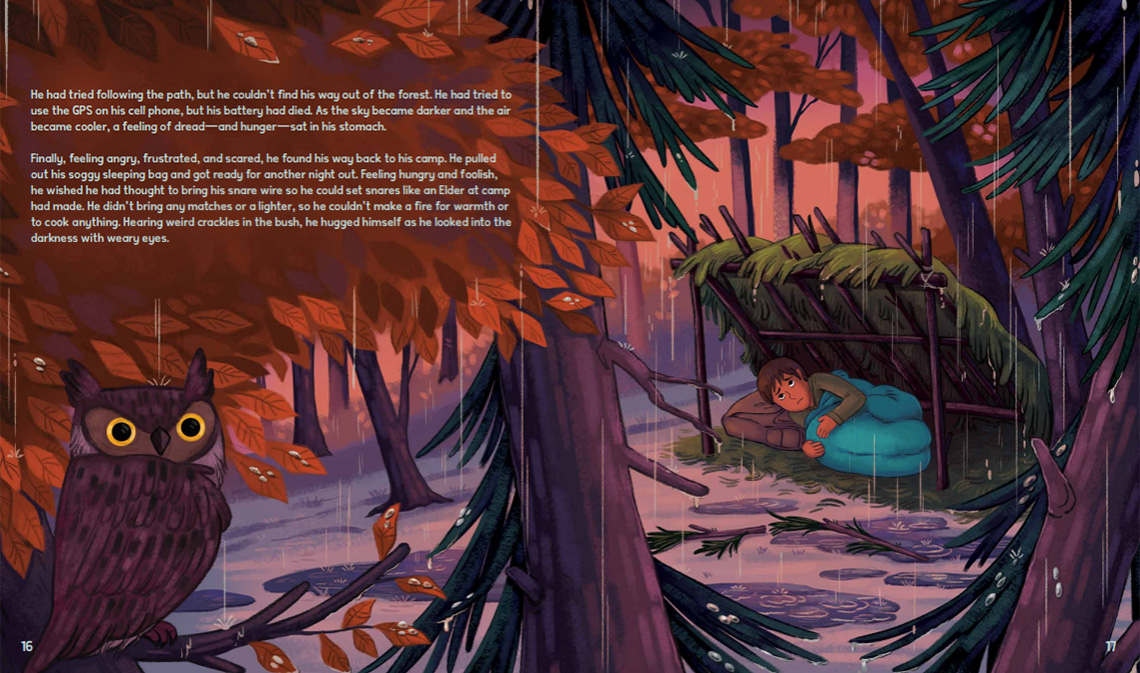
Thomas curled up in his sleeping back under his lean-to at night. His eyebrows are curved upwards, and his mouth is curved downwards. It is raining and there are puddles on the ground.
Page 16 of The Dancing Trees
What do you notice about the colours used in this illustration? How does it make you feel?
Press Reveal for a possible answer.
There are some warm and cool colours. It makes me feel like it might still be cold, because it’s also raining.
How is Thomas feeling? What clues can you use to tell?
Press Reveal for a possible answer.
I think Thomas is a bit scared. He is hugging himself and he looks a bit sad.
What else do you notice? Share your thoughts with a partner, if possible.
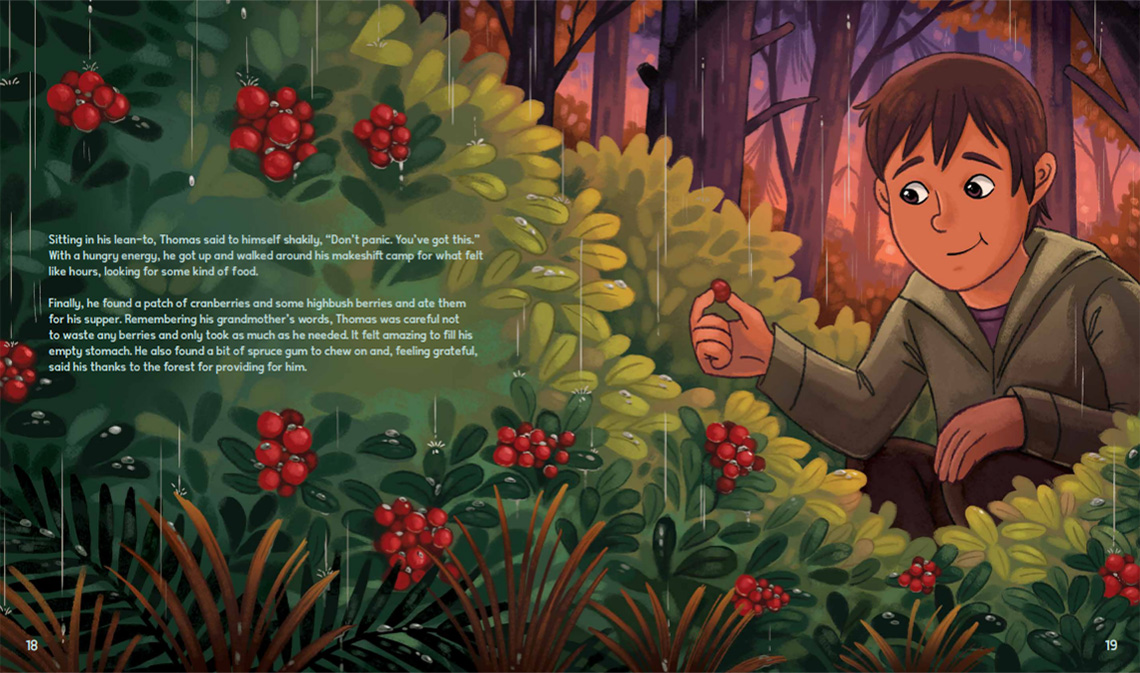
Page 18 of The Dancing Trees
How do you think Thomas is feeling now?
Press Reveal for a possible answer.
I think Thomas is feeling happy because he found berries to eat.
What lesson did Thomas’ grandmother teach him?
Press Reveal for a possible answer.
Thomas’ grandmother taught him not to waste and only take as much as he needed.
Pause and Reflect
Pause and reflect
Thomas remembered his lessons and said thank you to the forest for providing for him. Why is it important to be thankful?
Share your thoughts with a partner, if possible.
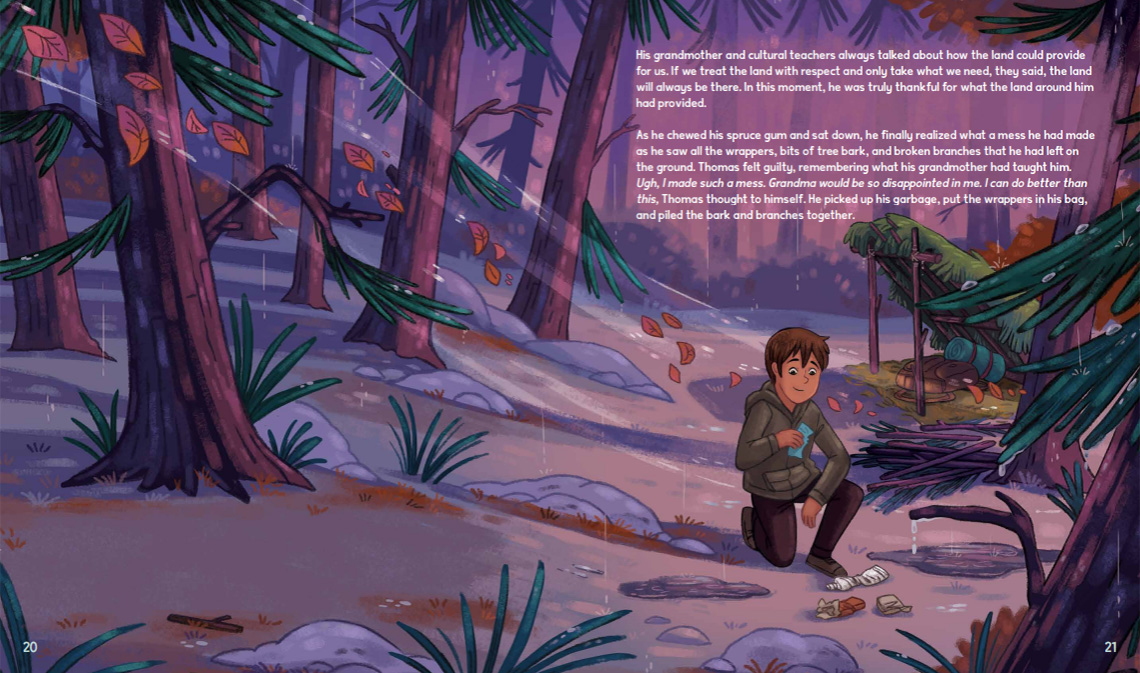
Thomas holding a piece of garbage and kneeling on the ground on one knee. He is looking at a pile of garbage on the ground. It is windy and it is raining.
Page 21 of The Dancing Trees
Thomas realized that he had not treated the forest with respect. He remembered what his grandmother and cultural teachers taught him:
"If we treat the land with respect and only take what we need, they said, the land will always be there."
How did Thomas try to help the forest in the end?
Press Reveal to check your answer.
He cleaned up his mess, picked up his wrappers, and put all the bark and branches together.
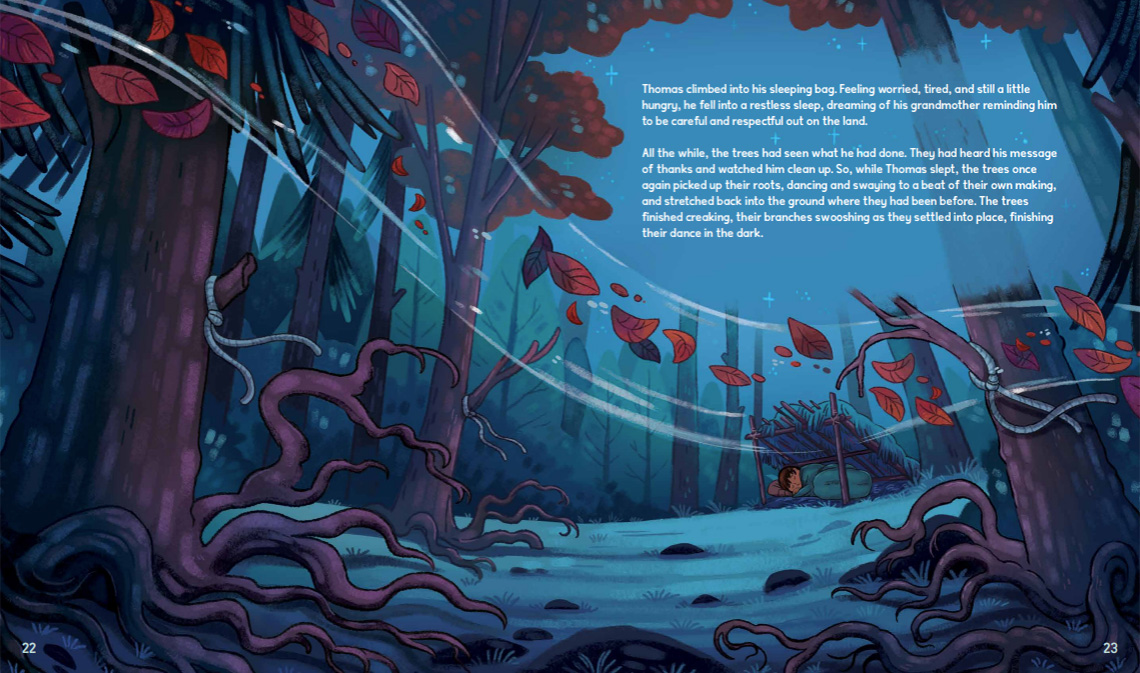
Page 23 of The Dancing Trees
How do you feel when you listen to the ways the trees moved and danced?
“The trees finished creaking, their branches swooshing as they settled into place, finishing their dance in the dark.”
The Dancing Trees
The words creaking and swooshing are examples of onomatopoeia, words that remind us of specific sounds. These words help us understand the movement of the trees as they danced.
What do you think it means that the trees “stretched back into the ground where they had been before”? How might this help Thomas?
Press Reveal to check your answer.
I think Thomas will be able to find his way home now, because the trees have gone back to their original spots.
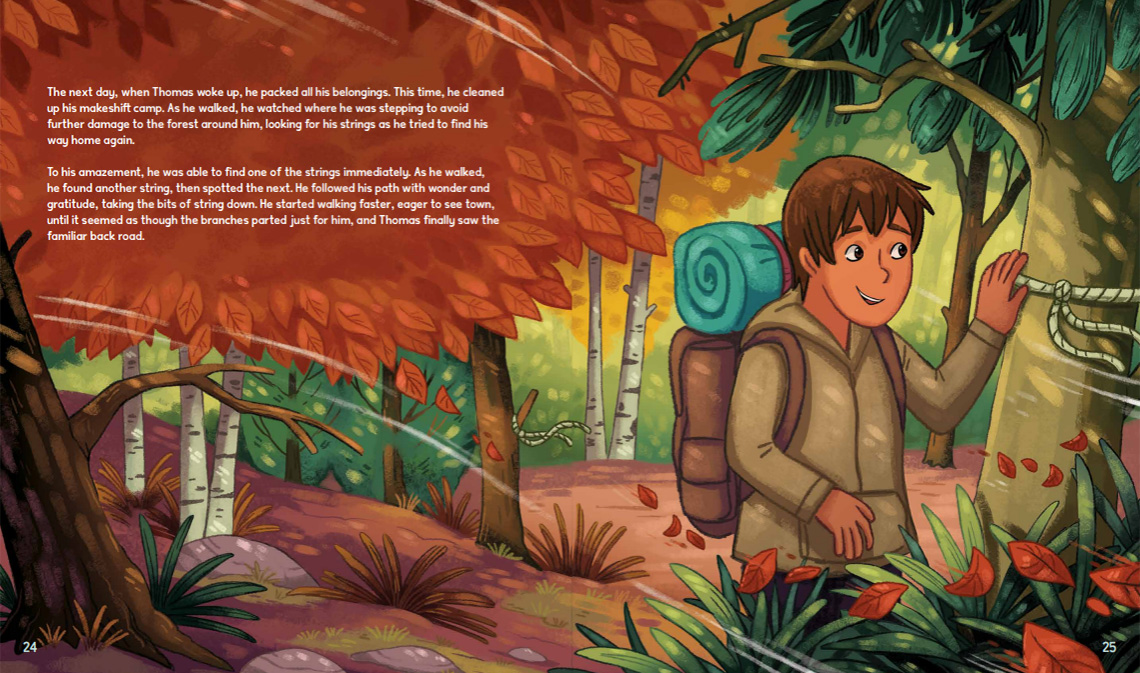
Thomas is walking through the forest during the day with his backpack. He has his hand on a string that is tied around the trunk of a tree. He is smiling widely.
Page 24 of The Dancing Trees
What do you notice about the colours used in the illustrations on this page? How does it make you feel?
Press Reveal for a possible answer.
There are a lot of warm colours in this illustration. It makes me feel like the weather is nice, and the sun is out. Thomas is smiling, and I think he is happy because he can find his way back home.
Proper nouns
Sentences always need to start with a capital letter. But did you know that names also need to start with a capital letter?
Names of specific people, places, or things are called proper nouns. These names always start with a capital letter no matter where they are in a sentence.
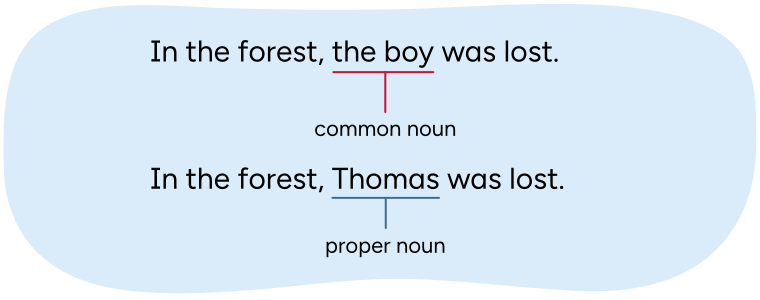
Two sentences showing the difference between a common noun and a proper noun:
'In the forest, the boy was lost.' The words 'the boy' are underlined and labeled as a common noun.
'In the forest, Thomas was lost.' 'Thomas' is underlined and labeled as a proper noun.
For each sentence, select the correct proper noun from the drop-down menu. Press Check Answer to see how you did.
Can you think of any other examples of proper nouns from your everyday life?
Respecting the land
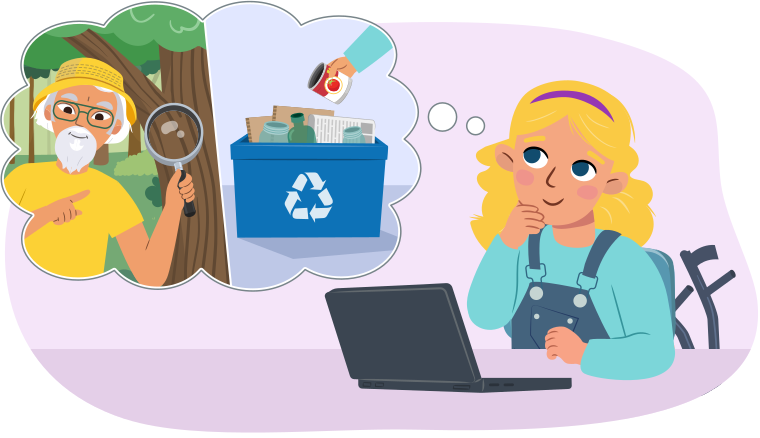
What are some different ways we can treat the land with respect that you’ve learned from Thomas’ experience in the forest?
Press Reveal for some possible answers.
- Clean up after yourself when you are outside.
- Ask questions about trees, plants, and animals in your environment to learn more about them.
- Be respectful of trees and plants. Try not to pick off bark or branches, instead look for any that have fallen naturally. Try not to pick flowers or plants.
Think about the different ways you show respect to the land.
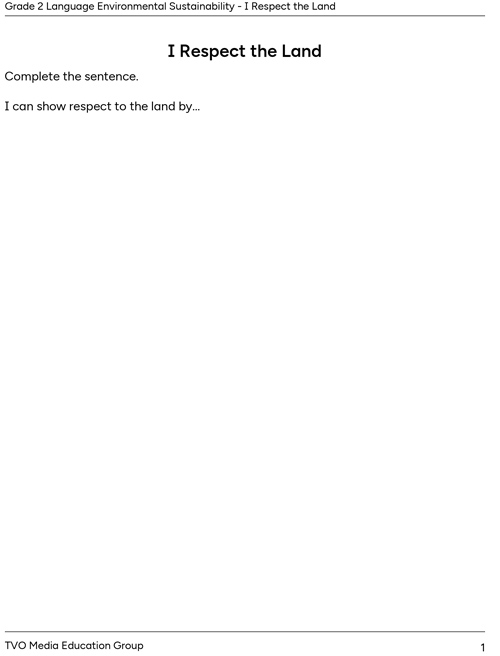
You will create two to three ideas using the sentence starter in the following document or using a method of your choice. After writing, you may draw a picture of how you show respect to the land.
If you would like, you can use speech-to-text or audio recording tools to record your thoughts.
What are some important lessons you’ve learned in your own life?
Proper noun review
Select the correct answer, then press Check Answer to see how you did.
Reflection
How do you feel about what you have learned in this activity? Which of the next four sentences best matches how you are feeling about your learning? Press the button that is beside this sentence.
I feel...
Now, record your ideas about your feelings using a voice recorder, speech-to-text, or writing tool.