Learning goals
We are learning to…
- communicate our knowledge of environmental sustainability through a presentation
- identify presentation strategies in an oral text
- create a presentation by identifying the audience, message, and presentation strategies that we used
- identify and use interjections in sentences
Success criteria
I am able to…
- identify sustainable practices we can use in our everyday lives
- communicate our learning about environmental sustainability in a presentation
- identify presentation strategies and how to use them
- create a presentation, identify the audience and message and presentation strategies that I used
- identify interjections and use them in a sentence
Sustainability
In today’s learning activity, we are going to learn about sustainability.
Explore the following images and think about what the word "sustainability" means to you.

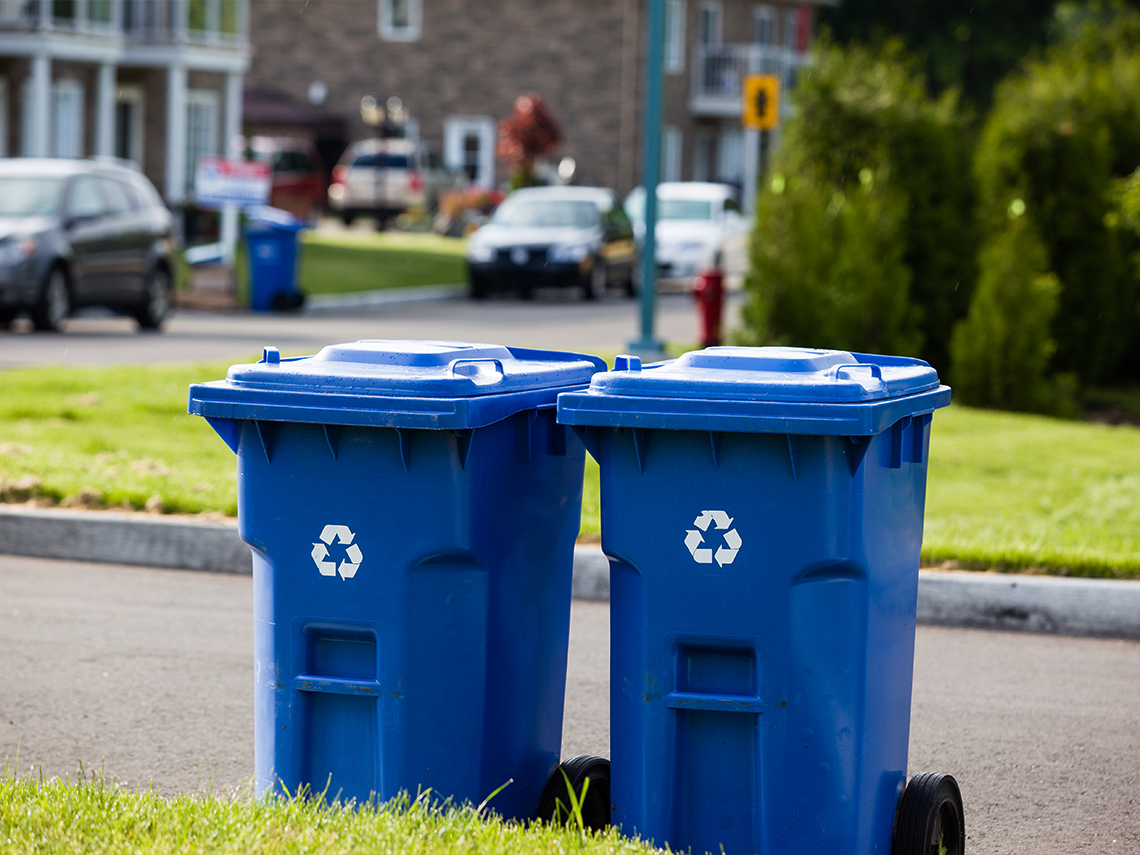

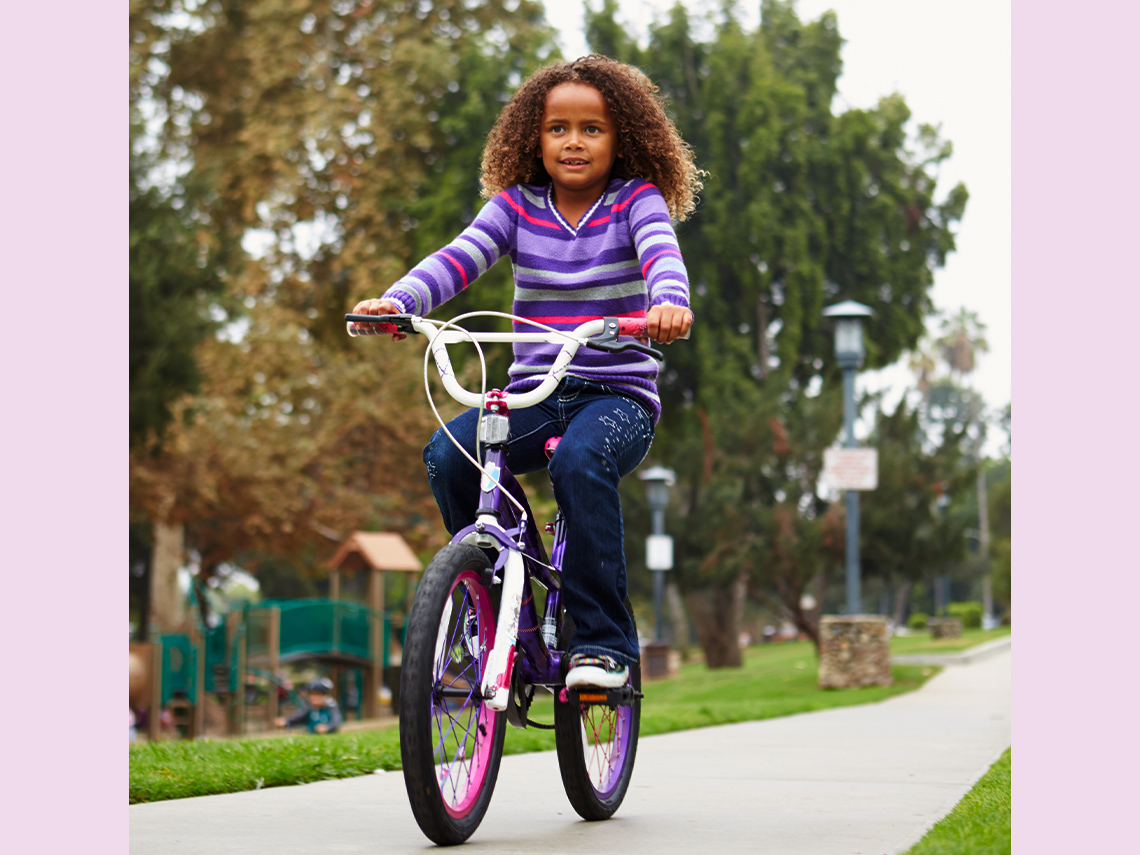

What is environmental sustainability?
Environmental sustainability means that when we take natural resources from the Earth, such as food, water, plants, and minerals, we make sure that there is still some left for the future. It is about making sure we don't use up all the things we need, like water, food, and clean air, so people in the future can have them too.
Sustainability is all about taking care of our planet so everyone, now and in the future, can live healthy and happy lives.
Let’s build our skills

Try it
Try it!
Sustainability is a big word, so first, let’s learn how to say it before we learn what it means.
How many syllables are in the word "sustainability"? Clap out each syllable.
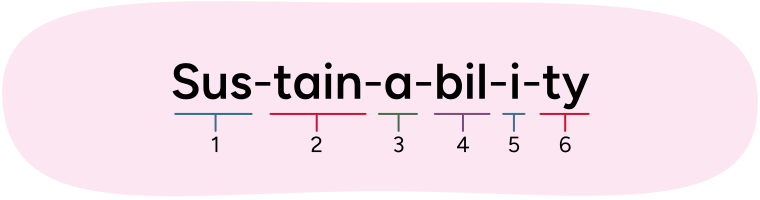

Syllables
Did you notice all the vowels in the word "sus-tain-a-bil-i-ty"?
There are six vowels and six syllables. Try saying all the syllables separately before pronouncing the whole word together.
Press the following audio clip to learn how to pronounce the word “sustainability”.
Sustainability Pronunciation
Root words and suffixes
We can also try finding the root word and the suffix.
Press the Definition button to learn the definitions for “root word” and “suffix”.
Root word
The main part of a word that gives it its basic meaning
Suffix
A group of letters added to the end of a root word to change its meaning
Example
"Play" (root word)+ "-ful" (suffix) = "playful"
Now let’s look at the word sustainability.
Press the Sustainability button to learn the definition of the word.
Sustainability is the ability to keep something going for a long time without it running out.
"Sustain" (root word) + "ability" (suffix) = "sustainability"
Finding the root word can help us both read the word and understand it better.

Did You Know?
Did you know?
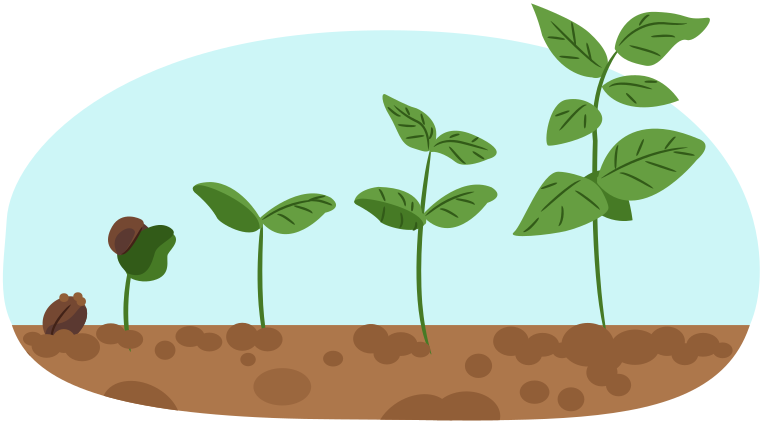
The root word “sustain” means to continue or keep up something over time. For example, if you water a plant regularly, you help sustain it, which means you keep it alive and healthy. This gives us a clue as to what the word sustainability means.
Adjectives and adverbs
The root word “sustain” can become an adjective or an adverb depending on the suffix you add to it.
Adverb: A word that describes a verb. For example, in the sentence “The child ran quickly” the adverb “quickly,” describes the verb “ran.”
Environmental sustainability
We have been exploring how environmental sustainability is something we can all take part in. In this next video, TVO hosts Monica and Laura are excited to share the ideas they came up with to help protect and take care of our planet Earth. As you explore the video, take note of the different ways of taking care of our planet so that it stays healthy for the future.

Vocabulary
Natural resources are things that come from nature and are useful to people. Examples include water, air, trees, soil, and minerals like gold and silver.

Reusable means something can be used more than once. For example, a reusable water bottle can be filled up and used many times instead of being thrown away after one use.

Use what you noticed in the previous video to complete the Ways to Help the Environment worksheet in your notebook or use the following fillable and printable document. If you would like, you can use speech-to-text or audio recording tools to record your thoughts.
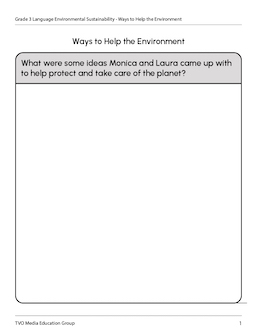
Press the Answers button to access some possible ways we can help the environment!
Some ways that we can help the environment include:
- using reusable water bottles and reusable straws
- recycling
- walking and bicycling
- using different sources of fuel for cars
Sharing our learning
In the video you previously watched, Monica and Laura share their ideas about protecting the planet, so that other people can also think about how they can help!
Sharing our learning and knowledge can be one way to help protect the planet. When we share our learning, it’s important to think about the strategies we can use to make sure our audience will pay attention.

Brainstorm
Perform a task on your own!
Do you think Monica and Laura were able to keep your attention and make the information they shared interesting? What do you think helped them do that?
Press the Possible Answers button to brainstorm some ideas.
- showing pictures
- speaking loudly and clearly
- using expression in their voice
Next, we are going to look at different strategies that can be used to share information so that people stay interested and informed!
Press the following tabs to find out more.
Communication is how we share information and feelings with others. We communicate by talking, listening, writing, and using body language. It helps us understand each other.
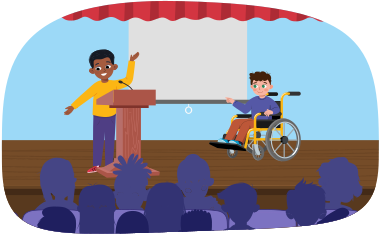
The audience is the group of people you are sharing your information to. They pay attention to what is being presented.
Communication strategies are used to make what you are showing or telling more interesting. You can use them in a video, for a school project, in a speech, or even when telling a story.
These strategies help get an audience’s attention and keep them excited about the topic that you are presenting. Communication strategies can also include non-verbal cues. Non-verbal cues are when the presenter does not use their voice, but instead uses facial expressions, gestures, and other types of body language to communicate with the audience.

Check out the following video to learn more about non-verbal cues.
Learning Check
Read each sentence and press “True” if it is correct or “False” if it is incorrect.
When you are finished, press Check Answer to see how you did.
Communication strategies
Explore the following drop-down menu to learn more strategies that can be used when you are sharing information. Using some of these strategies can help your audience stay interested, pay attention, and understand what you want to share. Press the name of each communication strategy to learn its definition.
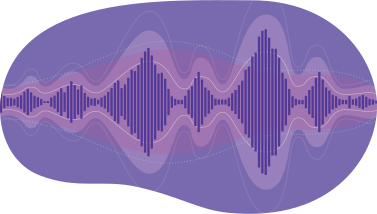
Volume is how loudly or quietly we communicate. We can change our volume based on how big our audience is or what we want to communicate.

When we present, we can change the expressions in our face to tell the audience how we feel about the information that we are sharing.
We can use body movement or hand gestures that help us share what we mean.
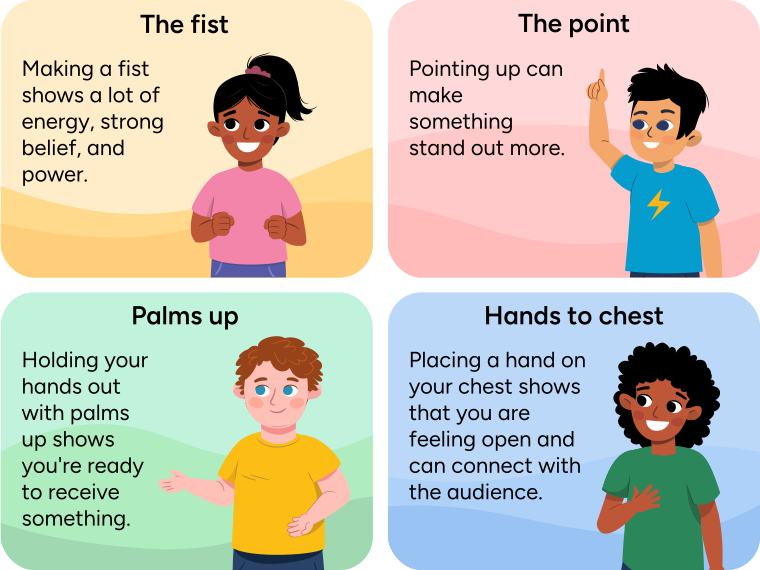
The fist: Making a first shows a lot of energy, strong belief, and power.
The point: Pointing up can make something stand out more.Palms up: Holding your hands out with palms up shows you're ready to receive something.
Hands to chest: Placing a hand on your chest shows that you are feeling open and can connect with the audience.

We can use things like pictures, diagrams, or videos. This keeps the presentation interesting and helps the audience understand what we are talking about.
Revisit the video titled Protect the Planet Day. What communication strategies did you notice were used in this video?
Record your answers by completing the Presentation and Communication Strategies worksheet in your notebook, or using the following fillable activity document.
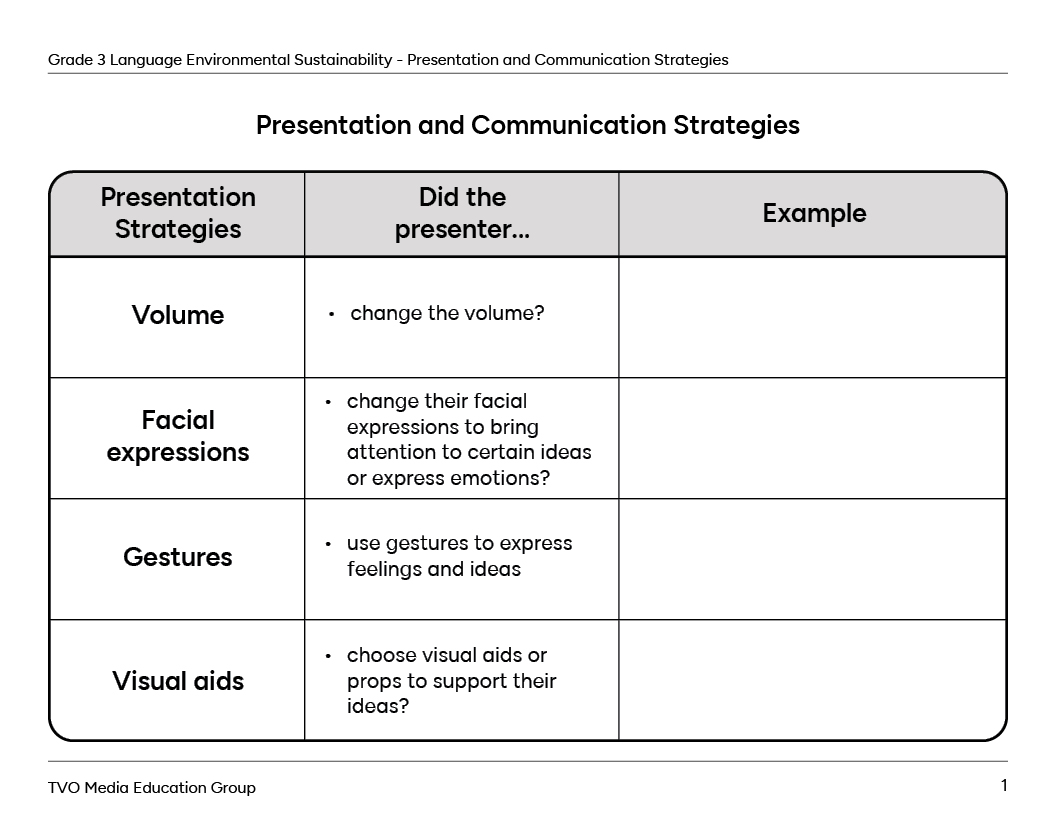
Press the Activity button to access the Presentation and Communication Strategies.
Activity(Opens in a new tab)Next, match the communication strategy to the examples that were shown in the video.
Interjections!
There are many different ways to express our emotions when we talk or write. One way is to use interjections.
Access the following audio clip entitled Interjections Pronunciation to learn how to pronounce the word “interjections”.
Interjections Pronunciation
Interjections are special words that help us show our feelings or emotions. They are like little expressions of how we feel at that moment.
Imagine you see a huge, beautiful rainbow. You might say, "Wow!" because you are surprised and happy. "Wow!" is an interjection.
If you accidentally drop your ice cream, you might say, "Oh no!" because you are sad. "Oh no!" is an interjection too.
Try It
Try it!
Let's practice using interjections in sentences. For each sentence, select the missing interjection from the drop-down menu.
Press Check Answer to see how you did.
You can use interjections in your presentation to express your emotions and to keep your presentation more interesting for the audience.
Share your ideas
Now, you are going to share your own ideas for sustainably taking care of the Earth. You can use a video, audio clip, or any other method of your choice to share your ideas.
Explore the following video for some ideas. In the video, children answer the question: “How do you help the environment?”
Record your ideas in your notebook or by using the following editable and fillable Taking Care of the Environment planner.
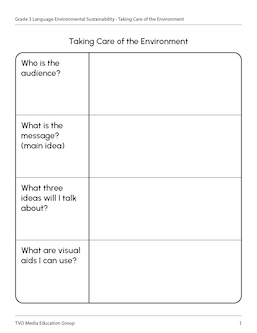
Press the Activity button to access the Taking Care of the Environment.
Activity(Opens in a new tab)Here's a completed planner to help you with your own planning.
| Title: | Taking Care of the Environment |
| Who is the audience? | People who want to learn about environmental sustainability |
| What is the message (main idea)? | Sharing different ways to help take care of the environment |
| What three ideas will I talk about? |
Recycling Planting trees Using less water |
| What visual aids can I use? | Pictures, posters, props |
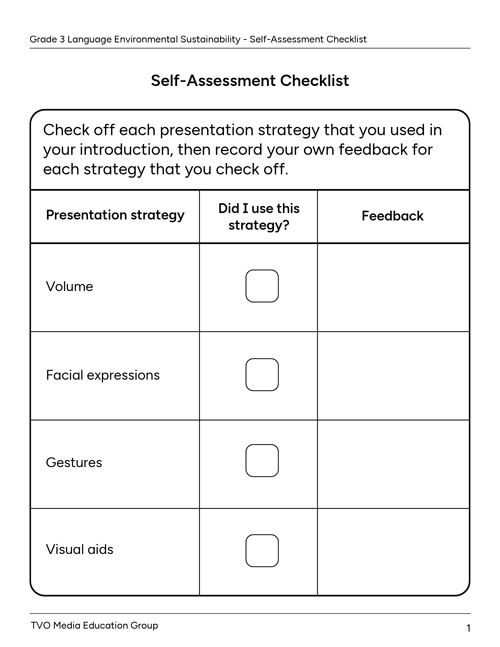
Now it is time to share your learning. Use the following Self-Assessment Checklist to help you think about the communication strategies you want to use to keep your audience interested.
Self-assessment checklist
Complete the fillable and printable Self-Assessment Checklist in your notebook or using the following document. If you would like, you can use speech-to-text or audio recording tools to record your thoughts.

Pause and Reflect
Pause and reflect
When you have finished your self-assessment, respond to the following questions:
- Which communication strategies did you choose?
- Did they help you share your ideas clearly?
Reflection
How do you feel about what you have learned in this activity? Which of the next four sentences best matches how you are feeling about your learning? Press the button that is beside this sentence.

I feel...
Now, record your ideas about your feelings using a voice recorder, speech-to-text, or writing tool.