Learning goals
We are learning to…
- engage with poetry elements such as imagery, mood, and message
- make connections between environmental stewardship and the land around us
- identify the message and mood in a poem
- develop ideas, draft and edit a poem, and identify the message and mood of the poem
Success criteria
I am able to…
- share my learning about environmental stewardship and how it connects to my everyday life
- identify poetry elements of imagery, message, and mood
- develop, draft, and edit a poem, considering the message and mood
- reflect on how the vocabulary I used helped to communicate my poem’s message and mood

“My Heart Soars”
The natural environment is full of wonders. It can provide food and medicine, and even inspire art and poetry.
Let’s explore the poem “My Heart Soars” by Chief Dan George (1899-1991), a leader of the Tsleil-Waututh Nation in Northern British Columbia. He was also an actor, poet, author, and musician. His poem explores his relationship with nature and how he feels with the land and all the elements within it.
As you explore the poem, think about the images (pictures) that might come to mind.
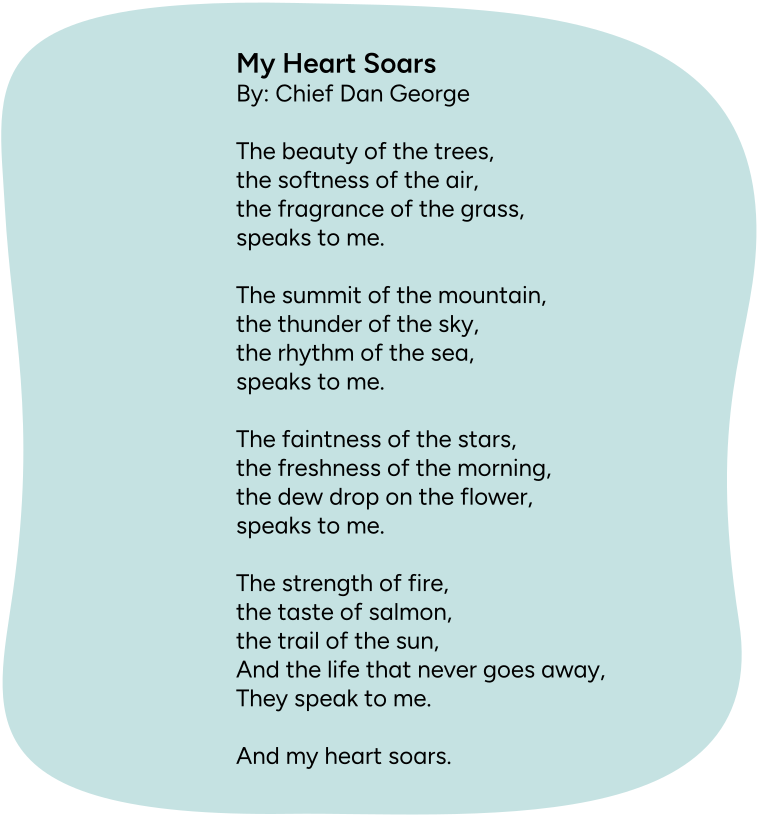
My Heart SoarsBy: Chief Dan George
The beauty of the trees,
the softness of the air,
the fragrance of the grass,
speaks to me.
The summit of the mountain,
the thunder of the sky,
the rhythm of the sea,
speaks to me.
The faintness of the stars,
the freshness of the morning,
the dew drop on the flower,
speaks to me.
The strength of fire,
the taste of salmon,
the trail of the sun,
And the life that never goes away,
They speak to me.
And my heart soars.
Imagery in poetry
Imagery in poetry helps create pictures in our minds by using describing words. In the previous poem, you can find examples of imagery in the lines “the beauty of the trees” or “the dew drop on the flower.”
Revisit the poem “My Heart Soars” then answer the following questions.
- What pictures do you see in your mind when you read the poem?
- How does the poem make you feel?
- Which words or lines in the poem make you feel this way?
- If you could draw a picture of one part of the poem, which part would you choose? What would it look like?
Record your thinking using a method of your choice.

Connecting with poetry
In the Minds On section, Chief Dan George’s poem “My Heart Soars” explores and shares his connection to the land around him. Let’s revisit the poem and think about how we can read poems in a fluent and expressive way.
Press the My Heart Soars button to revisit the poem.
My Heart Soars By: Chief Dan George
The beauty of the trees,
the softness of the air,
the fragrance of the grass,
speaks to me.
The summit of the mountain,
the thunder of the sky,
the rhythm of the sea,
speaks to me.
The faintness of the stars,
the freshness of the morning,
the dew drop on the flower,
speaks to me.
The strength of fire,
the taste of salmon,
the trail of the sun,
And the life that never goes away,
They speak to me.
And my heart soars.
My Heart Soars

Reading with fluency!
Did you know that punctuation is very important when we read, talk, and communicate? It helps us know how to say things that make the message clear.
Press the following audio clip to learn how to pronounce the word “punctuation”.
Punctuation Pronunciation
After reading the poem aloud at least once, go back and look at the punctation marks in the poem. They show you how to change the way you say the sentences.
Let’s explore the two punctuation marks used in the poem and how they change the way we read the poem.
Now, listen to the audio clip of the author reading the poem, then try reading the poem aloud again. As you read aloud, try to match how the author pauses in the audio clip.
- How do the pauses change or help the sound of the poem?
- Do they help communicate the meaning of the poem?
If possible, record yourself using an audio recorder, and listen to your reading to check for any improvements you might want to make.
Use the following checklist to review your progress.
Fluency criteria

Today’s vocabulary!
Before exploring poetry further, let’s review some important vocabulary.
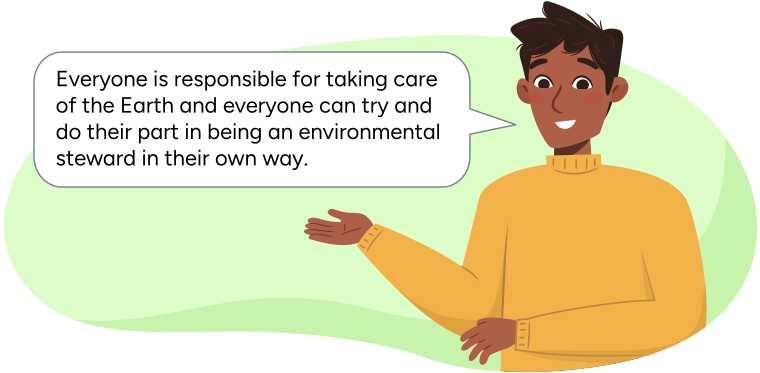
Understanding how we are connected to the land around us is an important part of taking care of our planet Earth. This is also called environmental stewardship.
Explore the definitions of steward and environmental stewardship in the following flashcards.

Parts of speech
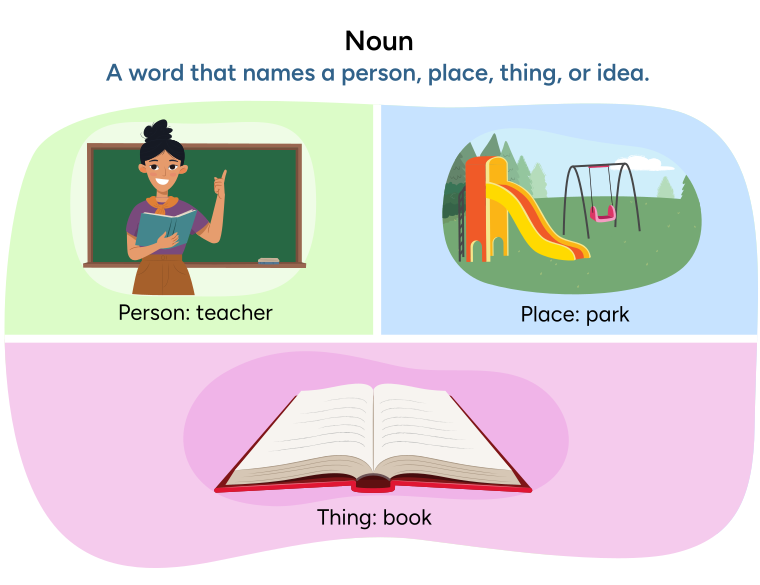
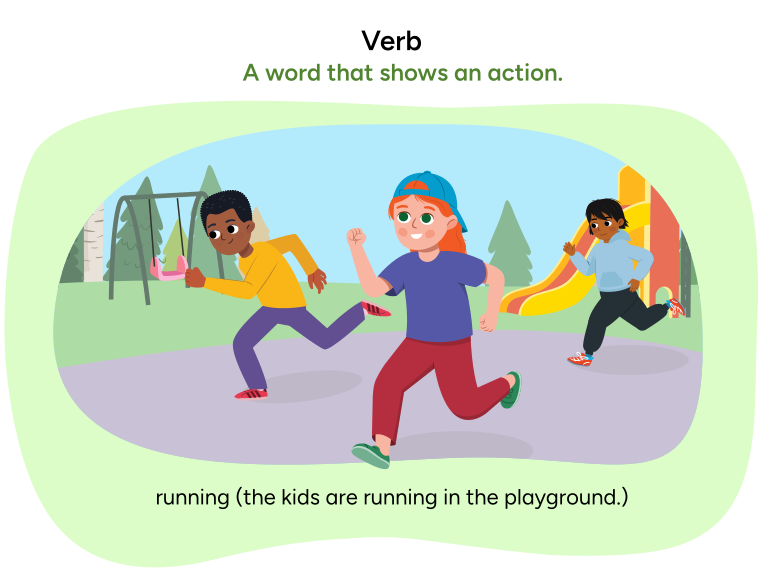
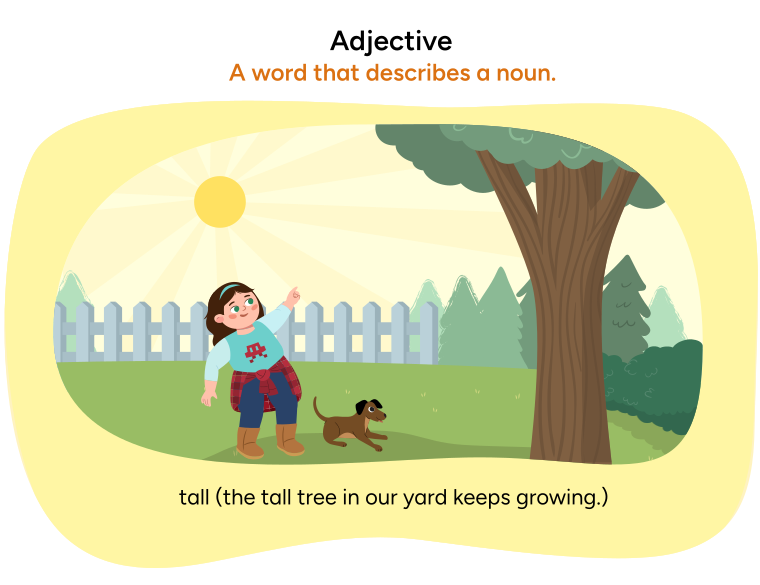
Next, review some of the parts of speech in the following carousel.

Did You Know?
Did you know?
Did you know that a noun can change into a verb or an adjective?
In this section of the learning activity, you are going to explore how words can change into different parts of speech just by changing the ending.
Let’s start with the word steward.
A steward is a noun because it is a person. If we add different endings to the word steward, we can change it into an adjective or to a verb.
Explore the following table to see how the word steward can change from a noun to an adjective or a verb.
| Word | Part of speech (noun, adjective, adverb) | Definition | Example sentence |
|---|---|---|---|
| Steward | Noun | A person who takes care of things | The zookeeper is a good steward of the animals, making sure they have food and a clean place to live. |
| Stewardly | Adjective | Describes someone who acts in a caring and responsible way | Zara showed their stewardly skills by helping to clean up the classroom after art class. |
| Stewarding | Verb | Taking care of something | The students had the job of stewarding the school garden by watering it and keeping it clean. |
Let’s practise!
Complete the following activity by filling in the blanks with the word that fits into each sentence. For each sentence, select the missing word from the drop-down menu. Press Check Answer to see how you did.

Social Emotional Learning
Social emotional

You’re doing great! It’s time for a short break before you explore acrostic poems.
Acrostic poems
Poetry can be one way to express how we feel and share our learning about environmental stewardship. Poems come in many shapes and types, including acrostic poems.
An acrostic poem uses each letter in the topic of a poem to describe the topic. The topic word is written down the left side. For each letter, a word or phrase starting with that letter is written about the topic.
Review the following example of an acrostic poem using the word “steward.”
Steward
Stand up for the earth by taking care of the land, water, and air.
Try to turn off the lights when you leave a room.
Encourage people to recycle and reuse.
Water your plants and help them grow strong.
Always clean up after yourself and pick up litter.
Respect animals by giving them a clean space.
Do your best to protect nature every day.
Check out the following video to learn more about acrostic poems.
Poetry elements
Before you begin writing your own acrostic poem, let’s review poetry elements.
What makes a poem? Poetry elements are things that help make the words and sentences you put together become a poem. Two important poetry elements are the message and the mood.
The message of a poem is the big idea or main thing the poet wants us to think about or feel.
The mood of a poem is how the poem makes us feel when we read it. For example, a happy poem might make us feel joyful or excited.
Review the acrostic poem titled “Steward.”
What do you think is the message and the mood of this poem?
Press Possible Answer button to learn more.
Message – This poem is about how you can be a steward and take care of the environment.
Mood – This poem feels positive and inspires others to do their part to keep the planet clean and healthy.
Next, you will be writing your own poem!
Writing poetry
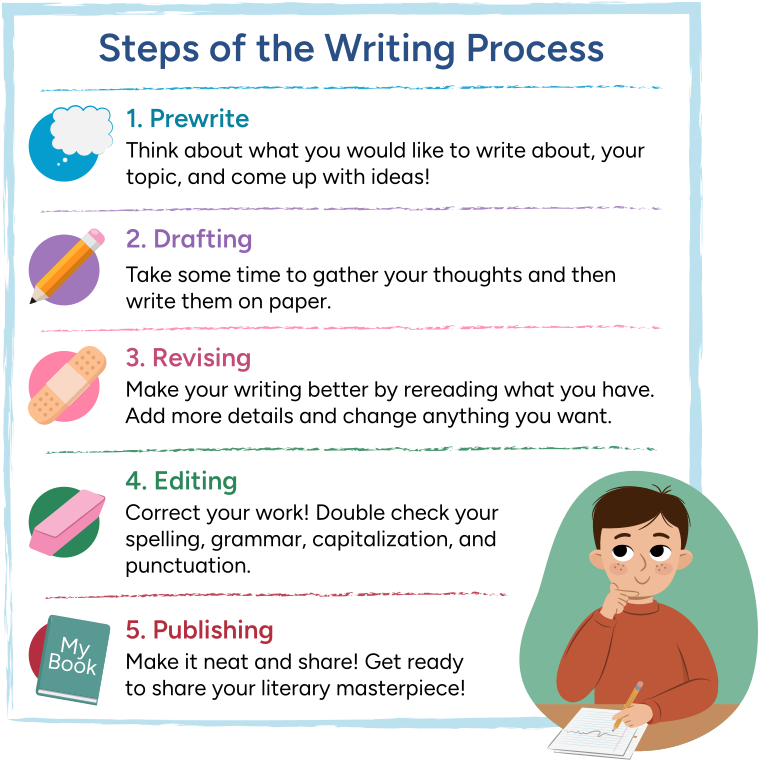
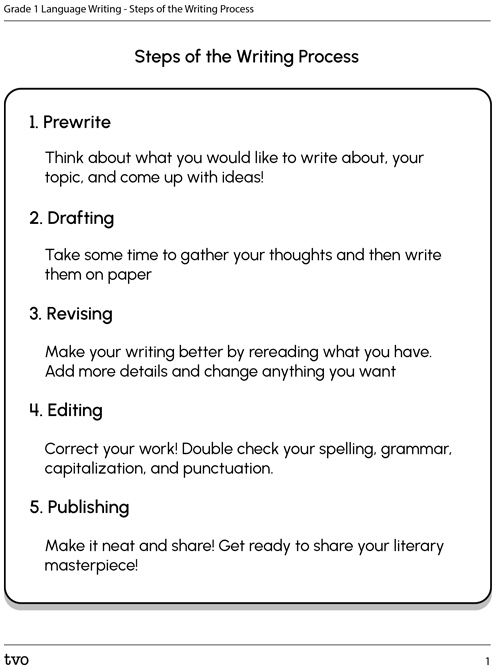
When we write poetry, we follow the writing process. Review the steps of the writing process in the following image.
Steps of the Writing Process
-
Prewrite
Think about what you would like to write about, your topic, and come up with ideas!
-
Drafting
Take some time to gather your thoughts and then write them on paper.
-
Revising
Make your writing better by rereading what you have. Add more details and change anything you want.
-
Editing
Correct your work! Double check your spelling, grammar,capitalization, and punctuation.
-
Publishing
Make it neat and share! Get ready to share your literary masterpiece!
Prewrite
Choose a topic for your poem that focuses on environmental stewardship (taking care of the environment).
Here are some possible topics:
- being an environmental steward
- your favourite part of the natural environment
- how you feel about the environment
Once you have chosen your topic, think about the message and mood of your poem.
- What do you want to say to your audience (the people listening to or reading your poem)?
- How do you want to make them feel?
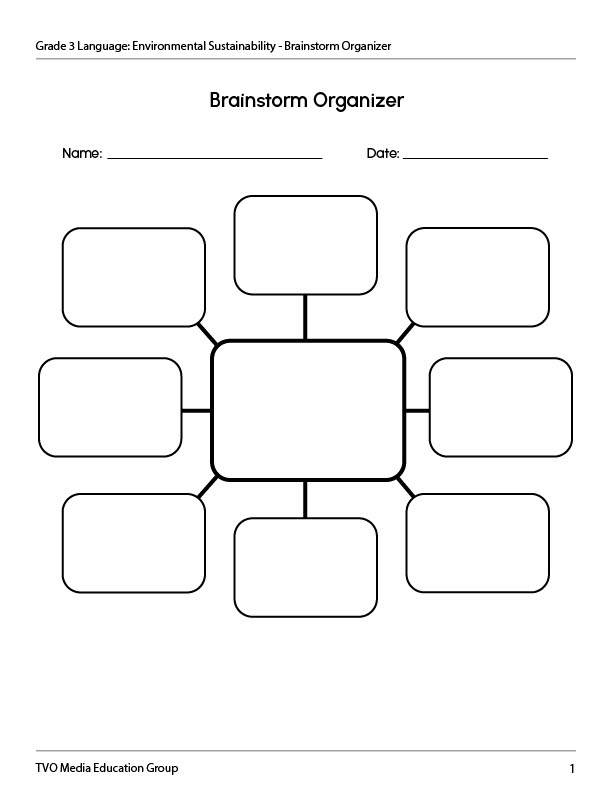
Record your words, feelings, and ideas about the topic of your poem by completing the fillable and printable Brainstorm Organizer in your notebook or using the following document. If you would like, you can use speech-to-text or audio recording tools to record your thoughts.
Drafting
Next, think of some adjectives, verbs, and nouns about your topic.

Student Tips
Student tips
If you need help finding adjectives to use in your poem, ask a peer or trusted adult about using a thesaurus or dictionary. Check out the video below to learn more about these important word tools.
It is time to turn your ideas into a poem. Complete the fillable and printable Poem Graphic Organizer in your notebook or using the following document. If you would like, you can use speech-to-text or audio recording tools to record your thoughts.
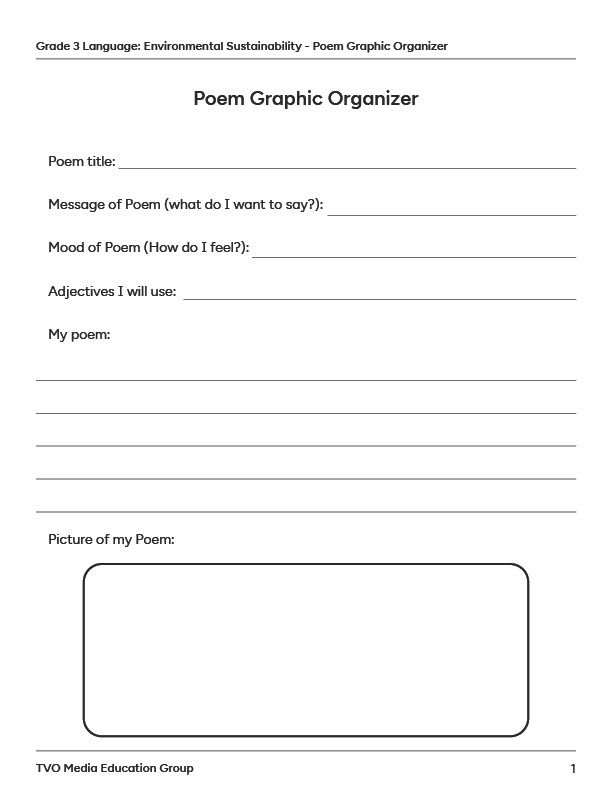
Use the following checklist provided to guide you along the way!
Success criteria
Revising
It's time to revise your poem.
Revising: this means checking your writing again to make changes that will make it better. It’s about improving your ideas and how you communicate them.
Press the following tabs for examples on how to revise your writing.
If you wrote, “The earth is big,” you might revise it to “The earth is huge” to make it more interesting.
If you wrote, “The park is nice,” you might revise it to “The park has tall trees and colourful flowers” to give more information.
If your poem is about saving water, you might revise it to add more ways to save water, like turning off the faucet while brushing teeth.
Editing
It's time to edit your poem.
Editing: this means checking your writing for grammar and spelling mistakes and fixing them.
Press the following tabs for examples on how to edit your writing.
If you wrote “enviroment” instead of “environment,” you need to correct the spelling.
If you wrote “animals need a clean environment” without a capital and period at the end, you should add both: “Animals need a clean environment.”
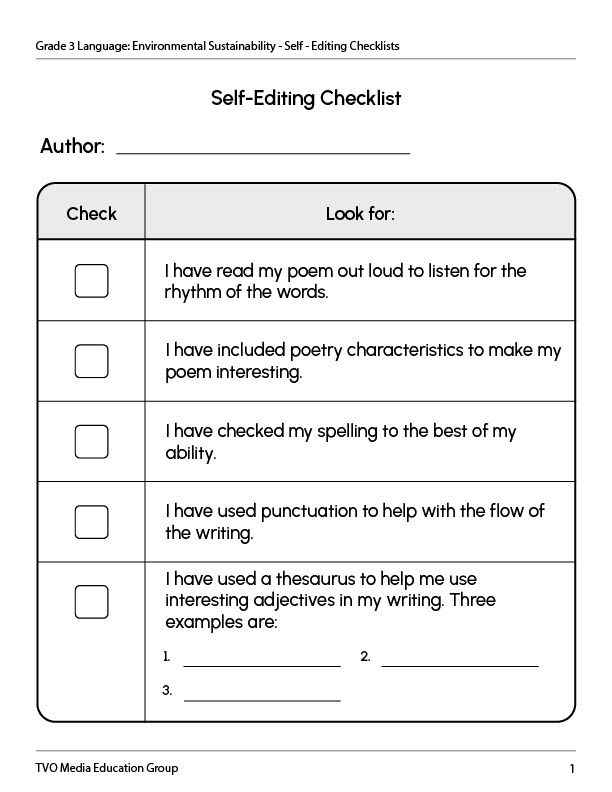
Complete the Self-Editing Checklist in your notebook or use the following fillable and printable document to help your editing and revision process.
Self-editing checklist

Publishing

What a lot of work you have put into your poem! You are now ready to publish your work. Create the final draft of your poem with all the revisions and editing. You can choose to write, type, use an audio clip, use digital tools or apps (approved by a trusted adult), or any other method of your choice.
Even at this stage, you may still come up with a word you want to change or an additional element you’d like to add. It’s not too late to add those in! In fact, every time you reread your work, you may find another place to make it even better!
Putting it all together
Respond to the following reflection questions in a method of your choice.
- How did writing a poem about taking care of the Earth help you think about environmental stewardship?
- What are some ways you included environmental stewardship in your poem?
- How do you think your poem can help others understand the importance of taking care of the Earth?
Reflection
How do you feel about what you have learned in this activity? Which of the next four sentences best matches how you are feeling about your learning? Press the button that is beside this sentence.

I feel...
Now, record your ideas about your feelings using a voice recorder, speech-to-text, or writing tool.