Learning goals
We are learning to…
- understand Inuit identities, perspectives, relationships, and ways of knowing, being, and doing
- identify and explain cause and effect relationships
- create, revise, edit and proofread texts
Success criteria
I am able to…
- explain how climate change negatively impacts the Arctic and Inuit communities
- apply critical thinking and analysis skills to summarize main points, identify the message and draw conclusions in different texts
- create an informational text that explains the cause and effect relationship between climate change, the Arctic, and Inuit communities

Examining images
Examine the following images. What do you notice? What do you wonder?
Think about the regions in Canada and how they differ by climate. What region do you think these images represent?
Press the Hint button to get a clue.
The farther North you travel, the colder it becomes.
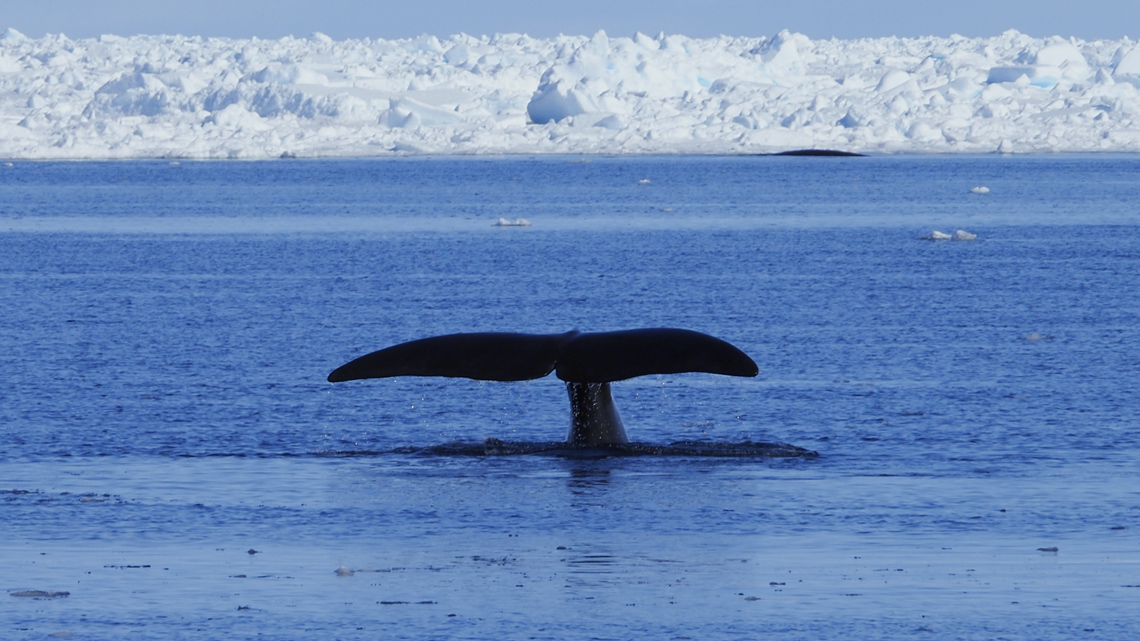
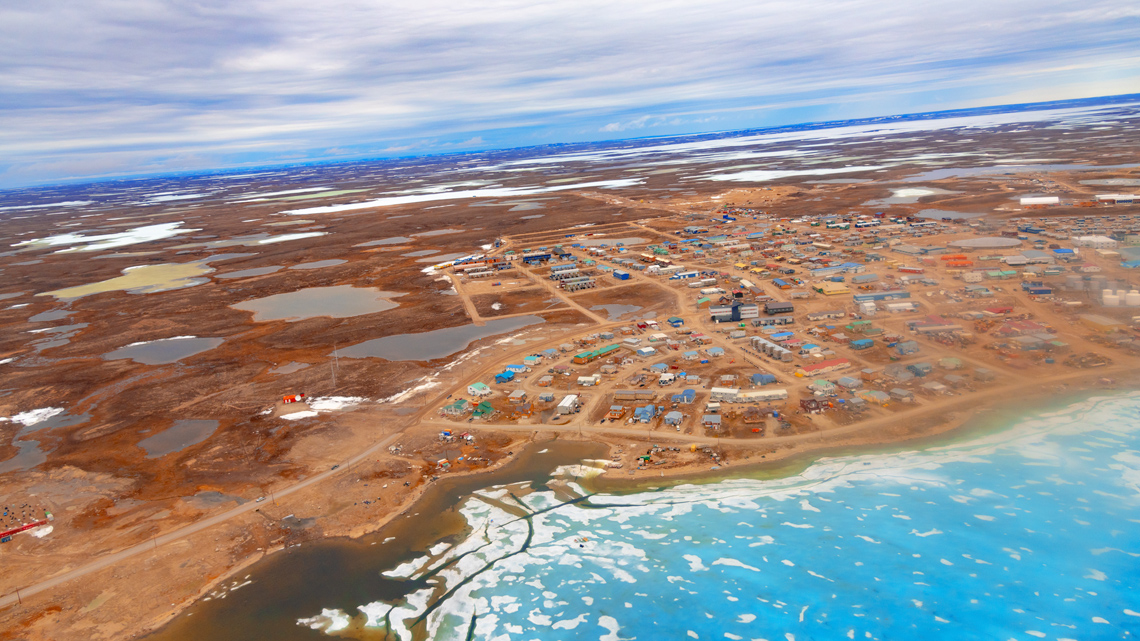
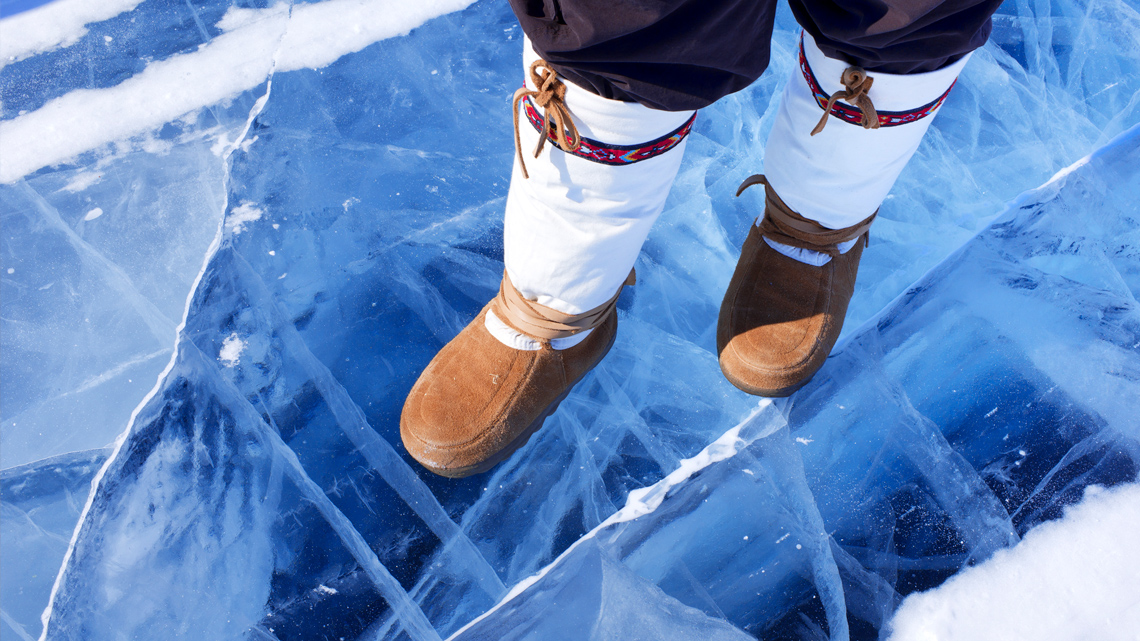
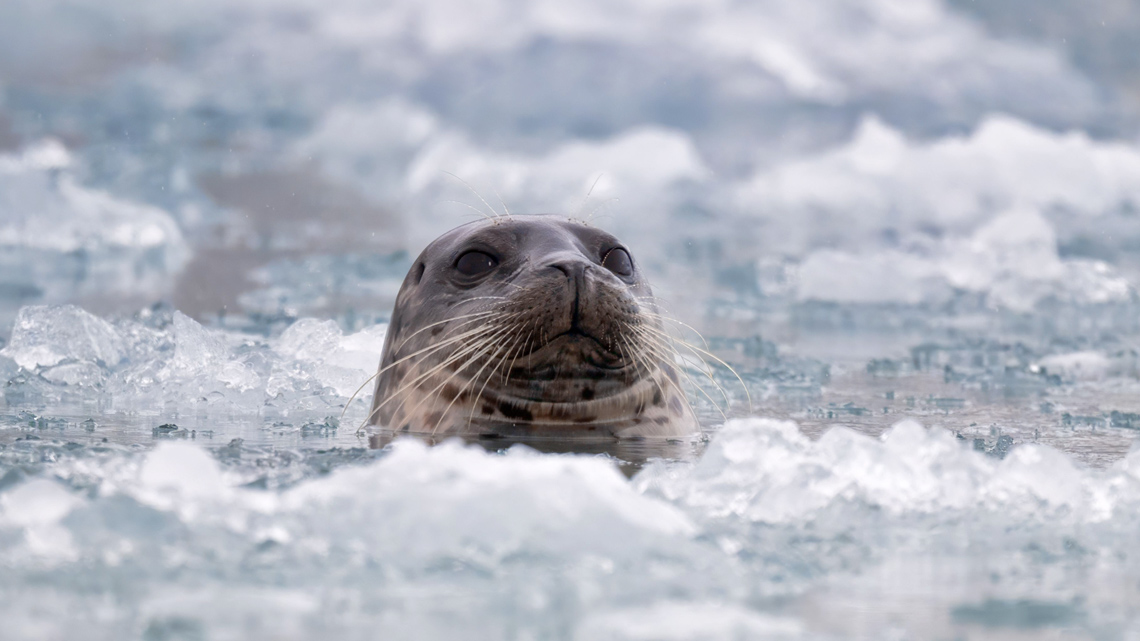
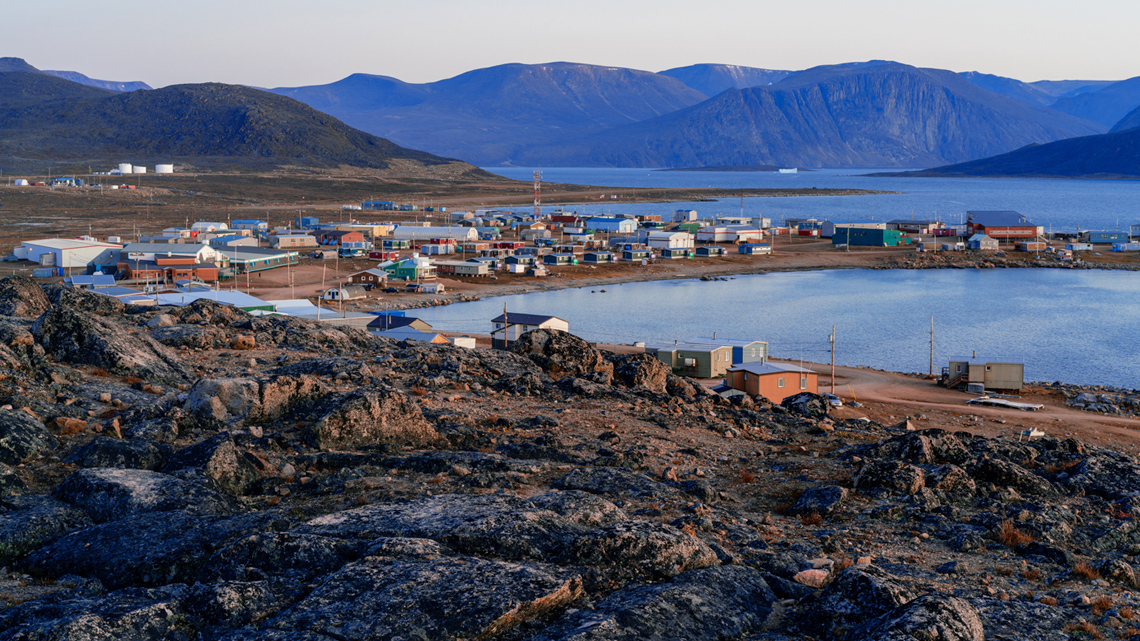
Image 1:
A Bowhead whale swimming in the water. The tail is sticking out.
Image 2:
An aerial view of the arctic town of Cambridge Bay in Nunavut, Canada. There is a large body of water and pockets of homes in the surrounding area.
Image 3:
Traditional mukluks or boots on ice.
Image 4:
A seal is sticking their head out of icy water.
Image 5:
Harsh artic landscape with bare hills and ocean overlook of Inuit of settlement of Qikiqtarjuaq Broughton Island Nunavut.

Brainstorm
Brainstorm
All of the images show some aspect of life in the Arctic regions of Canada.
- What do you know about the Arctic?
- What wonderings do you have about the Arctic?
Record your thinking in a notebook or using another method of your choice.
The Arctic region makes up 40% of the country's entire land mass. It is home to over 200,000 people, approximately half of whom are Indigenous.
In this learning activity, you will explore how climate change has impacted the Arctic region and changed the traditional ways of life of Inuit communities.

Learning about the Arctic
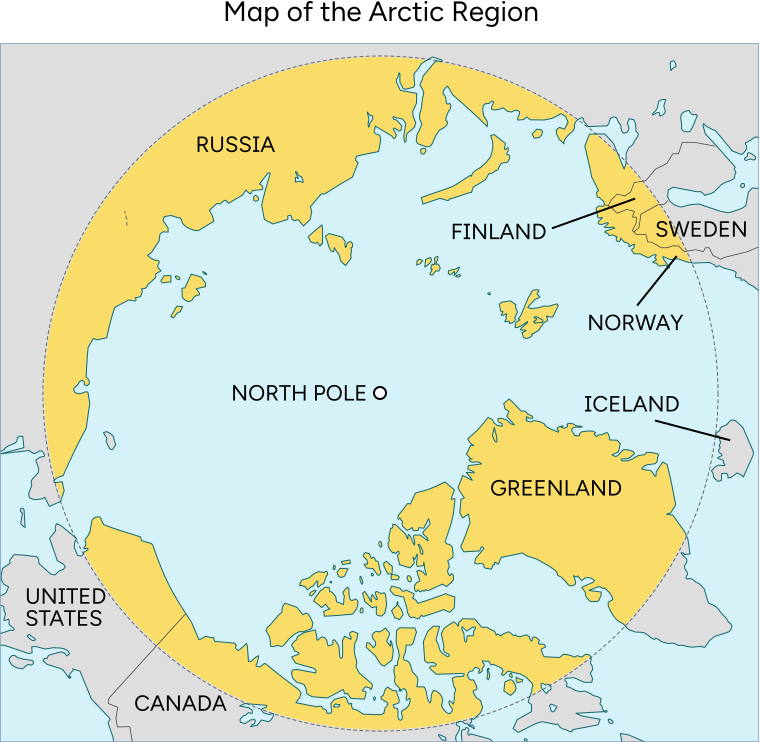
A map of the Arctic Region which includes regions in parts of Canada, Greenland, Iceland, Norway, Sweden, Finland, Russia, and the United States.
The Arctic region, also known as the Arctic Circle, includes parts of eight countries: Canada, Greenland, Iceland, Norway, Sweden, Finland, Russia, and the United States.
The North Pole lies at the centre of the Arctic Circle.
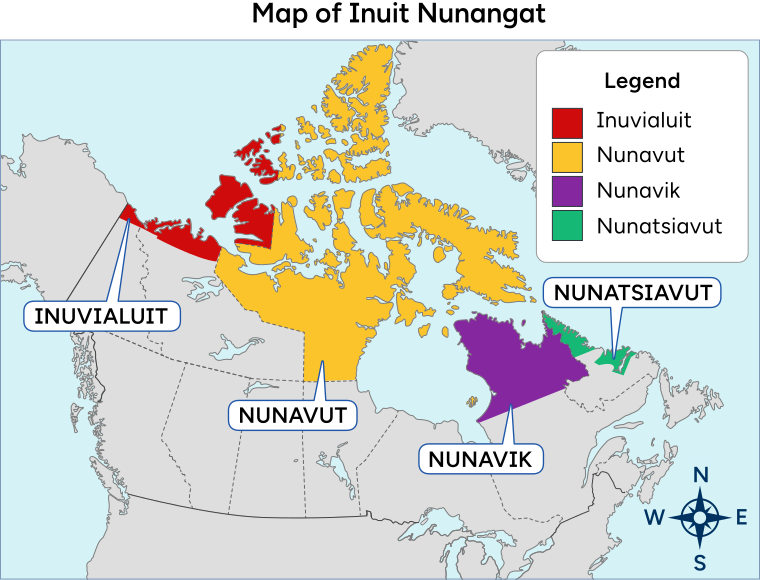
Part of the Arctic Circle also includes a section of Inuit Nunangat, which is the homeland of Inuit communities in Canada.
Inuit Nunangat encompasses 51 communities in Nunavut, Inuvialuit (the Northwest Territories and the Yukon), Nunavik (Northern Quebec), and Nunatsiavut (Newfoundland and Labrador) and includes land, water, and ice, which are all considered integral parts of the Inuit culture and way of life.
The effects of climate change are impacting communities in the Arctic region at a much faster rate than in the rest of the world. This means that the Inuit are impacted by climate change more than any other population.
Check out this interview clip with Sheila Watt-Cloutier, an Inuk activist from Nunavik and Nobel Peace Prize nominee. As you listen, record notes about how climate change is impacting the Arctic region and Inuit culture.
When you are done, press the Sample Answers button to check your answers.
- Ice is forming much later.
- The coast is eroding and permafrost is melting, which is impacting homes, buildings, and structures.
- New species of animals are appearing.
- Trees and plant growing patterns are changing — more lush and larger.
- Melting ice is raising sea levels.
- Inuit culture is changing, and parts are being lost because the land and climate are changing.
Learning check!
Complete the following sentences about the physical impacts of climate change on the Arctic.
For each sentence, select the missing word from the drop-down menu. Press Check Answer to see how you did.

Investigate
Investigate
In the video, Sheila Watt-Cloutier explains how the loss of ice means a loss of the wisdom of Inuit culture because young Inuit learn character-building and life skills through traditional life on the ice.
What are some of the character traits she mentions?
When you are ready press Possible Answer button to check your answer.
Sheila Watt-Cloutier explains that Inuit children are taught wisdom, patience, courage, persistence, and impulse control through traditional hunting activities on the ice.
Climate change and food insecurity
Because climate change is melting polar ice, this is impacting Inuit communities access to food sources and decreasing their hunting grounds (areas that they hunt in). The melting ice is also causing people to have to change their traditional practices of preparing and storing their food. Both effects are examples of some of the causes of food insecurity in Northern communities such as Inuit Nunangat.
Food insecurity is when people do not have reliable and/or affordable access to healthy, sustainable, and culturally appropriate foods.
The Inuit Tapiriit Kanatami, a national Inuit organization, states that “Canadian Inuit experience the highest rates of food insecurity of any Indigenous population in an industrialized nation” (Inuit Tapiriit Kanatami, 2024).
Understanding cause and effect
The sentence “Because climate change is melting polar ice, this is impacting Inuit communities' access to food sources and decreasing their hunting grounds (areas that they hunt in).” is an example of a cause and effect.
Cause and effect is understanding a chain of events that alters or changes something over time.
Cause can be thought of as the WHY (i.e., why an event happened).
Effect can be thought of as the WHAT (i.e., what happened as a result).

Cause and effect statements usually use some of the following key words:
- If…,then…
- because
- since
- as a result,
- so
- therefore
- caused
- effect
Most words that show cause and effect are called subordinating conjunctions. Subordinating conjunctions introduce reasons and explain how things work or why something happens.
Here is another sample sentence:
Because climate change is causing polar ice to melt, Inuit hunting grounds are becoming limited and more dangerous to navigate.
Can you think of any other cause and effect statements based on what you have learned so far about Inuit culture and climate change?
Hint: check out the paragraph introducing climate change and food insecurity for some examples.
Record one or two in your notebook or using another method of your choice. If possible, share your thoughts with a partner.
Check out the following poem called “The Thaw of the Arctic Empire”. As you read, consider what message the author wants you to know about the Arctic.
The Thaw of the Arctic Empire
By: L.A. Pynes
In the land where silence reigns,
and time itself creeps slow,
the Arctic ice, a frozen curtain,
has begun to ebb and flow.
Once a mirror to the sky,
reflecting the stars’ soft gleam,
a land of white shared by thriving life,
a kingdom of frost and dream.
Now, whispers float on warming winds,
the ice becomes frail and thin,
where polar bears once roamed with ease
we find fewer of their kin.
Sea levels rise, invade the land,
the shores begin to flee.
The glaciers groan in slow decay,
now open sea lies where they used to be.
But through the thawing mist and fog,
a resilient spirit remains.
A steady beat in the Arctic’s heart;
life still courses through its veins.
So let us note the changing song,
and listen with caution and care,
for it is up to us to make a change,
to protect the empire we share.

After you have read the poem at least once, practice reading it out loud.
Notice that the author has placed a punctuation mark at the end of each line. Be sure to insert a brief pause for each comma and a slightly longer pause for each period.
If possible, read in front of a mirror or record yourself to help you practice your expression to communicate the tone and meaning of the poem.
What do you think was the author’s goal, or message, of their poem?
Press the Author’s Note button to explore the author’s words about their poem.
“I decided to write this poem to help raise awareness of the impacts of climate change in the Arctic regions of Canada. I think sometimes when people are removed from a problem, either because of distance or because its not part of their everyday lives, they can forget that its there.
The Arctic region and the wildlife and Inuit communities that call it home are experiencing climate change at a rate faster than anywhere else in the world. This is threatening not only traditional ways of knowing, being and doing, but it also has an impact on the diversity of our world at large.
We are all part of the planet, and we all contribute to its health and sustainability. So, I hope that by writing this poem and raising awareness of some of the severe impacts of climate change, people will be inspired to think critically about what actions they can take in their everyday lives. No matter how big or small, we need to take action to protect our planet and make sure the future is a sustainable one for everyone who shares it.”
- - L.A. Pynes

Pause and Reflect
Reflection
In a notebook, or using another method of your choice, answer the following questions:
- How does reading the author’s note change or enhance your understanding of the text?
- Why is it important for people to know about climate change and its impacts on the planet and people such as the Inuit?
- Why is it important that all communities, not only Inuit communities, work towards solving climate change? How does the author help encourage others to reflect and act?

Focus on vocabulary
The prefix perma means something long-lasting or in a fixed (unchanging) state, such as something permanent. Based on this definition, what do you think the word permafrost means?
Press the Definition button to reveal the meaning of this word.
Permafrost is a permanently frozen layer on or under the Earth's surface.
Examine the following image and notice how the land does not appear to be frozen on the surface, but the cross-section reveals a thick frozen layer underneath.
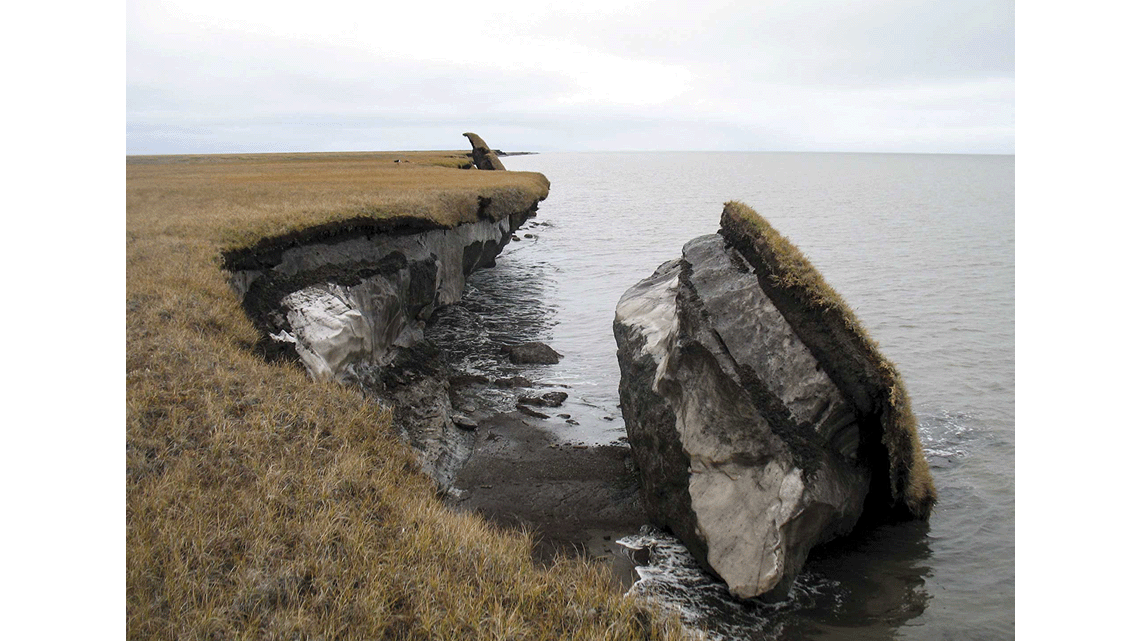
A coastal bluff along Drew Point, Alaska collapsing into the ocean. The collapsing cross-section reveals a thick frozen layer, while the surface above shows dry land.
Let’s review!
In a notebook, or using another method of your choice, explain the following quote from the interview with Sheila Watt-Cloutier in the West Block video:
“What happens in the Arctic does not stay in the Arctic.”
When you are done press the Sample Answer button to compare your answer to a possible response.
The quote “What happens in the Arctic does not stay in the Arctic” refers to the fact that climate change in the Arctic impacts other places in the world. As Arctic ice melts, sea levels rise everywhere else in the world. This causes flooding and destruction of homes and habitats and threatens the balance of life on the planet.

Putting it all together
In this learning activity, you became familiar with the impacts of climate change on the Arctic region, and the effect these changes have on the lives and culture of Inuit communities.
To consolidate your learning, you will now create an informational text that communicates the relationship between the causes and the effects of climate change in the Arctic region. The goal of your informational text is to raise awareness of this issue to help advocate for people to take action against climate change.
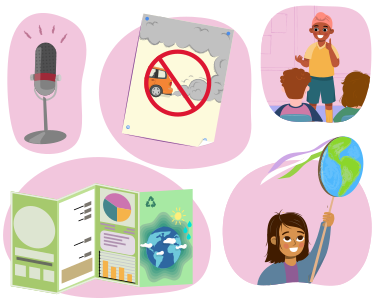
Informational texts include:
- infographics
- flyers/posters
- presentations
- brochures
- podcasts
- public service announcements
Choose the format of your choice and be sure to include at least four different causes and effects to communicate your message.
Press the Examples button to access more examples of signal and transition words that are useful when writing about a cause-and-effect-relationship.
| Cause | Effect |
|---|---|
|
because the reason for on account of bring about give rise to when created by contributed by led to due to since |
as a result as a consequence of outcome finally consequently without therefore for this reason hence effect then so |
After you have drafted your informational text, edit and revise it using the following success criteria. When you are satisfied with your writing, publish it using the tool of your choice.
Informational text success criteria
Reflection
How do you feel about what you have learned in this activity? Which of the next four sentences best matches how you are feeling about your learning? Press the button that is beside this sentence.

I feel...
Now, record your ideas about your feelings using a voice recorder, speech-to-text, or writing tool.