Learning goals
We are learning to…
- identify the lived experiences of diverse Canadian communities
- understand different parts of speech to support communication
- identify and summarize key information in texts to help understand and clarify meaning
Success criteria
I am able to…
- explain the importance of cod fishing, and its ban, to coastal communities in Eastern Canada
- identify the subject and direct objects in sentences
- use the “Five-Fingers” strategy to create a summary of the main points of a text

Exploring coastal communities
Explore the following images of some coastal communities in Canada.
Description

Image 1: A vibrant coastal community featuring colourful houses along a shoreline, with bright blue skies and white clouds stretching over the sloping hills. Small and large boats are anchored around the water.
Image 2: A vibrant coastal community featuring a spread of colourful homes against a slope of green hills in the background. A tranquil body of water flows between houses, with narrow roads along the homes.
In a notebook, or using another method of your choice, answer the following questions. If possible, share your thoughts with a partner.
- What region of Canada are these communities located in?
- What do you notice about the geography of the communities?
- How are they like or unlike the community you live in?
- How do you think weather and climate might impact these communities?
The two communities shown in the images are the East Coast towns of Twillingate and McCallum, Newfoundland, Canada. Both of these towns are outports, small coastal communities with harbours, or ports, for fishing, or sending and receiving goods by sea.
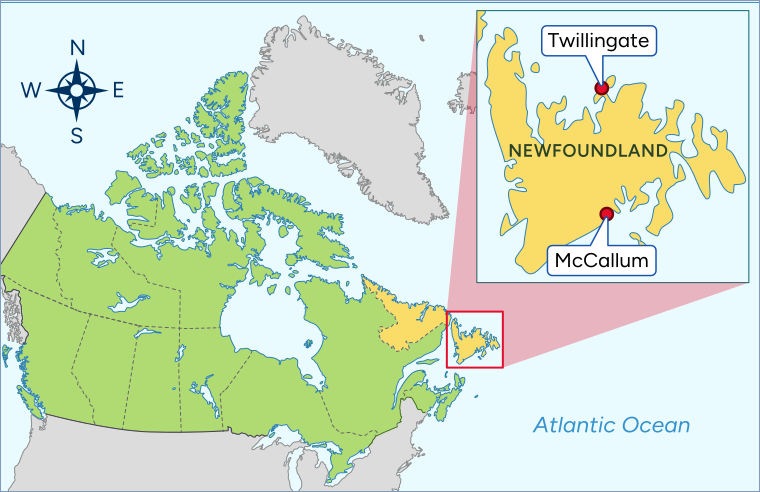
A map of Canada highlighting the region of Newfoundland with a zoom-in feature. The zoomed-in area displays Newfoundland marked with pins indicating the locations of Twillingate and McCallum. Both Twillingate and McCallum appear opposite each other on the map and are situated along Newfoundland's coast. In the corner of the map there is a compass rose marked north, west, east and south.
In this learning activity, we will learn how sustainability issues have impacted and changed the lives of some Atlantic (or East Coast of Canada) fishing communities.

Exploring Atlantic fishing communities
The Beothuk and Mi’kmaq were the original people and fishing communities within the province we now call Newfoundland. These communities had lived along the coasts for several thousand years before the arrival of European settlers. The Atlantic Ocean supplied the Beothuk's and Mi’kmaq’s diet with fish, birds, seals, and other sea mammals.
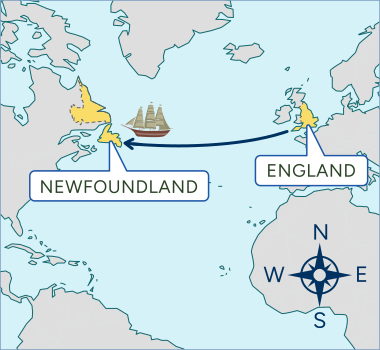
A map illustrating the journey from England to Newfoundland. An arrow at the region of England connects to Newfoundland with an arrow. The route is over an open ocean, with a boat positioned along the path, suggesting the journey can be achieved by water. In the corner of the map there is a compass rose marked north, west, east and south.
Source: The Canadian Encyclopedia. (2006, February 6). Beothuk. The Canadian Encyclopedia. Last edited July 22, 2022. Retrieved July 25, 2024, from https://www.thecanadianencyclopedia.ca/en/article/beothuk
European settlers first came to the Atlantic coast in 1497 to extract natural resources: fish. At first, they fished cod in the warmer months and then returned to England with their catch over winter. By the 1700s, permanent year-round settlements of English and French settlers started to grow along the coast of Newfoundland. This had a huge impact on the Beothuk and the Mi’kmaq, who were forced inland, away from their ancestral territories. They now had to compete with the increasing number of settlers for access to both the land and the ocean. This competition for natural resources contributed to the eventual end of distinct Beothuk communities in Newfoundland as many Beothuk were, in turn, absorbed into Mi’kmaq communities to ensure their survival.
Fishing has always been central to life in Newfoundland: it is an important part of its history, economy, and culture. Fishing was a tradition passed down through generations in many families. Numerous small coastal communities depended on fishing as their primary economic activity. However, from about the 1950s on, intense overfishing led to some species of codfish (or “cod”) becoming extinct. In 1992 the Government of Canada banned cod fishing to prevent this species of fish from becoming extinct. The ban was supposed to last for only two years to allow the cod fish population to increase, but it is still in effect today.

Did You Know?
Did you know?
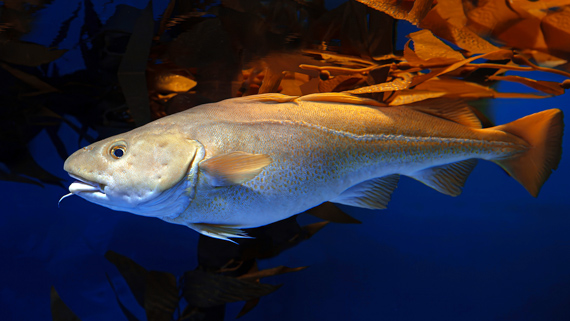
Did you know that codfish (or “cod”) is a type of cold-water fish, originally found off the Atlantic coasts of Canada, England, and United States?
This fish played such an important role in the history and economy of the Atlantic region that it was sometimes called “Newfoundland currency.”
Consider:
What impact do you think this ban had on coastal communities in Newfoundland?
How might people have responded to this ban?
Record your thinking in a notebook or using another method of your choice.
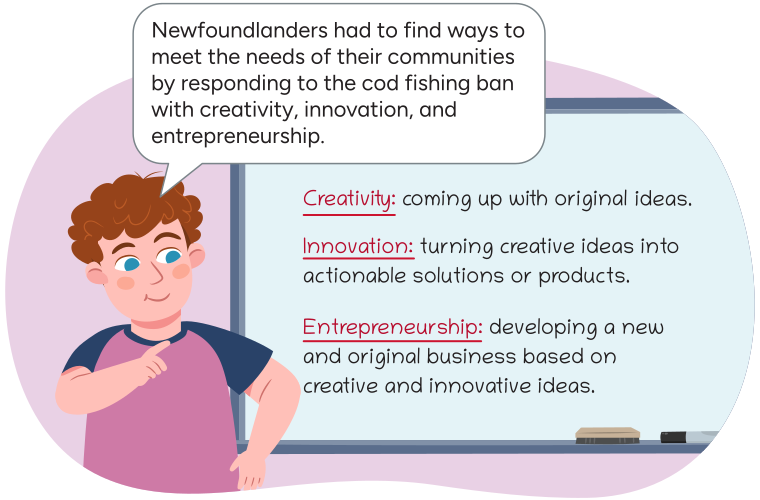
Andrew standing next to a whiteboard. Speech bubbles above him display the text: "Newfoundlanders had to find ways to meet the needs of their communities by responding to the cod fishing ban with creativity, innovation, and entrepreneurship." The whiteboard next to him features three definitions: Creativity is defined as "coming up with original ideas." Innovations is described as "turning creative ideas into actionable solutions or products." Entrepreneurship is defined as "developing a new and original business based on creative and innovative ideas."
Check out the following short film titled Last Fish, First Boat to learn about the creative and innovative solution that one person developed when faced with the end of cod fishing in Eastern Canada.
Post viewing questions
Now that you’ve watched the short film Last Fish, First Boat, it’s time to check what you’ve learned!
For each of the following questions, select the correct answer from the options provided. After making your choice, click Check Answer to see the result.
Reflect:
Record your answers to the following questions in a notebook or using another method of your choice. If possible, discuss your thoughts with a partner.
- How did Eugene Maloney demonstrate a creative, innovative, and entrepreneurial solution to the cod fishing ban?
- In your opinion, do you think this was an effective solution? What other solutions might there be?
- What more would you like to know about the fishing ban in Newfoundland?
When you are done, press Possible Answers to review some examples of how Eugene Maloney demonstrates creativity, innovation, and entrepreneurship in Last Fish, First Boat.
Creativity: Eugene Maloney found another way to be near the sea and around boats his whole life.
Innovation: Eugene Maloney realized that people still needed boats to move along the coast and he learned how to make all sorts of different boats.
Entrepreneurship: Eugene Maloney created a new business of making different types of boats to meet the needs of the coastal communities.
Writing a summary
A summary tells the essential parts of a story’s plot, without giving too much detail. Sometimes, a summary can turn into a retelling if we do not limit the information we choose to include.
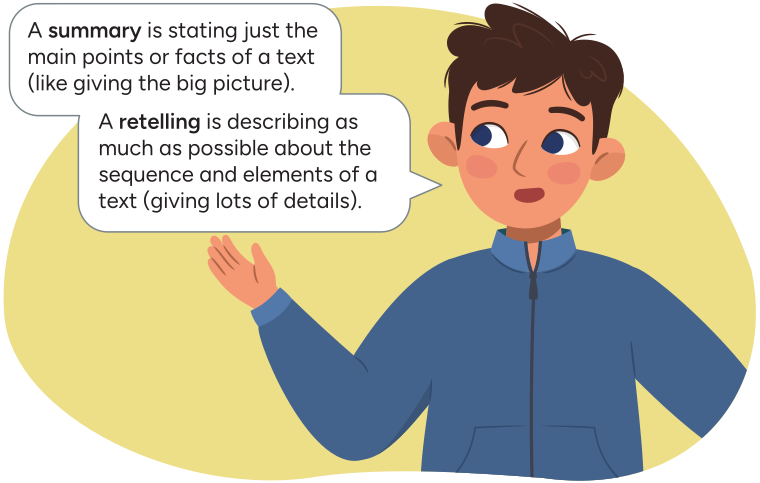
Oliver next to speech bubbles and text that says: "A summary is stating just the main points or facts of a text (like giving the big picture). A retelling is describing as much as possible about the sequence and elements of a text (giving lots of details)."
Let's explore a strategy that is an effective way to summarize the main points of a story without retelling it. It is sometimes known as the “Five-Fingers Summary”.
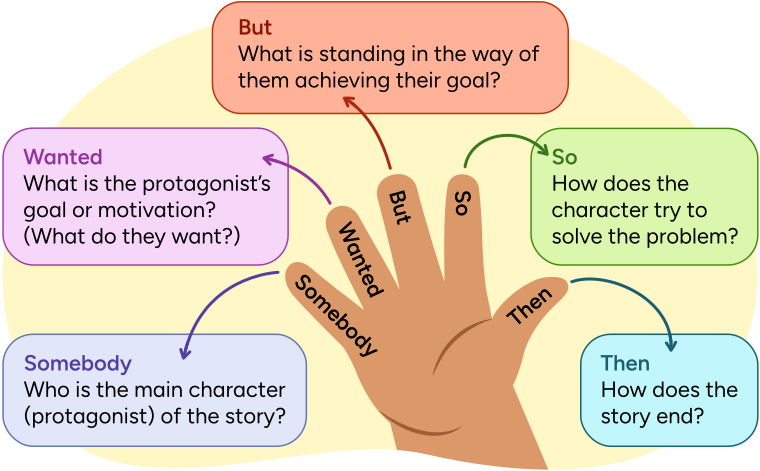
Let’s practice using the “Five-Fingers” strategy by summarizing Last Fish, First Boat. Use the following Graphic Organizer or another method of your choice to practice summarizing the main points.
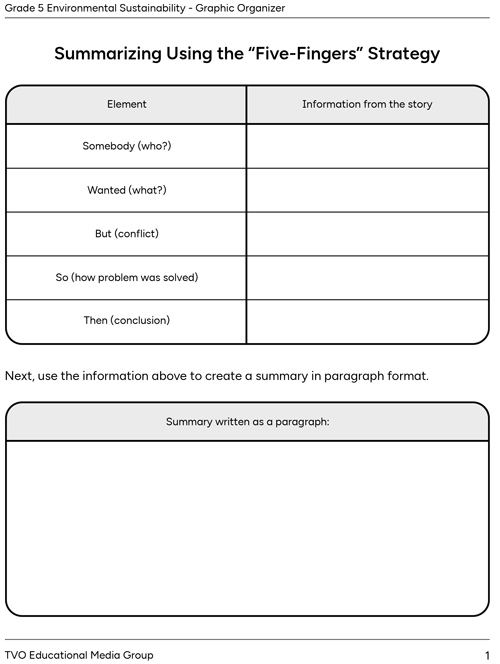
When you’re done creating your summary, press Possible Answers to compare your work to a modelled example. Did you capture all of the necessary details?
Insert the following table within click to reveal:
Modelled Example of Summarizing Using the “Five-Fingers” Strategy
|
Element |
Information from the story |
|---|---|
|
Somebody (who?) |
Eugene |
|
Wanted (what?) |
to fish for a living |
|
But (conflict) |
the Government banned cod fishing |
|
So (how problem was solved) |
He started a business to make boats for people along the coast |
|
Then (conclusion) |
he was still able to make his living from the sea and live near the ocean |
Paragraph Summary:
In the film Last Fish, First Boat, Eugene Maloney wanted to fish for a living, but the Government of Canada declared a ban on cod fishing. So, he began a business to make boats for people along the coast which meant he was then still able to make his living from the sea and live near the ocean.
Exploring a fictional text

Last Fish, First Boat was a nonfiction example of a story about the impacts of the ban on cod fishing in Eastern Canada. Nonfiction means that the details in the story represent real life and a real person’s perspective of what happened.
Next, let’s explore a fictional text on the same topic. Fictional means that the characters and what happens to them in the story are made up (not real) even though the banning of cod fishing was a real event.
Before you begin reading, let’s preview some vocabulary from the text.
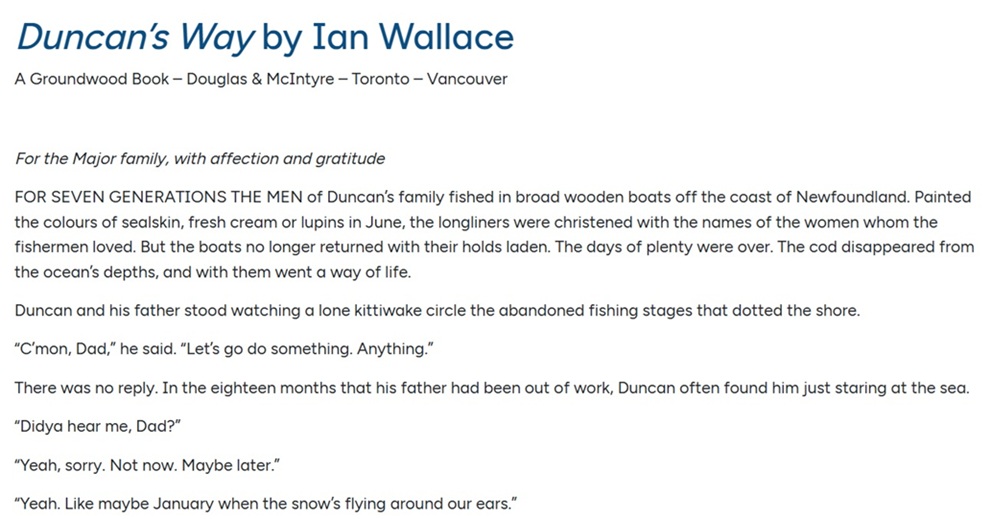
Read the following fictional short story called Duncan’s Way by Ian Wallace, about a Newfoundland family adjusting to the effects of the ban on cod fishing.
As you read, consider how the main character uses innovation, creativity, and entrepreneurship to find a solution for his family.
Learning check!
In a notebook, or using another method of your choice, answer the following comprehension questions about the fictional short story “Duncan’s Way” by Ian Wallace.
- Describe how the end of fishing has impacted Duncan’s family.
- What is Duncan’s goal in this story?
- Duncan’s plan has several benefits for his family. What are some benefits you can think of?
- How does Duncan’s plan demonstrate creativity, innovation , and entrepreneurship?
When you are finished, press Sample Answers to compare your answers with some modelled examples.
Sample Answers:
1. The end of fishing has a very big impact on Duncan’s family. Duncan’s father is very sad and spends many hours staring at the sea or watching TV. His parents are planning to move the family away from Newfoundland to find new employment opportunities.
2. Duncan's goal in the story is to find a way for his family to stay in Newfoundland. He also wants to see his dad happy again.
3. Duncan’s plan for a bakery boat will benefit the family because it will provide them with a way to earn money moving forward. It will also get his dad back on the water, where he is happy. The family can also spend time together as a family on the bakery boat.
4. Duncan’s plan demonstrates creativity, innovation, and entrepreneurship in the following ways:
Creativity: The plan is creative because it thinks of another use for a boat that serves several purposes (for example, a way for the family to have employment, a way for his dad to be back on the water, and a way to provide baked goods to remote communities).
Innovation: Adding a bakery to a boat is a new idea that isn’t a regular use of a boat. This is innovative because it’s thinking “outside the box.”
Entrepreneurship: The plan takes action to create a new bakery business on a boat to serve remote communities.
Grammar routine: nouns as direct objects
Direct objects are nouns that receive the action of the verb in a sentence. Their job is to help us understand the action of the sentence by answering the question “who” or “what.”
Examine the following sentences:
- The Government banned cod fishing.
- Eugene built boats for the coastal communities.
- Duncan helped his family.
- Duncan created a plan for his family.
The easiest way to identify the direct object in a sentence is to first identify the verb, or action, in the sentence. Next, ask the question “who or what does the verb apply to?”

Student Tips
Student tips
Important note: The direct object is different from the subject of the sentence.
The subject is the noun that performs the action of the sentence.
The direct object is the noun that the action applies to.
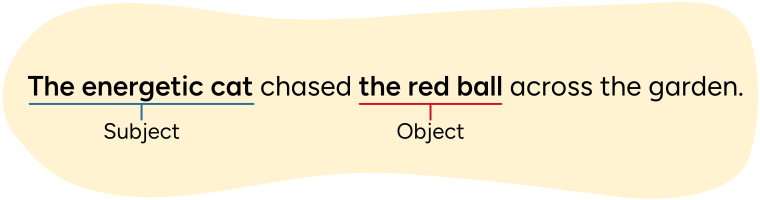
A sentence that says: The energetic cat chased the red ball across the garden. The text, "The energetic cat" is underlined and is the subject of the sentence. The text "the red ball" is underlined and is the object of the sentence.
Let’s reexamine one of the sentences and break it down so we can identify the direct object.
|
Sentence |
Verb |
“Who?” or “What?” Question |
Direct Object |
|---|---|---|---|
|
The Government banned cod fishing. |
banned |
“What was banned?” |
cod fishing |

Try It
Try it!
In your notebook or using a method of your choice, complete the following table with the missing information.
|
Sentence |
Verb |
“Who?” or “What?” Question |
Direct Object |
|---|---|---|---|
|
Eugene built boats for the coastal communities. |
built |
||
|
Duncan helped his family. |
“Who did Duncan help?” |
||
|
Duncan created a plan for his family. |
“What was created?” |
When you’re finished, press Reveal to check your work.
|
Sentence |
Verb |
“Who?” or “What?” Question |
Direct Object |
|---|---|---|---|
|
Eugene built boats for the coastal communities. |
built |
“What was built?” |
boats |
|
Duncan helped his family. |
helped |
“Who did Duncan help?” |
his family |
|
Duncan created a plan for his family. |
created |
“What was created?” |
a plan |

Putting it all together
Let’s review some of the vocabulary explored in this learning activity.
For each vocabulary term, select the correct definition.
Writing a summary for “Duncan’s Way”

Devon at a desk writing in a notebook. Above Devon is a thought bubble with the text: A summary should tell the essential parts of a story's plot, without giving too much detail.
In this learning activity, you explored how people in some Canadian communities found creative solutions when they were affected by big changes. You also learned a strategy for summarizing a literary text efficiently.
Now it's your turn to write a paragraph summary for the story “Duncan’s Way” by Ian Wallace that you read in the Action section of this learning activity.
Complete the fillable and printable Five-Finger Summary Activity in your notebook or using the following document. If you would like, you can use speech-to-text or audio recording tools to record your thoughts.
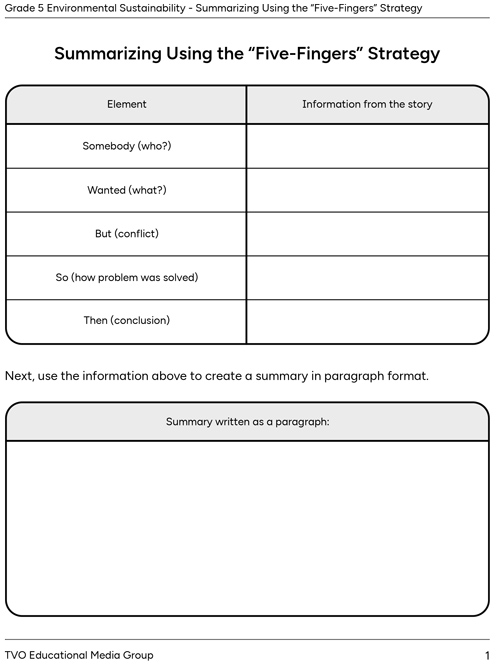
Press the Five-Finger Summary Activity button to access the Five-Finger Summary Activity.
Activity(Opens in a new tab)Self-Check:
When you are done writing your summary, self-assess your work using the following success criteria:
When you are sure that your writing is your very best, practice reading your summary aloud. Be aware of your intonation (how your voice rises and falls) and your pace (how quickly you are reading).
Reflection
As you read through these descriptions, which sentence best describes how you are feeling about your understanding of this learning activity? Press the button that is beside this sentence.

I feel...
Now, record your ideas using a voice recorder, speech-to-text, or writing tool.