Learning goals
We are learning to…
- understand and demonstrate cultural awareness of First Nations, Métis, and Inuit varied identities, perspectives, relationships, legacies, truths, and ways of knowing, being, and doing
- demonstrate an understanding of a variety of explicitly taught words and phrases
- analyze texts to identify differing perspectives and summarize main ideas
- plan, develop ideas, and select suitable media, techniques, and tools to publish final texts
Success criteria
I am able to…
- explain how honouring First Nations varied identities, perspectives, relationships, legacies, truths, and ways of knowing, being, and doing connects to sustainability and actions I can take
- work with specific vocabulary on the topic of Indigenous perspectives, relationships, and truths in a variety of ways such as in a vocabulary notebook
- compare and contrast the different ways that Indigenous peoples and settlers viewed treaties, land ownership and stewardship
- organize ideas and create a visual media text, such as a video or photo essay, to show my connections to the land I live on and my responsibilities to help sustain the land
Land acknowledgement
Have you heard of a land acknowledgement?
You may have experienced a land or territory acknowledgement at school before you begin your day, at an event, or maybe in the media.
A land acknowledgment is a statement of gratitude and appreciation to the land, and it also honours the Indigenous Peoples who have lived on the land for as long as can be remembered.
A land acknowledgement can be a meaningful way to recognize the long and enduring histories and relationships that First Nations, Inuit, and Métis peoples and communities have had, and continue to have, with the land since time immemorial . They are meant also as a way for non-Indigenous people to situate (or place) themselves and their own histories in how they came to be on the land now known as Canada.
“Getting to know people, creating a relationship to the place that you are from, the water that you drink… getting to know these things in an intimate way is what essentially will change peoples minds, change peoples hearts. Acknowledging the land and water that sustains us and
life on Mother Earth is part of becoming a balanced and present human being. Its about honouring and protecting the land and water, honouring ourselves and our bodies..”
– Nigit'stil Norbert, Gwich'ya Gwich'in, born and raised in Denendeh, Yellowknife, Northwest Territories
Source: Gwich’ya Gwich’in, N. N. (n.d.). Why acknowledge?. Whose Land - Welcome!
You may have noticed that the quote is missing some punctuation. Sometimes when direct speech is written down, pieces may be left out (such as punctuation). When we are using quotes in our work, we have to honour the original source and how they presented the quote, even if there are pieces missing.
Examine the following video to explore Ariana Roundpoint's personal land acknowledgment. Ariana is a Mohawk author from Akwesasne, a First Nations community near Cornwall, Ontario. Consider jotting down some notes about the details Ariana includes in her personal land acknowledgement.

Pause and Reflect
Pause and reflect
Take a moment and reflect on the following questions:
- What are some of the details Ariana included in her personal land acknowledgment?
- Why is this place special to Ariana as a First Nations person?
- What did you think or feel while listening to her words?
- Why are land acknowledgments important?
Source: Whose land lesson plan - grades K-5. TakingITGlobal. (n.d.). https://www.whose.land/en/lesson-plans
Record your responses in a notebook or using another method of your choice. If possible, share your thinking with a partner.
In this learning activity, you will explore the roles that honouring treaties, acknowledging the land, and respecting Indigenous stewardship have in building a sustainable future for the Earth.
Indigenous traditional or ancestral territories
Indigenous communities have lived on Turtle Island, the land that is now Canada, since time immemorial . Only in the last 500 years did a large population of settlers from other continents come to live on this land. Before European contact, there were hundreds of Indigenous nations.
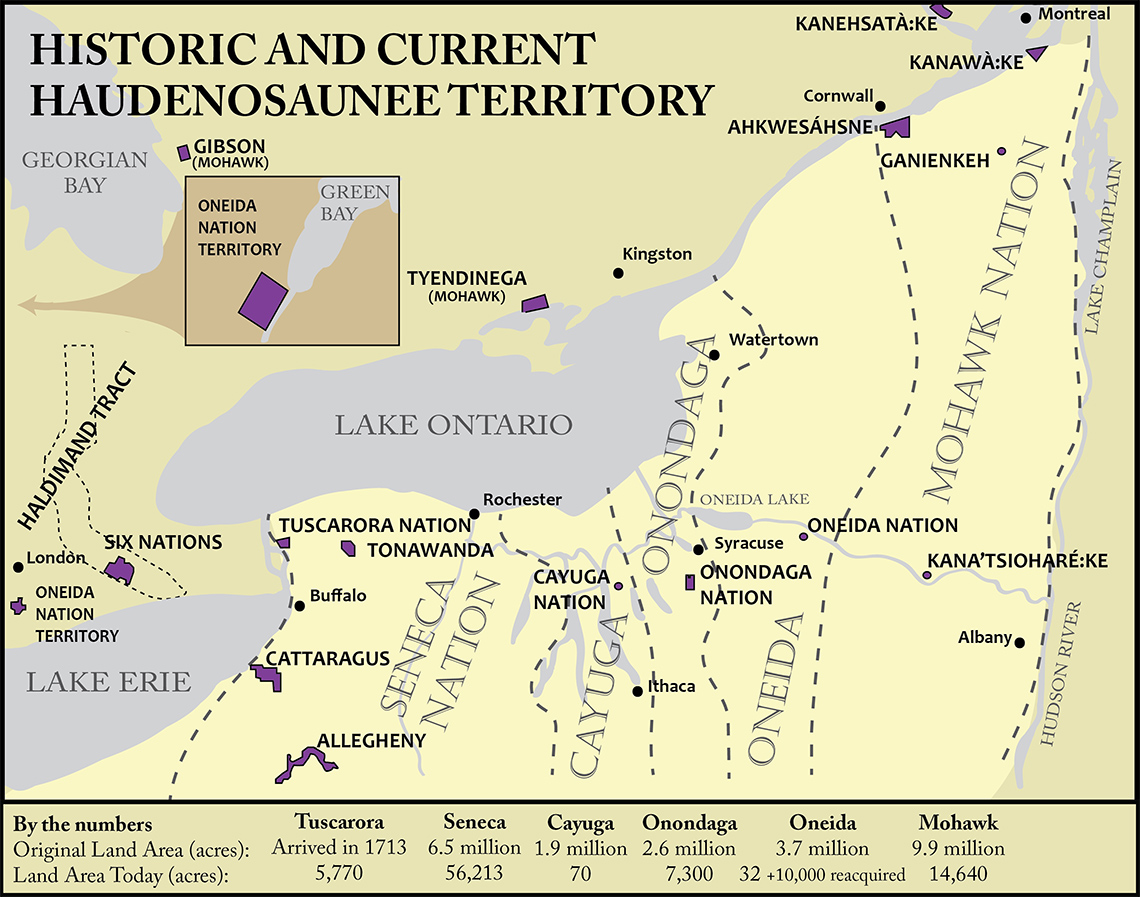
A map comparing the historic territories of the First Nations communities that were part of the Haudenosaunee Confederacy and where these Nations live today.
DescriptionThis map shows where the Six Nations of the Haudenosaunee were relocated to by the British Crown.
The Six Nations displayed on the map are: Tuscarora, Seneca, Cayuga, Onondaga, Oneida, and Mohawk.
There are 10 areas noted on the map that are the current territory of the Haudenosaunee. They are Gibson, Tyendinega, Ahkwesahsne, Kanehsatake, Kanawake, Ganienkeh, Allegheny, Cattaragus, Tonawanda, and Kanatsiohareke.
As we learn more about Indigenous ways of knowing and relating to the land, let’s consider the traditional territories, also referred to as ancestral territories, in Ontario.
Traditional territories are Indigenous lands that were traditionally occupied by a specific nation or community’s ancestors and are still in use today. Traditional territories are referenced in land acknowledgements.
For some, it may be difficult to visualize what the country that is now referred to as Canada might have looked like without provincial borders or the population that inhabits it now. This was when the land was made up of traditional territories. Borders were not as formal or official as they are today, but there were specific areas that Indigenous Nations lived, hunted, and travelled within. These borders would be defined by naturally occurring divisions in the Earth such as lakes, rivers, forests, etc.
Student Marcel is talking.
He is saying:
It is important to remember that the places in which a particular community lived had a great impact on how they would come to understand and learn from the world around them.

Key vocabulary
So far in this learning activity we have been introduced to several key vocabulary terms:
- land acknowledgement
- time immemorial
- traditional territories (or ancestral territories)
Whether you’ve heard these terms before or not, working with important or “key vocabulary” is a very useful tool in understanding new topics and texts. To understand a new word or term, it’s not enough for us to just read a definition. To really understand, our brains need to think about it in different ways. This is where a vocabulary notebook can be a useful tool!
Choose one of the following fillable and printable graphic organizers, or another method of your choice, to record the vocabulary terms and explore more about their meanings. If you would like, you can use speech-to-text or audio recording tools to record your thoughts.
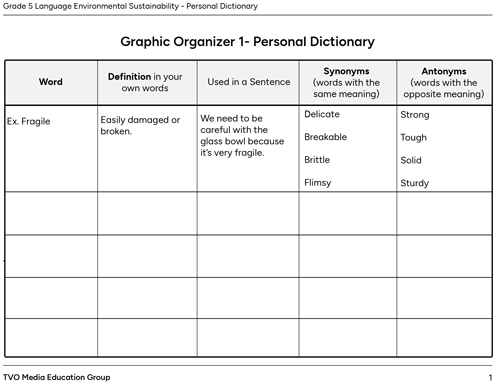
Press the Activity button to access the Graphic Organizer 1 – Personal Dictionary.
Activity(Opens in a new tab)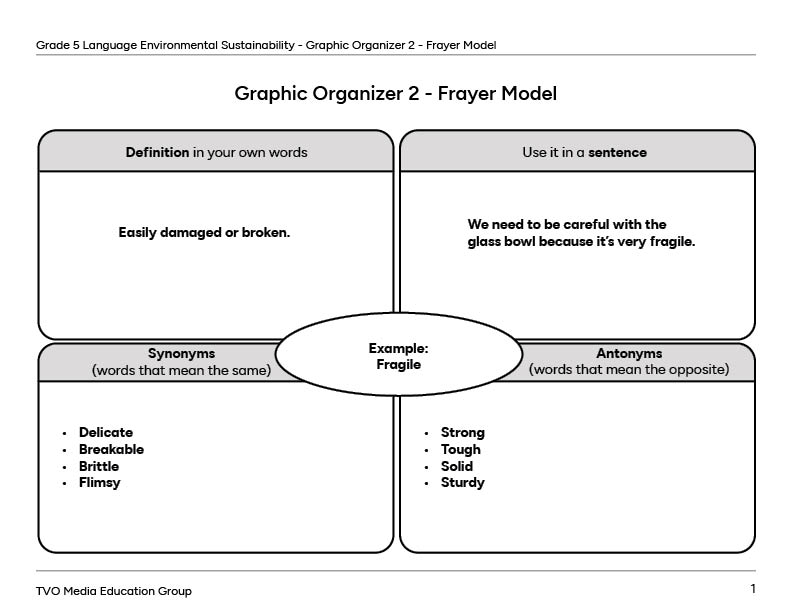
Press the Activity button to access the Graphic Organizer 2 – Frayer Model.
Activity(Opens in a new tab)As you come across more key vocabulary terms (or words that are new to you), add them to your vocabulary notebook.
The meaning of treaties and treaty territory
Treaties are agreements about how the land will be used and shared. They are agreements that are made between two nations and are legally-binding.
There is a long history of treaty-making on Turtle Island (North America). First Nations communities created their own treaties between separate nations that outlined each group’s roles and responsibilities. These treaties were recorded orally and also visually through forms such as wampum belts.

Did You Know?
Did you know?
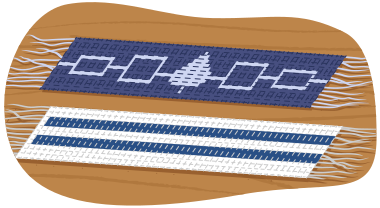
A wampum belt provides a way of understanding past events and gives us an opportunity to read history. The patterns provide a timeline and describe events and agreements or treaties between various Indigenous nations. The words of the agreement are woven into the belts and the speaker uses the wampum to remember the agreement.
Wampum belts represent the living history for different nations including the Haudenosaunee, the Mi’kmaq, and the Anishinaabe.
When we study the past, using primary sources to understand what happened is very important. One of the most valuable primary sources for understanding the past on Turtle Island are wampum belts.
Press the following tabs to review the different types of sources of historical information.
Primary sources include documents, images, or objects that provide information or personal memories from people who experienced an event as it was happening. Primary sources are usually made at the time of the event or shortly after.
Secondary sources include documents, images, or objects that were created by someone who did not directly experience an event. Secondary sources are often books or articles by experts on certain events. Secondary sources often refer to primary sources to support their analysis.
Treaties today often refer to the agreements made between First Nations and the Crown (the Canadian Government). This allowed the Crown to use the expansive traditional lands of Indigenous Peoples and outlined the promises and obligations that were required of both parties to fulfill this partnership.
The Canadian Government and Indigenous Peoples viewed treaties very differently. When the first treaties were signed, the Crown viewed them as official sales, or transfers of ownership, of land. In Indigenous Knowledge systems, people do not own the land, they are caretakers of the land and treaties were viewed as agreements to share the land and honour everyone’s cultures and ways of life. The idea of owning land is a colonial concept.

Brainstorm
Brainstorm
In a notebook, or using another method of your choice, explain the following in your own words:
How were/are Indigenous and settler views of land ownership and treaties different?
Caretakers of the Earth

Indigenous and settler points of view are also very different when it comes to making decisions about how the land and its resources should be treated or managed. Being a caretaker of the Earth and making sure it is sustainable for future generations is called environmental stewardship.
In Indigenous Knowledge systems, humans have a sacred responsibility to care for the Earth and use its resources in ways that don’t ruin or deplete them.
Settler, or colonial beliefs, have often prioritized control (power) and money (wealth) before environmental stewardship. Over the years, the actions of settlers and the Government have had many negative consequences for the land, air, and water. These consequences have made it difficult for Indigenous communities to live traditionally and practice their treaty rights such as hunting, fishing, and trapping.
Most of the time, the traditional and treaty territory of an area belongs to the same Indigenous Nations and/or communities. However sometimes, other Indigenous Nation(s) or communities may have signed a treaty outside of their traditional territory. Some territories have never had a treaty, and these lands are called unceded territories.
New vocabulary
Take a minute and record the following key vocabulary in your vocabulary notebook or using another method of your choice.
- treaties
- wampum belt
- primary source
- the Crown
- environmental stewardship
- unceded territories
Are there any other words or phrases that you’d also like to add? Do that now!
Identifying traditional and treaty territories

As we learn more about Indigenous ways of knowing and relating to the land, it is always important to consider the source of the information we are interacting with. Is it a primary source or a secondary source? Whose perspective or point of view is being represented? Is there any bias present?
To identify the traditional territory and treaty territory (or territories) on which your community is located, ask a trusted adult to help you and use the following suggestions to research and find the information.

Student Tips
Student tips
Here are some suggestions for how to research and find traditional territory and treaty territory (or territories) on which your community is located:
- Check the land acknowledgment used by the school board in your community or a government website for your community, such as your local library or municipality.
-
Explore the following map created by the Government of Ontario.
Note about this map stated on the Government of Ontario website: “Please note that this map has some limitations and is one of many ways to learn about treaties. Indigenous communities may have different understandings of the treaties than is represented here.” (Map of Ontario Treaties and Reserves, n.d.)
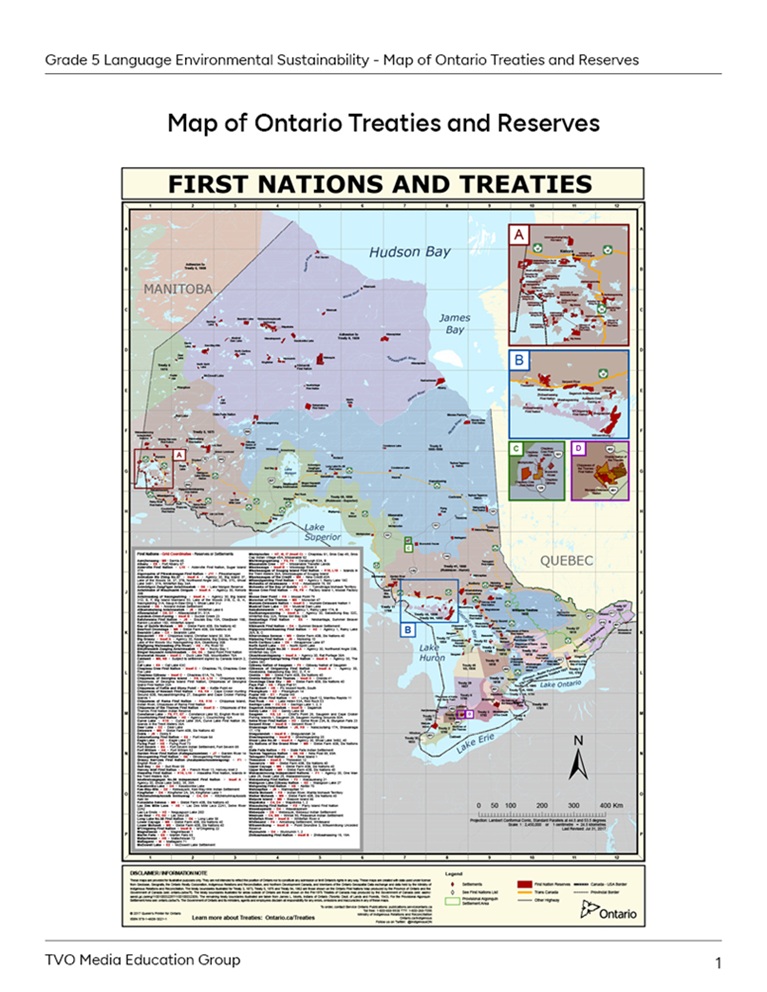
Press the Activity button to access the Map of Ontario Treaties and Reserves.
Activity(Opens in a new tab)
Grammar routine
Earlier in this learning activity, you were asked to compare the views of Indigenous Peoples and settlers when it comes to land ownership and treaties.
When we are comparing and contrasting information, conjunctions are a useful tool!
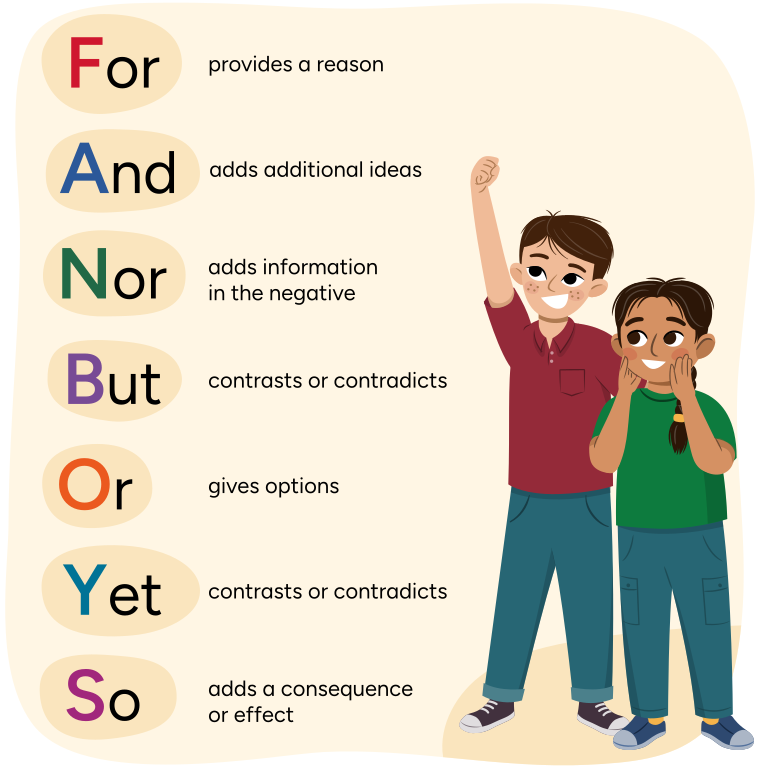
Conjunctions are words used to join words, phrases, clauses, and sentences to one another. You can think of them as the glue that holds sentences together!
Check out the following video to review some of the most common conjunctions.
Coordinating conjunctions are conjunctions that link words or phrases that are similar grammatically or equal to each other. Check out the following image to explore the acronym FANBOYS and the seven coordinating conjunctions used in the English language.

Try It
Try it!
The conjunction “but” is used to contrast or compare opposites.
In a notebook, or using another method of your choice, practice using the conjunction “but” by writing 3 sentences that contrast Indigenous and settler views of treaties, land ownership, and environmental stewardship.
When you are ready, press the Hint button to explore an example.
The Crown viewed treaties as land being sold but Indigenous people viewed treaties as agreements to share the land and honour everyone’s cultures and ways of life.
Understanding our role as treaty people
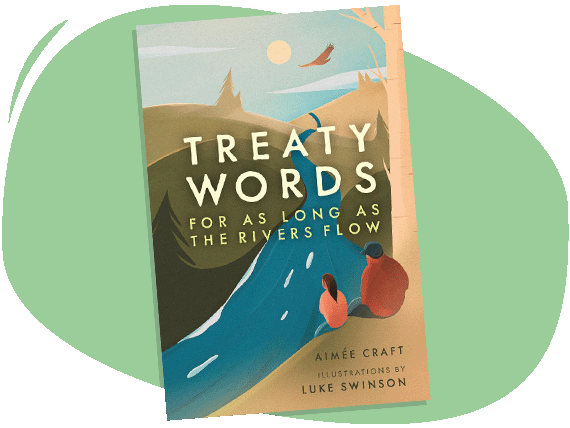
Aimée Craft is an Anishinaabe-Métis lawyer and author who writes books on understanding the significance and the importance of treaties. Her book Treaty Words: For As Long As the Rivers Flow is a picture book written specifically for young people.
Explore the following text from an interview Aimée Craft did in February 2021 with the Open Book foundation where she talks about her book Treaty Words: For As Long As the Rivers Flow.
Open Book [OB]: Tell us about your new book and how it came to be.
Aimée Craft [AC]: The intent of the book, which is to understand what good relationships are and the principles that Indigenous people observed as part of building good treaty relationships, came from listening to the land and water. Laying by a lake on a rock for a whole afternoon I listened to the ice, pop, crack and then turn to musical crystals before the ice regained its water form. It reminded that if we listen, and take time, we can learn so much from our natural environments. For about seven years I carried that story with me […]
OB: Is there a message you hope kids might take away from reading your book?
AC: I would like young readers to understand that they are part of something bigger than them. They have a whole world of relatives that are looking after them. In addition to your family, your friends, your teachers, your coaches, mother earth and all other beings that are part of creation are part of sustaining life. They’ve done it for much longer than we have and we have so much to learn from them. I also want them to think about how good relations between Indigenous peoples and settlers can be modelled – on concepts of reciprocity, respect and renewal. In many ways this book is about environmental and social consciousness.
After reading
Based on the text from the interview with Aimée Craft, answer the following questions. Record your thinking in a notebook or using another method of your choice.
- In your own words, why do you think Aimée wrote this book?
- What do you think the word “reciprocity” means? How could you find out?
- Aimée says “In many ways this book is about environmental and social consciousness.” Consciousness means being aware of ourselves, others, and the world around us. Why do people need to be aware of environmental issues and social issues, such as treaty agreements?
Learning check!
Answer the following question about the intention of a land acknowledgment.
Select the correct answer, then press Check Answer to see how you did.
Putting it all together
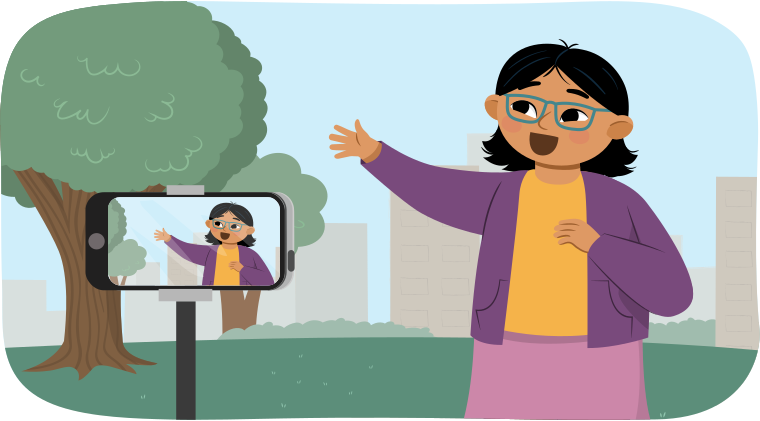
In the Minds On section of this learning activity, you explored a land acknowledgment by Ariana, who described what makes her traditional or ancestral territory so important to her.
To consolidate your learning, you will communicate about the land you live on, what you value about it, how it benefits you, and what your treaty obligations are towards it. You will share your ideas through a video or photo essay that uses words, images, and/or sounds to express your relationship to the land. You can also choose another method of your choice that communicates the information using words, images, and/or sounds.
Your final product should answer the following questions using words, images, and/or sounds.
- On what traditional lands do you live? What treaty area is it?
- What are you thankful or grateful for about the land?
- Who else shares or benefits from this section of land?
- What actions can you take to help take care of the land, thereby honouring the treaties of this region?
You may choose to use the following graphic organizer, or another method of your choice, to help you plan and organize your work.
Access the following Video or Photo Essay Planning Organizer to complete the activity.
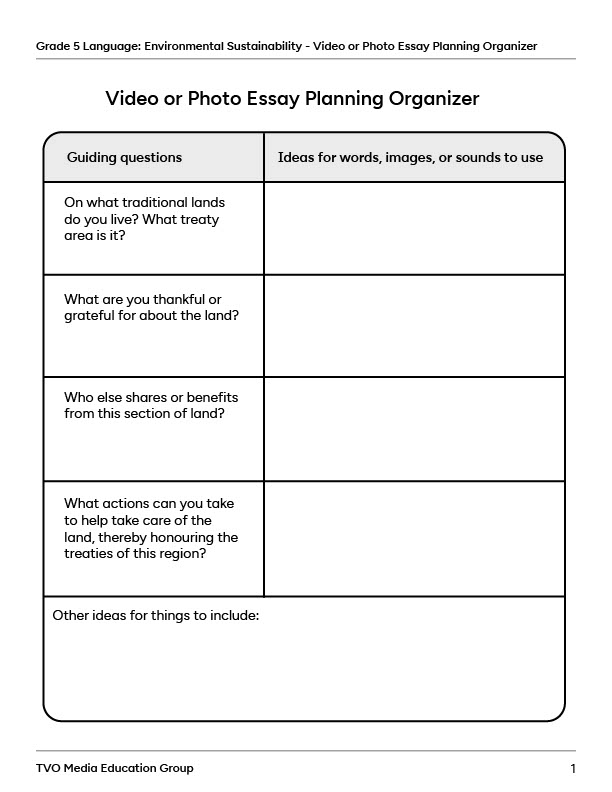
Press the Video or Photo Essay Planning Organizer button to access the Video or Photo Essay Planning Organizer.
Activity(Opens in a new tab)Use the following success criteria to help you create your final product.
Video or Photo Essay Planning Checklist
Reflection
How do you feel about what you have learned in this activity? Which of the next four sentences best matches how you are feeling about your learning? Press the button that is beside this sentence.
I feel...
Now, record your ideas about your feelings using a voice recorder, speech-to-text, or writing tool.