Learning goals
We are learning to…
- make connections between texts, the world, and ourselves
- identify relevant information in texts and draw conclusions
- read poetry aloud
- write narratives that use sensory details
Success criteria
I am able to…
- identify connections between Indigenous perspectives and relationships with the land and my own lived experiences
- summarize the main ideas in texts and use them to connect to my own lived experiences and the world at large
- use the elements of line and punctuation to read poetry fluently
- write a descriptive narrative of a nature experience that uses three or more senses
Making connections
Explore the following video clips of nature scenes.
Clip 1
Clip 2
Clip 3

Reflection journal
In a notebook, or using another method of your choice, begin a reflection journal with your thoughts on these questions:
- What feelings or emotions did you experience with each of the videos? What words could you use to describe the feelings or emotions you felt during each of the videos?
- Which video did you prefer the most?
- What was it about your favourite video that made you enjoy it?
As you work through this learning activity, you will find more reflection journal prompts. When you do, make sure to record your thinking in whatever format you choose for your reflection journal.
As humans, we are connected to the natural world around us. Nature and natural environments can have a strong effect on our physical, emotional, and mental wellness.
In this learning activity, we will explore some ways in which nature can support wellness, learn about Indigenous environmental perspectives, and reflect on some of our own personal experiences with nature.

Connecting with nature
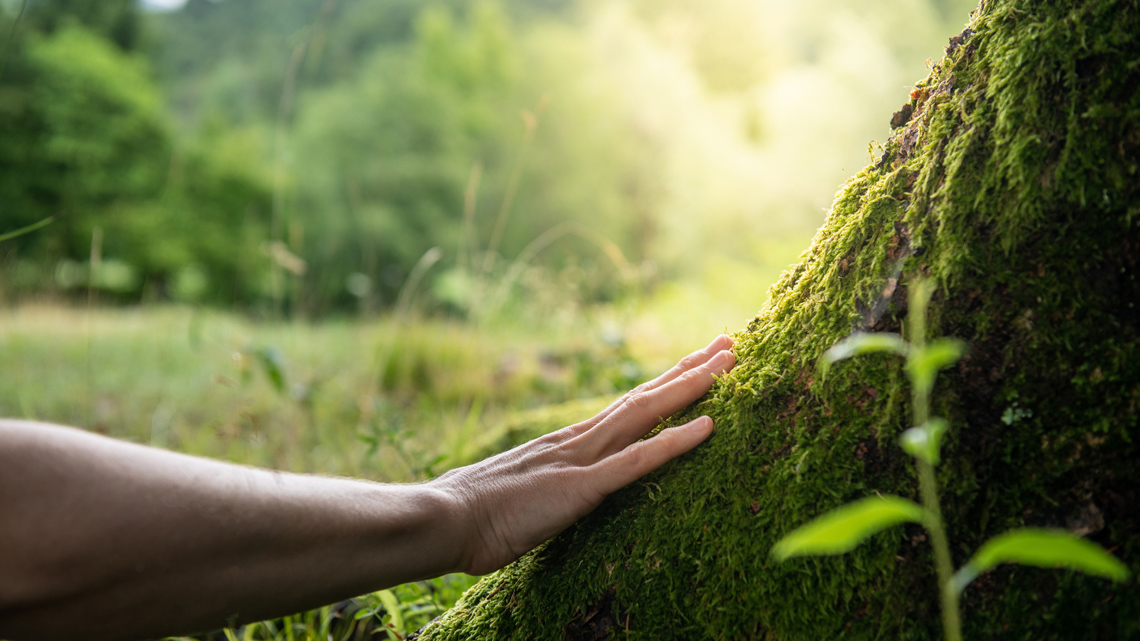
How do different people connect with nature?
The answer to that question has a lot to do with where people live and their access to natural spaces.
Some people might live in more rural or remote areas that are surrounded by many large natural spaces like fields, meadows, or forests. Others might live in more urban areas and have to rely on visiting green spaces. Green spaces are areas of nature, usually in urban places, where people can go to do activities for fun and relaxation that connect them to nature. Some examples of green spaces are parks, community gardens, or outdoor sport areas.
Reflection journal

Where do you go to connect with nature? When you are there, what kinds of activities do you do to connect with nature?
If you could choose any type of natural space to visit, what would it be? What activities would you do when there to help you connect with nature?
Record your thoughts in a notebook or using another method of your choice.
Activities to connect with nature
There are many different things and activities that people can do to help them feel more connected with nature.
Have you heard the term forest bathing before? Do you have any idea what it is?
Let’s learn more about forest bathing while we practice summarizing the main points of a text to help us draw conclusions on a topic.
Explore the following clip of TVO’s The Agenda to hear field reporter Charnel Anderson explain what it is.
In a notebook or using the following printable and fillable organizer, summarize the main points of the video to answer the first guiding question:
What is forest bathing and how is it done?
| Guiding question | Main points |
|---|---|
| What is forest bathing and how is it done? | |
| What are the benefits of forest bathing? |
Press the Activity button to access the Summarizing Forest Bathing.
Next, check out the second clip of the same segment and answer the second guiding question:
What are the benefits of forest bathing?
When you’re done recording the main points of both segments, press the Answers button to check your understanding.
| Summarizing Forest Bathing | |
|---|---|
| Guiding Question | Main Points |
| What is forest bathing and how is it done? |
Forest bathing is also known as "shinrin-yoku" in Japanese. It’s the slow and intentional practice of going into nature and connecting with all your senses. It can be done on your own or with someone to guide you through the practice. It can be done anywhere there is greenery, like a park, forest, or even with potted plants. |
| What are the benefits of forest bathing? | It can lower stress and improve overall health like boosting your body’s immune system and helping to fight off sickness and disease. It also has mental health benefits because it helps to relax the mind. |
Learning from the land
Nature can help us experience a sense of calm, inner peace, and allow our brains to rest and reset, especially in our busy world. Connecting to the land and learning from the land are very important to many cultures but are particularly important to Indigenous communities. The connections between Indigenous Peoples and their traditional territories have existed since time immemorial or as long as can be remembered. Each nation and/or community has their own distinct understanding and knowledge that stem from their deep and long-lasting relationship with their local environment.
Explore the following video where Sandra Indian and Katrine Jack, both of the Ojibways of Onigaming First Nation, share their thoughts and the significance of learning from and connecting to the land.
The Ojibways of Onigaming First Nation is an Anishinaabe community located in northwestern Ontario between Kenora and Fort Frances.

Connections
Connections
What was the main message of the video? What did Sandra and Katrine want the audience to take away from watching the video?
Can you think of an experience that you have had that has made you feel connected to nature and the natural world?
Record your thinking in a notebook or using another method of your choice.

Reading fluency routine
Poetry is a form of text that allows the author, or the poet, to share their feelings and thoughts on a topic. Personal connections to nature, the land, and the environment are some of the subjects that many poets like to write about.
Let’s explore a poem from the digital book called Tea and Bannock Stories: First Nations Community of Poetic Voices. The poem called “Have You Heard?”, written by Celinda J. Rice from Snuneymuxw First Nation, shares connections to the land, and more specifically water, that the author feels.
Snuneymuxw First Nation is near the eastern coast of Vancouver Island with villages on the Fraser River and in the Gulf Islands.
Read the poem aloud, then reflect on the following questions:
- Are there any words that you need to practice pronouncing?
- Where should you pause your speech based on the authors use of punctuation and line?
- What words do you think should receive special emphasis as you read?
|
Underneath the ripples lies a life that sings! Have you heard the water when it rings? Spoken language is not the only Means of communication for the lonely; Have you heard the water talk? Chuckling, rumbling, giggling, grumbling… Telling a tale of happiness in its sharing, In its sadness, and in its caring; Have you heard the water rock? Refining, sifting, taking, and leaving To each and all who stop along the way; Have you heard the water has to say? If you stop and listen long, you will hear The life existing close to us all, so near. Celinda J. Rice Rice, C. J. (2007, January). Tea and Bannock Stories: First Nations Community of Poetic Voices. |
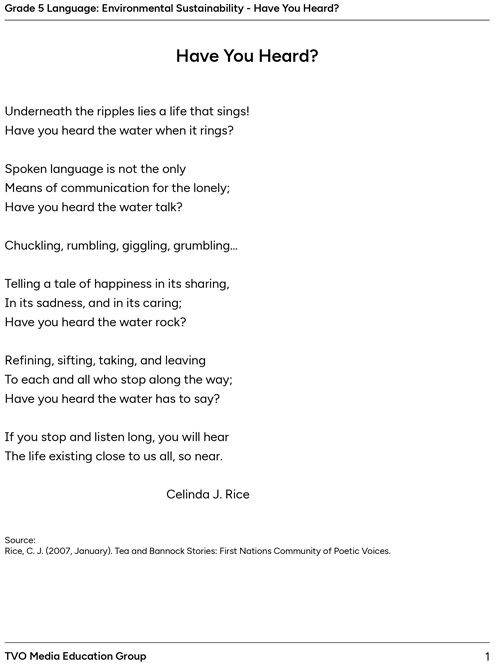
Read the poem aloud a second time, noticing how you can use your reflections from the above prompts to improve the fluency of your oral reading.

In the poem “Have You Heard?”, the author Celinda J. Rice uses words like happiness, sadness, and caring. These words are examples of abstract nouns. Abstract nouns are not physical things that can be seen or touched. They are non-physical things that can be experienced through feelings or emotions.
Some more examples of abstract nouns are: love, gratitude, wisdom, courage.
Can you think of a few more?
Record them in your notebook or using another method of your choice.
Let’s check!
Complete the following sorting activity to identify which nouns are abstract nouns.

Putting it all together
In this learning activity, you considered different ways of connecting with nature in order to support your own wellness. Experiences with nature have a positive effect on our well-being.
To consolidate your learning, you will now write descriptively about a nature experience.
Think of an experience that you have had that made you feel connected to nature and to the land. If you can’t think of one, you may choose to access the following video clip of the TVO Original documentary Tripping the French River to use as inspiration.
Use your chosen experience with nature or the clip of the TVO Original documentary Tripping the French River to create a descriptive writing piece to how it made you feel connected to nature or the land.
Press the following tabs to follow guidelines to help structure your writing.
You could write about an actual nature experience you have had in the past, or that you would like to have in the future, or you can use your imagination to describe an experience in nature that a character could have.
Tip: If you need inspiration, consider revisiting the nature videos you explored in the Minds On section of this learning activity.
Your goal is to paint a picture using words for your reader! We use our five senses to experience nature, so try to include details from different senses to make your writing come alive.
Tip: You can a graphic organizer to help you collect or brainstorm observations for each of the five senses, or create one of your own.
Write in any format that inspires you!
For example, you could write a poem, a short story, a diary entry, etc.
Whichever format you choose, try and use descriptive language, such as abstract nouns, to help communicate the feelings and emotions connected to your experience.
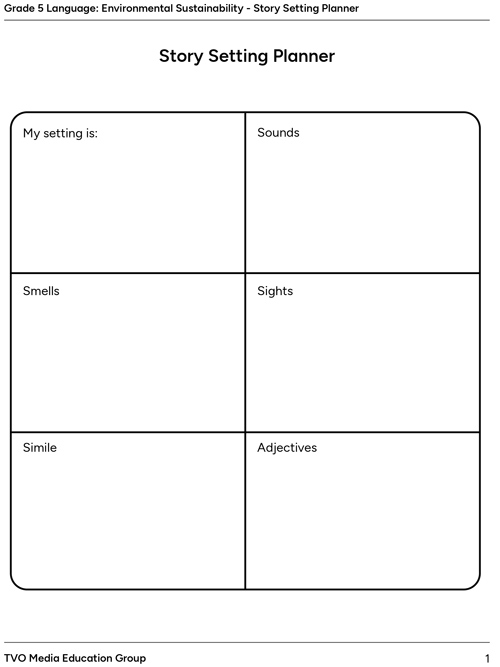
Access the following Story Setting Planner to complete the activity.
| My setting is: | Sounds |
| Smells | Sights |
| Similes | Adjectives |
Complete Story Setting Planner in your notebook or using the following fillable and printable document.
When you are done drafting, review your progress using the following success criteria:
Success Criteria
Reflection
In your reflection journal, a notebook, or using another method of your choice, answer the following questions:
- How can spending time in nature and on the land help you feel connected to it?
- What is an example of an activity that you could do to help you feel connected to the land?
- Why is it important for people to make connections to the land? How does this help the sustainability of our planet?
Reflection
As you read through these descriptions, which sentence best describes how you are feeling about your understanding of this learning activity? Press the button that is beside this sentence.

I feel...
Now, record your ideas using a voice recorder, speech-to-text, or writing tool.