Learning goals
We are learning to…
- acquire new subject-specific vocabulary
- identify solutions to real-world problems
- plan, develop ideas, and select suitable media, techniques, and tools to publish final texts
Success criteria
I am able to…
- explain cause and effect relationships as they relate to climate change
- create a vocabulary notebook, or other vocabulary list, with subject-specific vocabulary defined in my own words
- create a digital media text to educate others on the issue of food waste

Making connections
Examine the following pairs of images.
For each image:
- Describe what you observe.
- Explain what you think the image means or represents.
Set A
Description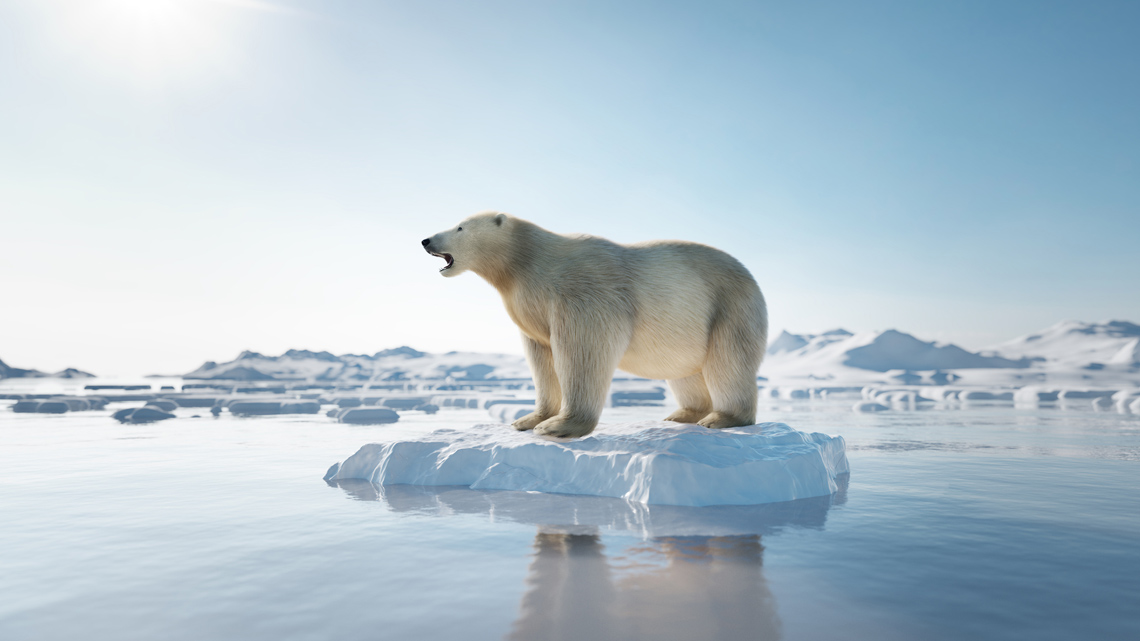
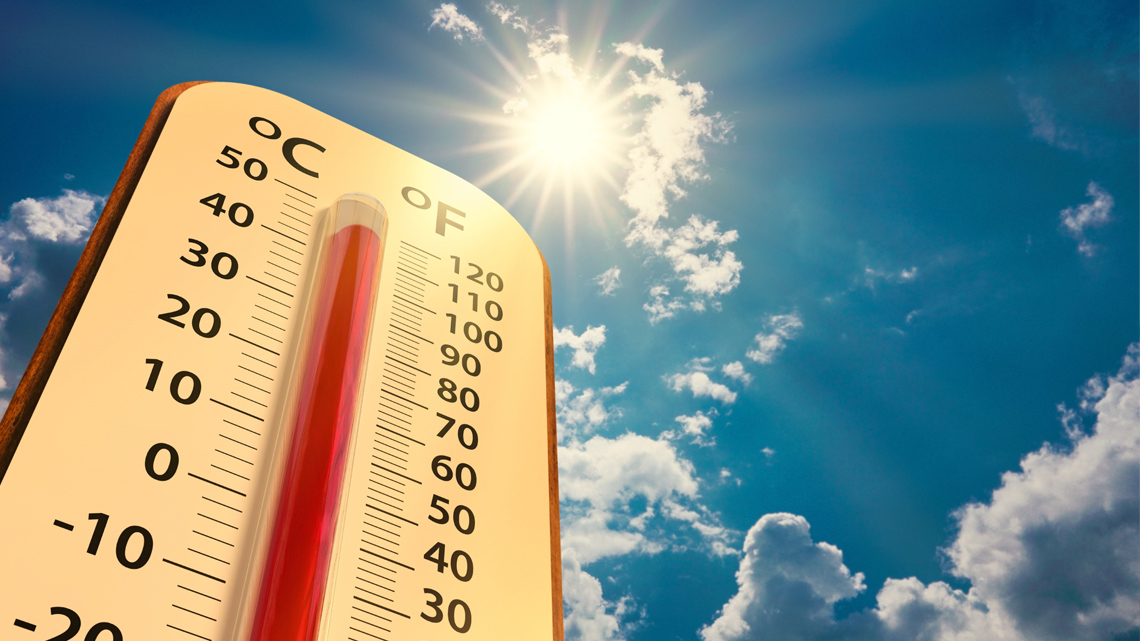
Image 2: A thermometer displaying a temperature of over 100°Farenheit or over 40°Celcius, with red liquid rising to the mark. In the background, a bright sun beams down over the thermometer.
Set B
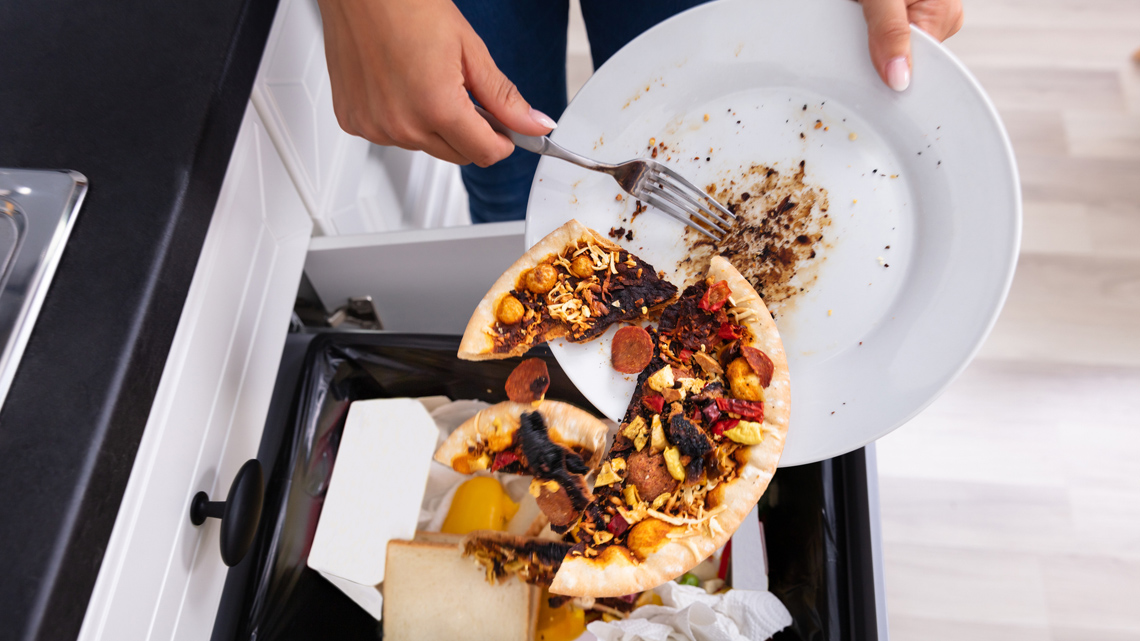
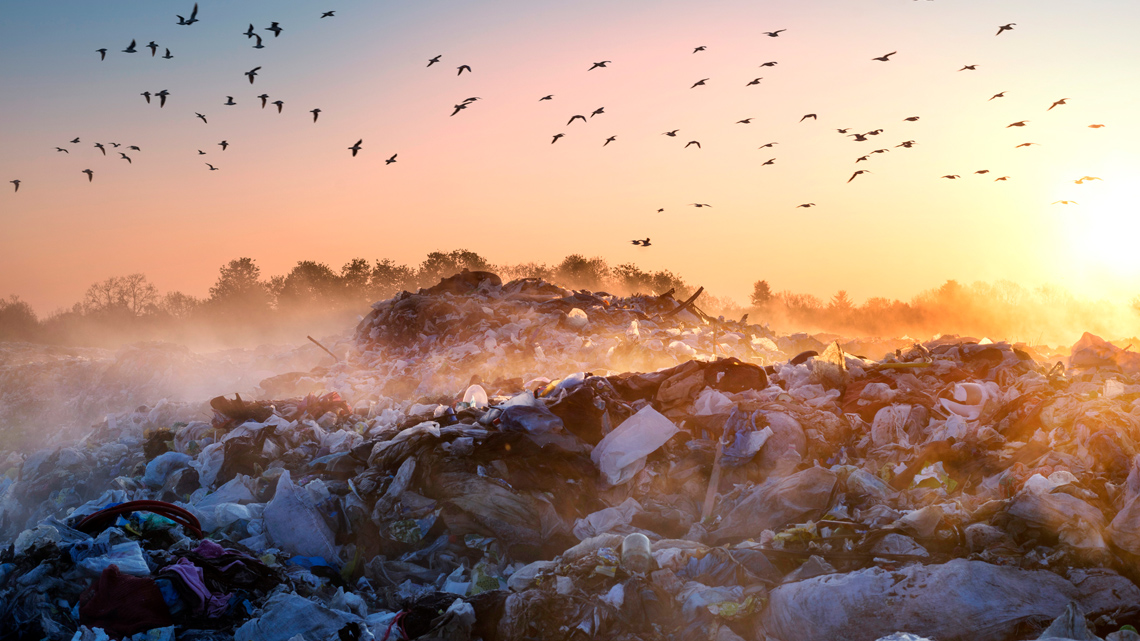

Connections
Forming connections
In a notebook, or using another method of your choice, answer the following questions. If possible, share your thoughts with a partner.
- How do you think the two sets of images might be connected to each other?
- Can you predict which image in each pair represents a cause and which represents an effect?
In this learning activity, we will learn about the growing problem of food waste, and how it contributes to climate change. We will explore simple and accessible steps that people are taking to reduce their carbon footprint.

Vocabulary routine!
Before we begin, pause to record the words climate change and carbon footprint. Think about each term and what might they mean. Record your thoughts in your vocabulary notebook, or using another method of your choice.
A vocabulary notebook is an important learning tool! If you are creating one for the first time, check out the following two examples as possible ways of recording word work.
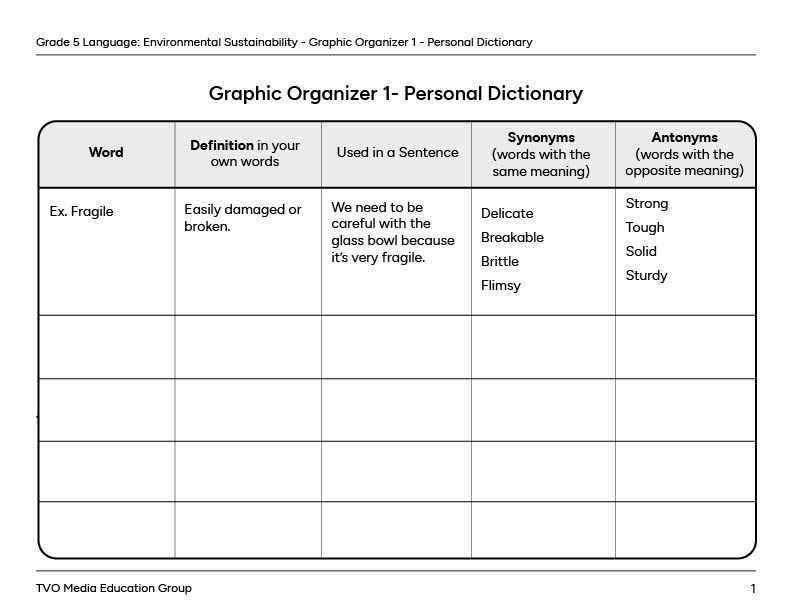
Press the Graphic Organizer 1 - Personal Dictionary button to access the Graphic Organizer 1 - Personal Dictionary.
Activity(Opens in a new tab)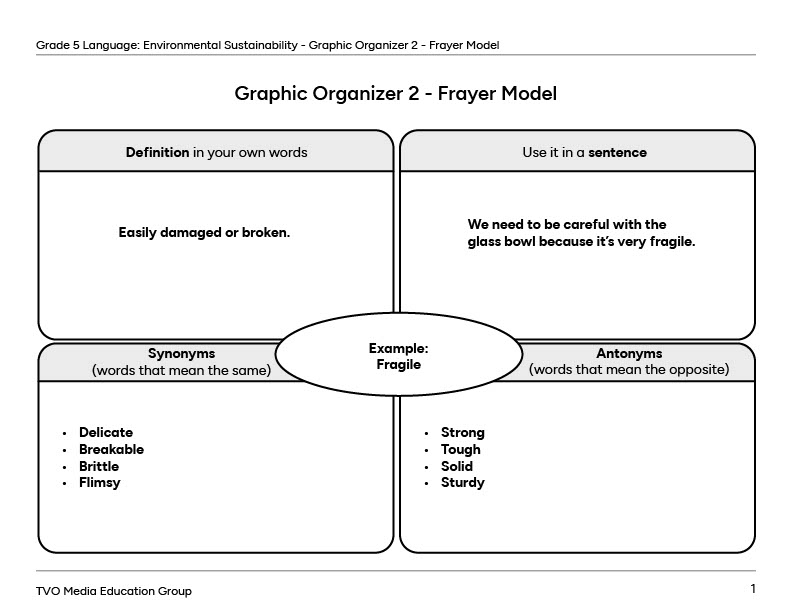
Press the Graphic Organizer 2 - Frayer Model button to access the Graphic Organizer 2 - Frayer Model.
Activity(Opens in a new tab)
Food waste
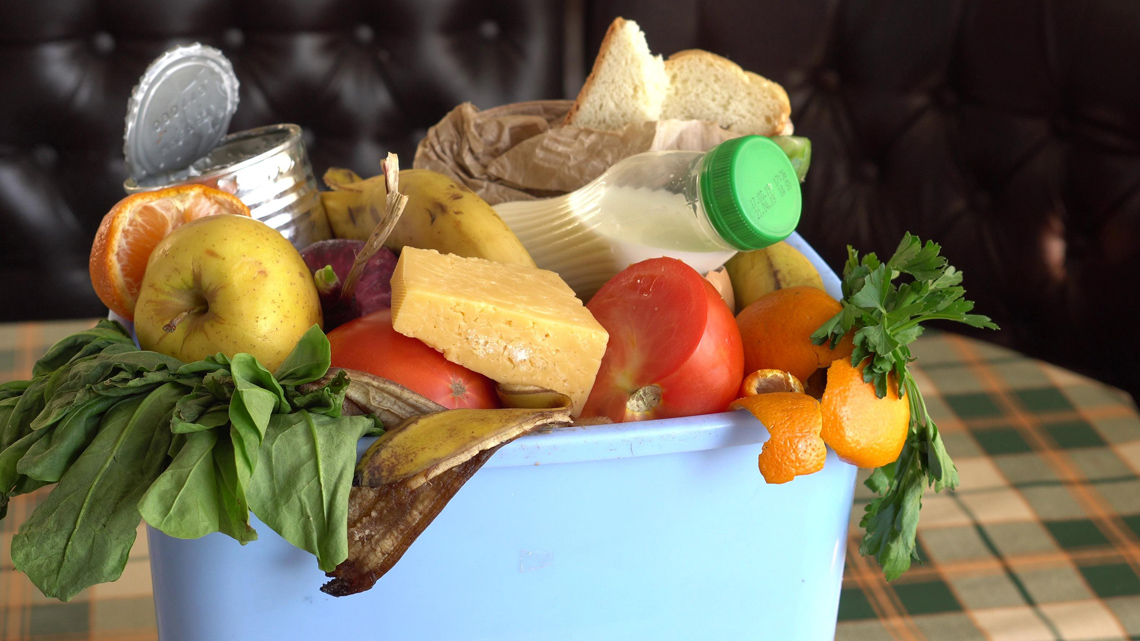
A pile of food waste in a container, featuring various items such as cheese, tomatoes, orange and banana peels, lettuce, apples, a tin can, bread, and a bottle of milk.
A lot of food is wasted every day all around the world for many different reasons. Nearly one-third of all food produced in the world goes to waste. How much food is that exactly?
Humans waste an estimated 1.3 billion tons of food every year. That is roughly the same weight as 217 million elephants!
When we waste food or don't use it all up, it can make it harder for everyone to have enough food to eat. This can also make food cost more because there's less of it available.
While many people on Earth experience food insecurity, the amount of food waste produced is roughly enough to feed the entire planet. Food insecurity is a term used when individuals do not have access to enough safe to eat and nutritious foods to meet their daily needs. It is estimated that one in every four Canadian children experience food insecurity.
Source: Administrator, P. (2023b, July 10). New data on household food insecurity in 2022. PROOF. https://proof.utoronto.ca/2023/new-data-on-household-food-insecurity-in-2022/

Did You Know?
Did you know?
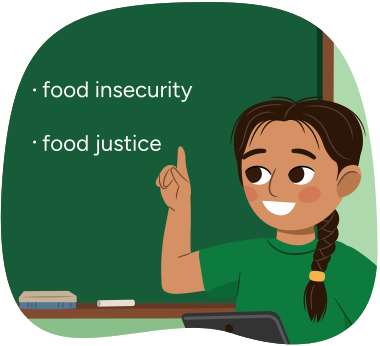
Did you know that food insecurity is a human rights issue sometimes called food justice? Food justice is the belief that every human should have the right to equal access to healthy, sustainable, and culturally appropriate foods.
Source: MediLexicon International. (n.d.). What is food justice? definition, causes, and impact. Medical News Today. https://www.medicalnewstoday.com/articles/what-is-food-justice
Take a minute and add the following terms to your vocabulary notebook or use another method of your choice. Try to complete definitions for these terms in your own words to deepen your understanding of them.
Vocabulary terms
- food insecurity
- food justice
Where is food wasted?
Check out the following interactive to learn more about some of the ways that food is wasted on our planet.
Source: Fight climate change by preventing food waste | stories | WWF. World Wild Life. (n.d.). https://www.worldwildlife.org/stories/fight-climate-change-by-preventing-food-waste
Blair, N. (2024, June 11). Food Waste Statistics in Canada. Made in CA. https://madeinca.ca/food-waste-canada-statistics/#:~:text=How%20much%20food%20is%20wasted,average%20household%20in%20a%20yea
Silver, E., Ogawa, S., & Hudson, K. (2023). Good food, bad waste: Let’s eat for the planet. Orca Book Publishers.
The climate cost of food waste
Wasted food is not just a social injustice , it is also an environmental hazard . When food gets thrown out, all the human effort that goes into it, as well as the water, fuel, and materials used to grow, transport, and pack that food is also wasted.
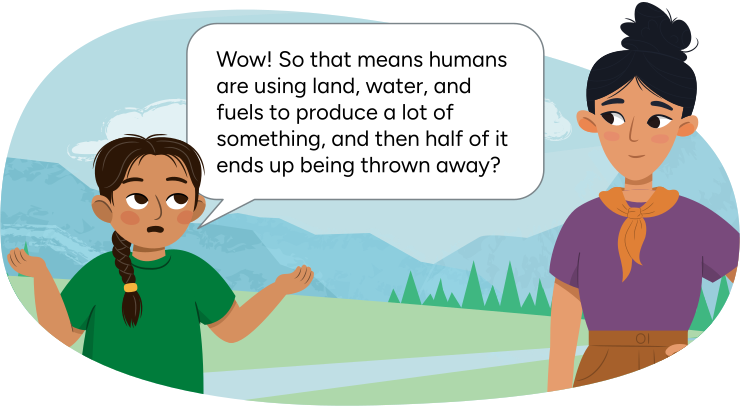
Student Remy is talking.
Student Remy is saying:
“So that means humans are using land, water, and fuels to produce a lot of something, and then half of it ends up being thrown away?”
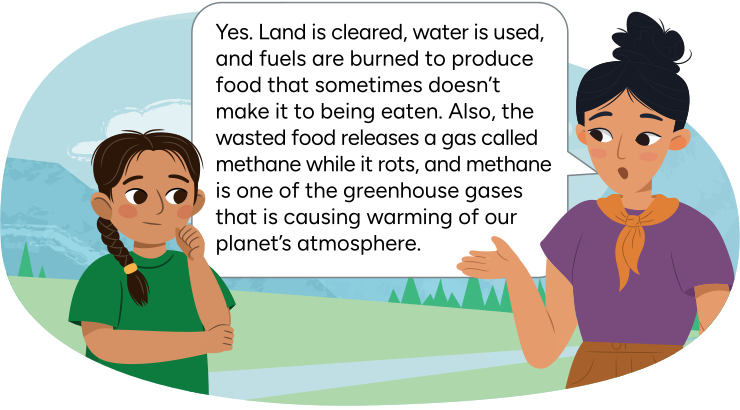
Teacher Chelsea responding to learner Remy's question.Teacher Chelsea says "Yes. Land is cleared, water is used, and fuels are burned to produce food that sometimes doesn't make it to being eaten. Also, the wasted food releases a gas called methane while it rots, and methane is one of the greenhouse gases that is causing warming of our planet's atmosphere."
Teacher Chelsea responding to learner Remy's question.Teacher Chelsea says "Yes. Land is cleared, water is used, and fuels are burned to produce food that sometimes doesn't make it to being eaten. Also, the wasted food releases a gas called methane while it rots, and methane is one of the greenhouse gases that is causing warming of our planet's atmosphere."
Teacher Chelsea responding to learner Remy's question.Teacher Chelsea says "Yes. Land is cleared, water is used, and fuels are burned to produce food that sometimes doesn't make it to being eaten. Also, the wasted food releases a gas called methane while it rots, and methane is one of the greenhouse gases that is causing warming of our planet's atmosphere."
Take a minute and add the following terms to your vocabulary notebook or use another method of your choice. Try to complete definitions for these terms in your own words to deepen your understanding of them.
Vocabulary terms
- social injustice
- hazard
- methane
- greenhouse gases

Kids are making a difference
How are some kids taking action to make a difference?
Read the following article from CBC Kids News to find out what steps some Canadian children have taken to reduce their food waste footprint.
Press the Article button to access the Can you help the Earth by eating your leftovers? Kids say yes.
Article(Opens in a new tab)Learning check!
There are many ways that kids can influence how much food gets wasted in their homes, at their schools, or in their communities. Complete the following fill-in-the-blank activity to review some of the actions mentioned in the article.
For each action, select the missing word from the drop-down menu.
Press Check Answer to see how you did.
Can you think of any other actions or ways that kids could help reduce food waste in their homes or communities? Record your thinking in a notebook or using another method of your choice.
If possible, share your answer with a partner.

Grammar routine!
The article “Can you help the Earth by eating your leftovers? Kids say yes” contained six quotes. Go back to the article and try to find the quotes to observe the punctuation used.
What punctuation rule can you observe inside each of the quotes?
Press Examples to examine the quotes in a list.
- “I found the challenge quite fun and it got me thinking about what I eat,” said Avalyn in an interview with CBC Kids News.
- “It’s just nice to know that instead of throwing something away and it going into a landfill, you can turn it into something else,” said Avalyn.
- “Wasting food is bad for the environment because you’re wasting a ton of resources, which helps climate change keep going,” said Asha. “All the greenhouse gases that go into [making something], all those people’s hard work, it just ends up in the trash.”
- “See what’s being thrown in the garbage and think of creative ways that you could use it in a soup, stew, chili or a beverage,” said Gordon.
- “Just because a piece of fruit or vegetable is imperfect doesn’t mean it’s useless. Just cut off the bad bits and chop it up.”
- Gordon encourages kids to challenge their parents and ask them, “What are we doing with our food?”
Learning check!
Answer the following question to confirm the punctuation rule used in the quotes.
Select the correct answer, then press Check Answer to see how you did.
Let’s check out some examples.
If the quote or dialogue is at the end of a sentence, place the period, question mark, or exclamation mark at the end before the closing quotation mark.
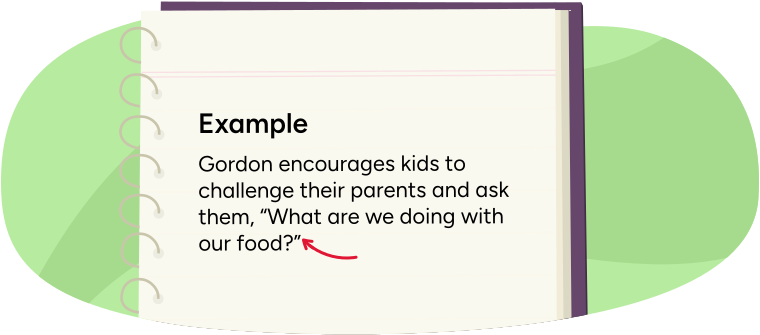
A notebook page with a heading that says "Example" followed by text that says: Gordon encourages kids to challenge their parents and ask them, "what are we doing with our food?" On the page, there is an arrow pointing towards the quotation mark at the end of the question.
If the sentence continues after the quote or dialogue, place a comma before the closing quotation mark.
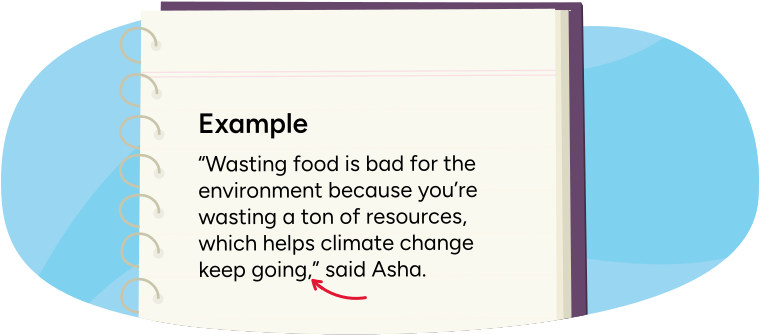
A notebook page with the heading "Example" contains a quote that reads: "Wasting food is bad for the environment because you're wasting a ton of resources, which helps climate change keep going," Asha said. An arrow on the page points to the quotation mark at the end of the word "going."
Creative uses for food waste
There are many creative ways that people in Canada and all around the world are reducing food waste and living more sustainably.
Explore the following video clip from the TVO Kids show Green Squad to learn about Vikram and his family and how they are adapting cultural practices from India in their home in Canada.
Were you surprised by any of the items that Vikram and Lisa sorted for composting?
What can and cannot be composted depends on where you live. Some individuals manage their own composting, while some communities and regions have recycling and composting services that collect waste and deal with it for them.
Every waste management service has their own rules and guidelines for items that can and cannot be composted depending on the facilities and technology they have available to them
It’s important to check with a trusted adult about what composting can be done in your community. If you’re not sure, together you could do a little research to learn what items can be easily composted in a home, school, or business and which items might be able to be composted using a local waste management service!

Pause and Reflect
Pause and reflect
In a notebook or using another method of your choice, answer the following questions:
Do you have composting available?
If so, what items listed in the video do you think may or may not be compostable in your community?
Reducing our carbon footprint
Indigenous Peoples throughout the world have long studied and taught their younger generations about the interconnectedness of all things on the Earth.
Indigenous communities have a deep understanding of their local environment as they have lived off, and learned from, the land for generations. The knowledge that derives from this understanding is called Traditional Ecological Knowledge or Traditional Knowledge.
Indigenous Peoples have always observed the changes in their environments and through observations, responded in ways that aim to protect the Earth for future generations.
Historically, not all people have considered this perspective and understanding and now our planet is changing at a rate faster than many life forms can keep up with.
How can we take action to reduce our carbon footprint and help the sustainability, or long-term health, of our planet?
One way is by trying to give back to the land and growing our own food. This helps us remember our close relationship to the land and how we are dependent on it for our survival.
Check out the following clip from an episode of the TVO Kids show Green Squad, where 13-year-old Malik visits a community garden near his home and learns how to create an indoor garden in his apartment.
Pause and Reflect
Pause and reflect
What did you learn by exploring Malik’s experience in the video? What are two actions you would recommend for someone to take to reduce their food waste or carbon footprint?
Record your thinking in a notebook of using another method of your choice.
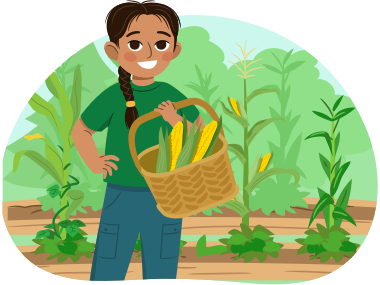
When people are able to eat food grown locally by farmers or in home, backyard, or community gardens, this helps to reduce our carbon footprint. Locally raised foods don’t have to travel long distances and they use limited packaging. Gardens also help add greenspaces to urban areas. Gardens can be private or shared, such as a community garden. Gardens can exist anywhere such as in backyards, on balconies, or in sunny rooms indoors.
Exploring food recovery
When planting or gardening is not an option, it is important to consider other ways to reduce food waste and help the world.
When food is saved and shared instead of wasted, humans and the Earth benefit. Saving food that might have been wasted and sharing it with people who can use it is called food recovery.
Press the following tabs to explore some of the innovative food recovery solutions that exist in Canada.
Rescues food from farmers, stores, and restaurants and distributes it to organizations like food banks, shelters, and school food programs.
Companies like Odd Bunch, Second Life, and Peko Produce rescue fruits and vegetables that are oddly shaped or coloured making them “ugly” or not visually appealing enough to be sold in grocery stores. They then include these foods in grocery subscription boxes that are sold to Canadians.
A Los Angeles organization that rescues fruits and vegetables from backyard trees, community orchards, and farms and distributes it to people experiencing food insecurity.
An app that helps shoppers find deals and discounts at their local grocery store on food that is near its sell-by date or needs to be eaten soon.
A Toronto non-profit organization that collects excess food that would otherwise go to waste from restaurants, grocery stores, farms, and food producers, and then transforms it into healthy meals. They sell foods and meals in a pay-what-you-can store, serve soup to college students twice a week, and they stock free community fridges across the city.
An app that allows restaurants, hospitals, and other organizations to call a driver to pick up food that is going to go to waste. The food is then delivered to places that need food or to the homes of people experiencing food insecurity. They also visit neighborhoods with their free mobile grocery store and have free grocery shops located inside schools to serve students and their families.
"Ugly Food Companies" are food manufacturers who buy fruits and vegetables that aren’t "pretty" enough to be sold in grocery stores and use them to create their own products. A few Canadian examples include Outcast Foods who make plant-based protein powders, Pretty Ugly Company who makes salsa and corn chips, and Loop who makes juices, smoothies, and sodas.
Connections
Connect
Do you know of any other creative and innovative individuals, groups, or organizations that are working towards food recovery? How do initiatives like this help the planet?

Let’s review!
Let’s review some of the vocabulary introduced in this learning activity. As you review each term, make sure it is recorded in your vocabulary notebook or use another method of your choice.
Putting it all together

To consolidate your learning, and to encourage continued critical thinking about food and waste, create a poster, commercial, or another media text to educate others on the topic of food waste.
Use the following graphic organizer, or another method of your choice, to help plan your final product.
| Type of media I will create: | |
| Information about food waste that I will include: | |
| Who will my audience be that I will share this with: | |
| Materials or tools that I will need to complete this: | |
| Any other ideas or notes: |
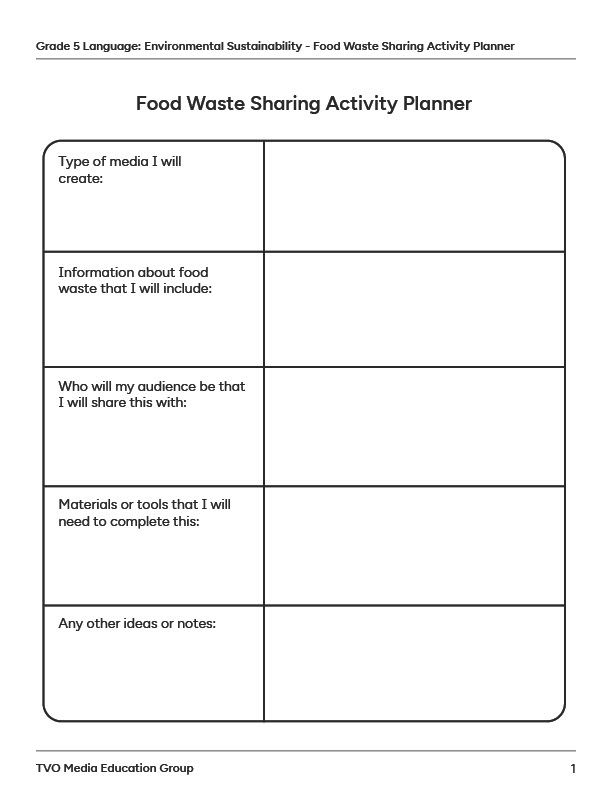
Press the Activity button to access the Food Waste Sharing Activity Planner.
Activity(Opens in a new tab)Once you have finished planning, create your final copy and publish or share it with peers or members of your community.
Pause and Reflect
Pause and reflect
After you have created and presented your food waste activity, reflect on your project and learning by answering the following questions in a notebook or using another method of your choice.
- What personal habits will this new learning help me change or improve?
- How will my learning in this area benefit myself, my community, and/or the planet now and in the future?
Reflection
As you read through these descriptions, which sentence best describes how you are feeling about your understanding of this learning activity? Press the button that is beside this sentence.

I feel...
Now, record your ideas using a voice recorder, speech-to-text, or writing tool.
Discover More
With the help and guidance of a trusted adult, do a little research to find out which of the items mentioned in the video in the Action section can and cannot be composted in your own community.
If possible, try to find the guidelines set out by your local waste management services or community.
Here is the list of items included in the video:
- hair
- vegetables
- wooden chopsticks
- eggshells
- glass
- fruits
- shredded paper
- diapers
- plants
Create a list in a notebook or using another method of your choice of items that are compostable and item that are not compostable.