Learning goals
We are learning to…
- analyze and explain how the knowledge and skills developed in this grade support learning in various subject areas and in everyday life
- compare the critical thinking skills we use when analyzing and evaluating various texts
- identify the skills that best support understanding, and explain why they are effective
- generate and develop ideas and details about various topics
- draft complex texts of various forms and genres, including narrative, expository, and informational texts, using a variety of media, tools, and strategies
Success criteria
I am able to…
- use morphemes (prefix, base, suffix) to draw conclusions about definitions
- read texts and view media texts about sustainable solutions, respond to short-answer questions using critical thinking skills, and reflect on those skills and their effectiveness
- brainstorm and draft a creative description of an innovative and sustainable future
- share my innovative solution with someone else in a method of my choice
Innovation drives sustainability
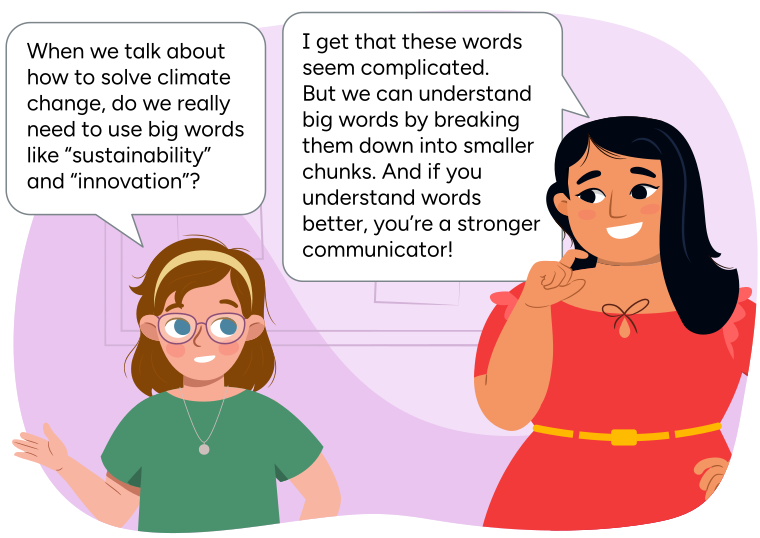
Ava asks Teacher Chiara a question.
Ava asks, "When we talk about how to solve climate change, do we really need to use big words like "sustainability" and "innovation"?
Teacher Chiara responds, I get that these words seem complicated. But we can understand big words by breaking them down into smaller chunks. And if you understand words better, you're a stronger communicator!
What is a morpheme?
A morpheme is the smallest chunk of a word that holds meaning on its own. All words have at least one morpheme, but a complex word will have two or more. For example, “bio” is a morpheme:
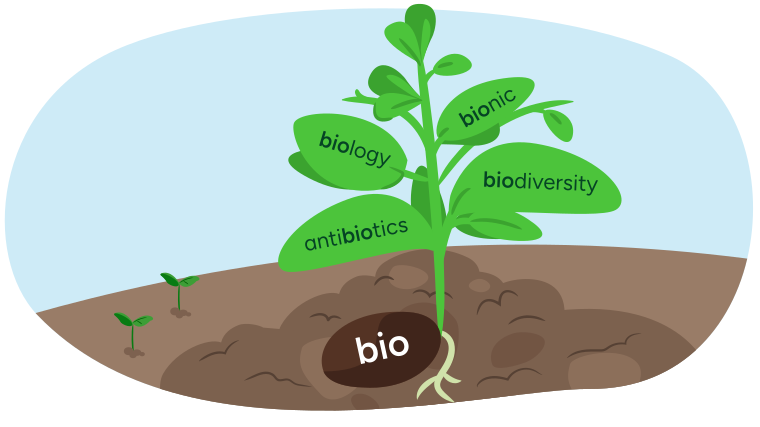
More specifically, a base word forms the foundation of any word. A prefix is a morpheme that attaches to the front of the base word, and a suffix is added to the end of a base. Both of these change the meaning of the base word!
You will now explore two words and their morphemes in the following interactive images.
First, explore the morphemes that make up the word “sustainability”:
Next, explore the morphemes that make up the word “innovation”:
Check your understanding!
Try this matching activity. For each word, select the right definition.
Your turn!

Often, innovation can drive sustainability by solving environmental challenges, improving the use of natural resources, and promoting a healthier planet. Can you think of an environmental problem or challenge that Earth is currently facing? Can you think of a solution to this problem? (A solution would be a sustainable practice or invention that addresses this problem.)
Press Hint to see an example of a problem and solution.
Pollution is an environmental problem, and recycling is a sustainable practice addressing pollution. For example, when we recycle plastics, they don’t end up polluting our environment.
Using a method of your choice, create a list of environmental problems and sustainable solutions. If you wish, complete the fillable and printable Organizer: Problems and Solutions in your notebook or using the following document. You can also use speech-to-text or audio recording tools to record your thoughts.
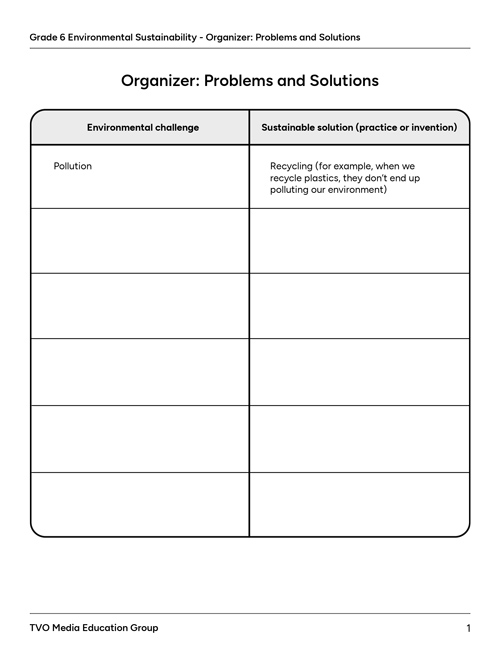
Press the Activity button to access the Organizer: Problems and Solutions.
Activity(Opens in a new tab)
A key skill: critical thinking
In this learning activity, you are going to explore several texts and media about sustainable innovations around the world. You will answer reflection questions that require you to think critically about the information.

Connections
What is critical thinking?
Critical thinking is both a valuable skill and an engaging process! What exactly does it entail?
The art of critical thinking is all about considering, questioning, and interpreting reliable information in order to come up with an informed opinion.
To expand our worldview and consider a wide range of perspectives on climate change and environmental sustainability, we engage in the critical thinking process.
The critical thinking process
Before you can share an informed opinion on something – such as an article, a work of art, an issue, or a theory – you need to follow the four steps of the critical thinking process.
The following interactive image uses the example of thinking critically about a text. Explore it to learn more about the four steps.
Critical thinking skills help you to understand and respond to new concepts. You will use these skills as you explore sustainable innovations in the next few sections!
Thinking critically: sustainable innovations
Green spaces
Around the world, people are using green spaces in creative ways to promote sustainability in cities. To learn more, press the following tabs.
A sponge city lessens the impacts of flooding in a city and improves water management. It has infrastructure that allows water to absorbed, stored, and reused. For example, a sponge city might have green roofs, rain gardens, and pavement that can absorb water. This design not only reduces the risk of flooding and improves water management, but also enhances biodiversity.
Want to learn more about how sponge cities prevent flooding? Watch this clip from a video made by Terra Mater.
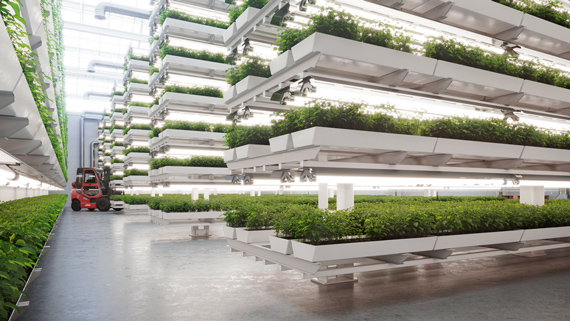
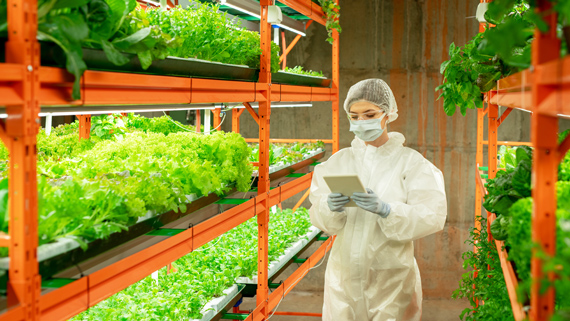
A vertical farm is a way of growing crops in stacked layers on walls or towers. Vertical farms sometimes use artificial lighting and advanced technology to create the best growing conditions. They are often located indoors, so they can provide food year-round. They are also often located near cities, which reduces the need for transportation. This saves money and energy, and reduces pollution.
A rooftop farm is… well, just what it sounds like! Rooftop farms or gardens use the rooftops of building to grow food, plants, and other crops. This is advantageous in cities, which lack space for ground-level farming. This innovative approach to agriculture promotes local food production, reduces the amount of transportation, absorbs heat in the city, promotes biodiversity, encourages community involvement, and contributes to sustainable development.
Watch the following video clip to learn how a group of Toronto students turned a campus roof into a rooftop farm, proving that it is possible to grow food in a city.
Now it’s time to think critically about green spaces!

Pause and Reflect
Reflection questions
Answer the following reflection questions in your notebook, or using another method of your choice.
- Summarize what you have explored. What are green spaces in urban places (cities)?
- Explain how green spaces contribute to urban sustainability. Use specific examples from your learning.
- How can city planners balance the need for housing and buildings and the need for green spaces?
Pollution reducers
Around the world, people are coming up with innovative ways to reduce pollution. Press the following tabs to learn about some examples.
Imagine if you could take air pollution and turn it into something useful? Guess what, you can! Scientists have found a way to capture pollution from greenhouse gases and, using microorganisms, turn it into a material called “AirCarbon.” AirCarbon is similar to plastic, but much better for the environment. It is 40% air and 60% greenhouse gas. Unlike plastic, this material is biodegradable: it breaks down quickly. AirCarbon is used to make food packaging, straws, forks, and knives.
The smog-free tower is part of the “Smog Free Project,” which aims to reduce pollution and provide clean air. The tower uses green energy to suck in polluted air, clean it, and release it back into the environment.
Watch the following video clip to earn more about the smog-free tower from the inventor himself, Daan Roosegaarde:
Would you like to find out more about Daan Roosegaarde’s innovative ideas? Do an online search for “Smog Free Project”!
Pause and Reflect
Reflection questions
Answer the following reflection questions in your notebook, or using another method of your choice.
- Why do you think there is a need for technologies to remove pollution from the air?
- Do you think AirCarbon and smog-free towers are sustainable solutions to climate change? Why or why not?
Solar savers
Solar energy refers to energy that is emitted by the sun. Solar panels absorb the sun’s rays to generate electricity or heat. Traditional solar panels have become quite common. Innovators around the world have been finding innovative ways to use this technology!
Press the following tabs to learn more.
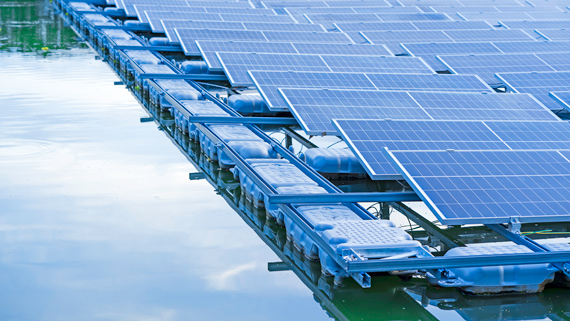
These solar panels float on bodies of waters, such as lakes or the ocean. They are mounted on platforms and anchored to the bottom. The panels absorb the sunlight and generate electricity that is transmitted to the shore via underwater cables. Floating solar panels have several advantages. They don’t take up space on land the way traditional solar panels do. They also provide shade to the water underneath them, which reduces water evaporation and slows down algae growth.
“Solar glass” is much like a traditional solar panel in that converts sunlight into electricity. The difference is that solar glass is transparent: you can see through it, just as you can see through a window. In the future, solar glass could be used in the construction of buildings.
Pause and Reflect
Reflection questions
Answer the following reflection questions in your notebook, or using another method of your choice.
- Compare the three types of solar panels. Do you think one is “better” than the others? Why or why not?
- What do you think could be preventing cities from creating more solar panel spaces (for example, on buildings and in water)?
- Why are floating solar panels considered an ideal sustainable option for cities?
Sustainable innovations: test your knowledge!
Now that you have explored a number of sustainable innovations, try the following multiple-choice questions.
Select the correct answer, then press Check Answer to see how you did.
You have just done a lot of work on sustainable innovations. Now is a great time to take a break before we look adjective clauses!

Student Wellness
Take a break!

Time for a body break! If possible, stretch your body and move around your space.
Grammar: what is an adjective clause?
Before we look at adjective clauses, let’s review some useful vocabulary.
Key terms
- Noun: A noun is a person, place, or thing.
- Adjective: An adjective is a word that modifies a noun.
- Clause: A clause is a group of words that contains a subject and a verb.

Adjective clauses
An adjective clause modifies (describes) a noun, just an individual adjective does. Compare the following sentences.
| Adjective | Adjective clause |
|---|---|
| The company installed gigantic floating solar panels. | The company installed floating solar panels, which were gigantic. |
| I met a lot of friendly new people. | I met a lot of new people, who were all very friendly. |
| I served the ice-cold water. | I served the water that was ice cold. |
Note that in these sentences, the adjective clause…
- comes right after the noun it modifies
- starts with a word like which, that, or who
Test your understanding!
Which adjective clause fits best? Try the following fill-in-the-blank activity.
For each sentence, select the right adjective clause from the drop-down menu.
Creative writing: Eco-Capsule City
In this task, you are going to plan and draft a creative description of an eco-friendly city in the future!
Imagine it’s the year 2150. The world embraces innovations that help the environment and make life better for future generations.
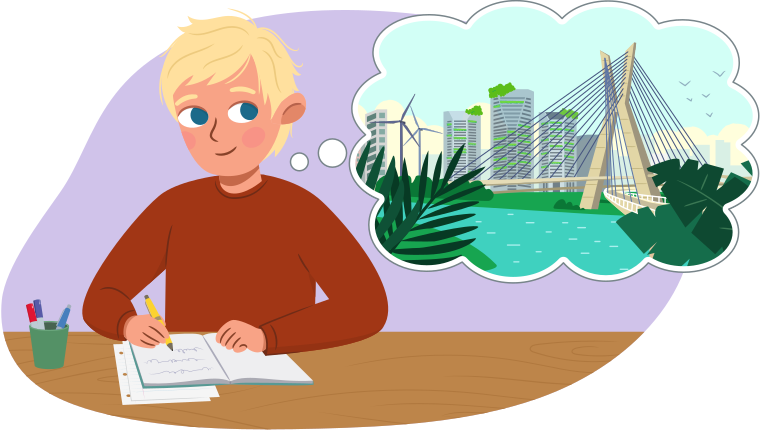
You will write a text that describes an “Eco-Capsule City”: a city that uses advanced technology to create an environmentally friendly living space. An Eco-Capsule City is designed to have minimal impacts on the environment and protect natural resources for generations to come.
Your Eco-Capsule City will include two innovative features that address a specific environmental challenge. Here are some examples of environmental challenges:
- pollution
- food waste
- overfishing
- greenhouse gas and fossil fuel emissions
- deforestation
- lack of clean water
Planning your city
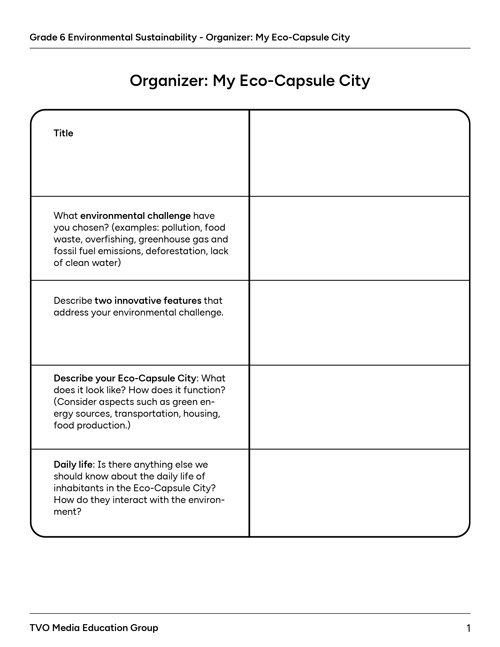
Complete the fillable and printable Organizer: My Eco-Capsule City in your notebook or using the following document. If you would like, you can use speech-to-text or audio recording tools to record your thoughts.
Write a draft
Using the information in your organizer, draft a description of your Eco-Capsule City. Be sure to start by explaining that it is the year 2050, and that sustainable innovations are embraced.
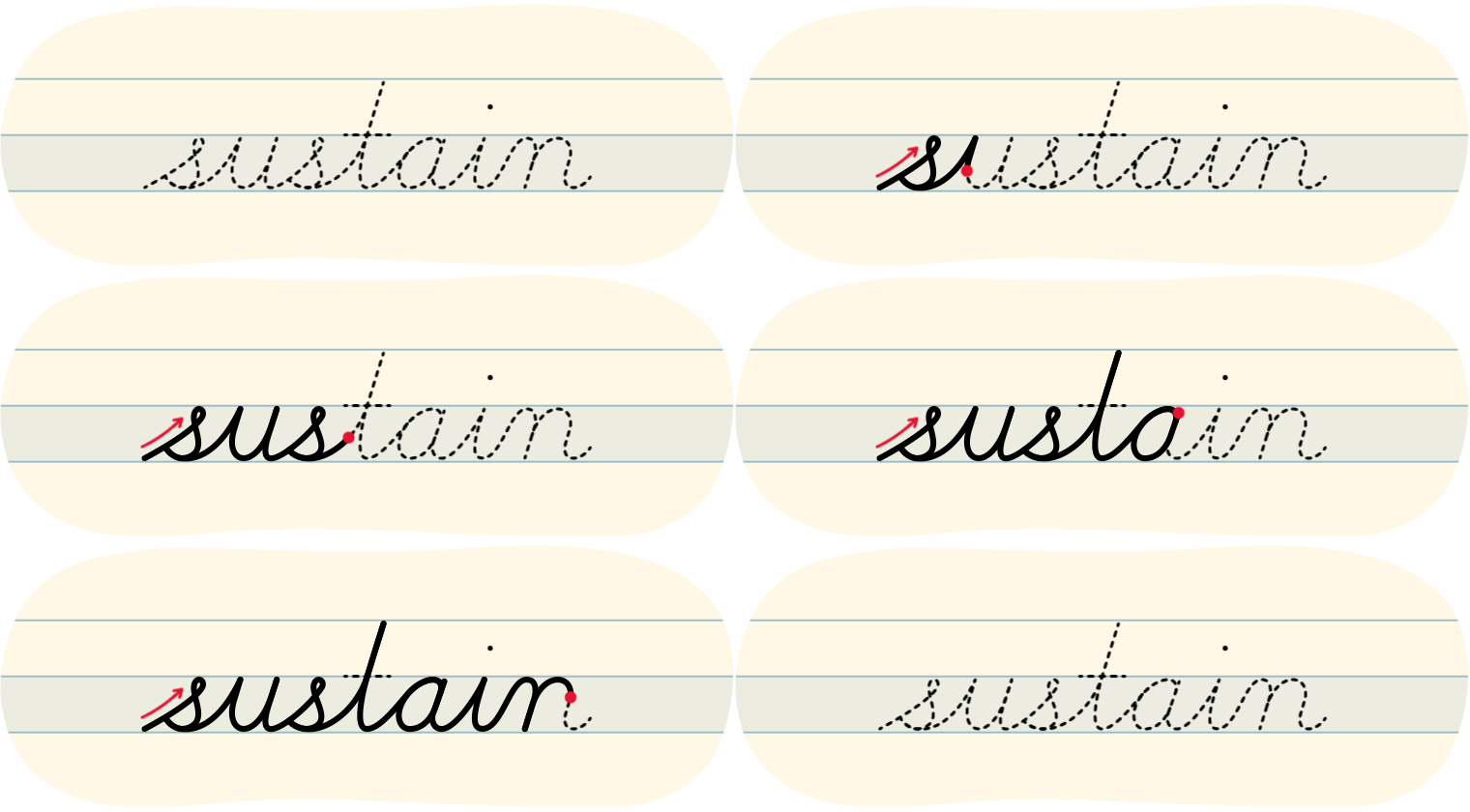
If you would like, you can write your draft in cursive.
Cursive Practice
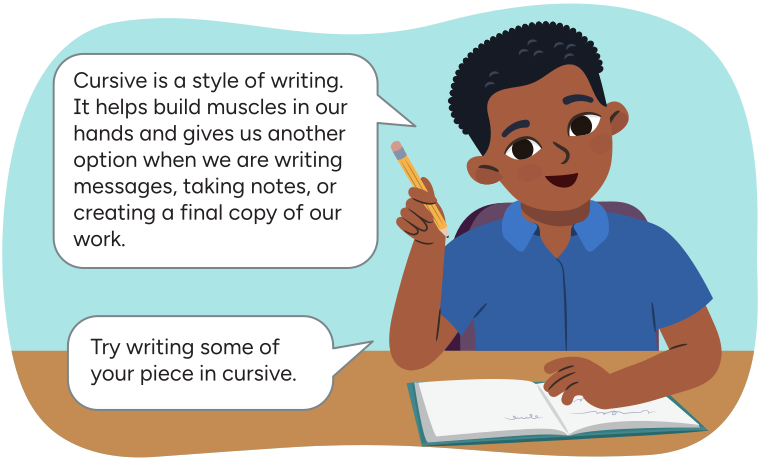
Author with two speech bubbles. Speech bubble 1 says, "Cursive is a style of writing. It helps build muscles in our hands and gives us another option when we are writing messages, taking notes, or creating a final copy of our work". Speech bubble 2 says, "Try writing some of your piece in cursive."
Let’s review cursive writing!
Check out the following animation of how the word “sustain” is written in cursive, then review the tips for cursive writing provided.
Tips for cursive letters
- When we write in lowercase, we always begin at the bottom
- When we write in uppercase we can start from the top or the bottom
- Try to keep the pencil on the page until you are done the word
- Try to press gently as you write so that your hand can move easily across the page
- Take your time to make sure that you are writing clearly and evenly
Left-handed tips for cursive writing

Explore the following video called Left-Handed Tips to learn more.
Congratulations! You have written a description of your Eco-Friendly City! Next you’ll think about reading part of your text out loud.
Fluency

Fluency is the ability to identify words correctly and read a text at an appropriate rate with ease, pace, automaticity, and expression. With proper phrasing and a focus on punctuation, the reader will gain more meaning from the text.
Select a paragraph from your text to share with someone. Practise the passage several times, focusing on reading fluency.
Fluency checklist
Based on the checklist, choose one area of fluency to focus on and set a goal for yourself. What strategies could you use to help you achieve this goal?

Putting it all together
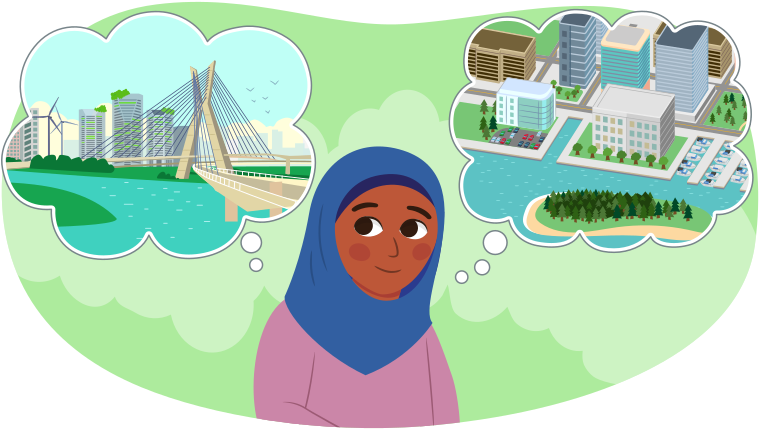
It’s time to further explain one of the innovative features of your Eco-Capsule City! You can share this information in a method of your choice. Here are some possibilities:
- poster
- presentation
- brochure
- podcast
Use the following checklist to make sure you cover the key points.
I explain …
Reflection
As you read through these descriptions, which sentence best describes how you are feeling about your understanding of this learning activity? Press the button that is beside this sentence.

I feel...
Now, record your ideas using a voice recorder, speech-to-text, or writing tool.