Learning goals
We are learning to…
- explain themes explored in First Nations, Métis, and Inuit cultures to show an understanding of the many identities and perspectives and ways of knowing, being, and doing
- analyze cultural elements that are represented in various texts (such as values, rituals and ceremonies, architecture, art and dance), investigate the meaning of these elements
- make connections between the cultural elements and our lived experience and culture and share our interpretations with others
- use different strategies and resources to generate and develop ideas about various topics connected to diversity, equity, and inclusion and connect them to our own experiences
Success criteria
I am able to…
- explain themes explored in the artwork of Christi Belcourt to show an understanding of the identities and perspectives and ways of knowing, being, and doing she represents in her work
- analyze cultural elements that are represented in the artwork and personal reflections of Christi Belcourt
- investigate the meaning of these cultural elements, make connections to my lived experiences, and then share my interpretations with others
- use different strategies and resources to brainstorm and develop ideas about the Christi Belcourt’s artwork and advocacy, and connect them to my own experiences
Exploring art
Examine the following piece of art. What do you notice? What do you wonder?
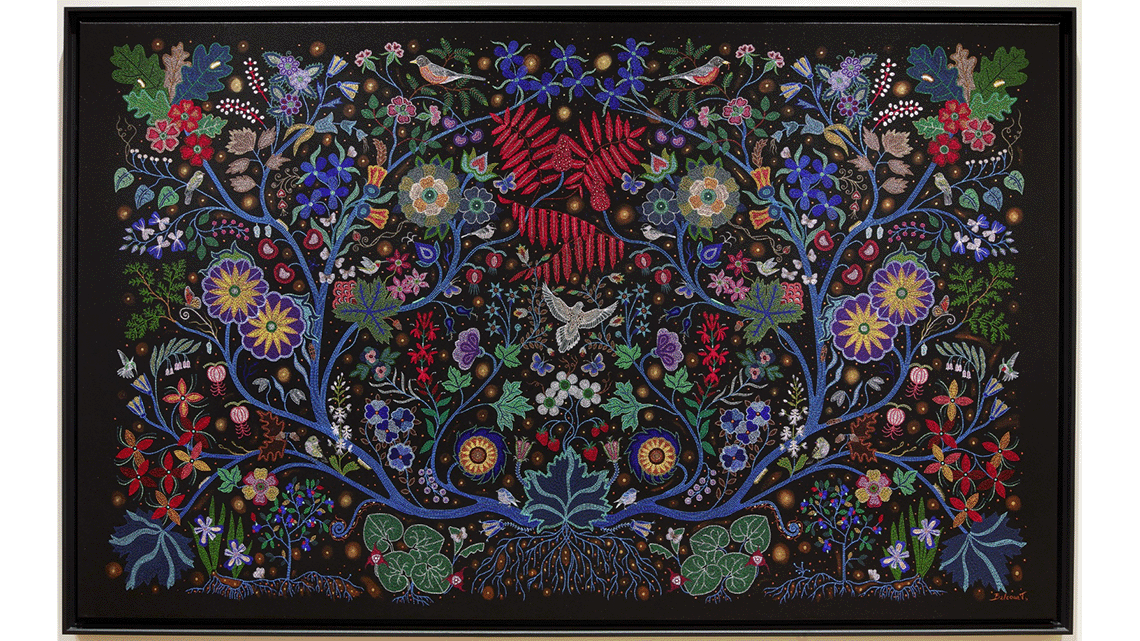
The Wisdom of the Universe by Christi Belcourt, 2014
What messages or themes do you think the artist explores in this artwork?
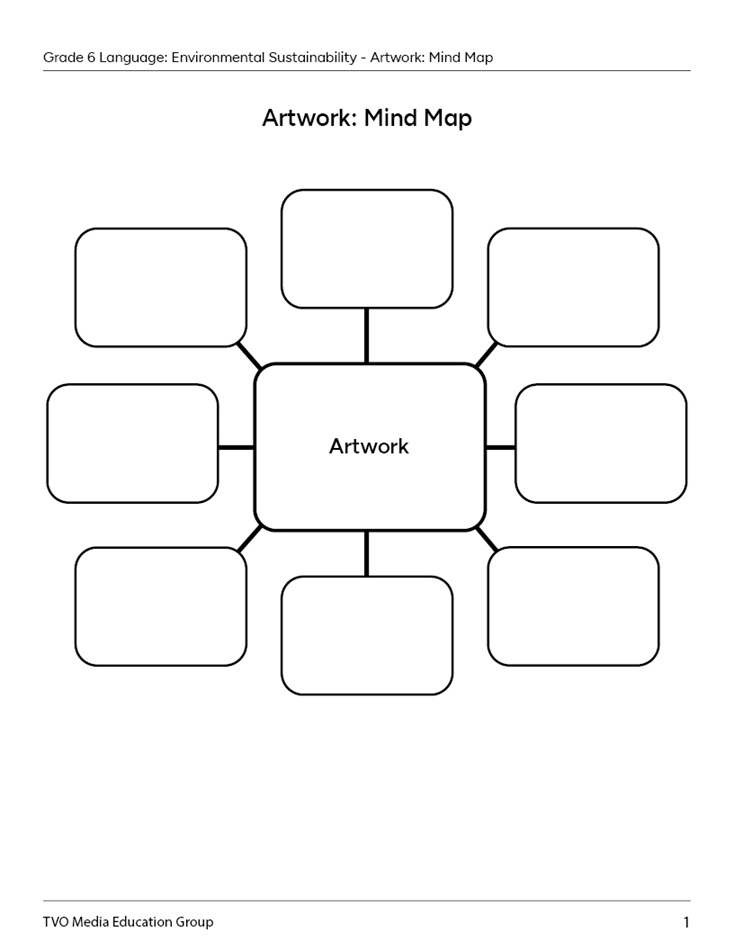
Record your thoughts using a method of your choice. You could create a mind map in your notebook, or complete the fillable and printable Artwork: Mind Map using the following document. If you would like, you can use speech-to-text or audio recording tools to record your thoughts.
If possible, share your thinking with a partner.

The art of Christi Belcourt
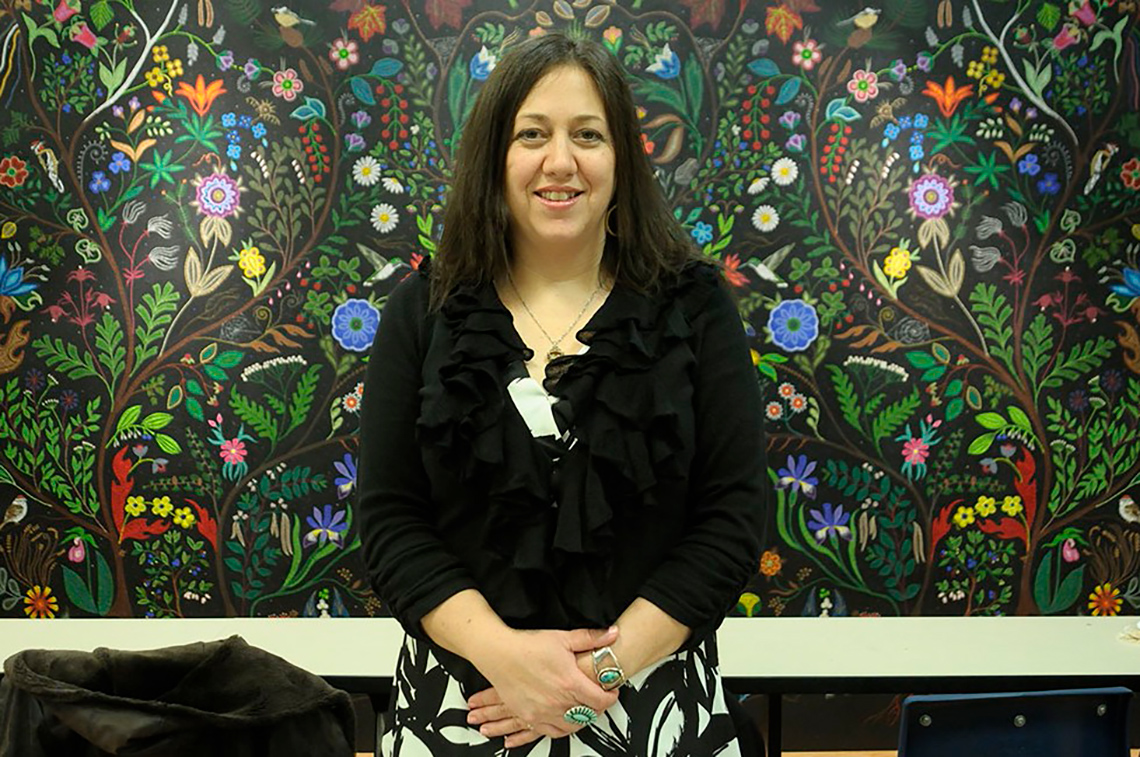
Christi Belcourt in front of her artwork My Heart (Is Beautiful) in 2010
Christi Belcourt (apihtâwikosisâniskwêw/mânitow sâkahikanihk) is a Métis visual artist from Manitou Sakhigan (Lac Ste. Anne) in Alberta, Canada.
Through her artwork, Belcourt represents themes such as the interconnectedness of living things and sustainability. She sees these themes through the lens of her own experience and through her Métis culture and traditions. In her artwork, Belcourt often includes symbols of nature as well as painted dots to reflect traditional Métis floral beadwork.
In addition to her artwork, Belcourt works as an environment activist. She promotes respect for land and water, seeking to protect them for future generations.
To learn more about Christi Belcourt and see more of her art, visit her website (do a search for “Christi Belcourt” using your favourite search engine).

Did You Know?
About the Métis…
The Métis are a distinct Indigenous people with a unique history, culture, language, and way of life. The Métis emerged as a distinct people and nation in the historic Northwest during eighteenth and nineteenth centuries. The initial unions between First Nations women and European men led to the creation of Métis communities that were and remain distinct from First Nations and European communities. Distinct Métis communities developed along fur trade routes and across the Northwest to form the Métis Homeland. The Métis Homeland includes the Prairie provinces (Manitoba, Saskatchewan, Alberta), as well as parts of Ontario, British Columbia, the Northwest Territories, and the northern United States.
Métis art
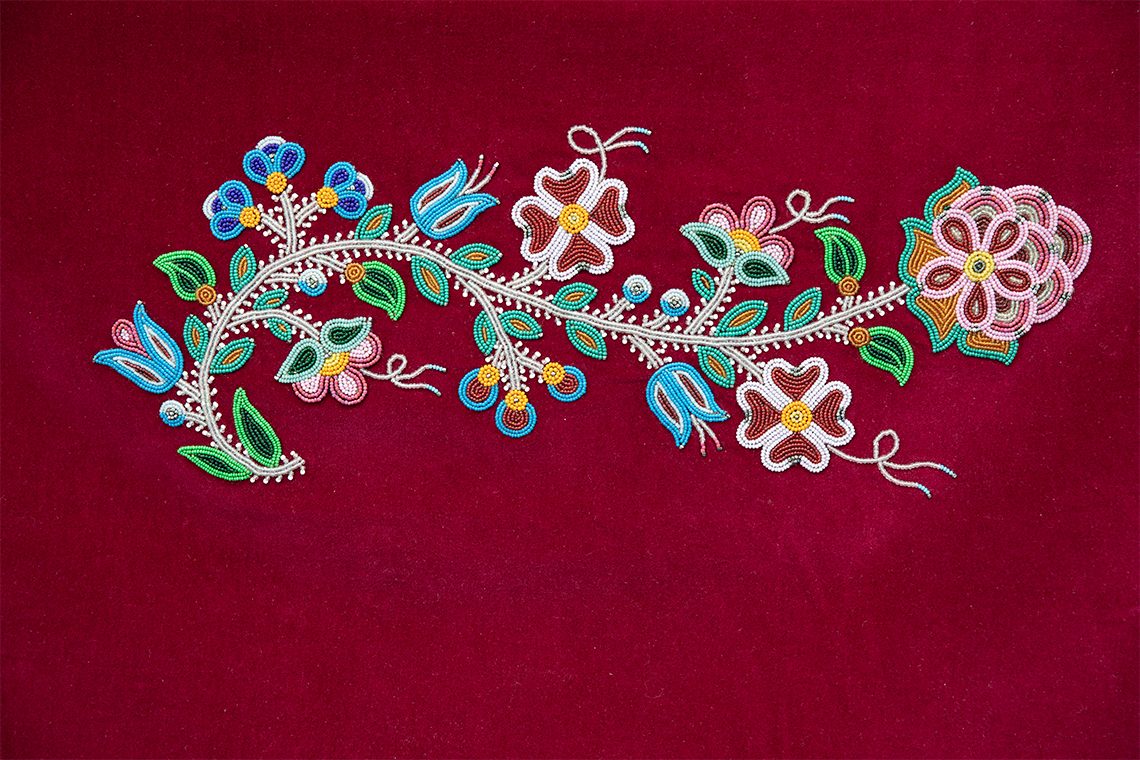
‘Abstract’ by Jennine Krauchi
Traditional Métis art, in the form of beadwork and embroidery, features lots of brightly coloured flowers. Because of this, the Métis have sometimes been called the “Flower Beadwork People.”
Today, Métis artists and artisans continue to use floral designs when making traditional items and other artwork.
Métis Nation of Ontario. (2022, July 28). Métis Nation of Ontario | Culture and Heritage | Who are the Métis. https://www.metisnation.org/culture-heritage/who-are-the-metis/
Canadian Geographic. (2018, June 14). Material culture. Indigenous Peoples Atlas of Canada. https://indigenouspeoplesatlasofcanada.ca/article/material-culture/#:~:text=traditional%20M%C3%A9tis%20beadwork.-,Beadwork,in%20their%20beadwork%20and%20embroidery.
Reading aloud
Next you will explore a passage by Christi Belcourt while working on your fluency skills.

Fluency

Fluency is the ability to identify words correctly and read a text at an appropriate rate with ease, pace, automaticity, and expression. With proper phrasing and a focus on punctuation, the reader will gain more meaning from the text.
One strategy to increase reading fluency is to re-read the same passage several times. Each time you read it, you will increase your reading rate, accuracy, and be able to add expression.
Christi Belcourt is very passionate about the work that she does, as you will see in the following passage. Try reading this passage out loud. If possible, record yourself using an audio recorder.
In the words of Christi Belcourt…
“I have nothing to say about my art. I will leave that to others. Everything that drives me, and drives my art and the mishmash of everything I do in my life, is my love for the Earth and my awe of it all. How is it possible we are even alive? The great power and mystery surrounds us every minute of every day. Everything – the plants, insects, winds, stars, rocks, animals, us – is a giant web of pure spirit. Nothing is separate from anything else. The spirit world surrounds us at all moments and is present in all things. If it's possible we live in a planet surrounded by stars, then nothing is impossible.”
Use the checklist provided to self-assess your own fluency. If possible, share with someone else and ask them to provide feedback on your fluency.
Fluency checklist
Based on the checklist, choose one area of fluency to focus on and set a goal for yourself. What strategies could you use to help you achieve this goal?
Did you know that familiarity with punctuation will help your reading fluency? Learn more in the next section!
Punctuation: Guiding the voice
Watch the following video to review the different types of punctuation:
Punctuation marks
Note the effect of the following pieces of punctuation. Read the sample sentences out loud:
| Punctuation mark | Effect on voice | Sample sentence |
|---|---|---|
| Exclamation mark (!) | Volume increases slightly, and voice indicates emphasis/ excitement | I love Christi Belcourt's art! |
| Open quotation marks (“) | Slide into a new voice. | Christi Belcourt asks, “How is it possible we are even alive?” |
Now let’s look at some of the pieces of punctuation found in the Christi Belcourt passage. Examine the following flashcards to see how each punctuation mark impacts expression.
Reading aloud…again!
Try reading the passage aloud once more. Be aware of how the punctuation impacts the pacing of what Belcourt is saying. If possible, record yourself using an audio recorder and compare it to the first recording you created.
In the words of Christi Belcourt…
“I have nothing to say about my art. I will leave that to
others. Everything that drives me, and drives my art and the mishmash of
everything I do in my life, is my love for the earth and my awe of it
all. How is it possible we are even alive? The great power
and mystery surrounds us every minute of every day. Everything – the
plants, insects, winds, stars, rocks, animals, us – is a giant web of pure
spirit. Nothing is separate from anything else. The spirit
world surrounds us at all moments and is present in all things. If
it's possible we live in a planet surrounded by stars,
then nothing is impossible.”
Did you notice a change in the way you read when you paid attention to the punctuation? If possible, share your thoughts with a partner about what emotions you think Christi is trying to communicate about her art.
Deep dive: The Wisdom of the Universe
Take a moment to re-examine the artwork from the Minds On section.
The Wisdom of the Universe by Christi Belcourt, 2014

Connections
Let’s reflect
Record your answers to the following questions in your notebook or using another method of your choice.
- What species of plants and animals can you identify in the painting?
- What might the significance of these plants and animals be to the artist, Christi Belcourt?
- What might Belcourt might be trying to express or communicate in this artwork?
Let’s learn a little bit more about the painting The Wisdom of the Universe! It was commissioned in 2014 by the Art Gallery of Ontario. It features Ontario plants and animals that are threatened, endangered, or extinct. Let’s explore three of the featured species, which are circled in the following image:
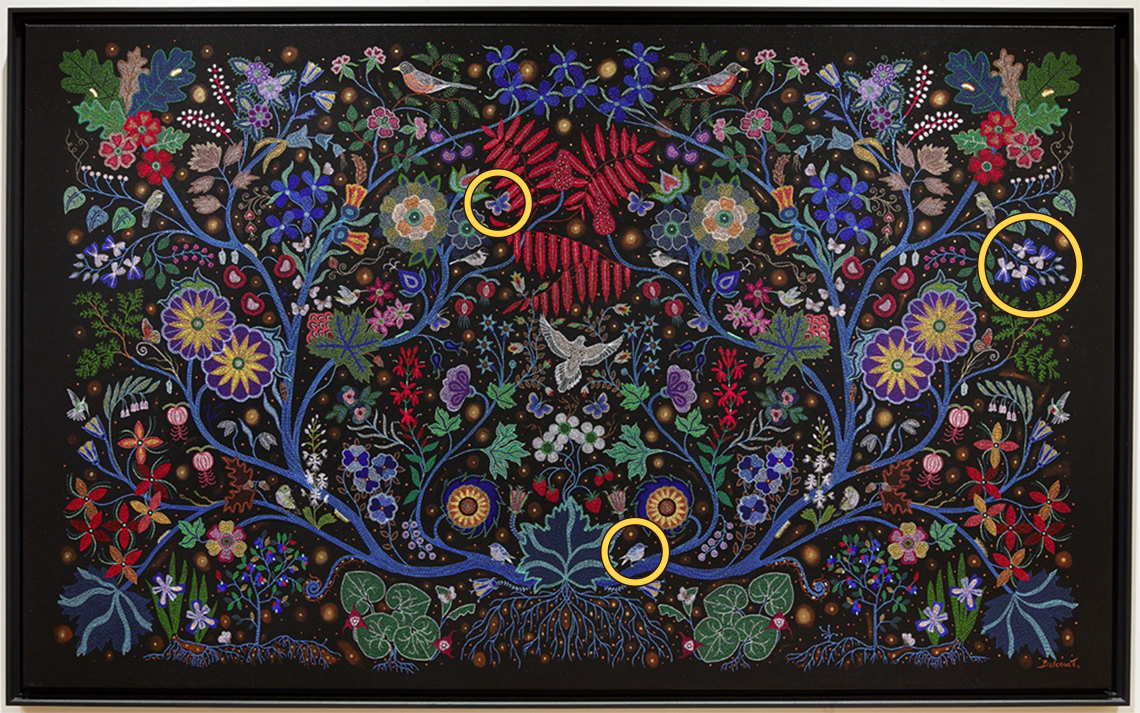
Note the three circled elements.
Press the following tabs to learn more about these species.
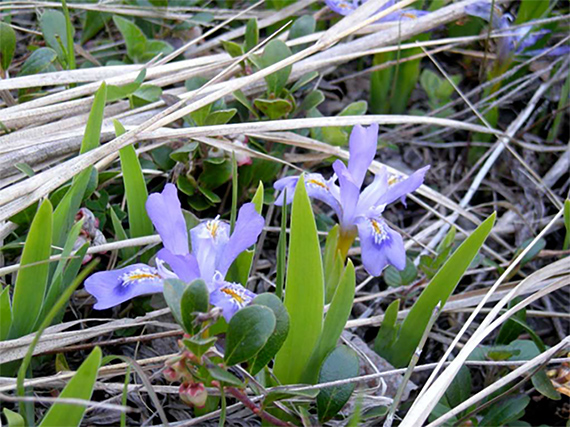
The dwarf lake iris, named for its size and where it grows, is a short plant with purple flowers (and on rare occasions white flowers). Underground roots spread out to sprout new plants. Ants can also spread the seeds found in the flowers.
This plant usually grows on lakeshores, so any changes in water levels or sunlight can be a threat to its survival. Land development along shorelines threaten this at-risk species.
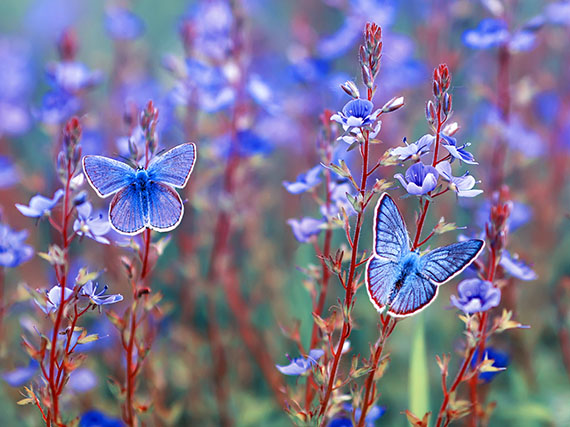
The Karner blue butterfly is a tiny, colourful species. Males are roughly the size of a quarter, with blue wings edged in black and white. Females have a darker, more purple or brown tone to their blue colouring, and have small black and orange spots at the end of their wings.
Karner blue butterflies used to live in Ontario in regions where the plant blue lupine grows, serving as one of the plant’s pollinators. Years of development throughout Ontario have led to a loss of habitat. Sadly, this species of butterfly is no longer found in Canada. We say that the species is extirpated, or extinct from a region but found elsewhere in the world.
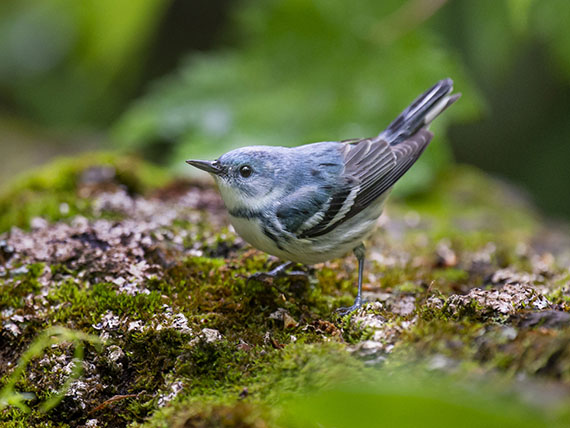
The cerulean warbler is a small blue, white, and black songbird. Females can usually be identified by the slightly yellowish tint to their bellies and “eyebrows.”
During the summer breeding season, cerulean warblers live in forests in southern Ontario and Quebec, as well as in parts of the U.S. They migrate to the Andes Mountains in South America before the winter.
These birds are classified as threatened because of habitat loss from the reduction and clearing of forested areas in both their summer and winter habitats.

Pause and Reflect
The big picture…
- Why is it important to learn about the status of different species?
- What might be the impact when a species is threatened or goes extinct?
Share your thoughts with a partner, if possible.
Biodiversity
In addition to being an artist, Christi Belcourt works as an environmentalist. Read the following quotation from Rewilding magazine, and think about what the word “biodiversity” might mean.
In the words of Christi Belcourt…
“I try to raise awareness about endangered species, about the importance of water, the sacredness of water and the interconnectedness of every living thing that sustains life on Earth,” Belcourt says. “I'm able to use my art as a way to launch into discussions around the environment around biodiversity, around the importance of sustainable practices and Indigenous law, which is in alignment with natural law.”
There are many different forms of life that exist on planet Earth. We call this biodiversity.
The prefix “bio” refers to living things:
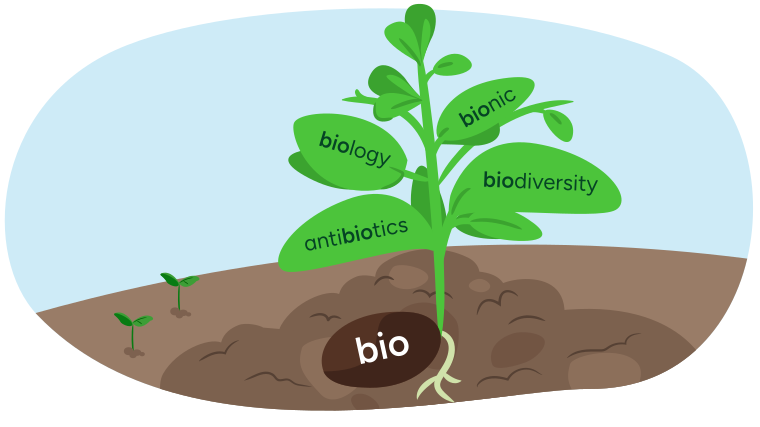
The base word is “diversity.” In this instance, it means “variety,” and suggests many differences.
When we put the two terms together, we get the word biodiversity, which refers to the many different forms of life on our planet. This includes the varied and unique habitats, ecosystems, and how they are all connected, either directly or indirectly.
Video: Biodiversity
To learn more about what biodiversity is and how important it is to our planet, watch the following video clip from WWF's “Wild Classroom.”
Indigenous communities protect and conserve the resources on land, air, and water. Many Indigenous communities seek to be in balance with nature, taking only what is needed. They are committed to limiting pollution and supporting biodiversity.
Biodiversity is all the life you will find in one area. It includes the following:
- plants
- animals
- fungi
- microorganisms (for example, bacteria)
All of these elements work together to create an ecosystem. In an ecosystem, everything is connected to create balance and help all life forms thrive. Indigenous knowledge are grounded in the understanding that everything is interconnected and is a direct link to a sustainable present and future.
You have just done some great work exploring Christi Belcourt’s artwork and its connections to biodiversity and sustainability. Now is a good time to take a break before we turn to some grammar!

Student Wellness
Take a break!

Time for a body break! If possible, stretch your body and move around your space.

Complex sentences
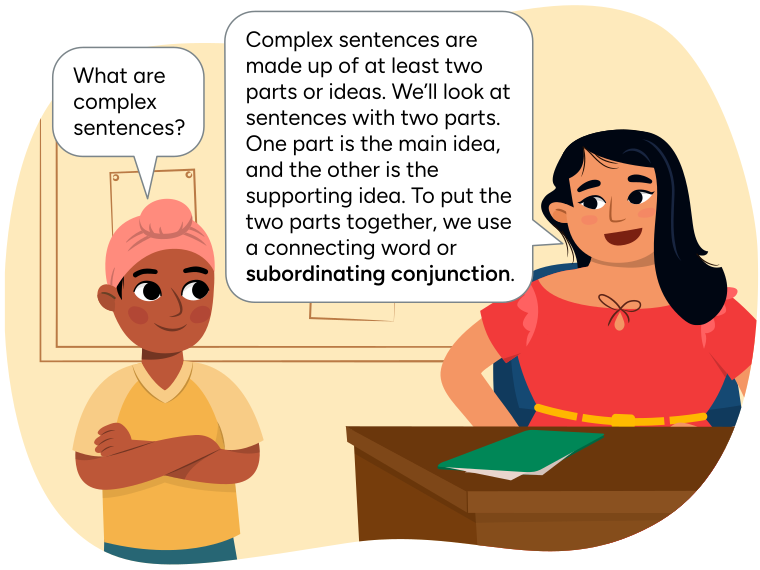
Teacher and student talking.
Student: What are complex sentences?
Teacher: Complex sentences are made up of at least two parts or ideas. We’ll look at sentences with two parts. One part is the main idea, and the other is the supporting idea. To put the two parts together, we use a connecting word or subordinating conjunction.
Here are some examples of subordinating conjunctions. Note how they are used in the sample sentences.
| Subordinating conjunction | Sample sentence |
|---|---|
| if | I’d like to learn to paint, if there are classes available. |
| since | The Métis have sometimes been called the “Flower Beadwork People” since their traditional art often features colourful flowers. |
| because | I admire Christi Belcourt because she cares so much about the environment. |
| while | I like paintings, while my brother prefers beadwork and embroidery. |
| unless | I’d like to go to an art museum, unless you are too tired. |
| though, although | I like Belcourt’s artwork, though I don’t know a lot about art in general. |
Let’s take a closer look at a complex sentence. Explore the following interactive image:
Complex sentences allow you to share your thoughts and feelings in a rich and interesting way!
Your turn!
In each of the following sentence, identify the subordinating conjunction. Select the correct answer, then press Check Answer to see how you did.

Putting it all together
It’s time to reflect on your learning.
Examine these artworks by Christi Belcourt.
The Wisdom of the Universe by Christi Belcourt, 2014
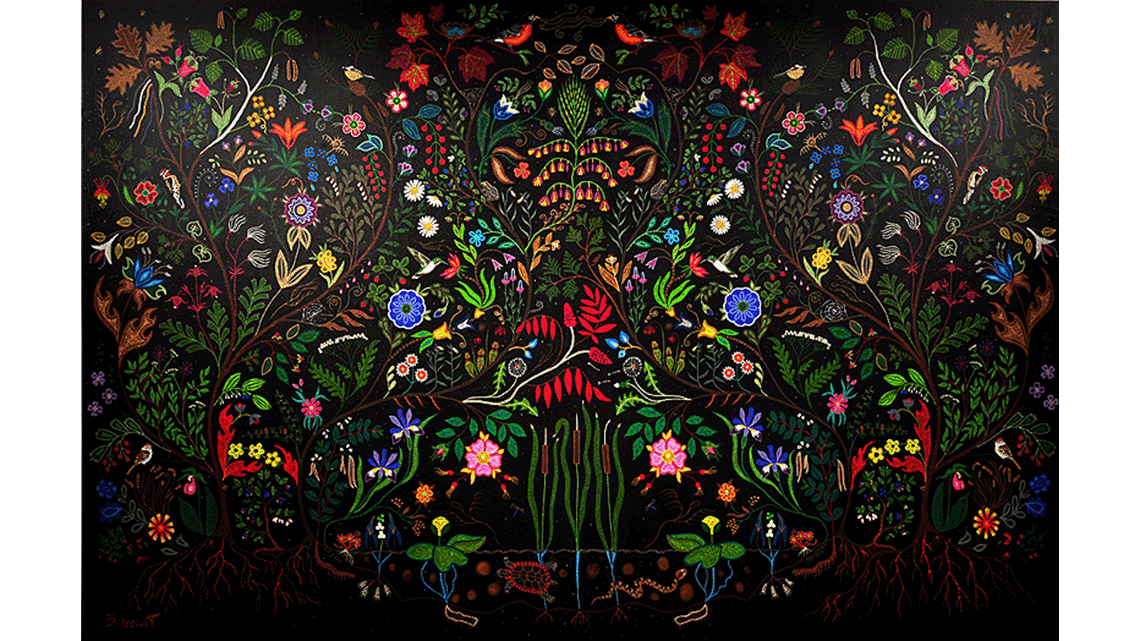
My Heart (Is Beautiful) by Christi Belcourty
Image 2 - My Heart (Is Beautiful) by Christi Belcourty: A nine-foot-by-twelve-foot painting of about fifty diverse plants and animals represented in bright hues on a dark background. There are very small white dots, cool-hued dots, and larger neutral-hued circles spread throughout the dark background. The left side and right side of the image have a symmetrical arrangement of plants and animals. All of these shapes are created with many tiny dots of paint that look like beads. In the lower corners of the image are the roots of plants whose stems curve and branch out across the entire painting. Many diverse plants grow out of these stems and fill most of the space in the image. These plants include arrowhead, bear berry, birch, blanket flower, blueberry, blue flag, cedar, chokeberry, daisy, dandelion, dogbane, juniper, leather leaf, maple, oak, old man whiskers, pine, pink lady's slipper, purple prairie cone flower, rabbit tobacco, raspberry, rose, sarsaparilla, spruce, strawberry, sumac, tamarack, tiger lily, wild rice, and yarrow. Spread out among the plants are a couple of chickadees, hummingbirds, sparrows, spider webs, robins, ticks, and woodpeckers. In the lower central part of the image is a small body of water with a turtle and snake in it. Cattails, pitcher plants, pond lilies, and sundews are growing in and around the water with their roots visible below the surface. In the upper corners of the image there are ribbons of diverse hues hanging near the top of a stem.
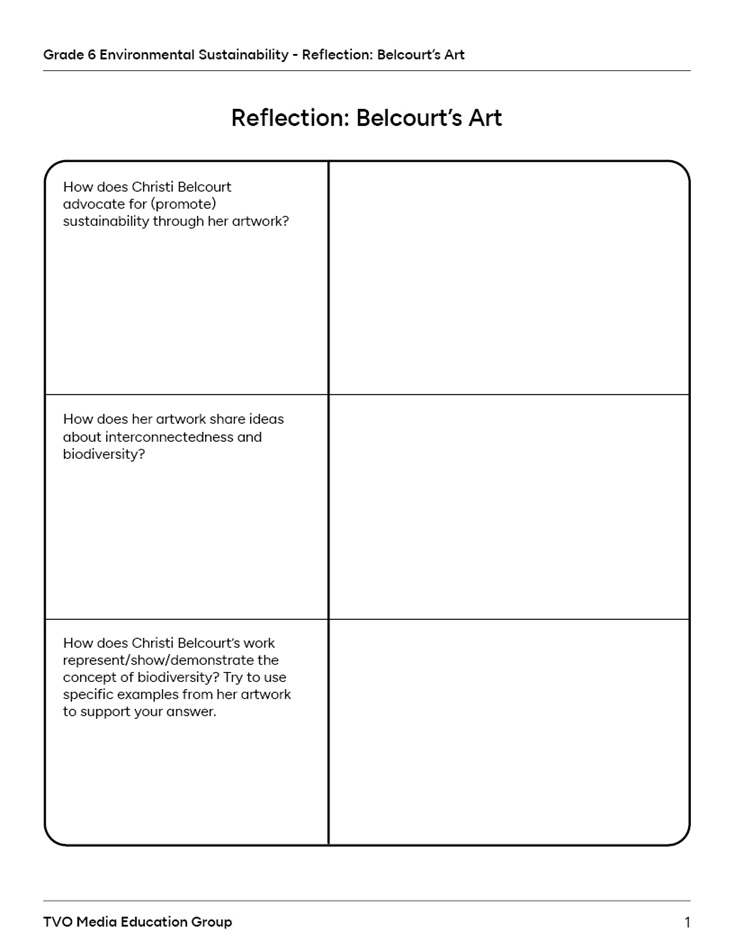
Now record your thoughts about Christi Belcourt’s art. Answer the following questions in your notebook or complete this fillable and printable graphic organizer called Reflections: Belcourt’s Art using the following document. If you would like, you can use speech-to-text or audio recording tools to record your thoughts.
If possible, share your ideas with a partner.
Punctuation review
We have seen that punctuation marks give us cues about how to read out loud. To review what you have learned, try the following true-or-false questions. Select the correct answer, then press Check Answer to see how you did.
Final task: Protecting biodiversity
In this learning activity, you explored the different ways that biodiversity has been honoured in visual art. You examined the work of Métis artist Christi Belcourt. You learned about Métis people across Canada and discovered some of their cultural traditions. You even practised crafting complex sentences that describe your personal response to artwork.
Create your own piece

In your final task, you will use some of these tools to demonstrate your commitment to protecting biodiversity. You have seen how Belcourt’s detailed pieces express the variety and complexity of nature. How might you express your own feelings about environmental conservation in a creative or artistic way?
Create a work in one of the following formats, or another of your choice:
- a poem
- a drawing, painting, or structure
- a speech
- a slideshow
- a dialogue or scene
If possible, share your work with a partner, and ask for their feedback.
Reflection
As you read through these descriptions, which sentence best describes how you are feeling about your understanding of this learning activity? Press the button that is beside this sentence.
I feel...
Now, record your ideas using a voice recorder, speech-to-text, or writing tool.