Learning goals
We are learning to…
- identify different elements of style in different texts and forms of communication, such as slogans, and describe how word choice and word patterns shape the effectiveness of slogans
- explain how transferable skills like critical thinking can help us to better communicate in a range of situations, including applying these skills to our writing
- identify and describe how literary devices work, including how alliteration can improve the catchiness of slogans
Success criteria
I am able to…
- describe how elements of style in writing like word choice and word patterns make “the 3 Rs” a memorable slogan for environmental action
- explain how authors can use literary devices, such as alliteration, to shape their message towards a certain purpose and audience
- apply my understanding of “the 3 Rs” to craft my own sustainability slogan

A catchy slogan

Connections
“The 3 Rs”

Have you heard the expression "the 3 Rs"? What does it mean to you? Write down any associations that come to mind, or use another method to record your thoughts.
The original meaning…
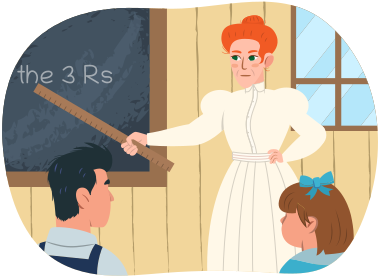
Back in the day, this is what “the 3 Rs” meant:
- reading
- ’riting
- ’rithmetic
In other words, the 3 Rs were reading, writing, and arithmetic: the basic components of education.
The newer meaning…
The expression “the 3 Rs” also has a more recent meaning. Explore the following image for some clues:
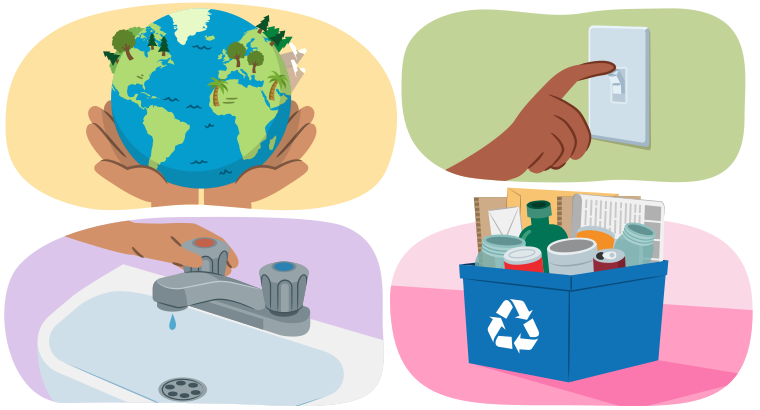
Yes, in our modern world, these are the 3 Rs:
- reduce
- reuse
- recycle
The new 3 Rs are considered to be as basic and as important as reading, writing, and arithmetic.
This new take on the old phrase became popular in the 1970s – the decade when environmental awareness was growing in North America.

Did You Know?
Earth Day

The first Earth Day was held in 1970. Environmental leaders, scientists, activists, and politicians came together for this occasion. However, it was no celebration. The environmentalists wanted to communicate to the public that they had to take immediate action to help the planet.
The growing environmental movement needed a memorable catchphrase. “The 3 Rs” became exactly that. No one knows exactly who came up with the phrase, but it influences people’s behaviour and habits to this day!
Let’s brainstorm!
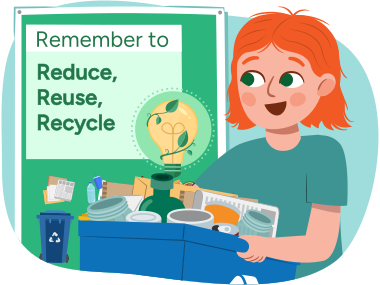
Student carrying a recycling box filled with recyclable materials. In the background a billboard that says “Remember to reduce, reuse, recycle”.
What are some examples of reducing, reusing, and recycling that you might encounter in your daily life?
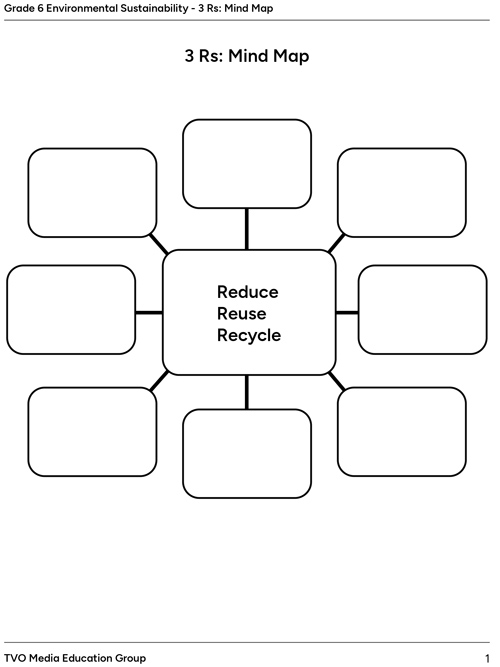
Record your thoughts using a method of your choice. You could create a mind map in your notebook, or complete the fillable and printable 3 Rs: Mind Map using the following document. If you would like, you can use speech-to-text or audio recording tools to record your thoughts.
Press the following tabs to see some examples of how people reduce, reuse, and recycle.
- buy food in bulk to reduce packaging
- buy shampoo bars to reduce packaging
- reduce the number of clothes you buy
- turn off lights when you don’t need them to reduce energy use
- use reusable water bottles, straws, and shopping bags
- reuse worn-out running shoes as gardening shoes
- purchase and donate thrift store items
- double-check which materials can be recycled
- "upcycle" plastic containers by using them as planters

Make it catchy!
“Reduce, reuse, recycle”: This phrase is used around the world to remind people of actions they can take every day to help the environment.

Pause and Reflect
Let’s analyze…
Consider the phrase “reduce, reuse, recycle.”
What makes it so catchy and easy to remember?
Write down your thoughts, or record them using the method of your choice.
Later in this learning activity, we will come back to the question of what makes this expression so catchy. But first, we need to learn about slogans!
The power of words: Slogans
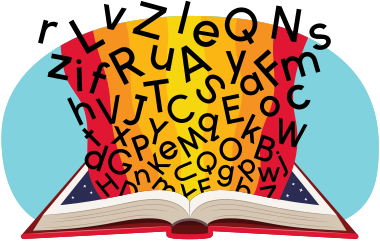
“The 3 Rs” is a catchy, memorable phrase designed to make you take certain actions to help the environment.
The advertising industry has a special term for catchy phrases: slogans. In ads, slogans are usually designed to make you buy something or try something. More generally, they might aim to give you certain feelings or associations with a company or product.
Here are some examples of slogans:
- Just do it! (Nike)
- Think different (Apple)
- I’m lovin’ it (McDonald’s)
- Leave limits behind (Avion Rewards)

Brainstorm
What slogans do you know?
Can you think of other examples of slogans? How do these slogans make you feel?
Write your thoughts in a notebook, or record them using another method of your choice.
Writing a good slogan
Whether you’re trying to get people to help the planet or buy something, it’s incredibly important to have a good slogan. To figure out what makes a slogan effective, let’s turn to the advertising field.
Press the following tabs to explore some characteristics of effective slogans.
Brevity means using very few words to have maximum impact. Slogans need to be short to be punchy and easy to remember. In general, a slogan contains just a few words.
Because slogans are very short, slogan-writers choose words with great care so that they have the maximum impact. The words may be chosen to express a certain feeling or energy.
In general, slogan-writers choose words that are…
- short
- easy to say
- easy to understand
Sometimes words are chosen to form catchy patterns. You’ll learn more about this in the next section!
Word patterns
Another way to hook an audience’s attention and craft an effective slogan is to choose words that form patterns. For example, you can repeat certain sounds or spellings in a pleasing way.
Press the following tabs to see some examples.
This type of pattern repeats that same sound at the end of words. The following is an example of a slogan that uses rhyming.
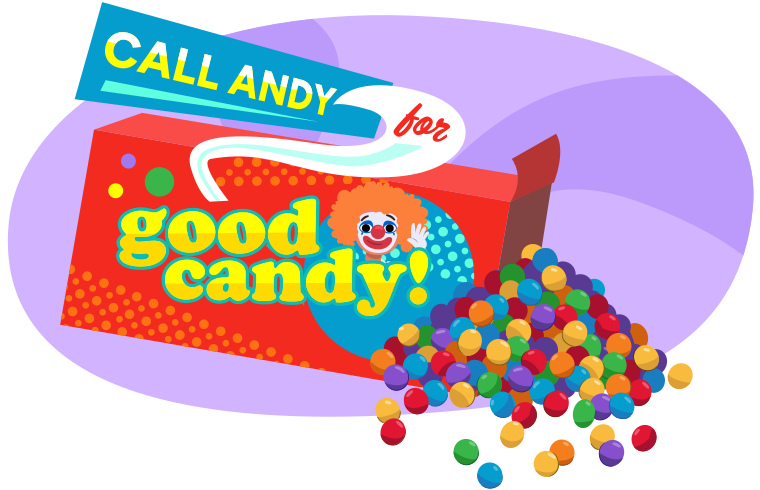
In this slogan, the words “Andy” and “candy” rhyme.
Listen to this audio clip to hear the rhyme.
Call Andy
In this slogan, four words begin with the “k” sound.
This type of pattern repeats the same sound at the beginning of words:

Listen to this audio clip to hear the alliteration.
Call Carl
Sometimes, an entire prefix is repeated. This is the case with the prefix “re” in the slogan we started with:
- Reduce, reuse, recycle
In this slogan, the short words create a punchy rhythm.
Rhythm has to do with the number of syllables, and where the accent falls. The following slogan contains only one-syllable words, giving it a punchy rhythm.
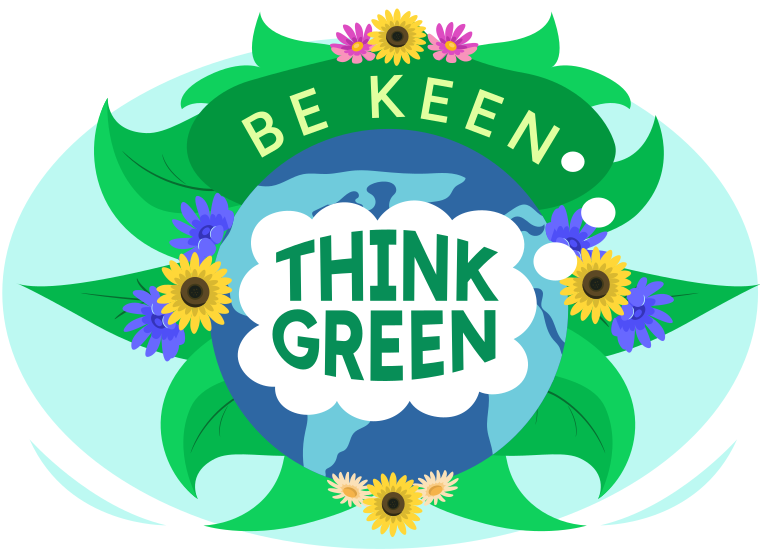
Listen to this audio clip to hear the rhythm.
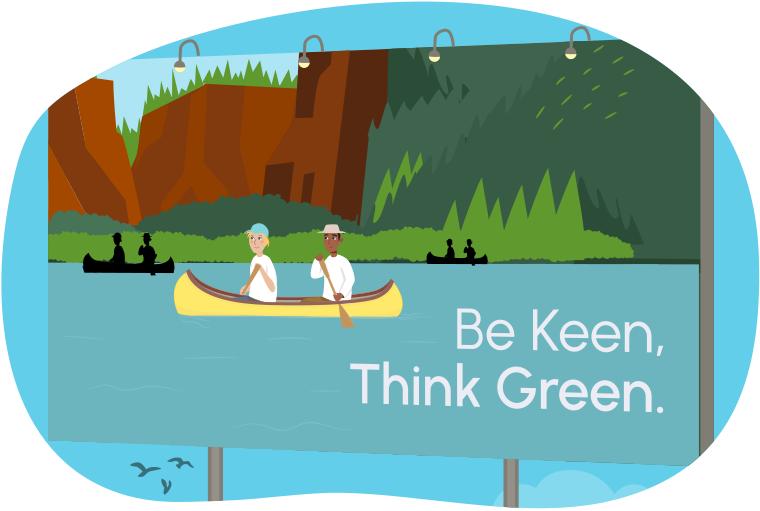
Be keen think green
Your turn!
To test your understanding, try the following multiple-choice questions.
Select the correct answer, then press Check Answer to see how you did.

Pause and Reflect
You be the judge!
The following table shows two versions of the same slogans:
| Version 1 | Version 2 |
|---|---|
|
Our treats are delicious! |
Try our tasty treats today! |
|
Get the fastest bike: Speed Plus |
Buy the best brand of bikes: Blue Breeze |
|
Play this fun game about space monkeys! |
Galactic Gorillas: a great game for your giggling group! |
Which version of the slogans do you like better? Why?
Write your answers in your notebook, or record them using the method of your choice.
Press Possible Answer button to see some ideas.
Most people say they like Version 2 better. These slogans use alliteration (repeated sounds at the beginning of words). This makes them catchier and easier to remember.
You have just done a lot of thinking about slogans. Now is a great time to take a break before we look at some grammar!

Student Wellness
Take a break!

Time for a body break! If possible, stretch your body and move around your space.
Grammar terms
As you may know, a sentence contains a subject and a verb, and expresses a complete thought.
We are going to look at different ways to structure sentences. But first, press the following tabs to learn or review some important terms.
An independent clause can stand alone as a complete sentence.
- Example: I like pizza.
A dependent clause can’t stand alone as a complete sentence. It plays a supporting role. Its job is to give us information about the independent clause.
- Example: I like pizza because it tastes good.
The independent clause is “I like pizza.” The dependent clause is “because it tastes good.” The dependent clause gives us information about the independent clause, but does not form a complete sentence on its own.

Sentence structure: Four types
Explore the following table to learn about the four basic sentence structures:
| Type | Definition | Example |
|---|---|---|
| Simple | Made up of just one independent clause | I studied hard. |
| Compound | made up of two or more independent clauses that are connected by punctuation or a conjunction | I studied hard, and I did well on the test. |
| Complex | made up of one independent clause and one dependent clause | I did well on the test because I studied hard. |
| Compound-complex | made up of two independent clauses and one dependent clause | When I study hard, I do well on tests, and I feel good about myself. |
Different sentences structures may be appropriate for different purposes and audiences. In addition, authors often vary their sentence structure to give their text interest. However, in many cases, a simple message is most effective when expressed in a simple sentence structure.
Your turn!
Identify the structure of the following sentences.
Select the correct answer, then press Check Answer to see how you did.
Pause and Reflect
Slogans and sentence structure

What kind of sentence structure do you think is most often used in slogans? Write your answer in your notebook, or record it using the method of your choice.
Press Possible Answer to see some ideas.
Because slogans are “short and sweet,” they most often use the simple sentence structure. An example is “Bridgette’s Bakery bakes the best bread.”
In fact, many slogans are not complete sentences at all. Check out these examples:
- Snap! Crackle! Pop! (Rice Krispies)
- Finger lickin’ good (KFC)
- Yours to discover (Ontario)
- Diversity, our strength (Toronto)
Sentence types
You’ve looked at different sentence structures. Now you’ll look at another way of categorizing sentences. Explore the four sentence types:
| Type | Definition | End punctuation | Example |
|---|---|---|---|
| Declarative | Makes a statement | period (.) | I finished my supper. |
| Interrogative | Asks a question | question mark (?) | Did you finish your supper? |
| Exclamatory | Exclaims something (says something with excitement or emphasis) | exclamation mark (!) | I finished my supper! |
| Imperative | Gives an order or command | exclamation mark (!) or period (.) |
Finish your supper! Finish your supper. |
Normally when we use the imperative, there is no subject. The subject is understood to be “you”:
- (You) finish your supper!
Check your understanding!
For each sentence type, select the corresponding example.
Pause and Reflect
Slogans and sentence types
Slogans may be declarative sentences, as in the case of “Bridgette’s Bakery bakes the best bread.” But there is another sentence type that is very often used in slogans. Look at these examples:
- Just do it (Nike)
- Eat great, even late (Wendy’s)
- Think different (Apple)
- Obey your thirst (Sprite)
- Fly the flag (Air Canada)
Can you identify the sentence type? Try this multiple-choice question:
Select the correct answer, then press Check Answer to see how you did.
Slogans are often imperative sentences (also called just “imperatives”). This makes sense because they are often trying to get us to do something or buy something.
Affirmative or negative?
Imperative sentences can be affirmative (positive) or negative. In other words, they can tell you to do something, or they can tell you not to do something. As you check out these examples, think of what word appears in negative imperative sentences:
| Affirmative (positive) | Negative |
|---|---|
| Close the door. | Don’t forget to close the door. |
| Turn the stove off. | Don’t leave the stove on. |
| Lock the door. | Don’t leave the door open. |
Your turn!
To test your understanding, try the following questions.
Select the correct answer, then press Check Answer to see how you did.
Back to the 3 Rs...
Student carrying a recycling box filled with recyclable materials. In the background a billboard that says, “Remember to reduce, reuse, recycle”.
You have now looked at some elements of style in writing. You have explored the importance of brevity, word choice, and word patterns (such as alliteration and rhyme). You have also looked at sentence structure and sentence types.
It’s time to return to the following question: What makes the slogan “reduce, reuse, recycle” catchy and effective?
Complete the fillable and printable graphic organizer Analyzing the 3 Rs in your notebook or using the following document. If you would like, you can use speech-to-text or audio recording tools to record your thoughts. If possible, discuss your ideas with a partner.
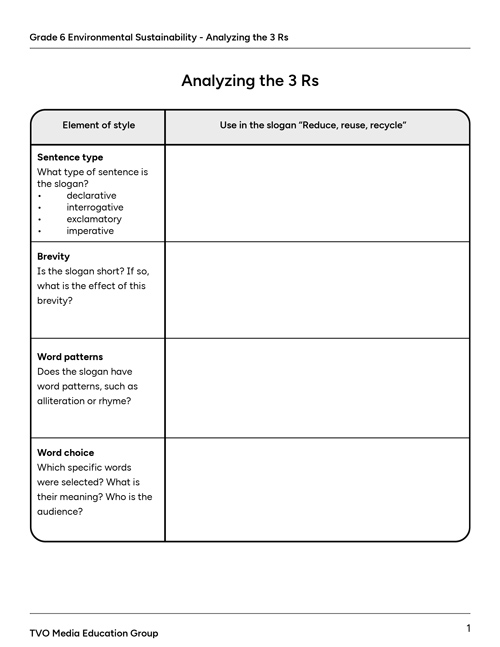
Once you have recorded your thoughts, press Possible Answers to see a filled-in organizer.
| Element of style | Use in the slogan “Reduce, reuse, recycle” |
|---|---|
|
Sentence type What type of sentence is the slogan?
|
The slogan is basically made up of three imperatives in a row. These imperatives are not harsh commands, but they encourage us to take specific actions to help the planet. |
|
Brevity Is the slogan short? If so, what is the effect of this brevity? |
The slogan is extremely short: just three words long. This makes it catchy and easy to remember. |
|
Word patterns Does the slogan have word patterns, such as alliteration or rhyme? |
The slogan uses alliteration: the “r” sound is used at the beginning of each of the three words. In fact, the entire prefix “re” is repeated, which emphasizes the need to do things again. The repeating prefix gives the slogan a sense of flow and rhythm, which also helps the audience to remember the message. |
|
Word choice Which specific words were selected? What is their meaning? Who is the audience? |
As seen above, the words were chosen because their sounds harmonize. But these words were also chosen because of what they mean. These three short words remind the audience (which includes everyone on Earth) that they need to:
The words are incredibly well chosen: if we live by them, we will truly help the environment. |
The evolution of “the 3 Rs”
As you learned earlier, the slogan “reduce, reuse, and recycle” emerged sometime during the 1970s, early in the environmental-awareness movement. It is frequently used to this day.
In recent years, many have suggested that more terms should be added to this famous slogan. To see some of the terms that have been suggested, explore the following flashcards:
Can you think of any other words that could be added to this list?

Putting it all together
Create your own sustainability slogan
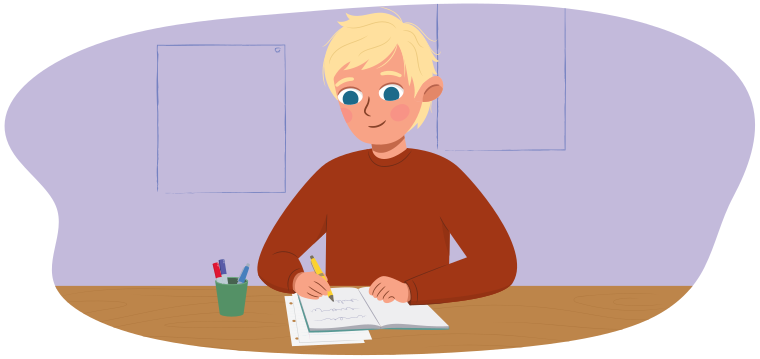
In your final task, you will use what you have learned to create your own sustainability slogan! This is a slogan that in some way encourages people to help the environment.
Keep your slogan “short and sweet.” Choose your words with care. You may wish to use a word pattern patterns such as alliteration or rhyme. If you wish, you can use some of the words we have looked at:
- reduce
- reuse
- recycle
- repair
- refuse
- rethink
- rot
Do you like art?
If you wish, you can make a poster that includes your slogan. Here’s an example:
Revise your work
Teacher saying the following words:
Once you have created your slogan, share it with a partner if possible. Ask them for their feedback. Do they find it catchy and easy to remember? Do they understand the message?
If necessary, revise your slogan to make it more effective.
Analyze your work
Once you are satisfied with your slogan, write three or four sentences explaining why you think it is effective and memorable. If you chose to illustrate your slogan, explain how this contributes to its effectiveness.
Reflection
As you read through these descriptions, which sentence best describes how you are feeling about your understanding of this learning activity? Press the button that is beside this sentence.

I feel...
Now, record your ideas using a voice recorder, speech-to-text, or writing tool.