In a method of your choice, record the texts that you’ve engaged with recently and the reason you engaged with them.
What is sustainability?
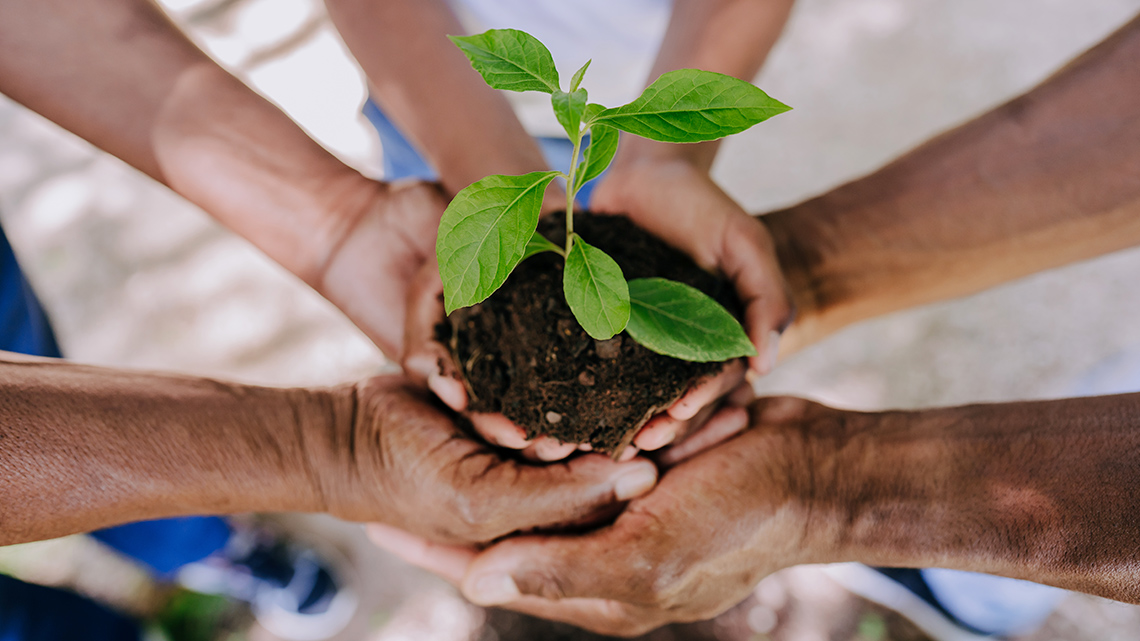
Sustainability refers to the ability to live within the limits of available resources. It is the ability to meet the needs in the present without compromising the ability of future generations to meet their own needs.
Environmental sustainability focuses on preserving and protecting natural resources,
ecosystems, and
biodiversity. It involves minimizing harm to the environment, reducing pollution, conserving energy and water, and promoting the sustainable use of
resources to maintain ecological balance and resilience.
Texts about sustainability
Imagine that you have been asked by your school to start a book club for students to collaborate about environmental sustainability. First, you would need to preview books about sustainability and then select two for the book club to focus on.
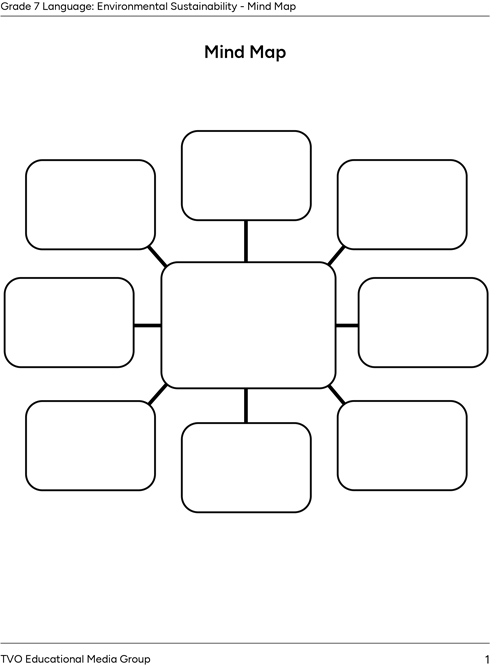
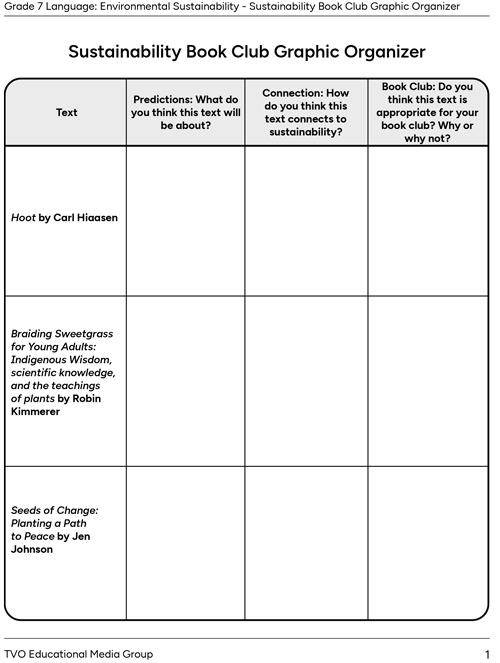
Explore the following text covers, synopses, and excerpts from the texts. Take notes about the text using the graphic organizer provided or in another method of your choice.
Use the following questions to guide your notetaking.
- What do you think this text will be about?
- How do you think this text connects to environmental sustainability?
- Do you think this text would be appropriate for your book club? Why or why not? (Consider the audience and purpose for reading)
Complete the fillable and printable Sustainability Book Club Graphic Organizer in your notebook or using the following document. If you would like, you can use speech-to-text or audio recording tools to record your thoughts.
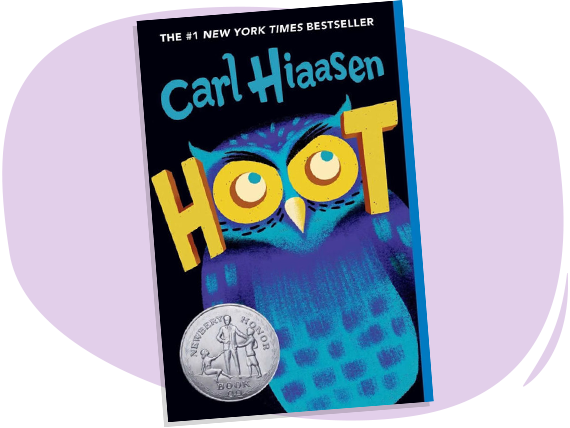
Text 1: Hoot by Carl Hiaasen
Hoot is a novel that follows a group of middle school students who attempt to protect a colony of endangered owls that are living on the construction site of a new restaurant. Will they be able to save the owl habitat from being destroyed?
Explore the following excerpt from Chapter 18 of the book Hoot. It is told from the perspective of the main character, who is working to defend the owls.
Hoot by Carl Hiaasen Hoot by Carl Hiaasen
When Roy’s turn came to address Mr. Ryan’s class, he didn’t use any of those articles for his topic. Instead he held up the newspaper and pointed to the torn page where the Mother Paula’s advertisement had been.
“Most everybody here likes pancakes,” Roy began. “I know I sure do. And when I first heard that a new Mother Paula’s was going to open here in Coconut Cove, I thought that was pretty cool.”
Several kids nodded and smiled. One girl pretended to rub her tummy hungrily.
“Even when I found out where they’re going to build it—that big empty lot at the corner of Woodbury and East Oriole—I didn’t see anything wrong with the idea,” Roy said. “Then one day a friend of mine took me out there and showed me something that changed my mind totally.”
Now the other students stopped talking among themselves and paid attention. They’d never heard the new kid say so much.
“It was an owl,” Roy went on, “about this tall.”
He held up two fingers, one eight or nine inches above the other, to show them. “When my family lived out West we saw plenty of owls, but never one this small. And he wasn’t a baby, either, he was full grown! He was so straight and serious, he looked like a little toy
professor.”
The class laughed.
“They’re called ‘burrowing’ owls because they actually live underground,” Roy continued, “in old holes made by tortoises and armadillos. Turns out that a couple of owl families hang out on that land at Woodbury and East Oriole. They made their nests in the dens and that’s
where they raise their babies.”
Some of the kids shifted uneasily. A few began whispering in worried tones and some looked at Mr. Ryan, who sat thoughtfully at his desk, chin propped in his hands.
“Roy,” he said gently, “this is an excellent subject for biology or social studies, but perhaps not for current events.”
“Oh, it’s definitely a current event,” Roy countered. “It’s happening tomorrow at noon, Mr. Ryan.”
“What is?”
“They’re going to start bulldozing to make way for the pancake house. It’s like a big party or something,” Roy said. “The lady who plays Mother Paula on TV is going to be there. The mayor, too. That’s what the paper said.”
A red-haired girl in the front row raised her hand. “Didn’t the paper say anything about the owls?”
“No. Not a word,” Roy said.
“So what’s gonna happen to ’em?” called a freckle-faced boy from the back of the classroom.
“I’ll tell you what’s going to happen.” Roy looked at Mr. Ryan. “The machines are going to bury all those burrows, and everything inside.”
“No way!” the red-haired girl cried, and the class erupted in agitated conversation until Mr. Ryan asked everyone to please be quiet and let Roy finish.
“The grown-up owls might try to fly away,” Roy said, “or they might just stay in the dens to protect their babies.”
“But they’ll die!” the freckle-faced kid shouted.
“How can the pancake people get away with this?” demanded another.
“I don’t know,” Roy said, “but it’s not legal, and it’s not right.”
Here Mr. Ryan interrupted firmly. “Hold on, Roy, what do you mean it’s ‘not legal’? You need to be careful when you’re making those kinds of serious allegations.”
Excitedly Roy explained that the burrowing owls were protected by state and federal laws, and that it was illegal to harm the birds or disturb active burrows without getting special government permits.
“All right. Fine,” said Mr. Ryan, “but what does the pancake company have to say about this? I’m sure they got the proper permission—”
“The file is missing,” Roy cut in, “and the foreman tried to tell me there weren’t any owls on the property, not a single one. Which is a lie.”
The class started buzzing again.
“So tomorrow at lunch,” Roy continued, “I’m going out there to ... well, just because I want the Mother Paula’s people to know that somebody in Coconut Cove cares about those birds.”
Mr. Ryan cleared his throat. “This is a sticky situation, Roy. I know how upset and frustrated you must feel, but I’ve got to remind you that students aren’t supposed to leave school property.”
“Then I’ll get a note from my parents,” Roy said.
The teacher smiled. “That would be the way to do it.” The class was expecting him to say more, but he didn’t.
“Look,” said Roy, “every day we’ve been reading about regular people, ordinary Americans who made history ’cause they got up and fought for something they believed in. Okay, I know we’re just talking about a few puny little owls, and I know everybody is crazy about Mother
Paula’s pancakes, but what’s happening out there is just plain wrong. So wrong.”
Roy’s throat was as dry as prairie dust, and his neck felt hot.
“Anyway,” he muttered, “it’s tomorrow at noon.”
Then he sat down.
The classroom fell quiet, a long heavy silence that roared in Roy’s ears like a train.
View Transcript(Open transcript in a new window)
Take a moment to complete the section on the book, Hoot, in the graphic organizer, or make notes in another method of your choice.
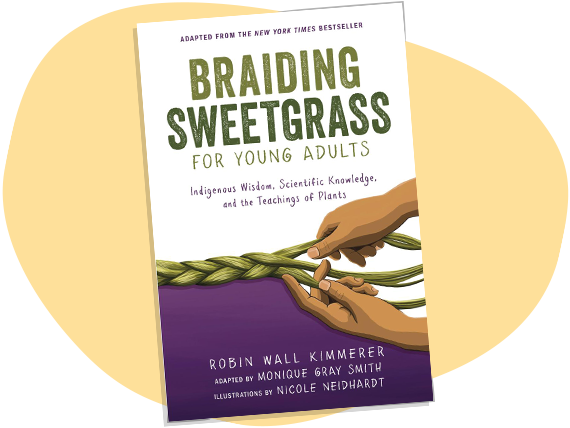
Text 2: Braiding Sweetgrass for Young Adults by Robin Kimmerer
Braiding Sweetgrass for Young Adults: Indigenous Wisdom, Scientific Knowledge, and the Teachings of Plants is written by Indigenous author Robin Wall Kimmerer. Kimmerer is an enrolled member of the Citizen Potawatomi Nation. The text combines Indigenous wisdom and scientific
knowledge to highlight the importance of connections with the land and the environment.
Explore the following excerpt from “Planting Sweetgrass: The Gift of Strawberries”. In this section, Kimmerer discusses the importance of reciprocity and sustainability in our interactions with the earth.

Did You Know?
Did you know?
Reciprocity is the practice of exchanging things with others for mutual benefit (meaning both groups benefit). For Indigenous communities, reciprocity is practiced with Mother Earth, emphasizing the preservation of natural resources and in return Mother Nature
provides us with things we need as well, such as food or shelter.
Conde, K. (2020, December 29). Reciprocity: An indigenous teaching for a better 2021. Reciprocity: an indigenous teaching for a better 2021. https://www.voicesofyouth.org/blog/reciprocity-indigenous-teaching-better-2021
Braiding Sweetgrass for Young Adults
In our family, the presents we gave one another were almost always homemade. I thought that was the definition of a gift: something you made for someone else. A gift economy – goods and services not purchased but received as gifts from the Earth. The abundance of strawberries
felt like and still feels like a pure gift from the land. I have not earned, paid, nor laboured for them. Well, sometimes I labour for them. They could be called natural resources or ecosystem services, but really, they are gifts.
[…]
When we speak of berries or apples or beans as gifts and not as goods or services or commodities, the whole relationship changes. Gratitude emerges, or at least, I hope it does. Gratitude is much more than thank you. It is a thread that fosters relationships.
Gratitude creates a sense of abundance. When feeling grateful, we take only what we need out of respect for generosity of the one who is giving. Whether that is strawberries, a friend sharing their time to listen to us, or a parent driving you somewhere you want to go.
If our first responsibility for the gift is gratitude, then the second is reciprocity: to give the gift in return. What could I give in return for their generosity? This is a beautiful question to ask yourself. What if we thought that everything we consume is a gift from
Mother Earth?
I think we could take better care of what we are given. Mistreating a gift has consequences. How we think influences how we act, and how we act has an impact. If we view strawberries as objects or property, they can be exploited as a commodity. There are consequences for
this.
I was taught to reciprocate berries with a gift of my own. It might be that I scatter their seeds or plant the little ones back in the ground so they will flourish and provide berries next Strawberry Moon. No person taught us this, the strawberries showed us. Gratitude and
reciprocity are the currency of a gift economy. The gifts have the unique ability to multiply with every exchange. A truly renewable resource.
View Transcript(Open transcript in a new window)
Kimmerer, R. W., Gray Smith, M., & Neidhardt, N. (2023a). Braiding Sweetgrass for Young Adults: Indigenous Wisdom, scientific knowledge, and the teachings of plants. Thorndike Press, a part of Gale, a Cengage Company.
Take a moment to add your notes on Braiding Sweetgrass for Young Adults: Indigenous Wisdom, Scientific Knowledge, and the Teachings of Plants to the graphic organizer, or take notes in another method of your choice.
Text 3: Seeds of Change by Jen Johnson
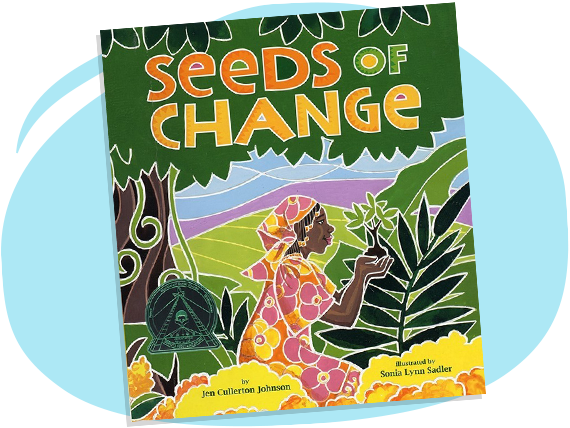
Seeds of Change: Planting a Path to Peace by Jen Cullerton Johnson tells the story of a girl named Wangari Maathai, a Kenyan environmentalist, who was taught to love nature and uses her knowledge of the environment to help save her land, one tree at a time.
Let’s explore an excerpt from this book in the following audio clip.
Johnson, J. C., & Sadler, S. L. (2011). Seeds of change: Planting a path to peace. Lee & Low.
Take a moment to add your notes on Seeds of Change: Planting a Path to Peace to the graphic organizer or take notes in another method of your choice.
My recommendations
Now that you’ve explored three different possible texts for your sustainability book club, respond to the following questions in your method of choice.
- Which two would you recommend?
- Why did you choose these two?
- What environmental themes, including sustainability, do you think the book will include that makes it a good fit?
Creating a book club
A book club is a group of people who get together after reading a specific section of a book to discuss what they are reading. Members are encouraged to share their thoughts, opinions, and insights about the book, as well as ask questions.