Learning goals
We are learning to…
- analyze themes explored in First Nations, Métis, and Inuit cultures to demonstrate an understanding of the varied identities, perspectives, relationships, legacies, truths, and ways of knowing, being, and doing
- analyze cultural elements that are represented in various texts, including values, rituals and ceremonies, architecture, art, and dance, by investigating the meanings of these elements, making connections to their lived experience and culture, and sharing their interpretations with others
- make revisions and edits to the content, elements of style, patterns, and features of draft texts, and add, delete and re-sequence sentences to improve clarity, focus, and coherence, using various strategies and seeking and selectively using feedback
- read, listen to, and view various forms of texts by diverse First Nations, Métis, and Inuit creators to make meaning through Indigenous storywork about First Nations, Métis, and Inuit histories, cultures, relationships, communities, groups, nations, and lived experiences
Success criteria
I am able to…
- read and answer comprehension questions on texts about Indigenous sustainability initiatives
- draw conclusions from and analyze information about Indigenous perspectives and ways of knowing, being, and doing, in connection to sustainable land use
- edit and revise a piece of writing about Indigenous-led sustainability using checklists provided and recommend two suggestions to improve writing
- reflect on and make connections between Indigenous-led sustainability and myself

Connections to the land

Relationships and connections to the land are critical to Indigenous ways of knowing, being, and doing. Connecting with the natural world deepens the relationship to it, and the understanding of the responsibilities all humans have towards the land.
Indigenous knowledge systems and sciences explain the importance of showing gratitude and reciprocity to the land for what it provides, and taking care of natural resources, such as trees, water, plants, animals, and much more.
Check out the following video to learn more about Indigenous perspectives on nature and the environment.
In the video, Isaac mentions “the law.” What is he referring to? Respond in a method of your choice.
Press the Possible Answer button to learn more.
Isaac is referring to everything in nature as the law. He references “Earth’s laws are weaved into a sacred blanket” that contains the animals, plants, clouds, stars, trees, rain, and much more. This is all connected and protects humans.
R-A-N chart
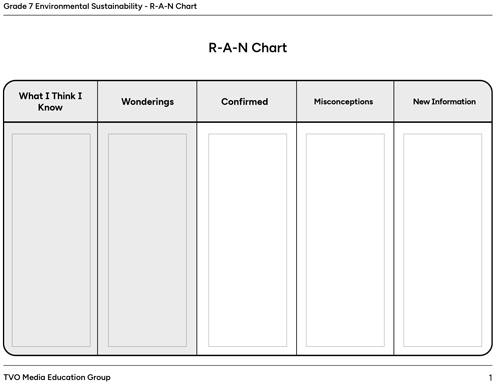
Consider what you believe you already know about Indigenous knowledge systems and Indigenous ways of knowing, being, and doing, specifically about connection to land and nature.
Complete the first two columns, “What I think I know” and “Wonderings,” in the fillable and printable R-A-N Chart in your notebook or using the following document. You will revisit this chart at the end of the learning activity to confirm your understanding. If you would like, you can use speech-to-text or audio recording tools to record your thoughts.
Previewing vocabulary and titles

Before you begin, let’s explore a few vocabulary words that you will encounter in the Action section of this learning activity.
Press the following tabs to find the definition of the following words.
Supervising or taking care of something, such as an organization or the environment.
The restoration of friendly relationships.
Able to be maintained at a certain rate or level; conserving an ecological balance by avoiding depletion of natural resources.
Within Indigenous ways of knowing, being, and doing, there is no hierarchy between land and people, meaning the land, the people, the plants, animals, fish etc. are all respected and valued. In this section of the learning activity, you will be further exploring how this connects to sustainable practices, and how Indigenous-led sustainability is beneficial to current and future generations.
Before you begin, explore the titles of the content that you will be exploring. Brainstorm and predict what you think you are going to learn about. Why do you think this? Record your ideas in your notebook, or another method of your choice.
Press the Titles button to learn more.
- Indigenous guardians
- Métis perspectives
- reconciliation and sustainability
Indigenous guardians
“We are the 'moccasins and mukluks' on the ground for our communities. We manage protected areas, restore animals and plants, test water quality, and monitor development projects.”
- Land Needs Guardians
Across Canada, there are 160 First Nations guardian programs managing lands, waters, and resources. These programs vary depending on where they are located, but all work towards sustainability. They manage proposed Indigenous protected and conserved areas to improve the health of communities and the stewardship of land.

Did You Know?
Did you know?
Indigenous protected and conserved areas reflect traditional Indigenous laws and traditions to continue to maintain a relationship with the land. For example, the salmon people protect salmon watersheds, or the caribou people conserve caribou ranges. These areas honour the relationship between people and the land and emphasize the importance of sustainable resource management.
Guardian programs promote connection between Indigenous communities, land users, industry representatives, and governments. This connection creates discussion about responsible land use and determine what happens to the land.
Check out the following video to learn more about what Indigenous Guardians do.
How do you think traditional Indigenous knowledge and ways to knowing, being, and doing, promote sustainability and responsible resource use? Record your ideas in a method of your choice.
Indigenous land guardian initiatives
Let’s take a moment to explore some of the Indigenous land guardian initiatives across Canada in the following accordion.
Press the following tabs to find out more.
Check out the following recording to hear the pronunciation of Thaidene Nëné.
Pronunciation of Thaidene Nëné
Thaidene Nëné is home to the Łutsël K'é Dene First Nation, located in the Northwest Territories. Areas of this region are identified as an Indigenous protected area, national park, territorial area, and wildlife conservation area and are protected in partnership with the Parks Canada and the Government of the Northwest Territories. The vision for Thaidene Nëné is “Our land, our culture for the future.” The ongoing sustainable approach by the Łutsël K'é Dene First Nation goes back to the time of early creation, “the time of the great animals.”
As we work towards Truth and Reconciliation, information about lands and territories is constantly being updated. This map was accessed through the permission terms of Parks Canada in November 2024. Please note that there is a spelling error on the map. It should read "Thaidene Nëné".
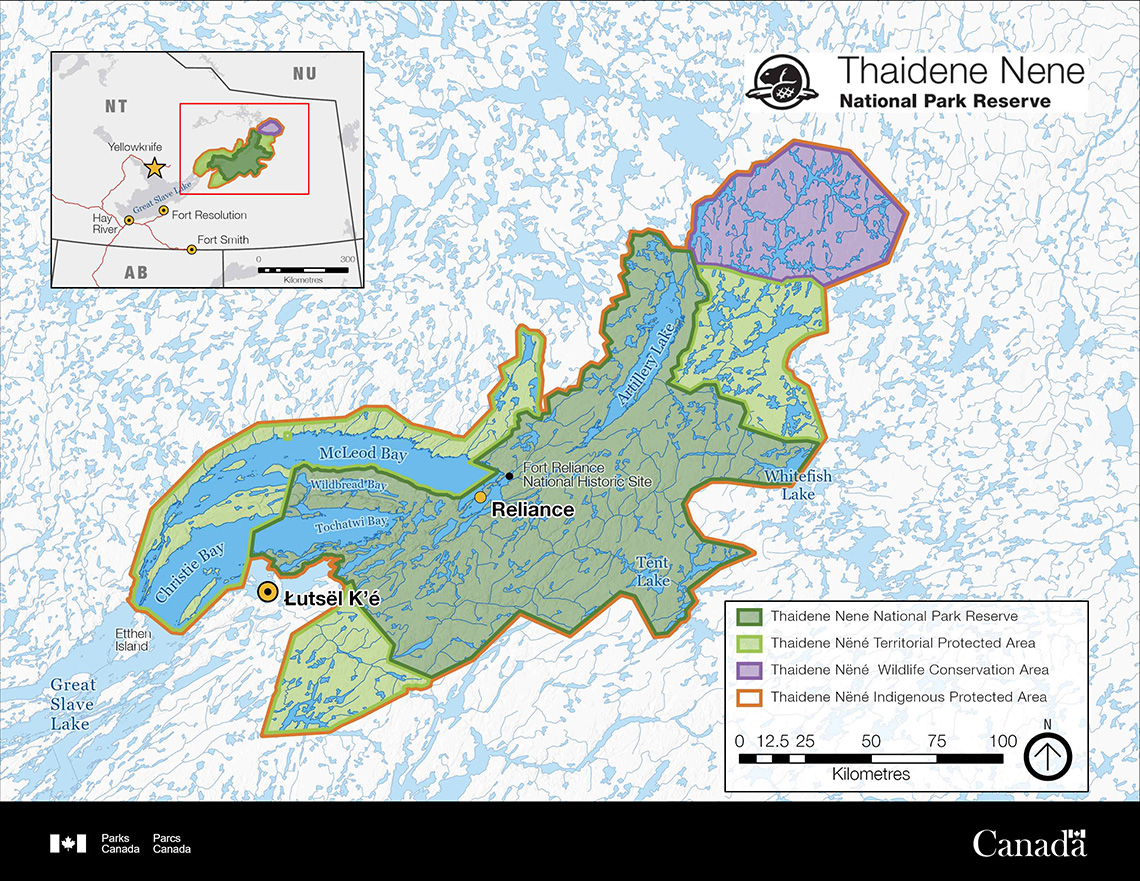
A map of Thaidene Nene National Park Reserve. The top left has a map that indicates where it is in Northwest Territories.
Thaidene Nene National Park Reserve is part of the Thaidene Nene Indigenous Protected Area which is designated by the Lutsel K'e Dene First Nation.
The vision for Thaidene Nëné uses the process of hide tanning, which is a sacred cultural practice that supports their way of life. In the process of hide tanning, the animal hide is attached to a pole using rope. The hide is the vision for Thaidene Nëné, the goals are the outside wooden poles, and the objectives, strategies, and measures are the rope. Hide tanning is a team effort and to protect and manage Thaidene Nëné, it will require a collaborative approach.
The Thaidene Nëné visions include ensuring the well-being of the land and people long into the future and identifying contaminated sites for remediation and research as well as building a sustainable community that meets the needs of community members.
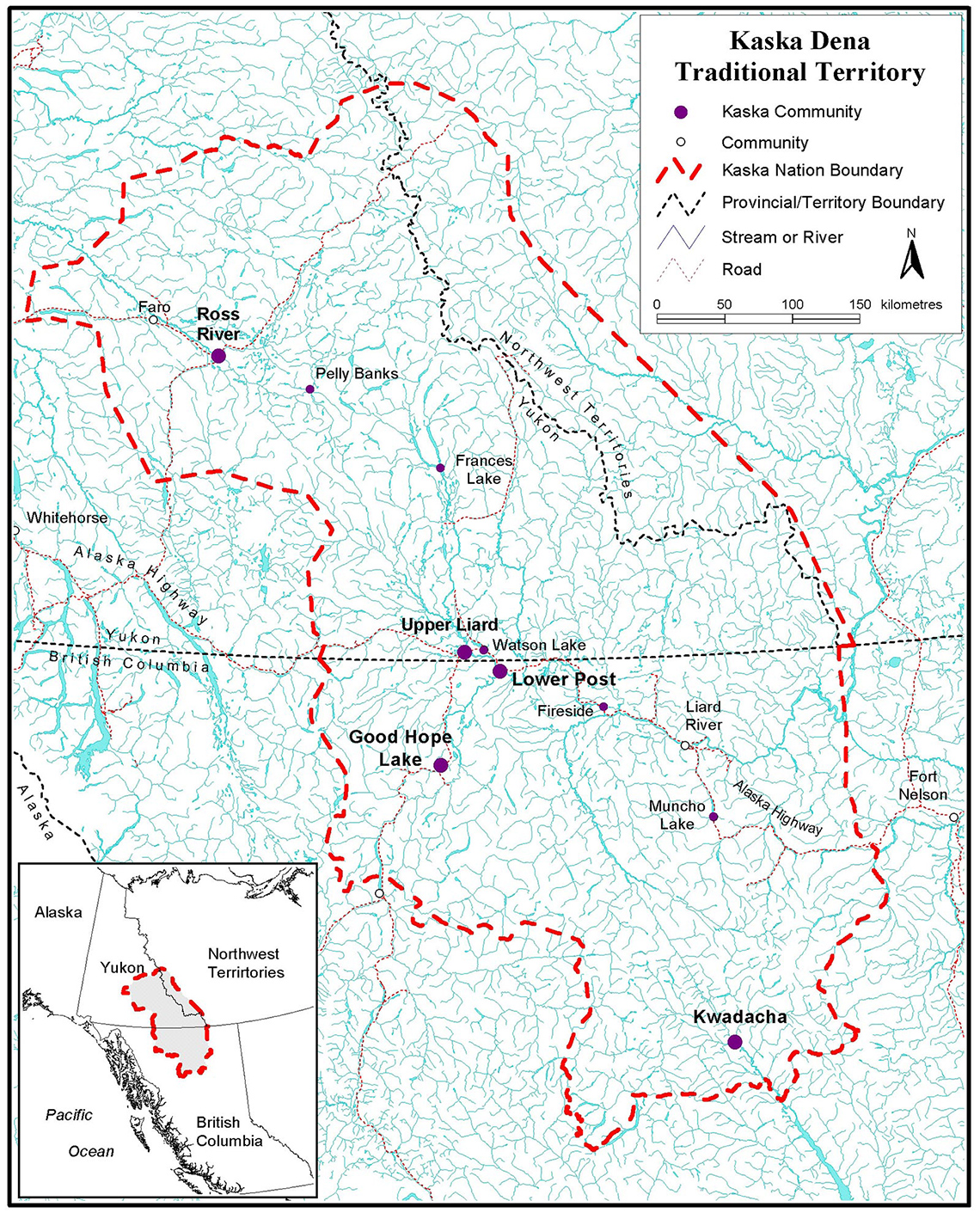
Kaska Dena have existed since time immemorial and are currently purposing the protecting of the 40,000 square kilometers of land in northern British Columbia. Traditional lands consist of areas in British Columbia, Yukon, and Northwest Territories. In traditional language, they say "Dene Kʼéh Kusān", which means "always will be there." The Kaska Dena are taking a sustainable and responsible approach to land management and resources to ensure ancestral lands and people will thrive today and for future generations.
The Kaska Dena plan to create protected areas to sustain and create jobs and conserve biodiversity. Policies created indicate that the Kaska Dena peoples will work with companies and governments to jointly manage land and resources. Reconciliation is about acknowledging and learning from the past to build a better future, including honouring the land.
Priorities of the land guardians include:
- maintaining a healthy, functioning ecosystem in the boreal forest, which serves as a major carbon sink
- reducing natural resource extraction
- providing an area undisturbed by roads and people, so the caribou will continue to thrive, as this protected area serves as home to a major caribou population
Scientists agree that large, protected areas, like this one, will offer the best chance at maintaining a healthy ecosystem in the age of climate change.
Let’s check!
Check your understanding of Indigenous Guardians in the following true or false activity.
Select the correct answer, then press Check Answer to see how you did.
In your notebook, or another method of your choice, respond to the following reflection question:
What values and knowledges of Indigenous communities, such as the Łutsël K'é Dene First Nation and Kaska Dena peoples, guide Indigenous approaches to sustainable land use? Give one example from the texts you explored.
Press the Possible Answer button to learn more.
Indigenous values and knowledge are reflected in the ways in which Indigenous communities protect and conserve the land, as they continue to maintain a healthy relationship based on sustainable resource use and community involvement.
Métis perspectives
Métis people have a deep connection with the environment, including plants, animals, medicines, and water. Climate change and extreme weather events have affected the health of these environments, and Métis communities believe that conserving and sustaining species and resources is critically important. Many Métis people believe all humans are connected to the land and are always able to return to the land. You can take some of nature, but you should never take more than you need.
Did You Know?
Did you know?
The Métis emerged as a distinct people and nation in the historic Northwest during 18th and 19th centuries. The initial unions between First Nations women and European men led to the gradual establishment of Métis communities that were and remain distinct from First Nations and European communities. Please note that Métis is not used to describe any person of mixed Indigenous ancestry. Rather, a Métis person, according to the Métis Nation, is “a person who self identifies as Métis, is of historic Métis Nation ancestry, is distinct from other Aboriginal peoples, and is accepted by the Métis Nation.”
Explore the following audio clip to find out more about the perspective of the Métis.
Métis Perspectives on Climate and Conservation
Métis people use clues in the environment to get information about current conditions and next steps. Trees are one natural resource that Métis communities learn from. One example is Dr. Colin Laroque, a Métis scholar from Saskatchewan, who said “trees are storytellers, they are the ‘Elder of our forests’ and if we listen carefully to them, we can hear their teachings about what they have seen and experienced.”
Check out the following video to learn more.
Dr. Colin Laroque said people “have to trust the words of a tree.” How can nature or the environment tell a story? Why is this important?
Reconciliation and sustainability
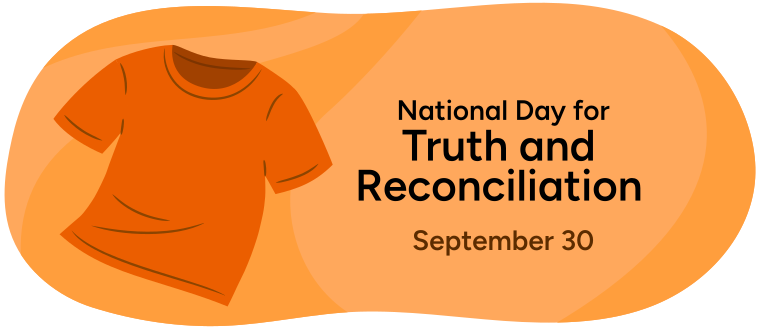
A poster with the title ‘National Day for Truth and Reconciliation: September 30th’. There is an orange T-shirt. The orange colour is associated with the National Day for Truth and Reconciliation. The orange T-shirts often feature artwork and designs by the Indigenous artists who make them.
You may have heard the term reconciliation before, but maybe you’re not sure what it means.
Reconciliation is where people are trying to rebuild and maintain a respectful relationship. In this instance, reconciliation is between Indigenous peoples and Canadians and the government. The need for reconciliation is deeply rooted in history. Since time immemorial, Indigenous peoples have inhabited the lands now known as Canada. Reconciliation is the opportunity to heal a broken relationship and establish a Canada that honours Indigenous peoples and their contributions.
As part of reconciliation, the Truth and Reconciliation Commission developed 94 Calls to Action to help repair the relationship between Indigenous and non-Indigenous communities. Within these calls to action, it identifies that Indigenous peoples should have rights over their land and resources, including meaningful consultation, maintaining respectful relationships, and obtaining consent from Indigenous peoples before proceeding with development projects. This includes the protection and conservation of natural resources on Indigenous lands.
Check out the following video entitled “Reconciliation through Land Conservation” to learn more. As you watch, consider how traditional Indigenous knowledge should be incorporated into sustainable resource use.
After watching this video, respond to the following discussion questions in a method of your choice.
- What do you think was meant by “it just can’t be development at all costs”?
- How do land conservation and protection relate to reconciliation?
Press the Answers button to learn more.
- What is meant by "it just can’t be development at all costs" is that there needs to be a balance between development and sustainable land use. The economy will continue to need development; however, conservation still needs to be the priority, and development cannot override the land, or we will no longer have natural resources to draw from. This requires collaboration, but there is room for both development and sustainability.
- Land conservation and protection relates to reconciliation because it recognizes that Indigenous peoples need to be a part of the decision-making process. All perspectives and rights must be considered, especially when planning development projects on Indigenous lands. Additionally, when land is conserved, it provides a place for Indigenous peoples to continue to exercise their traditional ways of living off the land.
Editing and revising
In this section of the learning activity, you will be revising and editing a piece of writing that a student created about Indigenous-led sustainability to share with and educate younger classes.
Let’s begin by reviewing the writing process.
Writers edit and revise their work for several key reasons, trying to refine their initial drafts into polished and effective pieces of writing. This process is important to enhance clarity, coherence, and overall impact.
So, what’s the difference between editing and revising? Press the following tabs to find out more.
Editing focuses on the language and correctness of the text, including reviewing and correcting spelling, punctuation, and grammatical errors, as well as enhancing word choice.
Areas of focus when editing include:
- grammar and syntax: correct grammatical errors, improve sentence structure, and ensure proper use of language
- punctuation and spelling: fixing punctuation errors and spelling mistakes
- consistency: ensuring consistent use of tense, perspective, and stylistic elements
- word choice: selecting precise vocabulary and avoid repetition to make the writing more clear
- formatting: adhere to specific formatting guidelines
Revising focuses on enhancing the content and structure of the writing, including improving the flow, clarity, and overall effectiveness.
Areas of focus when revising include:
- content: ensure all relevant information is included and irrelevant information is removed
- organization: assess the order and ensure logical flow
- clarity: clarify points and ensure the text communicates the intended message
- voice and tone: adjust the voice and tone to suit the intended audience and purpose of the text
Typically revising comes before editing because it is more effective to first ensure the structure and content are ready before focusing on language details.
Your turn!
Using the knowledge that you’ve learned so far, your task is to revise and edit the following piece of writing, looking for opportunities to improve it before it is shared.
Access the following student-written text entitled Indigenous-led sustainability, then revise and edit the text using the checklists provided.
| Indigenous-led sustainability |
|---|
|
Indigenous-led sustainability means principals guided by indigenous knowledge and ways of knowing, being and doing, to preserve the environment for generations to come. This is rooted in a deep connecshun to the land where the environment is not seen as a resource to be taken from but a resource to be respect and protected. There are many methods used by Indigenous people to sustain the land. Such as Indigenous guardians. and Metis perspectives. These concepts are all deeply rooted within the land and and emphasize the importance of conservationing natural resources not just for now but later on in life two. For example, some protected areas protect all animals and plants, like caribou. Indigenous-led sustainability offered valuable lessons on environmental stewardship and the importance of living as one with nature. This became increasingly importance and a priority in environmental conservation. This approached protected the planet and acknowledge the traditions of Indigenous peoples. And create a sustainable future for all? |
Complete in your notebook or using the following fillable and printable document.
Press the Activity button to access the Indigenous-led sustainability.
Use the following checklist to help guide your revising.
Revising checklist
Use the following checklist to help guide your editing.
Editing checklist
If you’d like, compare your revising and editing with someone else or with the following example.
Press the Possible Answer button to learn more.
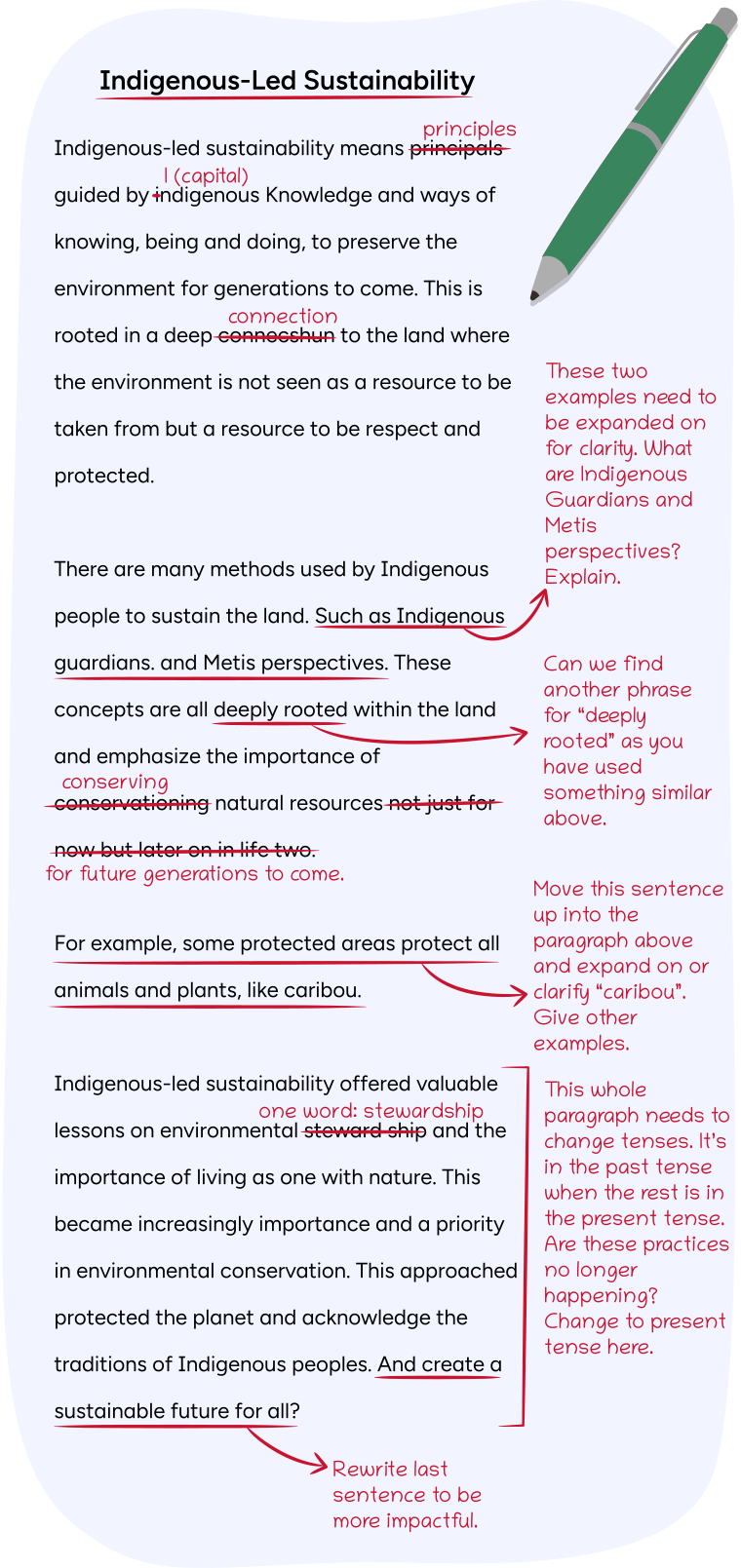
A multi-paragraph piece of writing titled "Indigenous-Led Sustainability" with edits written in red text.
The first paragraph begins with the sentence "Indigenous-led sustainability means principals guided by indigenous knowledge and ways of knowing, being and doing, to preserve the environment for generations to come." The word "principals" is crossed out and replaced with the word "principles" spelled with l-e-s at the end. The i in Indigenous is crossed out and replaced with a capital I. The next sentence says "This is rooted in a deep connecshun to the land where the environment is not seen as a resource to be taken from but a resource to be respected and protected." The word "connecshun" is spelled with s-h-u-n at the end and is crossed out and replaced with the proper spelling of the word "connection".
The next paragraph says "There are many methods used by Indigenous people to sustain the land. Such as Indigenous guardians, and Métis perspectives." The last sentence is underlined and an arrow points to a note that reads "These two examples need to be expanded on for clarity. What are Indigenous Guardians and Métis perspectives? Explain." The next sentence in the text says "These concepts are all deeply rooted within the land and emphasize the importance of conservationing natural resources not just for now but later on in life two." The words "deeply rooted" are underlined and an arrow points to a note that reads "Can we find another phrase for "deeply rooted" as you have used something similar above." The word "conservationing" is crossed out and replaced with the word "conserving". The phrase "not just for now but later on in life two" is crossed out and replaced with the phrase "for future generations to come."
The next paragraph says "For example, some protected areas protect all animals and plants, like caribou." This sentence is underlined and an arrow points to a note that reads "Move this sentence up into the paragraph above and expand on or clarify "caribou". Give other examples."
The final paragraph says "Indigenous-led sustainability offered valuable lessons on environmental steward ship and the importance of living as one with nature." The two words "steward" and "ship" are crossed out and the text "one word: stewardship" is written above them. The next sentences say "This became increasingly importance and a priority in environmental conservation. This approached protected the planet and acknowledge the traditions of Indigenous peoples. And create a sustainable future for all?" The last sentence is underlined and an arrow points to a note that reads "Rewrite last sentence to be more impactful." The entire last paragraph has a note attached to it that reads "This whole paragraph needs to change tenses. It's in the past tense when the rest is in the present tense. Are these practices no longer happening? Change to present tense here."
Based on your edits, provide two pieces of specific feedback for this writer to improve on before submitting their final piece. Record your ideas in a method of your choice.

Social Emotional Learning
Take a break!

You’ve just explored new vocabulary. Take a break before continuing onto the next part!

Vocabulary
At the beginning of this learning activity, you explored new vocabulary words that you then encountered in the texts you were exploring.
Listen to the audio recording of each of these words and attempt to spell the word, to the best of your ability, in your notebook, or another method of your choice.
Word 1
Word 2
Word 3
Press the Correct Spelling button to check your answer.
- stewardship
- reconciliation
- sustainable
Check your understanding of these words by sorting “like” words with them.
Production: Insert sorting activity with vocabulary words at the categories (mix up order)
- Management (stewardship)
- Protection (stewardship)
- Mending (reconciliation)
- Resolving (reconciliation)
- Balanced (sustainable)
- Conservation-minded (sustainable)

Relative pronouns
Let’s begin by refreshing our memories of independent and dependent clauses.
- An independent clause is a sentence that can stand alone.
- A dependent clause is an incomplete simple sentence – while they might have a subject and predicate, there is often more information needed for comprehension.
Relative pronouns link independent and dependent clauses. There are a few relative pronouns in the English language that can be used for different things.
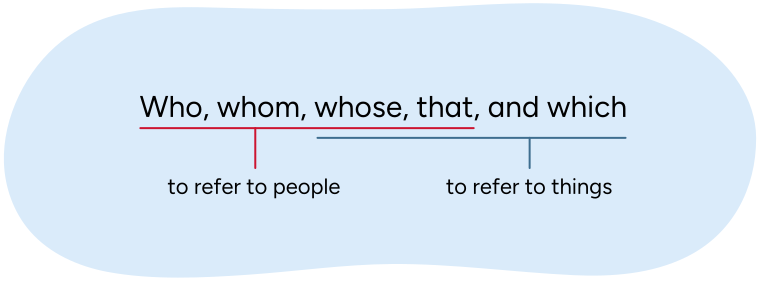
Which relative pronoun do you think belongs in the following sentence? Use the fill-in-the-blanks activity to investigate further.
For each sentence, select the missing word from the drop-down menu. Press Check Answer to see how you did.
Record your learning
Let’s revisit the R-A-N chart you filled in at the beginning of this learning activity. Take some time to fill in the other columns in the graphic organizer using the following questions to guide your responses, choosing at least two to respond to.
- What are some examples of Indigenous-led sustainability initiatives you learned about in this learning activity?
- What traditional values and knowledge guide Indigenous approaches to sustainability?
- What can we learn from Indigenous-led sustainability methods?
If possible, discuss these questions with someone else.

Let’s check!
Check your understanding of Indigenous-led sustainability using the following multiple-choice questions.
Select the correct answer, then press Check Answer to see how you did.
Putting it all together
Based on what you’ve learned, choose one of the following activities to complete.
-
How do Indigenous-led sustainability initiatives inspire you to take action for a more sustainable future? Record your ideas in a method of your choice and be sure to include specific ideas for what you will do to take action!
- Reflecting on the Indigenous-led sustainability initiatives you learned about, create a visual representation of your vision of a sustainable community or environment. This could be created digitally or on paper.
Reflection
As you read the following descriptions, select the one that best describes your current understanding of the learning in this activity. Press the corresponding button once you have made your choice.

I feel...
Now, expand on your ideas by recording your thoughts using a voice recorder, speech-to-text, or writing tool.
When you review your notes on this learning activity later, reflect on whether you would select a different description based on your further review of the material in this learning activity.