Learning goals
We are learning to…
- select and use appropriate digital and media tools to produce final texts using appropriate techniques and tools, including digital design and production tools, to achieve the intended effect
- analyze the purpose and audience for speaking in formal and informal contexts, and select and adapt speaking strategies to communicate clearly and coherently
- analyze complex texts, including literary and informational texts, by evaluating, synthesizing, and sequencing relevant information and formulating conclusions
- classify and sequence ideas and collected information, select effective strategies and tools, and identify and organize relevant content, evaluating the choices of text form, genre, and medium, and considering alternatives
Success criteria
I am able to…
- explore texts and media about biodiversity and respond to simple and complex comprehension questions, drawing conclusions, and providing text evidence
- organize relevant information for a news broadcast
- create a news broadcast about biodiversity based on learned information, incorporating effective speaking strategies

Explore
Let’s begin by responding to the following questions about biodiversity.
Select the correct answer, then press Check Answer to see how you did.

Brainstorm
Brainstorm
Consider what you already know about biodiversity.
Record your ideas in a notebook or another method of your choice.
You may use the fillable and printable Mind Map in your notebook or using the following document. If you would like, you can use speech-to-text or audio recording tools to record your thoughts.
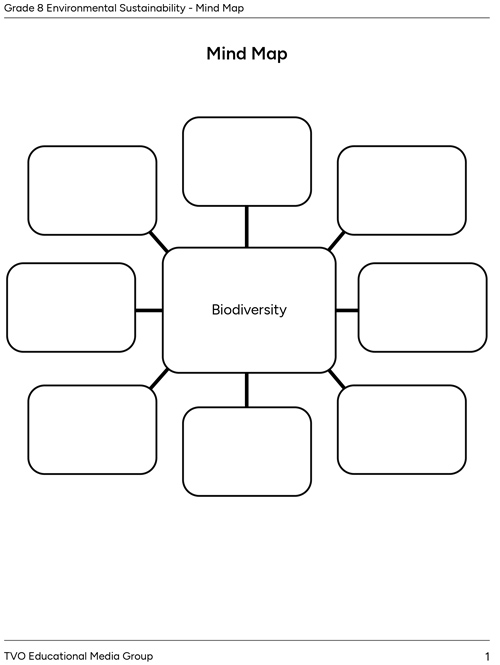
As you work through this learning activity, feel free to add ideas to your mind map.

Biodiversity
Biodiversity refers to the large variety of organisms found in one ecosystem, including animals, plants, fungi, and microorganisms like bacteria. These diverse species and organisms work together within an ecosystem to sustain life.
From providing essential resources like food, clean water, and medicines, to creating habitats for shelter, biodiversity forms the foundation of nature, and ensures the survival and well-being of all living beings.
Let’s explore the following video to learn more about the planet.
Create sketchnotes in your notebook or in another method of your choice about what you notice in the video.
Sketchnotes are rich visual notes created from a mix of drawings, symbols, words, and phrases that you encounter in a text or media. Rather than just writing notes, add a visual element to help you understand what you are learning.
After checking out the video, let’s think about what we’ve learnt!

Student Success
Think
Consider the following statement from the previous activity:
"All habitats, around the world, play an important role in keeping the planet healthy."
Using evidence from the video, explain how various habitats keep the planet and species within them healthy?
Record your ideas in a notebook or another method of your choice. If possible, share your ideas with a partner.
When you’re ready, press Let’s Check! to learn more.
The video discussed four ecosystems and their contribution to the planet’s health:
- The planet’s poles have the ability to keep the planet cool by reflecting sunlight and harbouring algae as part of the food chain.
- The freshwater systems transport life-giving water and nutrients, acting like veins in a human body.
- Also, forests and microscopic floating plants maintain the atmosphere by “locking away carbon and releasing oxygen.”
Biodiversity status
When studying an area of biodiversity, scientists examine different criteria to determine the status of biodiversity, and consider what could be changed or improved.
These scientists examine:
- different types of species
- the amount of each type
- how much the species are spread out
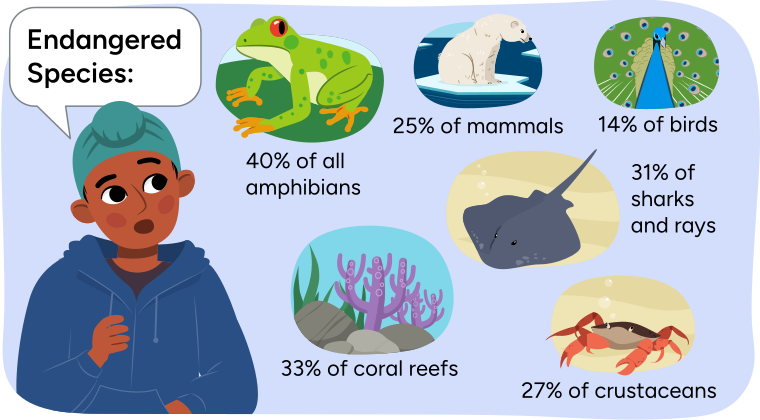
- which species are at risk or endangered
Scientists have found that due to human activities, around 1 million animal and plant species are threatened with extinction.
Predict!
What do you think is causing the decline in species?
Record your ideas in a notebook or another method of your choice.
Threats to biodiversity
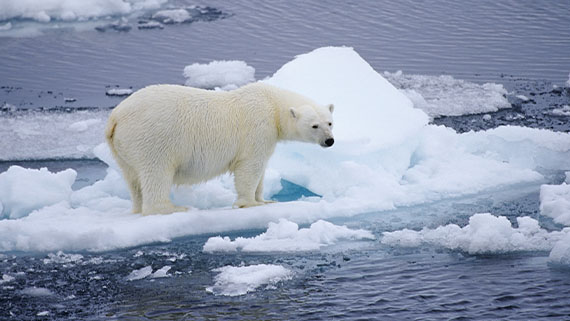
So, what’s causing the decline in many species?
The greatest threat to biodiversity is human activity.
Let’s learn more about these causes.
What do you think?
Choose two of the following questions to respond to:
- How do you think the information you explored is in a sequence? What was the sequence and how did it help communicate meaning?
- What conclusions can you draw from the information you’ve explored? What evidence supports these conclusions?
- What implications does this text have for your understanding of biodiversity and its implications on Earth?
- What questions do you still have about biodiversity?
Record your responses in a notebook or another method of your choice.

Connections
Connections
You might be wondering, why does biodiversity matter, or what can I do to help?
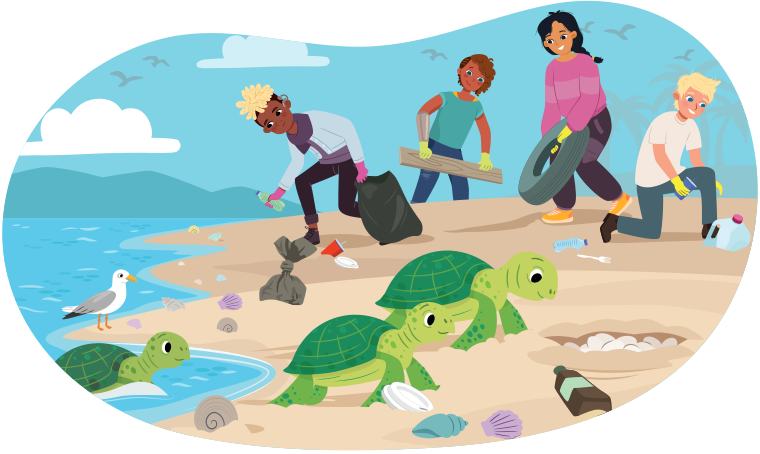
Take a few minutes to explore the World Wildlife Fund (Canada) on the internet to learn more about the organization’s goal to expand and protect habitats, while reducing the loss of biodiversity.
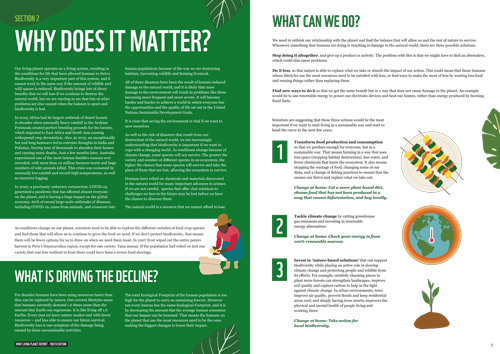
Check out the following Wildlife Report to learn more. You may download a copy for reference.
Taking action!
There are many actions that young people can take to protect the planet’s biodiversity!
Check out these actions in the following carousel.
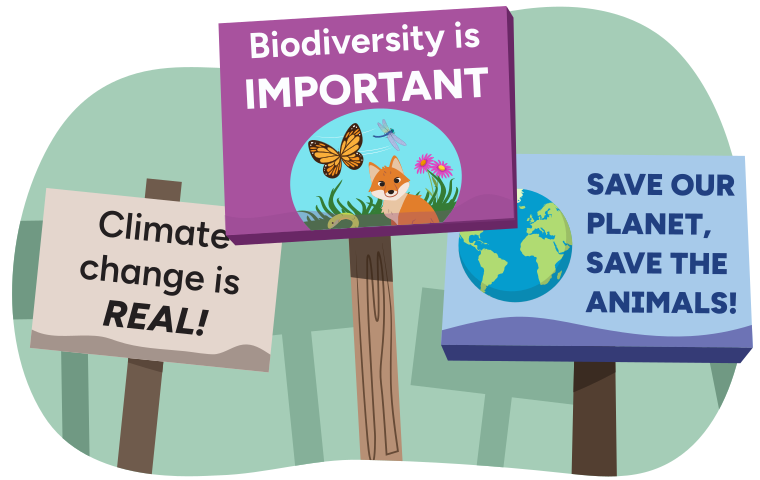
Spread the word about biodiversity! Educate others about biodiversity and its importance.
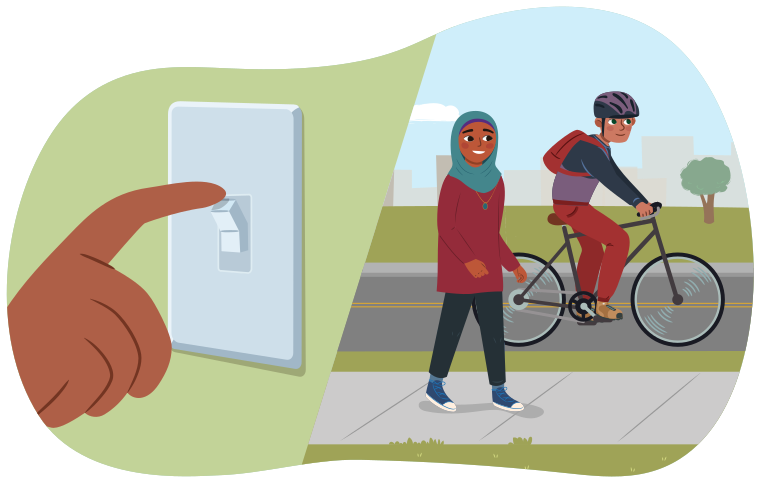
Save energy by turning off lights, electronics, and appliances when they are not being used, or walk or ride your bike when possible.
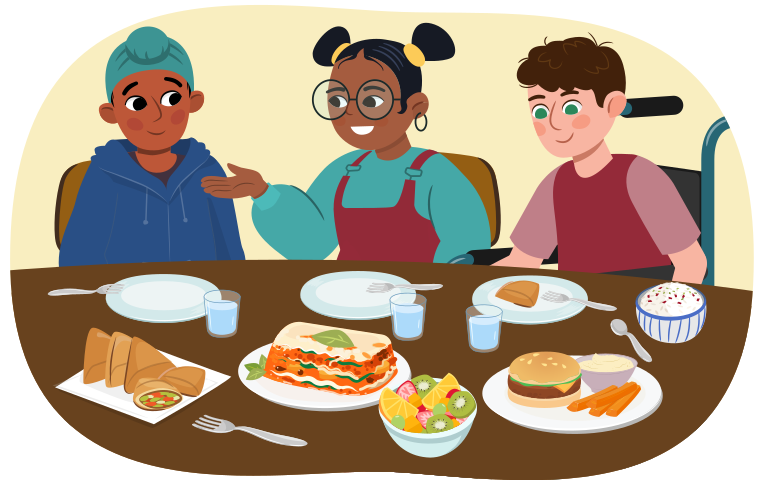
Consider the food you eat, where it is grown, and minimize food waste!

Consider your purchases! Look for sustainable options when making a purchase or try to reuse and recycle items.
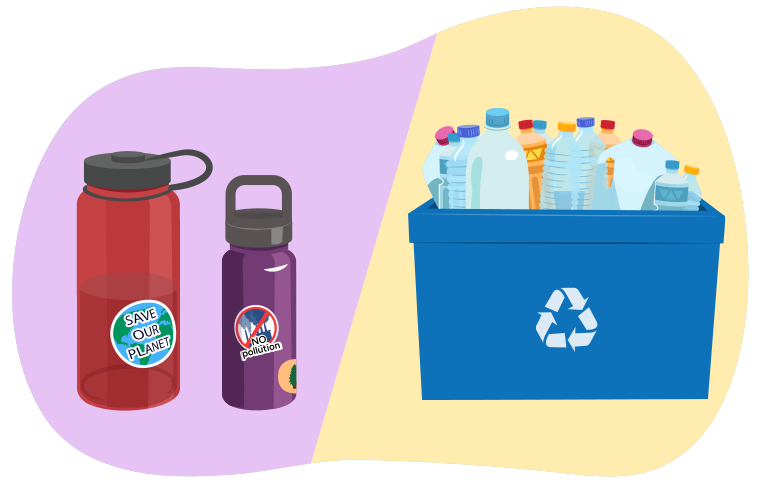
Use less plastics! Use less single-use plastics, such as water bottles or straws, and use reusable or recyclable materials when needed.
Image 1: Three signs for a protest or rally. The signs read: “Climate change is REAL!”, “Biodiversity is IMPORTANT”, and “SAVE OUR PLANET, SAVE THE ANIMALS!”

Reading Time
Case study
Borneo is a massive island in southeast Asia that is home to over 1,400 animal species and 15,000 plant species. This island is shared by Indonesia, Malaysia, and Brunei and well known for its rainforests, biodiversity, and unique ecosystems. Borneo rainforests are approximately 140 million years old.
The island is well known for being home to critically endangered species, like the orangutans, Bornean elephants, the Sumatran rhinoceros, and the Bornean clouded leopard. It also has a diverse array of plant life, like the iconic Rafflesia, the world’s largest flower.
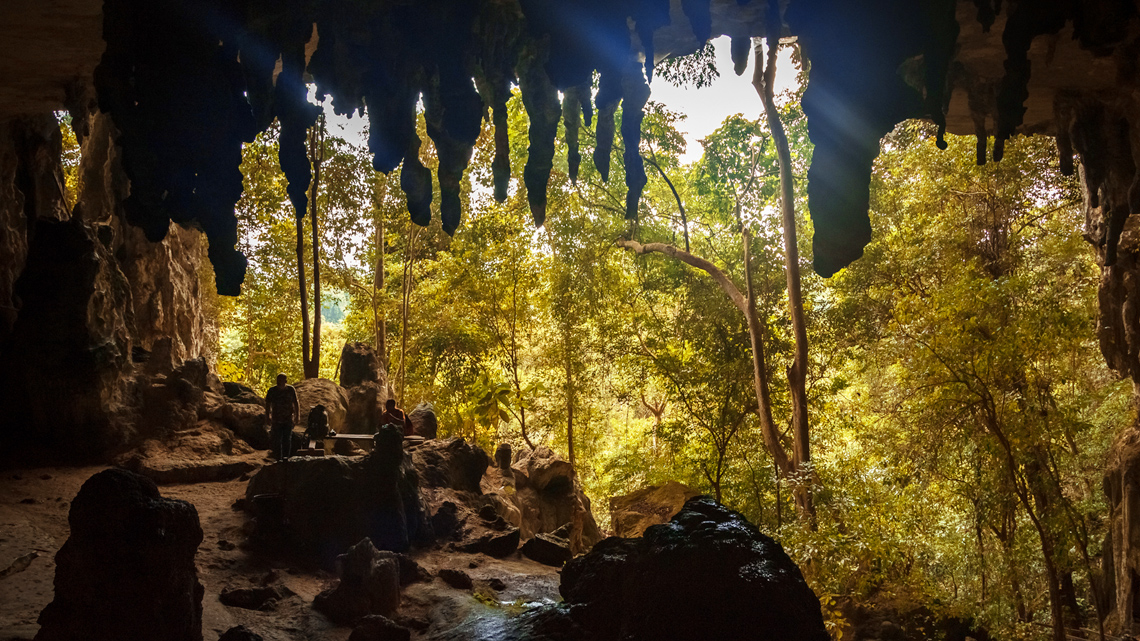
Natural cave in Borneo Rainforest
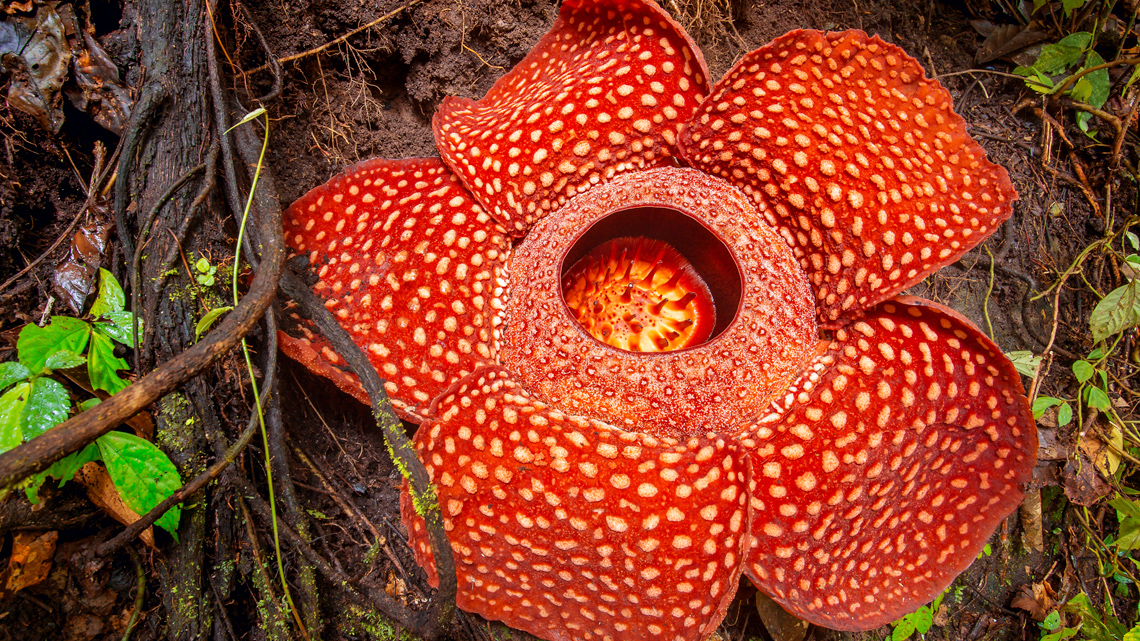
Rafflesia, biggest flower in the world.
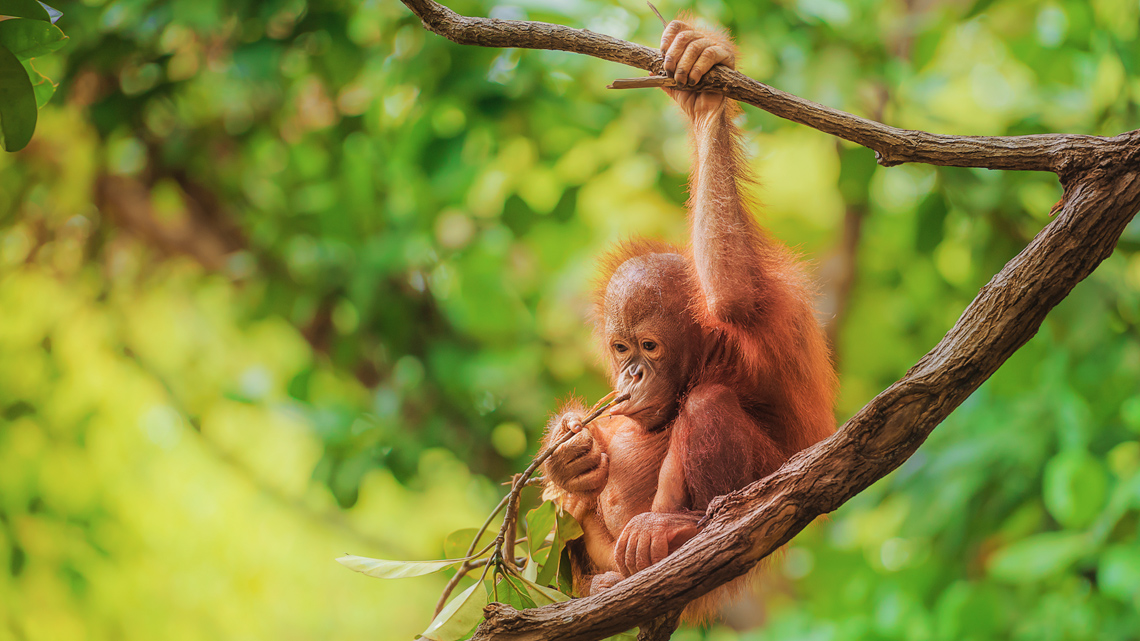
Baby orangutan in the Borneo Rainforest
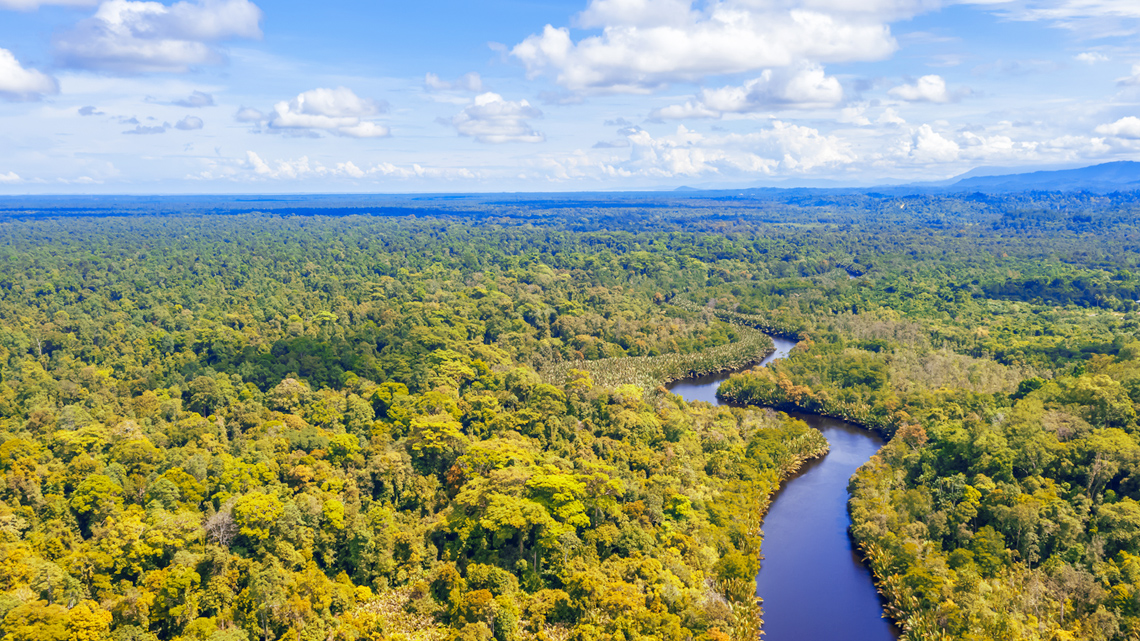
Borneo Rainforest
Even with its unique plants and animals, Borneo is still affected by human activities. The rainforest has many natural resources, but the unique ecosystem is under threat. Cutting down trees for wood, mining for coal and minerals, and creating palm oil plantations are destroying Borneo’s biodiversity. In 40 years, almost 30% of Borneo's forests have been lost, and animal populations are decreasing. This loss of biodiversity will continue to harm Borneo unless something is done to end it.
Let’s think!
After reading the case study, reflect on the following questions:
- Why do you think Borneo is considered a “biodiversity hot spot”?
- What human pressures are affecting the biodiversity in Borneo?
- What could this mean for the plant and animal species that inhabit it?
Record your ideas in a notebook or another method of your choice.
Vocabulary

Multi-syllabic words
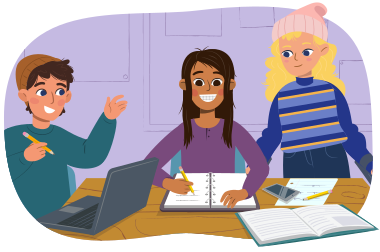
Throughout this learning activity there have been several multi-syllabic words. A multi-syllabic word is a word that consists of more than one syllable.
Explore the following words:
- elephant
- opportunity
- celebration
- water
How many syllables do they have?
Press Let’s Check! to learn more.
| Word | Syllables | How many syllables? |
|---|---|---|
| Elephant | El-e-phant | 3 |
| Opportunity | Op-por-tu-ni-ty | 5 |
| Celebration | Cel-e-bra-tion | 4 |
| Water | Wa-ter | 2 |
Check out the following video to learn more about strategies on how to sound out longer multi-syllabic words.
Using this strategy can help you to sound out longer, multi-syllabic words.

Listen on!
Listen to each word and try to spell them independently using the multi-syllabic word strategy.
Then, record each word in your notebook, or another method of your choice.
Word A
Word B
Word C
Word D
Word E
Press Let’s Check! to explore the syllable(s) for each vocabulary word.
| Word | Syllables | How many syllables? |
|---|---|---|
| Biodiversity | Bi-o-di-ver-sity | 3 |
| Ecosystem | E-co-sys-tem | 4 |
| Deforestation | De-for-est-a-tion | 5 |
| Overharvesting | O-ver-har-vest-ing | 5 |
| Agriculture | Ag-ri-cul-ture | 4 |
Vocab goals!
Let’s match the term with the correct definition.

Social Emotional Learning
Social emotional learning
Let’s take a break!
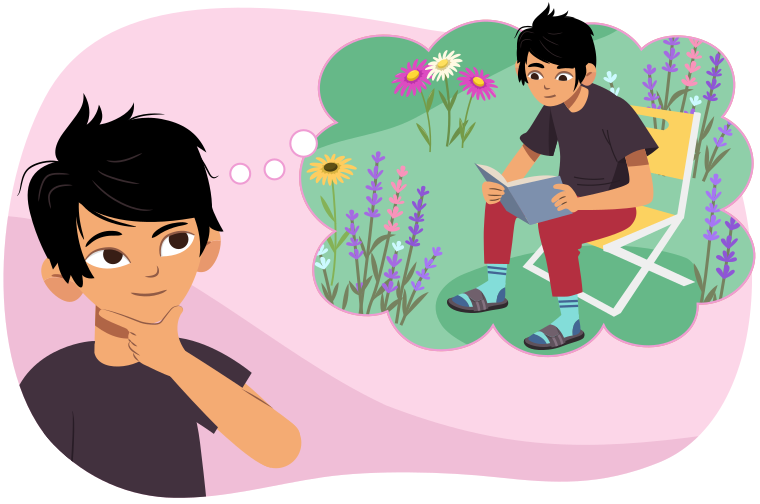
Imagine yourself at your favourite outdoor place. What excites you about the spot?
The news
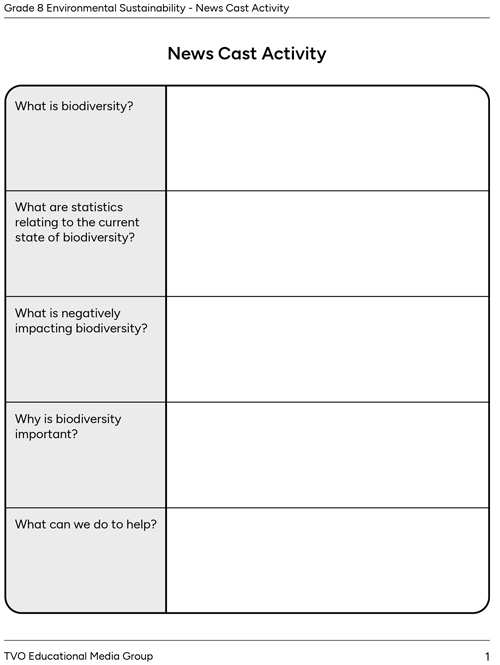
Develop a media news cast to inform audiences about biodiversity, the current state of our planet, and the need for help.
Your news cast should include the following:
- a description for what biodiversity is
- statistics relating to the current state of biodiversity
- what is negatively impacting biodiversity
- why biodiversity is important for both nature and humans
- what can be done to help
You may use the fillable and printable News Cast Activity in your notebook or using the following document. If you would like, you can use speech-to-text or audio recording tools to record your thoughts.

Try it
Try it!
Now that you’ve organized your information, consider the speaking skills that you might need to create an effective news cast.
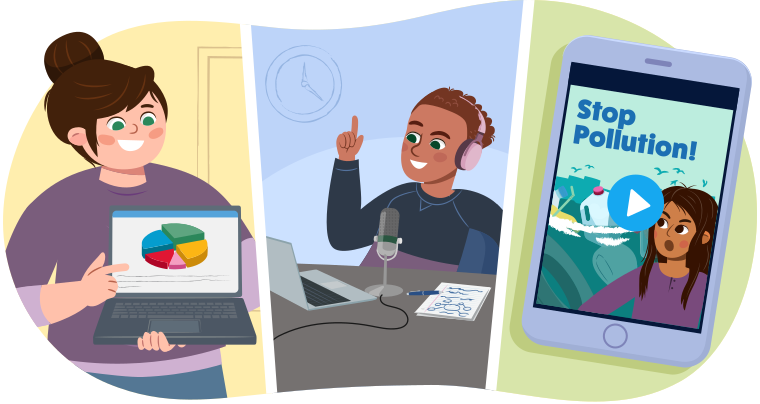
First, consider who your audience is and what the purpose of your news cast is.
Press Audience to learn more.
Depending on your news station, your audience could either be your peers at school (a school news program) or the public (news broadcast). The purpose for your news cast is to educate other on biodiversity.
Then, think about which strategies you think will be the most helpful to communicate your message.
Press Strategies to explore speaking strategies that can be used to communicate clearly and coherently.
- Plan your message: ensure your message is organized and practice your main points
- Speak clearly: articulate your words and speak at a moderate pace
- Use an appropriate volume: adjust your volume based on the size of the room and the number of people you are speaking to
- Use visual aids: use visual images, graphs, etc. to reinforce your message
- Use appropriate gestures: use hand gestures and body language to emphasize points
- Make eye contact: engage your audience by making eye contact with those you are speaking to
- Use pauses effectively: use strategic pauses to emphasize important points and give your audience time to comprehend information
- Adjust your speaking style: adjust your tone, language, and level of formality based on your audience
- End strongly: summarize your main points at the end and conclude with a strong, memorable statement

Now that your ideas are organized and you have effective speaking strategies, let’s share your broadcast.
If possible, use any digital production tools, to create a news cast recording to share with others.
It is important to practice your news cast before you share it, so that you deliver it with fluency!

Fluency
Did you practise your…?
Based on the checklist, choose one area of fluency to focus on and set a goal for yourself.
What strategies could you use to help you achieve this goal?
Wrap up
Let’s reflect on what we have learnt throughout this learning activity.
Select the correct answer, then press Check Answer to see how you did.

You may take a few minutes to return to the mind map from the Minds On section. Is there any new information that you would like to add to it?

Pause and Reflect
Pause and reflect
Based on what you’ve learned about biodiversity, respond to only two of the following questions:
- Define the word “biodiversity.” What does it mean to you? Why is it important?
- What speaking strategies did you find more effective during your news cast? Why? What would you do differently next time?
- What actions can you take to commit to restoring biodiversity or preventing biodiversity loss? What would you encourage others to do?
- What role do humans play in biodiversity? Are humans impacted by any of the effects of biodiversity loss?
Record your responses in a notebook or another method of your choice.
Reflection
As you read the following descriptions, select the one that best describes your current understanding of the learning in this activity. Press the corresponding button once you have made your choice.

I feel...
Now, expand on your ideas by recording your thoughts using a voice recorder, speech-to-text, or writing tool.
When you review your notes on this learning activity later, reflect on whether you would select a different description based on your further review of the material in this learning activity.