Learning goals
We are learning to…
- analyze and explain how the knowledge and skills developed in this grade support learning in various subject areas and in everyday life, and describe how they enhance understanding and communication
- make local and global inferences, using explicit and implicit evidence to explain and support our interpretations about various complex texts
- generate and develop ideas and details about challenging topics, such as topics related to diversity, equity, and inclusion and to other subject areas
- draft complex texts of various forms and genres and use a variety of appropriate media, tools, and strategies to transform information and communicate ideas
Success criteria
I am able to…
- explore and identify reasons we need sustainable food practices
- respond to several inferential questions, including citing evidence about both fiction and non-fiction texts about sustainable food
- create a plan for a sustainable food garden in your local school community and write a report about what you would include and its benefits
- write a blog post about what I have learned about sustainable food practices

Food production
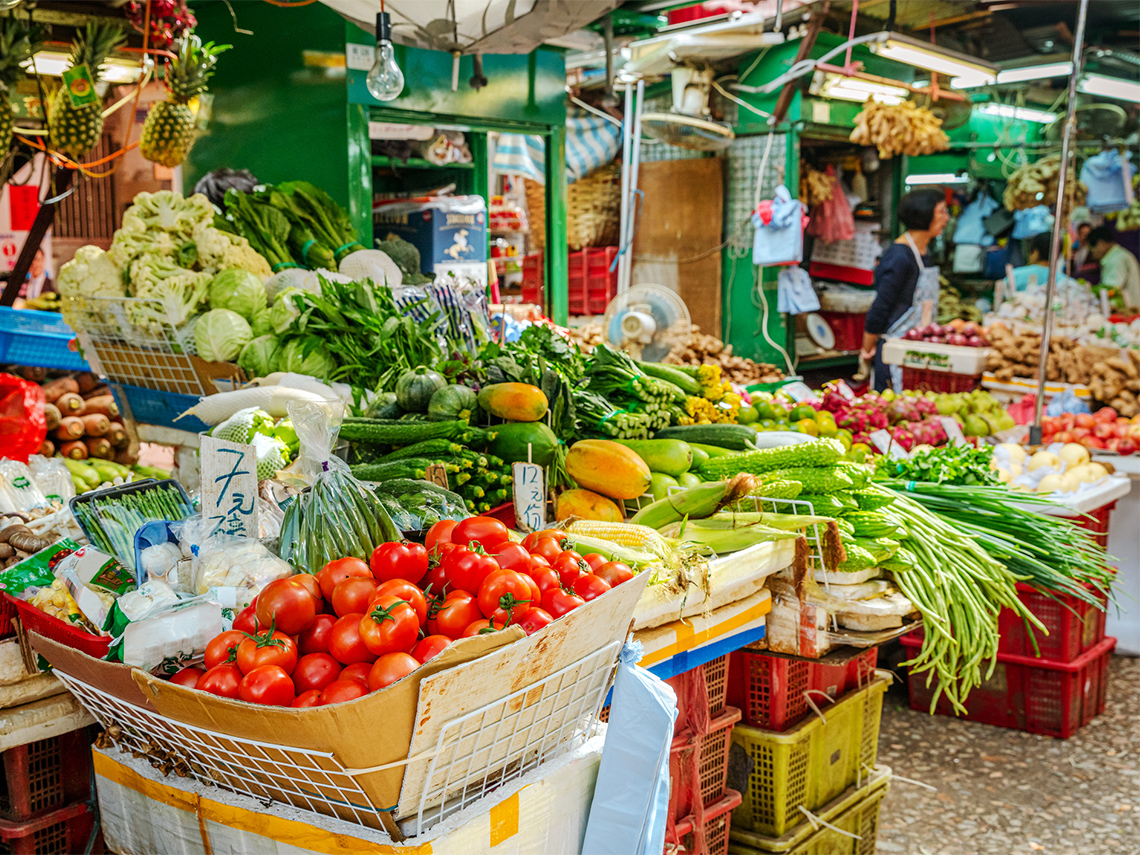
Let’s think about food production by exploring the following video.
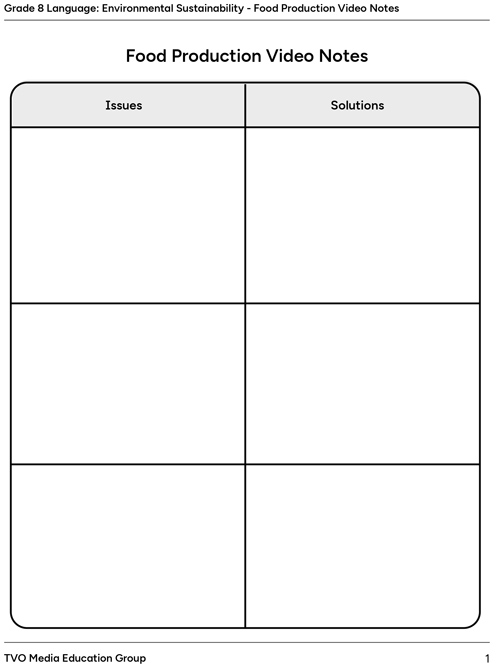
As you explore, record the issues and solutions presented about food production.
You may use the fillable and printable Food Production Video Notes in your notebook or using the following document. If you would like, you can use speech-to-text or audio recording tools to record your thoughts.
When you’re ready, press Let’s Check! to explore the food production issues and solutions.
| Issues | Solutions |
|---|---|
|
Transporting food contributes to a large carbon footprint. Single-use plastics take too long to break down. |
Produce food locally. Use reusable bags. Buy organic products when possible since organic farms absorb carbon. |

Sustainable foods
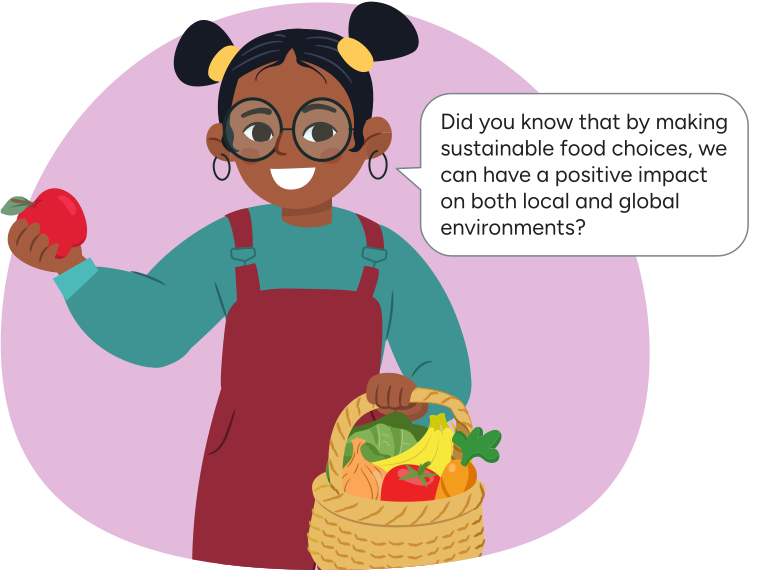
Student Tiara is holding a basket of fruits and vegetables and says: "Did you know that by making sustainable food choices, we can have a positive impact on both local and global environments?"
Vocab goals!
As you explore the following content on food sustainability, you may come across a word that you may not know.
Sometimes, if we explore the sentence that the word was used in, we can make meaning of the word. By finding the definition and related words, you will further understand the word and how it’s being used in context.
As you explore the learning activity, choose two words that are new to you.
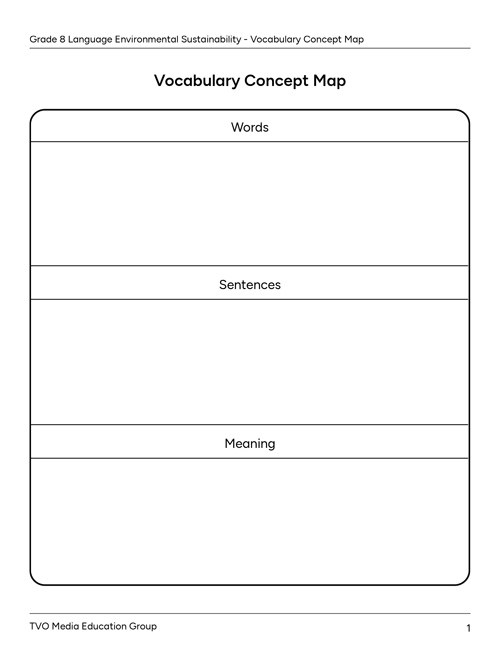
Then, complete the fillable and printable Vocabulary Concept Map in your notebook or using the following document. If you would like, you can use speech-to-text or audio recording tools to record your thoughts.
Impacts
Press the following tabs to check out why sustainable food choices are important, and how we can make them!
First, by eating foods that are grown locally, we avoid food having to travel really far to get to us. These methods of travel, such as trucks, boats, or planes, have a negative impact on the environment because of the fossil fuels they emit, so eating locally grown food reduces this impact.
It is also important to consider which foods are seasonal, because that can also reduce “food miles.” Foods that are not in season must be shipped from far away places.
You can also read food packaging to find out how far it has travelled, and to make sure you are only buying as much food as you need.
There is always a demand to produce more food as the population grows, yet 4.5 million tonnes of food is wasted each year.
This is an issue because the more food we waste, the more animals that were removed unnecessarily from their habitats and the more damage that ecosystems and wildlife undertake. Additionally, there are ethical concerns around enough food waste. We live in a world where not everyone is fortunate enough to have access to food, so as a society we should consider reducing food waste and making sure people around the world have access to nutritious foods.
Composting is a great environmentally sustainable idea, but don’t forget that this food has already been produced, so it is still impacting the environment. The best thing to do is avoid food waste!
Plant-based foods include fruits, vegetables, beans, nuts, grains, seeds, and much more. Growing plants for food needs land and energy, but the plant gets most of that energy from the sun, whereas keeping animals for food requires more energy that comes from other places.
Grammar

Grammar glimpses: Coordinating conjunctions
Coordinating conjunctions connect two independent clauses (simple sentences), words, or phrases. When you are connecting two independent clauses with a coordinating conjunction, a comma is placed before the conjunction.
| Coordinating Conjunction | Example |
|---|---|
| And | There is a high demand for food, and an even higher rate of food waste. |
| Nor | Not everyone is able to access healthy foods, nor is everyone able to afford the higher price point. |
| But | Agriculture requires access to land and energy, but the plants themselves get most of their energy from the sun. |
| Or | You can also read food packaging to learn how far it has travelled, or make sure you are only buying as much food as you need. |
| Yet | There is always a demand to produce more food as the population grows, yet 4.5 million tonnes of food is wasted each year. |
| So | The food we compost was produced somehow, so there was still a negative impact on the environment. |
Inferencing
When you make an inference, you are using your background knowledge and clues from the text, video, or image, to draw a conclusion about what is happening when it is not directly stated.
Inferences are an educated guess, or “reading between the lines,” to reach a logical conclusion.
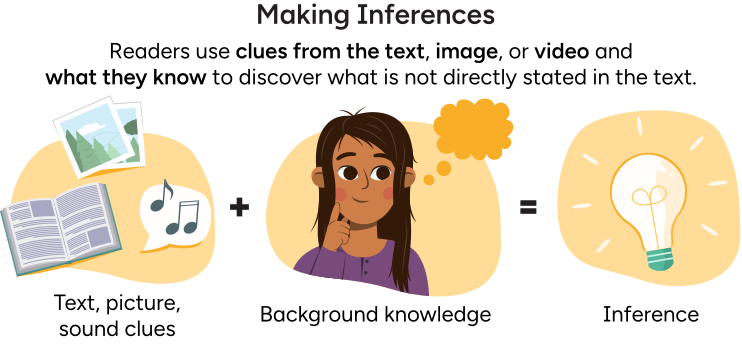
Making Inferences: To make an inference, readers use story clues and background knowledge (what they know) to discover what is not directly stated in the text.
There is an image of books, pictures and music notes and the text below reads: Text, picture, sound clues. There is a plus sign and then an image of a student thinking and the text reads: Background knowledge. Then an equals sign and an image of a lightbulb. The text reads: Inference.
Check out the following steps to help guide you to making an inference:


Reading time!
Reading time!
Let’s read the following fictional text, "The Green Revolution".
You may download a copy for reference.
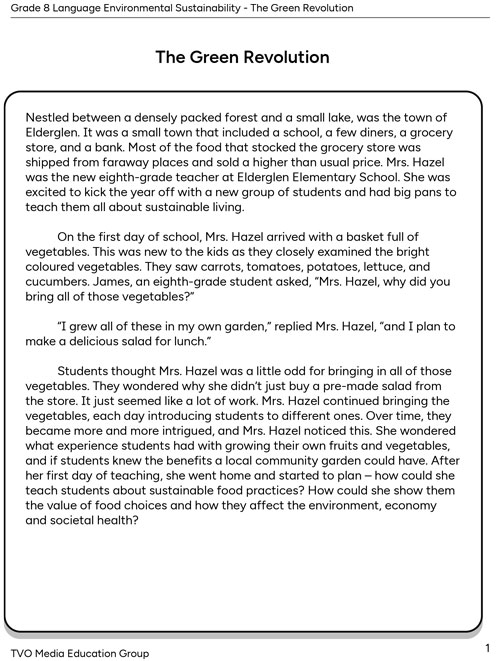
After reading the previous text, respond to any three of the following inferential questions:
- How did the students’ attitudes towards food and gardening change throughout the story? What events influenced these changes?
- How did the school garden influence the community of Elderglen? What changes occurred within the community?
- What challenges do you think the students faced while working on the garden project? How do you think they overcame these challenges? How did this contribute to their growth?
- What does Mrs. Hazel mean when she says, “We grew more than just food; we grew a sustainable community”? How does this statement reflect the outcome of the project?
- In what ways might the principles of sustainability learned from the garden project influence future decisions in the community?
Record your responses in a notebook or another method of your choice. If possible, share your ideas with another peer
Press Let’s Check! for a few hints.
When you respond to questions that require inferences, it is important to cite text evidence or details that support your conclusion. Check out a few sentence starters that you can use when citing text evidence:
- According to the text…
- According to the author…
- The author states…
- One example from the text is…
- On page…, I noticed…
- The reason I think this, is because…
Community gardens
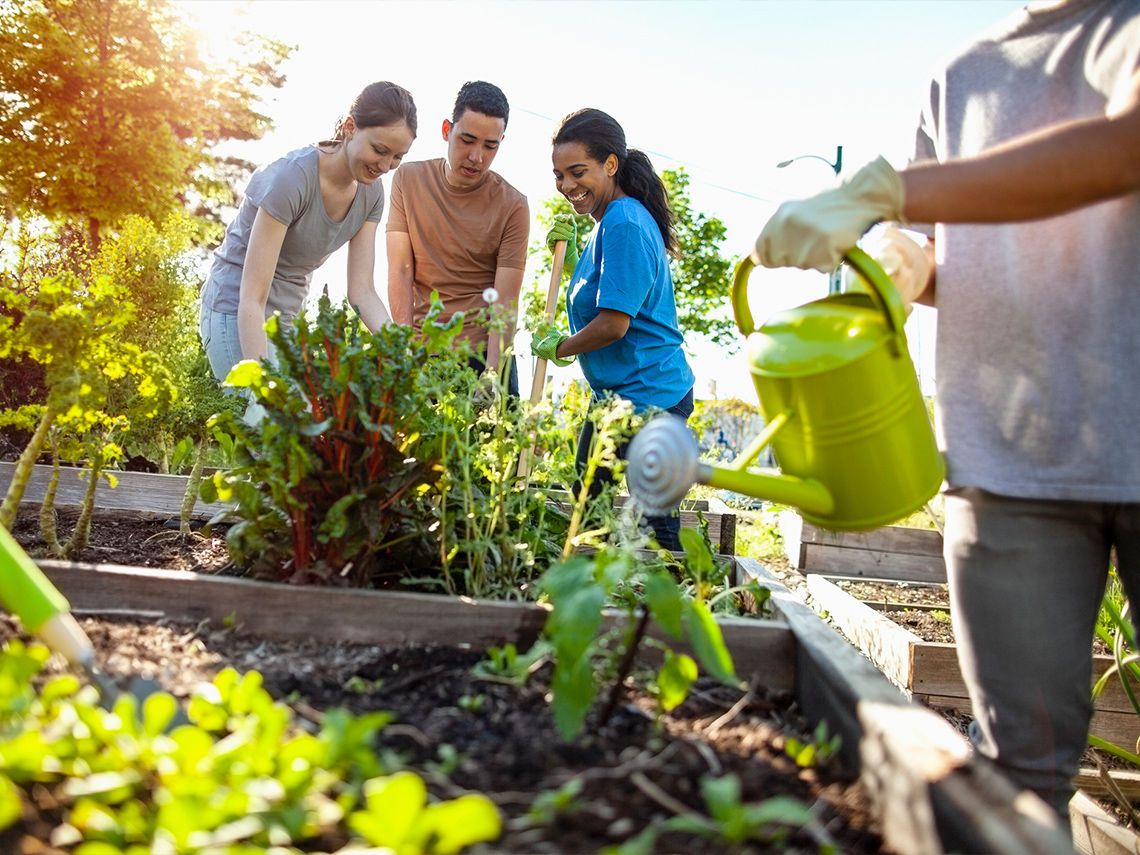
Around the world, community gardens provide food and many other benefits.
Let’s take a moment to explore some of the real-world gardens that exist around the country.
Press the following tabs to explore.
The City Farmer compost garden in Vancouver, B.C. is in the heart of Vancouver’s Kitsilano neighbourhood. The garden began in 1981 as a small project and continued to expand over the years.
Now, there are five different gardens within this location that work to benefit the community with sustainable food and practices. Additionally, these other gardens provide workshops for both schools and community members.
- Biodiversity garden supports the biodiversity of several different species, including bees and birds.
- Climate change adaption garden is filled with compost from houses within the community and plants such as olives, lemons, and limes.
- Organic food garden is an entirely organic garden featuring gooseberries, asparagus, and much more.
- Waterwise boulevard garden is made from grass removed from the boulevard and put into a variety of plants.
The Medicine Wheel Garden is Toronto’s first Indigenous community garden that began in 2013 with Elder Jacqui Lavalley who named the green space “Mashkikii;aki’ing” (medicine earth). More than 50 types of plants grow in the garden, including berries, plums, corn, tomatoes, zucchini, pumpkins, kale, and much more. The garden is tended to by men from the Na-Me-Res traditional housing program, who harvest crops and traditional plants such as sweetgrass, tobacco, and sage that can be used by their local Indigenous community.
The garden runs programs twice a week where community members share a meal and work together to harvest and complete tasks around the garden. One goal of the garden is to give Indigenous community members a place in the city to reconnect with the land and reclaim traditional approaches. The garden engages Indigenous people with a reciprocal relationship with the land, including ceremony and cultural practices.
The McQuesten Urban Farm is a development project that supports community members coming together to grow, cook, share, and advocate for good food. The farm was launched in 2016 as a response to the need for fresh, accessible food in the local community. This urban farm spans nearly two acres of reclaimed land that provides local residents with access to fresh fruits and vegetables, as well as a community hub where people of all ages come together to learn about sustainable farming practices and nutrition. In 2022, the garden was taken over by Indigenous leadership, providing a gathering place for Indigenous people in Hamilton to nourish and take care of the land. The farm operates on the principles of sustainability and social equity, ensuring that produce is grown in both a way that it is environmentally friendly and supportive of the local community. Volunteers from the local community work to plant, tend, and harvest crops that are then distributed throughout the community, fostering a strong sense of ownership and pride. McQuesten Urban Farm is now considered a vital asset to the city of Hamilton.
Check out the following video to learn more.

Brainstorm
Brainstorm
So, what are the benefits for these sustainable food gardens?
Brainstorm a list of ideas in a method of your choice.
If possible, share your ideas with a peer.
Benefits
Let’s explore a few of the benefits of sustainable food gardens.
Let’s use inference!
Respond to the following inferential questions about sustainable food gardens:
- What could be the long-term impacts if a community invests in a sustainable food garden? Consider economic, social, and environmental impacts.
- Why do sustainable food gardens promote a sense of community? Why is this important?
- Why might sustainable food gardens be more beneficial in urban (city) areas than rural (country) areas, or vice versa?
Record your ideas in a notebook or another method of your choice. Share your ideas with a partner, if possible.

Student Wellness
Student wellness
Five minute dance party!
If possible, play your favourite song or music, then move and dance around your space. Boost your energy and have fun!

Composition
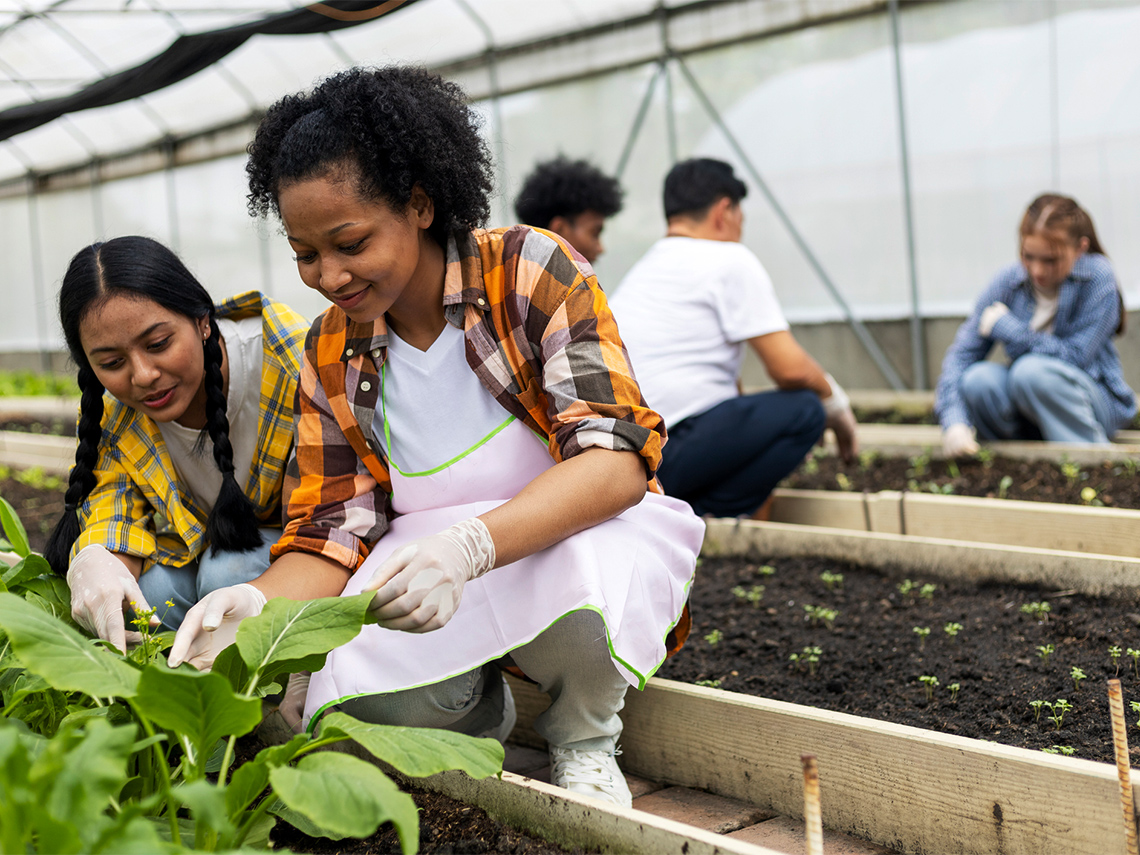
You have decided that you want to create a sustainable food garden in your school community.
Create a plan for a small sustainable food garden, and write a report that highlights the benefits that a sustainable food garden could bring to your school community.
Record your plan and report in a notebook or another method of your choice.
You may use the following checklist to guide your plan and report:
Your plan should include:
Your report should include:

Learning check!
As we wrap up the learning activity, let’s reflect on what we’ve learned about sustainable foods and community gardens. Think about whether each statement is true or false.
Final thoughts
For the final task, there are two options for you to choose from.
Record your ideas in a notebook or another method of your choice.
Press the following tabs to explore each task.
In a method of your choice, record three things you’ve learned about sustainable food and three things you are still wondering about it. If possible, share your thoughts and ideas with another peer.
This task is to write a 500-word blog post about sustainable food using a platform of your choice.
Your blog post should include the following:
- an explanation of what sustainable food means
- reasons why sustainable food is important
- sustainable food options, like sustainable community gardens
- suggestions or next steps the reader can take

Student Success
Let’s think
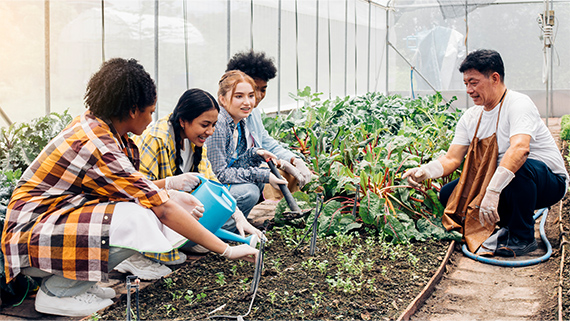
- How can the knowledge and skills developed in this learning activity about sustainable food practices support learning in other subject areas (i.e., science or geography) and in every day life?
- Explain how this learning activity enhanced your understanding of sustainable food systems and provided you with knowledge you need to communicate about it in the future.
Record your responses in a notebook or another method of your choice.
Reflection
As you read the following descriptions, select the one that best describes your current understanding of the learning in this activity. Press the corresponding button once you have made your choice.

I feel...
Now, expand on your ideas by recording your thoughts using a voice recorder, speech-to-text, or writing tool.
When you review your notes on this learning activity later, reflect on whether you would select a different description based on your further review of the material in this learning activity.