Learning goals
We are learning to…
- analyze themes explored in First Nations, Métis, and Inuit cultures to demonstrate an understanding of the varied identities, perspectives, relationships, legacies, truths, and ways of knowing, being, and doing
- read and comprehend various complex texts, connect, compare, and contrast the ideas expressed in texts and our knowledges and lived experiences, the ideas in other texts, and the world around us
- produce, publish, and present final texts using appropriate techniques and tools, including digital design and production tools, to achieve the intended effects and reflect on the strategies and tools we found helpful when publishing and presenting texts, setting goals for next steps
Success criteria
I am able to…
- explore and explain (define) environmental stewardship and its benefits
- read complex fiction and non-fiction texts about environmental stewardship, responding to comprehension questions and making connections
- understand how Indigenous ways of knowing, being, and doing are connected with environmental stewardship
- create an environmental stewardship campaign by publishing a media text of choice and reflect on this process

Explore
Check out the following images:
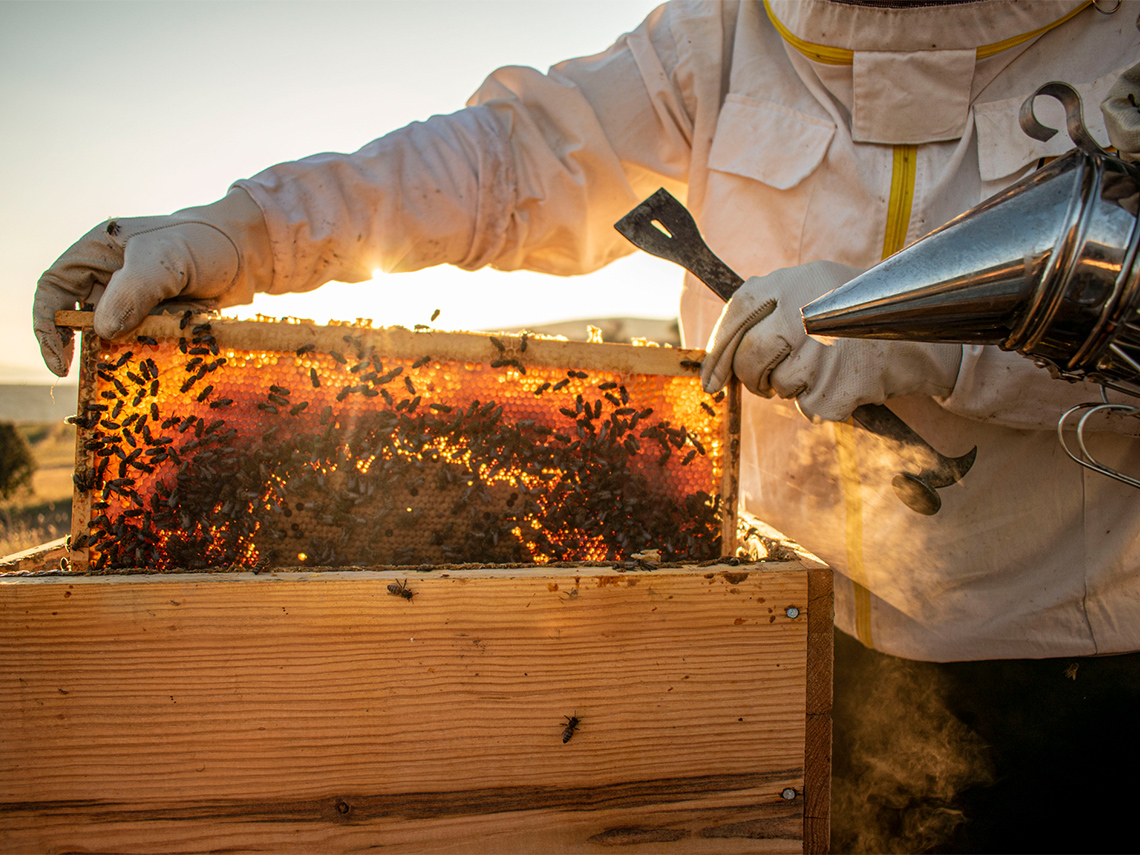
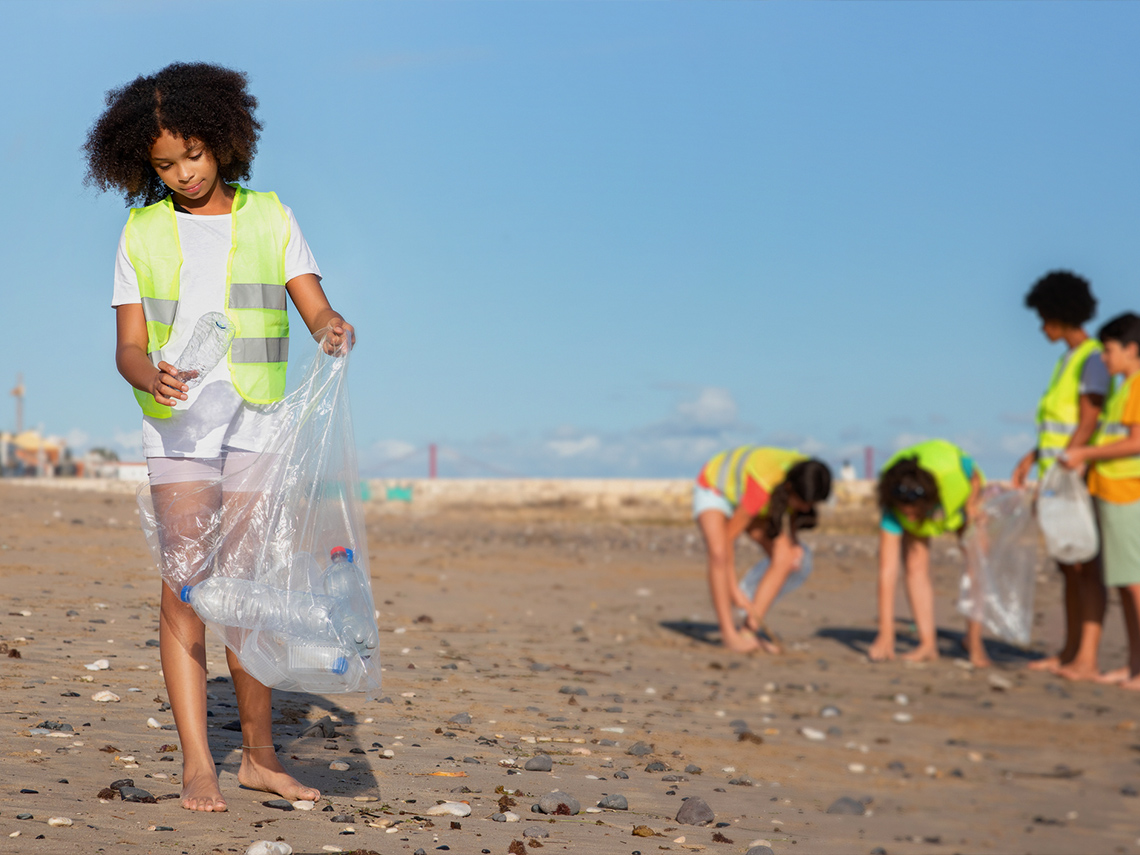
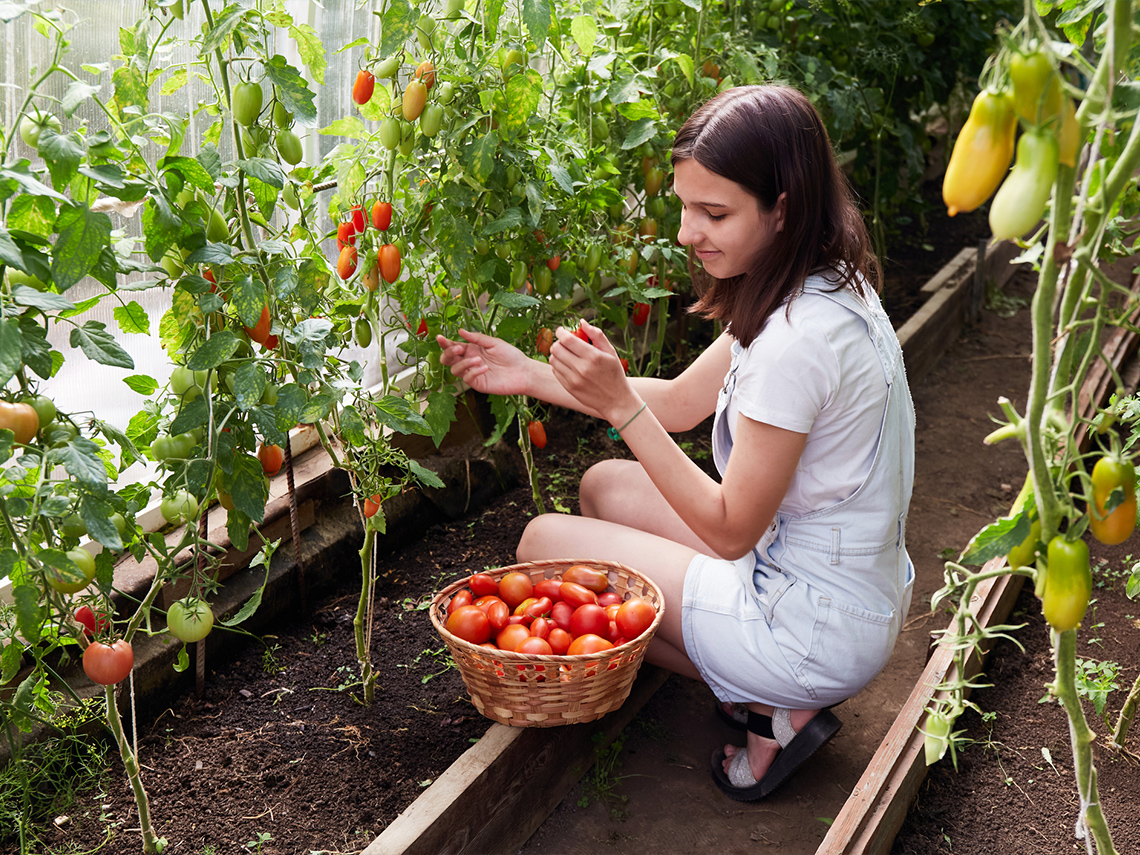

Brainstorm
Brainstorm
After checking out the previous images, note the following:
- What you think and wonder about each image?
- What do you think all these images have in common?
You may refer to the images, and record your ideas in a notebook or another method of your choice.
When you’re ready, press Let’s Check! to learn more.
All of the images are connected to the term "environmental" stewardship.
In this learning activity, we will further explore the concepts presented in each image (honeybees, harvesting, and ocean cleanup) as it connects to environmental stewardship.

Environmental stewardship

What do these two words mean?
Environmental: relates to the environment, which encompasses all living and non-living things that exist on Earth, including air, water, land, plants, animals, and humans.
Stewardship: the responsible management and taking care of something.
Based on these two definitions, what do you think environmental stewardship means?
Record a possible definition in your notebook or another method of your choice.
When you’re ready, press Let’s Check! to check out a definition.
Environmental stewardship refers to diverse actions that aim to conserve, protect, and create a more sustainable environment.
These actions are driven by people called “stewards” who work as a group or as individuals to conserve and protect the environment. So how can stewards help?
Check out the following images:

Stewards can help restore degraded ecosystems by helping plants and animals within these ecosystems.
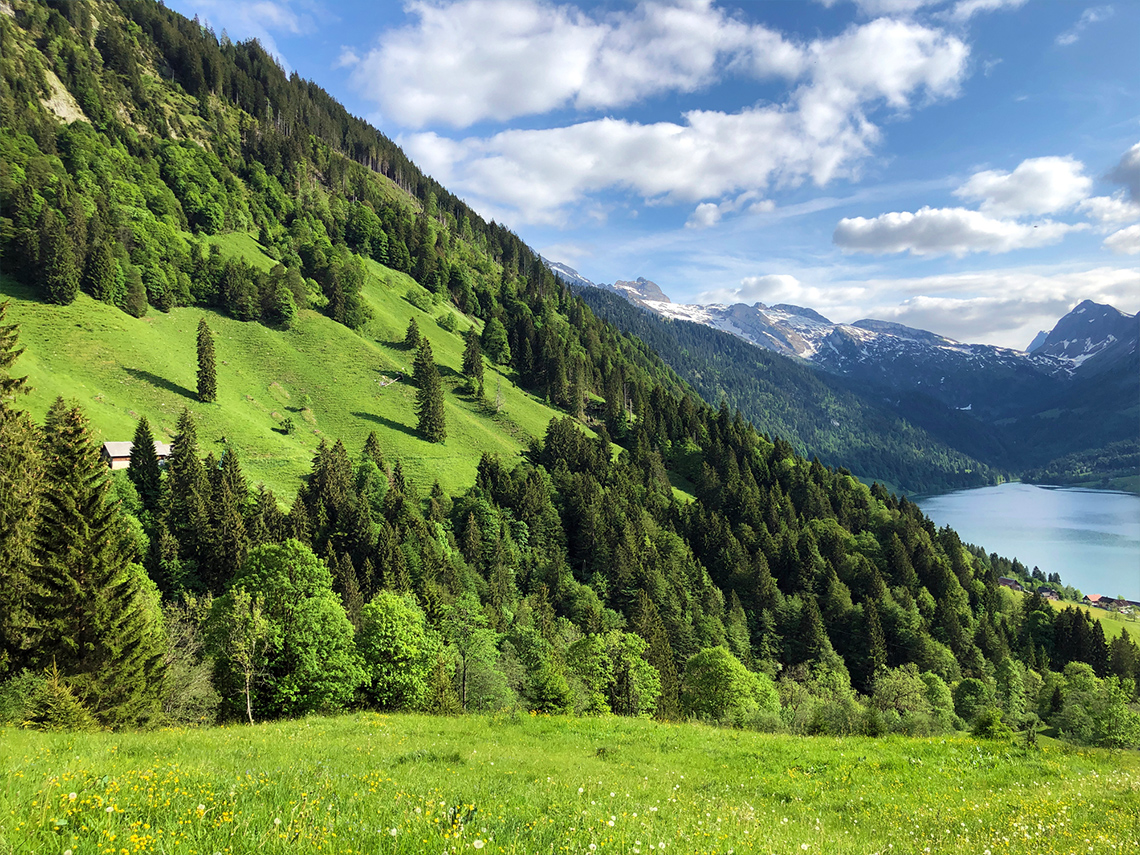
Stewards can manage the environment through the prevention of pollution and other destructive factors, and conservation.

Stewards can help to protect endangered species by preserving natural habitats.

Stewards can ensure that resources are used responsibly.

Stewards can create awareness and educate others about protecting the environment.

Student Success
Think
- What do you think individuals can do to become an environmental steward?
- What individual actions can they take?
Record your ideas in a notebook or another method of your choice.
When you’re ready, press Let’s Check! to learn more.
Here are a few examples of what individuals can do:
- reduce, reuse, recycle
- consider sources of pollution, such as transportation, and choose environmentally friendly methods (i.e., walk, bike, etc.)
- use recyclable products and reduce the use of single-use plastics
- reduce the amount of waste
- use energy efficient energy sources
- buy locally produced foods and goods
Indigenous stewards

Since time immemorial, Indigenous Peoples have been stewards of the land and waters in what we now call Canada. Through Indigenous ways of knowing, being, and doing, Indigenous communities are practicing and promoting environmental stewardship.
Braiding sweetgrass
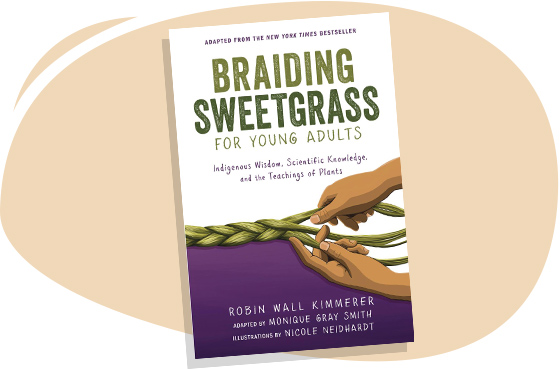
Braiding Sweetgrass for Young Adults is written by First Nations scientist, author, and professor, Robin Wall Kimmerer, who is a member of the Citizen Potawatomi Nation. In her book, she combines Indigenous wisdom and scientific knowledge to highlight the importance of connections with the land, the plants, and the environment.
Explore the following excerpt from Picking Sweetgrass: The Honourable Harvest. In this section, Kimmerer discusses the ethical guidelines for harvesting from the land in a way that respects the gifts of other species and ensures sustainability of ecosystems, emphasizing to take only what is needed, give thanks, and reciprocate the gifts of Earth.

An excerpt
“The Indigenous canon of principles and practices that I’ve been taught and that govern the exchange of life for life is known as the Honorable Harvest. They are rules of sorts that we follow so that the world might be rich for the seventh generation as it is for our own. The Honorable Harvest governs our taking, shapes our relationships with the natural world, and reins in our tendency to consume.
While the details might be different in various cultures and ecosystems, the fundamental principles are nearly universal among people who live close to the land. The guidelines for the Honorable Harvest are not written down or even consistently spoken of as a whole - they are reinforced in small acts of daily life.
But if you were to list them, they might look something like this:
Know the ways of the ones who take care of you, so that you may take care of them.
Introduce yourself. Be accountable as the one who comes asking for life.
Ask permission before taking. Abide by the answer.
Never take the first. Never take the last.
Take only what you need.
Take only which is given.
Never take more than half. Leave some for others.
Harvest in a way that minimizes harm.
Use the harvest respectfully. Never waste what you have taken. Share.
Give thanks for what you have been given.
Give a gift in reciprocity for what you have taken.
Sustain the ones who sustain you and the Earth will last forever".
What do you think?
- How do you think the guidelines for the Honorable Harvest align with environmental stewardship?
- What guideline(s) speaks to you the most? Why?
Press Let’s Check! to learn more.
The Honorable Harvest guidelines align closely with environmental stewardship because they emphasize using resources sustainably, respecting nature, and reciprocity with the natural world. These guidelines represent the responsible use and protection of the natural environment.
Guidelines
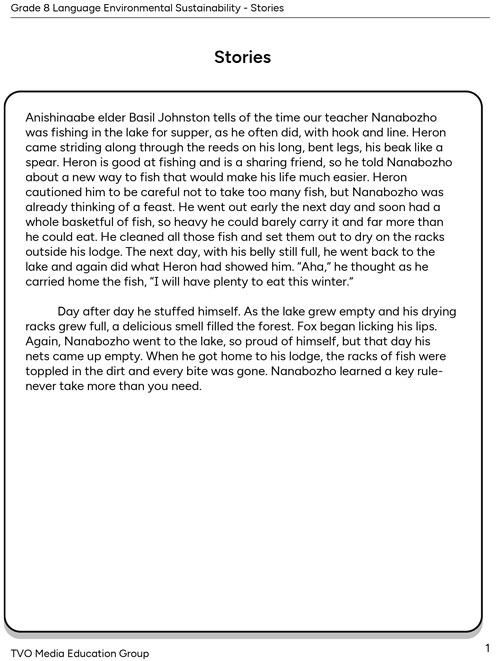
Now, you will explore a story from Braiding Sweetgrass for Young Adults that highlight the Honorable Harvest guidelines. As you explore, try to identify which guidelines the story is referring to.
Read the following Story to learn more.
Learning check!
Let’s review what you’ve learnt from the previous passages.
Select the correct answer, then press Check Answer to see how you did.
What do you think?
What principle(s) of the Honorable Harvest does the previous story share?
Record your ideas in a notebook or another method of your choice.
Press Let’s Check! to learn more.
- Never take the first. Never take the last.
- Take only what you need.
- Never take more than half. Leave some for others.

Reading Time
Fiction stories
Choose one of the following fictional stories about environmental stewardship to explore:
Story A: The Keeper of the Hive
Story B: The Ocean Cleanup
Press Reminder to learn more about fictional stories.
A fictional story is a narrative piece of writing that presents events, characters, and settings that are imagined rather than based on real-life events.
Story A
Read the following Story A: The Keeper of the Hive to learn more.
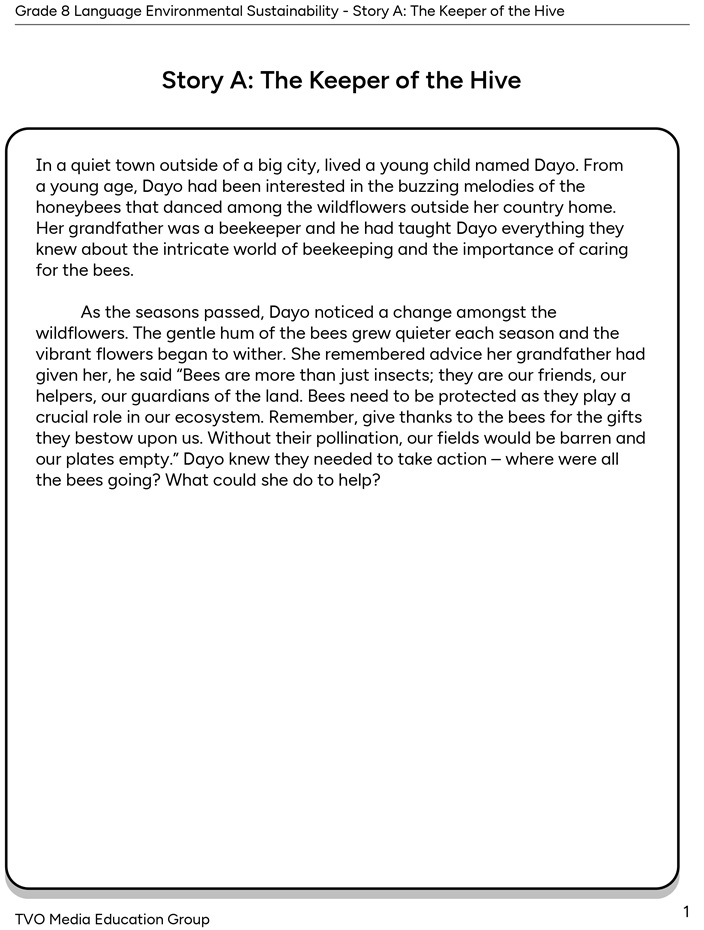
Press the Activity button to access the Story A: The Keeper of the Hive.
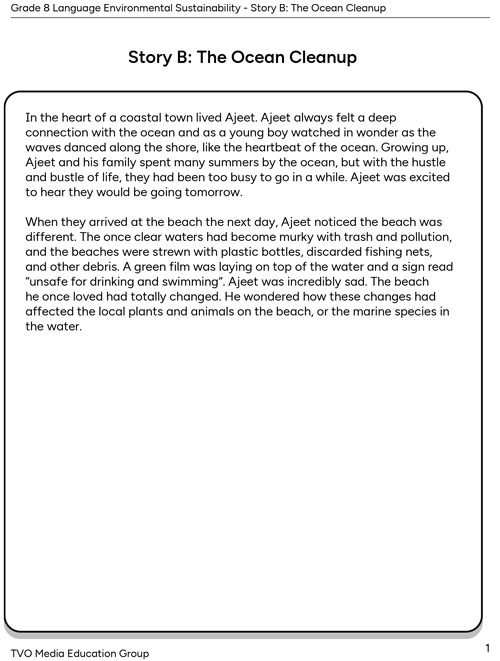
Activity(Opens in a new tab)Story B
Read the following Story B: The Ocean Cleanup to learn more.
Learning check!
Let’s review what you may have learnt from your chosen story. Please note that the following activity includes questions based on both stories.
Select the correct answer, then press Check Answer to see how you did.
Making connections
Comprehension strategies are used before, during, and after reading. We also use them when listening to and viewing a variety of texts, including digital and media texts, to understand and clarify the meaning of texts.
One comprehension strategy is making connections to your own knowledge and lived experiences, as well as other texts and the world around you. In this learning activity, you will make connections between what you have learned, your personal experiences, other texts, and the world around you.
Check out the following interactive to learn more about making connections.

Connections
Connections
After exploring the various text connections, let’s reflect on the text previously explored in this learning activity and make connections.
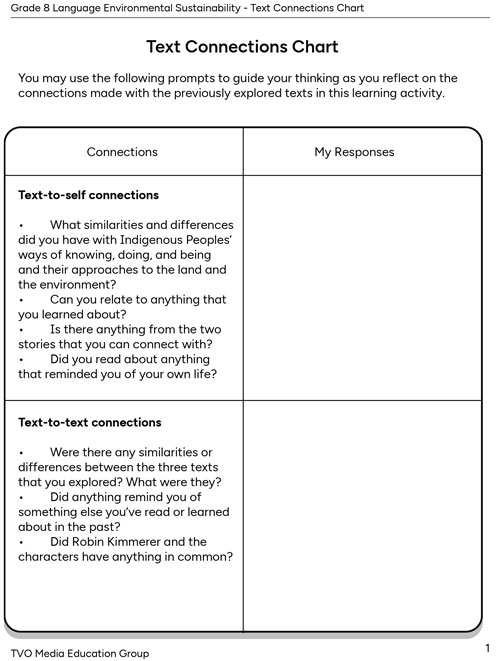
Complete the fillable and printable Text Connections Chart in your notebook or using the following document. If you would like, you can use speech-to-text or audio recording tools to record your thoughts.
The campaign
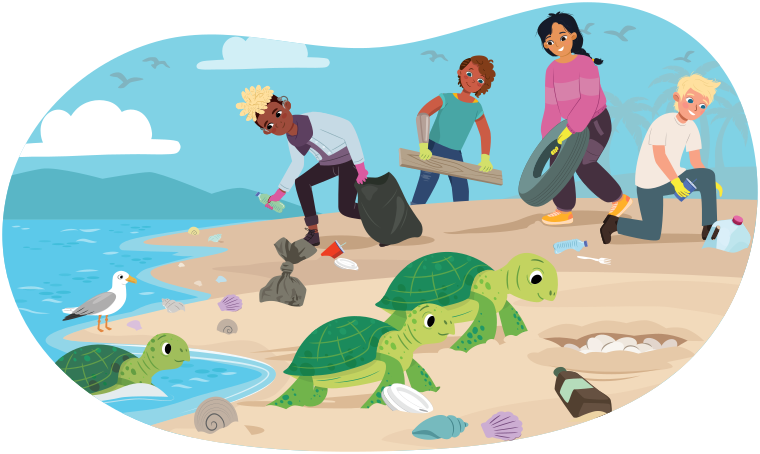
In this learning activity, you have learned about environmental stewardship, Indigenous ways of knowing, being, and doing regarding environmental stewardship, the honeybee decline, and ocean clean-up efforts.
Your turn!
Your task is to create an environmental stewardship campaign using media elements to educate a wide variety of audiences and inspire action.
You may focus your campaign on raising awareness about one of the topics explored today, or another topic that you’ve learned about previously that interests you.
Press Suggestions to explore sample topics.
For example, deforestation, energy conservation, pollution, land use, sustainable farming, or water conservation.
Before we start our awareness campaign, let’s learn about the steps of a campaign.
You may refer to the previous steps while working on your own campaign.
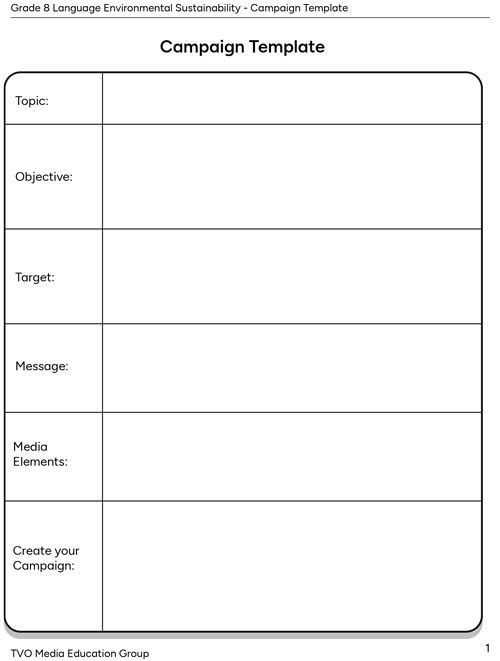
To record your ideas, you may use the fillable and printable Campaign Template in your notebook or using the following document. If you would like, you can use speech-to-text or audio recording tools to record your thoughts.

Pause and Reflect
Pause and reflect
Once your environmental stewardship campaign has been launched, respond to the following:
- How did the choices you made about your media elements and campaign help you communicate your message with your intended audience?
- Which strategies or tools did you find helpful when publishing your text?
- What goals do you have, or next steps, for the next time you have to create and publish a media text? How can you improve as a text creator?
Record your responses in a notebook or another method of your choice.
Reading with expression
For this activity, you will be focusing on reading with expression. This involves changing your pitch, tone, volume, and pace to convey the emotions and meanings embedded in the text.
Script reading
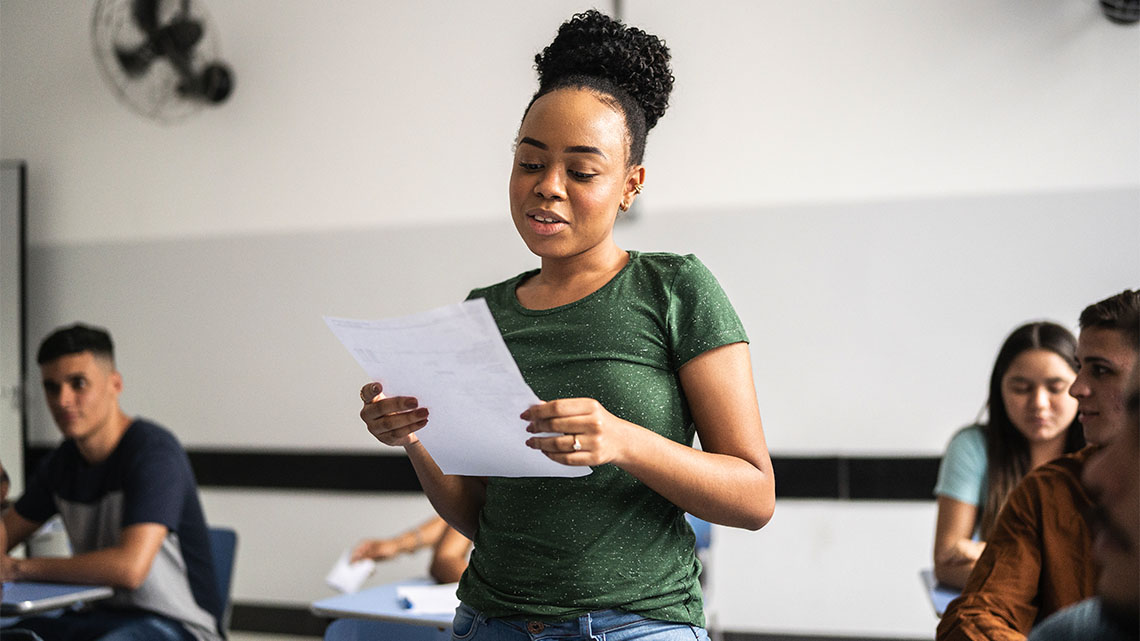
Read through the following short reader’s Theatre Script about environmental stewardship. Be sure to pay close attention to the expression clues found in brackets!
If possible, have more than one person or peer play each part, give it a try!
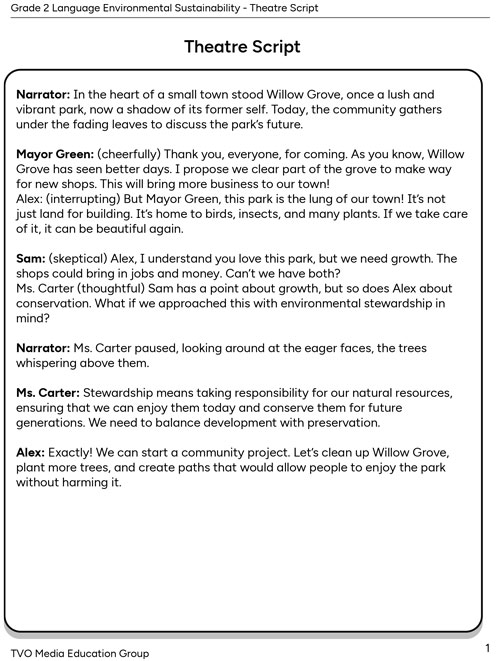
Check out the following fluency tips as you read through the theatre script.
Fluency
A fluent reader focuses on…
After reading the script, choose one area of fluency that you feel you should focus on and set a goal for yourself. What strategies could you use to help you achieve this goal?

Social Emotional Learning
Social emotional learning
Take a moment to focus on your breathing to relax your body and mind. Close your eyes, take a deep breath, then slowly exhale.

Grammar

Independent and dependent clauses
Independent and dependent clauses can be connected easily. By adding a subordinating conjunction (for example: if, because, before, after, although, once) or relative pronoun (for example: where, when, wherever, whenever), you can connect these two sentences.
Two clauses can also be joined together with the appropriate punctuation. If the dependent clause comes first, then you can use a comma to separate them.
Check out the following example:
|
Independent clause: we went outside for recess Dependent clause: the bell rang |
We went outside for recess when the bell rang. When the bell rang, we went outside for recess. We went outside for recess because the bell rang. The bell rang, so we went outside for recess. |
Which clause?
Read through each clause and choose whether they’re independent or dependent.
Grammar glimpses: colon and semi-colon
The colon (:) and semi-colon (;) are both punctuation marks that can separate two independent clauses.
Press the following tabs to learn more.
The colon (:) is used to introduce something described in the first part of the sentence, usually a list, but it can also introduce another independent clause.
For example:
- She loved to travel: exploring new cultures and experiencing new cuisines were her passions.
- The concert was unforgettable: the music was mesmerizing and the atmosphere was electric.
The semi-colon (;) can also be used in a similar way to a colon, but only if the two independent clauses are closely related.
For example:
- I went to the market; I forgot to buy corn soup.
- The marathon was grueling; runners pushed themselves beyond their limits.

Try it
Try it!
Check out the following sentences:
- He lives near the beach. The salty air is making his car rust.
- It was a very hot day. I have to use a fan to keep cool.
- We did an experiment in class. All the students participated.
Then, rewrite the sentences using semi-colons in a notebook or another method of your choice.
When you’re ready, press Let’s Check! to explore the re-written sentences.
- He lives near the beach; the salty air is making his car rust.
- It was a very hot day; I have to use a fan to keep cool.
- We did an experiment in class; all the students participated.

Wrap up

Choose three of the following questions to respond to as you reflect on what you’ve learnt about environmental stewardship:
- Define “environmental stewardship.” How would you explain it to someone younger than you?
- Can you think of a time when you acted as an environmental steward? What did you do? How did it impact the environment? How did it make you feel?
- What are some actions you can take in your everyday life to be an environmental steward? List at least three ideas.
- Discuss how small actions by many individuals can lead to significant environmental benefits. Can you provide an example?
- Why is it important to educate others about environmental stewardship? How does awareness contribute to better environmental practices?
- What role can local communities play in promoting environmental stewardship? Give examples of Indigenous and/or community-led initiatives that have made a difference.
- Imagine a community 50 years from now if we either ignore or embrace environmental stewardship. Describe both scenarios. How would this affect the environment? The world? Us?
Record your responses in a notebook or another method of your choice.
Learning check!
Let’s review dependent and independent clauses. For the following activity, you will match the independent to the dependent clause to make a complete sentence.
For each independent clause select the corresponding dependent clause.
Reflection
As you read the following descriptions, select the one that best describes your current understanding of the learning in this activity. Press the corresponding button once you have made your choice.

I feel...
Now, expand on your ideas by recording your thoughts using a voice recorder, speech-to-text, or writing tool.
When you review your notes on this learning activity later, reflect on whether you would select a different description based on your further review of the material in this learning activity.