Learning goals
We are learning to…
- use transferable skills, like critical thinking, creativity, and communication, to analyze a text
- use a thesaurus to expand our vocabulary and improve our writing
- identify and create metaphors
- use literary devices in texts that we create
- brainstorm, plan, organize, draft, and publish a poem
Success criteria
I am able to…
- define metaphors and explain how they are used to communicate meaning
- use a thesaurus to make my writing more interesting
- distinguish the difference between adjectives and metaphors
- create metaphors to describe myself
- identify literary devices such as repetition, metaphors, stanzas, and imagery in the text "I Am Every Good Thing”
- brainstorm, plan, draft, and publish a poem
Book: “I Am Every Good Thing”
Explore the cover of the book “I Am Every Good Thing,” by Derrick Barnes and Gordon C. James. What do you notice?
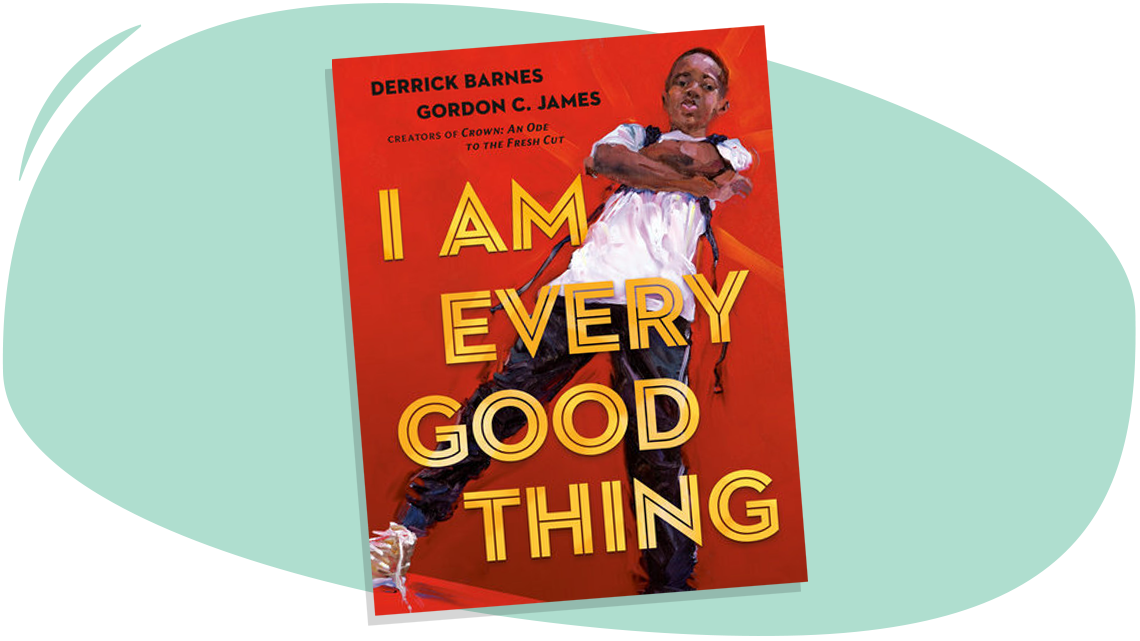
Consider the clues we can get from examining the front cover of the book:
- What does the title “I Am Every Good Thing” make you think of?
- Examine the colours. The background is red and orange, and the title of the book is in bright yellow capital letters. Can you describe the emotions these colours make you feel? Do you feel the book is going to be serious and sad? Or happy and positive?
- The illustration of the boy on the front cover shows him standing tall with his arms crossed, looking down at the reader. What words would you use to describe the way he’s standing? Do you think he is confident and strong, or shy and scared?
Words that describe
While examining the front cover of the book, we used several words that describe things:
- confident
- happy
- positive
- sad
- scared
- serious
- shy
- strong
What do we call these describing words? Press the Suggested Answer button.
These describing words are called adjectives.
An adjective is a word that describes a noun. Examples are bad, beautiful, and brave.
A noun is a word that represents a person, place, thing, or animal. Examples are girl, park, tree, and turtle.
Video: Adjectives
Check out the following video entitled “Adjectives”to learn more.
Using adjectives to describe ourselves
We can use adjectives to describe the many different parts of our personality.
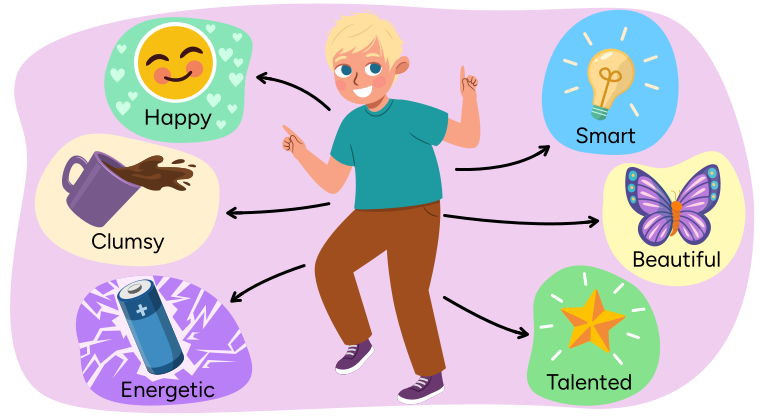

Brainstorm
Examples of adjectives
Here are some examples of adjectives that you might use to describe someone’s personality.
- kind
- strong
- reliable
- brave
- creative
- kind
- strong
- reliable
- brave
- creative
Can you think of other adjectives? Record them using a method of your choice.
What is a thesaurus?
A thesaurus is a great resource for finding new and interesting words to use in your writing. Like a dictionary, a thesaurus is organized in alphabetical order. However, it helps you find words that have similar meanings (synonyms) or opposite meanings (antonyms).
Parts of a thesaurus
To learn more about the parts of a thesaurus, explore this interactive image of a thesaurus page.
Online thesaurus

A thesaurus can also be found in digital form online. An online thesaurus works in the same way as the book format except that you type in the word you are looking for rather than search for it alphabetically.
Now let’s learn more about how to use a thesaurus!
Example: Using a thesaurus
Let’s say that Marcel has written the following sentence: “Amanda is very happy.”
Marcel wants to replace the word happy. He looks it up in a thesaurus, and finds the following information:
- Synonyms (similar words): cheerful, glad, jolly, merry, thrilled
- Antonyms (opposite words): sad, down, miserable, serious
Marcel’s new sentence could be the following: “Amanda is very cheerful.”
You now know how to use a thesaurus. Let’s think about why you might want to use one!

Student Success
Think

How could a thesaurus help you improve your writing?
Record your answer, then press Possible Answer to compare.
A thesaurus helps you improve your word choices and increase your vocabulary.
Describe yourself!
What are some adjectives that describe your personality?
In a journal of your choice, record at least five adjectives that describe your personality. You may choose to use some of the adjectives in this list:
- kind
- strong
- reliable
- brave
- creative
- caring
- fun
- patient
- energetic
- confident
You may also use a thesaurus to find adjectives, if there is one available to you. Remember to always ask a trusted adult before using an online thesaurus.

Descriptions: “I Am Every Good Thing”
In the book “I Am Every Good Thing,” authors Derrick Barnes and Gordon C. James describe the main character in many creative ways.
What is a “main character”? Record your answer, then press Suggested Answer to compare.
The main character is the most important person or animal in a story. The story is about the main character.
Explore the following page from the book “I Am Every Good Thing.” How is the main character described?

Your turn!
Try the following multiple-choice questions. Select the correct answer, then press the Check Answer button to see how you did.
Figurative language: Metaphors
How do you know that the main character is lively and fun when the authors did not use those exact adjectives?

The line “I am a nonstop ball of energy” describes someone who is lively and fun. Of course, the main character is not actually a ball of energy!
The boy is compared to a ball of energy to describe him in a creative way. We call this a metaphor.

Metaphors
A metaphor compares two things that are different but share a characteristic. In this book, the author uses metaphors to help us get to know and understand the main character.
Metaphors are used to add imagery to our writing. Imagery helps describe something in a way that gives the reader an “image” in their mind.
Metaphor or simile?
Both metaphors and similes compare two things. What’s the difference? A simile uses the word “like” or “as.” A metaphor just says that one thing is another.
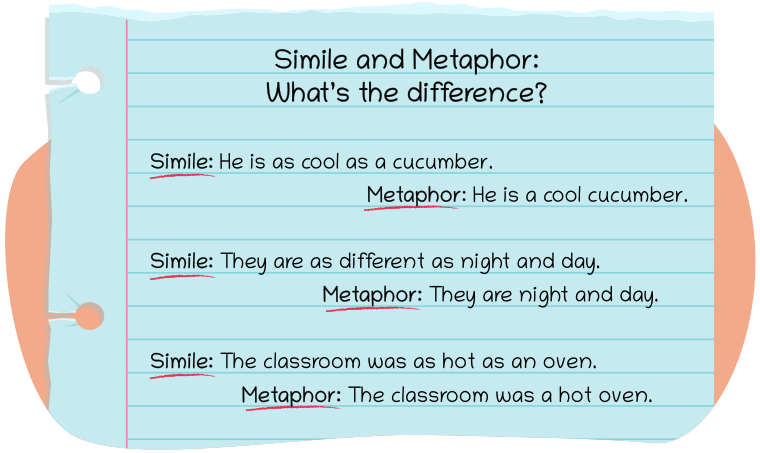
Simile and Metaphor:
What’s the difference?
Simile: He is as cool as a cucumber.
Metaphor: He is a cool cucumber.
Simile: They are as different as night and day.
Metaphor: They are night and day.
Simile: The classroom was as hot as an oven.
Metaphor: The classroom was a hot oven.
Identifying metaphors
The authors of “I Am Every Good Thing,” Derrick Barnes and Gordon C. James, use many metaphors in their book.
Look for metaphors on this page:
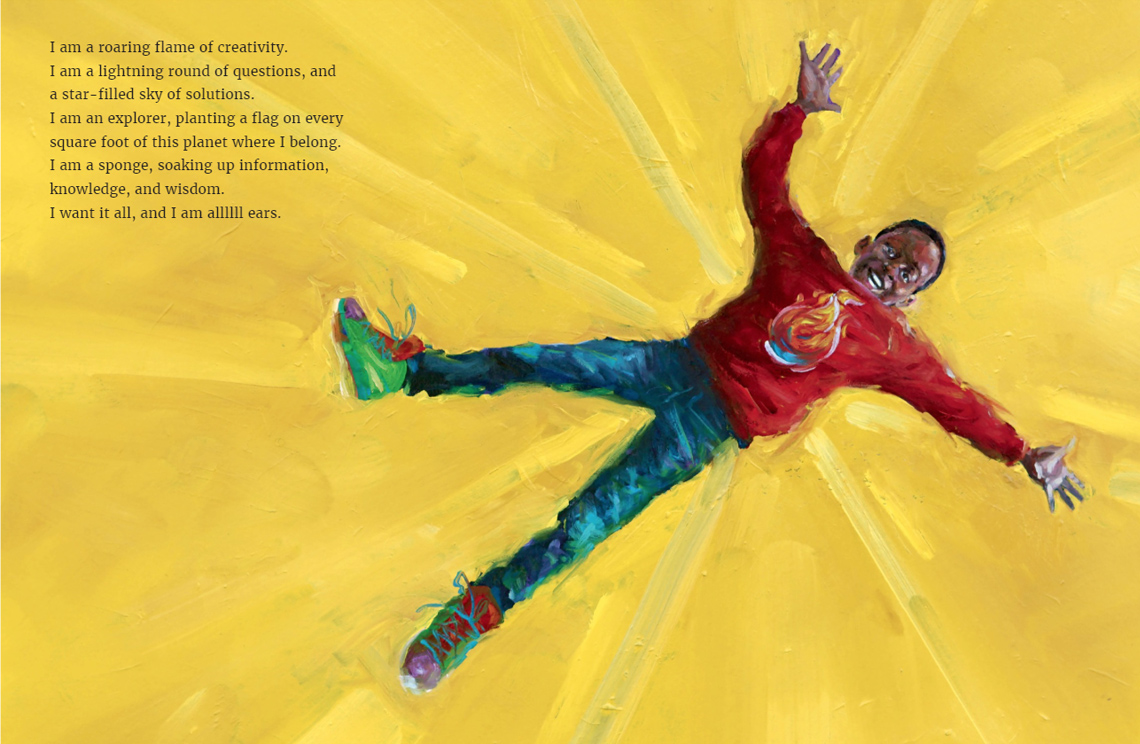
A smiling boy lying on his back, his limbs outspread. He is on a yellow background. The text reads as follows:
I am a roaring flame of creativity.
I am a lightning round of questions, anda star-filled sky of solutions.
I am an explorer, planting a flag on everysquare foot of this planet where I belong.
I am a sponge, soaking up information,knowledge and wisdom.
I want it all, and I am allllll ears.
Did you notice the following metaphor? “I am a lightning round of questions.”
A “lightning round” is part of a game or contest when you ask as many questions as possible in a short period of time. Of course, the child is not really a “lightening round of questions” – but the comparison helps us understand that the boy asks lots of questions and is very curious.
How many other metaphors did you find?
Your turn!
Match the metaphors from the text with their meanings.
Metaphors or adjectives?
Are the following statements metaphors or are they simply sentences that contain adjectives?
Place each card in the correct category. Use the arrow buttons to navigate between cards.
Metaphors use words to create pictures in our minds. These mental pictures are called “imagery.”

Pause and Reflect
Can you picture it?
Read the following metaphors from “I Am Every Good Thing.” In a journal of your choice, draw a picture for each metaphor. If you prefer, you can find pictures, or use speech-to-text or audio recording tools to describe them.
- I am roaring flame of creativity.
- I am all ears.
- I am a star-filled sky of solutions.
- I am a sponge, soaking up questions.
Creating your own metaphors
It’s time to learn to create your own metaphors. Here are the steps to follow!
Steps: Create your own metaphor
| Step | Example |
|---|---|
|
Step 1: Pick an adjective that describes you. |
Neebin describes herself as “brave.” |
|
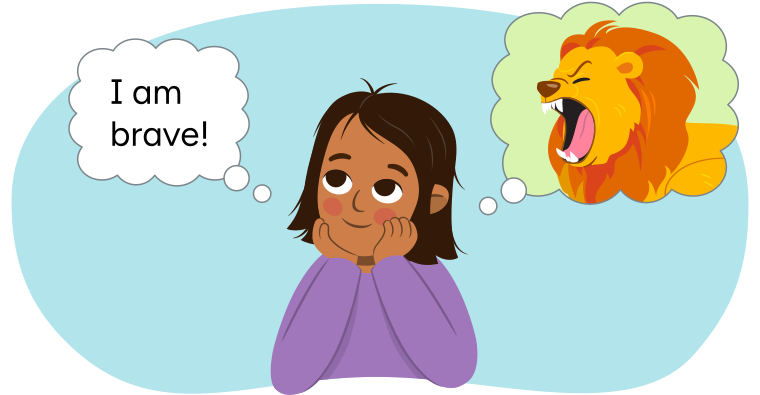
Step 2: Think of an animal or thing that your adjective could describe. |
Neebin decides that the word “brave” could describe a lion. |
|
Step 3: Create a metaphor using “I am a…” or “I am an…” |
Neebin writes this metaphor: “I am a lion.” |
|
Step 4: Expand on your metaphor by explaining why you are like the thing you chose. |
Neebin expands on her metaphor like this: “I am a lion because I try new things even when I am a little bit afraid.” |
Your turn!
Now it’s your turn to describe your personality by creating metaphors, using the same steps as Neebin.
Reflect on the list of adjectives that you wrote to describe your personality in the Minds On section. Pick two of them, and write two metaphors in a journal of your choice!

Excellent work! You have just completed the section on metaphors. Now is a great time to take a break before you move on to the section on poetry.

Student Wellness
Take a break!
Time for a body break! If possible, stretch your body and move around your space.
Poetry
We have seen that metaphors use words to paint a picture and get an idea across in a powerful way. Metaphors are often used in poems.
A poem uses carefully chosen words that are arranged in a way that helps share your thoughts, feelings, and ideas. Poems are everywhere. Think about all the songs you know. They are musical poetry.
Some poems follow specific rules, and some may not follow any rules at all, but all poems have literary devices. This means that they have devices (or ways) to help the reader create an image in their minds using words. You have already studied one kind of literary device: the metaphor.
Rhyme is another popular literary device used in poetry. With rhyme, two or more words share the same ending or sound similar. Rhymes are often found at the ends of lines in a poem. Here is an example:
Confident, courageous, determined, and bold,
And yet, also guided by my heart of gold.
Flashcards: Literary devices
Writing a poem to celebrate YOU!
Now that you’ve learned about poems and literary devices, you are going to create a poem that celebrates you!
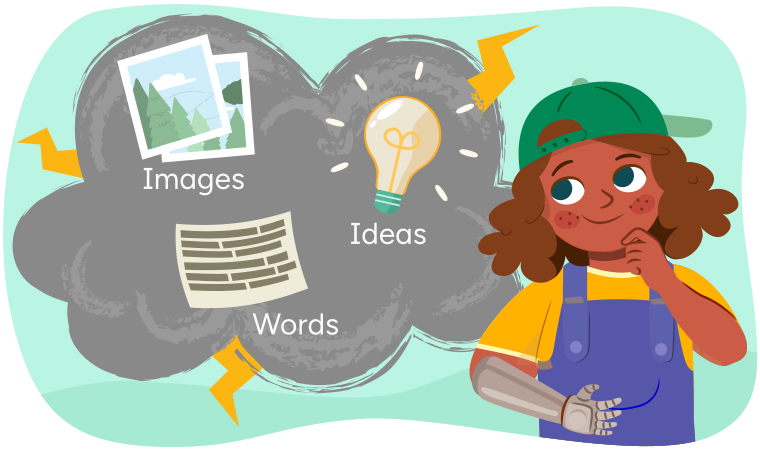
Brainstorming
The first step is to brainstorm words, images, and ideas.
Complete the fillable and printable Brainstorming Web in your notebook or using the following document. If you would like, you can use speech-to-text or audio recording tools to record your thoughts.

Planning
The book “I Am Every Good Thing” starts almost every page with the repeating words “I am,” but it does not follow a rhyming pattern. Feel free to go back and examine the poetry from “I Am Every Good Thing” for ideas – but remember not to copy these words. Your poem needs to be about YOU!
You may choose how to begin your poem as well as whether to use rhyme or not. You can also choose to make your lines and your stanzas as long or as short as you want!
Now think about what you want to share about yourself with others. (Remember: only write about things that you’re comfortable sharing.) Which adjectives could you turn into metaphors for your poem?
Challenge yourself to use a thesaurus to find two new descriptive words to add to your poem.
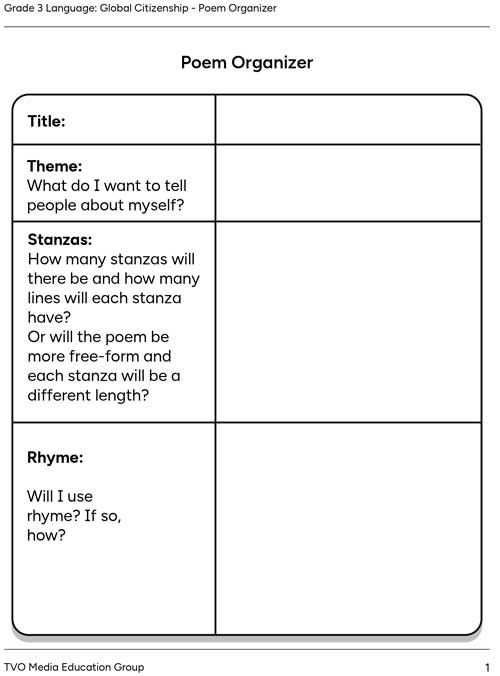
To plan your poem, use the following fillable Poem Organizer, or copy it into a journal of your choice.
Writing a draft
Once you have filled in the organizer, write out the first draft of your poem in a journal of your choice.
Putting it all together

Let's review some of the things you've done so far:
- created metaphors about yourself
- brainstormed ideas for your poem
- planned your poem
- created a draft of your poem
Now it’s time to take the next steps to make your poem even better!
Revising
Try reading your poem out loud to get a sense of the rhythm. See if you need to add or change any words or descriptions.
You can really change how your poem sounds and how the reader feels when they are reading it by carefully considering the literary devices you include, the way you arrange your lines, and the words you choose.
Once you having finished revising, find a partner to share your poem with if possible. Do they have any ideas on how to make your poem better?
Checking your work
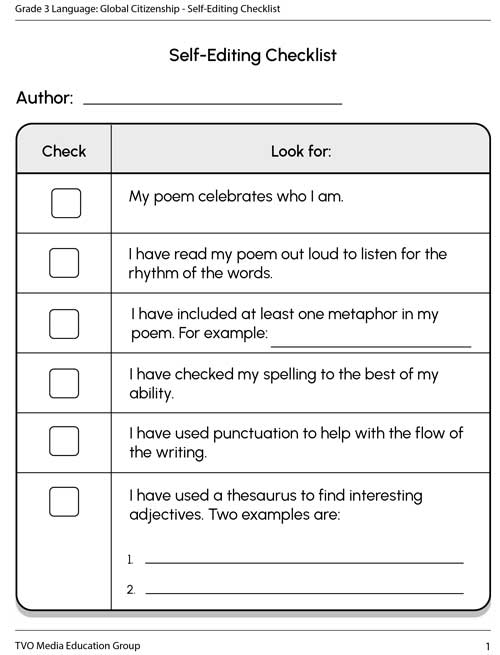
Complete the fillable and printable Self-Editing Checklist in your notebook or using the following document. If you would like, you can use speech-to-text or audio recording tools to record your thoughts.
Publishing
What a lot of work you have put into your poem!

You are now ready to publish your work. Create the final draft of your poem by writing it in your notebook, typing it, or recording it using a method of your choice.
Even now, you might still come up with a word you want to change or add. It’s not too late for changes! In fact, every time you review your work, you might find another way to make it even better!
When you have completed your final copy, share your poem with a teacher or a learning partner if possible.
Pause and Reflect
Thinking about your poem

Using a method of your choice, record your answers to the following questions:
- Why do you think it’s important to celebrate who you are?
- What is your favourite part of your poem? Why?
Reflection
How do you feel about what you have learned in this activity? Which of the next four sentences best matches how you are feeling about your learning? Press the button that is beside this sentence.

I feel...
Now, record your ideas about your feelings using a voice recorder, speech-to-text, or writing tool.