Let's get started!
Today’s vocabulary!
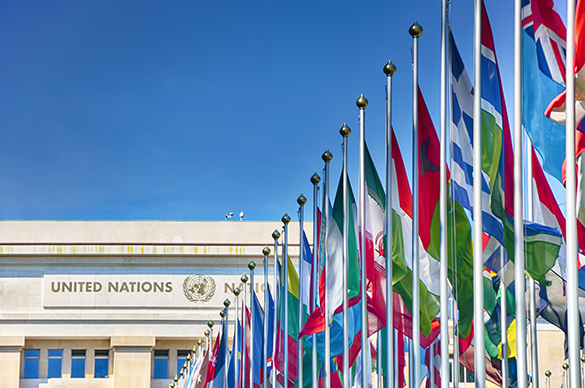
United Nations building with nation flags.
A group of countries working together to promote peace and work together to reach common goals.
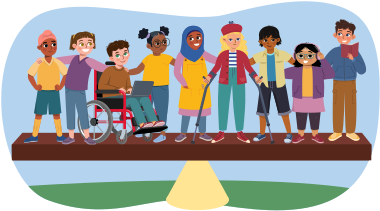
Diverse range of people standing on a balance beam, representing equality.
The rules that make sure all humans have the things they need like clean drinking water, education, and health centers.
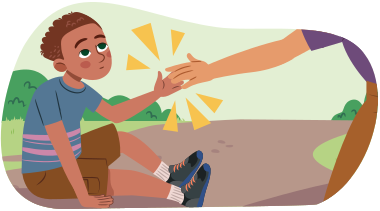
Child rights
A special set of rights made for children because they need extra protection and help while they grow.

Did You Know?
Did you know?
Did you know that all children have a special set of rights? Child rights are rules to make sure children have what they need to grow and succeed. Children have these rights no matter who they are, where they live, and what they do. No child has more rights than another child.

Brainstorm
Brainstorm
Think about some of the things that you need in your life to grow and succeed. Record your thoughts in a method of your choice.
Explore the following pictures. Each picture connects to a right that all children have. Take a moment to think about each picture.
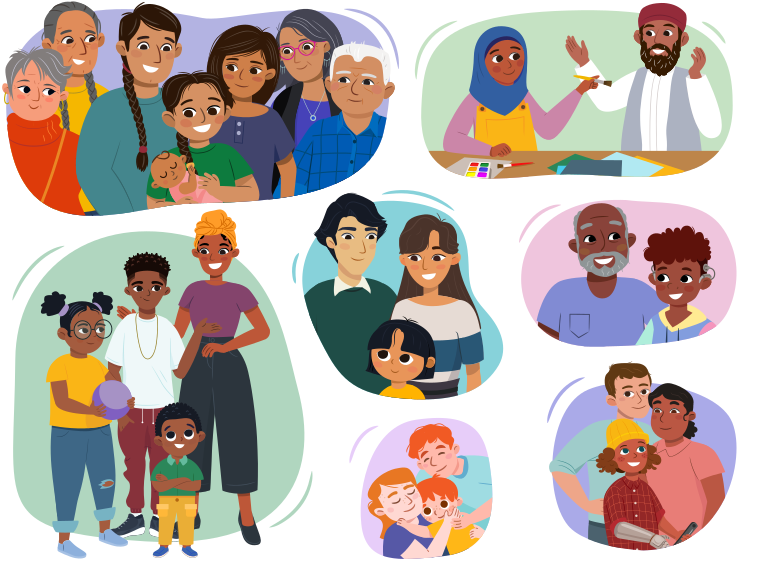
Intergeneration of people representing diverse families.
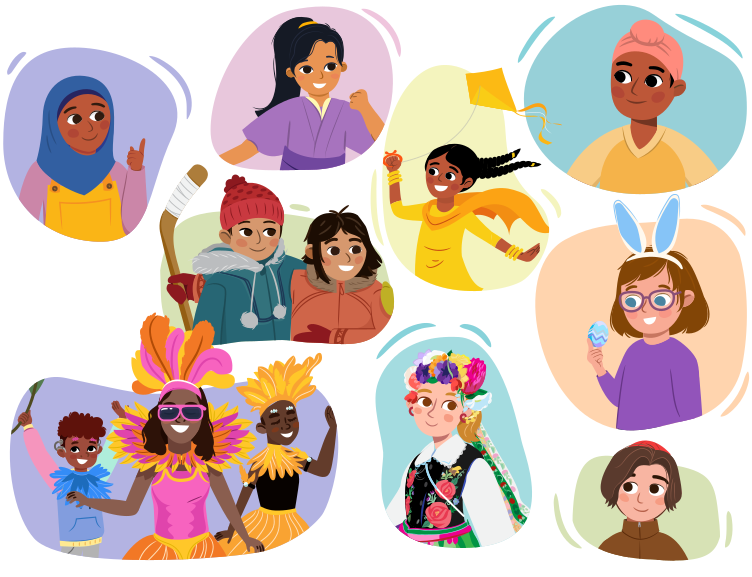
Collage of characters representing various cultures.
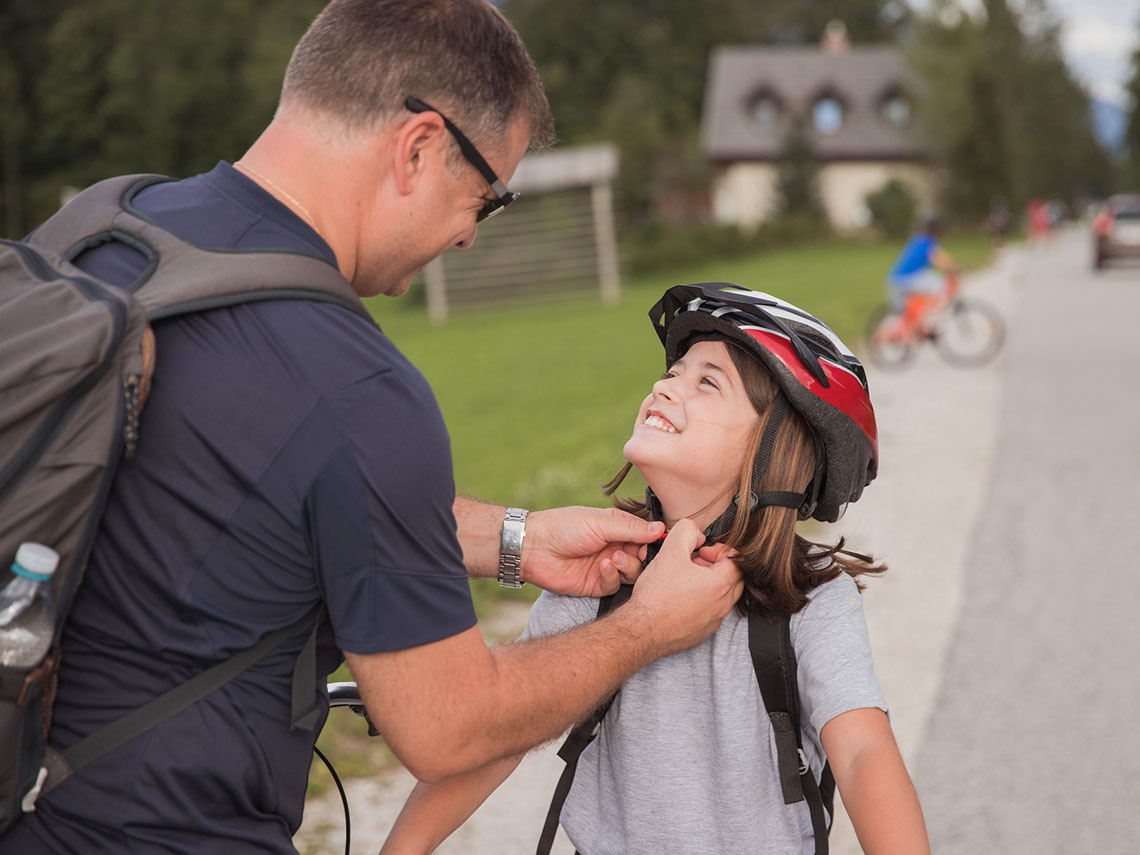
Child on bike while adult secures helmet.
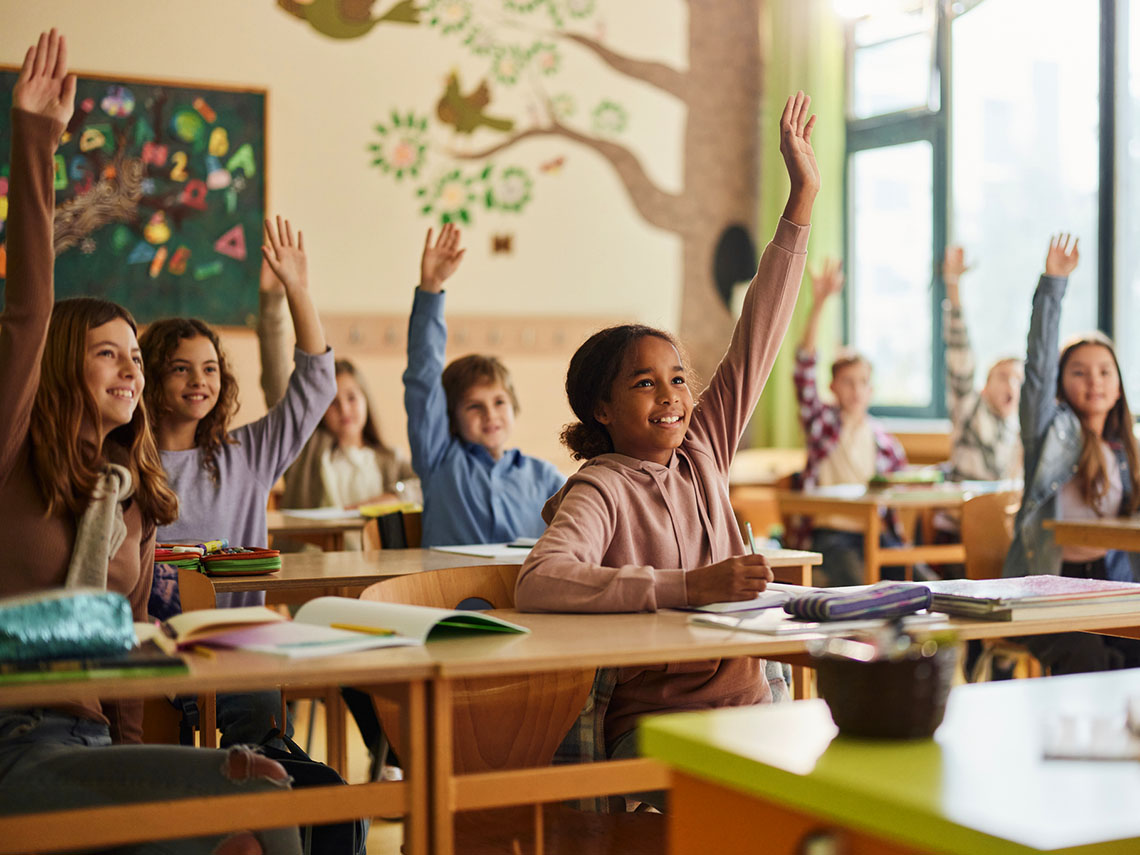
Classroom of children, sitting at their desks with arms raised.
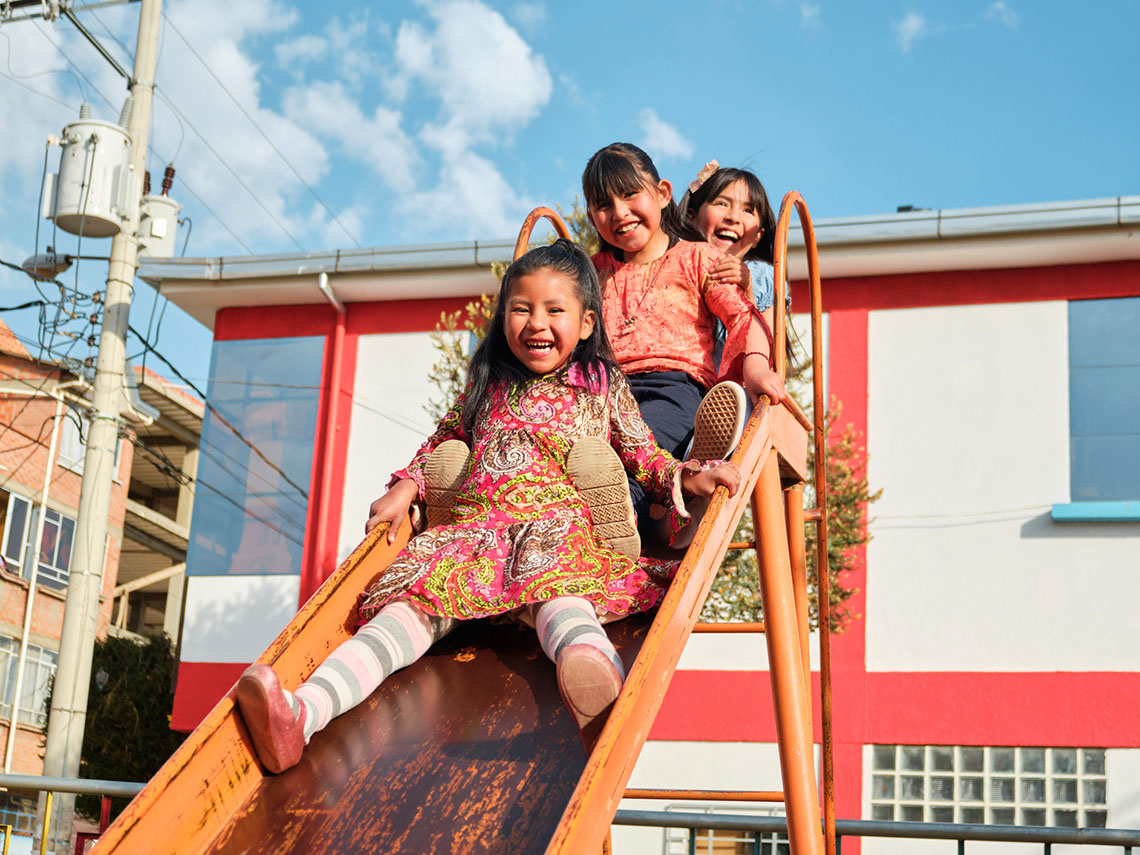
Three smiling children sitting in a row atop a slide at the park.
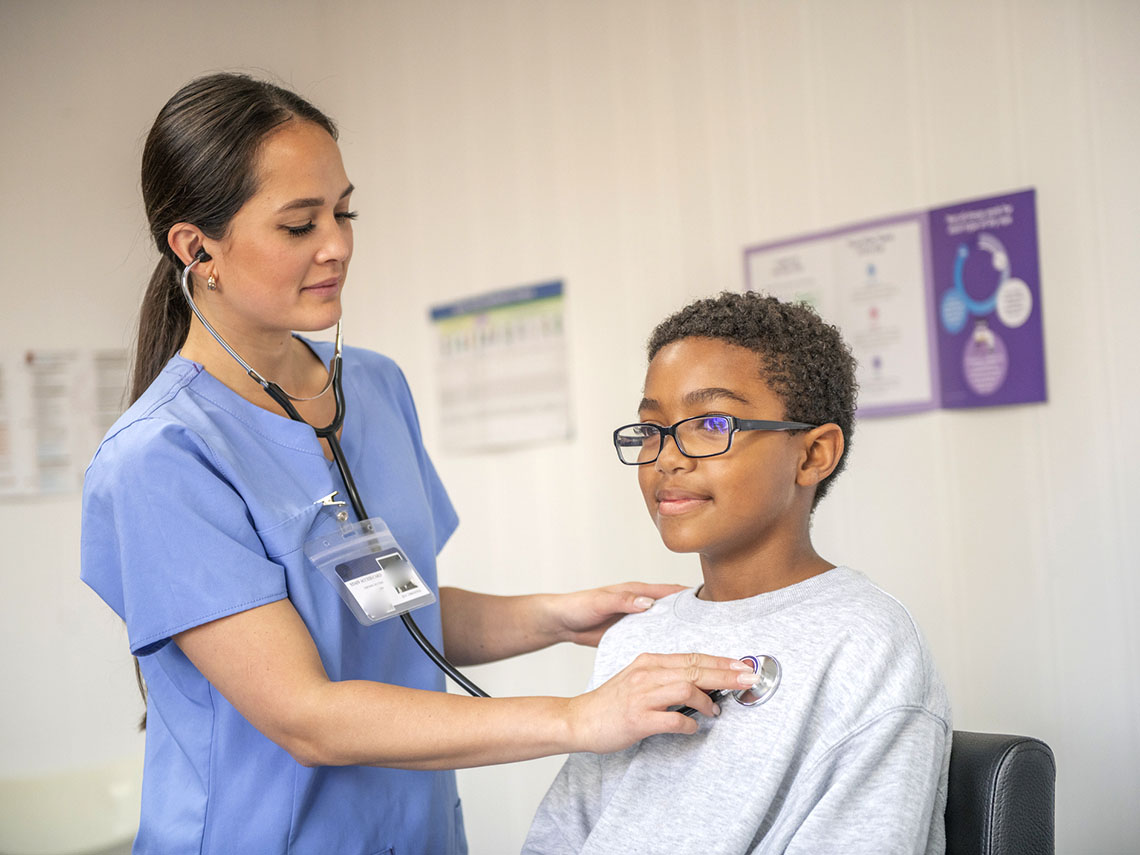
Child sitting on doctors bed while doctor checks their chest with a stethoscope.
Explore the following video. This video shares some feelings and ideas that children have about child rights. As you enjoy the video, think about the rights that are important to you.
Let’s check
What are some of the child rights talked about in this video?
Let's review some questions about the video.
What do you think is the most important right for every child to have? Why do you think that?
Record your answers in a method of your choice.
What are rights?
Rights help children and their families make good choices for their lives so they have a chance to grow into capable adults that can take care of themselves, their family, and their community.
Did You Know?
Did you know?
The United Nations has defined 42 children’s rights?
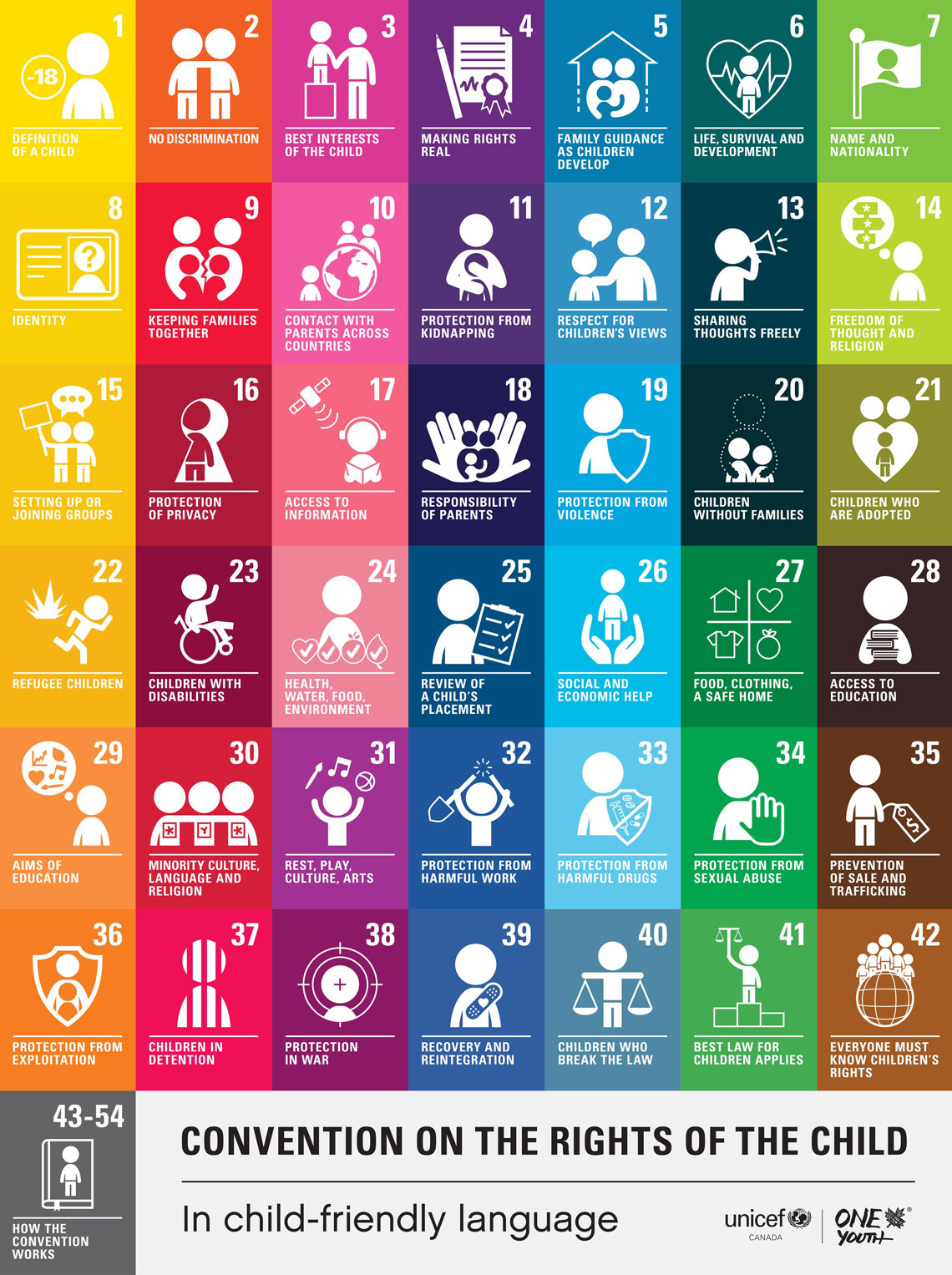
© UNICEF, 2019
Convention chart displaying 43 child right icons.
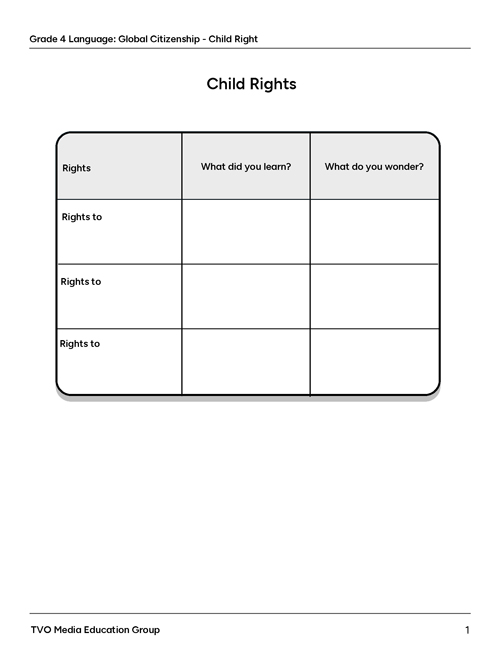
Choose three of these rights and complete the Child Rights Document in your notebook or using the following fillable and printable document. If you would like you can use speech-to -text or audio recording tools to record your thoughts.
Right to Play
Explore the following poem below and think about how it relates to the Child Rights you learned about. Click on the audio to hear the poem.
Right to Play
When children go outside,
jump in the air or go on a ride.
This helps them grow healthy and strong,
like a tree that’s tall and long,
All children have the right to play,
transforming together, tomorrow, and today!
The Right to Play
What do you think the message of the poem might be?
Press Reveal to check your answer.
Words that rhyme
You may have noticed that the poem contained rhyming words.
Authors use rhyming words to create a rhythm and flow in their poems. Rhyming words share the same or similar endings.
Can you find which of the following words rhyme with the bolded word? How did you know the words are rhyming words?
Press Hint to reveal how to know when words rhyme.
Hint: The ending of the words is the same or similar. The endings will sound similar even if they aren’t spelled the same.
Select the correct answer, then press Check Answer to see how you did.
Brainstorm
Brainstorm rhyming rules!
Now that you’ve identified the rhyming words, think about the rule that all the rhyming words followed. Then, come up with a rhyming rule for each group of words.
Complete the Rhyming Rules Activity in your notebook or using the following fillable and printable document. If you would like you can use speech-to -text or audio recording tools to record your thoughts
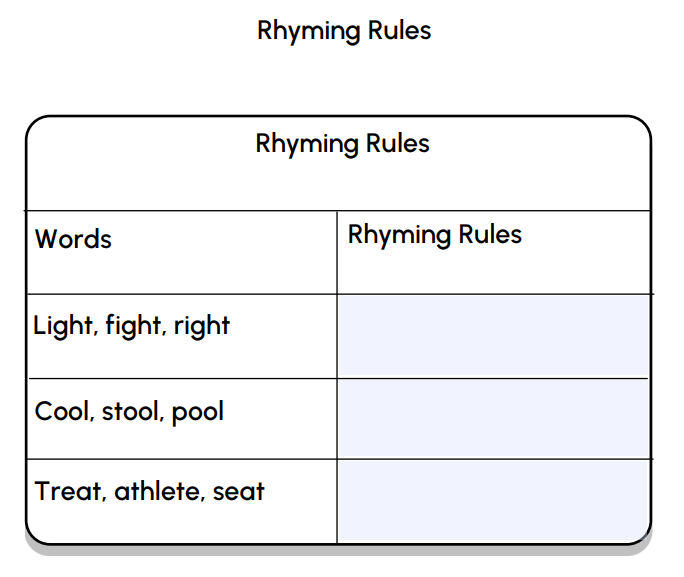
Press Answers to reveal the rhyming rules for the words.
Light, fight, right
Treat, athlete, seat
Cheap, leap, deep
Once we understand the rhyming rule for a set of rhyming words, we can use that as a reading strategy to explore new vocabulary.
Poetic devices
Before exploring the poem below, let’s learn about some parts of a poem called poetic devices.
| Poetic devices | Features | Examples |
|---|---|---|
| Couplet | A pair of lines that rhyme. | Lightning, thunder all around,
So much rain falls to the ground. |
| Rhyme | Words that have the same ending sounds. | Around and Ground |
| Alliteration | Two or more words that have the same beginning sound repeated in a phrase or sentence. | Busy as a bee in a big birch tree. |
| Stanza | In a poem, a group of 3 or more lines divided by a space. |
First Stanza Roses are red, violets are blue, school is starting, and all is new. Second Stanza I start my day, with my friends, I hope the fun, never ends. |
| Simile | Uses the word “like” or “as” to compare two things. | Her eyes shone like the moon. |
Right to Play
When children go outside,
jump in the air or go on a ride.
This helps them grow healthy and strong,
like a tree that’s tall and long,
All children have the right to play,
transforming together, tomorrow, and today!
The author of this poem uses poetic devices to share what they mean and to catch your attention. Think about the poetic devices you learned earlier: alliteration, stanza, couplet, rhyme, simile.
Find the poetic devices in the poem "Right to Play".
Stanza 1:
When children go outside,
jump in the air or go on a ride.
Stanza 2:
This helps them grow healthy and strong.
Like a tree that’s tall and
long.
Stanza 3:
All children have the right to play.
Transforming together, tomorrow,
and today.
Extend your learning!
Now that you’ve learned about child rights and you’ve learned a poem about child rights, you are going to create a poem of your own!
Choose one of the child rights:
- right to family
- right to be safe
- right to health
- right to play
- right to learn
- right to culture
Think about why this right is important and what you why you want to share about it. To help you with your poem think back to the poem Right to Play.
Create your own poem using the checklist below to guide you. Use the rhyming words provided in the word bank to help you get started, or use rhyming words of your own.
Poem checklist
| Rhyming word bank | ||
|---|---|---|
| family | happily | right |
| tall | small | light |
| school | cool | strong |
| long | celebrate | educate |
| are | bear | air |

Pause and Reflect
Pause and reflect
- What is something you like about your poem?
- What is your poem’s message?
- Are there any words or poetic devices you use to communicate this message?
- Why is this right important to you?
Reflection
As you read through these descriptions, which sentence best describes how you are feeling about your understanding of this learning activity? Press the button that is beside this sentence.
I feel...
Now, record your ideas using a voice recorder, speech-to-text, or writing tool.