explain how skills and understanding developed in this grade
support learning in various subject areas and in everyday
life
read and view a text by an Inuit creator to develop
understanding of Inuit histories, cultures, relationships,
communities, groups, nations, and lived experiences
make predictions using background knowledge, text features,
and evidence from the text
use reading strategies and consult references to monitor and
ensure our understanding
explain how strategies, such as making predictions have helped
us understand texts
select and classify ideas and information and sequence
content
draft texts of various forms and genres, including
informational texts
Success criteria
I am able to…
explain how using different reading strategies and resources
helps me understand a new text, and how these strategies could
help me to complete different tasks and in everyday life
read and view What’s My Superpower? by Inuk author
Aviaq Johnston and explore Inuktitut vocabulary in the text to
develop an understanding of some examples of Inuit culture and
traditions
make predictions, use reading fluency strategies and consult
the glossary to monitor my understanding
explain how strategies, such as making predictions helped me
understand the story
find the meaning for a group of words from
What’s My Superpower? and write them out in my own
words to create my own glossary
Clues on the page
When we read a new story, we can use the strategy of making
predictions to get started.
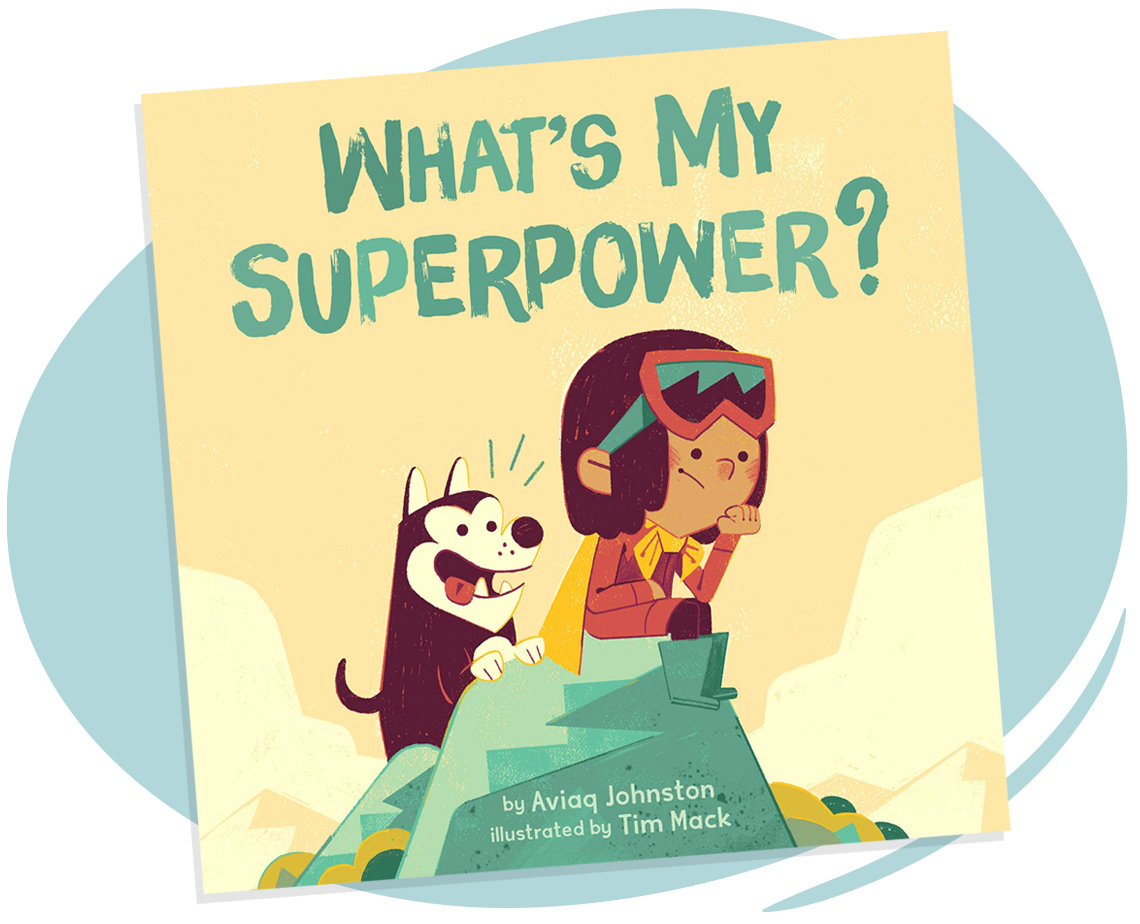
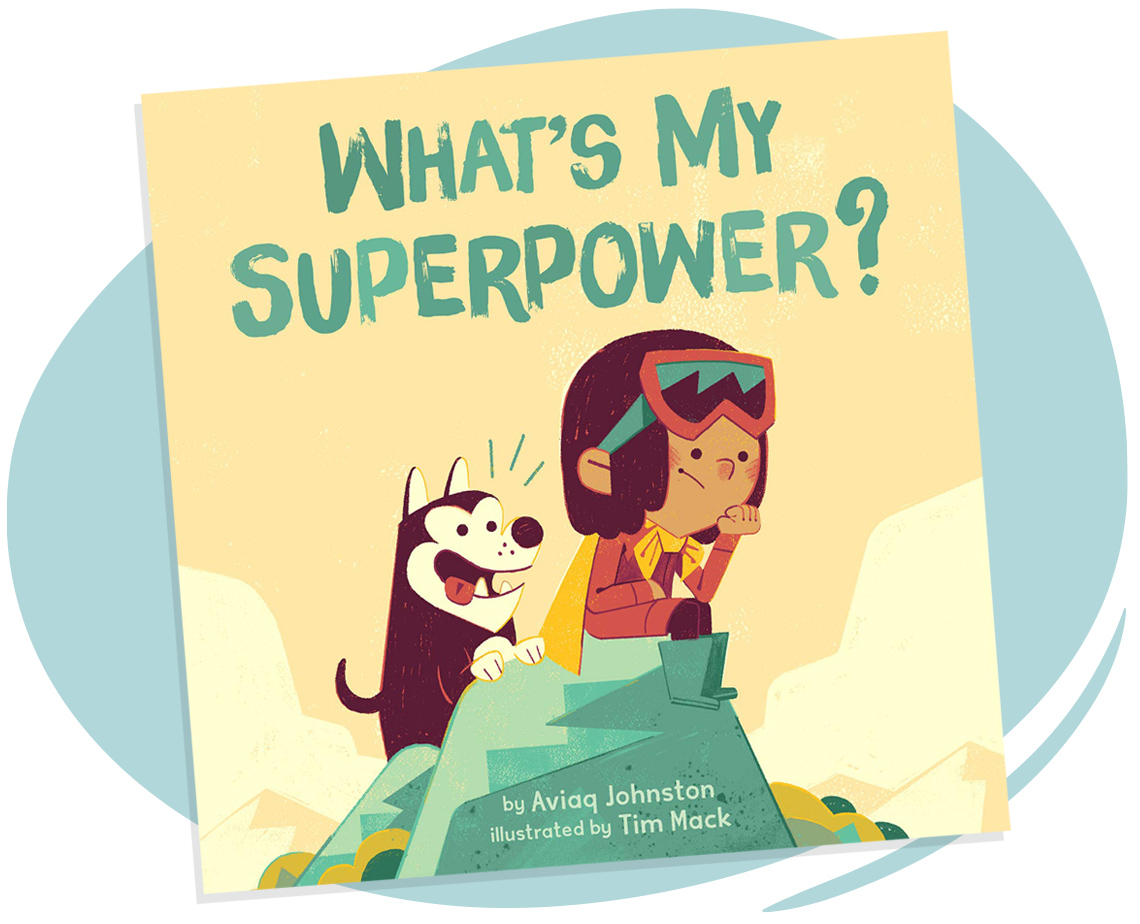
Explore the following cover page and use the following
questions to guide you.
Who or what is on the cover page?
If there are characters on the page, what do you think
their relationship is to each other?
What images, colours, or text do you see?
What does the title make you think of?
Does this book cover remind you of anything in your
life?
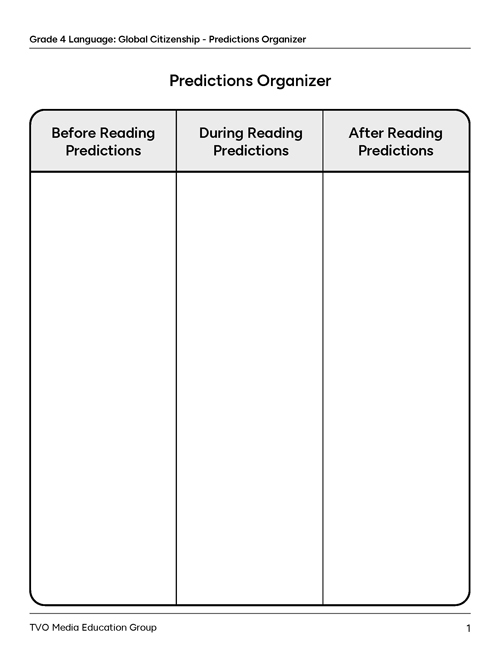
Record your answers in a method of your choice or complete
the “Before reading predictions” column.
Note: Save your work. You will revisit
the following document again during this learning
activity.
Complete the fillable and printable
Predictions Organizer in your notebook or
using the following document. If you would like,
you can use speech-to-text or audio recording
tools to record your thoughts.
Press the Activity button to access the
redictions Organizer.
I notice a child and a dog on the cover page.
It looks like the character is wearing a
superhero costume, and they are in thinking
pose. Since the title is “What’s My Superpower?”
I predict that the story will
be about this character trying to find their
own superpower.
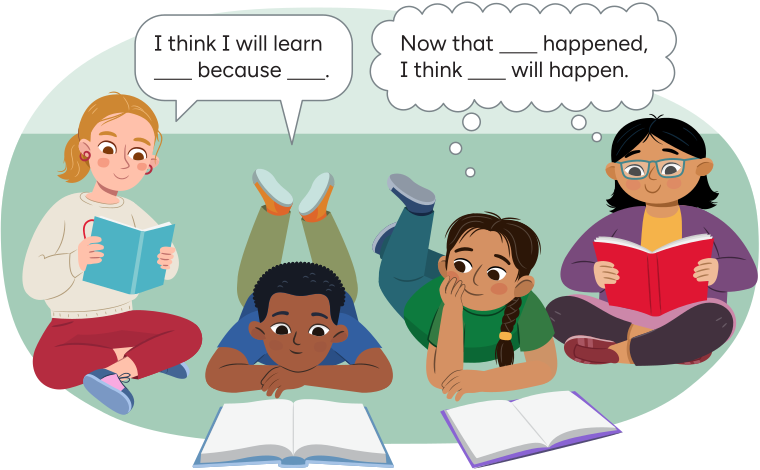
Learners reading books. Sandy and Arthur say, 'I
think I will learn… because…' Remy and Avery
think, 'Now that… happened, I think… will happen.'
As we explore new texts, we can use our predicting strategy
before, during and after reading. We can also use specific
resources within the text to support our understanding and
take the time to practice our reading fluency so that we
pick up any words or phrases that are unfamiliar.
Taking the time to use strategies and resources can help us
make connections and get a deeper understanding of the
characters, plot, main message and setting of a story.
As we get ready to read
What’s My Superpower? let’s take a bit of time to
think about during reading predictions, glossaries, and a
few reading fluency strategies.
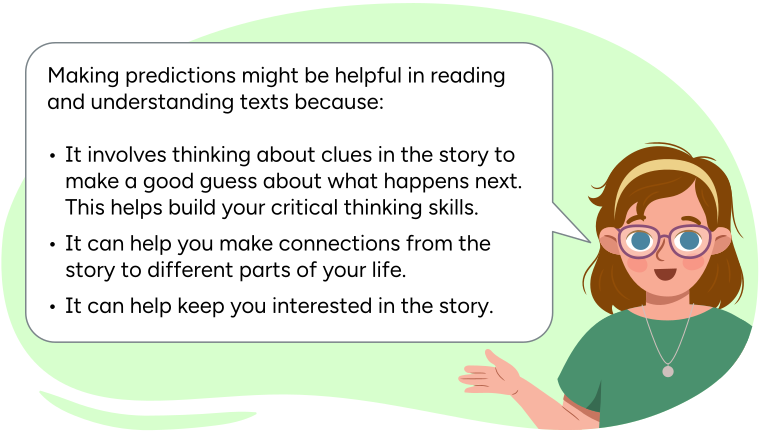
Ava shares, 'Making predictions might be
helpful in reading and understanding texts
because:
It involves thinking about clues in the
story to make a good guess about what
happens next. This helps build your critical
thinking skills.
It can help you make connections from the
story to different parts of your life.
It can help keep you interested in the
story.'
Making predictions during reading can help us make
connections to the story, the characters and help us
understand the main message. You can use
context clues to help you make
predictions.
Some examples of context clues are:
pictures
words
text features (font, colours, bold print, and captions)
As you read, record your answers in a method of your choice
or complete the ‘During reading predictions’ column of the
fillable
Predictions Organizer from the Minds On.
You may use the following questions to help guide you:
What has happened in the story so far?
What do you think is going to happen next?
Glossary
One way that an author can support their readers to
understand their text is by including a
glossary. A glossary is like a dictionary
and lists important words found in the text. Oftentimes,
the glossary is found at the end of a text and the words
are listed alphabetically. A glossary is especially helpful
when there technical or subject specific words that might
be new to the reader or words in other languages.
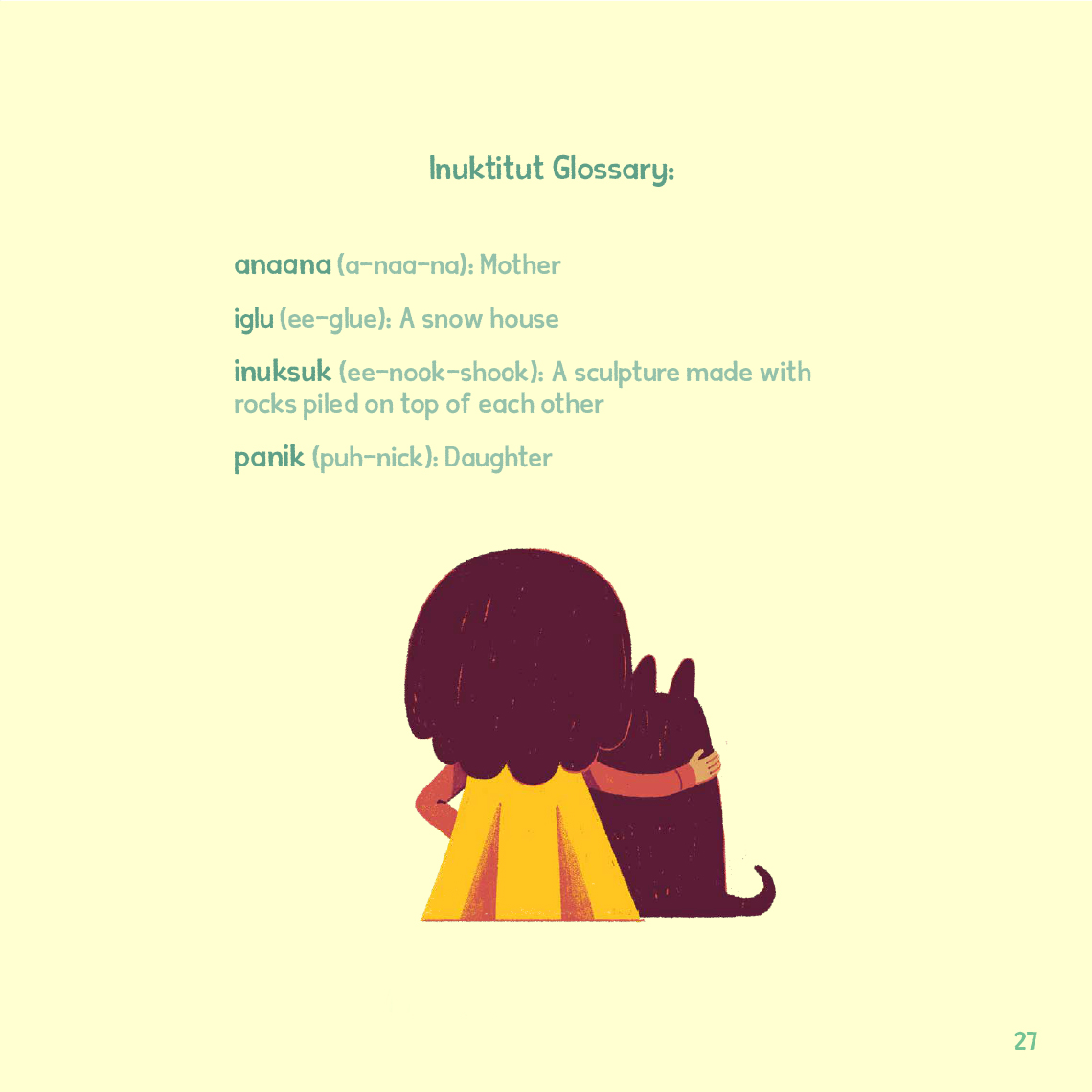
In What’s My Superpower? the glossary can be found
at the end of the book, and includes words in the
Inuktitut language, with definitions of what each word
means. You might also notice that each Inuktitut word also
includes the pronunciation beside it.
Before exploring the story, take a moment to review the
glossary. You can continue to refer to the glossary as you
read the story.
Reading
practice!
Try the following as you read to help you improve your
reading fluency:
Record yourself reading aloud on your own and listen
to the recording to look for where you can
improve.
Use a ruler or reading window to follow along.
Listen to an audio clip of the story and read along
with it.
Check off which strategies worked best for you! Now that we
have reviewed a few different tools and reading strategies,
let’s learn a bit about the author of
What’s My Superpower? and read the story.
Let’s read!
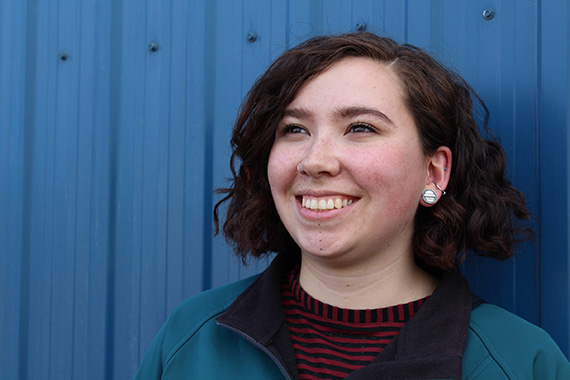
What’s My Superpower? was written by Aviaq
Johnston. Aviaq Johnston is an Inuk author from
Igloolik, Nunavut. She loves reading, writing, and
studying. Aviaq won two awards for a short story she
wrote called, "Tarnikuluk" in 2014. She enjoys traveling
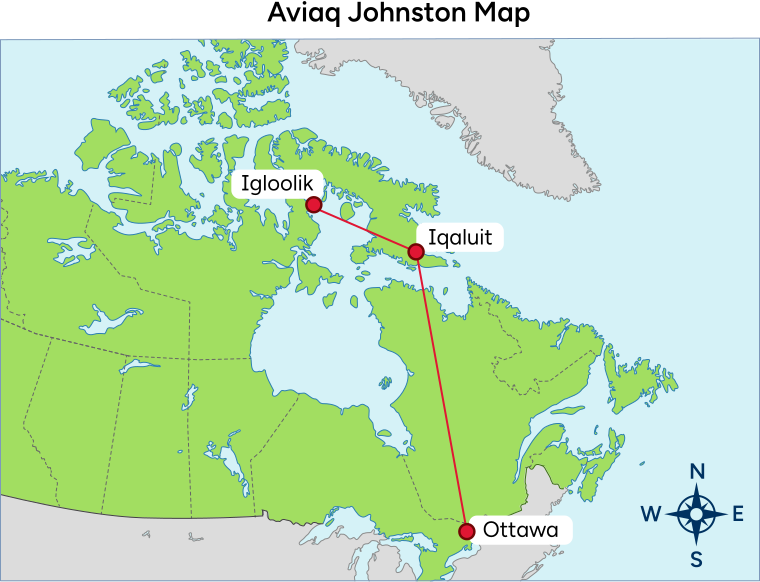
and spends her time living between Iqaluit and Ottawa.
A map of the three places the author Aviaq
Johnston has lived: Ottawa, Iqaluit, and
Igloolik. Ottawa is in southern Ontario.
Iqaluit is on the southeast coast of Baffin
Island, Nunavut. It is much further north than
Ottawa. Igloolik is on Igloolik Island in
Nunavut. It is further west than Iqaluit.
What's My Superpower?What's My Superpower?
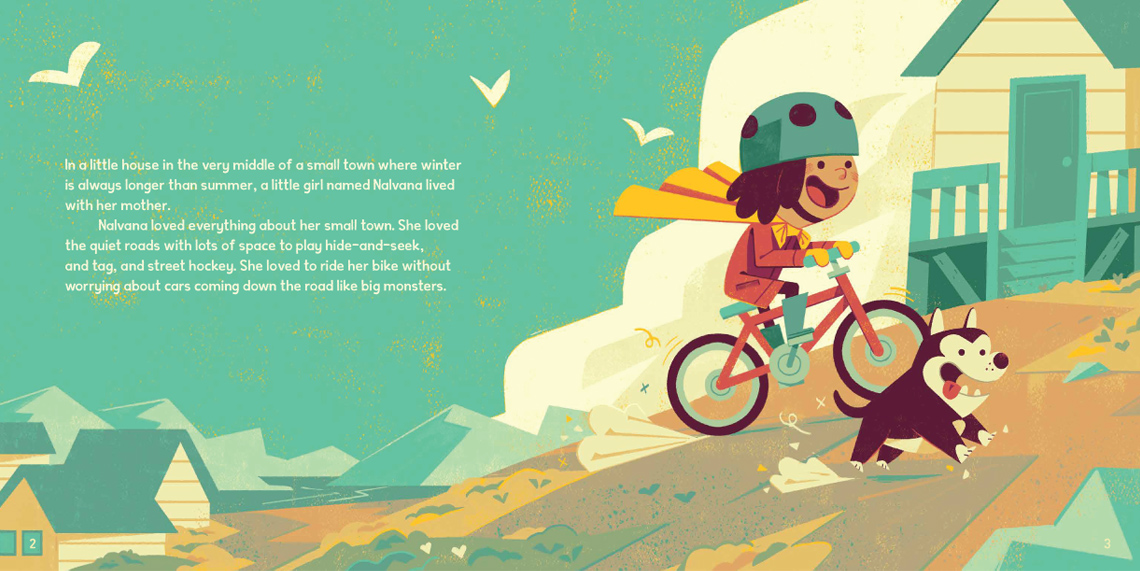
In a little house in the very middle of a
small town where winter is always longer
than summer, a little girl named Nalvana
lived with her mother.
Nalvana loved everything about her small
town. She loved the quiet roads with lots of
space to play hide-and-seek, and tag, and
street hockey. She loved to ride her bike
without worrying about cars coming down the
road like big monsters.
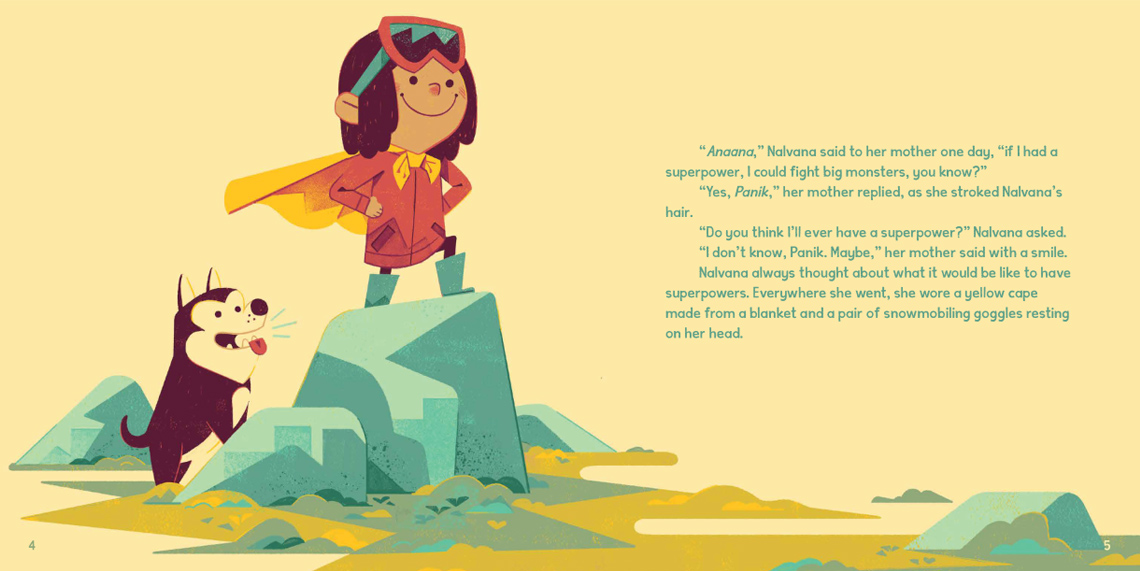
“Anaana,” Nalvana said to her mother one
day, “if I had a superpower, I could fight
big monsters, you know?”
“Yes, Panik,” her mother replied, as she
stroked Nalvana’s hair.
“Do you think I’ll ever have a superpower?”
Nalvana asked. “I don’t know, Panik. Maybe,”
her mother said with a smile.
Nalvana always thought about what it would
be like to have superpowers. Everywhere she
went, she wore a yellow cape made from a
blanket and a pair of snowmobiling goggles
resting on her head.
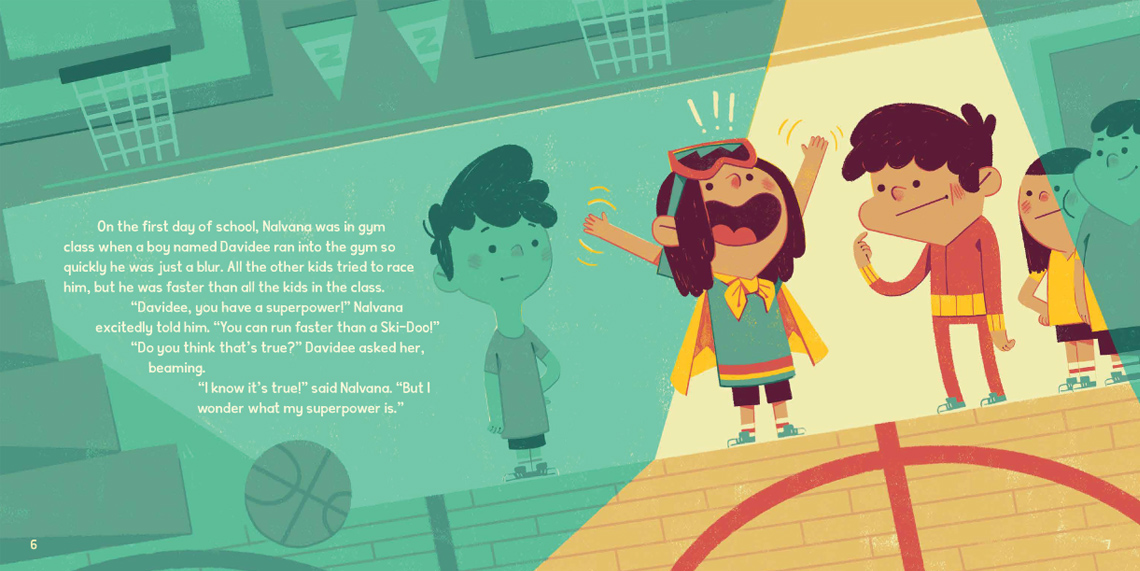
On the first day of school, Nalvana was in
gym class when a boy named Davidee ran into
the gym so quickly he was just a blur. All
the other kids tried to race him, but he was
faster than all the kids in the class.
“Davidee, you have a superpower!” Nalvana
excitedly told him. “You can run faster than
a Ski-Doo!”
“Do you think that’s true?” Davidee asked
her, beaming.
“I know it’s true!” said Nalvana. “But I
wonder what my superpower is.”
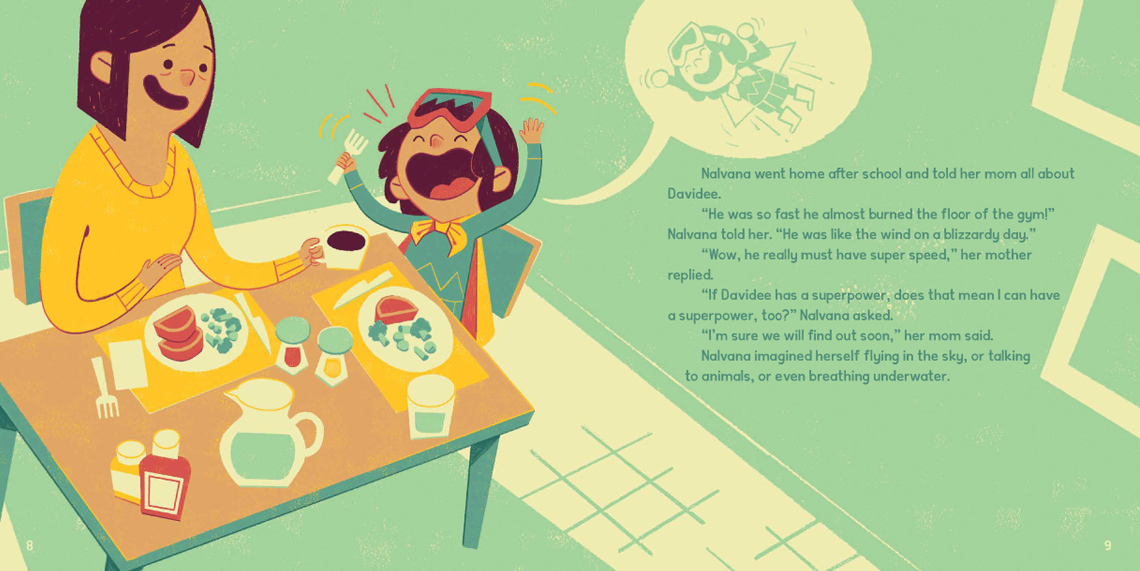
Nalvana went home after school and told her
mom all about Davidee.
“He was so fast he almost burned the floor
of the gym!” Nalvana told her. “He was like
the wind on a blizzardy day.”
“Wow, he really must have super speed,” her
mother replied.
“If Davidee has a superpower, does that mean
I can have a superpower, too?” Nalvana
asked.
“I’m sure we will find out soon,” her mom
said.
Nalvana imagined herself flying in the sky,
or talking to animals, or even breathing
underwater.
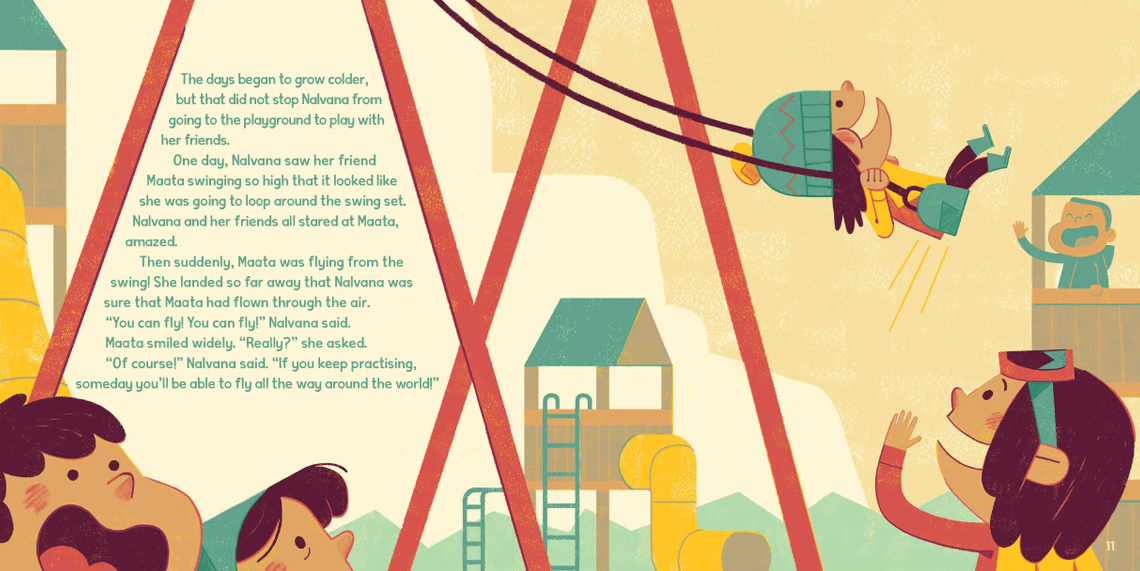
The days began to grow colder, but that did
not stop Nalvana from going to the
playground to play with her friends.
One day, Nalvana saw her friend Maata
swinging so high that it looked like she was
going to loop around the swing set. Nalvana
and her friends all stared at Maata, amazed.
Then suddenly, Maata was flying from the
swing! She landed so far away that Nalvana
was sure that Maata had flown through the
air.
“You can fly! You can fly!” Nalvana said.
Maata smiled widely. “Really?” she asked.
“Of course!” Nalvana said. “If you keep
practising, someday you’ll be able to fly
all the way around the world!”
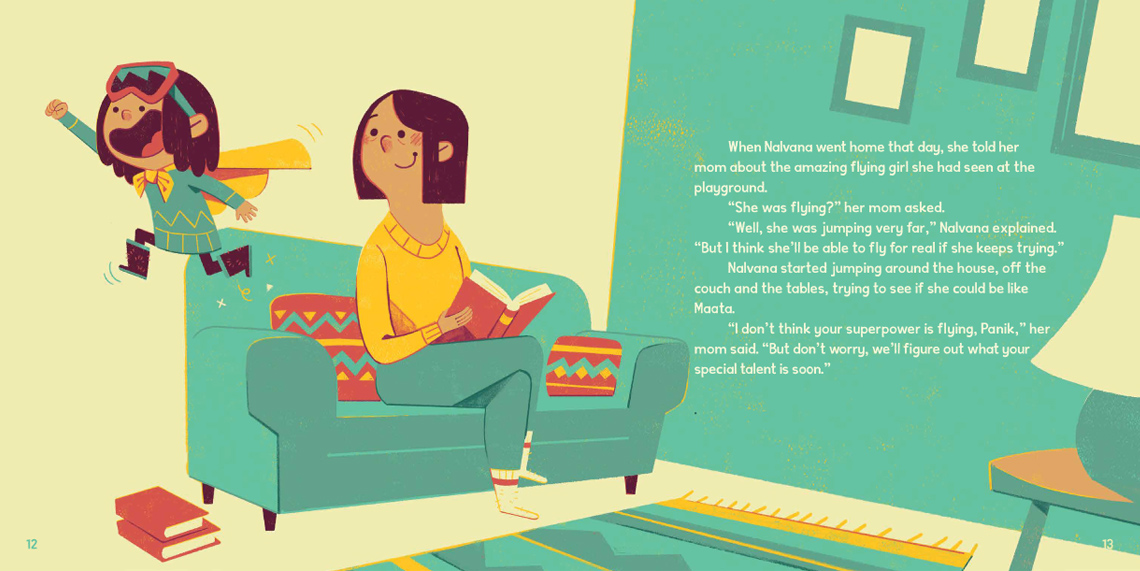
When Nalvana went home that day, she told
her mom about the amazing flying girl she
had seen at the playground.
“She was flying?” her mom asked.
“Well, she was jumping very far,” Nalvana
explained. “But I think she’ll be able to
fly for real if she keeps trying.”
Nalvana started jumping around the house,
off the couch and the tables, trying to see
if she could be like Maata.
“I don’t think your superpower is flying,
Panik,” her mom said. “But don’t worry,
we’ll figure out what your special talent is
soon.”
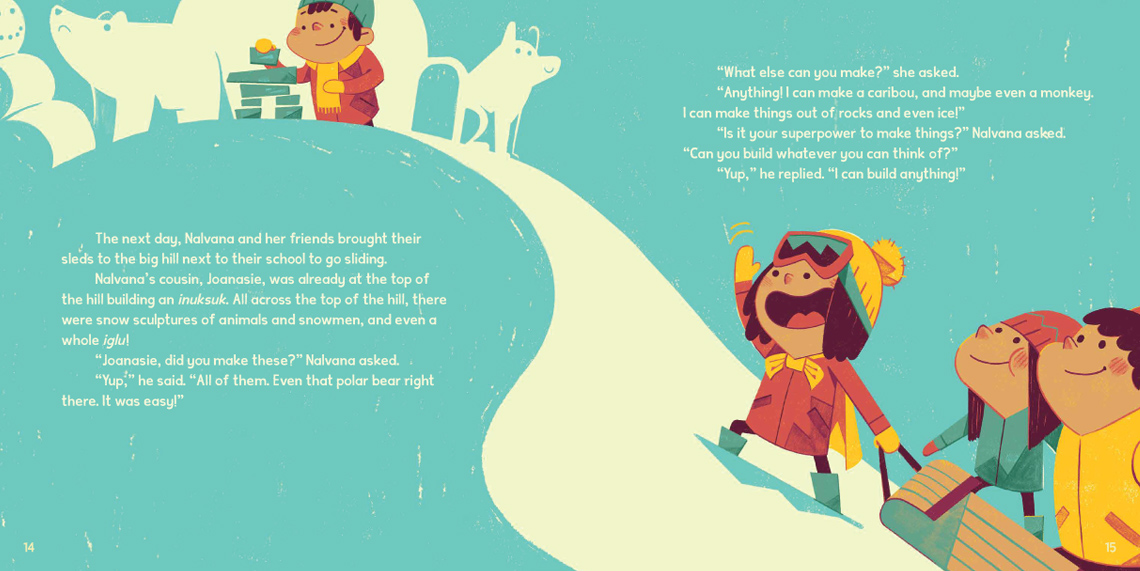
The next day, Nalvana and her friends
brought their sleds to the big hill next to
their school to go sliding.
Nalvana’s cousin, Joanasie, was already at
the top of the hill building an inuksuk. All
across the top of the hill, there were snow
sculptures of animals and snowmen, and even
a whole iglu!
“Joanasie, did you make these?” Nalvana
asked.
“Yup,” he said. “All of them. Even that
polar bear right there. It was easy!”
“What else can you make?” she asked.
“Anything! I can make a caribou, and maybe
even a monkey. I can make things out of
rocks and even ice!”
“Is it your superpower to make things?”
Nalvana asked. “Can you build whatever you
can think of?”
“Yup,” he replied. “I can build anything!”
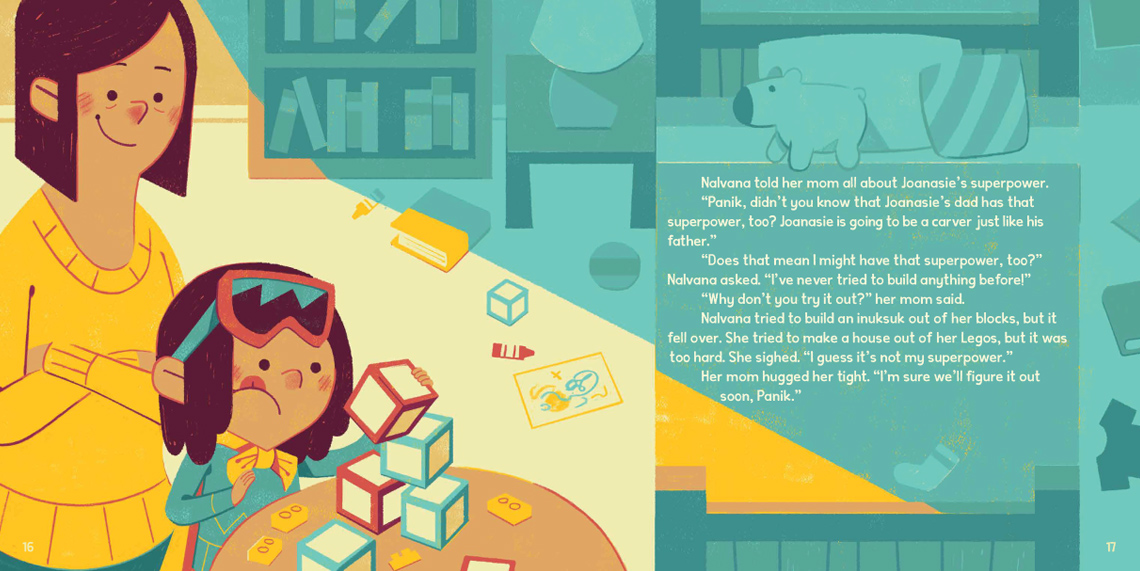
Nalvana told her mom all about Joanasie’s
superpower.
“Panik, didn’t you know that Joanasie’s dad
has that superpower, too? Joanasie is going
to be a carver just like his father.”
“Does that mean I might have that
superpower, too?” Nalvana asked. “I’ve never
tried to build anything before!”
“Why don’t you try it out?” her mom said.
Nalvana tried to build an inuksuk out of her
blocks, but it fell over. She tried to make
a house out of her Legos, but it was too
hard. She sighed. “I guess it’s not my
superpower.”
Her mom hugged her tight. “I’m sure we’ll
figure it out soon, Panik.”
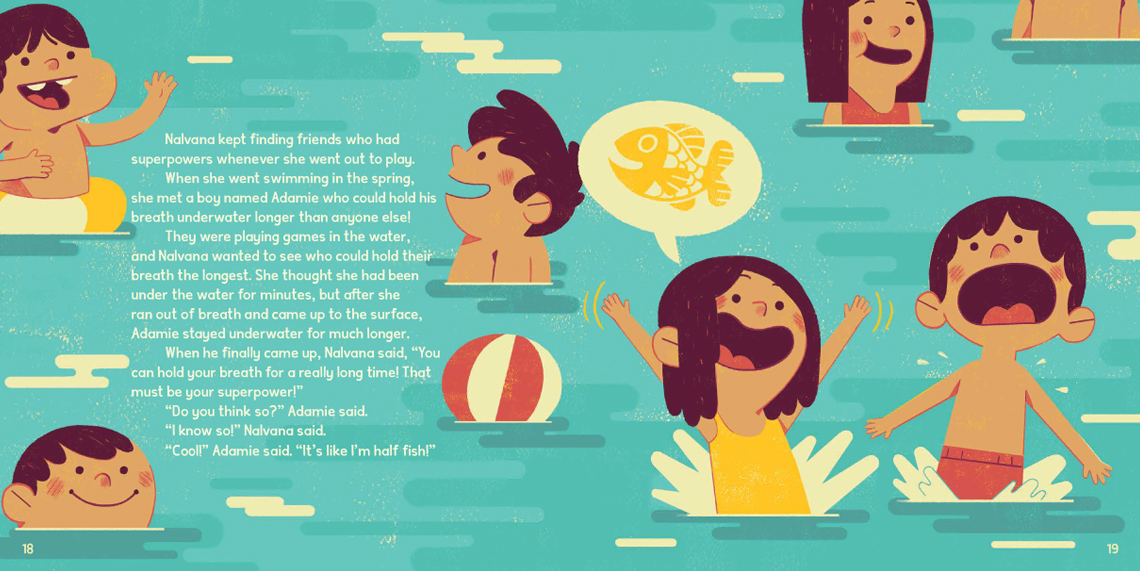
Nalvana kept finding friends who had
superpowers whenever she went out to play.
When she went swimming in the spring, she
met a boy named Adamie who could hold his
breath underwater longer than anyone else!
They were playing games in the water, and
Nalvana wanted to see who could hold their
breath the longest. She thought she had been
under the water for minutes, but after she
ran out of breath and came up to the
surface, Adamie stayed underwater for much
longer.
When he finally came up, Nalvana said, “You
can hold your breath for a really long time!
That must be your superpower!”
“Do you think so?” Adamie said.
“I know so!” Nalvana said.
“Cool!” Adamie said. “It’s like I’m half
fish!”
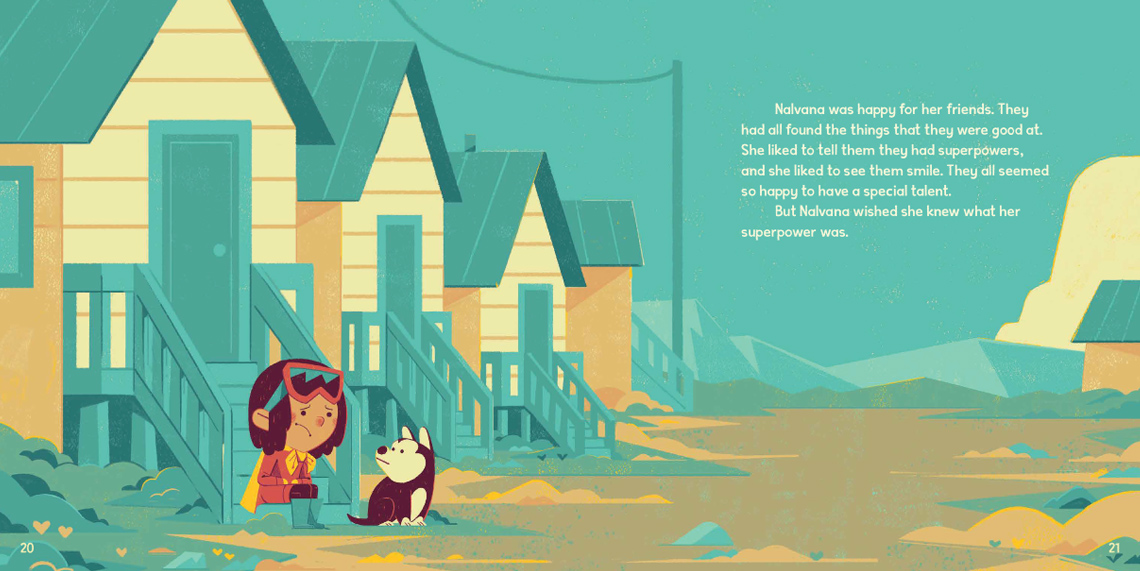
Nalvana was happy for her friends. They had
all found the things that they were good at.
She liked to tell them they had superpowers,
and she liked to see them smile. They all
seemed so happy to have a special talent.
But Nalvana wished she knew what her
superpower was.
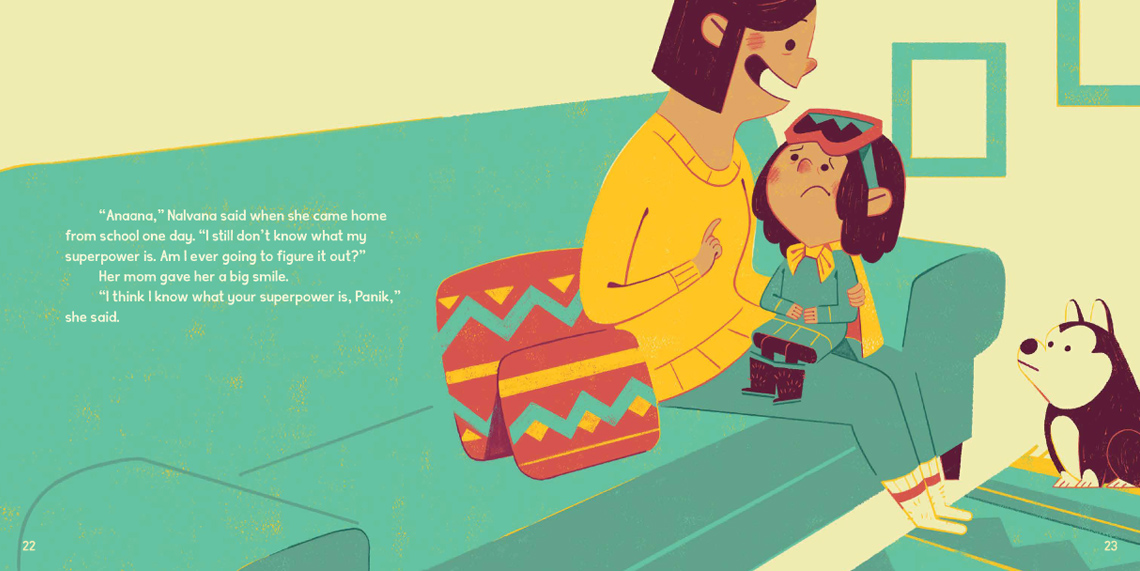
“Anaana,” Nalvana said when she came home
from school one day. “I still don’t know
what my superpower is. Am I ever going to
figure it out?”
Her mom gave her a big smile.
“I think I know what your superpower is,
Panik,” she said.
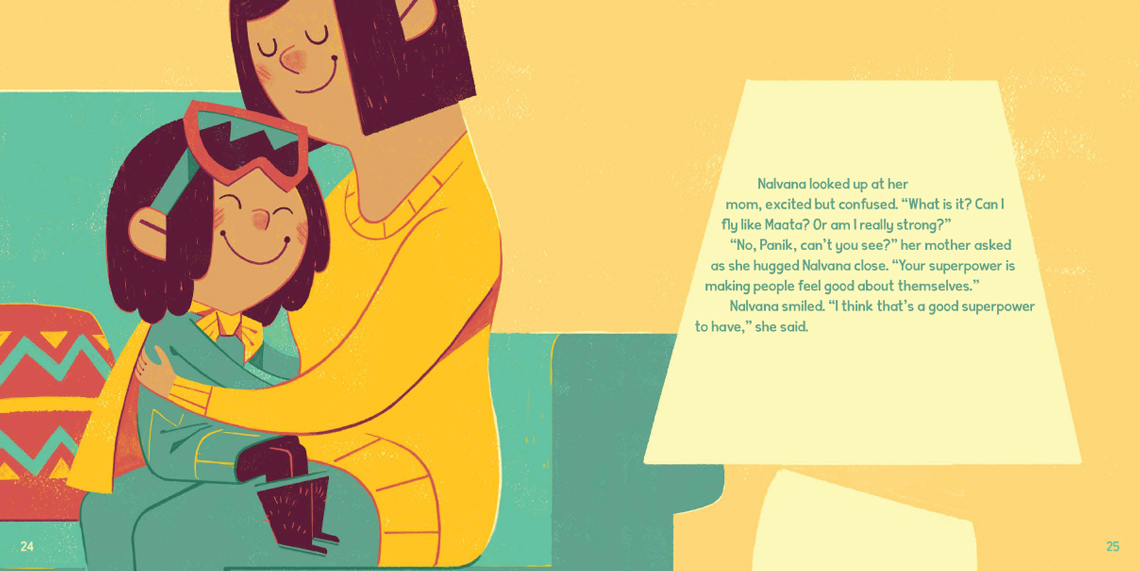
Nalvana looked up at her mom, excited but
confused. “What is it? Can I fly like Maata?
Or am I really strong?”
“No, Panik, can’t you see?” her mother asked
as she hugged Nalvana close. “Your
superpower is making people feel good about
themselves.”
Nalvana smiled. “I think that’s a good
superpower to have,” she said.
Now that you have read the story, review the predictions
you made in the Minds On section based on the book cover
and record your thoughts in the “After reading predictions”
column of the fillable
Predictions Organizer.
You may use the following questions to help guide you:
Which of your predictions were correct?
What evidence from the story shows your predictions were
correct?
Pause and Reflect
Pause and reflect
What did you think was the main message or lesson
in the story?
Were you able to identify or connect with any of
the characters in the story?
What specific information about Inuit culture and
traditions did you learn from Nalvana and her
community?
How did listening to the story in Inuktitut make
you feel?
Possessive adjectives
An adjective is a word that describes something by telling
us more about it. It can describe how something looks,
feels, sounds, tastes, or acts.
Some adjectives are also used to tell us who or what the
noun belongs to. These adjectives are called possessive
adjectives. They describe ownership.
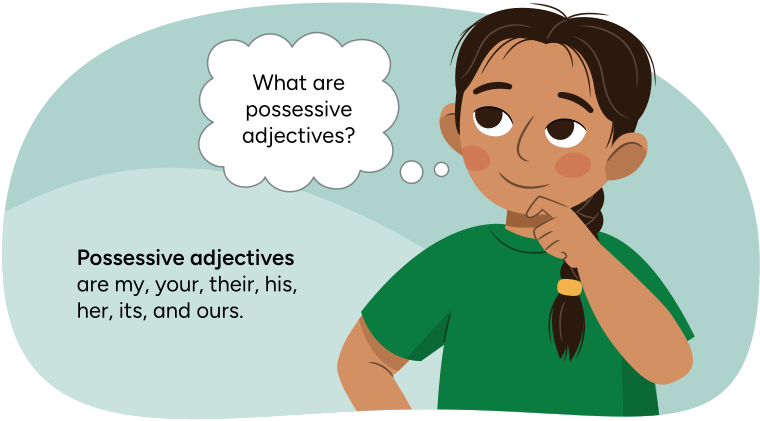
Neebin wonders, 'What are the possessive
adjectives?' The list of possessive adjectives
include the following: my, your, their, his, her,
its and ours.
Let’s explore a few examples of sentences from the story
What’s My Superpower? Try and identify the
possessive adjective in each of the following sentences.
One day, Nalvana saw her friend Maata swinging so high
that she looked like she was going to loop around the
swing set.
Press Answer to reveal the possessive
adjective in the sentence.
“I still don’t know what
my superpower is. Am I ever going to
figure it out?”
Investigate
Investigate
Return to the story
What’s My Superpower? and find two more
examples where possessive adjectives are used.
How do you know they are possessive adjectives?
Explain and record your answers using a method of
your choice.
Create your own glossary!
We have explored different tools and strategies that help
us develop our reading comprehension. Now, it’s time to try
creating your own tool to support another reader as they
explore the story
What’s My Superpower?
The tool you will create is a glossary!
Press Sample to revisit the glossary from
the story What's My Superpower? before you begin.
Design and create your own glossary for
the following words that are used in the story:
superpower
snowboarding
carver
ski-Doo
Hint: A glossary is like a dictionary
which lists important words found in the text.
Oftentimes, the glossary is found at the end of a text
and the words are listed alphabetically. A glossary is
especially helpful when there technical or subject
specific words that might be new to the reader or words
in other languages.
Use a dictionary, thesaurus or ask a trusted adult to help
you find the meaning of each word. Next, write out the
definitions using your own words.
Reflection
Which type of tool or reading strategy helped develop your
understanding most as you were exploring the text
What’s My Superpower??
How might you use this reading strategy for another task in
your everyday life?
Why might it be important to read stories about people all
around the world?
Reflection
How do you feel about what you have learned in this
activity? Which of the next four sentences best matches how
you are feeling about your learning? Press the button that
is beside this sentence.
I feel...
Now, record your ideas about your feelings using a voice
recorder, speech-to-text, or writing tool.