Learning goals
We are learning to…
- demonstrate an understanding of global citizenship and how this transferrable skill is used in different contexts
- explore concepts related to identity and self through culturally responsive and relevant texts
- read aloud fluently, with appropriate pauses and expression
- write poetry that expresses our personal voice
Success criteria
I am able to…
- identify interconnections between my own lived experiences and the experience of others through texts
- pause at punctuation to enhance my reading of literary texts
- write a poem that explores the theme of identity and expresses my own voice
- explain new vocabulary in my own words
Thinking about interconnectedness
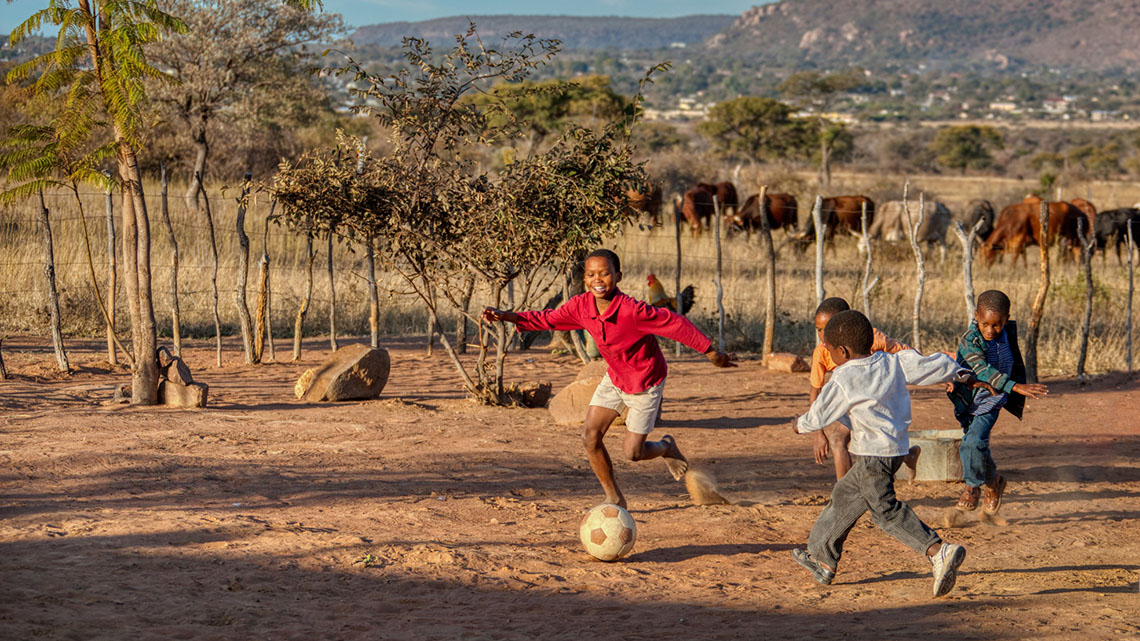
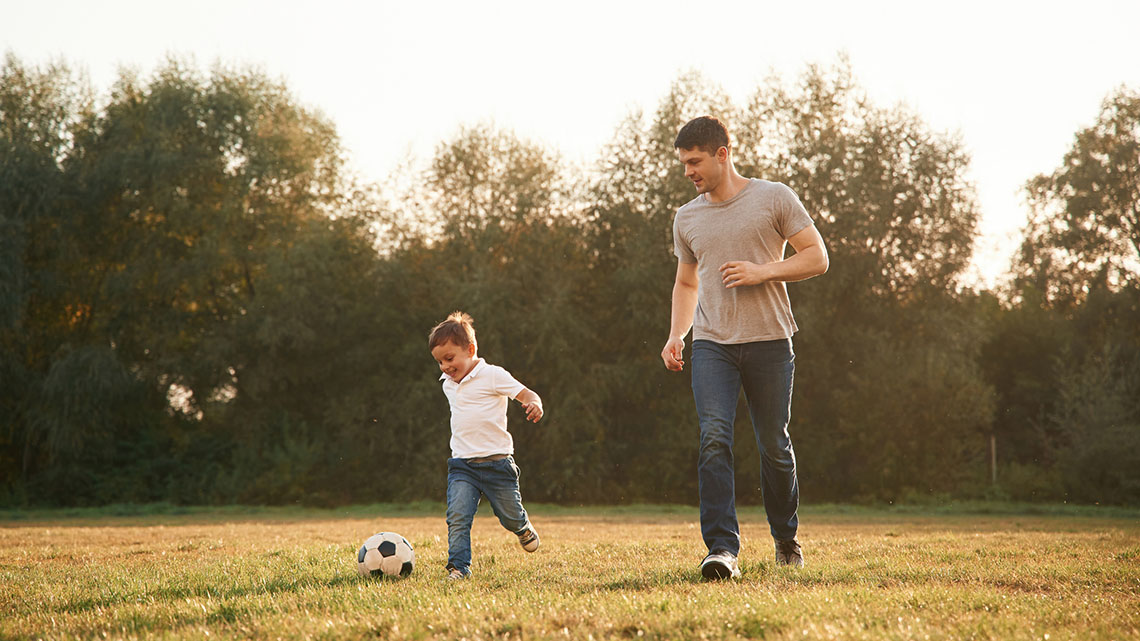
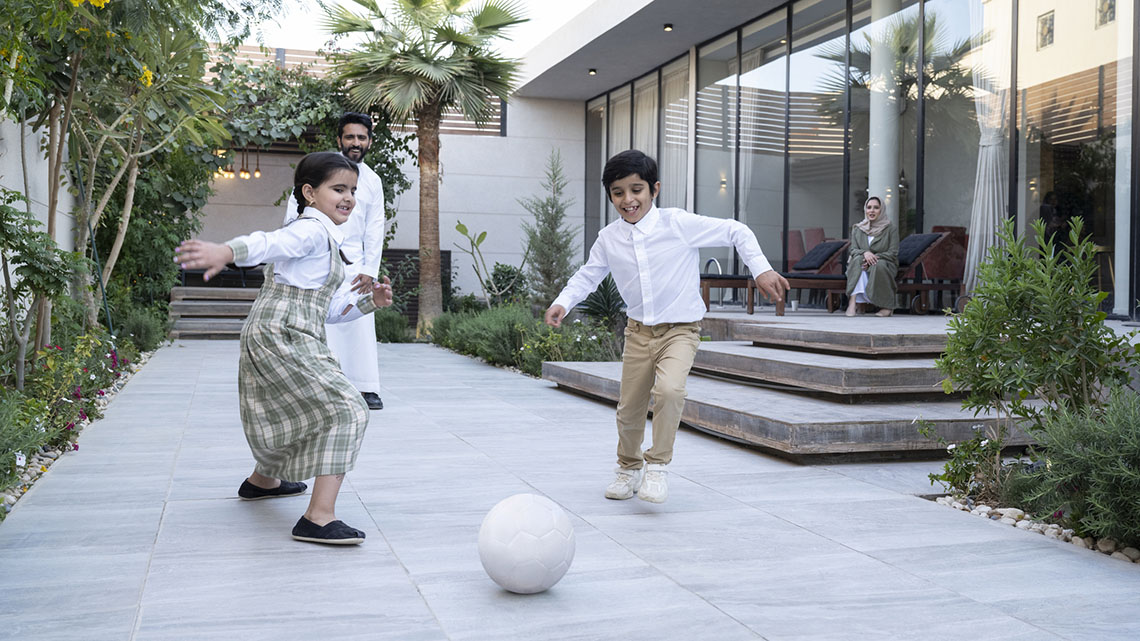
Examine the following images. What do you notice? In what ways are the images similar? In what ways are they different? Can you connect anything in the pictures to your own life experiences?
Record your observations orally, in print, or using another method of your choice. If possible, share your ideas with a partner.

Connections
Connections
Did you notice any of the following about the images?
- They all show children kicking a ball.
- The children are all smiling and look like they are having fun!
- The types of plants and trees are different in all three images.
- The children seem to have diverse racial identities.
- Each are wearing different clothing that is suited to the climate of their individual locations.
- It seems like the children live in different parts of the world.
While there are parts of these images that are unique, they are more similar than they are different. We know that children all around the world want to laugh, have fun, and play. Those are human experiences that we have in common. The ways in which humans are similar to each other, and can relate to each other, can be described with the word interconnectedness. Being aware of how we are interconnected with other humans, plants, animals, and the Earth itself is an important part of being a global citizen, or someone who is “aware of and understands the wider world – and their place in it.” (Oxfam)
In this learning activity, we will continue to explore interconnectedness and what it means to be a global citizen.
Building vocabulary is important
In the Minds On section, we were introduced to two important vocabulary terms:
- interconnectedness
- global citizen
Whether you’ve heard these terms before or not, working with important or “key vocabulary” is a very useful tool in understanding new topics and texts.
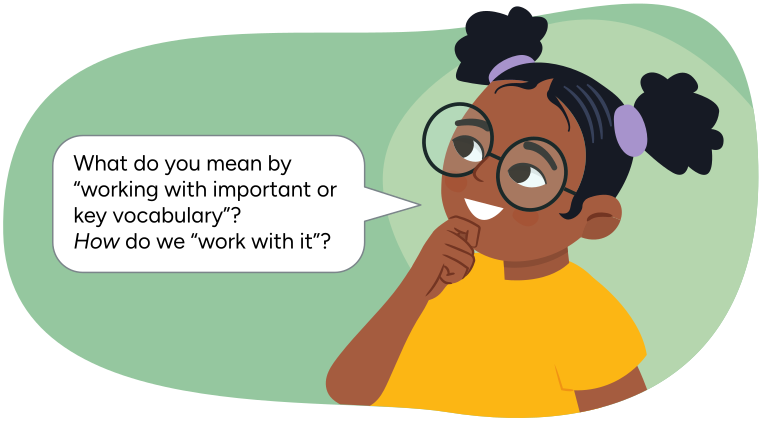 Description
Student is talking.
What do you mean by “working with important or key vocabulary”?
How do we “work with it”?
To understand a new word or term, it’s not enough for us to just read a definition. To really understand, our brains need to think about it in different ways.

Vocabulary routine!
Choose one of the following graphic organizers, or another method of your choice, to record the vocabulary terms, interconnectedness and global citizen, and explore more about their meanings.
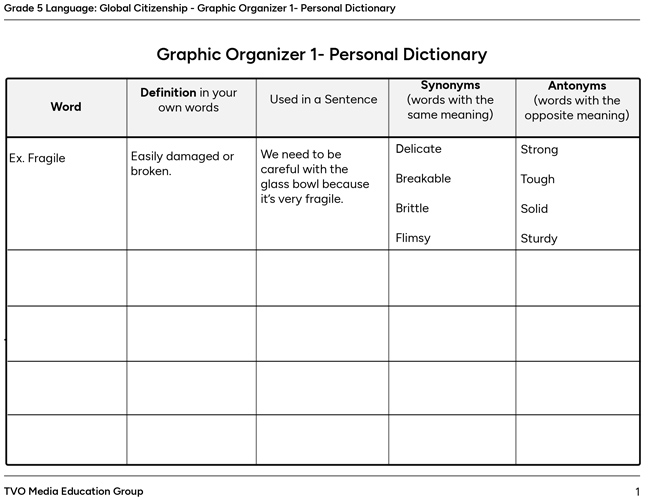
Press the Activity button to access the Graphic Organizer 1- Personal Dictionary.
Activity(Opens in a new tab)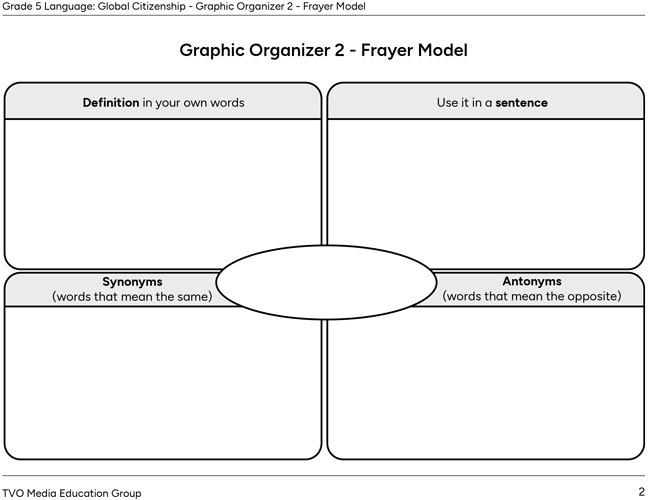
Press the Activity button to access the Graphic Organizer 2- Frayer Model.
Activity(Opens in a new tab)How are we connected?
Learning about the stories, traditions, and experiences of diverse people is an important part of beginning to understand our own place in the world. It is also a great way to explore our interconnectedness with other people and all living things in the world.
Since time immemorial, Indigenous Peoples have understood and taught their younger generations about the importance of recognizing interconnectedness.
Let’s explore the book Be a Good Ancestor by Leona Prince and Gabrielle Prince. Both authors are from the Lake Babine Nation and Nak’azdli Whu’ten located in the Central Interior of British Columbia.
As you read, take note of the examples of interconnections and consider what message the author wants to communicate with the audience.
Description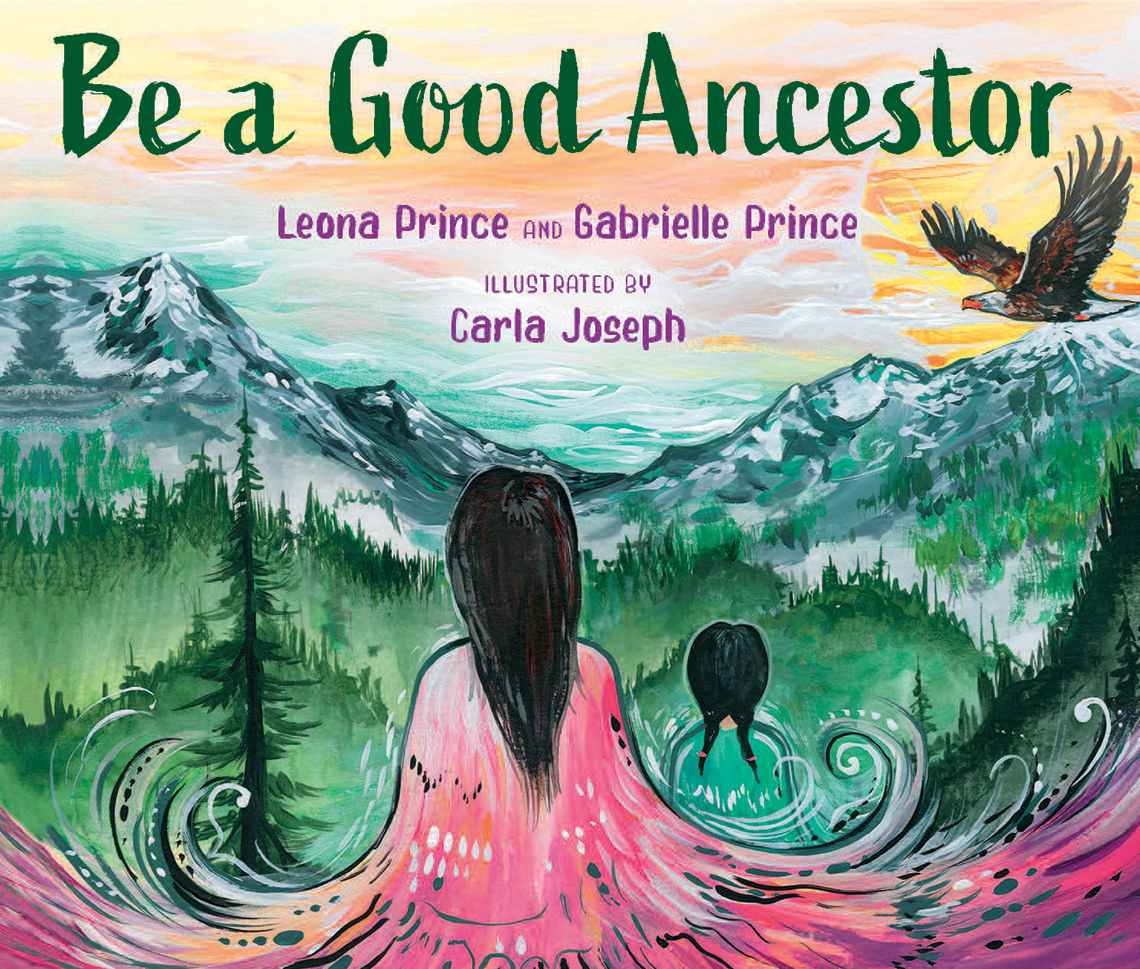
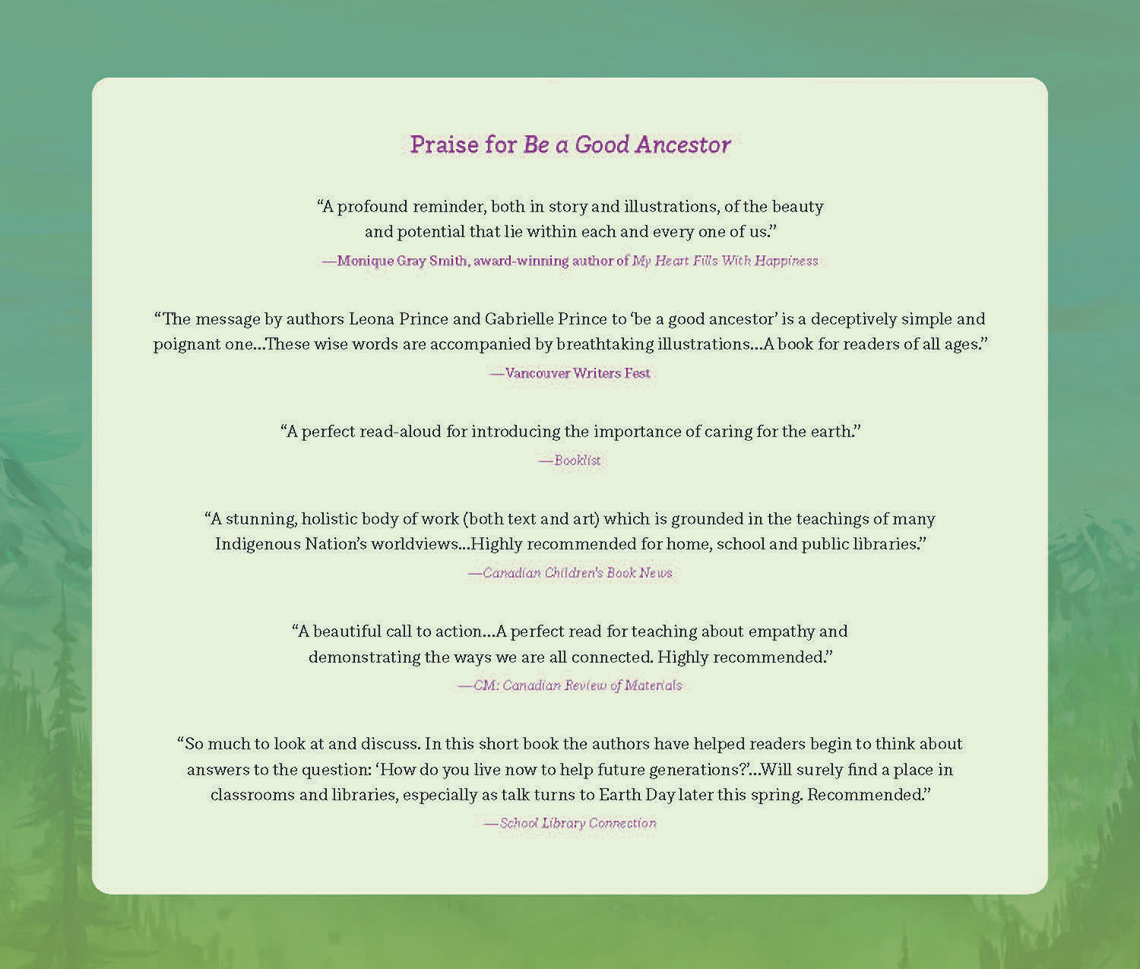
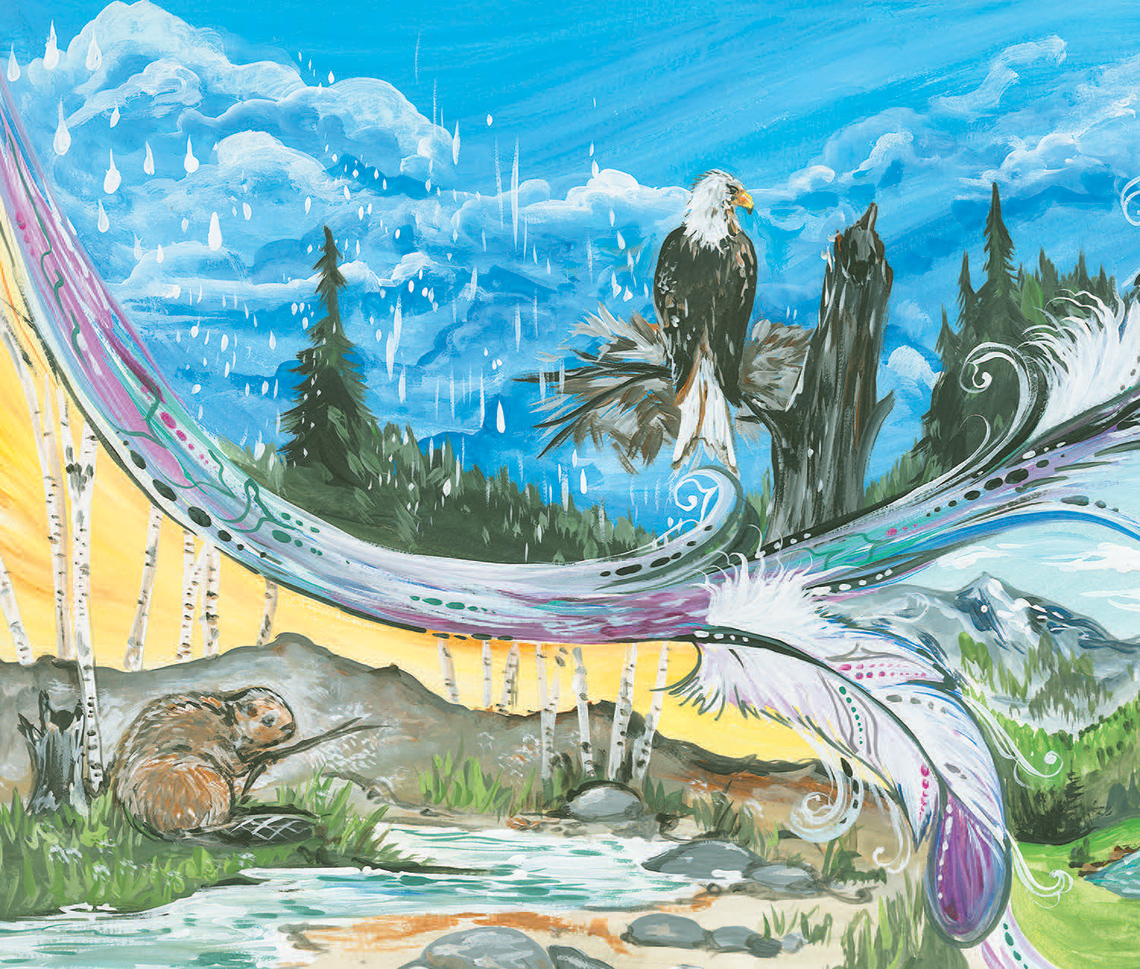
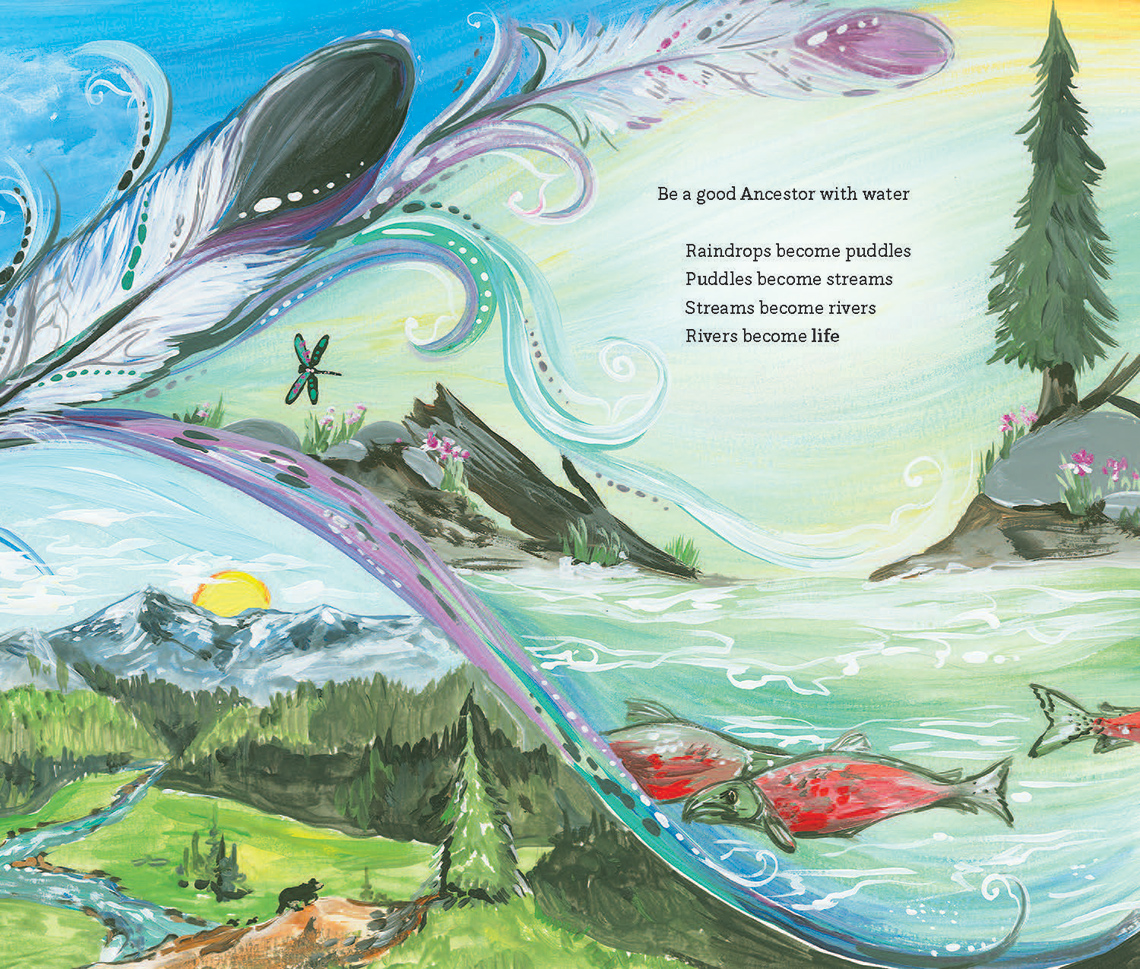
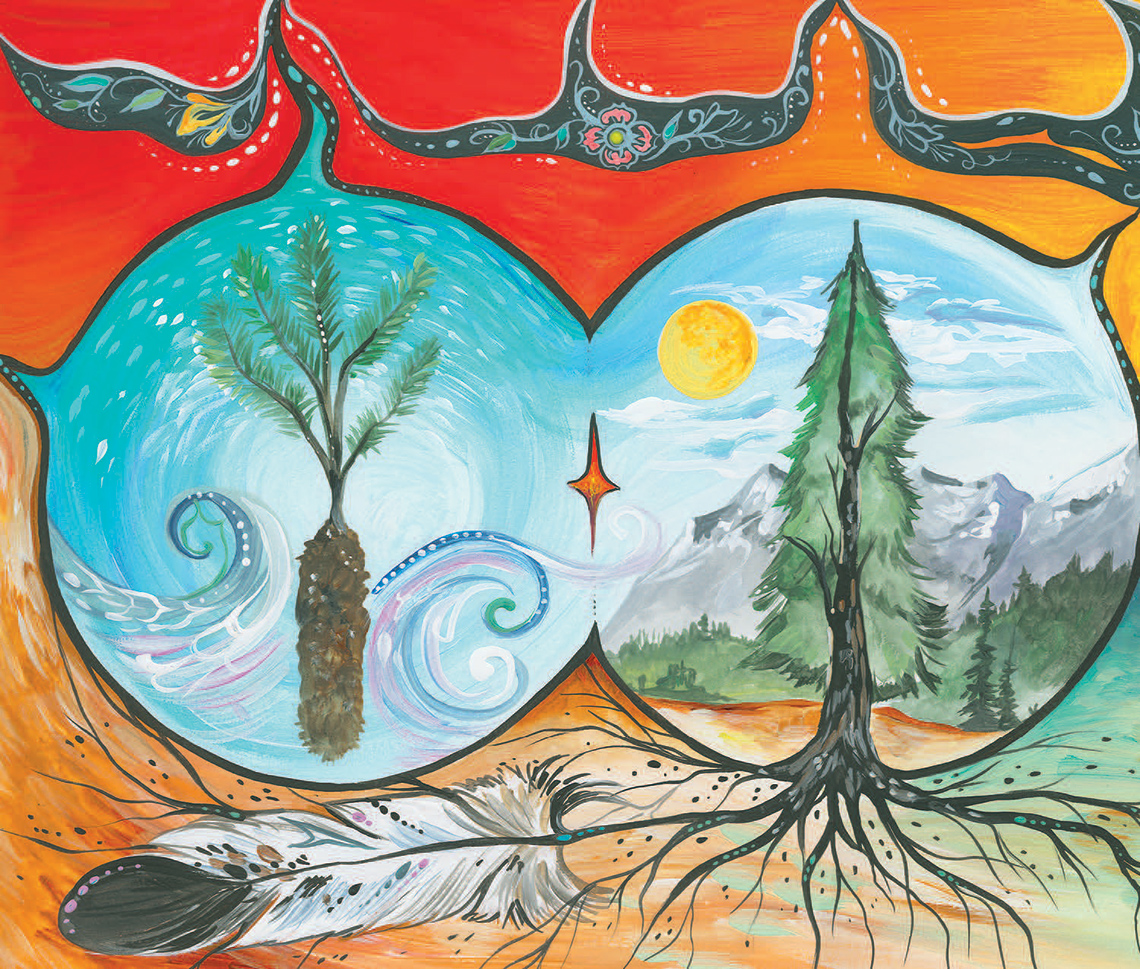
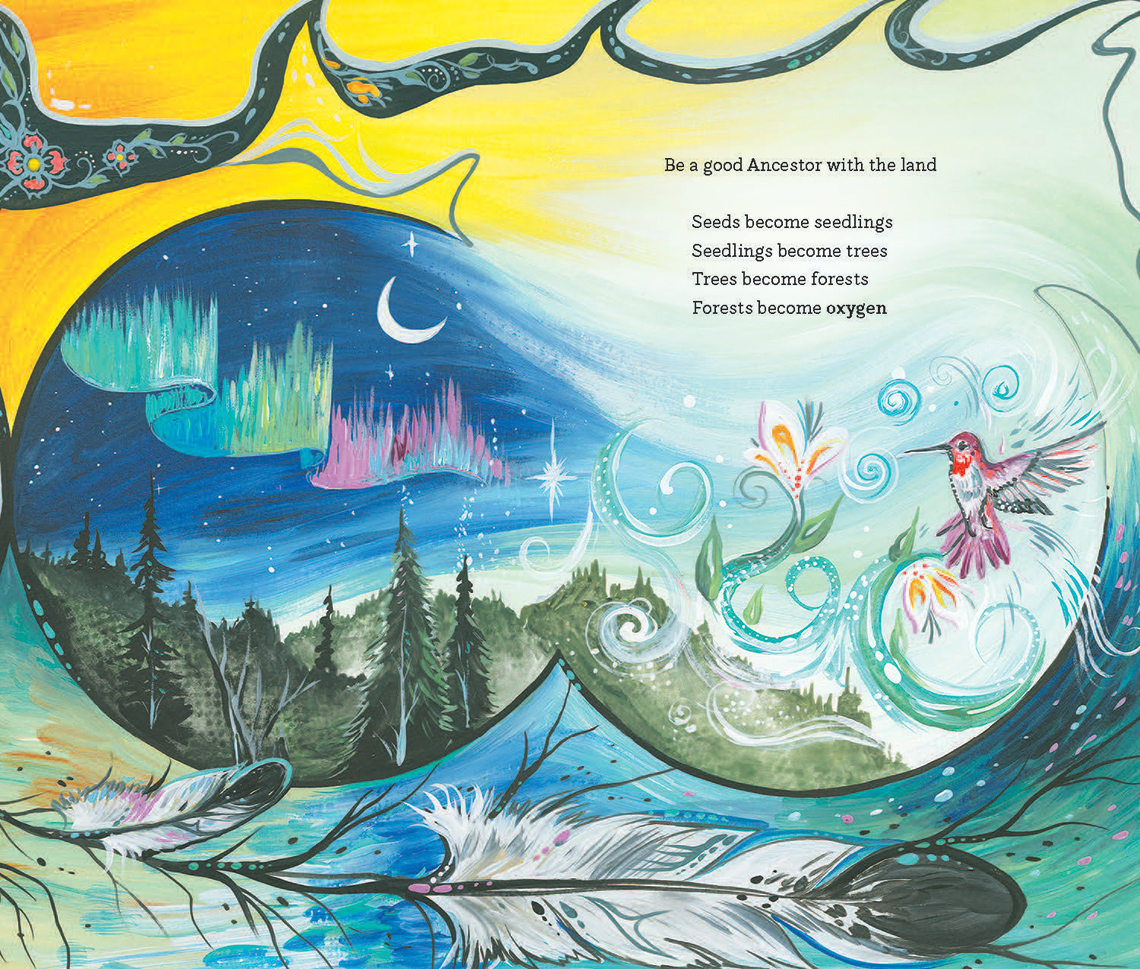
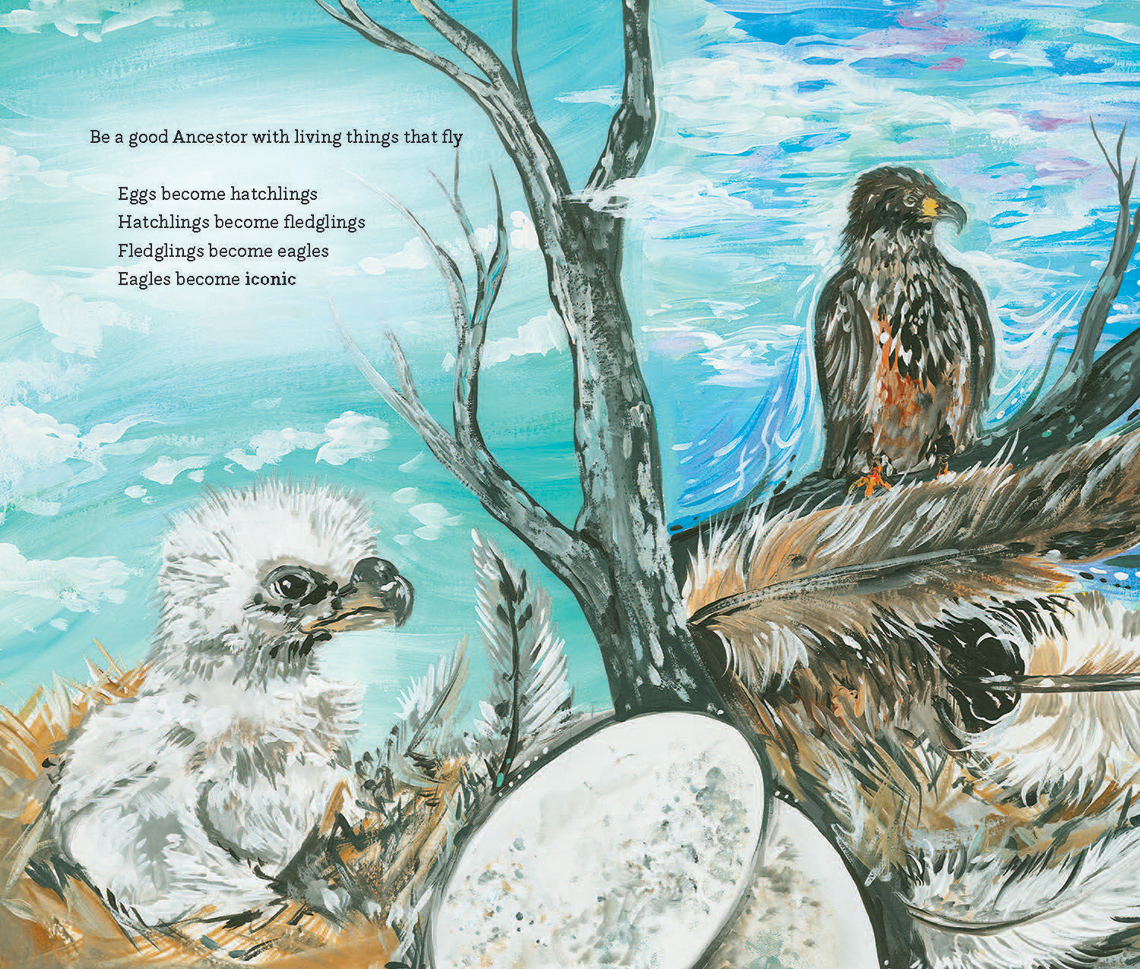
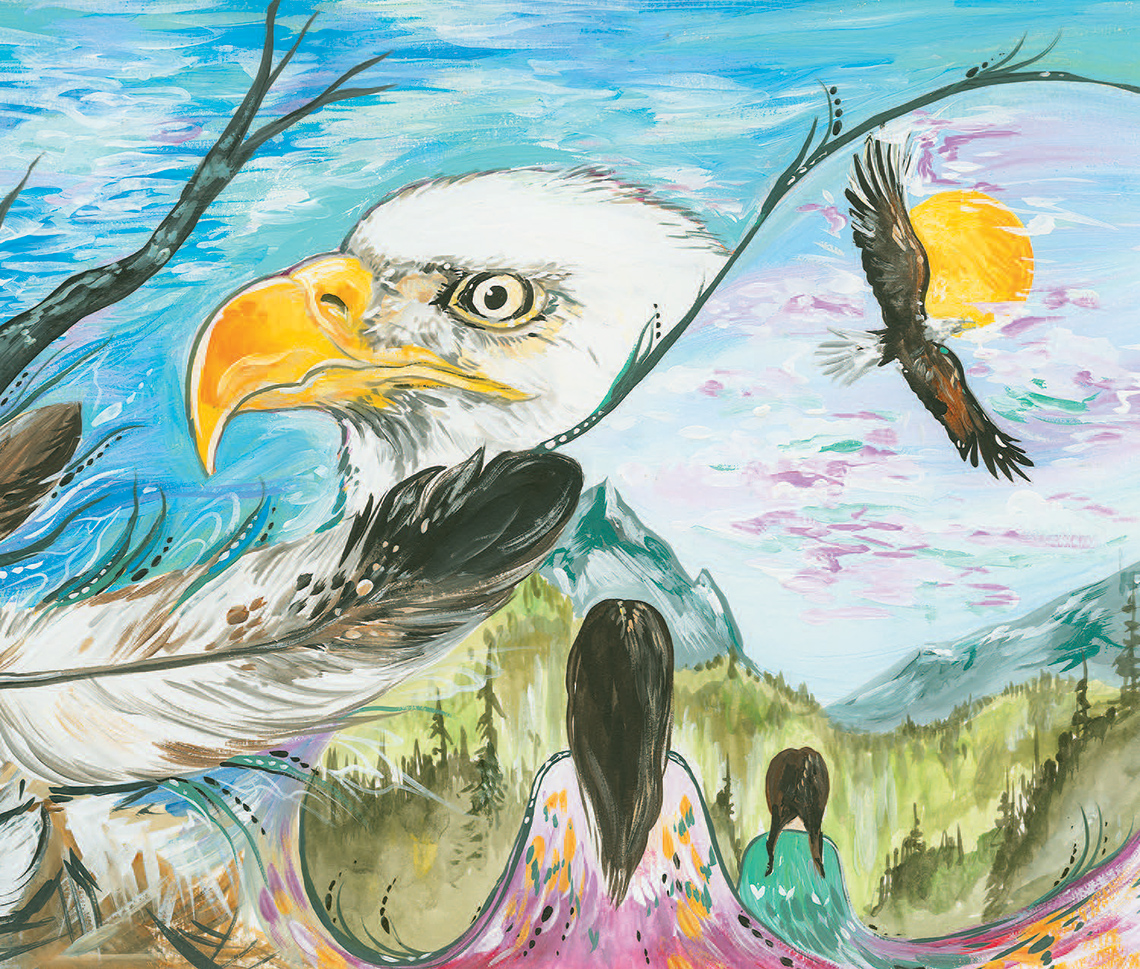
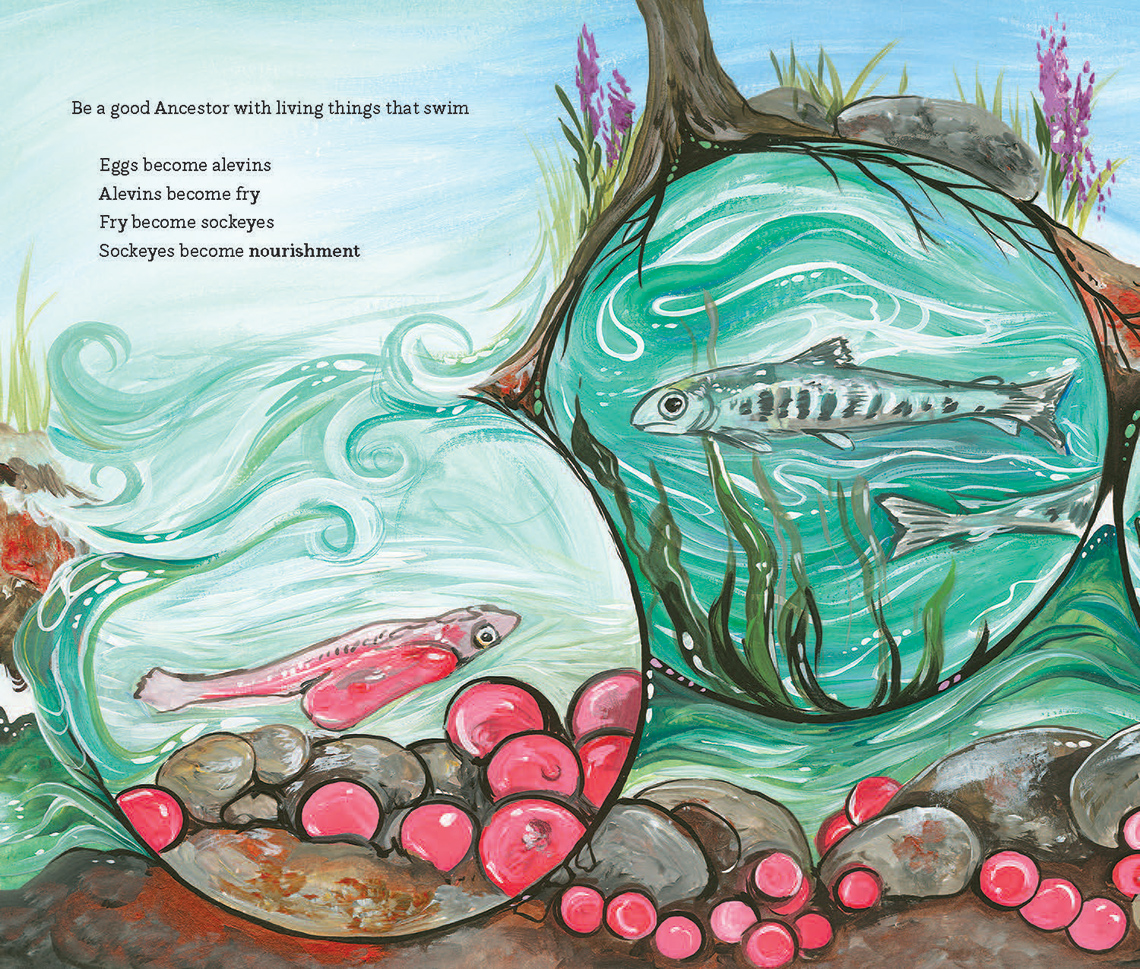
Image 1:
There is and elder person and a child looking out mountains and forest. There is an eagle flying in the sky.
Image 2:
This page consists of different advance praises for the book.
One of the praises reads:
“A perfect read-aloud for introducing the important of caring for the earth”
Image 3:
This is the title page.
This page reads:
Be a Good Ancestor
Leona Prince and Gabrielle Prince
Illustrated by Carla Joesph
Orca Book Publishers
Image 4:
There is a bever near a dam holding a piece of grass in their hands. There is an eagle sitting on a tall tree stump. In the background there is a forest of trees and a sky full of clouds. There is a feather flowing across the page.
Image 5:
The same feather is flowing in this page which splits up the images. The bottom image is a scenery of a river flowing into the forest with mountains in the background. The sun is peeking out of the mountains. There is also a small bear walking up a small hill near the river.
The top image is of fish swimming under water. Above the water there is a dragon fly and a small tree.
This page reads the following with the word life bolded:
Be a good Ancestor with water
Raindrops become puddles
Puddles become streams
Streams become rivers
Rivers become life
Image 6:
This page is split between two images that are in a shape of a circle but are connected. The first circle has a small growing tree, and the second has the tree with the roots growing out underground. One of the roots is connected to a feather.
Image 7:
The roots from the tree continue onto the bottom of this page with two feathers. On the top there is a scenery of the top of a forest in the night sky. The moon and stars are in the sky. The night sky blends into scenery of a hummingbird and small flowers.
This page reads the following with the word oxygen bolded:
Be a good Ancestor with the land
Seeds become seedlings
Seedlings become trees
Trees become forests
Forests become oxygen
Image 8:
There are two baby eagles sitting. One is sitting on a branch and the other in a nest with two eggs.
This page reads the following with the word iconic bolded:
Be a good Ancestor with living things that fly
Eggs become hatchlings
Hatchlings become fledglings
Fledglings become eagles
Eagles become iconic
Image 9:
There is an elder and a young child looking out into the forest and mountains. There is an eagle flying in the sky with the sun shining in the sky. On this page at the top left there is a large image of a side view of an eagle with a large feather underneath.
Image 10:
There are several eggs underwater with an alevins floating on top. There is also sockeyes swimming.
This page reads the following with the word nourishment bolded:
Be a good Ancestor with living things that swim
Eggs become alevins
Alveins become fry
Fry become sockeyes
Sockeyes become nourishment
Take a moment to reflect what you have read so far before you continue.
Description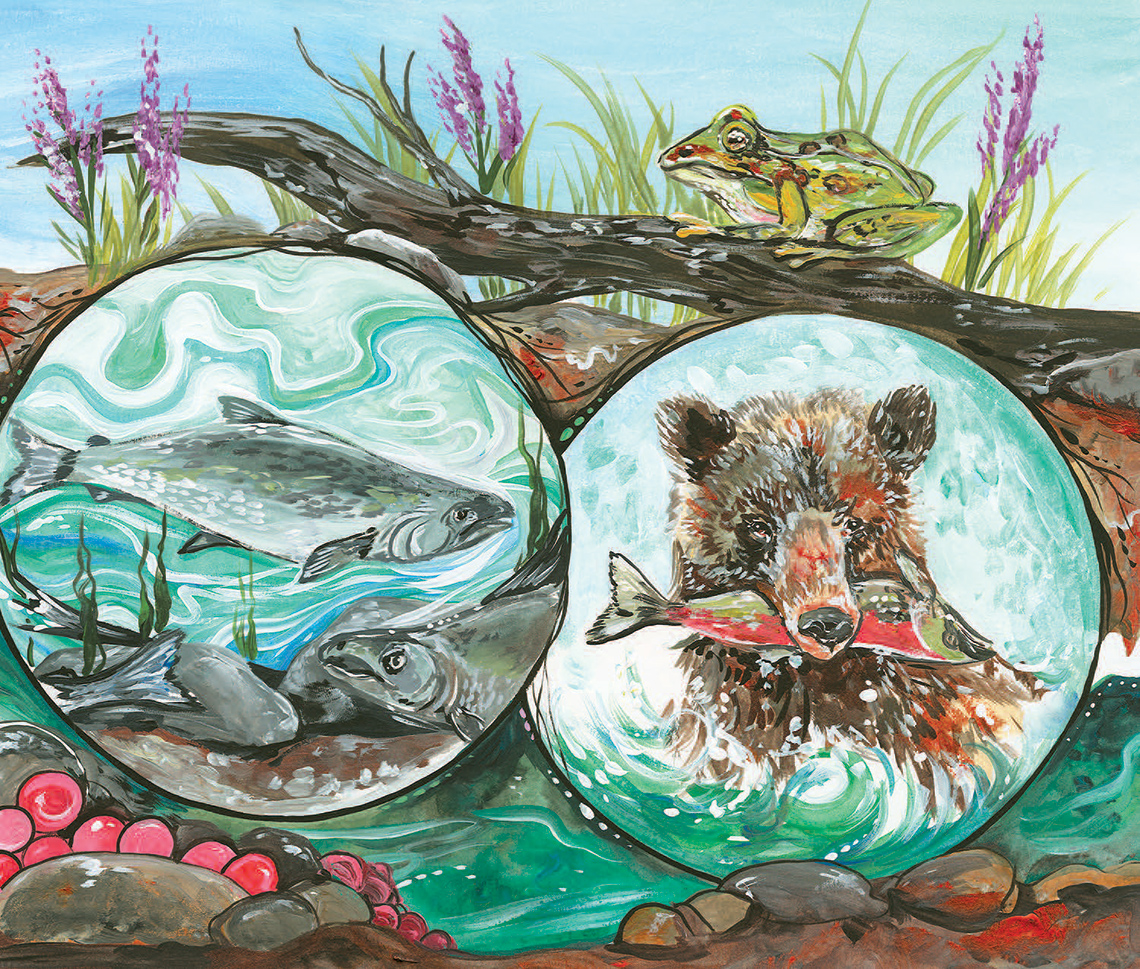
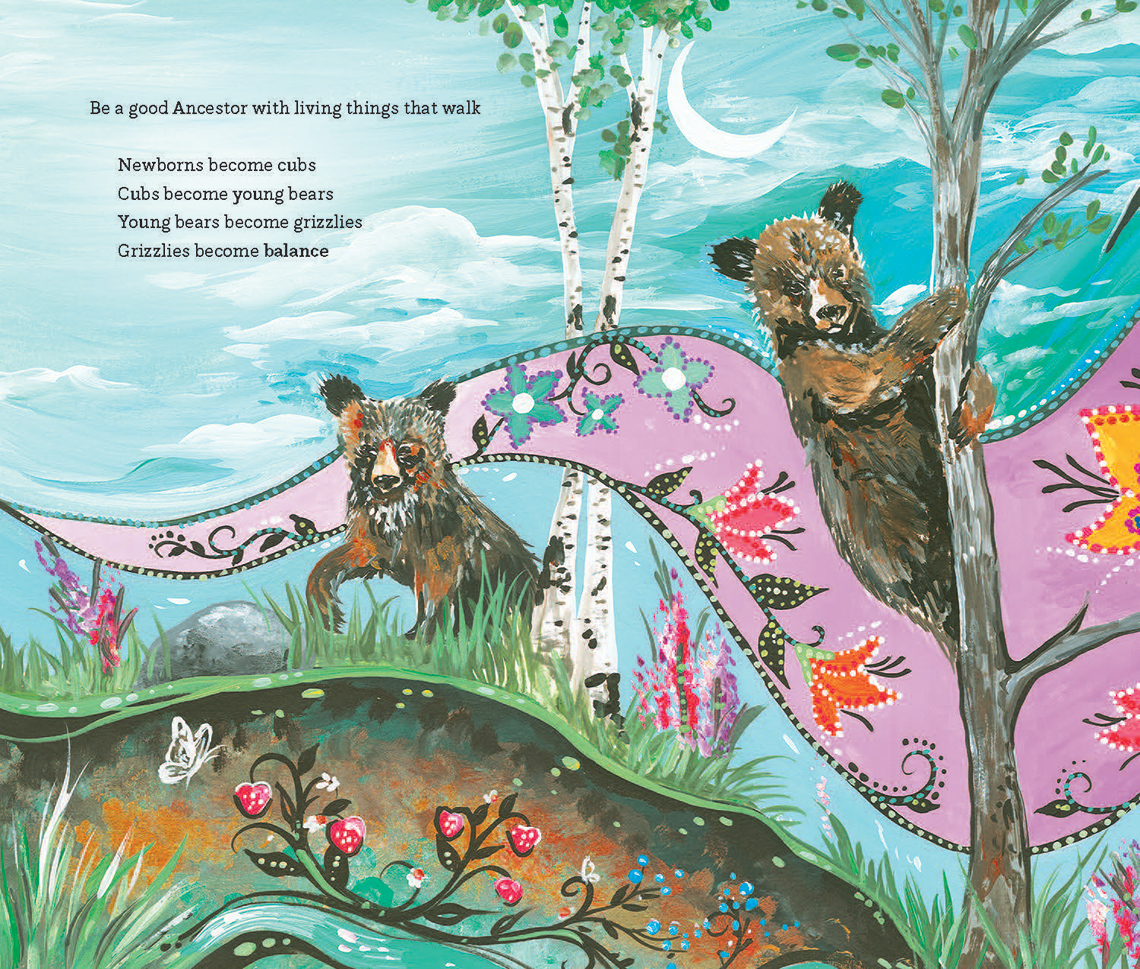
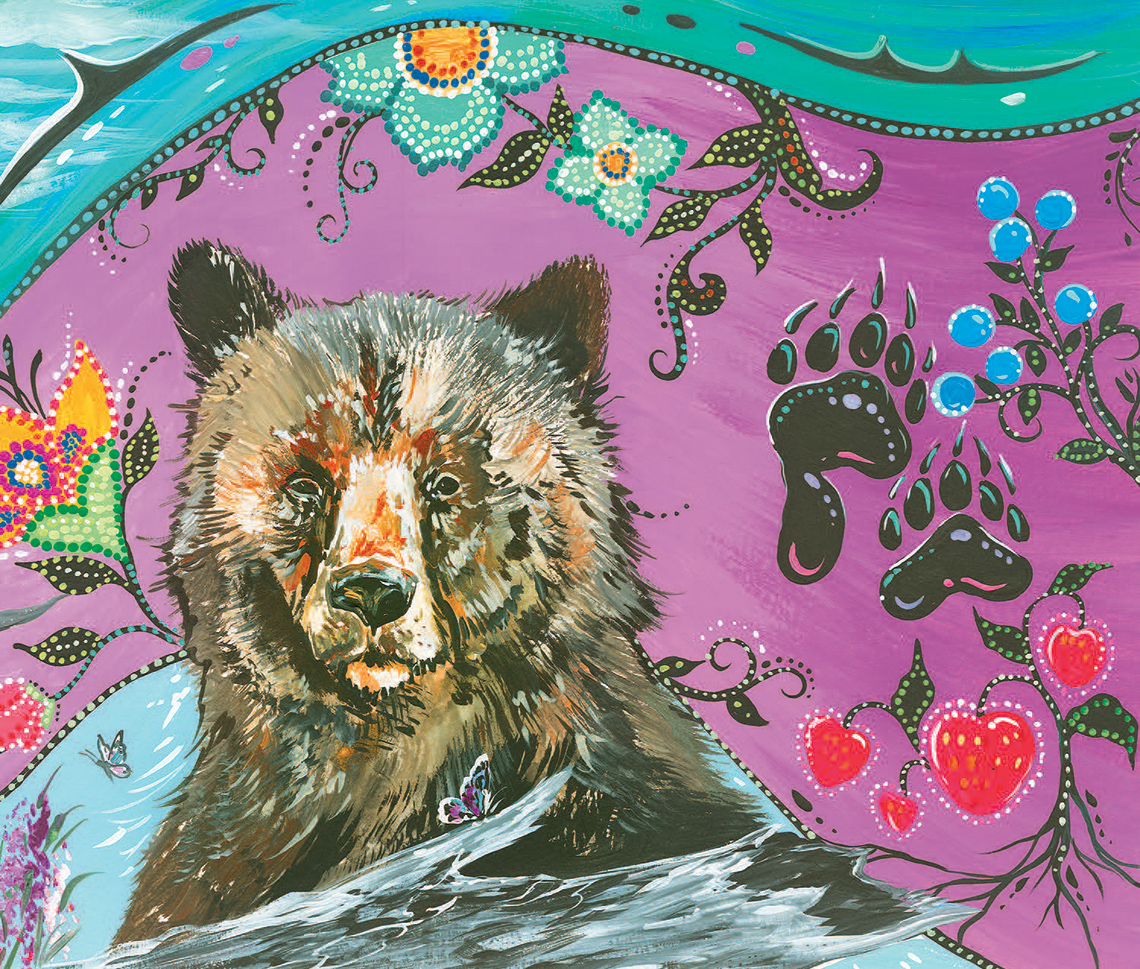
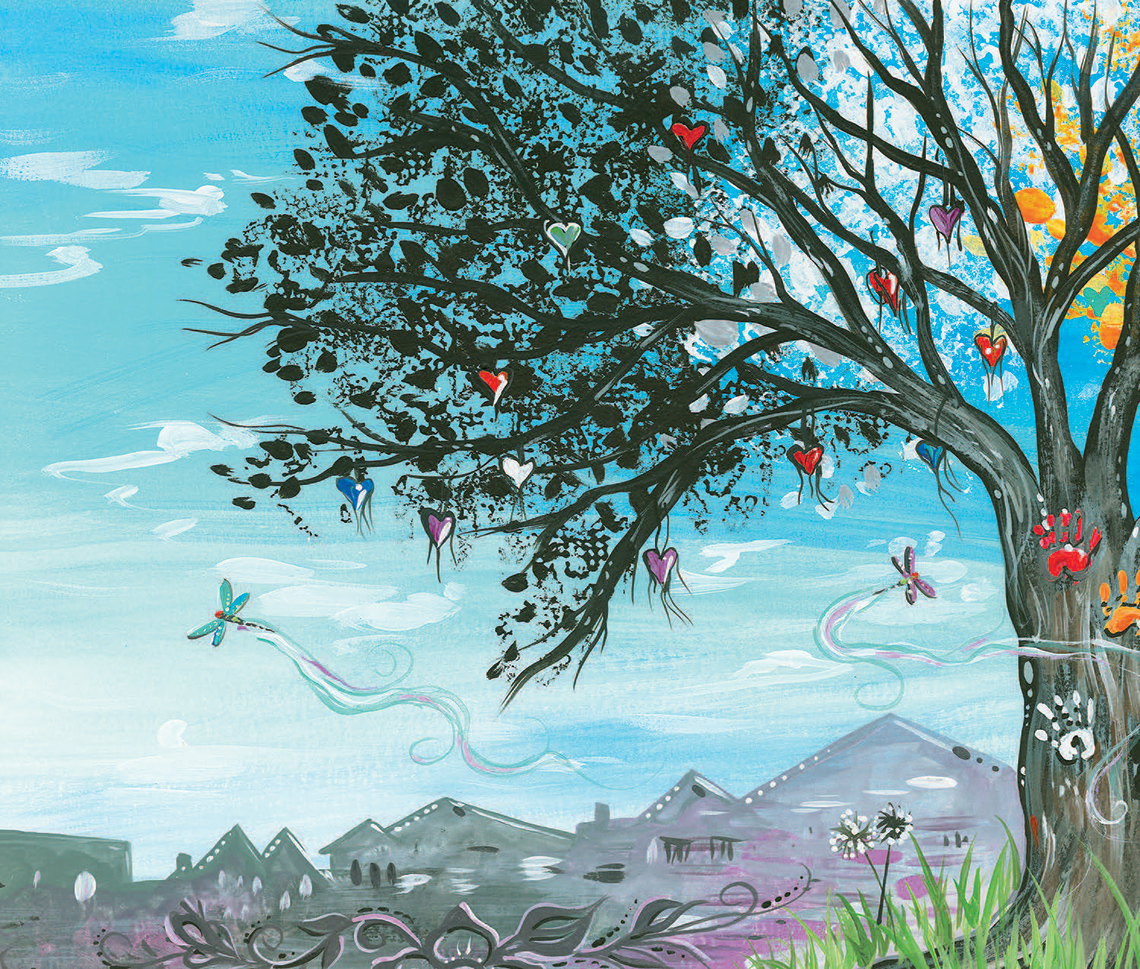
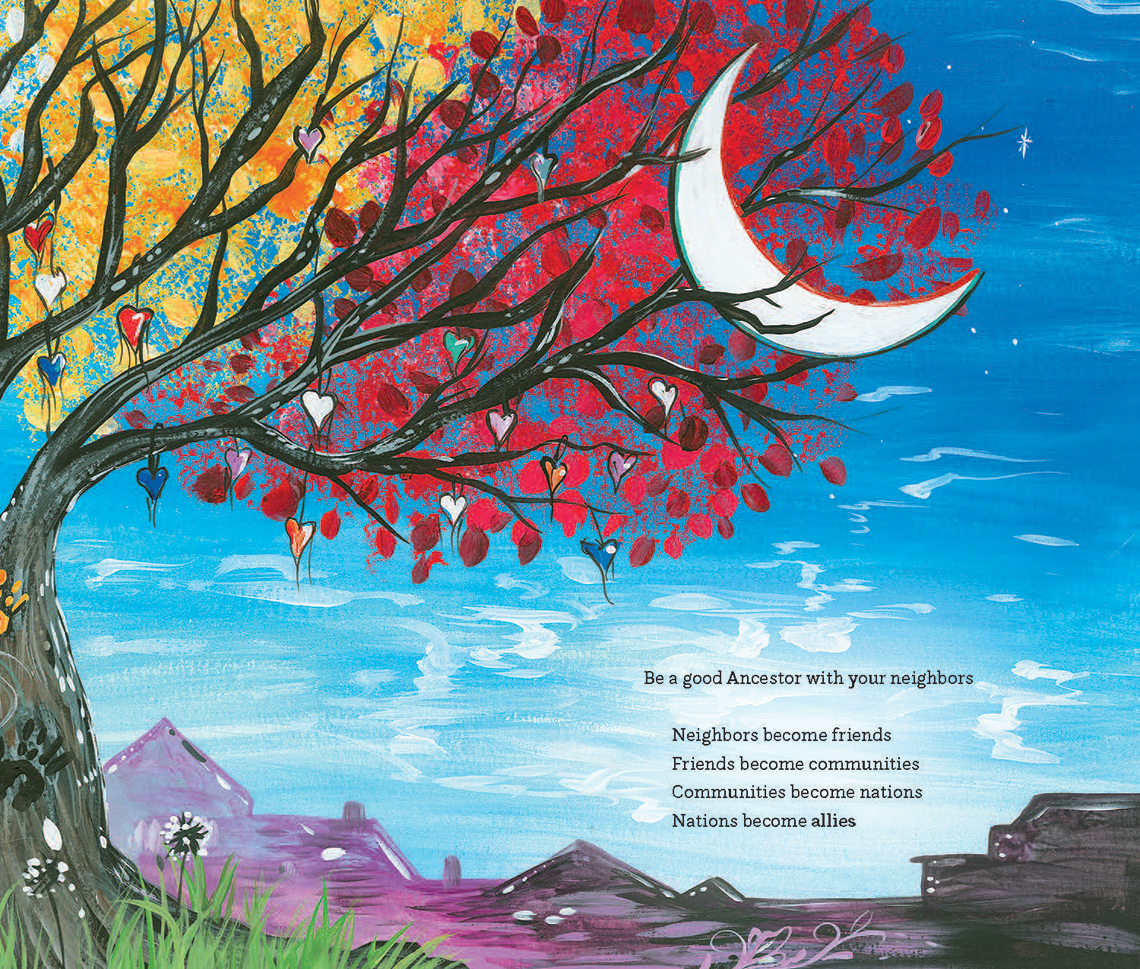
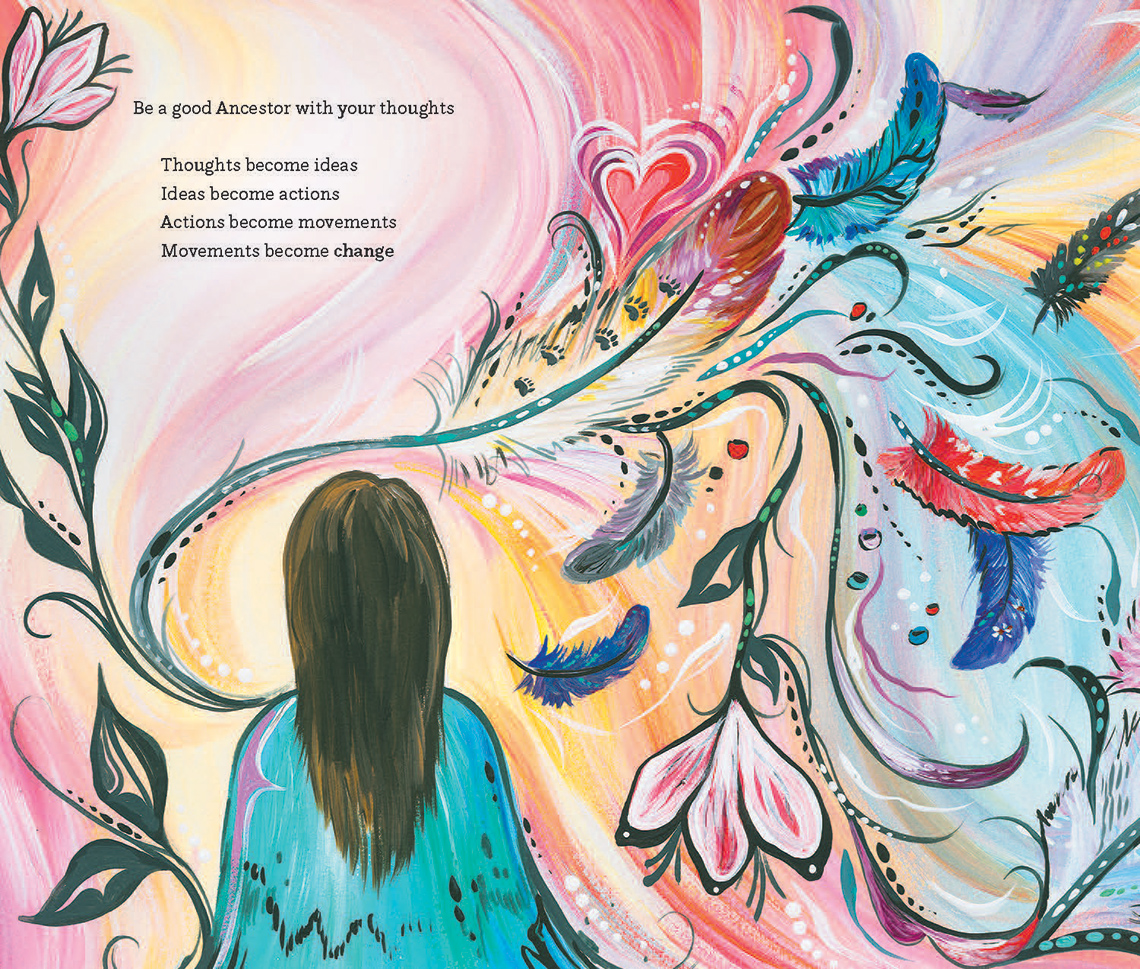
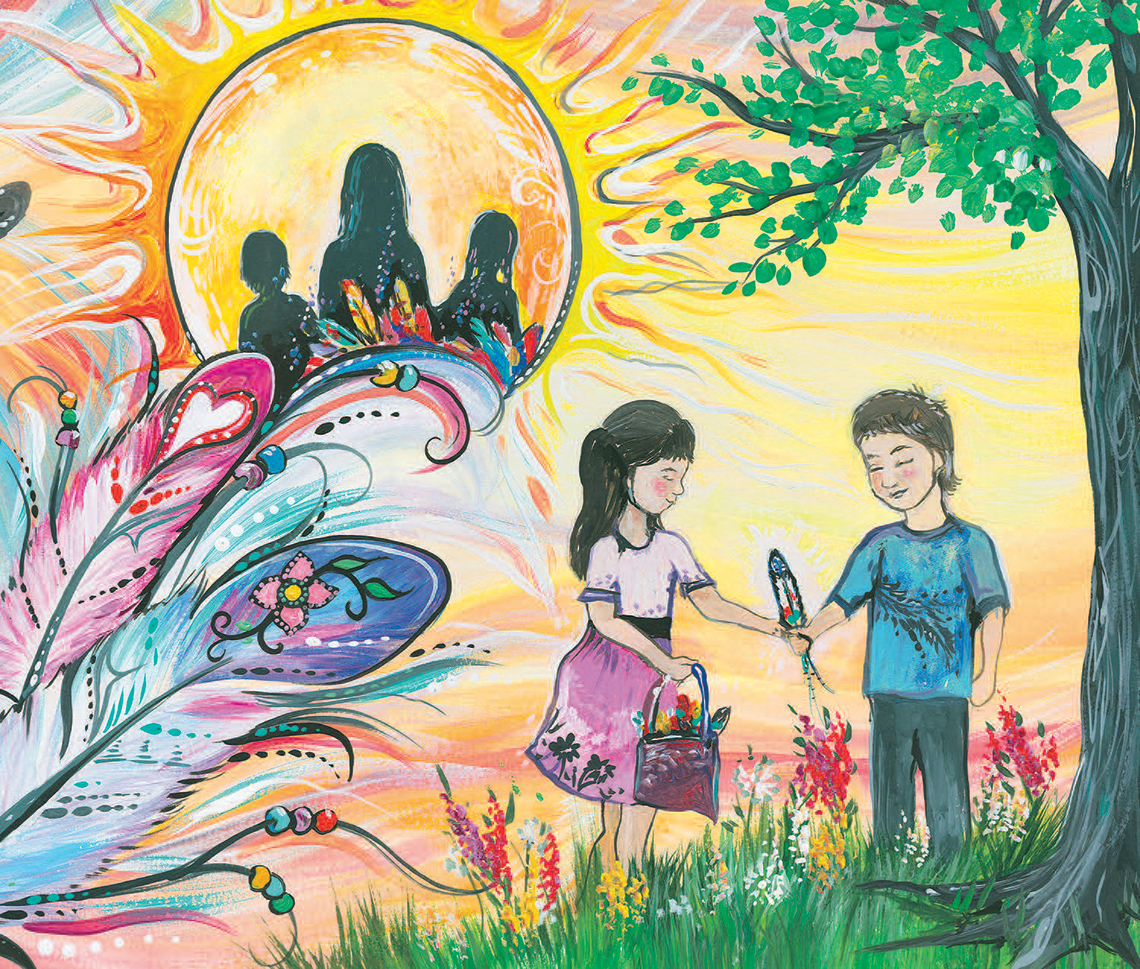
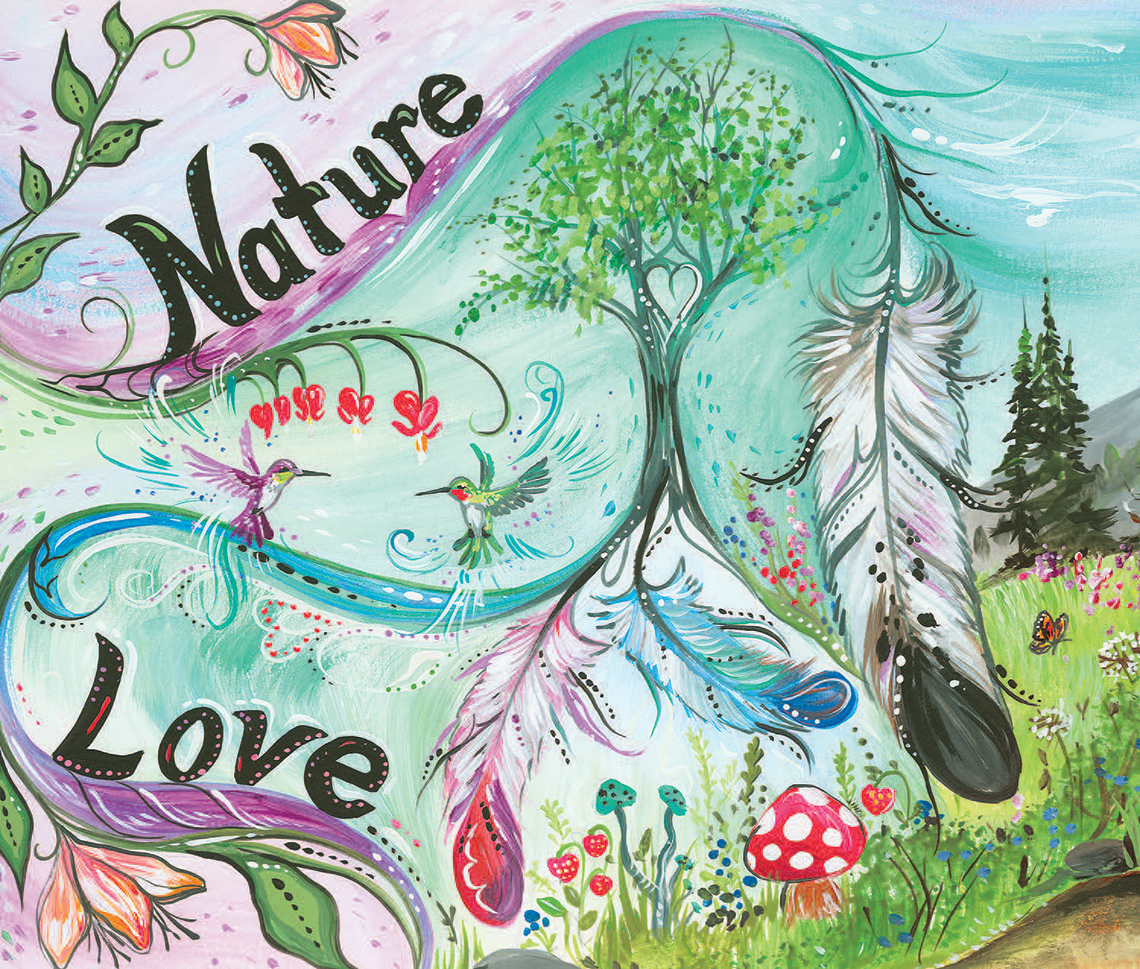
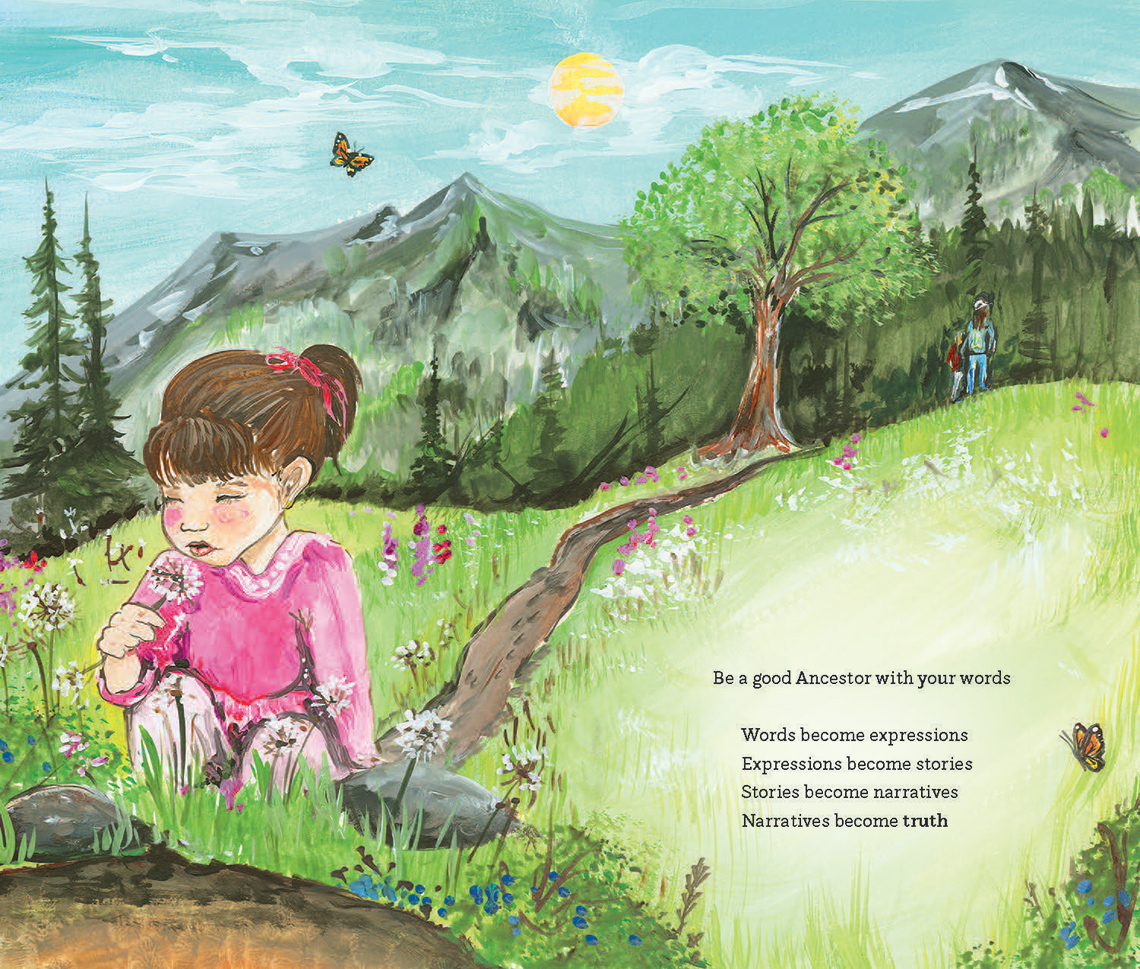
Image 1:
There is a frog sitting on top of a large branch. Under the branch there are two sets of images. The first image is underwater with three sockeyes swimming. The second image is of a bear with a fish in his mouth.
Image 2:
There is a baby bear climbing a tree an another bear in the grass.
This page reads the following with the word balance bolded:
Be a good Ancestor with living things that walk
Newborns become cubs
Cubs become young bears
Young bears become grizzlies
Grizzlies become balance
Image 3:
There is a large image of a grizzly bear with footprints and branch with different flowers in the background.
Image 4:
A large tree with branches that have leaves. There are heart shaped ornaments hanging from the branches. On the tree trunk there are three handprints. There is an outline of house roof tops in the background with a dragonfly flying away.
Image 5:
There is a tree filled with leaves and heart shaped ornaments hanging all over. There is also a moon sitting in one of the branches. The background has an outline of house rooftops.
This page reads the following with the word allies bolded:
Be a good Ancestor with your neighbours
Neighbours become friends
Friends become communities
Communities become nations
Nations become allies
Image 6:
A teenage child with different leaves and feathers flowing in the background.
This page reads the following with the word change bolded:
Be a good Ancestor with your thoughts
Thoughts become ideas
Ideas become actions
Actions become movements
Movements become change
Image 7:
The bottom left corner has large feather peaking out. There are two school aged children exchanging feathers in front of a tree. In the background there is a sun with a shadowed outline of an adult and two small children one on each side.
Image 8:
There is a medium size tree in the middle of the page. The roots are attached to feathers. One of the roots spreads out into a curved line with the words “Love” at the end of it. The word “Nature” is mentioned at the top left corner of the page with a feather at the ends.
Image 9:
There is a small child sitting in the grass at the bottom of a hill holding a dandelion in her hand.
In the background there is a forest and a mountain view. The sun is in the sky hiding behind clouds with a butterfly flying.
This page reads the following with the word truth bolded:
Be a good Ancestor with your words
Words become expressions
Expressions become stories
Stories become narratives
Narratives become truth
Continue reading Be a Good Ancestor by Leona Prince and Gabrielle Prince.
Description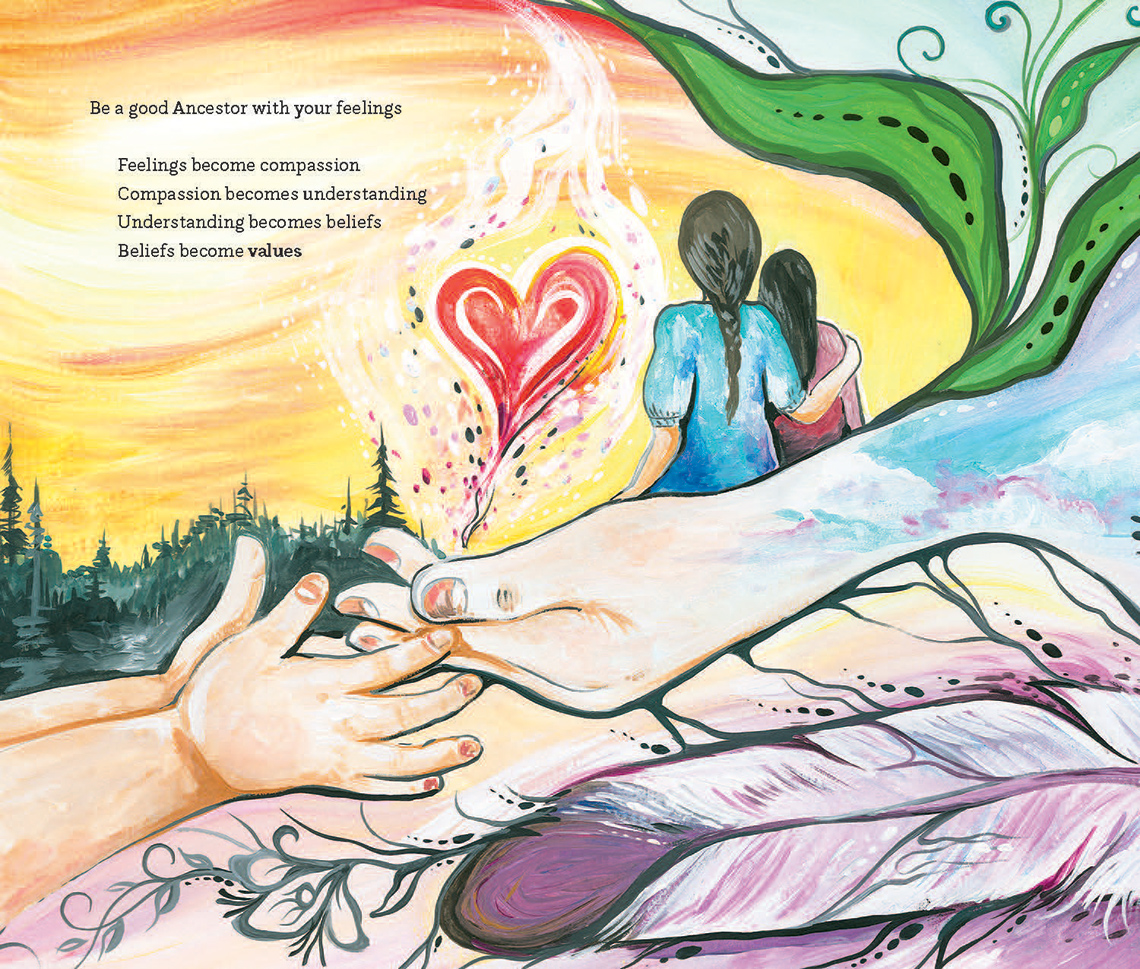
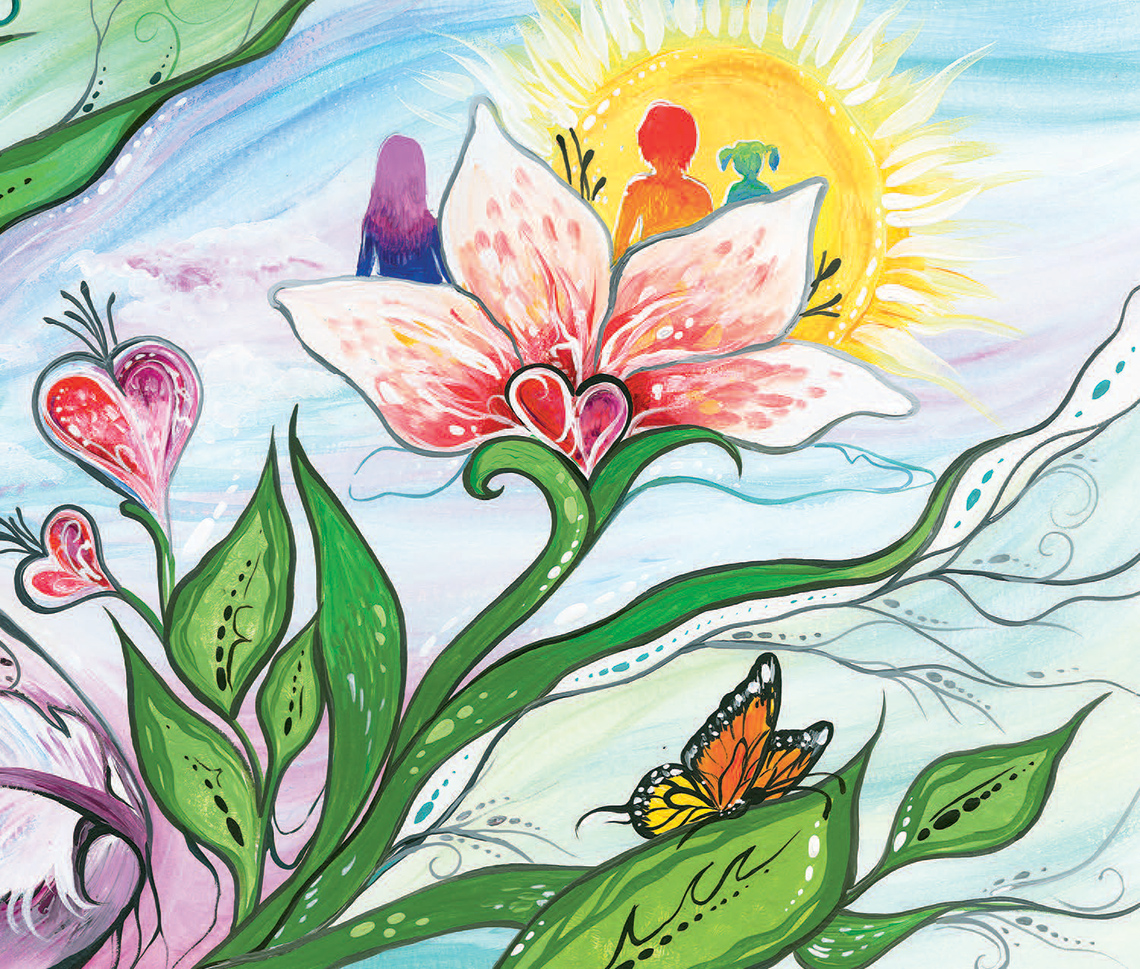
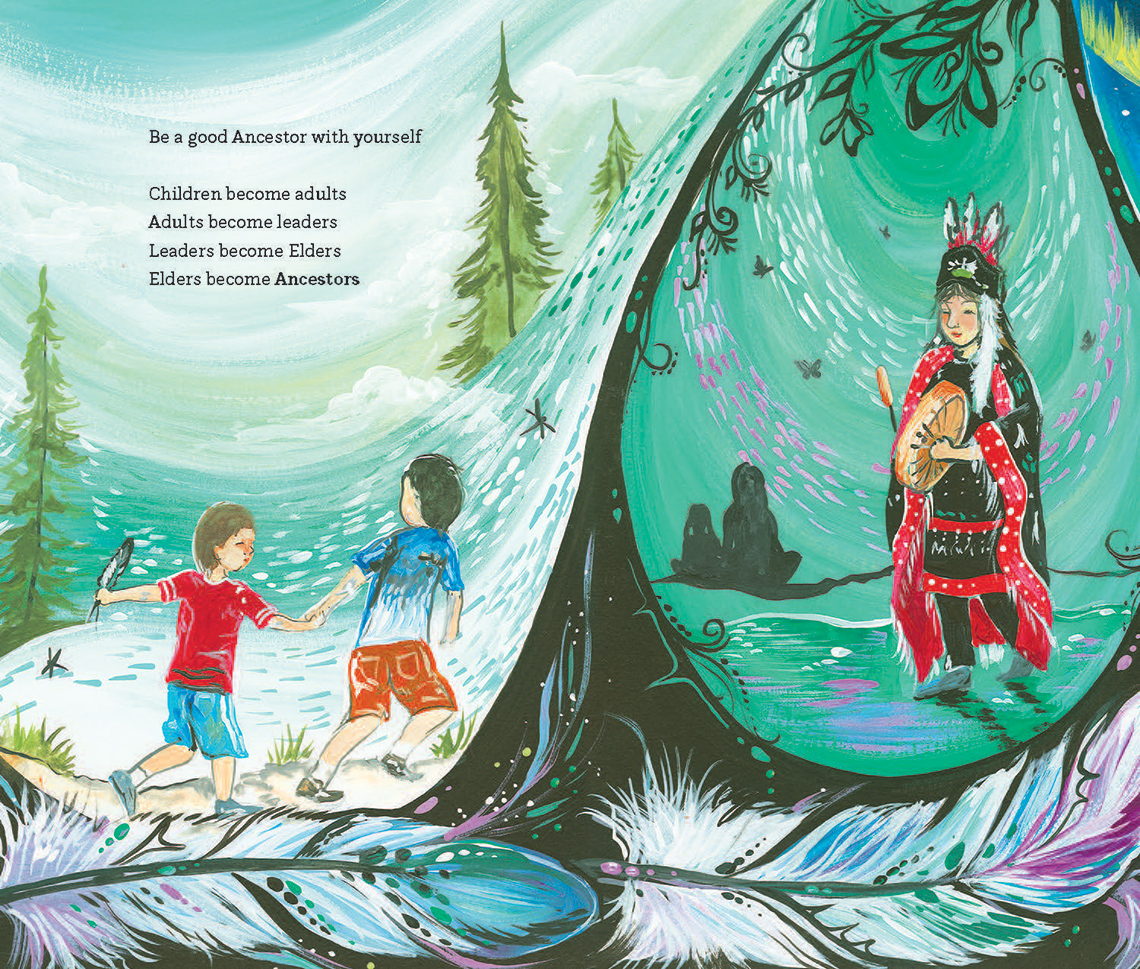
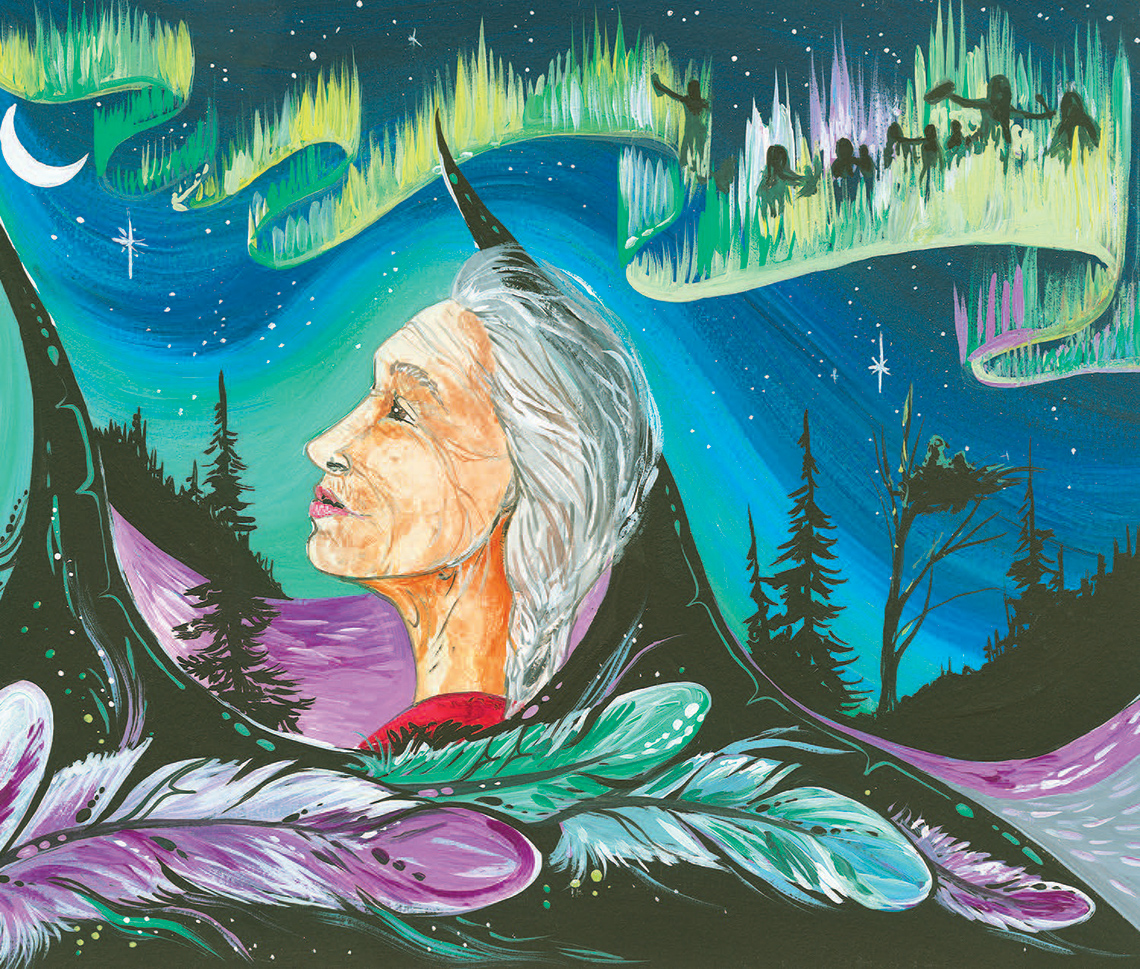
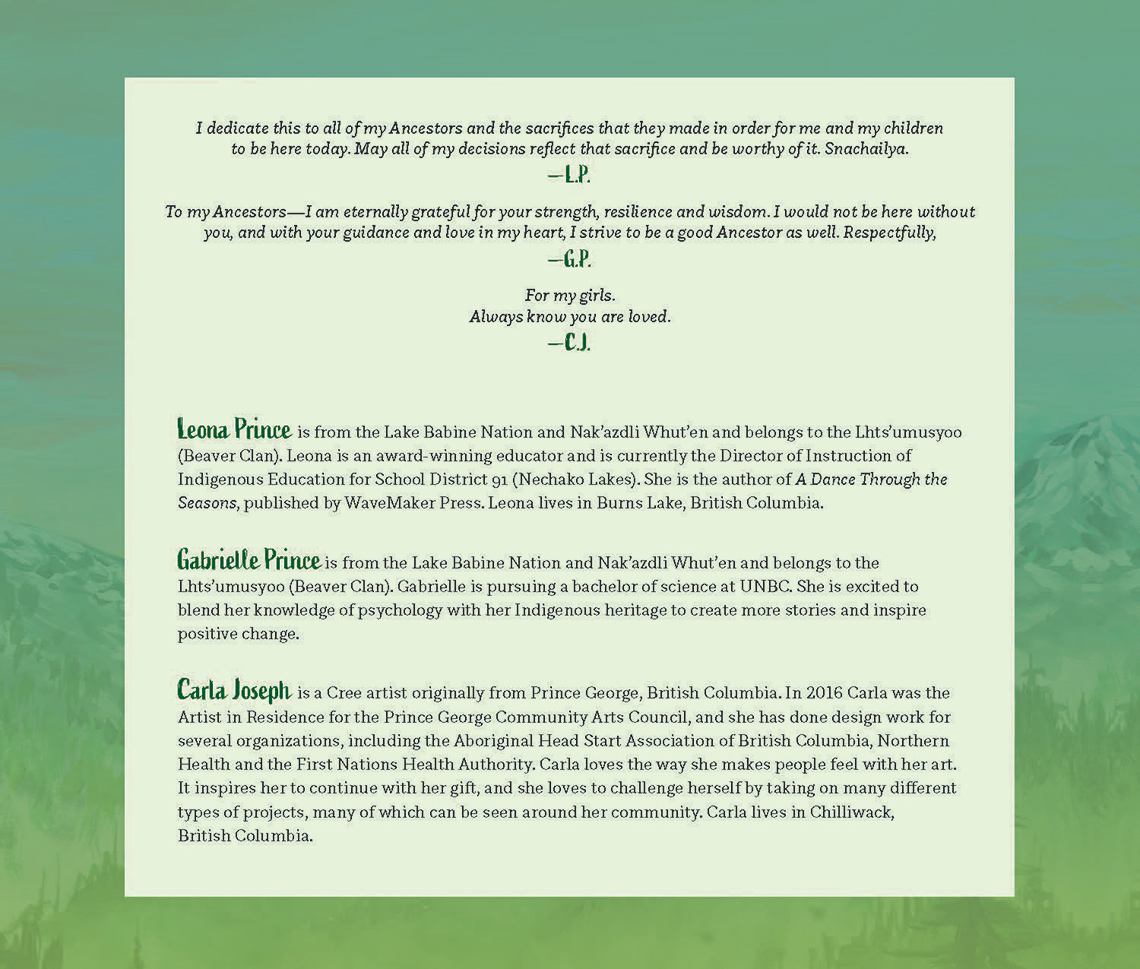
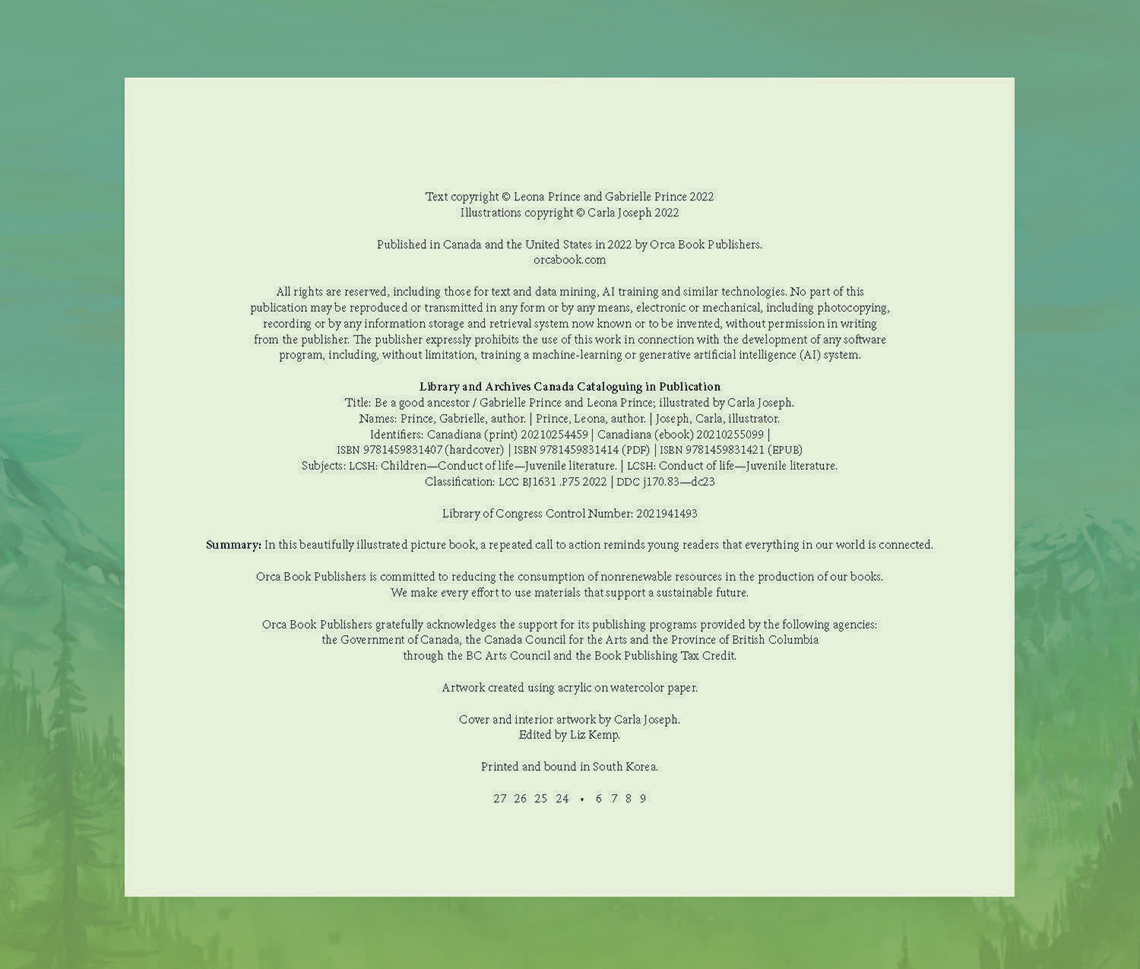
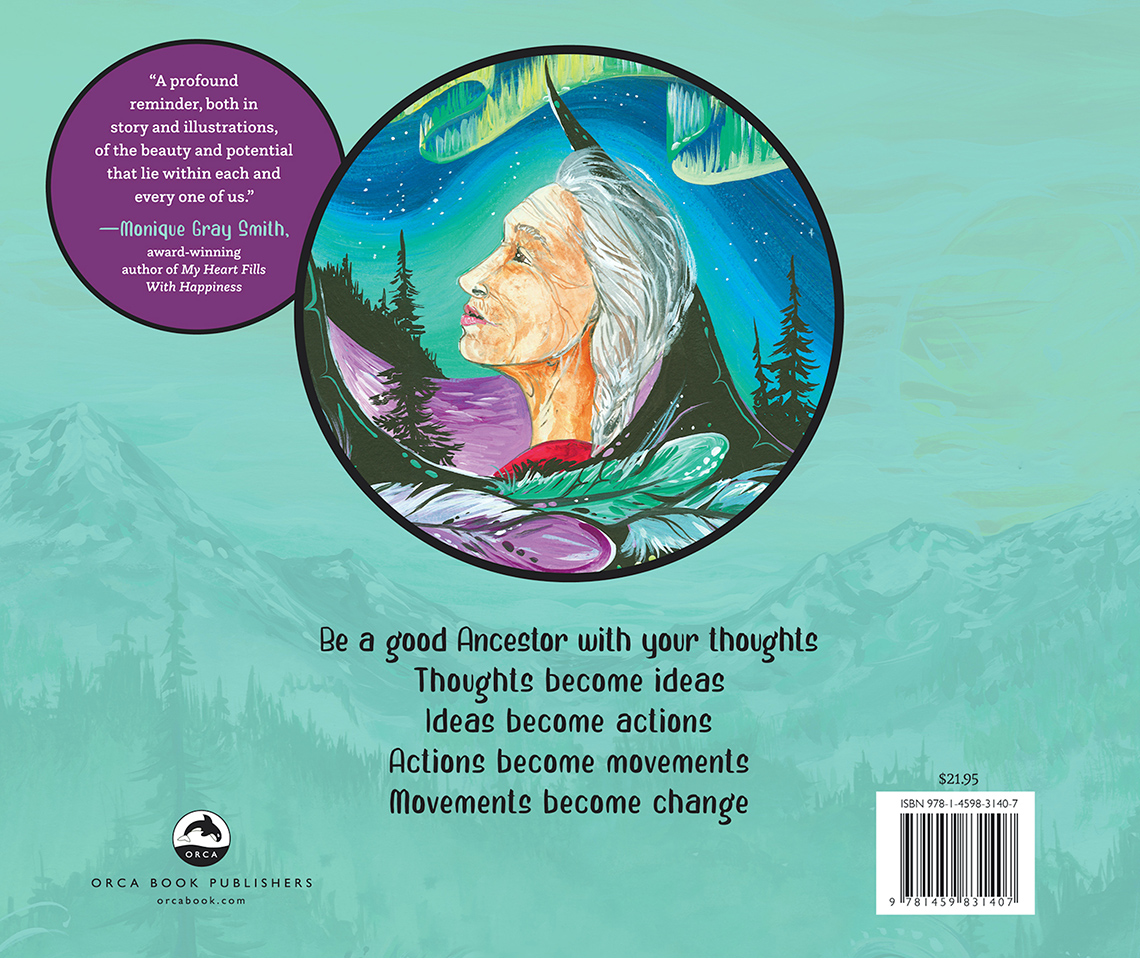
Image 1:
The center of the pages there are hands of a small child reaching towards an adult’s hand. There is a heart floating out from the palms of their hands. Sittig on the arm of the adult hands there is a mother and daughter looking out into the sky.
This page reads the following with the word values bolded:
Be a good Ancestor with your feelings
Feelings become compassion
Compassion becomes understanding
Understanding become beliefs
Beliefs become values
Image 2:
There is a large flower in the middle of the page. On the petals there are three small children sitting. There is the sun in the background.
Image 3:
There are two young boys holding hands and walking. One of them has a feather in their hands. There is also an Elder wearing their cultural clothing and holding an instrument in hands.
This page reads the following with the word Ancestors bolded:
Be a good Ancestor with yourself
Children become adults
Adults become leaders
Leaders become elders
Elders become Ancestors
Image 4:
There is a side view of an Elder looking at the moon in the night sky. In the sky there are also a small group of people holding instruments in hand. The background has trees and in the fore front there are feathers.
Image 5:
This page consists of different dedications for the book.
One of the praises reads:
I dedicate this to all my Ancestors and the sacrifices that they made in order for me and my c children to be here today. May all of my decisions reflect that sacrifices and be worthy of it. Snachailya.
Image 6:
Copyright information of the book Be a Good Ancestor by Leona Prince and Gabrielle Prince. This section of the book lists its publication, legal, copyright, and printing details.
Image 7:
Back of the cover page of the book Be a Good Ancestor by Leona Prince and Gabrielle Prince
In a notebook or using another method of your choice, answer the following question:
- What are some of the ways the authors show interconnectedness in the book Be a Good Ancestor?
When you are ready, press the Sample Answer button to explore a possible response.
In the book Be a Good Ancestor, why do you think the authors chose to bold one word on every page? Why those words and not others? How might this connect to the author’s message?
The author’s messageis the big idea that the author or creator of a text is trying to communicate with us, the audience. It is what they want their audience to know, feel, or do. Sometimes this is also called the author’s purpose.
Your turn!
Practice identifying the author’s message using these sentence prompts to get you started:
In the book Be a Good Ancestor, the authors are saying that…
The authors want the audience to know that…
If needed, press the Possible Answer button for an example of a modelled response.
In the book Be a Good Ancestor, the authors are saying that all living things in the world are connected to each other no matter how small or big. The authors want the audience to know that everyone’s actions and interactions with the environment and each other have an impact on the world.
What is a global citizen?
So far, we’ve explored one definition of the term global citizen. But global citizenship is a big concept! When it comes to big concepts, there is often more than one way of describing or defining them.
Here is another way of defining global citizenship:
“A global citizen is someone who understands interconnectedness, respects and values diversity, has the ability to challenge injustice and inequities, and takes action in a way that is personally meaningful.” (Unicef)
Let’s learn more about being a global citizen! Complete the following activity to explore five characteristics that global citizens possess.
For each sentence, select the missing word from the drop-down menu. Press Check Answer to see how you did.
 Description
Tiara and teacher Ravi talking.
Tiara says: Hmm, I think I already do a lot of these things in my own community!
Teacher Ravi responds: Nice! You are applying your new learning by making personal connections between it and your lived experiences.

Did You Know?
Did you know?
You may have noticed that the things that global citizens do are simply examples of, well–being kind! That is true, but it goes a little deeper than kindness. Demonstrating empathy and compassion are at the heart of being a global citizen. Empathyis the ability to recognize and share the thoughts and feelings of another person, animal, character, etc... Compassionis when you relate to someone else’s feelings or situation, and you want to take action and do something about it.
Now it is YOUR turn!
What might global citizenship look like in your life?
Think of actions that you have taken in the past or could do in the future. Try to think of one specific action for each of the five characteristics listed in the matching activity.
For example, for “Helping others in need”, you might remember a time that you helped a neighbour carry their groceries.
Share your examples orally with a partner or record them using a method of your choice. If you are writing your ideas digitally or on paper, you could make a list, a table, or a web, and title it “Global Citizenship Looks Like…”

Social Emotional Learning
Social emotional learning

You’re doing great! It’s time for a short break!
Exploring interconnectedness through texts
As we think about the concepts of interconnectedness and global citizenship, it is important to remember that it starts small, and it begins with you–with each of us. Parts of our identity such as our age, where in the world we live, and access to resources are going to influence what is possible for each of us to do. Think globally, but act locally, within your circle of influence. Small actions that you take within your home, peer circle, school, community, etc., add up and it all helps the world to be a better, kinder, and more sustainable place!
Understanding who YOU are and the connections that are important to you is the first step to understanding the world around you and your place within it. We need to be able to identify our own feelings and the things and people that we feel connected to in order to feel empathy towards others and identify changes we want to make in the world around us.
Journalling, poetry, and writing in general are one way of exploring our emotions and connections and expressing ourselves creatively.

Reading Time
My Heart Soars
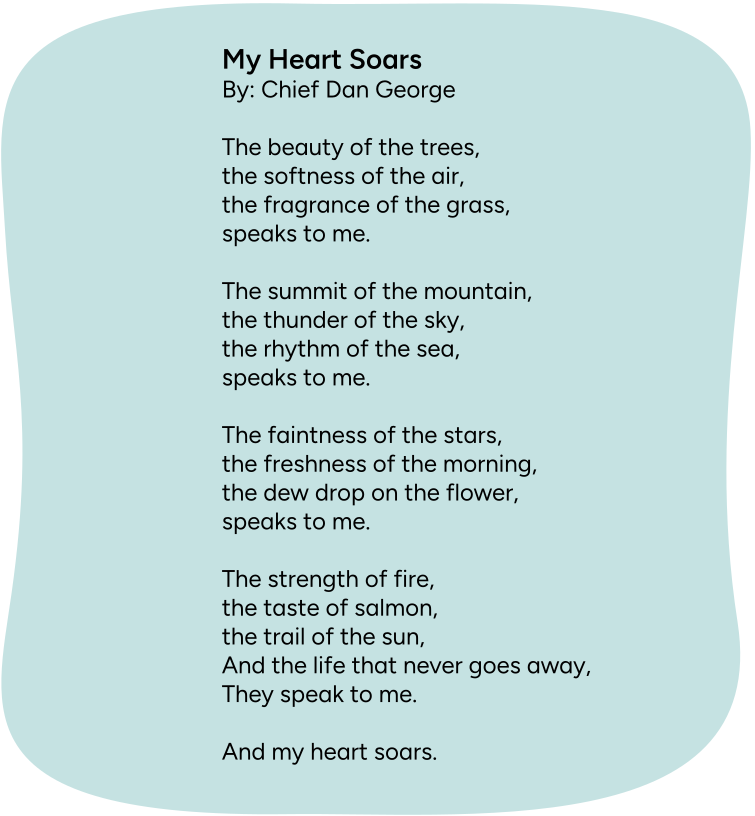
Let’s read the poem My Heart Soars by Chief Dan George (1899-1991) who was a leader of the Tsleil-Waututh Nation in Northern British Columbia, actor, poet, author, and musician. His poem explores his identity and the interconnectedness he feels with the land and all the elements within it.
As you read, think about what message the author wants you to take from this poem.
 Description
My Heart Soars By: Chief Dan George
The beauty of the trees,
the softness
of the air,
the fragrance of the
grass,
speaks to me.
The summit of the mountain,
the
thunder of the sky,
the rhythm of the
sea,
speaks to me.
The faintness of the stars,
the
freshness of the morning,
the dew drop
on the flower,
speaks to me.
The strength of fire,
the taste of
salmon,
the trail of the sun,
And the life that never goes away,
They speak to me.
And my heart
soars.

Reading with fluency!
After reading the poem aloud at least once, go back and pay attention to the punctuation used in the poem.
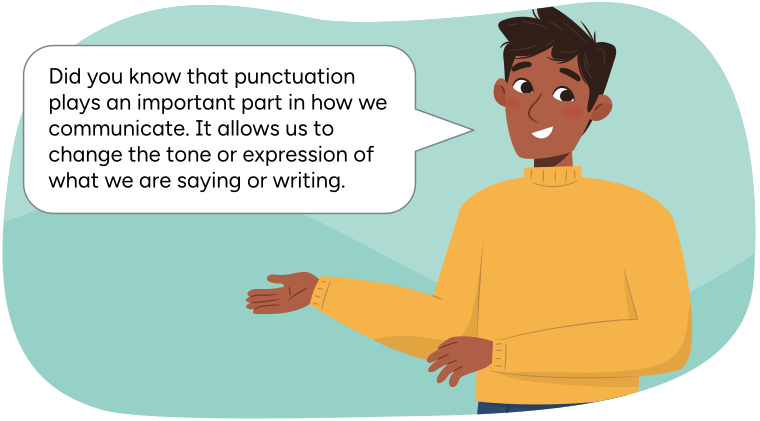 Description
Let’s explore two punctuation marks used in the poem and the effect they are intended to have when we’re reading the poem.
| period | . | Pause completely, then continue. |
|---|---|---|
| comma | , | Pause, slow down slightly. You might take a breath here before continuing. |

Try It
Try it!
Now, try reading the poem aloud again, this time mirroring the author’s intended speed and pausing based on the punctuation.
- How do those purposeful pauses change or help the sound of the poem?
- Do they change or help communicate the meaning of the poem?
Practice reading the poem until you feel comfortable that your pronunciation and pausing are fluent. If possible, record yourself using an audio recorder, and listen to your reading. Are you satisfied with your speed, volume, pausing, and expression?
Review your progress with this self-assessment checklist:
| Criteria | Working On it | Got it |
|---|---|---|
|
I can read all of the words without error. |
||
|
I am pausing purposefully for punctuation. |
||
|
I am reading at a pace where I can be understood. |
||
|
My voice sounds dramatic and expressive! |
Exploring the author’s message
What do you think the author’s message is in the poem?
Remember, you can communicate your thoughts by using the following sentence starters:
In “(insert title of text)”, (insert the author’s name) is saying that…
They want the audience to know that…”.
If needed, press the Possible Answer button for an example of the author’s message.

Pause and Reflect
Bringing it all together
Answer the following questions orally, digitally, in print, or using another method of your choice:
- In what ways is the author’s message in the poem “My Heart Soars” similar to the messages in the book Be a Good Ancestor?In what ways is it different?
- In what way does the poem “My Heart Soars” reflect the ideas of interconnection, global citizenship, empathy, and compassion?
Composition activity
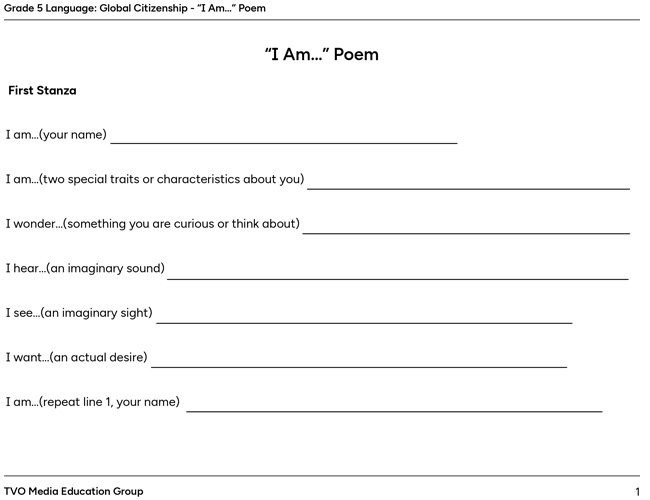
Now, it is your turn to write a poem about yourself, your emotions, and the things you feel connected to. I Am poems are a great opportunity for us to reflect on who we are and express that in writing.
You may use the following template to help you create your I Am poem. If one of the lines doesn’t feel quite right for you, feel free to change it. YOU are the poet! Alternately, you may create a different poem structure of your choice that explores your identity, emotions, and the things you feel connected to.
Let’s check!
It’s time to revise and edit your poem.
When you’re finished revising and editing your poem, create a final copy digitally, in print, or using another method of your choice.
Putting it all together
In this learning activity, you have learned about interconnectedness and what it means to be a global citizen. Global citizens must think globally and act locally, and they must be willing to use their voices to speak up, speak out, and take action.
To continue your journey to becoming a global citizen, publish/share/perform your I Am poem in a method of your choice. For example, you could read it aloud to someone else, or you could publish it, or you could present it alongside a piece of art that further expresses who you are.
Vocabulary review!
This learning activity has featured the words:
- interconnectedness
- global citizen
- author’s message
- empathy
- compassion
Did You Know?
Did you know?
Grammar Note: Notice that the new words in this learning activity are all abstract nouns. Abstract nouns are things we cannot see or touch, but we can think of and experience them.
Let’s pause to make sure that we understand each of them, and then add them to our vocabulary notebook.
- First, try to record a definition using your own words. You may wish to go back and review where each term was introduced earlier.
- Next, check the accuracy of your definition using either a dictionary or the text definitions in this learning activity.
- Lastly, record other information that will help deepen your understanding of these words, such as a synonym, an antonym, a diagram or sketch that represents the word.
Try It
Try it!
Let’s be sure we remember a few of our new concepts. Try finishing these sentences in your own words:
- A global citizen is someone who…
- The author’s message is what they want their audience to…
- The difference between empathy and compassion is…
Reflection
As you read through these descriptions, which sentence best describes how you are feeling about your understanding of this learning activity? Press the button that is beside this sentence.
I feel...
Now, record your ideas using a voice recorder, speech-to-text, or writing tool.