The Indian Act was passed in 1876 and is the legislation that determines First Nations identity, rights, and governance in Canada to this day. The Indian Act is the main law that the federal government uses to control most aspects of First Nation life.
Learning goals
We are learning to…
- apply language skills to understand and make connections to diverse experiences and other subjects
- apply comprehension strategies to understand and clarify the meaning of texts
- plan, develop, and organize ideas to publish texts
Success criteria
I am able to…
- explain the importance of advocating for rights, particularly Indigenous rights
- make connections to texts and identify new or unfamiliar words to help me understand
- draft, edit, and publish a formal structured paragraph
Rights and responsibilities
As a global citizen, but also as a Canadian citizen, it is important to know your rights and responsibilities and the rights of others. This helps us be informed and able to advocate in situations when rights are being challenged or when people are not able to access their rights.
Do you know what the following words mean?
- citizen
- rights
- responsibilities
- advocate
Check out the following video to learn more about rights and responsibilities and gain meaning for these vocabulary words.

Vocabulary routine!
Did the video help you gain meaning for any of the words?
For this learning activity, we will use definitions of rights and responsibilities as they relate to Canadian law. As you review the meanings of the vocabulary words, be sure to add them to your vocabulary notebook. Look for more vocabulary words throughout this learning activity to add to your vocabulary notebook too!
If you haven’t started a vocabulary notebook, check out the following two examples that you could use to start yours.
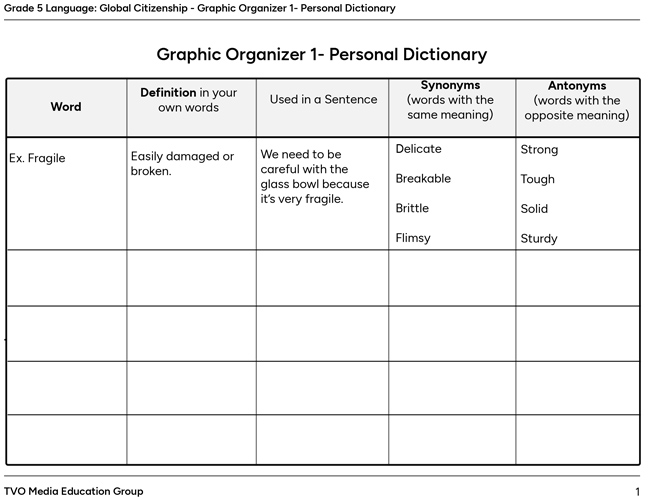
Press the Activity button to access the Graphic Organizer 1 - Personal Dictionary.
Activity(Opens in a new tab)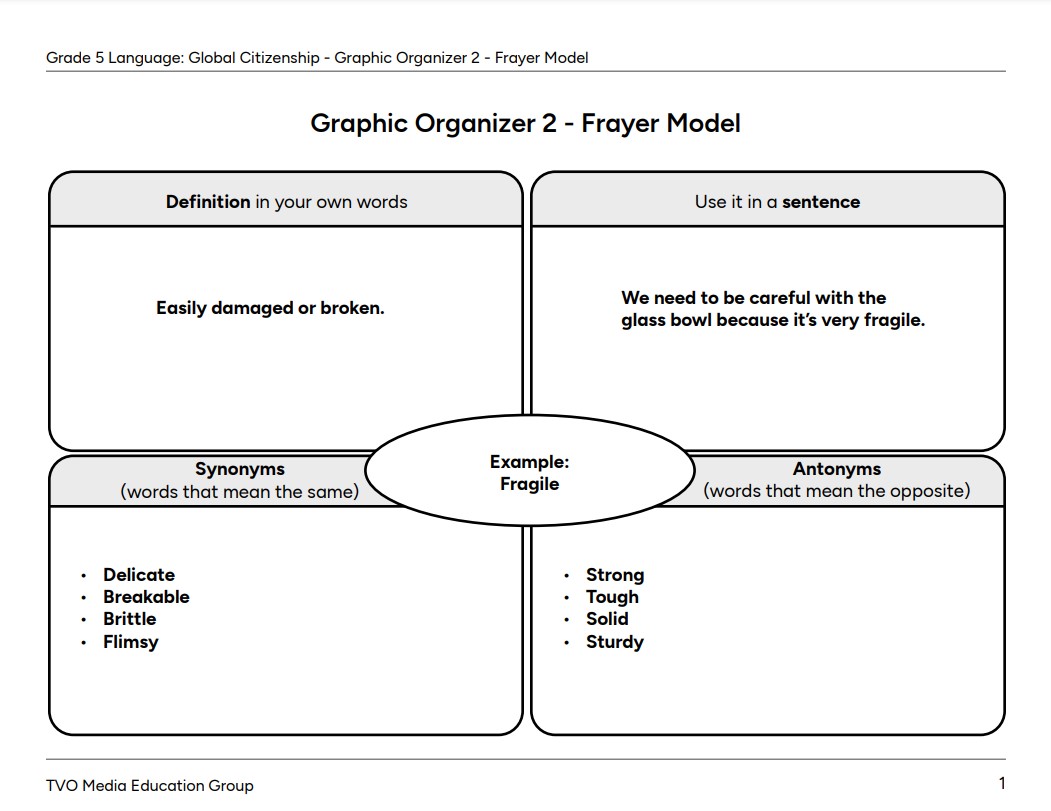
Press the Activity button to access the Graphic Organizer 2 - Frayer Model.
Activity(Opens in a new tab)Review the meanings of the following vocabulary words:

Did You Know?
Did you know?
In Canada, the Canadian Charter of Rights and Freedoms is a legal document that was created in 1982. It lists the rights of every Canadian Citizen that cannot be taken away and are protected by Canadian law.
Seems straight forward, right? Well unfortunately, and very surprisingly, rights are not always so simple. Some groups in Canada have had their rights and freedom denied and infringed upon by the government.
In this learning activity, we will focus on one example of a group that has had, and continues to have, a long history of the government failing to uphold their rights – First Nations in Canada. We will read about some of the ways that individuals have advocated and fought for change and equality to learn ways that we too, can be allies, agents of change, and good global citizens.
Exploring reading strategies
As you work through this learning activity and explore the history, experiences, and perspectives related to Indigenous rights in Canada, we will focus on practising different reading comprehension strategies to unpack and understand the content. Look for tips and strategies to apply as you read, watch, or listen to each section.

Brainstorm
Brainstorm
In your notebook, or using another method of your choice, answer the following questions. If possible, share your thinking with a partner.
- What kind of rights do you think are important as a citizen?
- What rights do you think every person should have?
- Do you know any examples of when someone’s rights have been denied or infringed upon?
- Do you know any examples of when someone has stood up to advocate or fight for their rights or the rights of others?
A long and complicated history of colonialism in Canada
Please note the term “Indian” is offensive when used by non-Indigenous people. Historically, it is a term that has been used to oppress or exclude Indigenous Peoples. “Indian” is still used in many government documents and laws that were originally written long ago, and remains as a legal definition used in Canada and will only be used as a historical or legal reference in this learning activity. One example is the Canadian legislation , or law, called the Indian Act.
The Indian Act
Read the following to learn more about The Indian Act.
What is the Indian Act? What is the Indian Act?
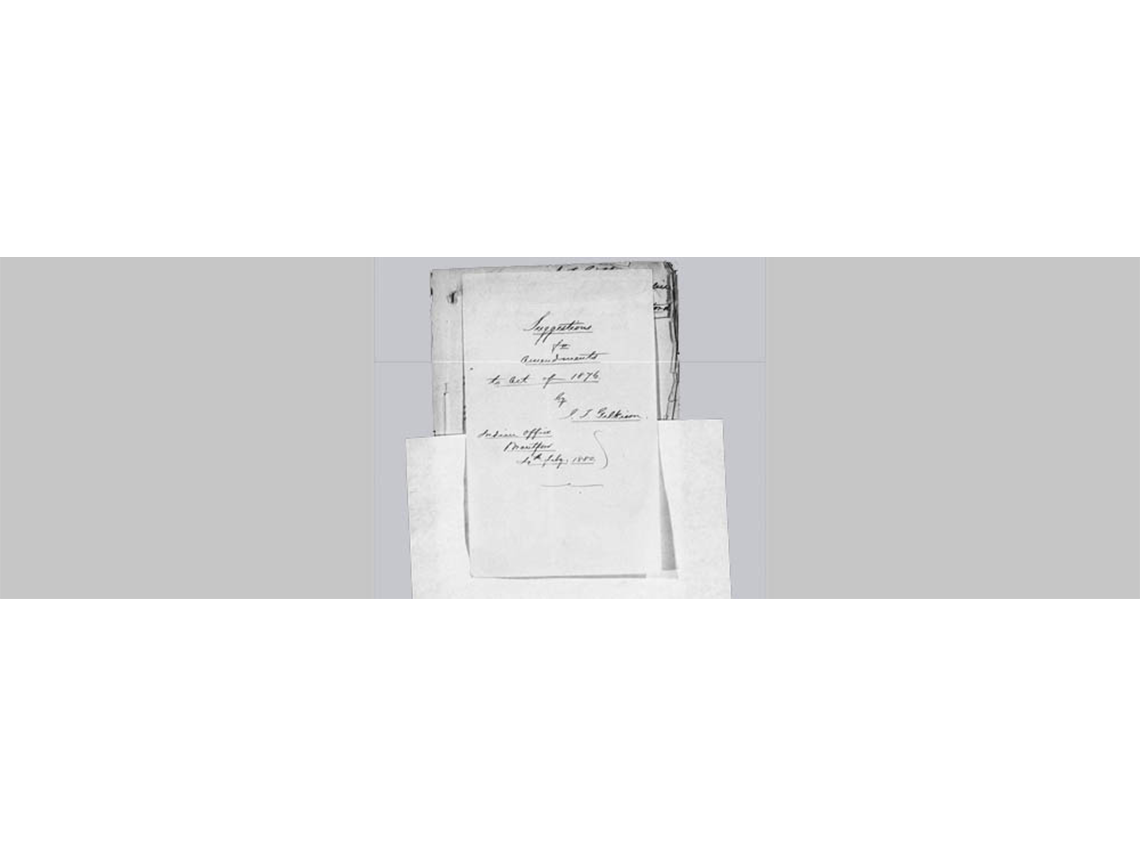

The Indian Act gave the government sweeping powers with regards to First Nation identity, political structures, governance, cultural practices, and education. These powers restricted First Nations freedoms and forbade First Nations individuals and communities from expressing their identities through governance, cultural practices, and ceremonies.
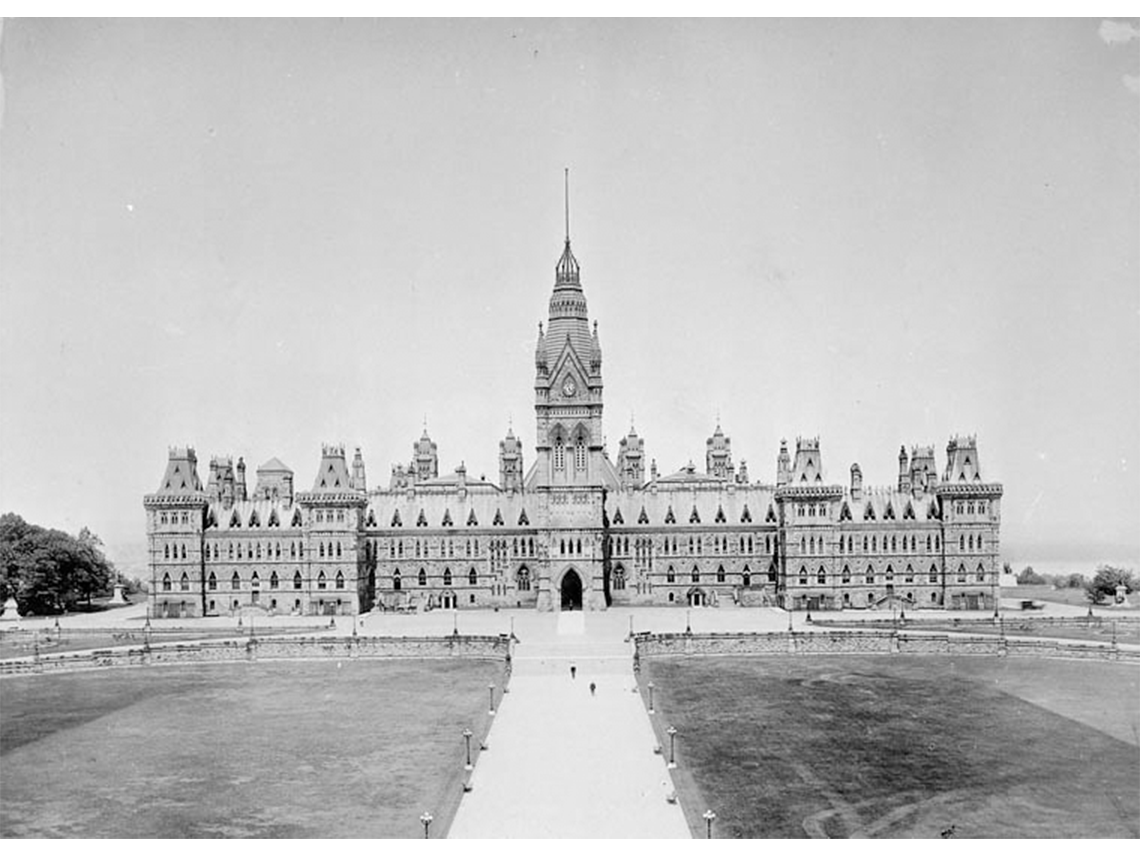
The Act was created by Parliament without consultation from First Nations communities. It does not include the Inuit or Métis peoples (the Indian Act was adjusted in 1924 to include the Inuit but they were later removed from the Act).
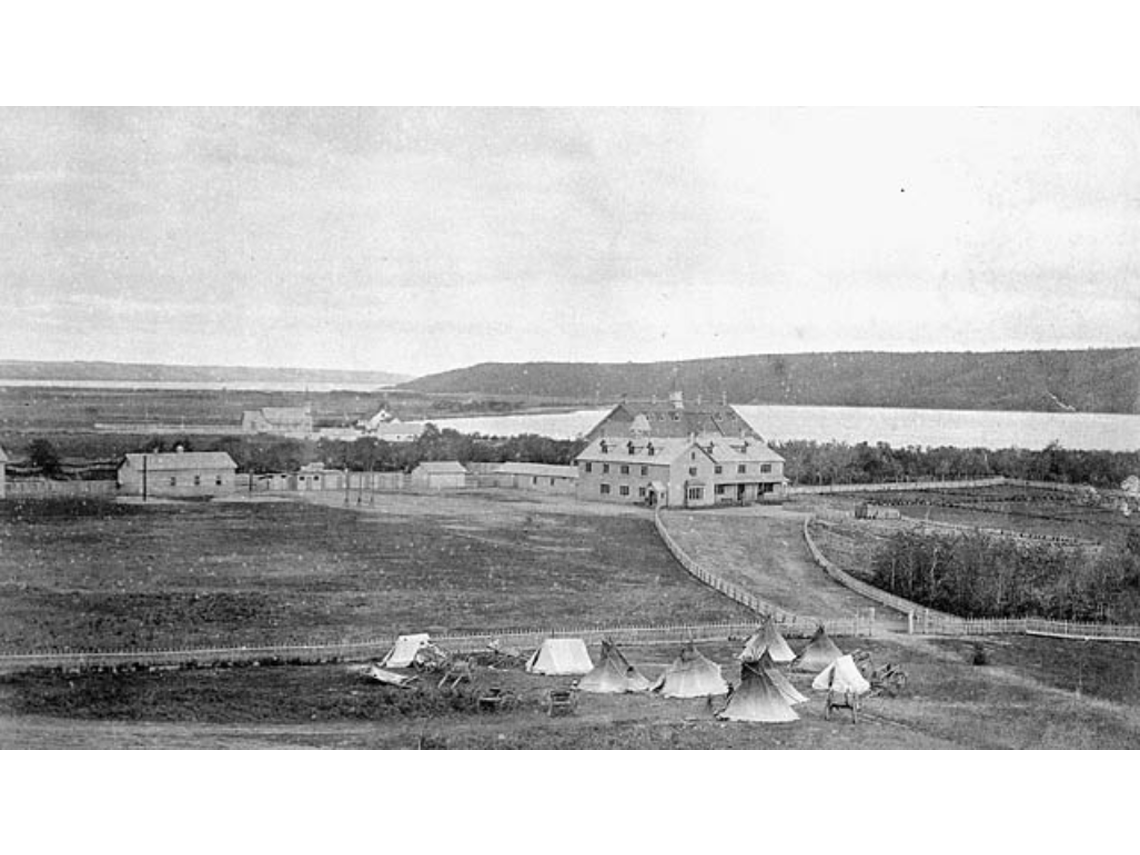
The purpose of the Act was to have First Nations individuals give up their Indian status and become part of the Canadian population where they would then have the same rights as Canadian citizens. For example, First Nations individuals could have the right to vote and pursue a post-secondary education but would lose all recognition of being an Indigenous Peoples in Canada. We use the terms enfranchisement and assimilation to describe both of these actions.
 Description
Teacher Chiara saying: Another reading comprehension
strategy is looking out for and writing down any new or
unknown words. Take a minute and explore the following
definitions of the terms status, enfranchisement, and
assimilation. Record them in your vocabulary notebook.
Add any other words that were new or unknown for you
too.
Did You Know?
Did you know?
The Indian Act outlines many rules and restrictions placed on First Nations individuals and communities. A few of these restrictions included:
- excluding women from band council politics
- making it illegal for First Nations individuals and communities to hire lawyers
- outlawing ceremonies and cultural gatherings such as the potlatch
The Indian Act continued

Under the Indian Act, the federal government mandated the education of First Nations children and partnered with the Catholic and Christian churches to create the residential school system. The residential school system was to provide First Nations children an education with the focus on assimilating them (erasing their language and culture). While the Inuit and Métis peoples were not included in the Indian Act, they were enrolled in residential schools, nonetheless.
As the federal government increased its efforts to assimilate Indigenous Peoples into mainstream society, First Nations, Inuit, and Métis Peoples continued to organize and fight for their rights. Many Indigenous Peoples had resisted the oppressive treatment and legislation prior to this era but encountered great difficulty due to the oppressive laws and policies created by the government such as the Indian Act.
Let’s pause after reading to check your understanding of what you’ve read so far. Think about the following questions:
- What helped you understand the text?
- What can you do to remember key parts of the text?
Jot down your thoughts or, if possible, share them with a partner.
First Nations rights
The Indian Act violated several rights and freedoms protected under the Canadian Charter.
Here is a sample of just some of the rights of Indigenous People that were violated by the Indian Act:
- The Democratic Right to Vote – First Nations individuals with Indian status would be forcibly enfranchised (lose their status and not be able to live with their community on reserve) if they wanted to vote in an election.
- Mobility Rights - Individuals with Indian status who left the reserve for a period of time would be forcibly enfranchised and restricted from living in their community of origin.
- Equality and Legal Rights – First Nations women were not subject to the same rules in the Indian Act as Indigenous men and would be forcibly enfranchised and forced to leave their community depending on whom they married. This is sometimes called the “marrying out rule”.
Check out the following clip from TVO’s The Agenda where guest Bob Kwakwaka'wakw of British Columbia and author of 21 Things You May Not Know About the Indian Act, explains more about the “marrying out rule” in the Indian Act that violated First Nations women’s rights.
Indigenous women changemakers
Over the years since the Indian Act was first written, many First Nations women spoken up, rallied, protested, and some filed lawsuits against the government because sections of the Indian Actlimited their rights.
Let’s explore some of the Indigenous women changemakers who bravely took action to fight for their rights and those of their descendants.
Source: Bill C-31. (n.d). Indigenous Foundations. Arts, University of British Columbia (UBC) (n.d.). Retrieved May 27,2024, from https://indigenousfoundations.arts.ubc.ca/bill_c-31/
The actions of these strong and courageous women led to the creation of a new law called “Bill C-31” which changed the Indian Act so that First Nations women could marry whomever they chose and not lose their status. Bill C-31 also said that First Nations women, and their descendants, that had already lost their status because of the “marrying out rule”, would regain their status and could return to their reserves.
Learning check!
Check your understanding of what you have learned by answering the following questions.
Select the correct answer, then press Check Answer to see how you did.
Although Bill C-31 is an example of a “win” for Indigenous Peoples’ rights, it's a reminder that there is much work to do for the government to uphold Indigenous Peoples rights in Canada. There are still many Indigenous rights that are being denied or infringed upon as a result of the Indian Act.
Did You Know?
Did you know?
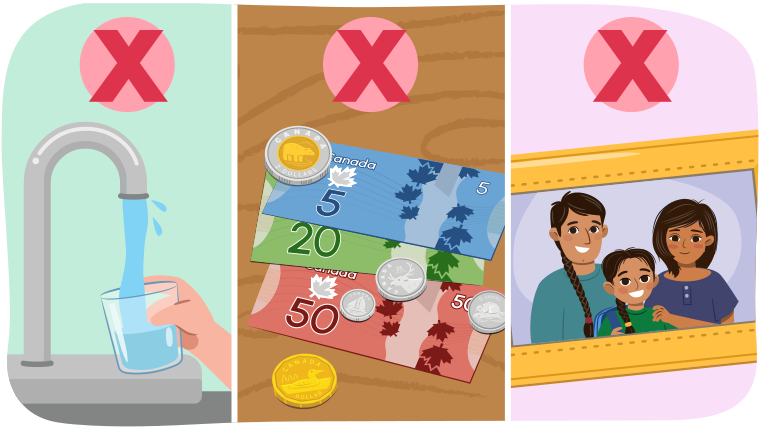
Some of the Indigenous rights that are still being denied or infringed upon.
They include the following:
- lack of clean drinking water
- less funding for students who go to school on-reserve
- continued gender discrimination in the Indian Act connected to how Indian status is passed down through generations of families
Despite the many issues that arose after the Indian Act was passed, many First Nations communities fear that without it, reserves (and therefore land), as well as legal identities, would be terminated and there would no longer be a way to recognize First Nations peoples in Canada. So, advocating for what First Nations individuals and communities would like to see changed in the Indian Act is one way to support Indigenous rights.
Source: Native Women’s Association of Canada. (n.d.). The Indian Act Said What? Retrieved from https://www.nwac.ca/assets-knowledge-centre/The-Indian-Act-Said-WHAT-infographic.pdf

Student Wellness
Take a break!
Time for a body break! If possible, stretch your body and move around your space.
Being an advocate
Standing up for our rights and the rights of others is an example of advocating. Advocating is important because it can often lead to much-needed change as we read about with the Indigenous women changemakers: Jeanette Corbiere Lavell, Yvonne Bedard, and Senator Sandra Lovelace.
Now that you are familiar with some rights and responsibilities, and an example of how not everyone in Canada has equal access to their rights, how will you help advocate to make change?
One way to advocate, is by writing to your elected representatives in government and asking them to take action to address social issues such as the continued restrictions on the rights of Indigenous Peoples in Canada.
Write for rights!
Everyone deserves to have access to rights under the law. You are going to write a structured paragraph to a government official advocating for them to take action to ensure Indigenous Peoples in Canada have equal rights as they are outlined in the Canadian Charter of Rights and Freedoms.
It is not always easy to construct expressive sentences, and even harder to put sentences together into well-structured paragraphs. However, there are lots of tools that writers can use to organize their ideas into paragraphs.
Explore the following video How to Write a Paragraph where Teacher Wynne explains how to organize your thoughts into a paragraph. She compares writing a paragraph to a hamburger and though this seems strange, her ideas end up getting organized so that the reader can fully understand her thoughts.
 Description
Esma saying: Teacher Winny used the visual of a
hamburger to help her plan and organize her paragraph.
Why is it important to have a way to organize our
writing? What would happen if we couldn't organize our
writing? Can you think of another way (or another tool)
that could help you organize your thoughts before
writing?

Let’s get writing!
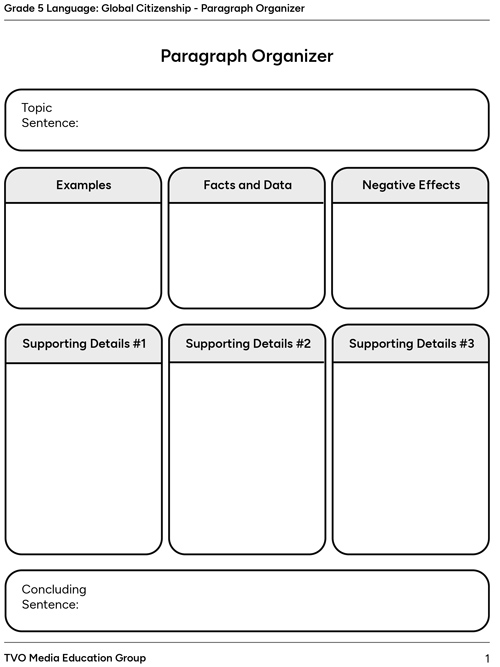
Use the following information to help you plan and draft your paragraph. You can use the graphic organizer provided, or another method of your choice to record your work.
Press the following tabs to learn more.
The job of a topic sentence is to clearly identify what your paragraph is about. It should capture your audience's interest and give them an idea of what your paragraph is about. Topic sentences can be statements, or they can be questions.
Try one of these sentence starters:
- (Topic) is important because…
- Everyone should…
- I believe…
- Have you ever wondered…
- Did you know…
Tip: do not begin your paragraph with the words “My paragraph...”!
Using a paragraph planning tool of your choice, write down three main ideas connected to your topics. These could be examples, some facts and data, or some negative effects.
Jot down supporting details (specific ideas and examples) for each of your three main ideas. Be sure to clearly identify why your topic is important, and if appropriate, a real-life example connected to it.
The last sentence should summarize the contents of your paragraph and leave a lasting impression on your audience. Sometimes it can also include a question or prompt that helps the reader take action or continue thinking about the topic.
Try one of these sentence starters…
- It is clear that…
- In conclusion…
- Now that you know…
- To summarize,

Student Tips
Tip
As you grow as a writer, your concluding sentence may end up being more than one sentence, or it may have longer and varied sentence structures.
For example, you could have:
|
Two separate simple sentences: “All people deserve human rights. Each of us should help advocate for human rights in our communities.” |
|
A compound sentence: “All people deserve human rights, and each of us should help advocate for human rights in our communities.” |
|
A complex sentence: “Now that you know about human rights, you can help advocate for them in your community.” |
|
A compound-complex sentence: “Now that you know about human rights, you can help advocate for them in your community, and you can make a difference in the world!” |
Draft your paragraph
Now it is time to put all your thoughts together and write your paragraph!
You might choose to draft your paragraph by hand, using either print or cursive writing. Or you could choose to draft your paragraph digitally.
Check out the following tips for writing in cursive or typing with automaticity.

Cursive Practice
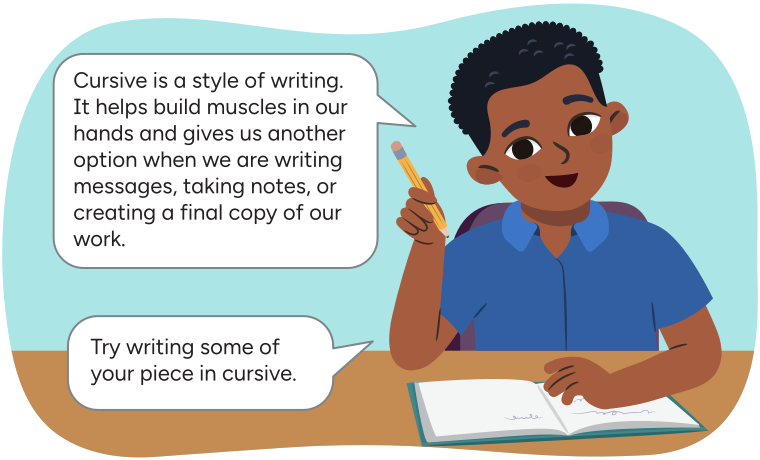
Arthur saying: Cursive is a style of writing. It helps build muscles in our hands and gives us another option when we are writing messages, taking notes, or creating a final copy of our work. Try writing some of your piece in cursive.
Let’s review cursive writing!
Check out the following animation of how the word “rights” is written in cursive, then review the tips for cursive writing provided.
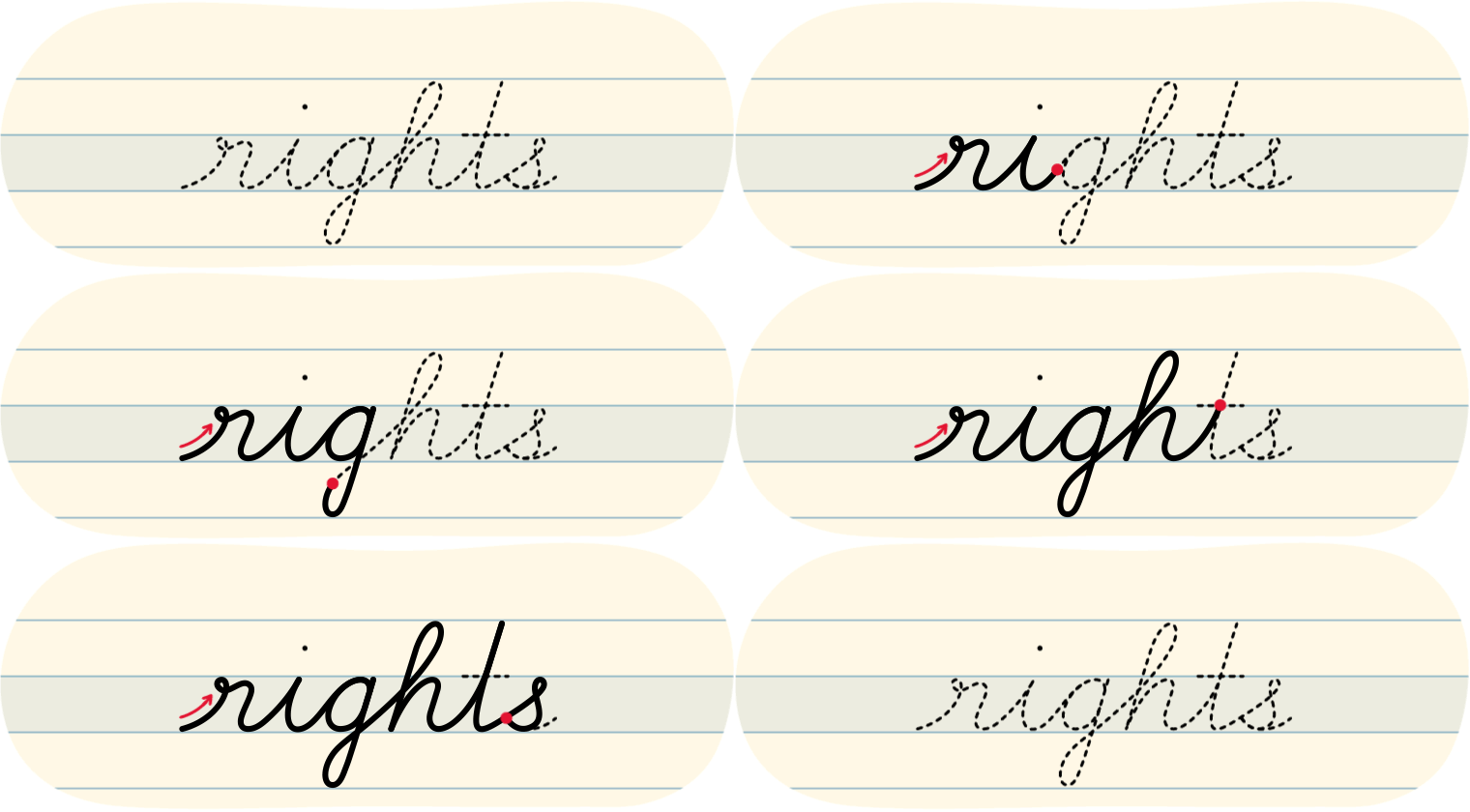
Tips for cursive letters
- When we write in lowercase, we always begin at the bottom.
- When we write in uppercase we can start from the top or the bottom.
- Try to keep the pencil on the page until you are done the word.
- Try to press gently as you write so that your hand can move easily across the page.
- Take your time to make sure that you are writing clearly and evenly.
Left-handed tips for cursive writing

Explore the video on Left-Handed Tips to learn more.

Typing Practice
Type it!
Typing is a great skill to develop! When we need to use a computer or tablet keyboard, knowing how to type helps us:
- take notes
- respond to messages
- create final drafts of our work
Explore the following image to see what fingers are used to type each letter or number.
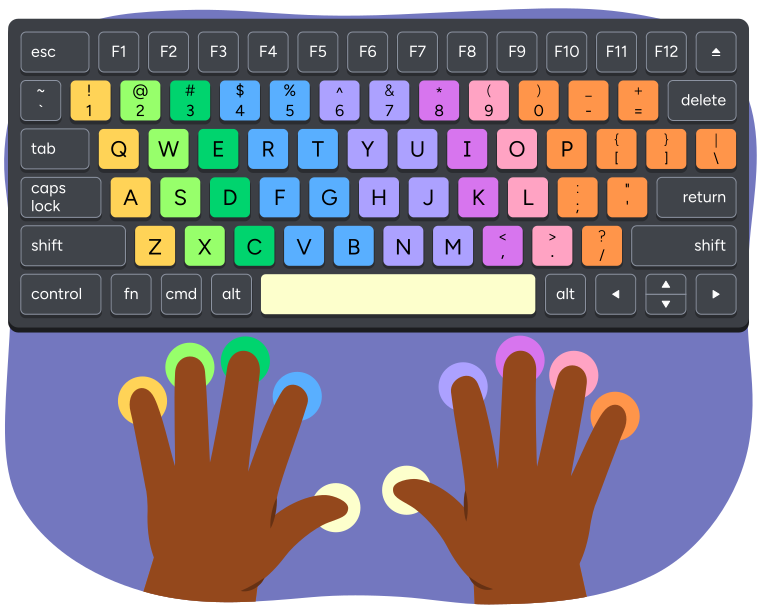
A keyboard and hands showing which fingers are used to press each key when typing.The left pinky finger presses the keys 1, Q, A, and Z.The left ring finger presses the keys 2, W, S, and X.The left middle finger presses the keys 3, E, D, and C.The left index finger presses the keys 4, 5, R, T, F, G, V, and B.The left or right thumb presses the space bar.The right index finger presses the keys 6, 7, Y, U, H, J, N, and M.The right middle finger presses the keys 8, I, K, and comma.The right ring finger presses the keys 9, O, L, and period.The right pinky finger presses the keys 0, minus, equal, P, open bracket, closed bracket, backslash, semicolon, apostrophe, and forward slash.
We use specific muscles in our hands to type! It’s important to practice so that it becomes easier to type correctly without putting too much pressure on our hands and our wrist.
For additional typing practice, check out the game, “Keyboard Climber 2”!
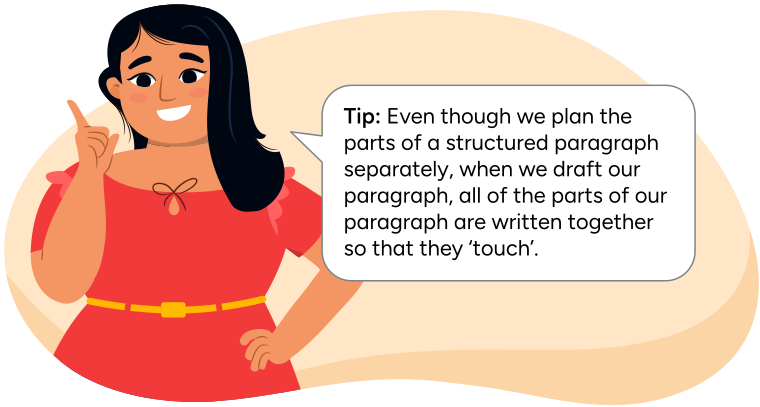 Description
Teacher Chiara saying: Tip: Even though we plan the
parts of a structured paragraph separately, when we
draft our paragraph, all of the parts of our paragraph
are written together so that they 'touch.'
Let’s check!
It’s time to review your paragraph draft to make sure that it has all the pieces it needs to be complete, and to correct any errors.
Use this checklist to self-assess your writing.
Publishing your paragraph
Now it’s time to publish your paragraph. Because it’s intended to be sent to an elected government official it needs to look professional for them to consider your message and take it seriously.
Which of the following formats do you think would be appropriate and not as appropriate for communicating a professional and formal message?
Choose from one of the appropriate formats for professional writing to publish the final copy of your paragraph.
In your notebook, or using another method of your choice, explain why the format that you choose is appropriate for more professional/formal writing and compare and contrast that with one of the formats that would not be as appropriate.

Reading fluency routine
In this learning activity, you learned about rights and responsibilities, and why it is an important skill of global citizens to advocate for peoples’ rights. Another way of taking action and advocating is speaking up and using our voice to share information, spread awareness, or advocate for ourselves, people, and causes.
Practice using your voice now, by reading your paragraph as if you were delivering a short speech. You could read it to another person, practice reading it in front of a mirror, or voice record yourself and listen to it afterward.
Use the following checklist to ask yourself questions as you read out loud.
| Do I have… | Yes | No |
|---|---|---|
|
A volume level that can be heard by others? |
||
|
A strong, persuasive tone that make people listen? |
||
|
Changes in pitch and pace that help emphasize parts of my message? |
Try reading your paragraph out loud multiple times to make sure you can answer ‘yes’ to all of these questions.
Reflection
As you read through these descriptions, which sentence best describes how you are feeling about your understanding of this learning activity? Press the button that is beside this sentence.
I feel...
Now, record your ideas using a voice recorder, speech-to-text, or writing tool.