Learning goals
We are learning to…
- understand historical contexts, lived experiences and perspectives, connecting them with transferable skills
- read informational and literary texts for meaning
- identify different verb tenses
- demonstrate an understanding of variety of words
Success criteria
I am able to…
- explain the evolution and the importance of having rights of children
- analyze different cultural perspectives in texts and how they were shaped by historical contexts
- distinguish between the simple past tense and the past perfect verb tense
- record and use explicitly taught vocabulary in different contexts
Celebrating children worldwide
Check out the following video. As you observe, try to answer these questions:
- What is the purpose or main message of the video?
- What do you already know about the subject of the video, or what personal connections can you make?
Need some help with strategies to help you better understand or find the main message?
Press the Listening Strategies button to review some tips before watching the video.
Here are some tips to help you understand when listening to new content:
Before Listening
- Make predictions – what will the content be about? The topic/genre? What will happen?
- Ask questions – use your predictions to ask questions that you’ll listen for answers to.
- Make connections – do you think the content connects to anything you already have experience with?
During Listening
- Make connections – continue making connections as you did before listening.
- Visual – try to make pictures about the content in your mind to help you “see” it.
- Flag new words – write down any unknown words.
- Monitor – take breaks to make sure the content is making sense, if not consider jotting down what’s happened so far in order.
After Listening
- What helped you understand?
- What connections did you make to help you understand (to other stories or personal experiences)?
- What did you do to understand unfamiliar words? How did you decode them?
- What can you do to remember key parts of the story?
Access the following video to learn more.
In 1954, the first version of World Children’s Day was established (back then it was called Universal Children’s Day). Since then, every November 20th, World Children’s Day is recognized all over the world as a day to encourage people coming together to raise awareness and improve the lives of children everywhere.

Pause and Reflect
Pause and reflect
Why do you think World Children’s Day needs to be commemorated and specifically celebrated?
To create a detailed, educated answer, we need to think about the role that children played in society in the past and the connections to the lives of children in the present.
In this learning activity, we will focus on some of the history of the role of Canadian children and make connections to the very important 20th century realization that many countries around the world all came to: children have rights too!
Previewing vocabulary
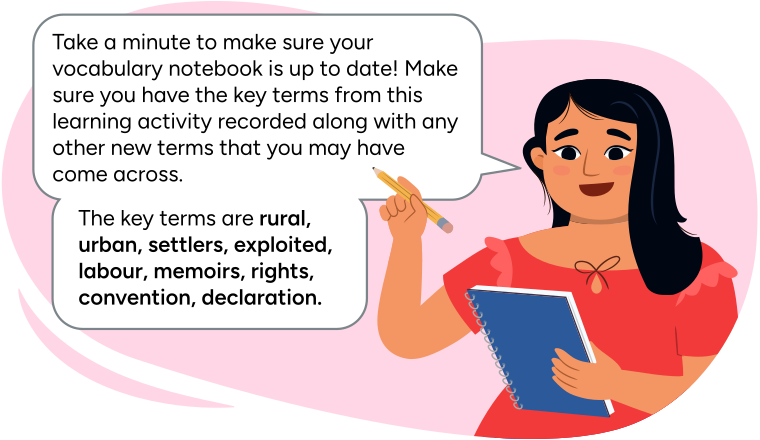
Before we begin, let’s preview some key vocabulary that we will come across in this learning activity:
- rural
- urban
- settlers
- exploited
- labour
- memoirs
- rights
- convention
- declaration
Do you recognize any of these words before? Do any remind you of other words?
Add all these words to your ongoing vocabulary notebook.
As you work through this learning activity look for these words! Try to understand their meaning by recording their definition in your own words, finding synonyms, or using them in new sentences. Make sure to record these pieces in your vocabulary notebook to help your brain understand and recognize these terms the next time you come across them!
Understanding children’s lives in the past
Long before the modern Canada that we know today, many ruralpeople lived on farms.
In both Indigenous and settler communities, families raised animals, planted crops, and/or fished and hunted to meet their physical needs. Some created things by hand such as clothing, blankets, and baskets and traded these items with others in and outside of their communities.
All members of the family had responsibilities and roles to play. It was common for children to engage in many different forms of work or chores to support their families or communities.
As more settlerscame to what is now commonly referred to as Canada, schools were beginning to be built in some communities, and some children from settler families began to attend school during the months of the year when they weren’t needed for planting and harvesting. Not all children had the time or the ability to attend school though and some were only allowed to attend up to a certain age.
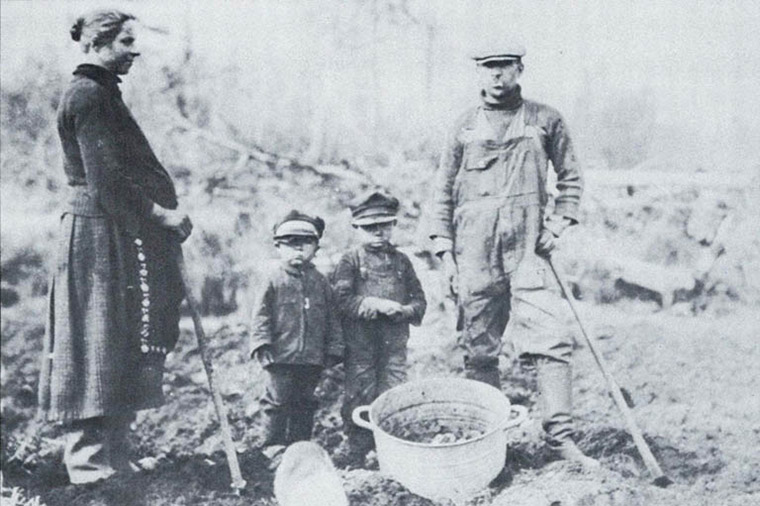
Life in cities was very different. New technology meant lots of factory jobs, and urbanareas grew as people left the countryside in the hope of a better life in the city.
But wages for factory workers were so low that both parents and children had to work to earn a living, usually six days a week year-round, for very long hours. Employees were not treated fairly at that time, and children were treated even more unfairly than adults.
Children were also preferred for certain factory jobs because of their small hands, yet they were usually paid much less than adults were. Outside of the cities, many male children worked in underground coal mines. Jobs like these were both dangerous and exhausting. While children were paid for their work, it wasn’t fair pay, and they often didn’t have a choice.
Another area of forced child labour in Canada’s history happened within the residential school system. Beginning in the early 1800s and finally ending in 1996, First Nations, Métis, and Inuit children were forced, and later mandated under the Indian Act, to attend residential schools throughout Canada by the government and Catholic and Protestant churches.
As outlined in the Indigenous Peoples Atlas of Canada, in these institutions First Nations, Métis, and Inuit children “were forced to abandon their traditions, cultural practices and languages”. Residential schools are also an example of children being exploitedfor their unpaid labour. Originally, residential schools were industrial labour and farm schools. While they claimed to offer Indigenous children an education, they spent little time in lessons and worked long days cleaning, farming, nursing, sewing, building, and doing other types of physical labour (Geographic, 2018).
Children in Canada’s past, and particularly Indigenous children, did not have the rightsand protections that most have today. It is important to remember that not all experiences of childhood were the same. Ethnicity, social class, language, geographical location, and more, shaped the lived experiences of Canadian children and continue to do so today.
Connecting to the past through text
Children’s non-fiction is a genre of text that is a recount of real people and real events. Memoirsare a form of non-fiction narrative based on a real person’s perspective of true events. This form of text is often used to help children learn about historical events from a first-person perspective or as an informational text.
The following passages from the novel Fatty Legs: A True Story allows us to observe the past through the eyes of a child. Inuvialuuit Knowledge Keeper Margaret-Olemaun Pokiak-Fenton wrote this book based on her experiences as a residential school survivor after attending a residential school in Aklavik, Northwest Territories. It reflects her personal feelings and experiences of her childhood at home and then being forced to attend residential school at that time. Olemeaun was later renamed Margaret by the nuns at the residential school.

Reading Time
Let's read a story
Read along with the following two passages from the book Fatty Legs: A True Story by Margaret-Olemaun Pokiak-Fenton as Olemaun arrives at residential school for the first time and then finds that things are not what she expected.
Press the Activity button to access the Fatty Legs: A True Story.
Check your understanding!
Let’s review some of the events in this story.

Exploring the past (tense)
Because memoirs are a real person’s memories of events in their lives (Get it? “Memoirs” because they are based on memories!), they are written using verbs (actions) in the past tense.
Check out the following two sentences from the readings from Fatty Legs: A True Story. Can you identify the action words, or verbs, that communicate that the events happened in the past?
Sample 1:
“…a dozen children dressed in uniforms crouched in the silty garden…” (pg. 22)
Sample 2:
“I had spent so many days anticipating the thaw.” (pg. 43)
Press the Answer button when you are done reading to check your response.
| “...a dozen children dressed in uniforms crouched in the silty garden…” |
The words “dressed” and “crouched” are verbs that end in “ed”. Verbs that end in “ed” are examples of the Simple Paste tense. Format: verb + ed |
| “I had spent so many days anticipating the thaw.” |
The combination of words “had spent” are examples of the Past Perfect tense. Using the verb “have/had” and the past participle of the main action verb. Format: “have/had” + verb |
Can you find any other examples of the simple past tense or the past perfect tense in the text? Can you create examples of your own based on an event from your past?

Connections
Thinking about perspectives
Let’s consider some different perspectives and make connections to the text.
Answer the following questions in a notebook or using another method of your choice. If possible, share your thoughts with a partner.
- What does the book Fatty Legs: A True Story reveal about the lived experiences of author Margaret-Olemaun Pokiak-Fenton?
- Many Canadian children worked instead of going to school up until the mid-twentieth century. Think about Olemaun’s lived experiences and then think about what you learned about settler children working in an urban factory during the same time. In what ways might their experiences have been similar, and in what ways might their experiences have been different?

Student Wellness
Student wellness
Let’s take a few minutes to relax, clear our minds, and refocus our attention.
Modern changes to Children’s Rights
In the 20th century (1901-2000), attitudes and beliefs about children and their rights changed a lot. As an engaged global citizen, it is important for you to know your rights and the rights of other children like you!
Let’s explore two important global advancements that have been made to advocate for and support children’s rights.
Exploring the UNCRC
In 1989, countries from around the world came together and made a promise to uphold the rights and freedoms of children. The document they created is called the “United Nations Convention on the Rights of the Child” (UNCRC for short) and it identifies 42 different rights and freedoms (called articles) that all children should have. 196 counties have agreed to this convention.
Before reading, pause and think about what rights you think children have or should have.
As you read the following infographic for UNCRC, take notice of the rights that you are already familiar with. Also, notice the rights that surprise you, or are new learning for you.
Access the following The Convention on the Rights of the Child in child friendly language to learn more about the UNCRC.
Learning check!
How well did you understand this text? Can you identify the article numbers for each of these children’s rights?
For each article number, select the corresponding children’s right.
United Nations Declaration on the Rights of Indigenous Peoples
As we learned earlier in this learning activity, Indigenous children in Canada have historically been targeted, mistreated, and had their rights and freedoms denied. This was clearly shown with the residential school system that existed until 1996. Unfortunately, the historical lack of rights and freedoms of Indigenous Peoples is not unique to Canada.
On September 13, 2007 the “United Nations Declaration on the Rights of Indigenous Peoples” (UNDRIP for short) officially came into action. This declarationcontains 46 different rights and freedoms (called articles) of Indigenous Peoples that are to be protected by governments around the world.
There are several articles that are specific to the rights of Indigenous children. Let’s review a consolidated, student-friendly version of some of the articles from a document that was put together specifically for Indigenous youth to help them understand their rights.

Exploring UNDRIP
Access the following document and read articles 14, 15, and 22.
Access the following United Nations Declaration on the Rights of Indigenous Peoples to learn more.
Pause and Reflect
Self reflection
Understanding important global social issues not only helps you be a better, more informed global citizen, but it also helps build your critical thinking and problem-solving skills.
Try and make a personal connection to the information you just read about both the “United Nations Convention on the Rights of the Child” and the “United Nations Declaration on the Rights of Indigenous Peoples”. You can share aloud to a partner or record it in your notebook or using another method of your choice.
You can use these sentence frames to get you started:
- Something I already knew was…
- Something that surprised me to learn was…
Review new learning!
Let’s review some of the learning we did in the Action section. Complete the following multiple-choice questions to test your skills.
Select the correct answer, then press Check Answer to see how you did.
 Description
Putting it all together
All children around the world are entitled to the rights, freedoms, and protections outlined in the UNCRC and UNDRIP. However, not all children everywhere have them. Some parts of the world have not yet made laws that enforce the rights of children. Even in countries where those laws exist, including in Canada, individuals or groups of children experience situations or events where their rights are ignored. That’s why it is important for children to know their rights and to champion the rights of others!
As an engaged global citizen, you can help spread awareness about the rights that all children should have. Practice combining your global citizenship and your communication skills by sharing what you’ve learned about the rights of children with your peer group or community.
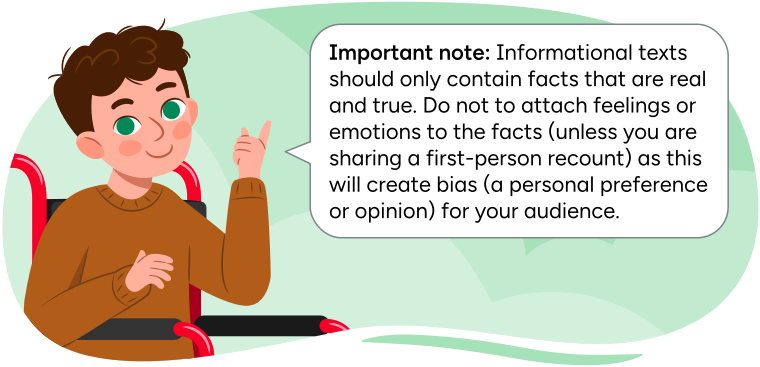
How could you do this? Create an informational text!
 Description
Here is a list of formats to consider:
- video or audio commercial
- poster
- podcast episode
- infographic
- flipbook
Choose the content and the format that you feel passionate about to share this important message.
Reflection
As you read through these descriptions, which sentence best describes how you are feeling about your understanding of this learning activity? Press the button that is beside this sentence.
I feel...
Now, record your ideas using a voice recorder, speech-to-text, or writing tool.