

The Dancing Trees by Masiana Kelly. Illustrated by Michelle Simpson.
Learning goals
We are learning to…
- unpack the transferable skill of global citizenship and sustainability
- research and organize content
- build vocabulary and understand word origins and their meaning
- adjust our expression and intonation for different types of texts
Success criteria
I am able to…
- identify ways that I can care for the Earth on a daily basis
- collect and organize biographical notes about an Indigenous environmental activist
- use new vocabulary in different contexts including creating my own definitions and making connections with suffix meanings
- adjust my expression and intonation to show a change of mood in a literary text
Exploring images
Examine the book cover The Dancing Trees by Masiana Kelly.
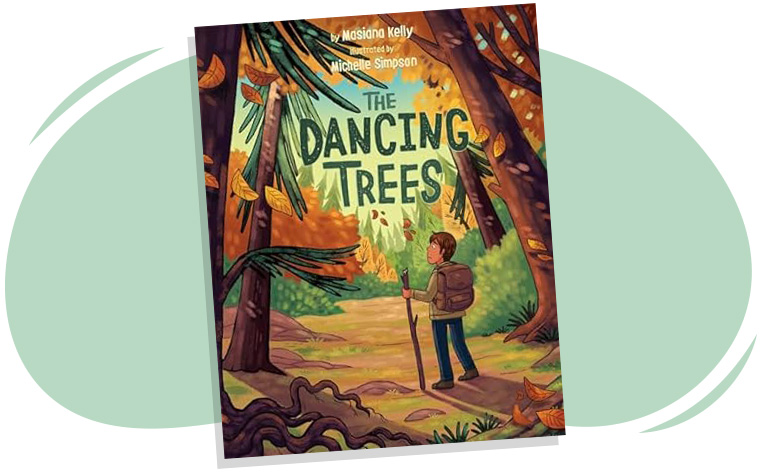
Cover of "The Dancing Trees" written by Masiana Kelly and illustrated by Michelle Simpson. There is a hiker with a worried expression in a forest. Leaves blow in the wind, and tall trees with winding roots lean in toward the hiker.
What do you notice or wonder about the following:
- the theme or topic of the book
- the title
- the author
- the lesson or message of the book
Record your thinking in a notebook, or another method of your choice. If possible, share your thoughts with a partner.

Vocabulary routine
Before we go further into our learning, let’s pause to consider five important vocabulary terms connected to our learning. You will learn more about these words and their meaning throughout this learning activity.
Vocabulary Terms

- steward
- environmental stewardship
- global citizenship
- advocate
- activist
Take a moment to record these words in your vocabulary notebook.
Your vocabulary notebook is an important learner tool! If you are creating one for the first time, here are two possible ways of recording vocabulary terms.
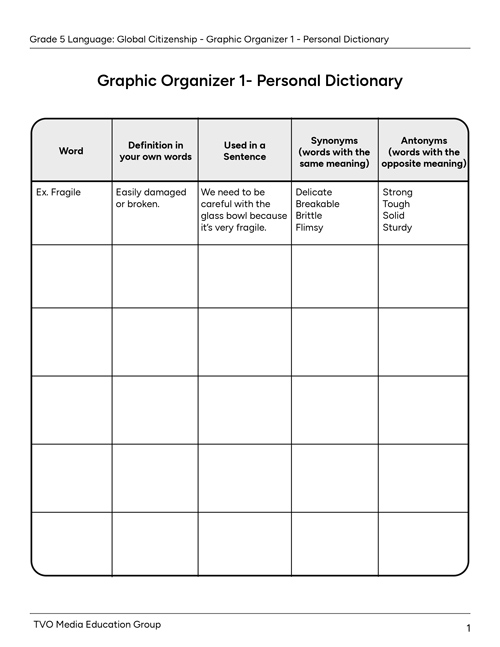
Press the Activity button to access the Graphic Organizer 1 - Personal Dictionary.
Activity(Opens in a new tab)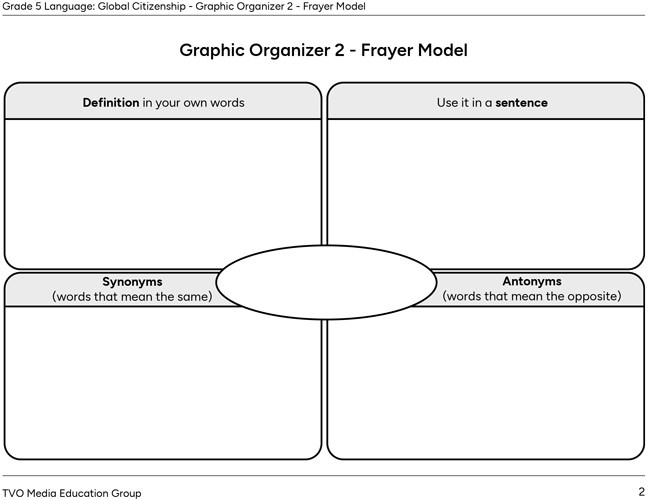
Press the Activity button to access the Graphic Organizer 2 - Frayer Model.
Activity(Opens in a new tab)Exploring environmentalism in literature
In the Minds On section, you made predictions about the book The Dancing Trees by Masiana Kelly. Let’s learn a little bit more about the book.
About the author and book
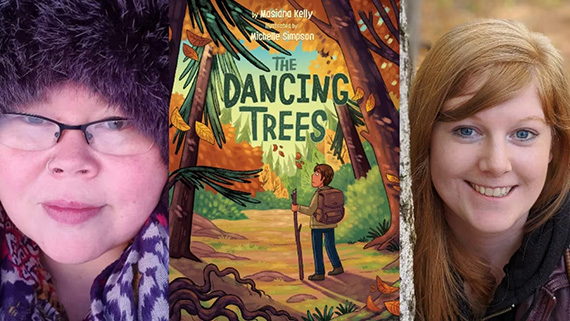
Masiana Kelly, is an Inuit and Dene author from Kugluktuk, Nunavut, and Fort Simpson, Northwest Territories. Her heritage, the teachings of Elders, and the beauty of the landscape of where she lives come together as she tells a story that shows the importance of taking care of the land around us and treating it with respect. This is an important part of being a steward of the Earth and is connected environmental stewardship .
 Description
Teacher Ravi saying: Steward and environmental stewardship are
two of our vocabulary terms! Take a minute and record their
definitions (in your own words) in your vocabulary notebook.

Reading Time
Reading for meaning
Read the following story, The Dancing Trees by Masiana Kelly. As you read, notice how the main character's attitude and opinion of the environment changes throughout the story. Think about what being a steward of the Earth might look like for someone your age.
The Dancing Trees by Masiana Kelly The Dancing Trees by Masiana Kelly
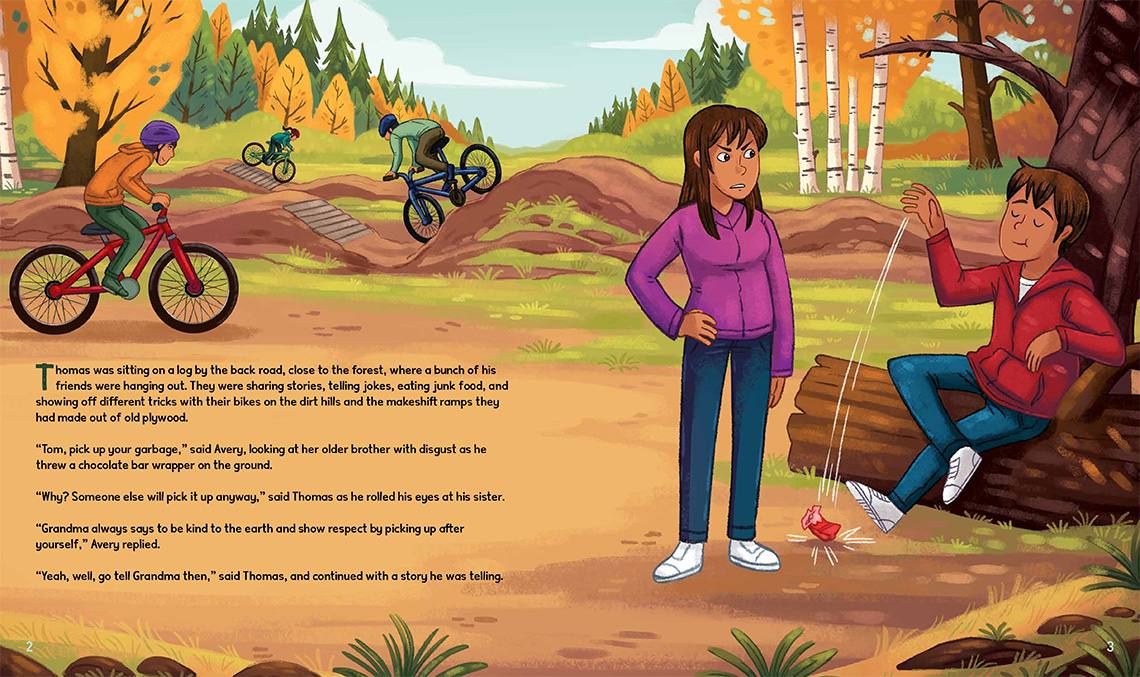
Thomas was sitting on a log by the back road, close to
the forest, where a bunch of his friends were hanging
out. They were sharing stories, telling jokes, eating
junk food, and showing off different tricks with their
bikes on the dirt hills and the makeshift ramps they had
made out of old plywood.
“Tom, pick up your garbage,” said Avery, looking at her
older brother with disgust as he threw a chocolate bar
wrapper on the ground.
“Why? Someone else will pick it up anyway,” said Thomas
as he rolled his eyes at his sister.
“Grandma always says to be kind to the earth and show
respect by picking up after yourself,” Avery replied.
“Yeah, well, go tell Grandma then,” said Thomas, and
continued with a story he was telling.
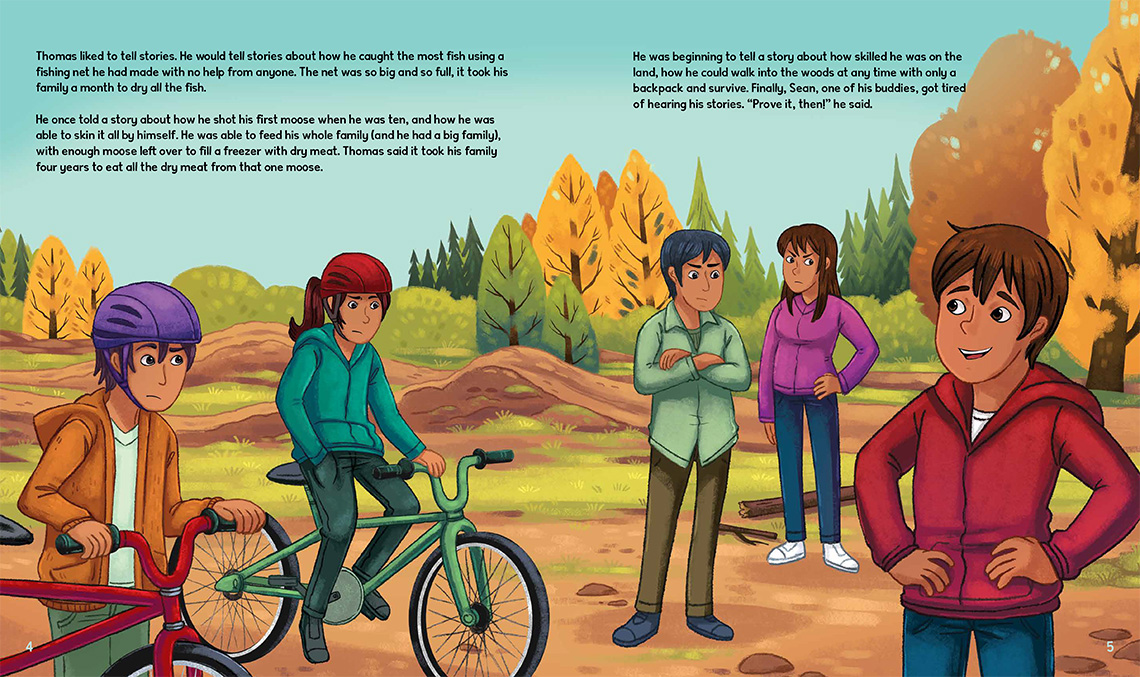
Thomas liked to tell stories. He would tell stories
about how he caught the most fish using a fishing net he
had made with no help from anyone. The net was so big
and so full, it took his family a month to dry all the
fish.
He once told a story about how he shot his first moose
when he was ten, and how he was able to skin it all by
himself. He was able to feed his whole family (and he
had a big family), with enough moose left over to fill a
freezer with dry meat. Thomas said it took his family
four years to eat all the dry meat from that one moose.
He was beginning to tell a story about how skilled he
was on the land, how he could walk into the woods at any
time with only a backpack and survive. Finally, Sean,
one of his buddies, got tired of hearing his stories.
“Prove it, then!” he said.
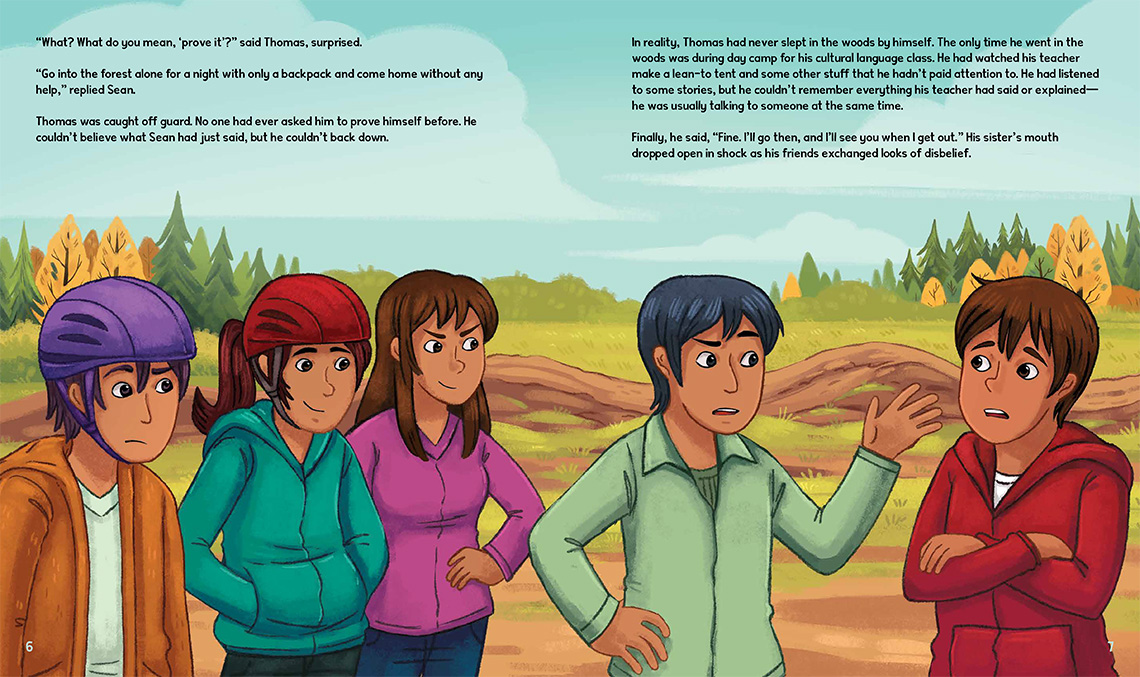
“What? What do you mean, ‘prove it’?” said Thomas,
surprised.
“Go into the forest alone for a night with only a
backpack and come home without any help,” replied Sean.
Thomas was caught off guard. No one had ever asked him
to prove himself before. He couldn’t believe what Sean
had just said, but he couldn’t back down.
In reality, Thomas had never slept in the woods by
himself. The only time he went in the woods was during
day camp for his cultural language class. He had watched
his teacher make a lean-to tent and some other stuff
that he hadn’t paid attention to. He had listened to
some stories, but he couldn’t remember everything his
teacher had said or explained—he was usually talking to
someone at the same time.
Finally, he said, “Fine. I’ll go then, and I’ll see you
when I get out.” His sister’s mouth dropped open in
shock as his friends exchanged looks of disbelief.
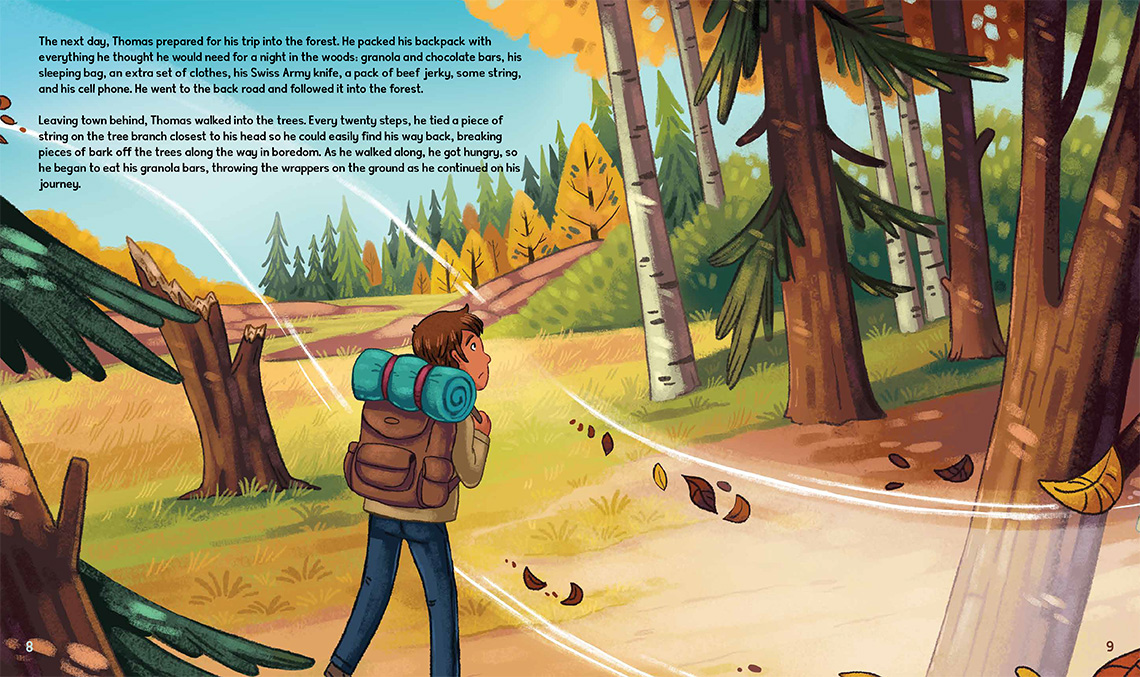
The next day, Thomas prepared for his trip into the
forest. He packed his backpack with everything he
thought he would need for a night in the woods: granola
and chocolate bars, his sleeping bag, an extra set of
clothes, his Swiss Army knife, a pack of beef jerky,
some string, and his cell phone. He went to the back
road and followed it into the forest.
Leaving town behind, Thomas walked into the trees. Every
twenty steps, he tied a piece of string on the tree
branch closest to his head so he could easily find his
way back, breaking pieces of bark off the trees along
the way in boredom. As he walked along, he got hungry,
so he began to eat his granola bars, throwing the
wrappers on the ground as he continued on his journey.
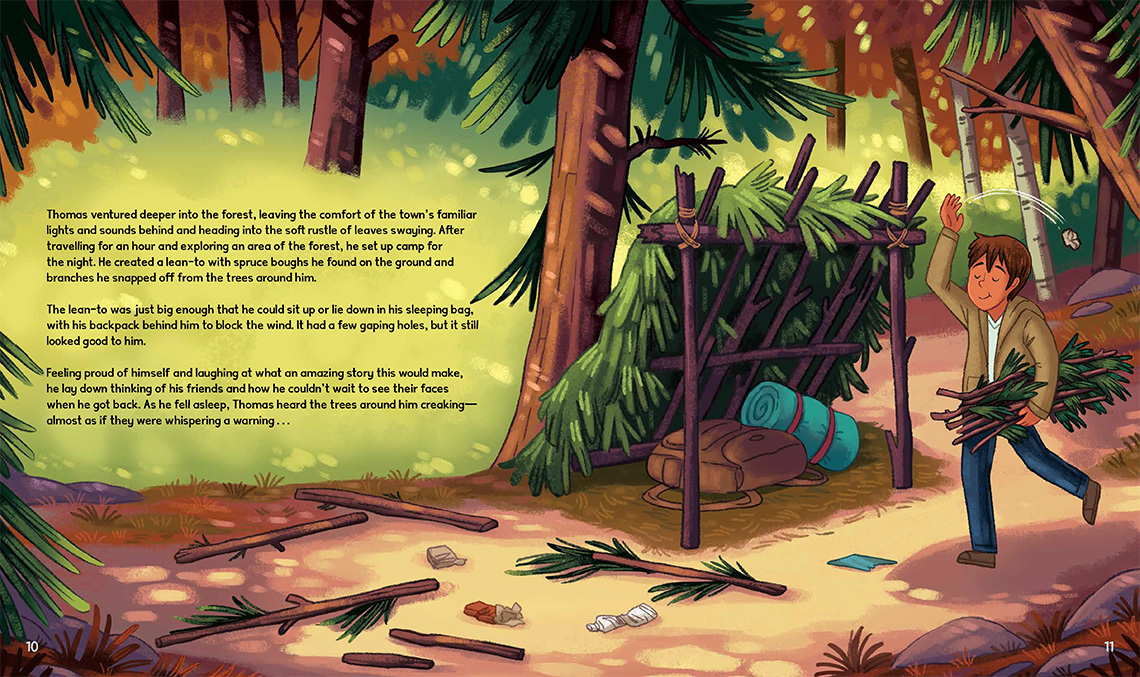
Thomas ventured deeper into the forest, leaving the
comfort of the town’s familiar lights and sounds behind
and heading into the soft rustle of leaves swaying.
After travelling for an hour and exploring an area of
the forest, he set up camp for the night. He created a
lean-to with spruce boughs he found on the ground and
branches he snapped off from the trees around him.
The lean-to was just big enough that could sit up or lie
down in his sleeping bag, with his backpack behind him
to block the wind. It had a few gaping holes, but it
still looked good to him.
Feeling proud of himself and laughing at what an amazing
story this would make, he lay down thinking of his
friends and how he couldn’t wait to see their faces when
he got back. As he fell asleep, Thomas heard the trees
around him creaking—almost as if they were whispering a
warning…
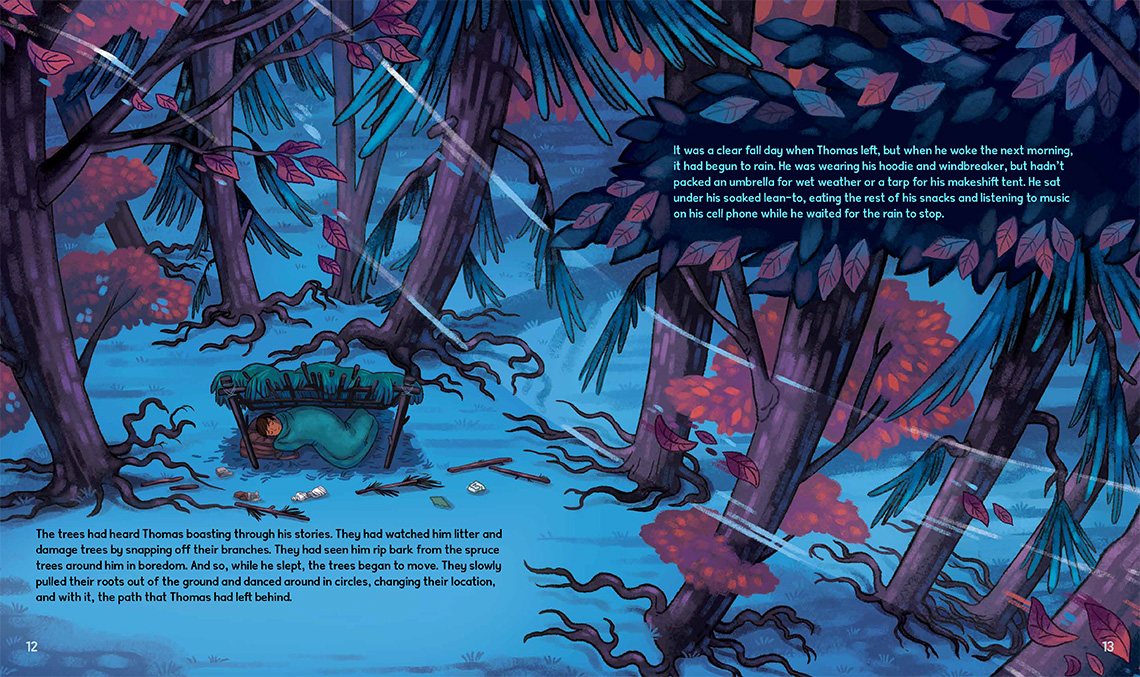
The trees had heard Thomas boasting through his stories.
They had watched him litter and damage trees by snapping
off their branches. They had seen him rip bark from the
spruce trees around him in boredom. And so, while he
slept, the trees began to move. They slowly pulled their
roots out of the ground and danced around in circles,
changing their location, and with it, the path that
Thomas had left behind.
It was a clear fall day when Thomas left, but when he
woke the next morning, it had begun to rain. He was
wearing his hoodie and windbreaker, but hadn’t packed an
umbrella for wet weather or a tarp for his makeshift
tent. He sat under his soaked lean-to, eating the rest
of his snacks and listening to music on his cell phone
while he waited for the rain to stop.
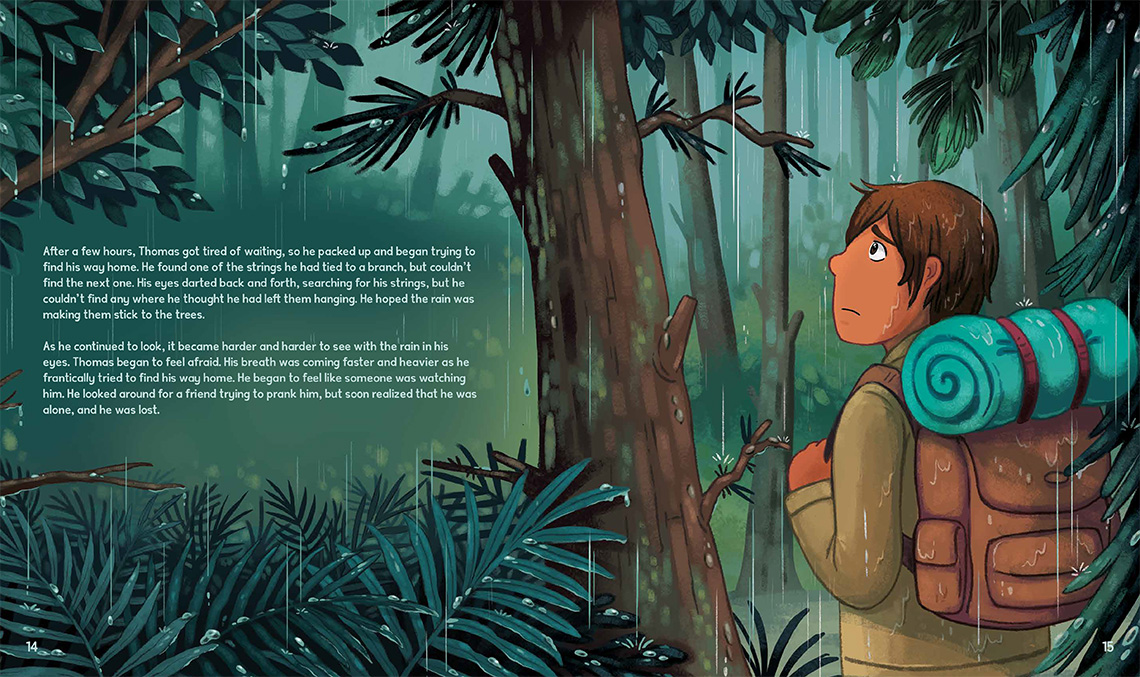
After a few hours, Thomas got tired of waiting, so he
packed up and began trying to find his way home. He
found one of the strings he had tied to a branch, but
couldn’t find the next one. His eyes darted back and
forth, searching for his strings, but he couldn’t find
any where he thought he had left them hanging. He hoped
the rain was making them stick to the trees.
As he continued to look, it became harder and harder to
see with the rain in his eyes. Thomas began to feel
afraid. His breath was coming faster and heavier as he
frantically tried to find his way home. He began to feel
like someone was watching him. He looked around for a
friend trying to prank him, but soon realized that he
was alone, and he was lost.
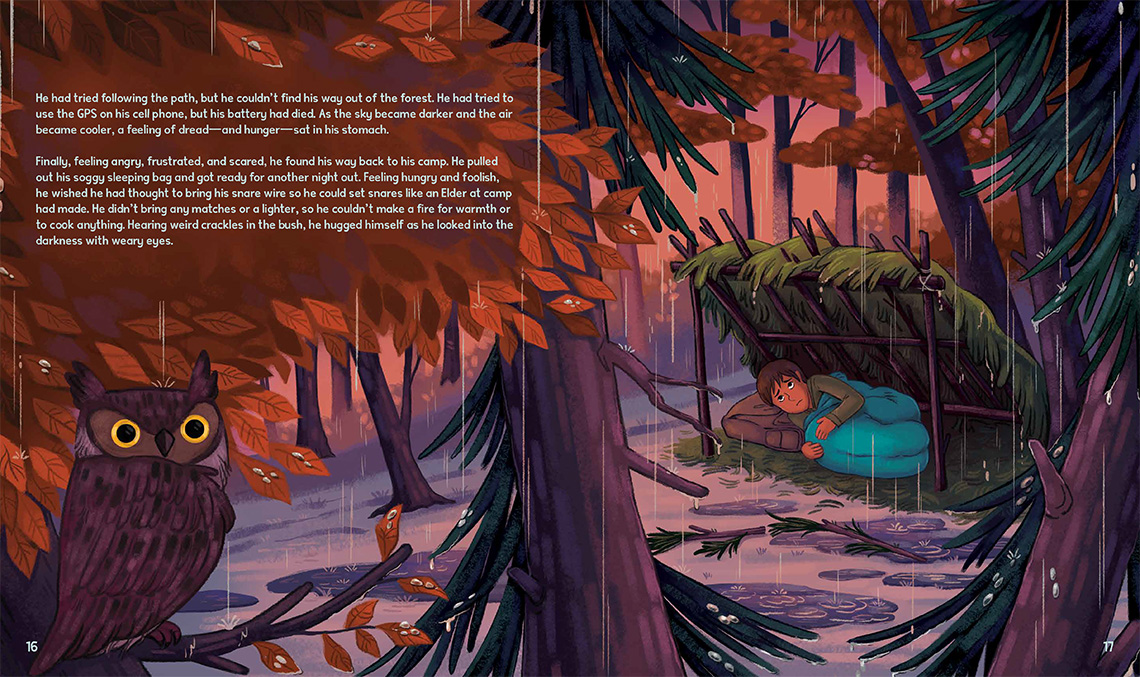
He had tried following the path, but he couldn’t find
his way out of the forest. He had tried to use the GPS
on his cell phone, but his battery had died. As the sky
became darker and the air became cooler, a feeling of
dread—and hunger—sat in his stomach.
Finally, feeling angry, frustrated, and scared, he found
his way back to his camp. He pulled out his soggy
sleeping bag and got ready for another night out.
Feeling hungry and foolish, he wished he had thought to
bring his snare wire so he could set snares like an
Elder at camp had made. He didn’t bring any matches or a
lighter, so he couldn’t make a fire for warmth or to
cook anything. Hearing weird crackles in the bush, he
hugged himself as he looked into the darkness with weary
eyes.
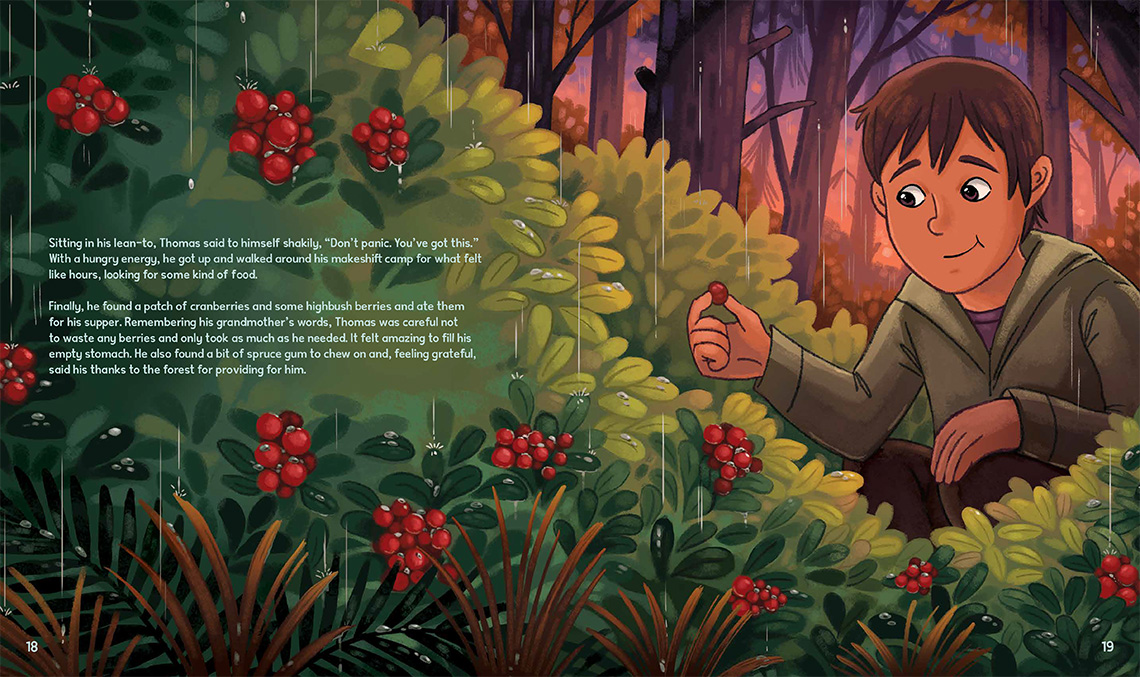
Sitting in his lean-to, Thomas said to himself shakily,
“Don’t panic. You’ve got this.” With a hungry energy, he
got up and walked around his makeshift camp for what
felt like hours, looking for some kind of food.
Finally, he found a patch of cranberries and some
highbush berries and ate them for his supper.
Remembering his grandmother’s words, Thomas was careful
not to waste any berries and only took as much as he
needed. It felt amazing to fill his empty stomach. He
also found a bit of spruce gum to chew on and, feeling
grateful, said his thanks to the forest for providing
for him.
His grandmother and cultural teachers always talked
about how the land could provide for us. If we treat the
land with respect and only take what we need, they said,
the land will always be there. In this moment, he was
truly thankful for what the land around him had
provided.
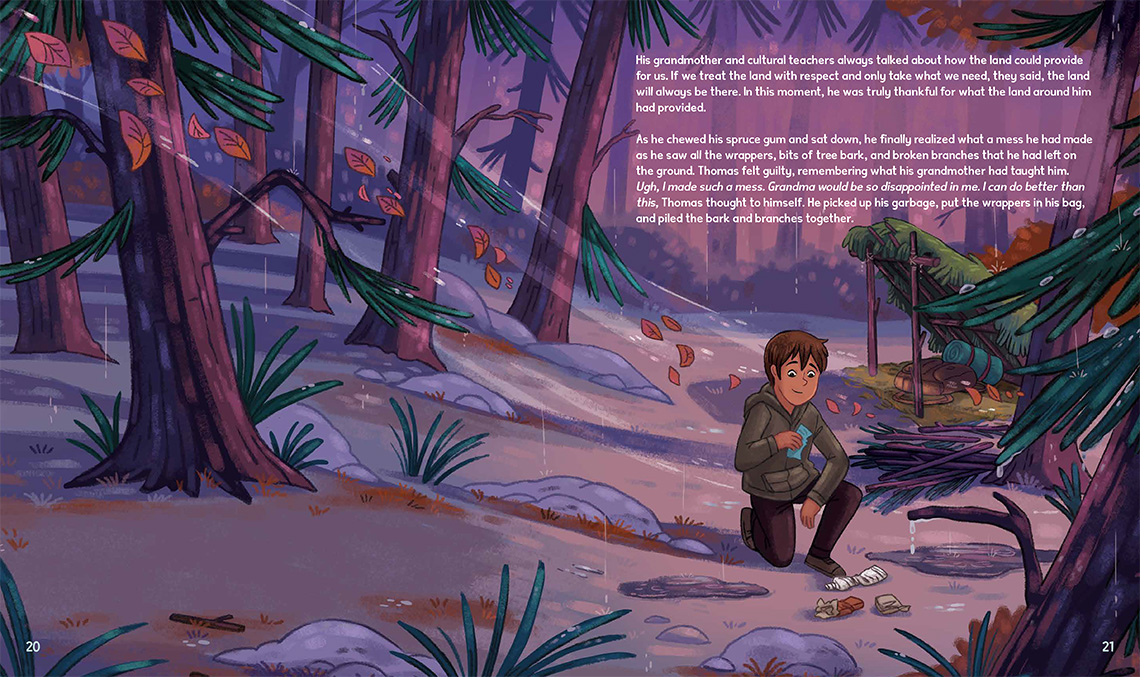
As he chewed his spruce gum and sat down, he finally
realized what a mess he had made as he saw all the
wrappers, bits of tree bark, and broken branches that he
had left on the ground. Thomas felt guilty, remembering
what his grandmother had taught him. Ugh, I made such a
mess. Grandma would be so disappointed in me. I can do
better than this, Thomas thought to himself. He picked
up his garbage, put the wrappers in his bag, and piled
the bark and branches together.
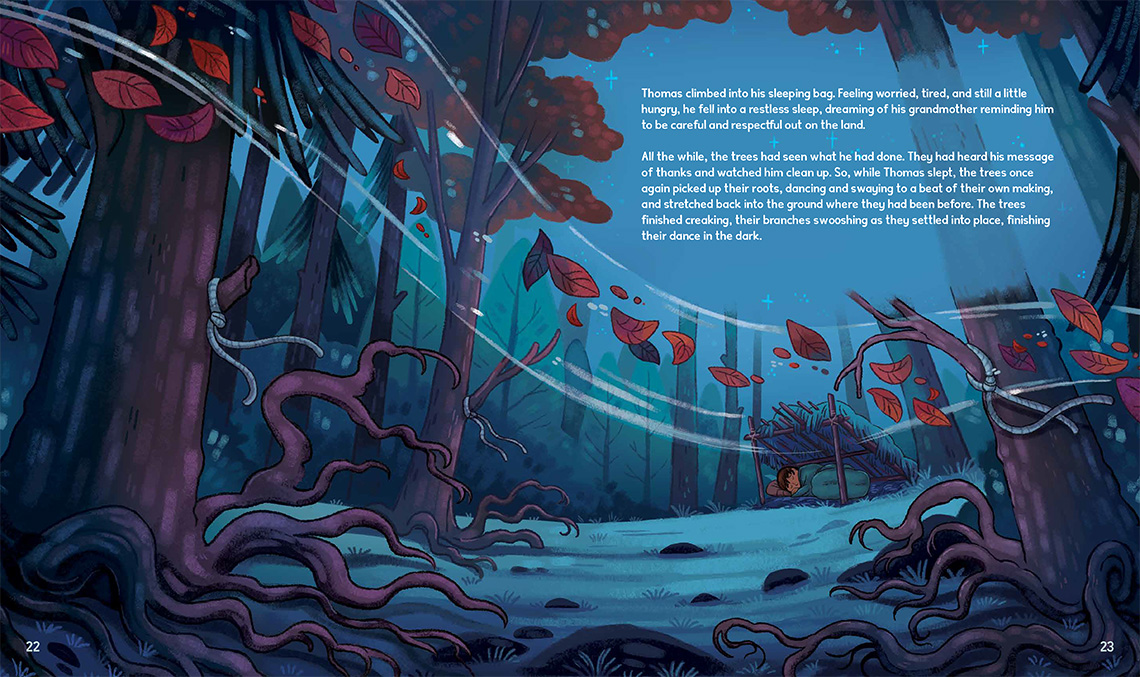
Thomas climbed into his sleeping bag. Feeling worried,
tired, and still a little hungry, he fell into a
restless sleep, dreaming of his grandmother reminding
him to be careful and respectful out on the land.
All the while, the trees had seen what he had done. They
had heard his message of thanks and watched him clean
up. So, while Thomas slept, the trees once again picked
up their roots, dancing and swaying to a beat of their
own making, and stretched back into the ground where
they had been before. The trees finished creaking, their
branches swooshing as they settled into place, finishing
their dance in the dark.
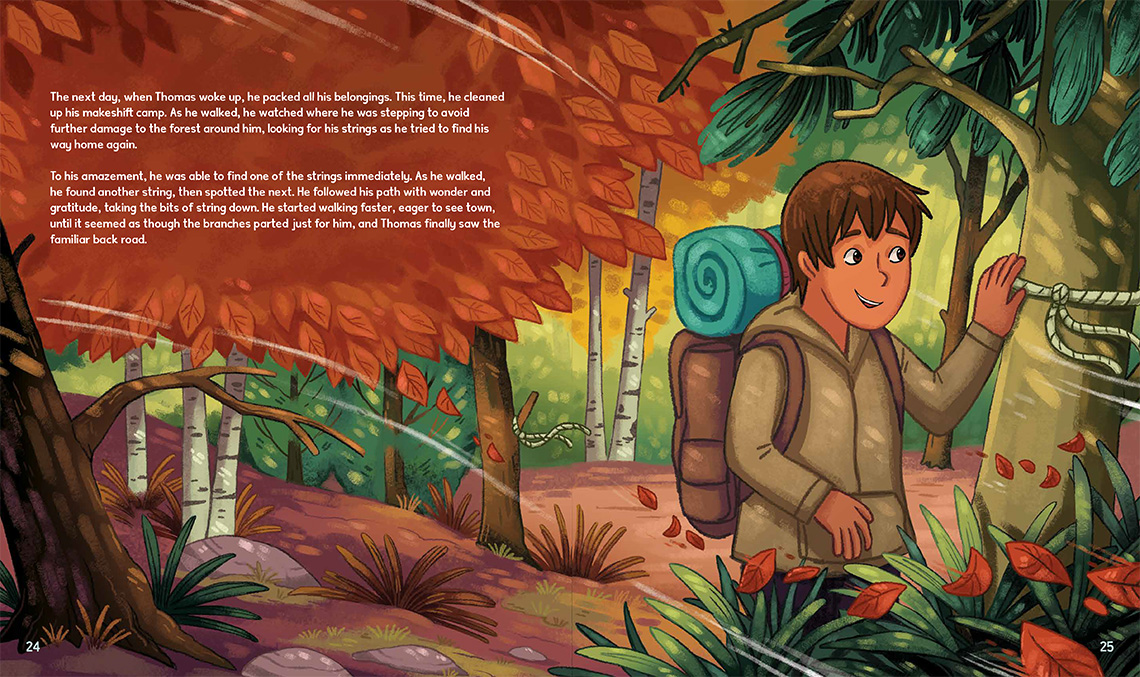
The next day, when Thomas woke up, he packed all his
belongings. This time, he cleaned up his makeshift camp.
As he walked, he watched where he was stepping to avoid
further damage to the forest around him, looking for his
strings as he tried to find his way home again.
To his amazement, he was able to find one of the strings
immediately. As he walked, he found another string, then
spotted the next. He followed his path with wonder and
gratitude, taking the bits of string down. He started
walking faster, eager to see town, until it seemed as
though the branches parted just for him, and Thomas
finally saw the familiar back road.
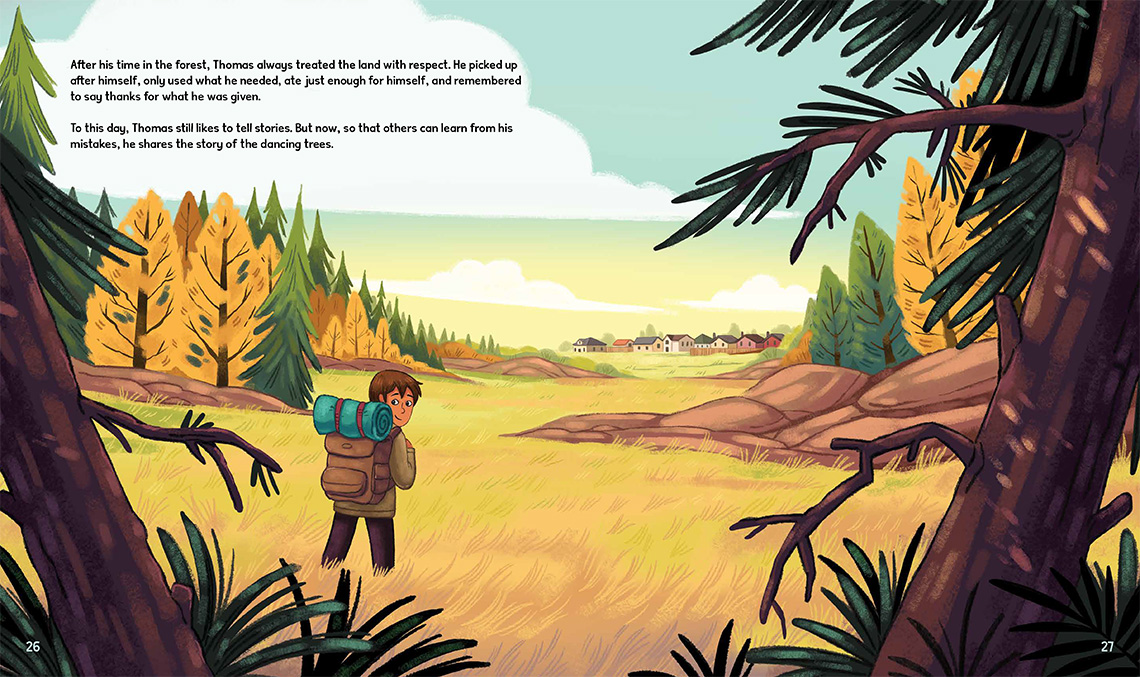
After his time in the forest, Thomas always treated the
land with respect. He picked up after himself, only used
what he needed, ate just enough for himself, and
remembered to say thanks for what he was given.
To this day, Thomas still likes to tell stories. But
now, so that others can learn from his mistakes, he
shares the story of the dancing trees.
Masiana Kelly is an Inuk/Dene from Kugluktuk, Nunavut,
and Fort Simpson, Northwest Territories. She carries
with her the lessons her grandparents taught her. She
lives in Kugluktuk with her husband, two boys, and two
dogs. They enjoy spending quality time together and with
their extended family.
Michelle Simpson is an illustrator and designer based
out of Niagara Falls, Ontario. Michelle graduated with a
BAA in illustration from Sheridan College and now works
as a full-time freelance illustrator, focusing mainly on
children’s book illustration. She has also worked as a
concept artist for kids cartoons such as Ollie: The Boy
Who Became What He Ate and Tee and Mo. You can find her
work at michellescribbles.com or shop at
michiscribbles.etsy.com.
Check your understanding!
Let’s review some of the main events of this story. Answer the following questions in a notebook or using another method of your choice.

Reading fluency routine
The Dancing Trees by Masiana Kelly The Dancing Trees by Masiana Kelly
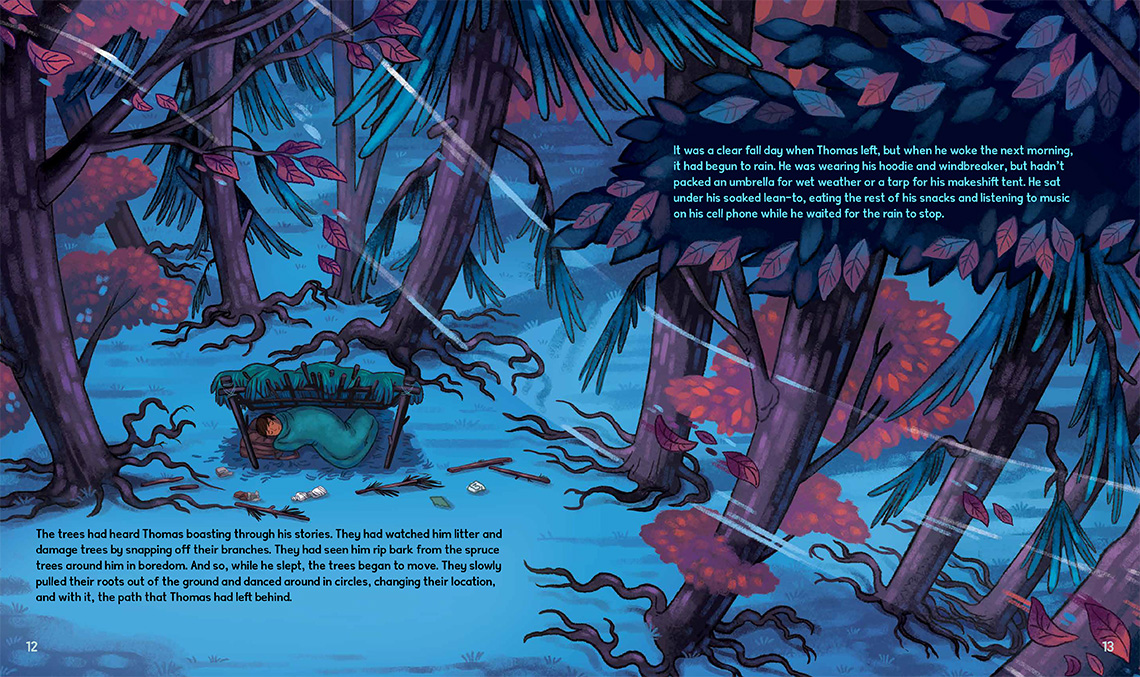
The trees had heard Thomas boasting through his stories. They had watched him litter and damage trees by snapping off their branches. They had seen him rip bark from the spruce trees around him in boredom. And so, while he slept, the trees began to move. They slowly pulled their roots out of the ground and danced around in circles, changing their location, and with it, the path that Thomas had left behind.
It was a clear fall day when Thomas left, but when he woke the next morning, it had begun to rain. He was wearing his hoodie and windbreaker, but hadn’t packed an umbrella for wet weather or a tarp for his makeshift tent. He sat under his soaked lean-to, eating the rest of his snacks and listening to music on his cell phone while he waited for the rain to stop.
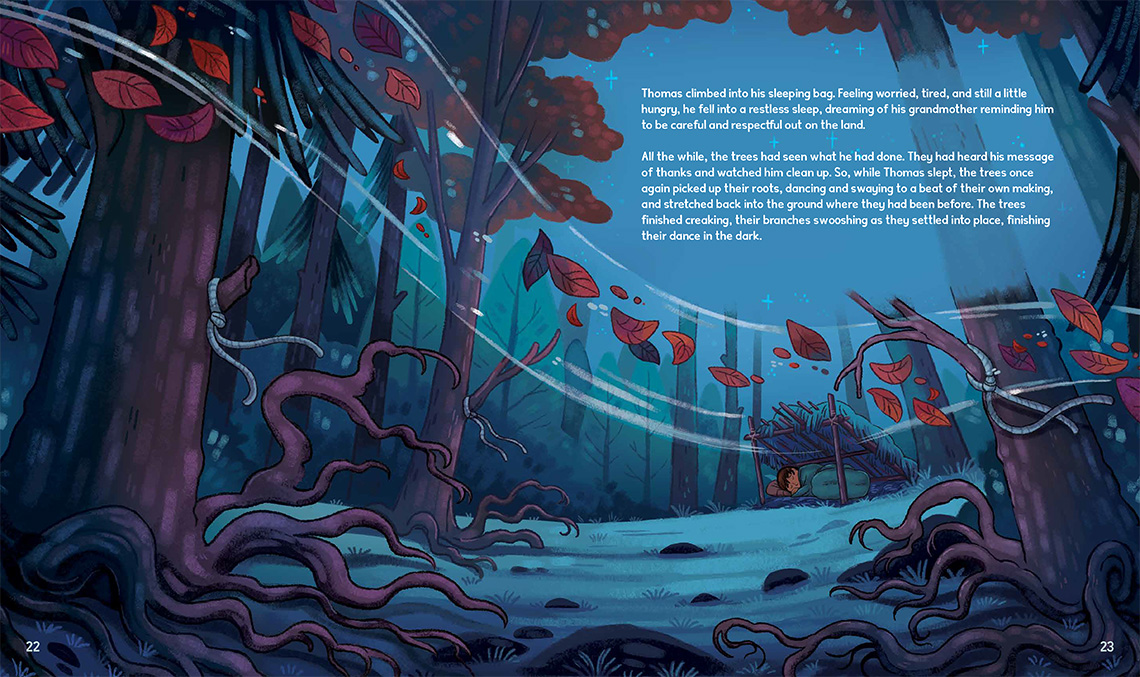
Thomas climbed into his sleeping bag. Feeling worried, tired, and still a little hungry, he fell into a restless sleep, dreaming of his grandmother reminding him to be careful and respectful out on the land.
All the while, the trees had seen what he had done. They had heard his message of thanks and watched him clean up. So, while Thomas slept, the trees once again picked up their roots, dancing and swaying to a beat of their own making, and stretched back into the ground where they had been before. The trees finished creaking, their branches swooshing as they settled into place, finishing their dance in the dark.
In The Dancing Trees, the author included the perspective of the trees and their reactions to Thomas. Go back to pages 12 and 23 and practice reading both pages aloud. As you read, consider the following:
- Focus on reading each sentence or phrase fluently, without stumbling.
- Adjust your tone to communicate the displeasure (or unhappiness) of the trees on page 12, and their appreciation (or happiness) on page 23.
Self-check
How fluent and expressive was your reading?
Use the following checklist to self-assess.
Being a steward of the Earth
Global citizens must take care of the Earth because humans cannot live a safe and healthy life without clean air, water, and land. Being a caretaker of the Earth, and making sure it is sustainable for future generations, can also be called environmental stewardship .
Environmental stewardship is not a new concept. Many people and cultures throughout the world have honoured and valued their relationship with the land and passed along wisdoms and learnings through their generations. In the book The Dancing Trees, author Masiana Kelly used teachings from her Inuit and Dene heritage as the lessons that guided her main character, Thomas.
There are many unique cultures, languages, and histories among First Nations, Inuit, and Métis peoples, however what the many communities share is the understanding that we all depend on the land and water to live safely and well.
With these skills and knowledge of how to live on, and learn from the land, Indigenous communities have been able to survive and thrive on their lands for as long as can be remembered.
Indigenous communities have long worked to protect and conserve the resources on land, air, and water. In doing so, many different communities act in ways that aim to be in balance with nature, taking only what is needed, and helping limit pollution and encourage the longevity of living things.
Spotlight on Indigenous environmental activists
Let’s explore some examples of young people that are Indigenous environmental activists. These individuals demonstrate global citizenship skills by caring about the Earth and its people, and they advocate on their behalf.
Activist , global citizenship , and advocate are three of our vocabulary terms! As you explore the content on the Indigenous activists, try and identify the meaning of each of these terms. When you’re done, take a minute and record their definitions in your vocabulary notebook. Feel free to also record any other words that are new to you as well as their definitions!
Make your vocabulary notebook personal and individualized for you!
Choose one of the following profiles to learn about an Indigenous activist, the environmental issues they are passionate about, and the changes they are advocating for.
Press the following tabs to learn about different Indigenous activists.
Have you ever had to question if the water that comes out of the tap is safe?
Autumn Peltier is an Anishinabek woman who grew up in Wiikwemkoong First Nation on Manitoulin Island in Ontario, surrounded by freshwater lakes and rivers. At the age of eight, she was devastated to learn that there were First Nations communities on her island that did not have safe drinking water. In fact, at that time in Canada, 116 different First Nations communities had boil water advisories. Autumn expressed a strong connection to water and the belief that water is the sacred origin of all life. She was also inspired by her aunt Josephine Mandamin, an Anishinaabe elder, famous for walking over 25,000 kilometers around Canada's Great Lakes to protest and bring awareness to the clean water crisis in Indigenous communities.
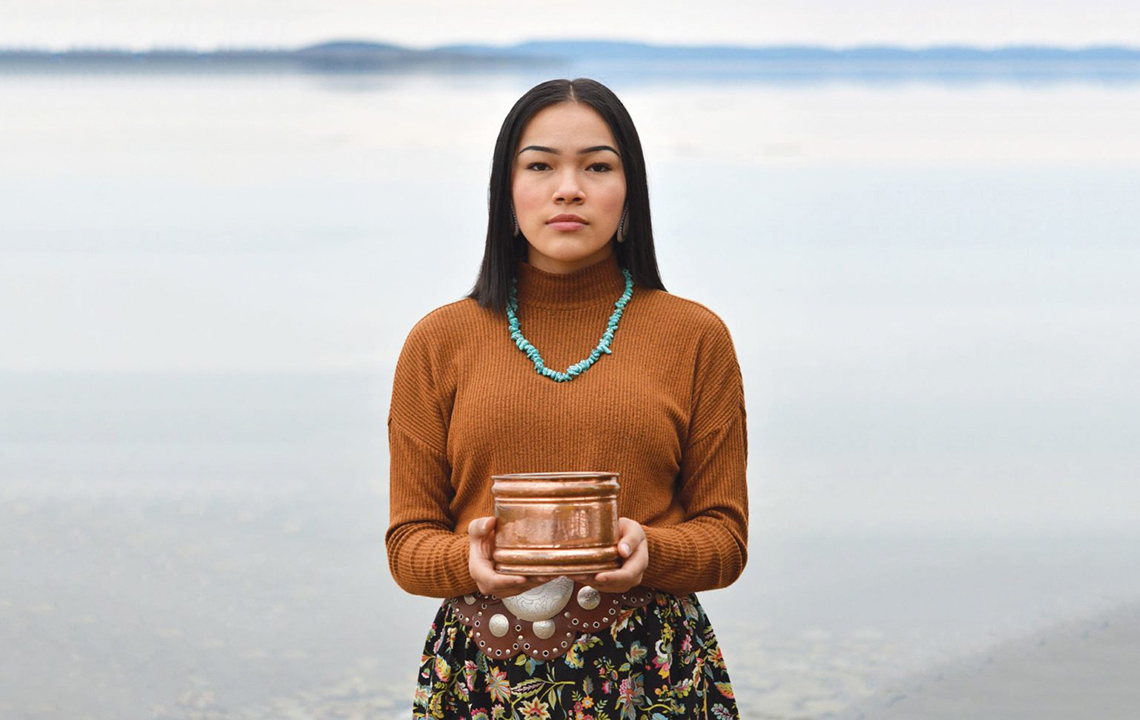
In 2016, at the age of 12, Autumn spoke up and addressed Prime Minister Justin Trudeau at the Assembly of First Nations. She bravely advocated for Indigenous communities by telling him that she was not happy with the choices he’d made in his clean-water policies. This was just the beginning of Autumn’s work as a water activist.
Her work as a speaker and advocate for fresh water has earned her numerous awards and nominations such as the Children’s Peace Prize, as well as an honorary doctorate from a university. She is now the Chief Water Commissioner for the Anishinabek Nation, as her aunt was before her. Her 2023 movie Water Walker has brought the Indigenous water crisis in Canada to the attention of the world. Autumn continues to be one of the leading global voices on Indigenous matters and is active through social media, public appearances, and her work with charitable organizations.
Her advice to other children and youth is:
“It is important to speak up on behalf of those who are too afraid to speak up. It can be as easy as writing a letter to your local leaders. The message is so much more powerful when it comes from a young person. You can be the light in someone’s darkness.”
Source: Mukhi, P. (2021, April 13). 8 questions for Autumn peltier. Time for Kids. https://www.timeforkids.com/g56/8-questions-for-autumn-peltier-2/
Nicholas Flowers developed a deep appreciation for the land and the water from his Inuit elders while growing up in Nunatsiavut, northern Newfoundland, and Labrador. As a proud Inuk and environmental activist, he is committed to giving back to the land and respecting it by using natural resources carefully. He is especially interested in finding new sources of renewable energy to use in northern communities. Fossil fuels have negative impacts on the environment, contribute to global warming, are non-renewable, and can be hard for people in northern and rural communities to access.
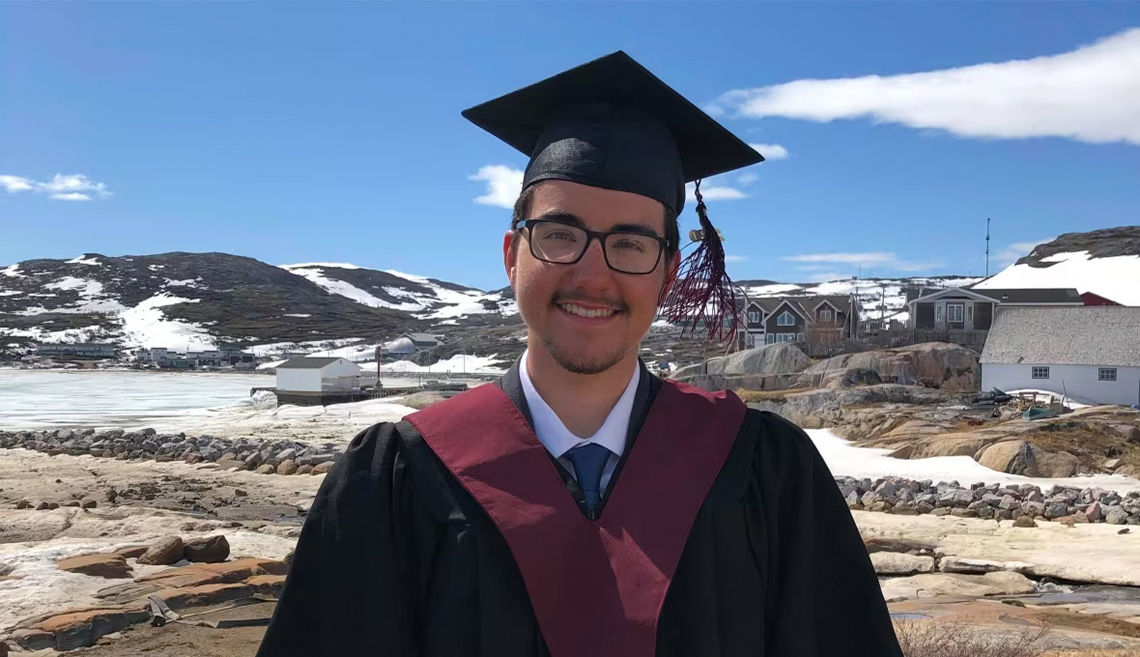
Finding renewable alternatives inspired his award-winning grade 12 science project, where Nicholas built a traditional Inuit lamp called a qulliq, out of soapstone, and then powered it using seal oil. Seal oil is a renewable resource and readily available in Labrador, whereas traditional lamp fuels, like kerosene and paraffin, are fossil fuels and sometimes hard to find. Nicholas hopes to one day see renewable energies used in larger applications in northern communities.
Nicholas’ innovation and community leadership in developing an after-school science club for kids in kindergarten to grade 5, won him a $25,000 STEAM Horizon award to attend a Canadian university to continue studying environmental science and share his Inuit heritage. He hopes to return to his community and work collaboratively with youth and community leaders to advocate for projects that take place on Indigenous land that are respectful of both the land and the values and traditions of communities.
He says:
“If settlers are planning a project on the land of an Indigenous community, it's important that they work together with the Indigenous communities, both youth and elders alike, and get the opinions of all community members, so that the wildlife, the plants, the waters and the land can all be respected and in a healthy and balanced way.”
Source: CBC/Radio Canada. (2020, June 21). Nunatsiavut Student Wins Scholarship for Science Work | CBC news. CBCnews. https://www.cbc.ca/news/canada/newfoundland-labrador/nicholas-flowers-steam-scholarship-1.5619967
Gathering research information
 Description
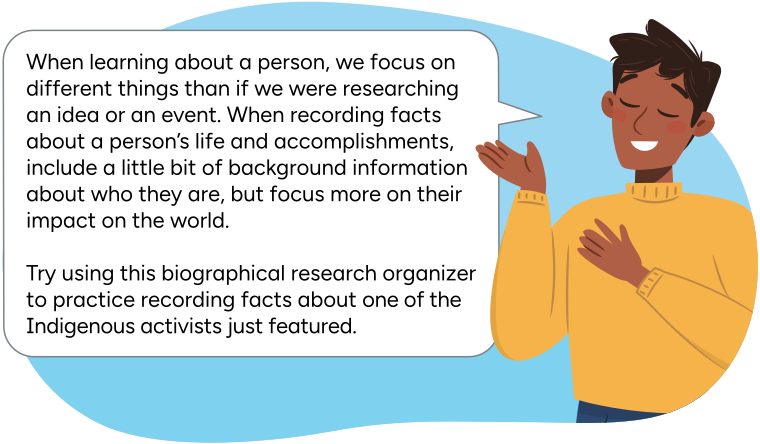
Teacher Ravi saying: When learning about a person, we focus on
different things than if we were researching an idea or an
event. When recording facts about a person's life and
accomplishments, include a little bit of background information
about who they are, but focus more on their impact on the world.
Try using the following biographical research organizer to
practice recording facts about one of the Indigenous activists
just featured.
Complete the fillable and printable Biographical Research Organizer in your notebook or using the following document. If you would like, you can use speech-to-text or audio recording tools to record your thoughts.
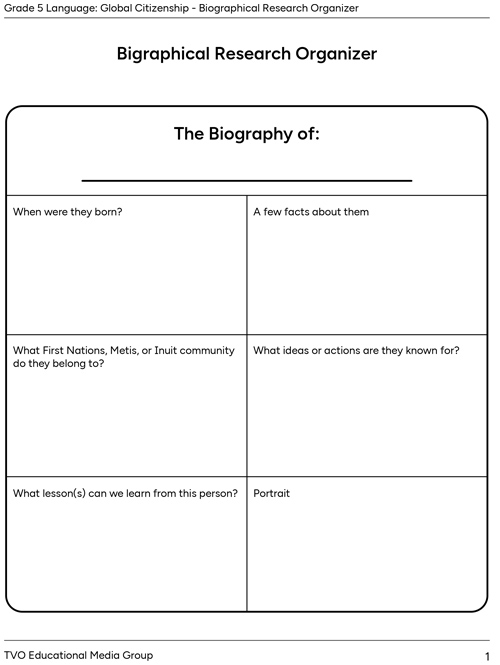
Press the Activity button to access the Biographical Research Organizer.
Activity(Opens in a new tab)Conduct your own research!
Now it’s time to put your skills to the test and conduct your own research on another Indigenous environmental activist!
Safety
Before you begin your research, review the following Research Safety tips.
When doing research on the Internet, it is important to stay safe and stay focused. You can use the acronym T.R.U.S.T. to help guide you as you do your research.
Press the following tabs to explore some research safety tips.
Think about your topic and develop specific questions to get better research results.
For example, if you’re working on the topic of recycling, you might start with a general question and make it more specific before beginning your research.
|
General Question: Why is recycling good for the environment? |
|
Specific Question: How does recycling help protect marine wildlife? |
Be patient while doing your research. Go through each website carefully, and take notes using a graphic organizer, or notebook. Record the websites used for specific information – it’s important to give credit to the creator of the content.
Consult more than one resource to help you determine if the information you gather is accurate and true.
Remember, research can take time. It helps to be focused and calm! Taking a break can help refresh our thinking and process new information.
It’s important to use reliable sources so that you can put together accurate and up-to-date information about your topic.
Websites ending with .com, .org, and .net can be purchased and used by any person.
The ending .org is usually used by non-profit organizations which may be trying to persuade rather than educate.
Websites ending in .edu are reserved for colleges and universities. Canadian websites have a .ca ending.
Consider the following questions when you are doing your reliability check. You might also ask a trusted adult or a peer for help if you are uncertain about a website.
- When was the resource published? (This might help you determine if the information is current.)
- Who created the resource/website? What is their educational background or work experience?
- Who is the intended audience?
- Who benefits from this information being shared?
- Whose perspectives are represented? Whose perspectives are missing?
Do you understand all the words on the site? Can you decode their meaning?
Does what you’re reading make sense?
If not, it’s okay. Consider trying a different source. It’s important for you to understand the information that you read so that you can put it in your own words.
It’s important to stay safe while doing online research. If a website asks you for any personal information, close it and try a different website.
Personal information could include asking for your full name, email address, phone number, home address, photos, or school name. Do not provide any personal information and close the website.
Does the site have pop-up windows? These windows usually ask the user to click to “win a prize” or “check out information”. Do not click on the pop-ups and close the website.
Throughout the research process, feel free to check in with a peer or trusted adult.
If there is anything specific that makes you feel uncomfortable or worried while you are doing your research:
- Pause and take a break.
- Speak to a trusted adult.
Using the same graphic organizer provided, or another format of your choosing, conduct some research and report on another Indigenous environmental activist of your choice.
Press the Suggestions button to access a list of individuals you can choose to research from.
- Ta’Kaiya Blaney
- Pinar Sinopoulos-Lloyd
- Ra'nikonhrí:io and Katsenhaiénton Lazare
- Dallas Goldtooth
- Quannah Chasinghorse
- Xiye Bastida
- Hindou Oumarou Ibrahim

Pause and Reflect
Reflecting on research
In this research activity, you used a graphic organizer to help collect biographical research notes. Did you find this learning strategy helpful?
Take a moment to reflect on how this tool helped guide the focus of your research and the organization of your research notes.
Did you find it:
Take your reflection a bit further and try and identify what parts you found most helpful and/or what parts you didn’t find helpful and why?
What changes could you make to this tool, or other tools, to make it more helpful for you as you record your research?
Vocabulary review!
This learning activity featured the words activist, global citizenship, environmental stewardship, and advocate. Let’s pause to make sure that we understand each of them, and then add any new words to our vocabulary notebook.
- First, try to record a definition using your own words. You may wish to go back and review where each term was introduced earlier.
- Next, check the accuracy of your definition using either a dictionary or another source.
- Lastly, add something that will help deepen your understanding of these words, such as a real-world example, a synonym, a diagram, or a sketch that represents the word.
Word meanings!
 Description
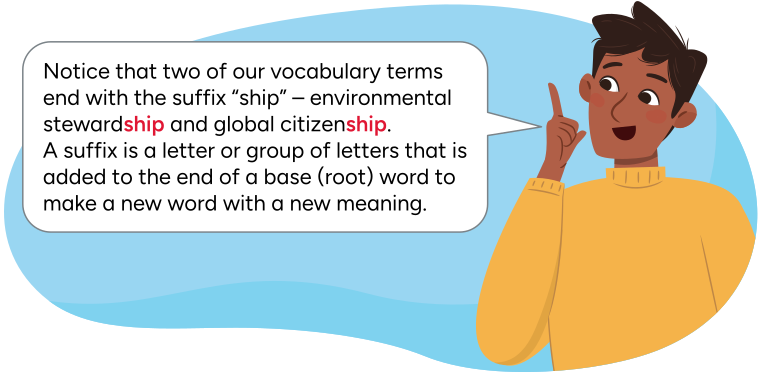
Teaching Ravi saying: Notice that two of our vocabulary terms
end with the suffix "ship" - environmental stewardship and
global citizenship. A suffix is a letter or group of letters
that is added to the end of a base (root) word to make a new
word with a new meaning.
|
base word + suffix = new word The suffix "ship" means the state or condition of being something. Its origin is Germanic. Let’s check out a familiar example: friend + ship = friendship, the act of being a friend. |
 Description
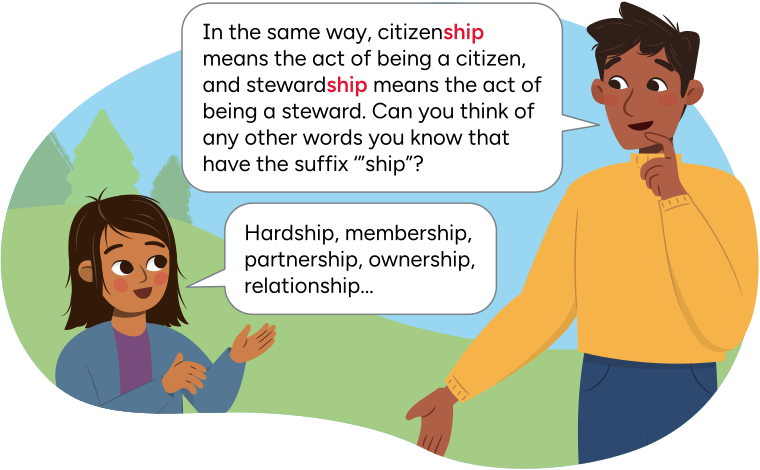
Neebin and Teacher Ravi talking.
Teacher Ravi asks: In the same way, citizenship means the act of being a citizen, and stewardship means the act of being a steward. Can you think of any other words you know that have the suffix "ship"?
Neebin responds: Hardship, membership, partnership, ownership, relationship…

Putting it all together
Let’s start by reviewing the meaning of some of the key vocabulary terms we explored in this learning activity.
For each vocabulary term match it with their correct definition.
Has learning about real-life activists inspired you? It is amazing to think what one person can do!
Being a steward of the Earth does not have to mean that you are famous or win an award. We can each take steps in our daily lives to be stewards of the Earth and to practice environmental stewardship.
In this learning activity, you learned how some Indigenous activists practice global citizenship by being stewards of the Earth. You also read about a character who remembers how to be a good steward of the Earth through everyday actions.
How can you apply this learning to your own life?
In a notebook or using another method of your choice create a list of three to five actions, steps, or goals that you could pursue to practice global citizenship and be a steward of the Earth.
Consider starting your list with one of the following sentence prompts:
“To be a good global citizen I can/will…”
“To show environmental stewardship I can/will…”
Reflection
As you read through these descriptions, which sentence best describes how you are feeling about your understanding of this learning activity? Press the button that is beside this sentence.

I feel...
Now, record your ideas using a voice recorder, speech-to-text, or writing tool.
Press "Discover More" to extend your skills.
Discover MoreExtend your learning!
The Indigenous activist profiles touched upon different environmental issues and topics.
To extend and enhance your learning, consider conducting additional research about one of these topics:
|
|
|
|
Consider the following questions before you begin.
- How will you organize your research?
- What tools could you use?
- Who will you share your learning with?