Learning goals
We are learning to…
- understand historical contexts, experiences, and perspectives of diverse groups
- demonstrate an understanding of different vocabulary words
- identify literary devices
- understand the use of proper adjectives
- develop ideas for writing and organize them using a variety of strategies
Success criteria
I am able to…
- identify and make connections to groups of Canadian refugees, their circumstances, and experiences
- create definitions in my own words and find synonyms, antonyms, and examples of vocabulary terms
- identify examples of metaphor and explain how they help create meaning
- identify and correctly capitalize proper adjectives
- organize my ideas for actions my school community can take to support newcomers to Canada
Exploring video texts
Before exploring new content, there are different strategies that we can use to help us understand what we’re reading, viewing, or listening to. Let’s explore a few and then apply them as we activate our prior knowledge about Canadian citizenship and newcomers to Canada.
Press the following tabs to learn more about each of the strategies that we can use before engaging with new content.
What will the content be about? What will happen?
Use your predictions to ask questions that you’ll look for answers to.
Do you think the content connects to anything you already have experience with?
You are going to explore a clip from The National Film Board’s documentary called 19 Days.
19 days is a “short documentary that follows several refugee families during their first 19 days in Canada, as they navigate an unfamiliar terrain that has suddenly become their home.”
As you watch the clip, try to answer the following questions:
- Who do you see in the video?
- What are they doing?
- Where do you think they are?
- Why do you think they are there?
- What questions do you have after watching this video?
Share your responses out loud with a learning partner or record them using a method of your choice.
Check out the following video to learn more.
Canada has a strong history of welcoming the world through its borders.
As a country, Canada tries to demonstrate global citizenship by helping support and providing refuge for people from anywhere in the world who need protection. A refugee is a person who leaves their country because it is not safe for them, and they need protection.
In this learning activity, you will learn about some of Canada’s refugee groups, their experiences coming to Canada, and how our governments and citizens help new Canadians get settled.

Canada: A country of newcomers

Canada has a long history of different groups settling and establishing new lives across its lands. It’s important to note that Indigenous communities have lived on Turtle Island, the land that is now Canada, since time immemorial . Only in the last 500 years did a large population of settlers from other continents come to live on this land. Before European contact, there were hundreds of Indigenous nations living and thriving across Turtle Island.
When European explorers and colonizers first arrived in North America, they encountered First Nations communities who were living and thriving with their own distinct cultures, languages, and ways of knowing. Once the explorers realized what valuable resources could be taken from Canada, the King of France claimed the land, created a colony, and encouraged people from France to move to what is now called Québec, (previously called the colony of New France).
After the French came to Canada, the British soon arrived and created their own English colonies.
As more settlers arrived in Canada (which was then called British North America), more Indigenous Peoples were forcibly removed from their lands and their traditional activities (such as hunting, fishing, and trapping) were severely impacted.
Because the population was growing, the government realized they needed even more people in the country to help build things like railroads, canals, and farm the land to support the new communities of settlers. A combination of reasons like fleeing harm in their home country and seeking new opportunities brought people to British North America. Some of these communities, including Chinese, Irish, Ukrainians, and Jewish people, made significant contributions to the development of British North America. It is important to acknowledge that although settler communities were coming to the lands for many different reasons, they were displacing Indigenous Peoples from their homelands and changing their way of life.
Many of Canada’s early settler communities were created by refugees who escaped violence, war, or persecution. These diverse cultural groups have contributed to the creation of Canada as we know it.

Vocabulary routine
So far, we have been introduced to three different vocabulary terms:
- refugees
- time immemorial
- settlers
Whether you’ve heard these terms before or not, working with important or “key vocabulary” is a very useful tool in understanding new topics and texts.
To understand a new word or term, it’s not enough to just read a definition. To really understand, our brains need to think about it in different ways. This is where a tool such as a vocabulary notebook comes in handy!
Take a minute to add the terms refugees, time immemorial, and settlers to your vocabulary notebook. If you haven’t started a vocabulary notebook yet, choose one of the following graphic organizers, or use another method of your choice, to record the vocabulary terms and explore more about their meanings.
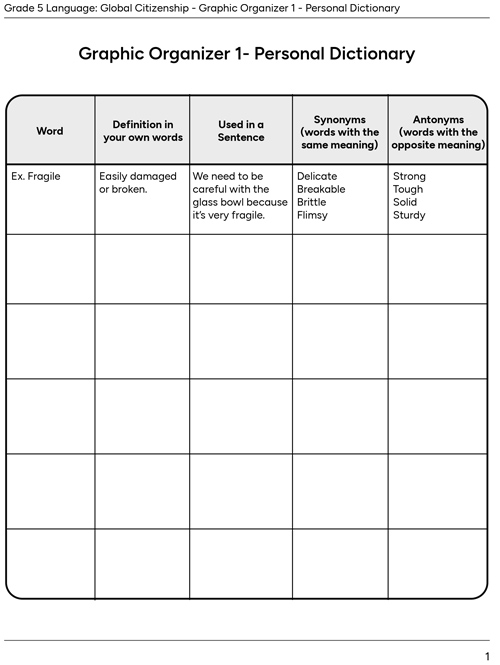
Press the Activity button to access the Graphic Organizer 1- Personal Dictionary.
Activity(Opens in a new tab)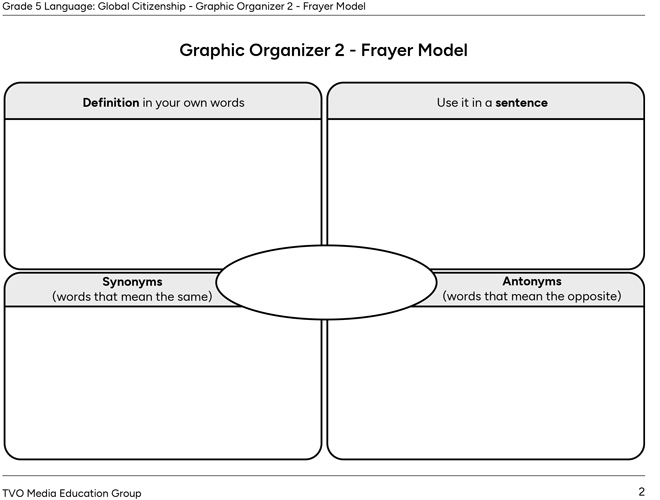
Press the Activity button to access the Graphic Organizer 2- Frayer Model.
Activity(Opens in a new tab)Focus on: some of Canada’s recent refugees
Today, Canada is still a country with a high rate of immigration and newcomers.
Starting in 2011 and lasting nearly ten years, the country of Syria experienced a civil war that displaced more than 5.5 million people outside of their country. Another seven million people were displaced inside their country.
Many neighbouring countries provided refuge for the millions of displaced Syrians. A small number have found new homes in North America. Canada welcomed over 50,000 Syrian refugees from 2015 on.
What must that feel like to be forced to leave a home and start a new life in a new country, where you likely don’t speak the language or know the customs and workings of daily life?

Reading Time
Let’s read!
Let’s read the text Stepping Stones: A Refugee Family’s Journey by Canadian children’s author Margriet Ruurs, and with stone artwork by Syrian artist Nizar Ali Badr. Margriet happened upon Nizar’s art and was inspired to work with it to tell the story of the Syrian refugee crisis. The book is written in both English and Arabic.
While the text reflects the experiences of some Syrian refugees, the issues, feelings, and experiences could be experienced by anyone settling into a new country.
What experiences or emotions might someone have as they travel to and settle into a new life?
As you read, your goal is to understand the story and circumstances of Rama and her family.
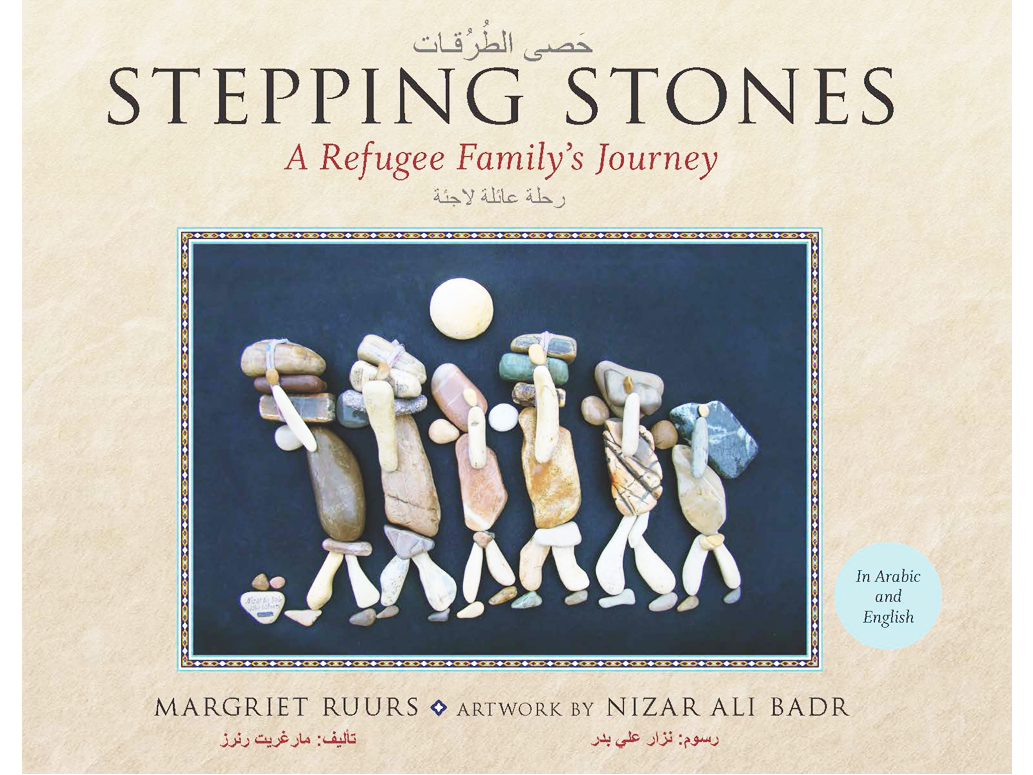
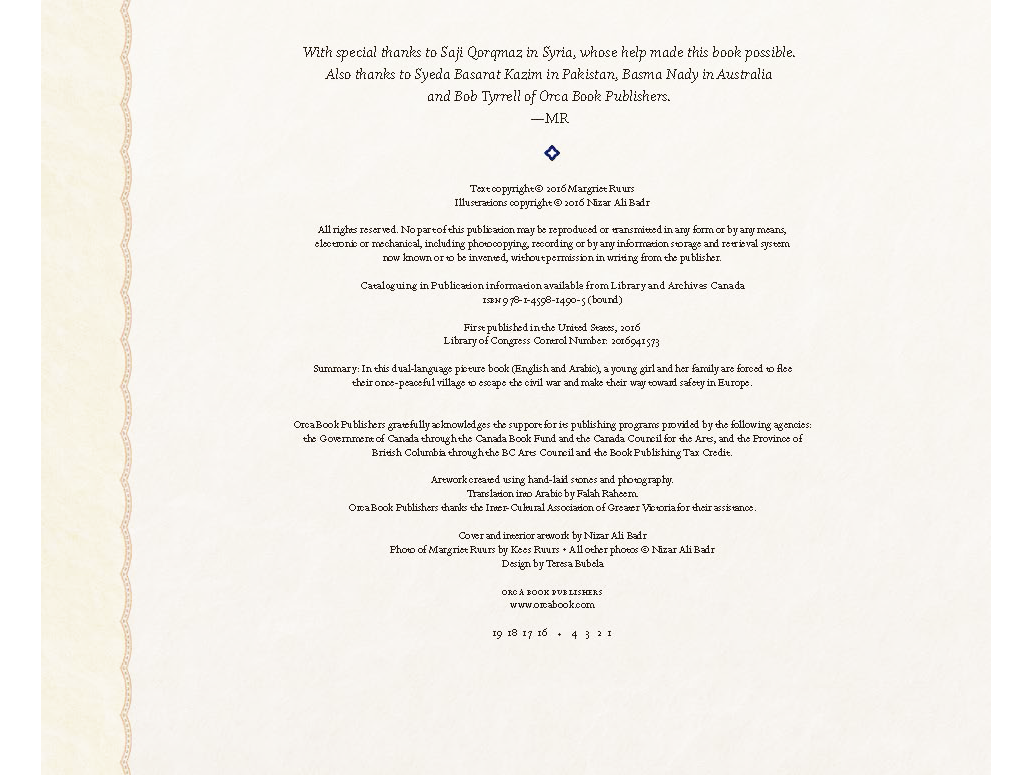
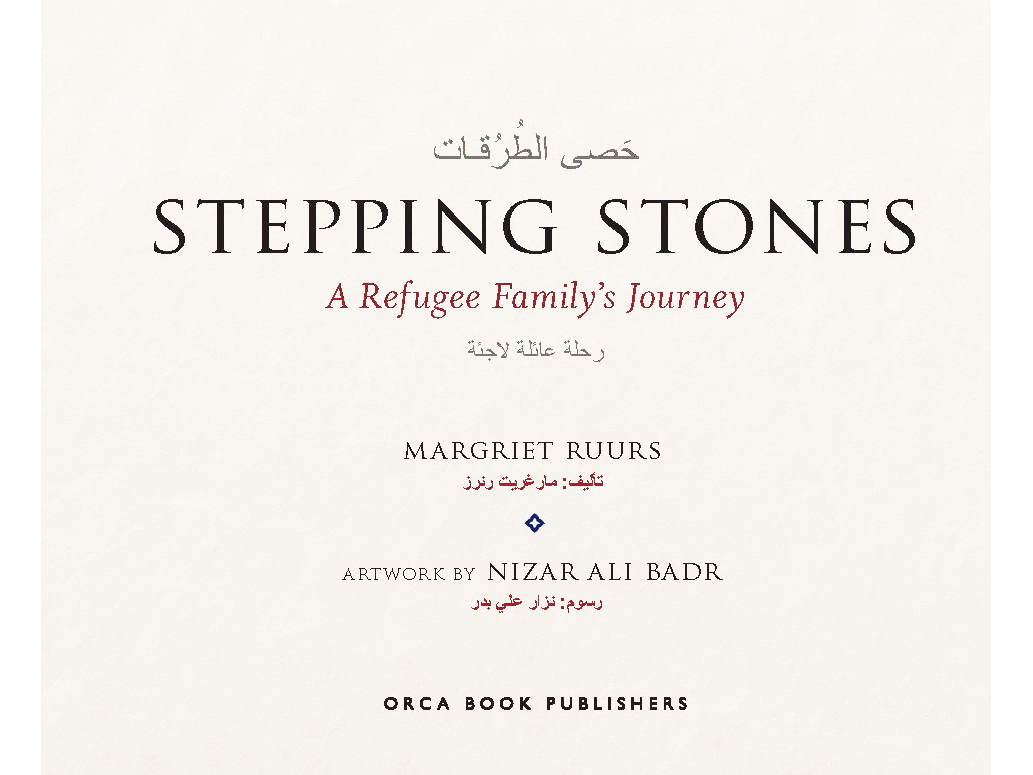
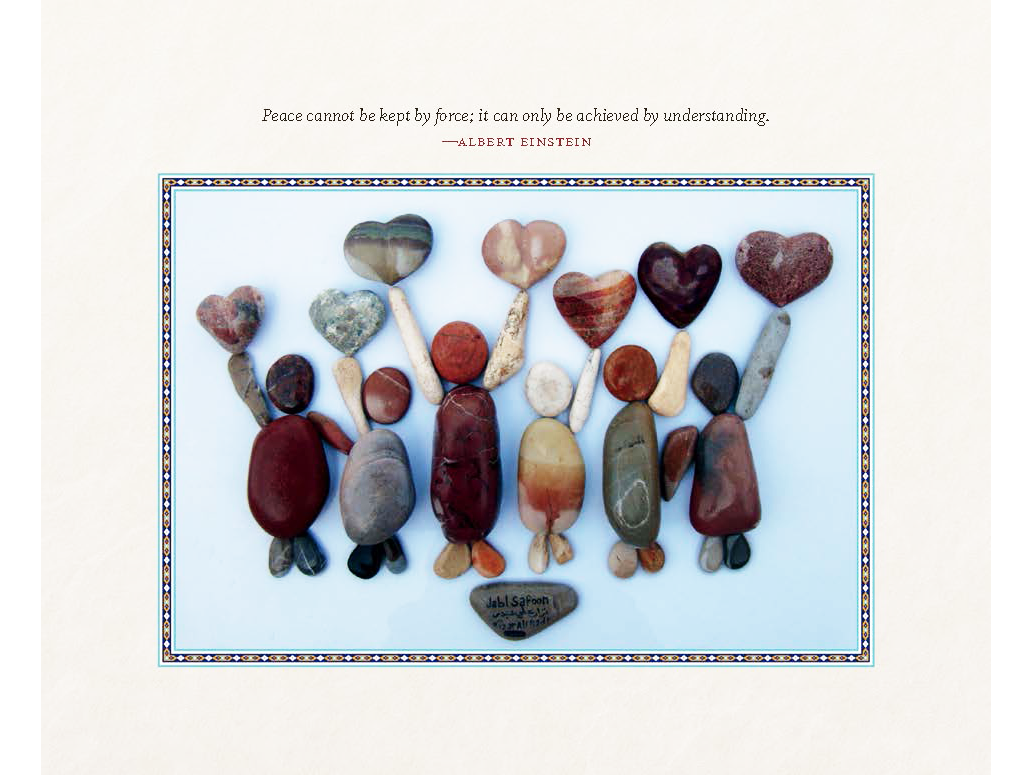
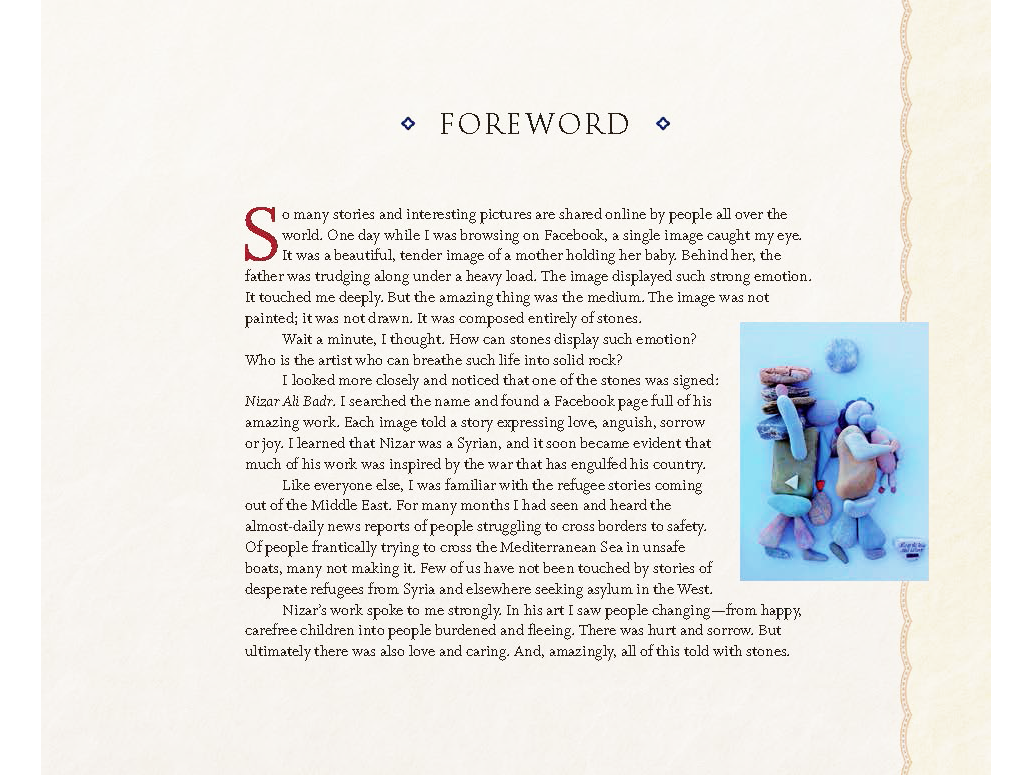
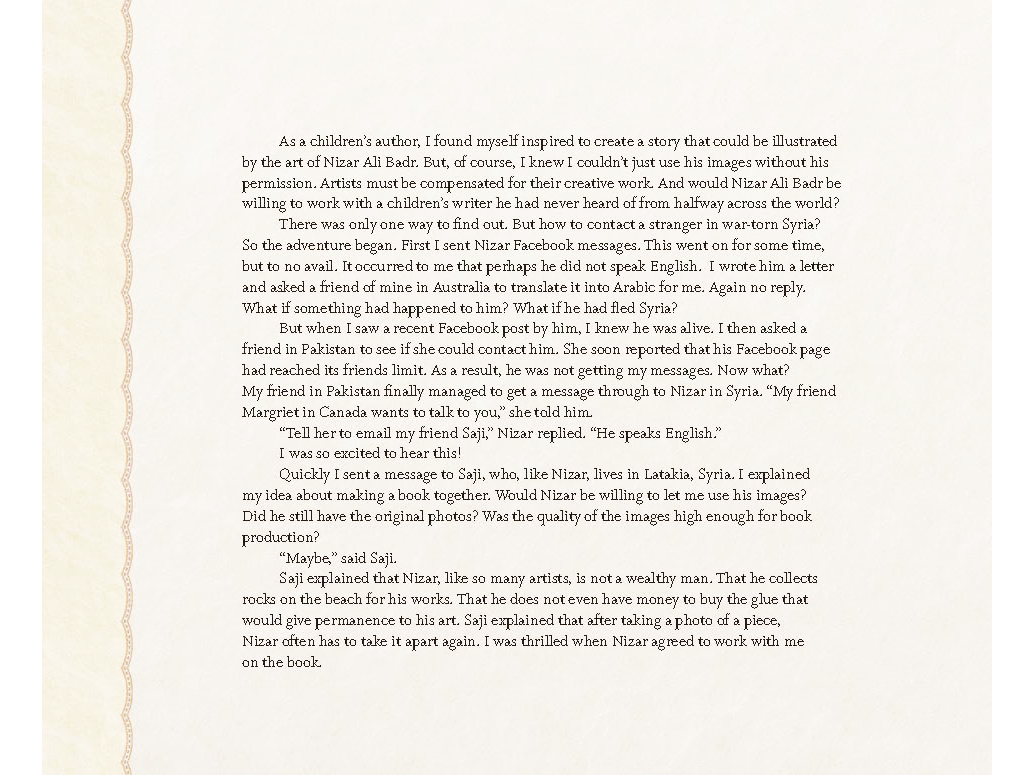
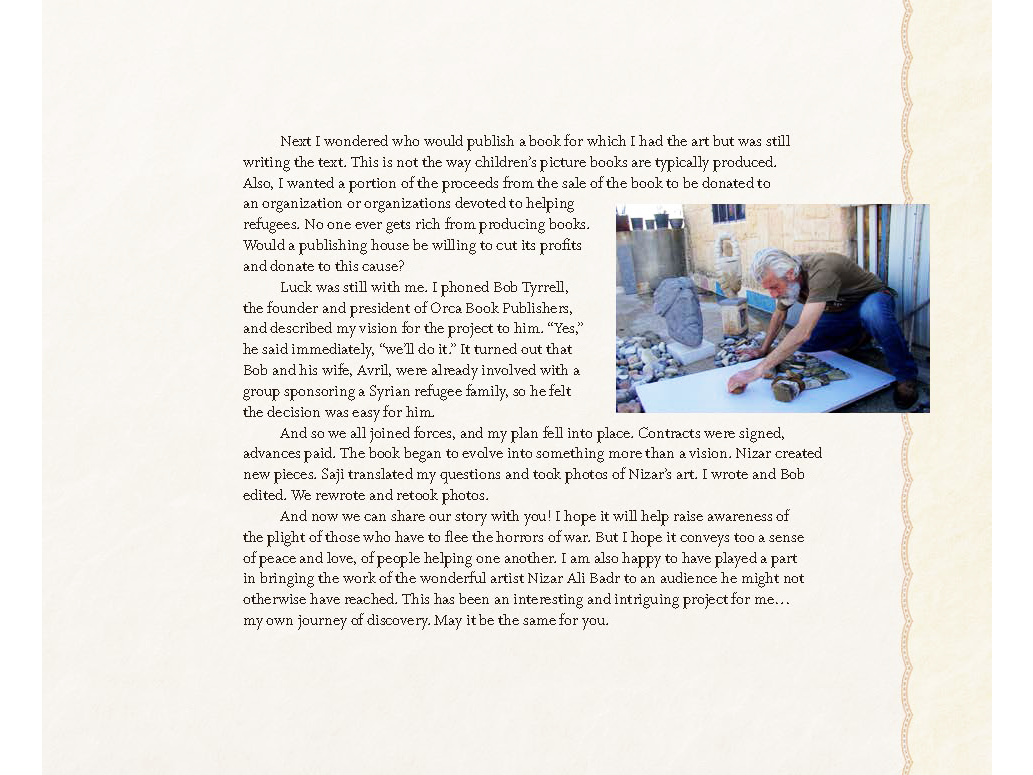
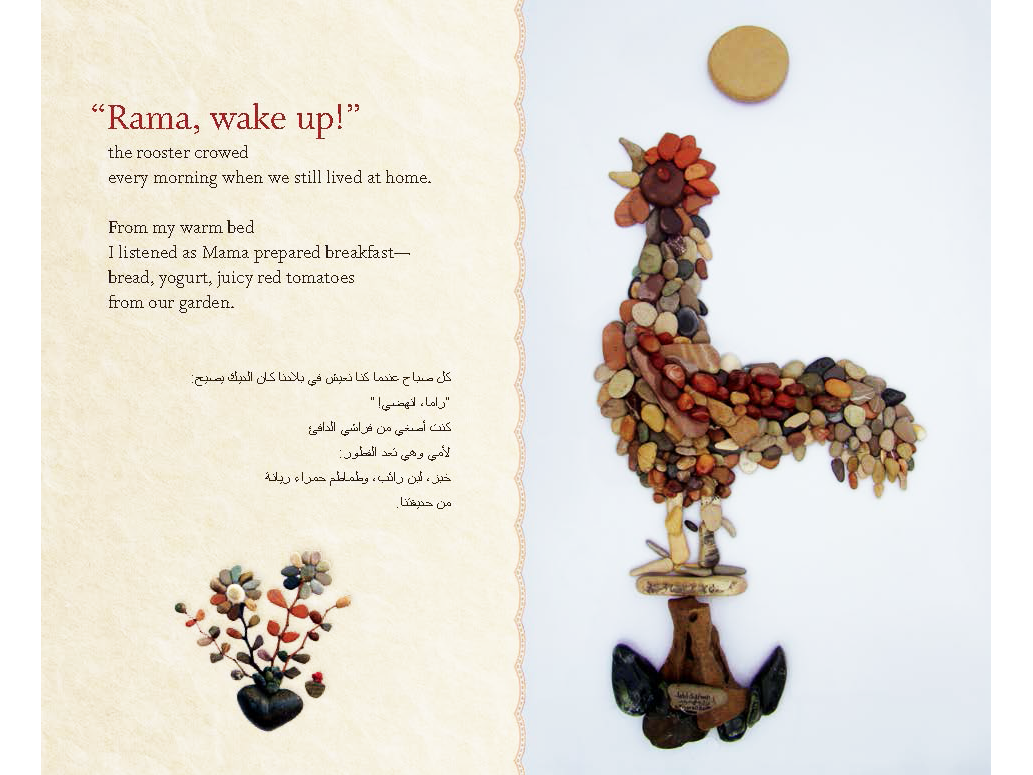
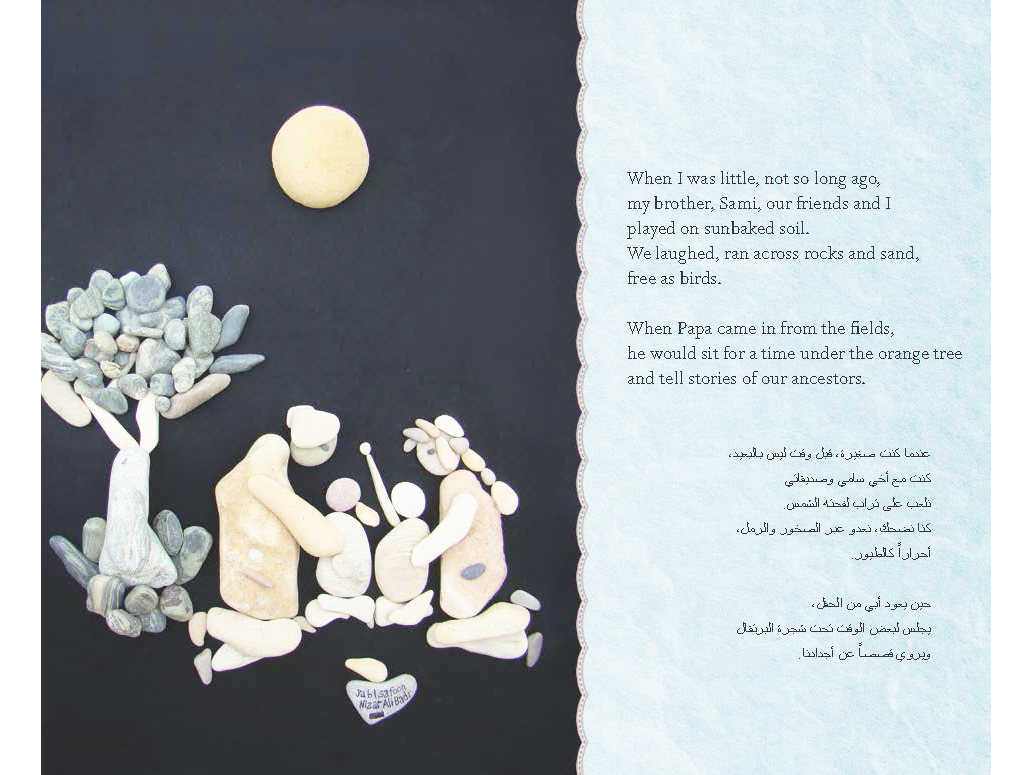
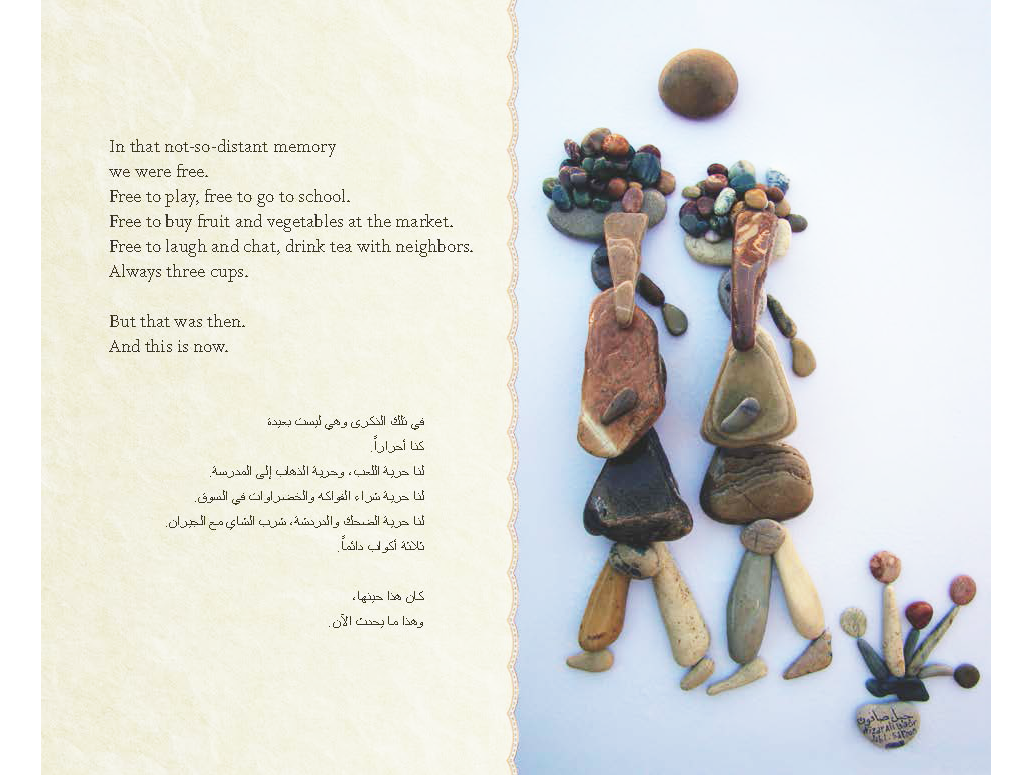
Image 1
The front cover of the picture book Stepping Stones: A Refugee Family's Journey, written by Margriet Ruurs and artwork by Nizar Ali Badr. A blue circle with the words "In Arabic and English" appears on the right. The book title, author name, and artist name appear in both Arabic and English. The centre of the cover shows an image of a family walking in a single file under the sun, holding objects above their heads. The figures are constructed using different shapes of stones.
Image 2
Copyright information for the book Stepping Stones: A Refugee Family’s Journey, written by Margriet Ruurs and artwork by Nizar Ali Badr. This section of the book lists its publication, legal, copyright, and printing details.
Image 3
Title page for the book Stepping Stones: A Refugee Family’s Journey, written by Margriet Ruurs and artwork by Nizar Ali Badr.
Image 4
Epigraph page with the following quote by Albert Einstein: “Peace cannot be kept by force; it can only be achieved by understanding.” There is an image of a group of people holding hearts up above their heads. The figures are constructed using different shapes of stones.
Image 5
The first part of the Foreword section for the book. The author discusses how she came across the book’s artist and how his work spoke to her.
Image 6
The second part of the Foreword section for the book. The author discusses how she got in touch with him and how he agreed to work on the book.
Image 7
The last part of the Foreword section for the book. The author discusses how she contacted the publishing house about her book idea and how they agreed to publish it.
Image 8
The page reads, “’Rama, wake up!’ the rooster crowed every morning when we still lived at home. From my warm bed I listened as Mama prepared breakfast—bread, yogurt, juicy red tomatoes from our garden.” The text appears in both English and Arabic. There is an image of a rooster crowing made from different sizes and colours of stones.
Image 9
The page reads, “When I was little, not so long ago, my brother, Sami, our friends and I played on sunbaked soil. We laughed, ran across rocks and sand, free as birds. When Papa came in from the fields, he would sit for a time under the orange tree and tell stories of our ancestors.” The text appears in both English and Arabic. The image is of two parents and two children sitting under a tree. The image is made from different sizes and colours of stones.
Image 10
The page reads, “In that not-so-distant memory we were free. Free to play, free to go to school. Free to buy fruit and vegetables at the market. Free to laugh and chat, drink tea with neighbours. Always three cups. But that was then. And this is now.” The text appears in both English and Arabic. The image is of two figures walking under the sun with baskets of produce held above their heads. The image is made from different sizes and colours of stones.
Take a moment to reflect what you have read so far before you continue.
Description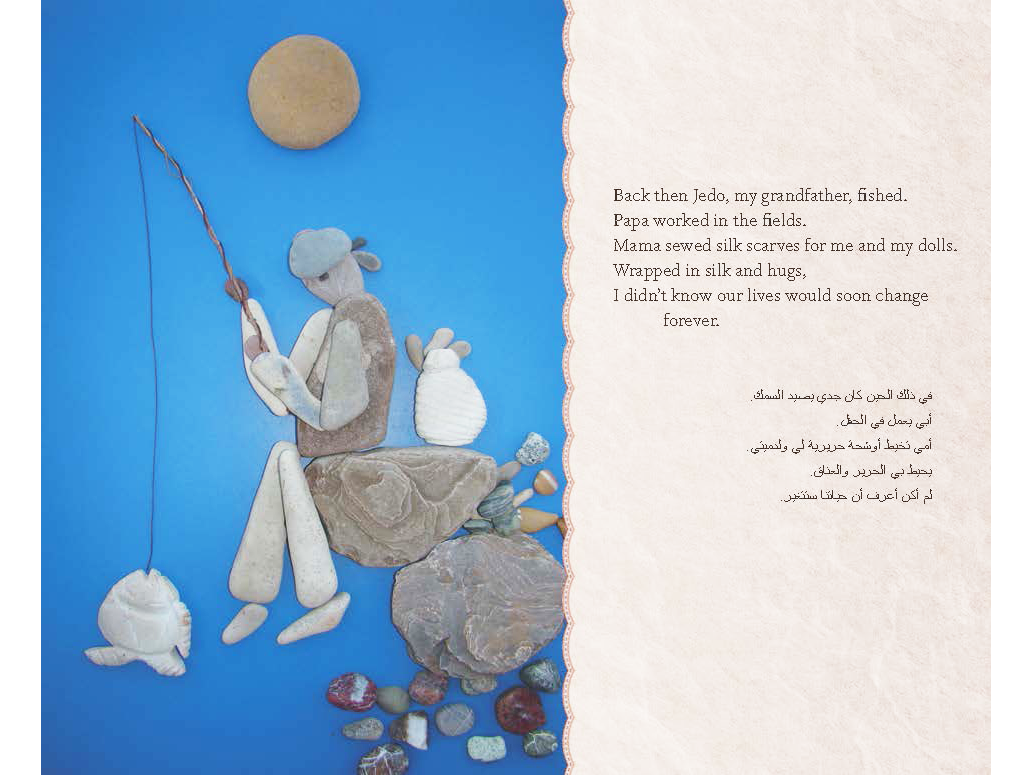
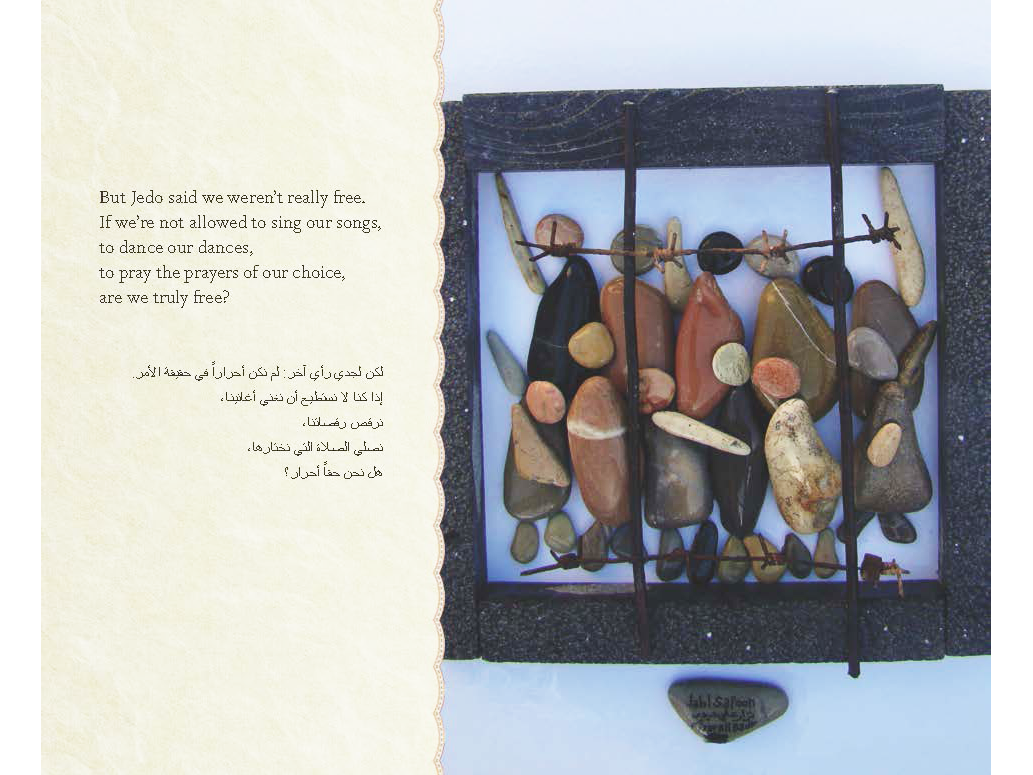
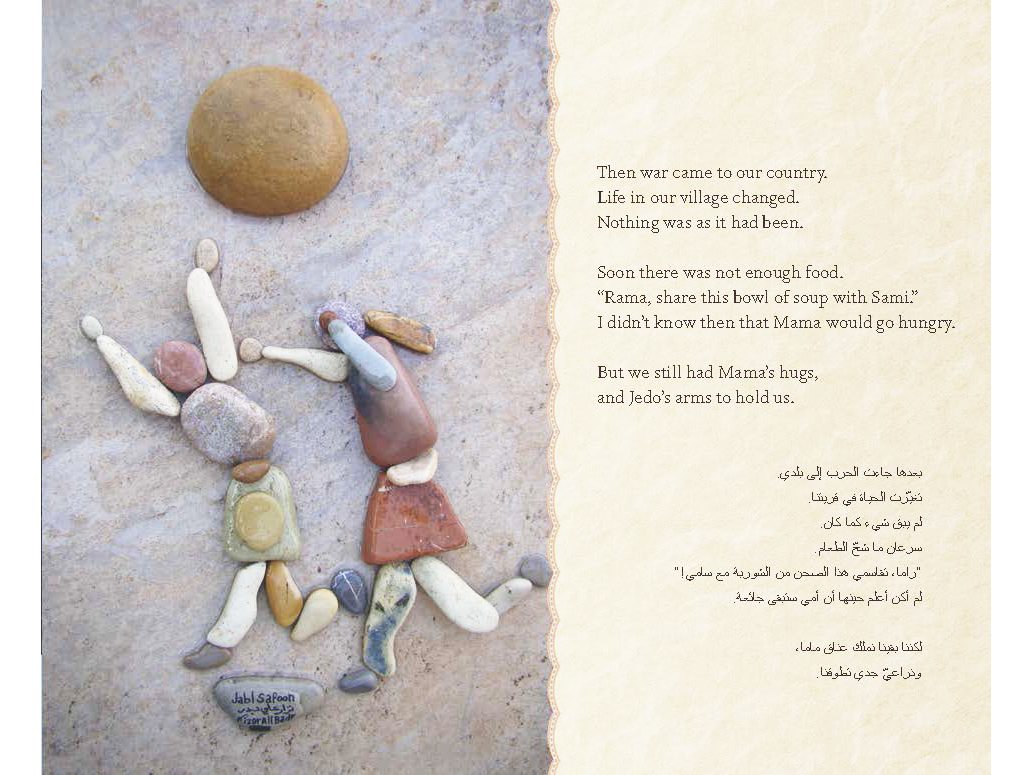
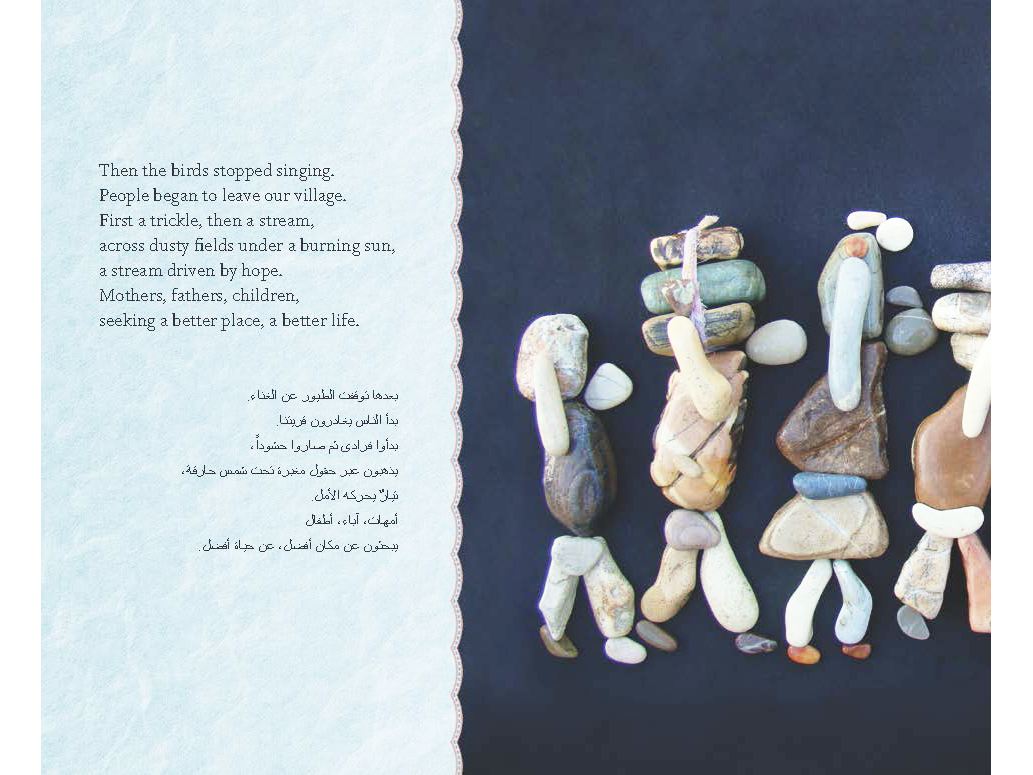
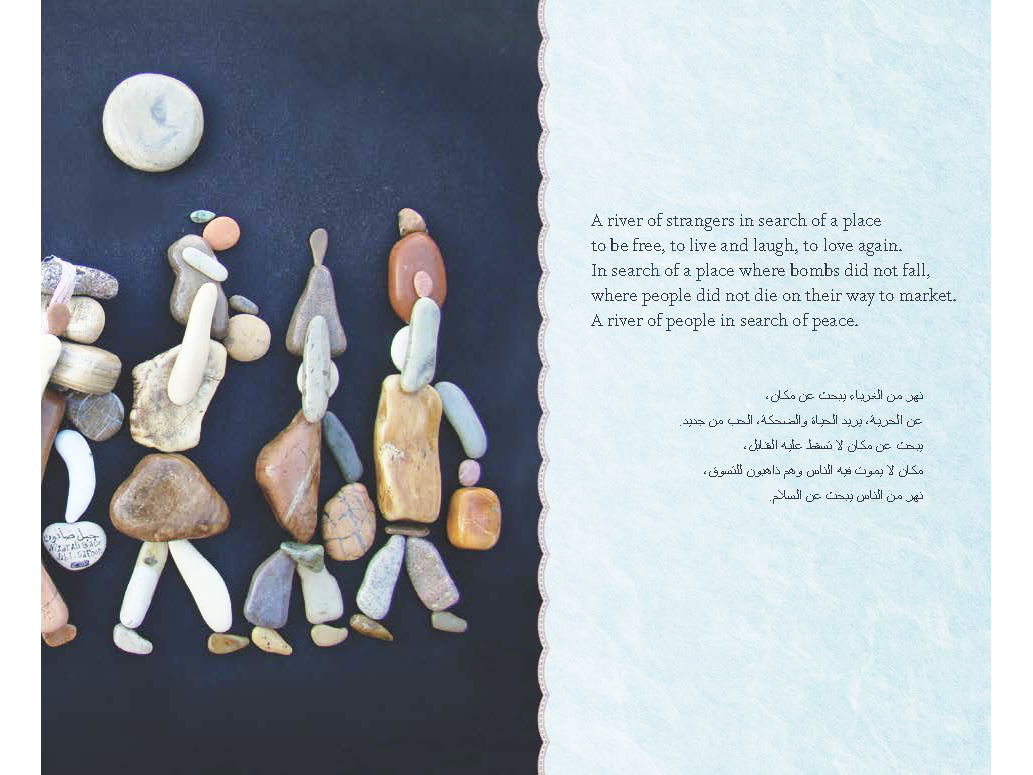
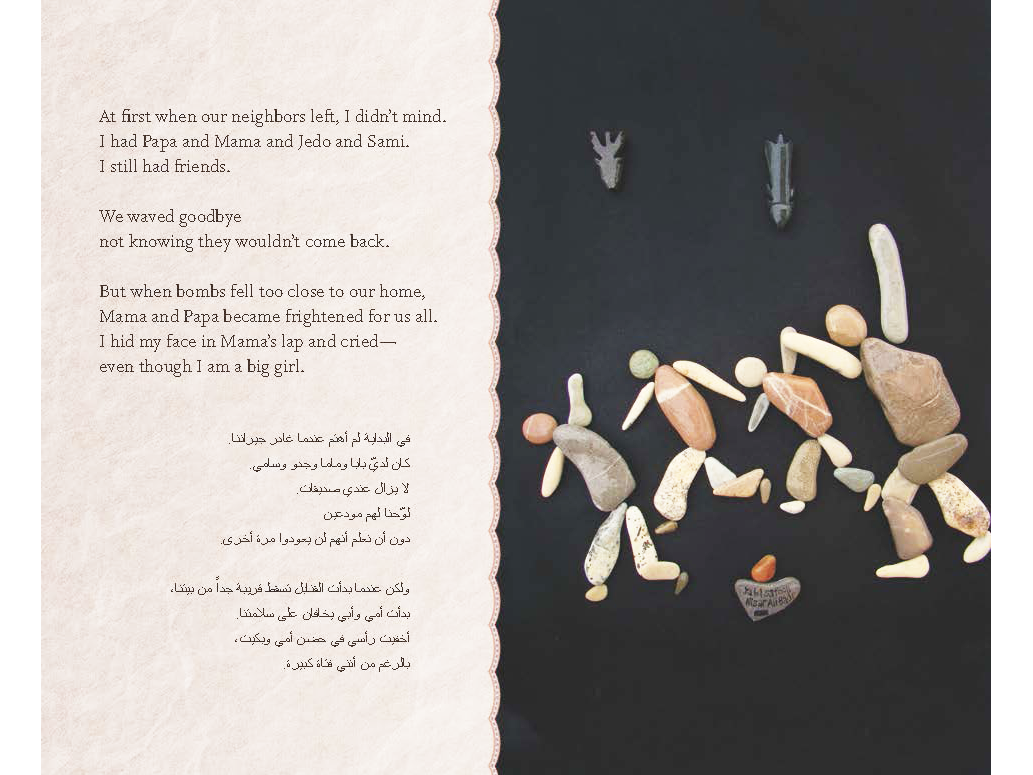
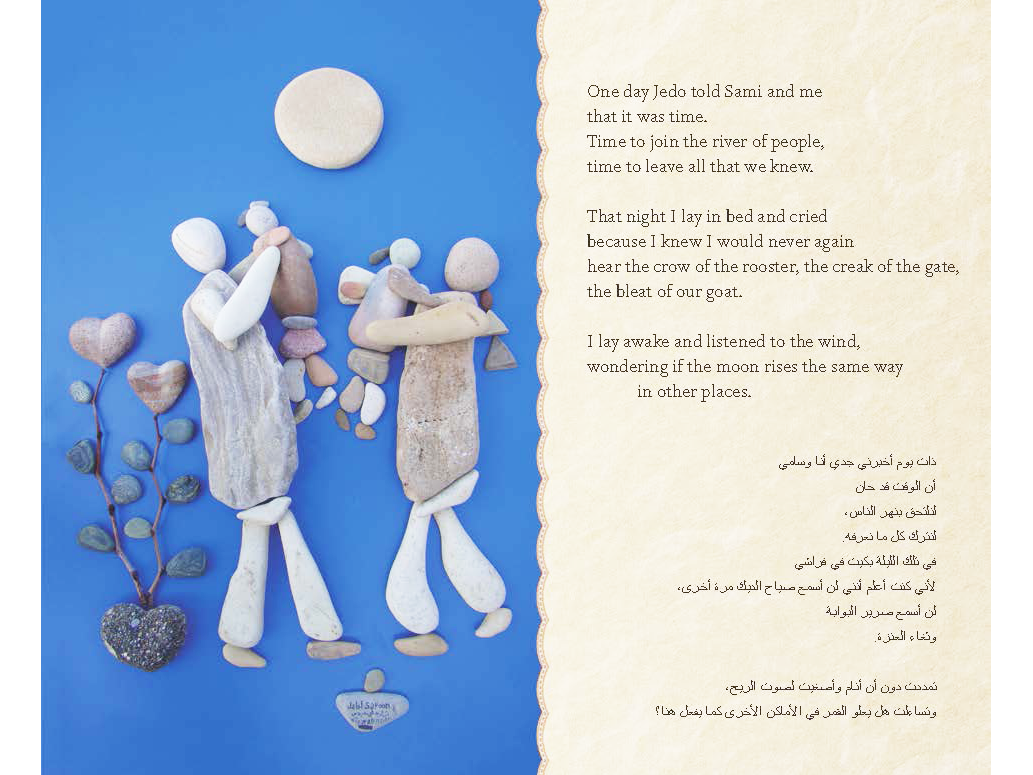
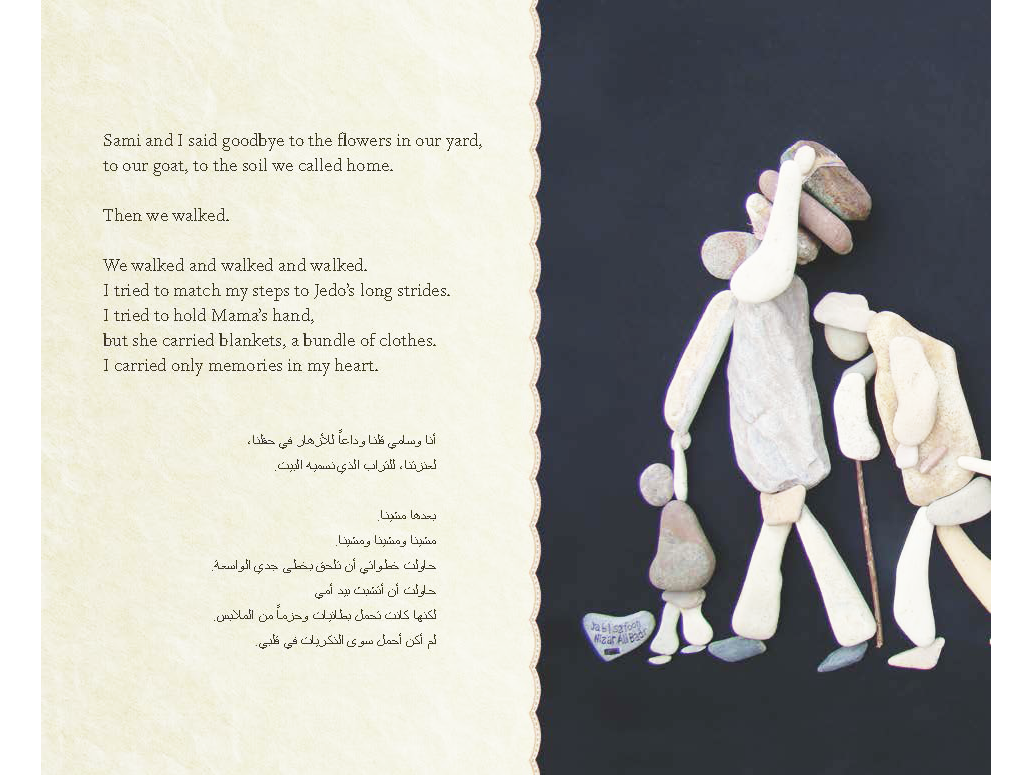
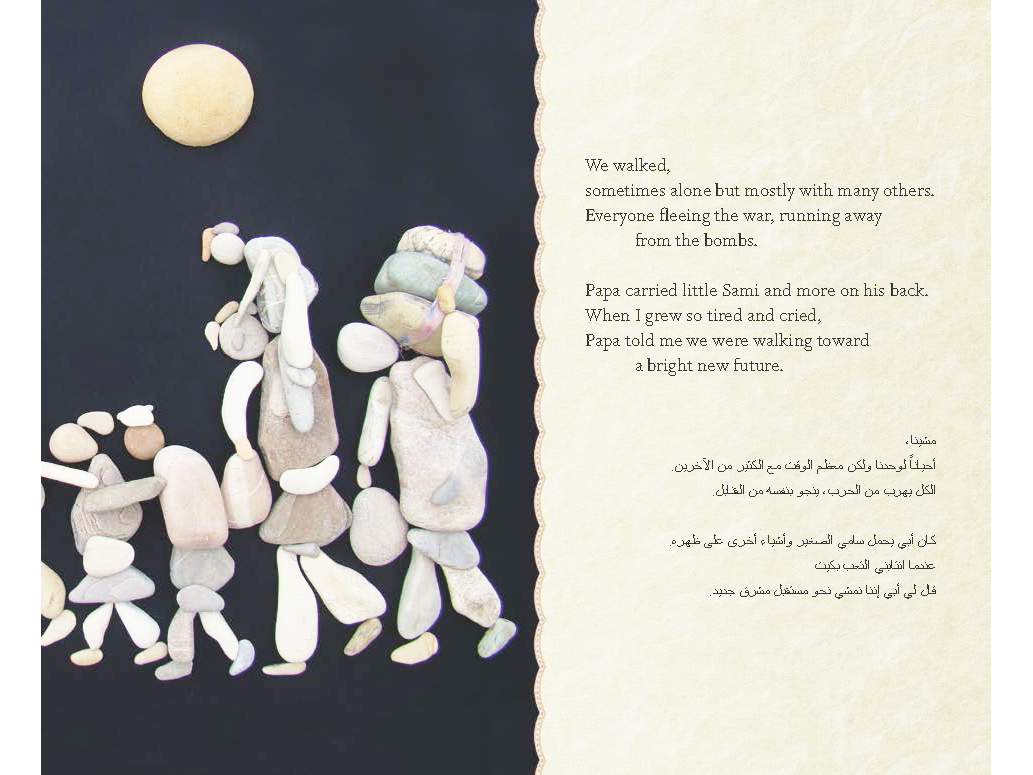
Image 1
The page reads, “Back then Jedo, my grandfather, fished. Papa worked in the fields. Mama sewed silk scarves for me and my dolls. Wrapped in silk and hugs, I didn’t know our lives would soon change forever.” The text appears in both English and Arabic. The image is of a man sitting on a ledge, fishing. The image is made from different sizes and colours of stones.
Image 2
The page reads, “But Jedo said we weren’t really free. If we’re not allowed to sing our songs, to dance our dances, to pray the prayers of our choice, are we truly free?” The text appears in both English and Arabic. The image is of a group of people behind held in a room, behind bars and barbed wire. The image is made from different sizes and colours of stones.
Image 3
The page reads, “Then war came to our country. Life in our village changed. Nothing was as it had been. Soon there was not enough food. ‘Rama, share this bowl of soup with Sami.’ I didn’t know then that Mama would go hungry. But we still had Mama’s hugs, and Jedo’s arms to hold us.” The text appears in both English and Arabic. The image is of two figures playing and chasing each other under the sun. The image is made from different sizes and colours of stones.
Image 4
The page reads, “Then the birds stopped singing. People began to leave our village. First a trickle, then a stream, across dusty fields under a burning sun, a stream driven by hope. Mothers, fathers, children, seeking a better place, a better life.” The text appears in both English and Arabic. The image is of human figures walking in a single file, holding heavy belongings above their heads and in their hands. The image is made from different sizes and colours of stones.
Image 5
The page reads, “A river of strangers in search of a place to be free, to live and laugh, to love again. In search of a place where bombs did not fall, where people did not die on their way to market. A river of people in search of peace.” The text appears in both English and Arabic. The image is of human figures walking in a single file, holding heavy belongings above their heads and in their hands. The image is made from different sizes and colours of stones.
Image 6
The page reads, “At first when our neighbours left, I didn’t mind. I had Papa and Mama and Jedo and Sami. I still had friends. We waved goodbye not knowing they wouldn’t come back. But when bombs fell too close to our home, Mama and Papa became frightened for us all. I hid my face in Mama’s lap and cried—even though I am a big girl.” The text appears in both English and Arabic. The image is of human figures running as bombs fall on them from the sky. The image is made from different sizes and colours of stones.
Image 7
The page reads, “One day Jedo told Sami and me that it was time. Time to join the river of people, time to leave all that we knew. That night I lay in bed and cried because I knew I would never again hear the crow of the rooster, the creak of the gate, the bleat of our goat. I lay awake and listened to the wind, wondering if the moon rises the same way in other places.” The text appears in both English and Arabic. The image is of a mother and father each holding a child in their arms. The image is made from different sizes and colours of stones.
Image 8
The page reads, “Sami and I said goodbye to the flowers in our yard, to our goat, to the soil we called home. Then we walked. We walked and walked and walked. I tried to match my steps to Jedo’s long strides. I tried to hold Mama’s hand, but she carried blankets, a bundle clothes. I carried only memories in my heart.” The text appears in both English and Arabic. The image is of a person carrying blankets on their head and they are holding the hand of a child. An elderly person with a walking can follows them. The image is made from different sizes and colours of stones.
Image 9
The page reads, “We walked, sometimes alone but mostly with many others. Everyone fleeing the war, running away from the bombs. Papa carried little Sami and more on his back. When I grew so tired and cried, Papa told me we were walking toward a bright new future.” The text appears in both English and Arabic. The image is of two children walking ahead of two adults. The adults are holding suitcases above their heads and one adult has a child sitting on their shoulders. The image is made from different sizes and colours of stones.
Continue reading Stepping Stones: A Refugee Family’s Journey in the following carousel.
Description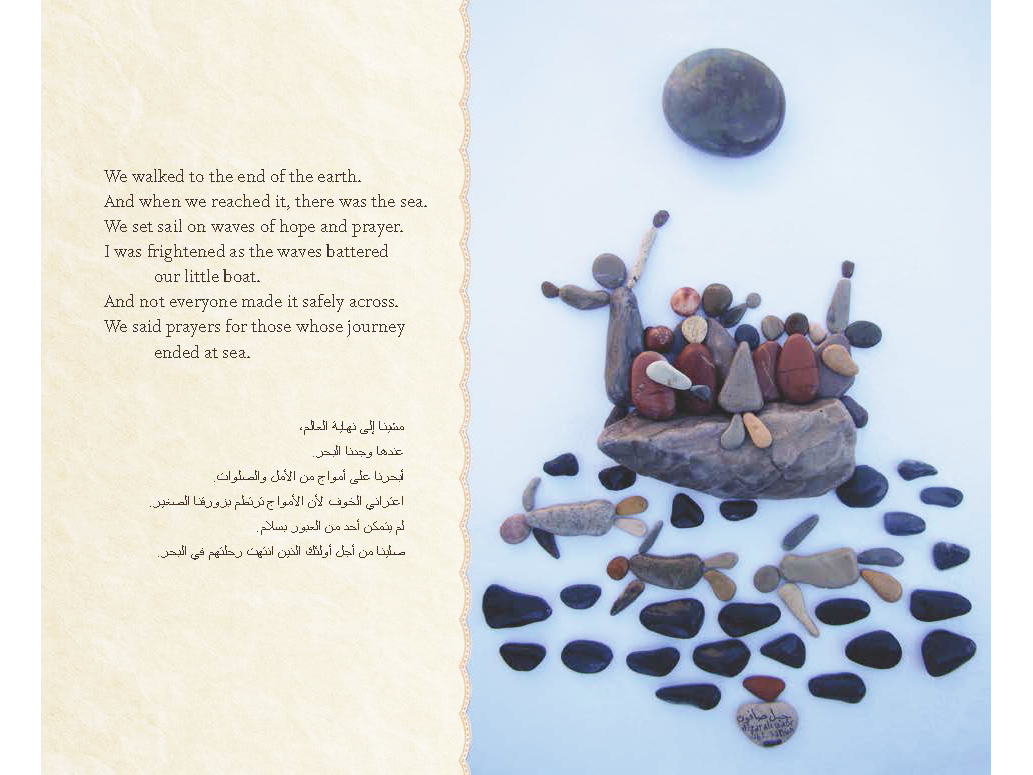
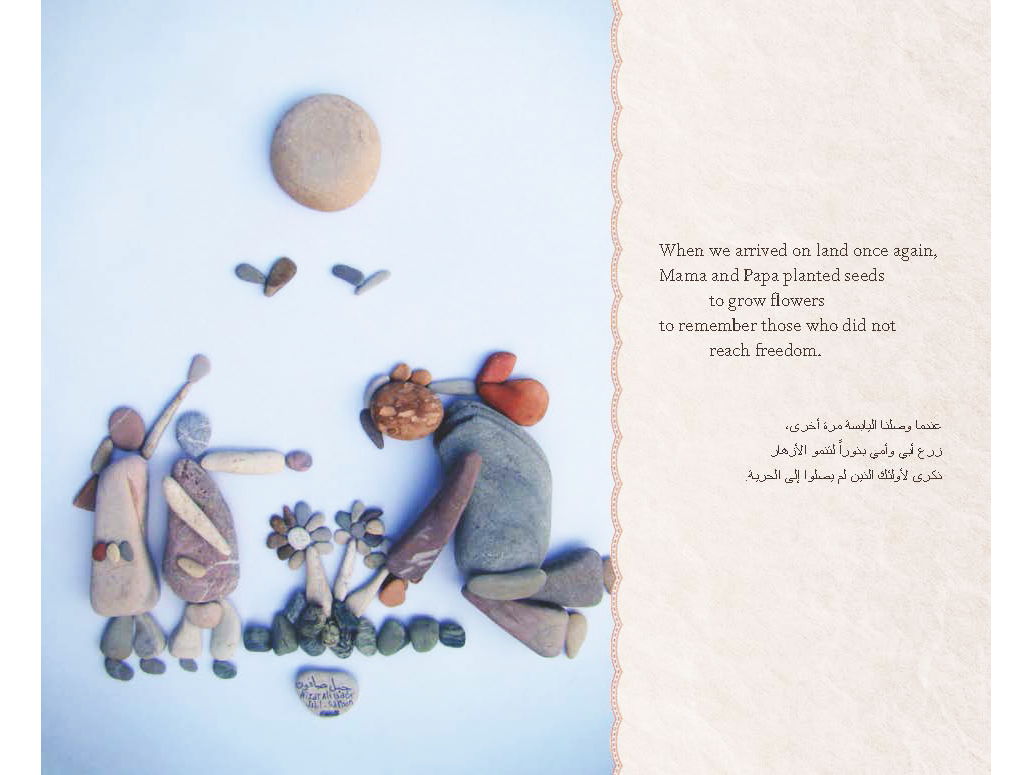
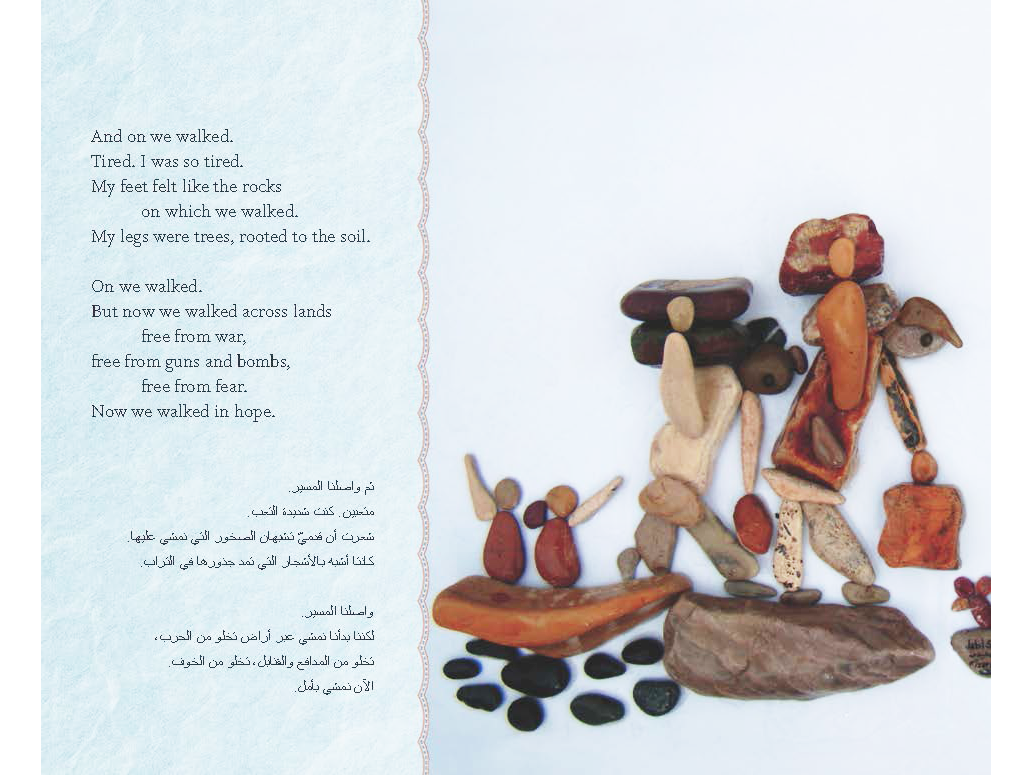
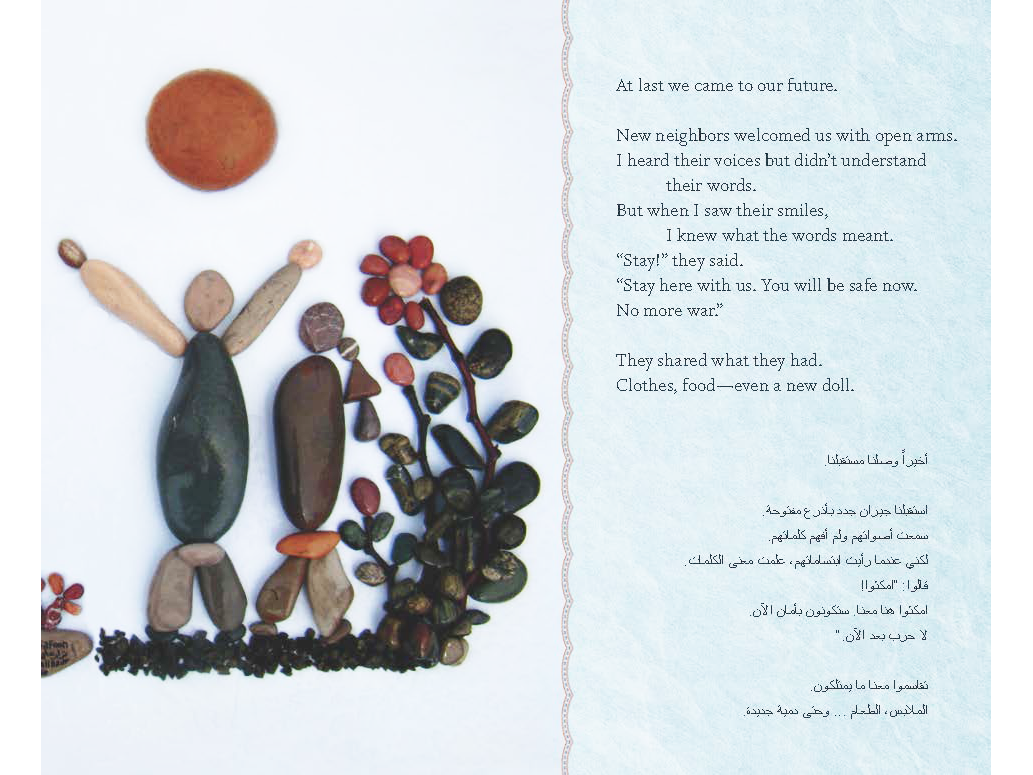
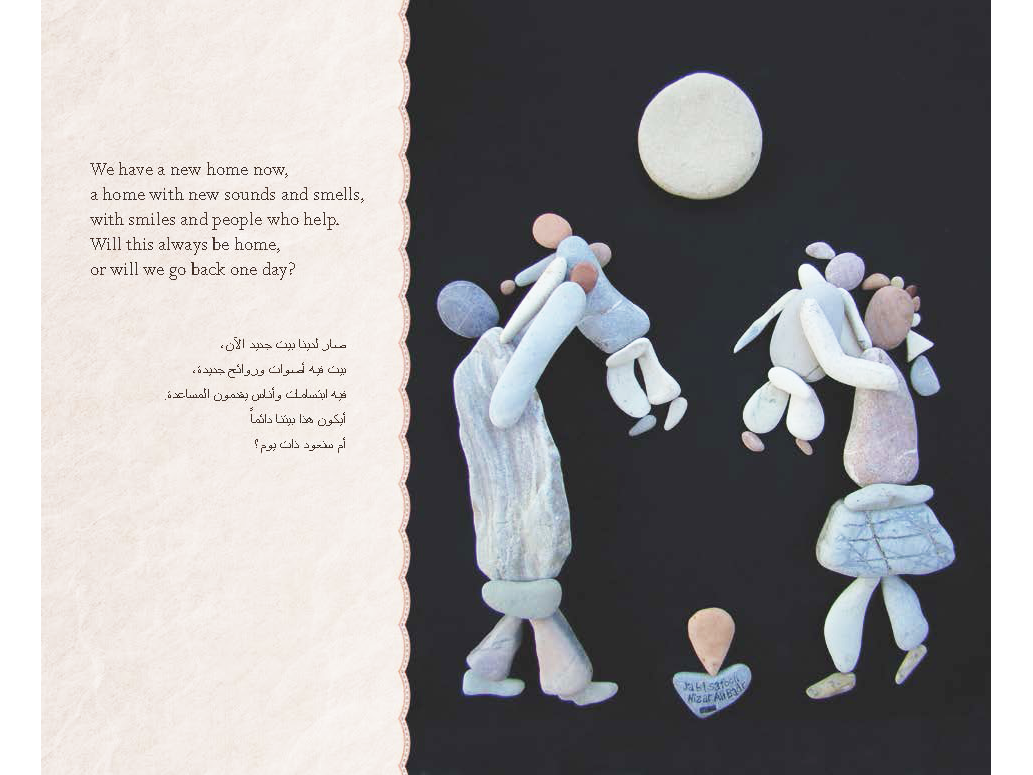
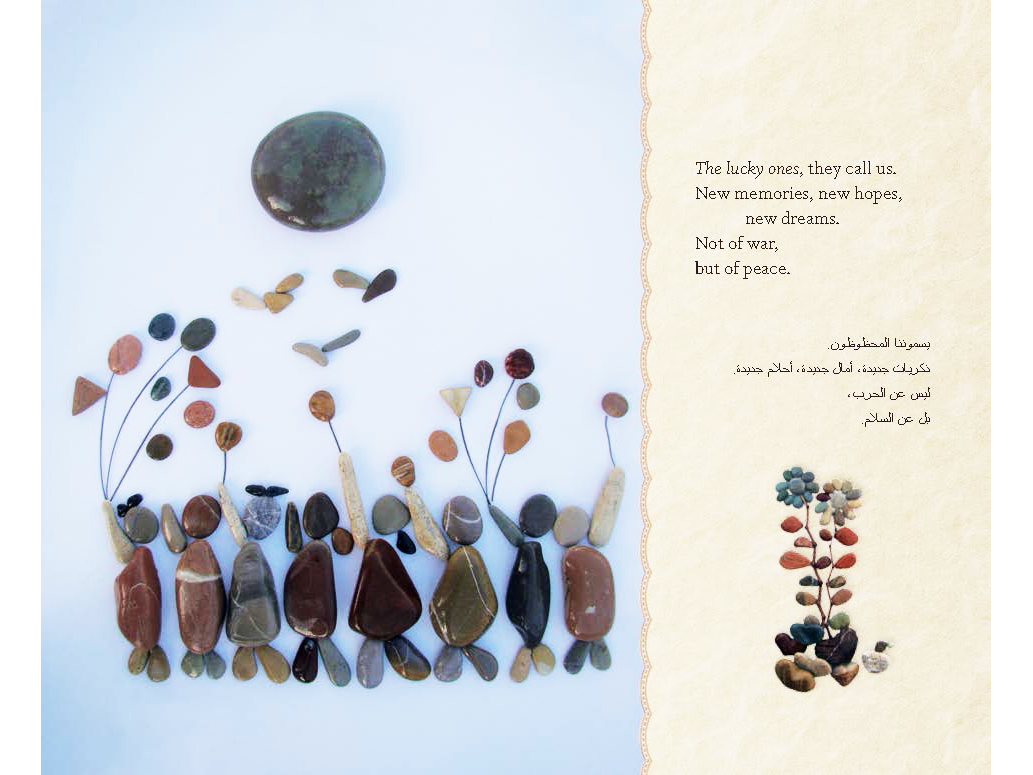
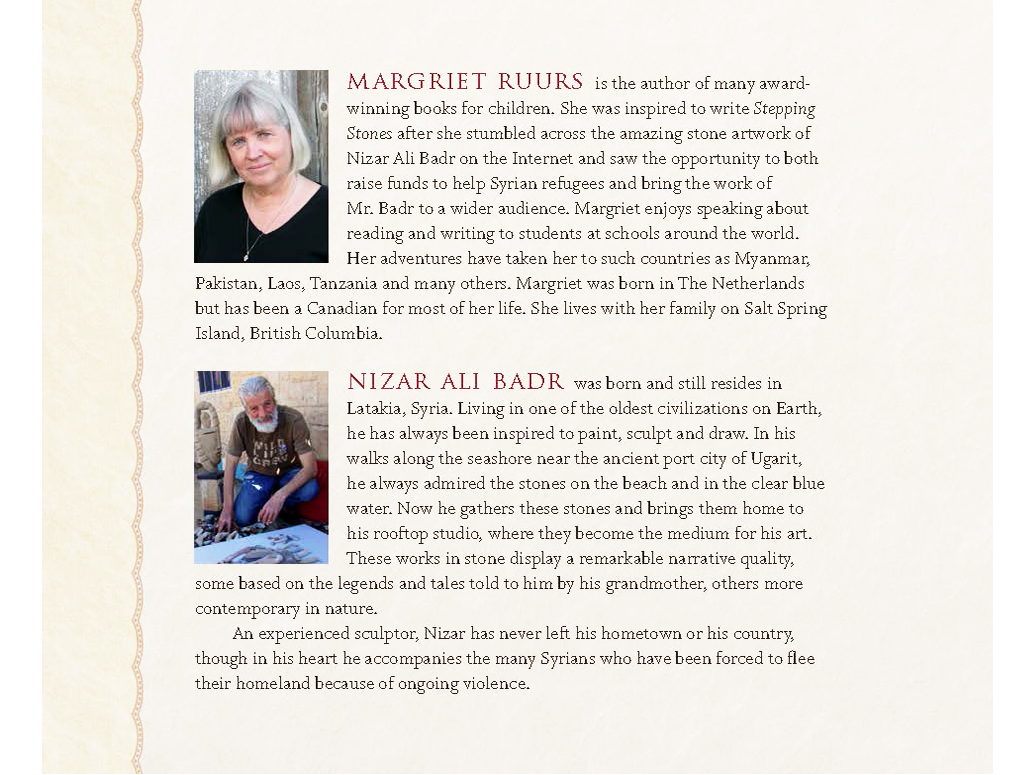
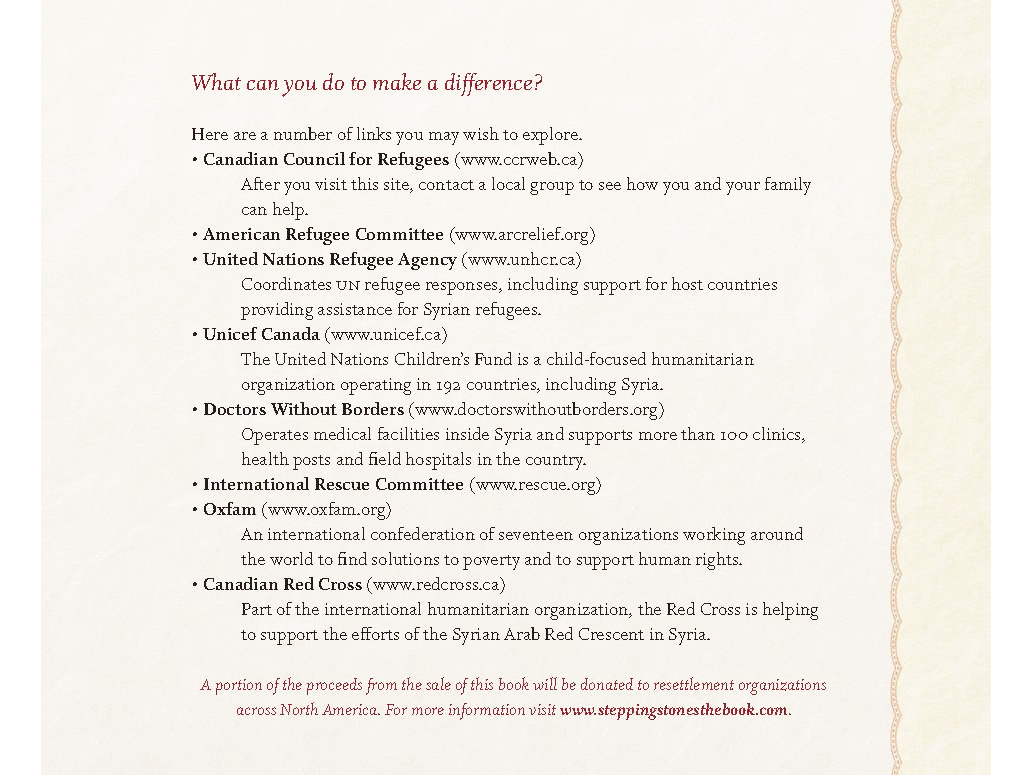
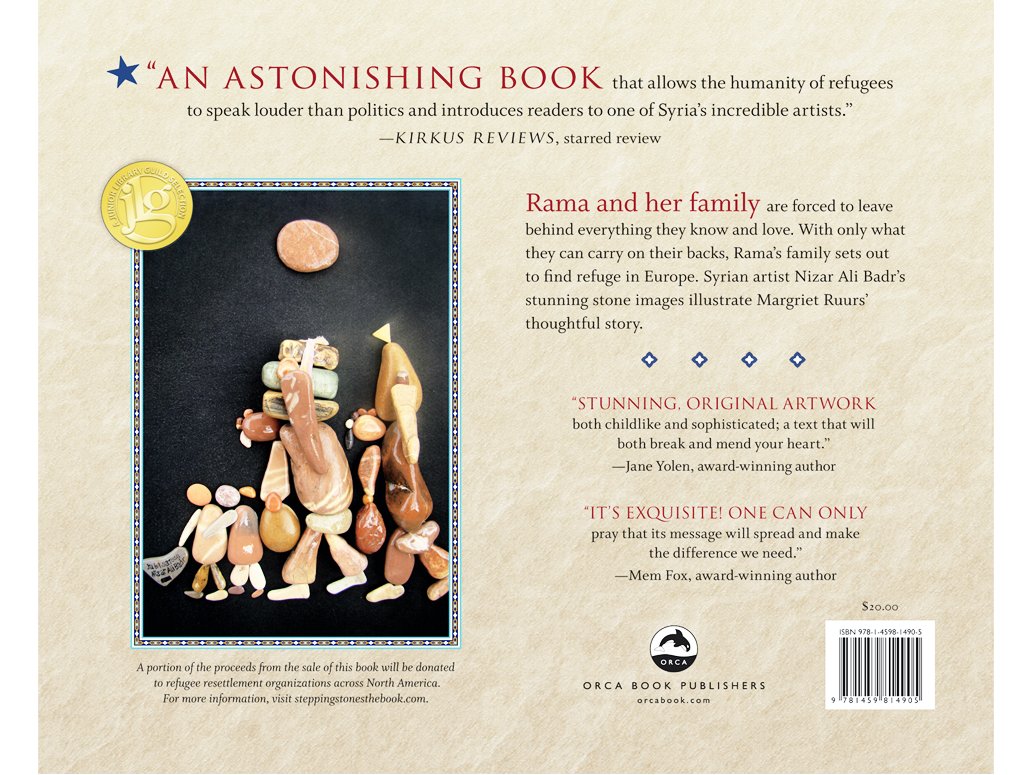
Image 1
The page reads, “We walked to the end of the earth. And when we reached it, there was the sea. We set sail on waves of hope and prayer. I was frightened as the waves battered our little boat. And not everyone made it safely across. We said prayers for those whose journey ended at sea.” The text appears in both English and Arabic. The image is of a group of people sitting in a boat. There are three bodies floating in the body of water. The image is made from different sizes and colours of stones.
Image 2
The page reads, “When we arrived on land once again, Mama and Papa planted seeds to grow flowers to remember those who did not reach freedom.” The text appears in both English and Arabic. The image is of an adult planting flowers in the soil while two children look on as birds fly overhead. The image is made from different sizes and colours of stones.
Image 3
The page reads, “And on we walked. Tired. I was so tired. My feet felt like rocks on which we walked. My legs were trees, rooted to the soil. On we walked. But now we walked across lands free from war, free from guns and bombs, free from fear. Now we walked in hope.” The text appears in both English and Arabic. The image is of two adults and two children walking. The adults are holding suitcases in their hands and above their heads while the children’s arms are outstretched towards the sky. The image is made from different sizes and colours of stones.
Image 4
The page reads, “At last we came to our future. New neighbours welcomed us with open arms. I heard their voices but didn’t understand their words. But when I saw their smiles, I knew what the words meant. ‘Stay!’ they said. ‘Stay here with us. You will be safe now. No more war.’ They shared what they had. Clothes, food—even a new doll.” The text appears in both English and Arabic. The image is of two adults. One adult is smelling the flowers and the other adult raises their arms to the sky. The image is made from different sizes and colours of stones.
Image 5
The page reads, “We have a new home now, a home with new sounds and smells, with smiles and people who help. Will this always be home, or will we go back one day?” The text appears in both English and Arabic. The image is of two adults excitedly picking their children up. The image is made from different sizes and colours of stones.
Image 6
The page reads, “The lucky ones, they call us. New memories, new hopes, new dreams. Not of war, but of peace.” The text appears in both English and Arabic. The image is of a group of children holding many balloons as birds fly overhead. The image is made from different sizes and colours of stones.
Image 7
The author and artist biography page for the book Stepping Stones: A Refugee Family’s Journey, written by Margriet Ruurs and artwork by Nizar Ali Badr.
Image 8
A list of online resources that readers may wish to explore for the book Stepping Stones: A Refugee Family’s Journey, written by Margriet Ruurs and artwork by Nizar Ali Badr.
Image 9
The back cover for the book Stepping Stones: A Refugee Family’s Journey, written by Margriet Ruurs and artwork by Nizar Ali Badr.
Brainstorm
Identifying perspectives
In your notebook, or using another method of your choice, answer the following questions. If possible, share your thoughts with a partner.
- Describe some of Rama’s happy childhood memories of her home.
- Why did Rama’s family leave their home?
- Who is telling this story? How does that perspective shape the story?
- Choose one of the illustrations that you like the most and describe it. What do you notice about the artist's materials and techniques? What message does the illustration communicate to you?
Focus on: literary devices
Imagery is descriptions and figures of speech used by writers to create strong mental pictures in the minds of readers. A metaphor is one example of imagery, it is a figure of speech where a word or phrase is compared to something that it is imaginatively, but not literally, applicable to. For example, the metaphor “heart of gold” is used to describe someone who is considered to be very good and kind because gold was historically considered something that was “valued for its goodness”.
Let’s explore an example of a metaphor from the book.
“People began to leave our village. First a trickle, then a stream."
In your notebook or using another method of your choice, answer the following questions:
- What does this metaphor mean?
- Why do you feel the author chose to use the metaphor?
- Can you identify at least one other example of a metaphor used in the book?
 Description
Welcoming refugees in Canada
The Canadian government assists newcomers with refugee status as they adjust to life in their new homes. Welcoming newcomer Canadians is not only the responsibility of the government. It is everyone’s responsibility as active citizens to welcome new Canadians and help our neighbours.
Canada’s recent Syrian immigration was the first time Canadian citizens played such a significant role in helping many newcomers come to Canada. The federal government made a promise to help 25,000 Syrians immigrate to Canada, but then Canadian citizens stepped up and helped to more than double that number!
Groups of Canadians such as community groups, religious congregations, and even individual citizens worked together to raise money to sponsor Syrian refugees. Sponsoring means that you commit to helping a person or family find somewhere to live, work, food, clothing, etc., and help them adjust and settle into a new life in Canada.

Student Wellness
Student wellness

Water break!
Remember to drink water and stay hydrated during the day.

Exploring nouns and adjectives
The names of countries are proper nouns and are always capitalized. Canada and Syria are the names of specific places and are examples of proper nouns.
A proper noun turns into a proper adjective when used to describe something.
Adjectives are words that describe nouns. They answer questions like "Which one? What kind? and ‘How many?"
Consider the following examples.
Example 1: She is a Canadian citizen.
In this example, citizen is a noun, and Canadian is the proper adjective that tells us what kind of citizen she is.
Example 2: Rama is a Syrian refugee.
In this example, refugee is a noun, and Syrian is the proper adjective that tells us where Rama is a refugee from.
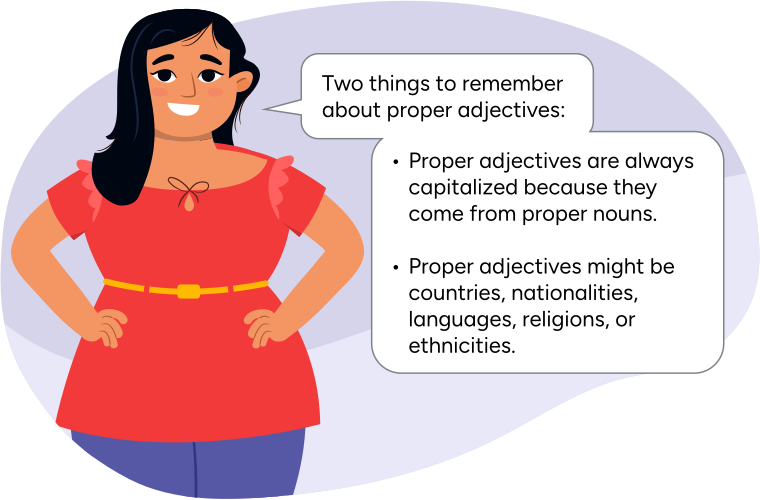
Teacher Chiara saying: Two things to remember about proper adjectives:
- Proper adjectives are always capitalized because they come from proper nouns.
- Proper adjectives might be countries, nationalities, languages, religions, or ethnicities.
Check out the following chart to explore some more examples:
| Sentence | Proper adjective | Noun it describes |
|---|---|---|
| I enjoy Irish dancing. | Irish | dancing |
| He is a Muslim scholar. | Muslim | scholar |
| They are an expert on Japanese culture. | Japanese | culture |
| I identify as Black Canadian. | Black | Canadian |
| Let’s go to an Afghani restaurant for dinner. | Afghani | restaurant |
Another book about a refugee’s experience, called Other Words for Home by Jasmine Warga, tells the story of Jude, a young Syrian girl forced to leave her home and start a new life in the United States.
In that description of the book, there was an example of a proper adjective. Did you spot it?
Press the Answer button to check if you correctly identified the proper adjective.
In the sentence: “…tells the story of Jude, a young Syrian girl forced to leave her home and start a new life in the United States.”, the word Syrian is the proper adjective because it describes the nationality of the girl named Jude.

Reading Time
Reading review
Review the following text passage from the book Other Words for Home. In your notebook, or using another method of your choice, can you identify all the proper adjectives in the passage?
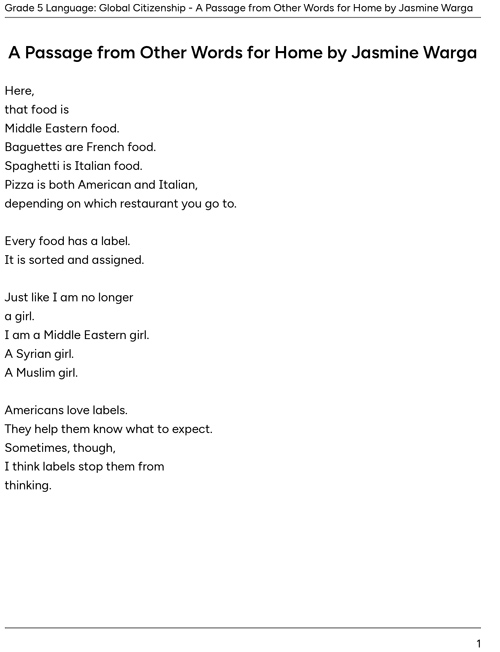
Press the Activity button to access the A Passage from Other Words for Home by Jasmine Warga.
Activity(Opens in a new tab)When you’re ready, check to see how you did by pressing the Answer button.
The proper adjectives in the passage are: Middle Eastern, French, Italian, American, Syrian, and Muslim.
Here,
that food is
Middle Eastern food.
Baguettes are French food.
Spaghetti is Italian food.
Pizza is both American and Italian,
depending on which restaurant you go to.
Every food has a label.
It is sorted and assigned.
Just like I am no longer
a girl.
I am a Middle Eastern girl.
A Syrian girl.
A Muslim girl.
Americans love labels.
They help them know what to expect.
Sometimes, though,
I think labels stop them from
thinking.
Vocabulary check!
Several new vocabulary words have been introduced throughout this learning activity. Take a minute to go back through the content and add any new words to your vocabulary notebook. Some of the words you might consider adding are:
- imagery
- metaphor
- proper adjective
- any other words or terms that were new for you!

Putting it all together
In this learning activity, you learned that proper adjectives should always be capitalized. Can you identify the proper adjectives in the following examples?
Helping newcomers in my community
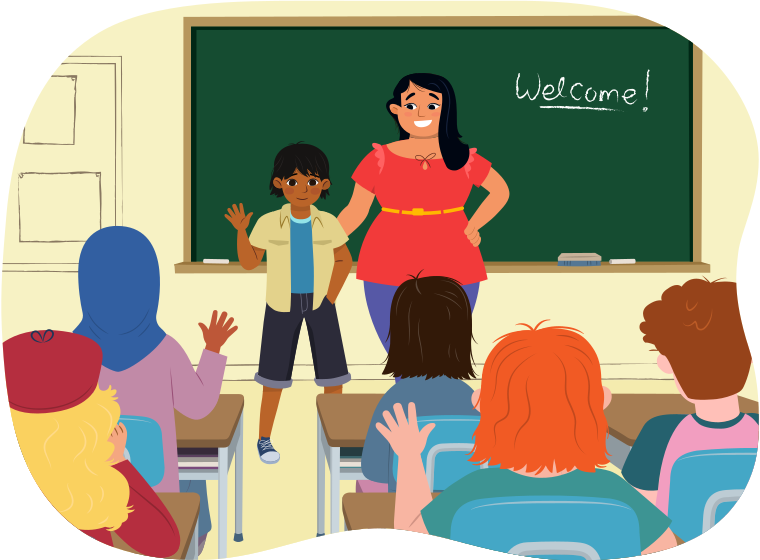
In this learning activity, you considered how Canada is a nation that is made up of many newcomers. Every person or family who is not an Indigenous person is a settler and was at some point a newcomer.
Because Canada has a high rate of immigration, it is very possible that you know someone, or may meet someone in the future, who is a recent newcomer. It is also very possible that your school community has welcomed or may one-day welcome students who are new to Canada.
To consolidate your learning and extend your thinking to real-world applications, your task is to create a plan with specific actions that you and your school community could take to be welcoming and supportive for newcomers to Canada.
Things to consider:
- What supports might students new to Canada need on their first day, week, and month of school?
- What school routines need to be introduced?
- How can the celebrations and traditions of your school expand to reflect student diversity?
- What language supports might new students need? How can they be provided to them?
- How could clubs and extra-curriculars reflect a wider range of student identities?
- Are there parts of the school environment that could be made bilingual?
What tool will you use to record your ideas for actions that you or your school community could take to support newcomers to Canada? Is there a graphic organizer, such as a word web, or a t-chart, that might help you brainstorm and organize your thoughts? If possible, create or discuss your plan with a learning partner.
When you are satisfied with your action plan, decide the best way to communicate your message to your school community and create it!
Some ideas to choose from could be:
- a brochure
- a list
- a poster
- a school announcement
- a video or live presentation
Reflection
As you read through these descriptions, which sentence best describes how you are feeling about your understanding of this learning activity? Press the button that is beside this sentence.
I feel...
Now, record your ideas using a voice recorder, speech-to-text, or writing tool.