
The Dancing Trees by Masiana Kelly. Illustrated by Michelle Simpson.
Learning goals
We are learning to…
- unpack the transferable skills of global citizenship and critical thinking
- generate ideas and organize content for writing
- make connections to texts
- understand perspectives in narrative texts
Success criteria
I am able to…
- identify ways that texts can help us be better global citizens and critical thinkers
- plan and organize my ideas for a story based on a personal event or experience
- list connections between the book The Dancing Trees and my own experiences, other texts I’ve read, and the world around me
- explain how changing perspectives in a text could impact the tone and message of the text
What does this remind me of…?
As global citizens, we try to make connections to the world around us.
As readers, we do something similar when we try to deepen our understanding of texts by connecting the ideas in them to the world around us.
Let’s practise!
Examine the cover of the book The Dancing Trees by Masiana Kelly.
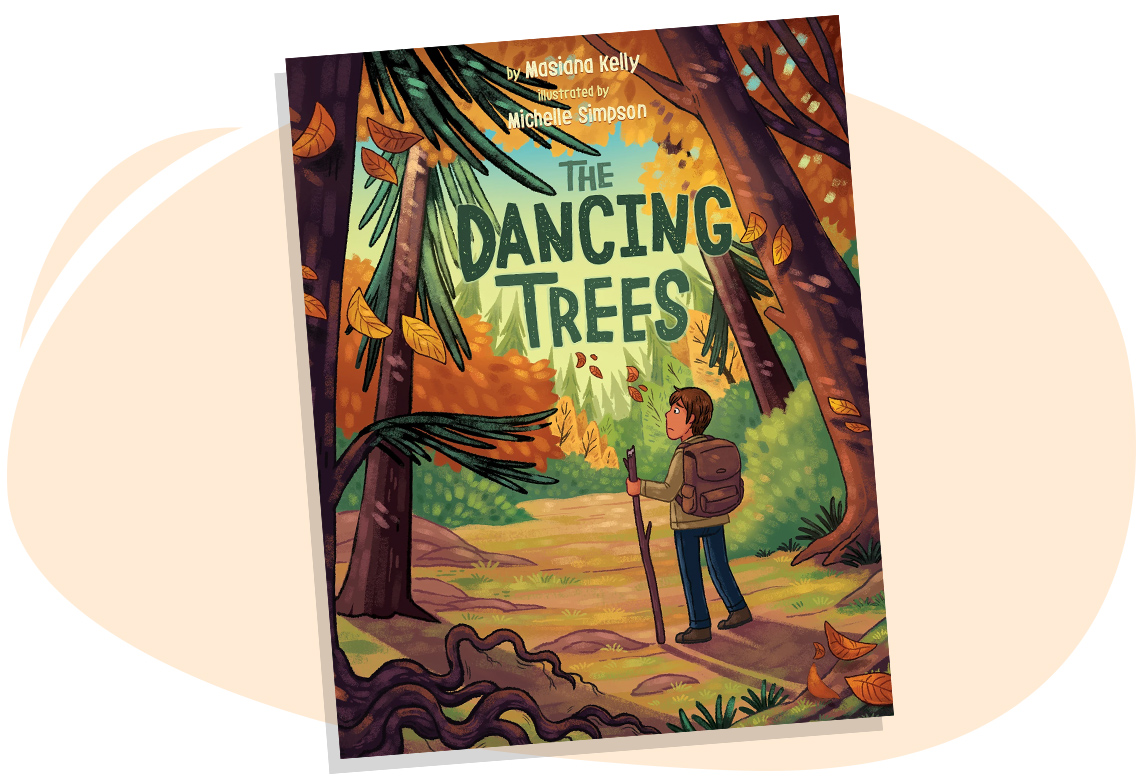
Cover of "The Dancing Trees" written by Masiana Kelly and illustrated by Michelle Simpson. There is a hiker with a worried expression in a forest. Leaves blow in the wind, and tall trees with winding roots lean in toward the hiker.
What does this book cover remind you of in the real word?

Student Success
Connecting
In a notebook or using another method of your choice, complete this sentence stem:
- The cover makes me think about… (an event or issue in your community, nation, or world) because…
Making connections
In the Minds On section, you examined the cover of the book The Dancing Trees by Masiana Kelly, and then made some connections between the book and the world around you. This is an example of a text-to-world connection, one of three types of connections that we can make when reading texts.
Let’s explore the three main ways that we make connections to texts. Press the following tabs to learn more.
These are connections between the text and our own knowledge and real-life experiences. It involves asking questions like the following:
- What experience do I have already with this topic or type of text?
- Do I enjoy this form of text?
These are connections we make between different types of texts. It involves asking questions like the following:
- How does this text compare to other texts I know?
- What are the similarities and differences between these two text forms?
These are connections we make between texts and the world around us. It involves asking questions like the following:
- Where have I heard this message in the world around me before?
- What facts have we learned about this topic?
Let’s practise!
We are going to make connections to the book The Dancing Trees. Before we begin, let’s learn a little bit more about author Masiana Kelly.
About the author
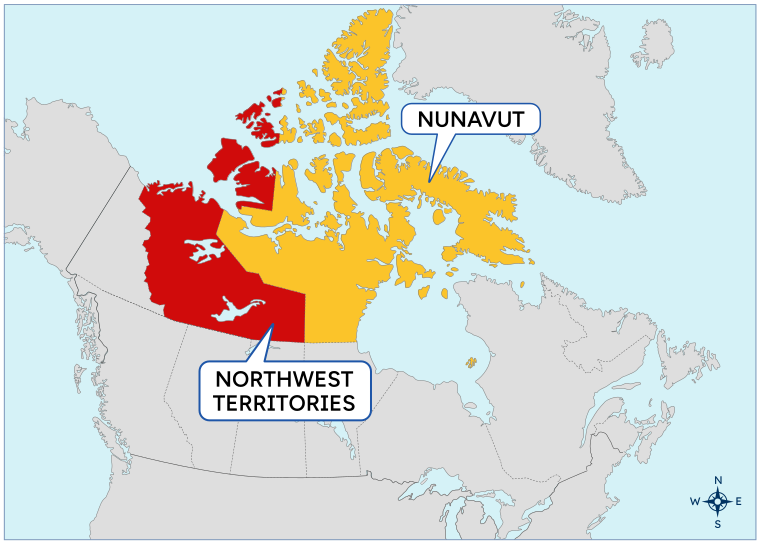
Masiana Kelly is an Inuit and Dene author from Kugluktuk, Nunavut, and Fort Simpson, Northwest Territories. Her heritage, the teachings of Elders, and the beauty of the landscape of where she lives come together as she tells a story that shows the importance of taking care of the land around us and treating it with respect. This is an important part of being a steward of the Earth and is connected to environmental stewardship .
Pre-reading: Reading for meaning
Read the following story, The Dancing Trees by Masiana Kelly. As you read, notice how the main character's attitude toward and opinion of the environment change throughout the story. Think about what being a steward of the Earth might look like for someone your age.
The Dancing Trees The Dancing Trees
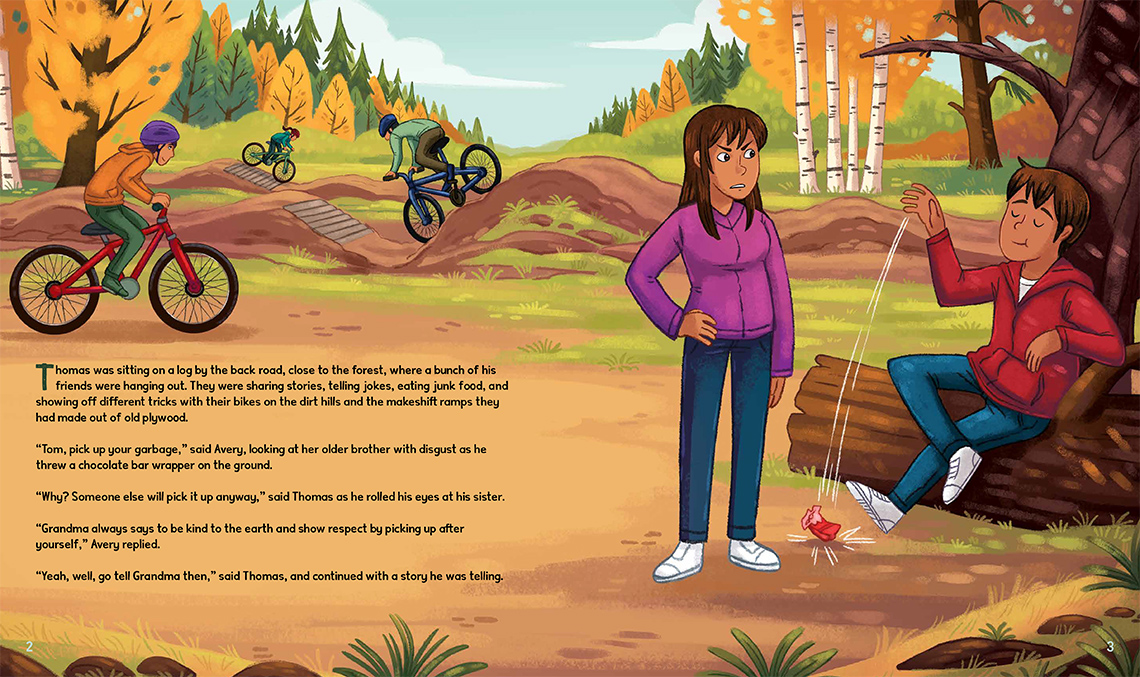
Thomas was sitting on a log by the back road, close to the forest, where a bunch of his friends were hanging out. They were sharing stories, telling jokes, eating junk food, and showing off different tricks with their bikes on the dirt hills and the makeshift ramps they had made out of old plywood.
“Tom, pick up your garbage,” said Avery, looking at her older brother with disgust as he threw a chocolate bar wrapper on the ground.
“Why? Someone else will pick it up anyway,” said Thomas as he rolled his eyes at his sister.
“Grandma always says to be kind to the earth and show respect by picking up after yourself,” Avery replied.
“Yeah, well, go tell Grandma then,” said Thomas, and continued with a story he was telling.
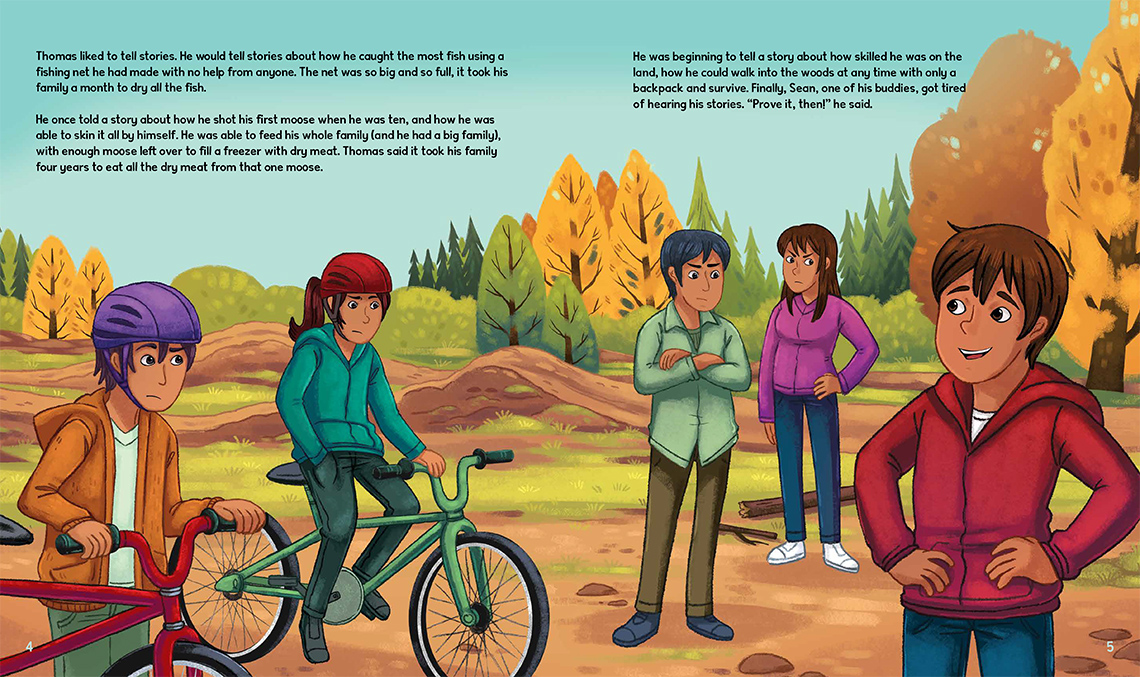
Thomas liked to tell stories. He would tell stories about how he caught the most fish using a fishing net he had made with no help from anyone. The net was so big and so full, it took his family a month to dry all the fish.
He once told a story about how he shot his first moose when he was ten, and how he was able to skin it all by himself. He was able to feed his whole family (and he had a big family), with enough moose left over to fill a freezer with dry meat. Thomas said it took his family four years to eat all the dry meat from that one moose.
He was beginning to tell a story about how skilled he was on the land, how he could walk into the woods at any time with only a backpack and survive. Finally, Sean, one of his buddies, got tired of hearing his stories. “Prove it, then!” he said.
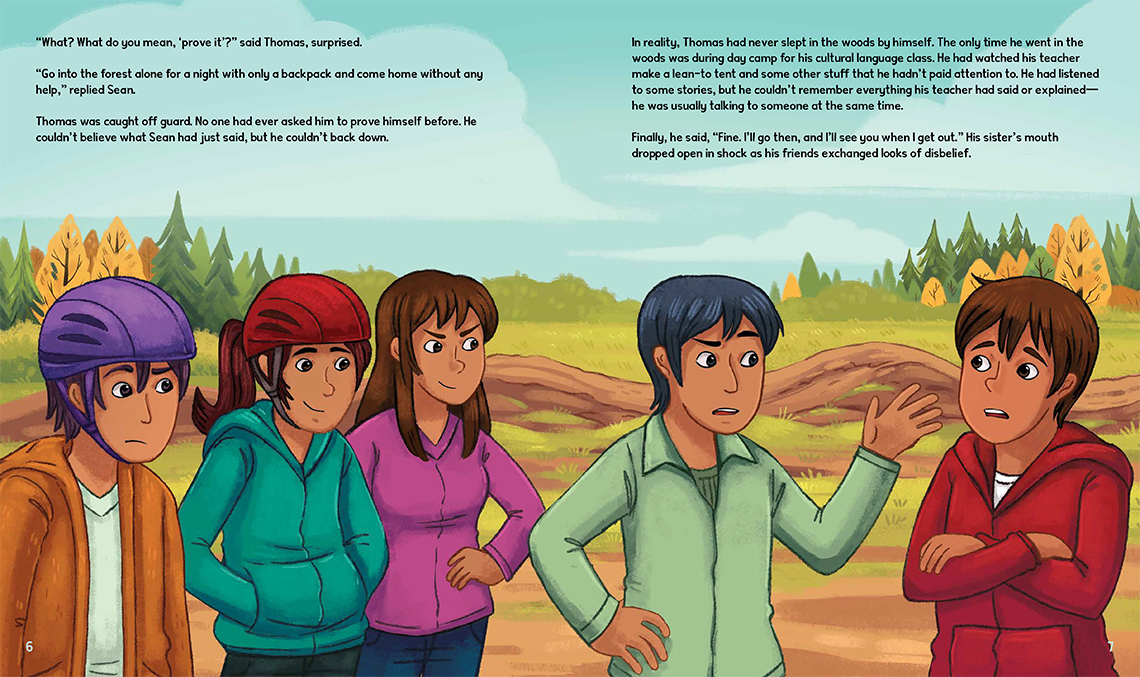
“What? What do you mean, ‘prove it’?” said Thomas, surprised.
“Go into the forest alone for a night with only a backpack and come home without any help,” replied Sean.
Thomas was caught off guard. No one had ever asked him to prove himself before. He couldn’t believe what Sean had just said, but he couldn’t back down.
In reality, Thomas had never slept in the woods by himself. The only time he went in the woods was during day camp for his cultural language class. He had watched his teacher make a lean-to tent and some other stuff that he hadn’t paid attention to. He had listened to some stories, but he couldn’t remember everything his teacher had said or explained—he was usually talking to someone at the same time.
Finally, he said, “Fine. I’ll go then, and I’ll see you when I get out.” His sister’s mouth dropped open in shock as his friends exchanged looks of disbelief.
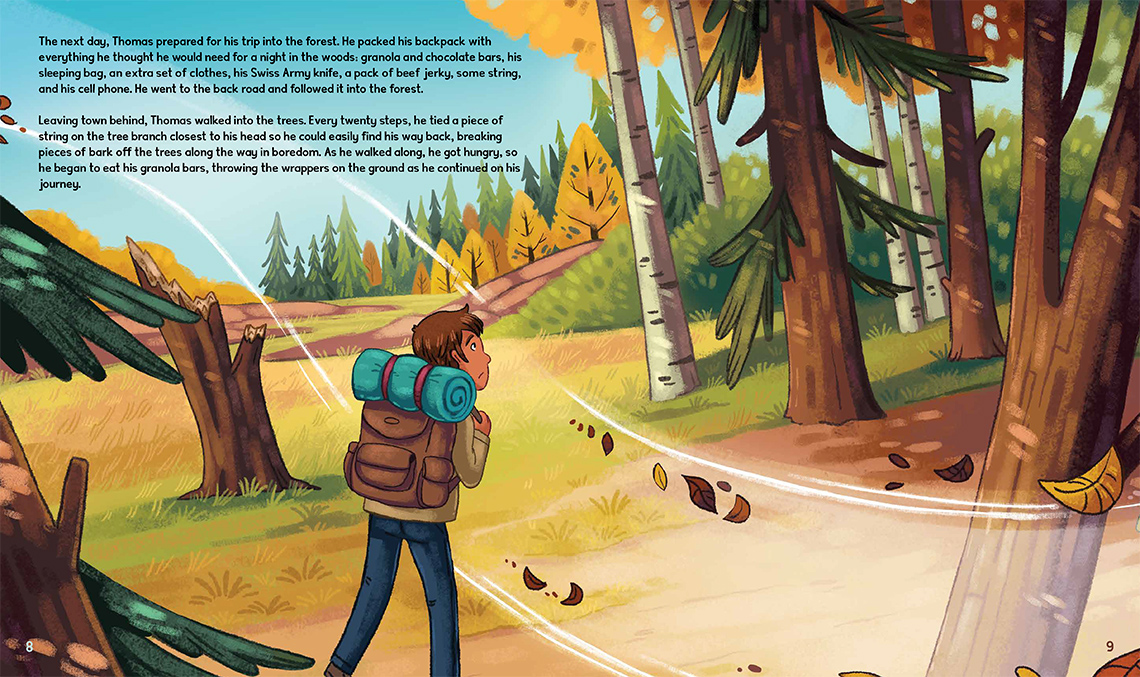
The next day, Thomas prepared for his trip into the forest. He packed his backpack with everything he thought he would need for a night in the woods: granola and chocolate bars, his sleeping bag, an extra set of clothes, his Swiss Army knife, a pack of beef jerky, some string, and his cell phone. He went to the back road and followed it into the forest.
Leaving town behind, Thomas walked into the trees. Every twenty steps, he tied a piece of string on the tree branch closest to his head so he could easily find his way back, breaking pieces of bark off the trees along the way in boredom. As he walked along, he got hungry, so he began to eat his granola bars, throwing the wrappers on the ground as he continued on his journey.
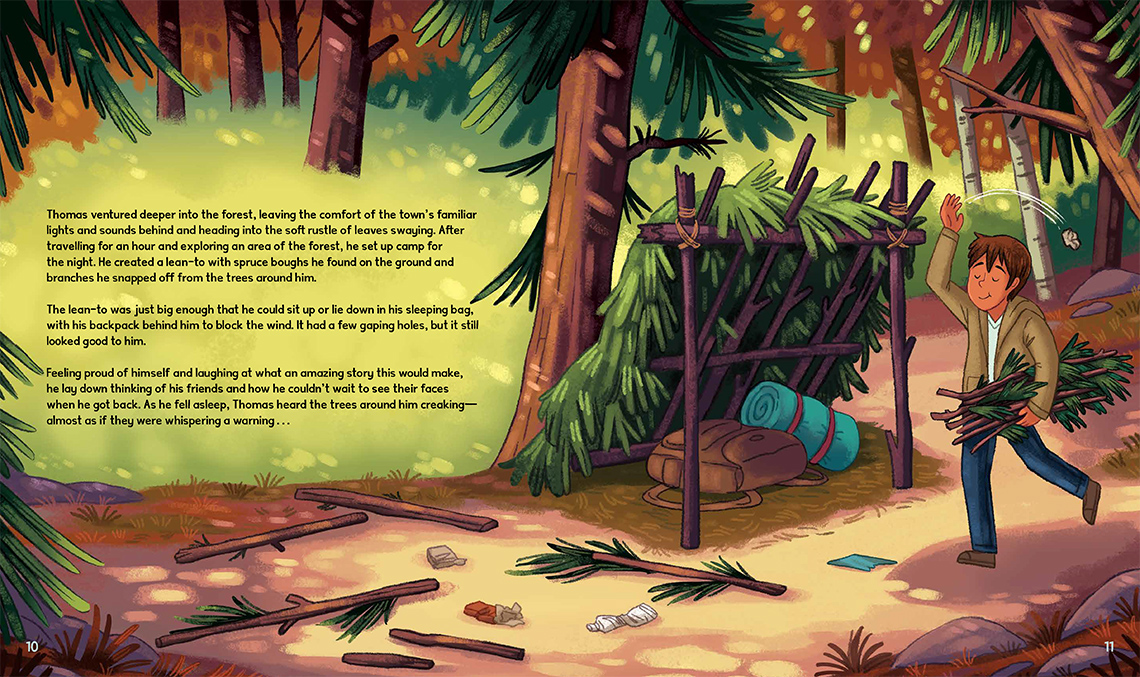
Thomas ventured deeper into the forest, leaving the comfort of the town's familiar lights and sounds behind and
heading into the soft rustle of leaves swaying. After travelling for an hour and exploring an area of the forest,
he set up camp for the night. He created a lean-to with spruce boughs he found on the ground and branches he
snapped off from the trees around him.
The lean-to was just big enough that he could sit up or lie down in his sleeping bag, with his backpack behind
him to block the wind. It had a few gaping holes, but it still looked good to him.
Feeling proud of himself and laughing at what an amazing story this would make, he lay down thinking of his
friends and how he couldn't wait to see their faces when he got back. As he fell asleep, Thomas heard the trees
around him creaking-almost as if they were whispering a warning…
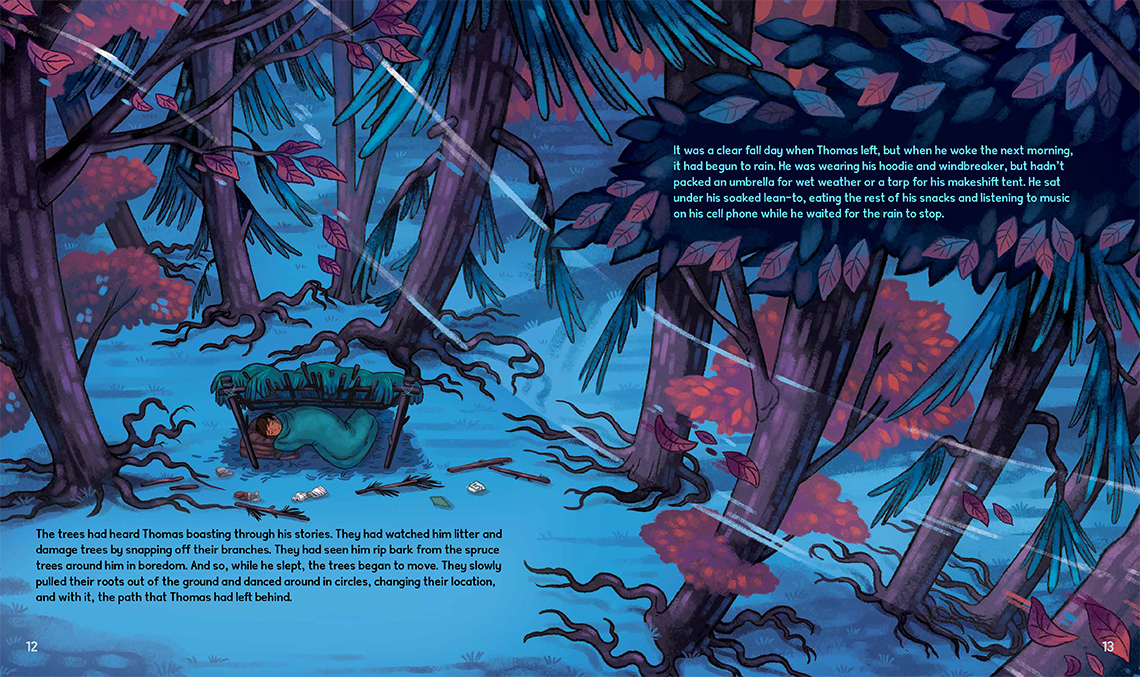
The trees had heard Thomas boasting through his stories. They had watched him litter and damage trees by snapping off their branches. They had seen him rip bark from the spruce trees around him in boredom. And so, while he slept, the trees began to move. They slowly pulled their roots out of the ground and danced around in circles, changing their location, and with it, the path that Thomas had left behind.
It was a clear fall day when Thomas left, but when he woke the next morning, it had begun to rain. He was wearing his hoodie and windbreaker, but hadn't packed an umbrella for wet weather or a tarp for his makeshift tent. He sat under his soaked lean-to, eating the rest of his snacks and listening to music on his cell phone while he waited for the rain to stop.
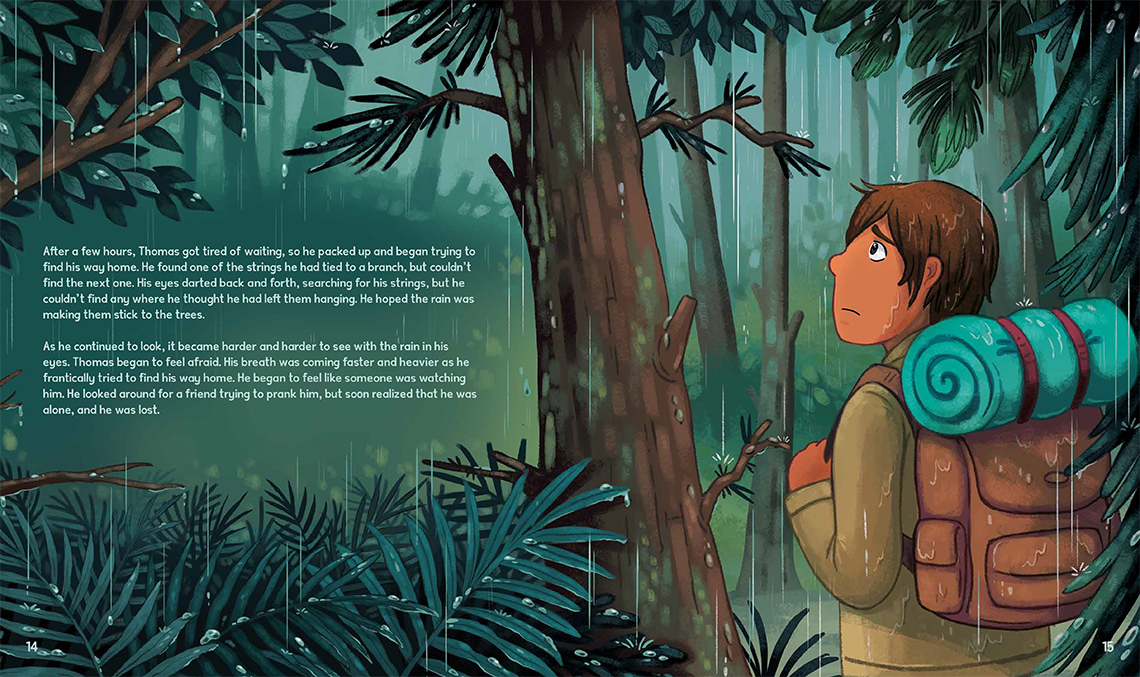
After a few hours, Thomas got tired of waiting, so he packed up and began trying to find his way home. He found one of the strings he had tied to a branch, but couldn’t find the next one. His eyes darted back and forth, searching for his strings, but he couldn’t find any where he thought he had left them hanging. He hoped the rain was making them stick to the trees.
As he continued to look, it became harder and harder to see with the rain in his eyes. Thomas began to feel afraid. His breath was coming faster and heavier as he frantically tried to find his way home. He began to feel like someone was watching him. He looked around for a friend trying to prank him, but soon realized that he was alone, and he was lost.
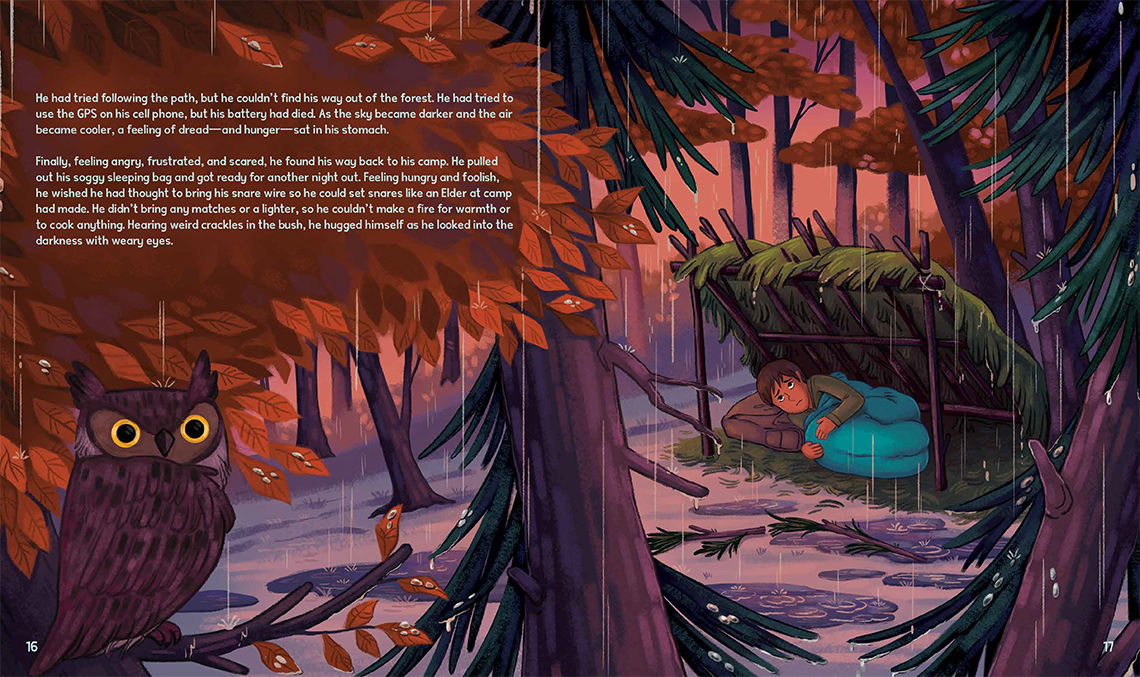
He had tried following the path, but he couldn't find his way out of the forest. He had tried to use the GPS on his cell phone, but his battery had died. As the sky became darker and the air became cooler, a feeling of dread and hunger sat in his stomach.
Finally, feeling angry, frustrated, and scared, he found his way back to his camp. He pulled out his soggy sleeping bag and got ready for another night out. Feeling hungry and foolish, he wished he had thought to bring his snare wire so he could set snares like an Elder at camp had made. He didn't bring any matches or a lighter, so he couldn't make a fire for warmth or to cook anything. Hearing weird crackles in the bush, he hugged himself as he looked into the darkness with weary eyes.
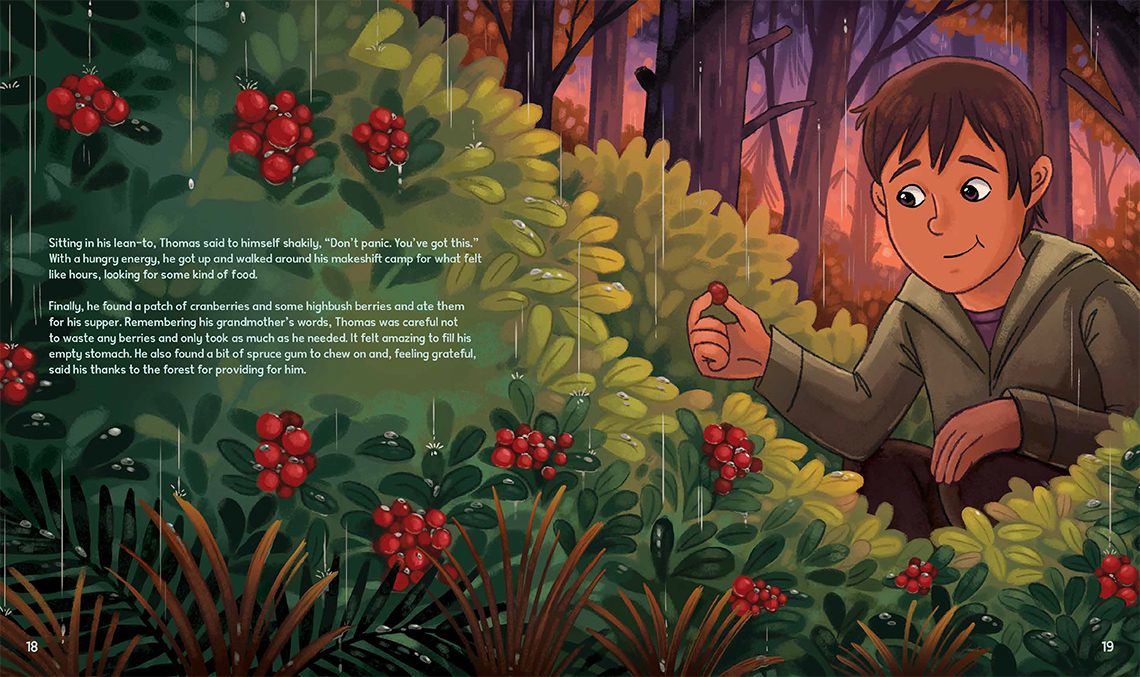
Sitting in his lean-to, Thomas said to himself shakily, "Don't panic. You've got this." With a hungry energy, he
got up and walked around his makeshift camp for what felt like hours, looking for some kind of food.
Finally, he found a patch of cranberries and some highbush berries and ate them for his supper. Remembering his
grandmother's words, Thomas was careful not to waste any berries and only took as much as he needed. It felt
amazing to fill his empty stomach. He also found a bit of spruce gum to chew on and, feeling grateful, said his
thanks to the forest for providing for him.
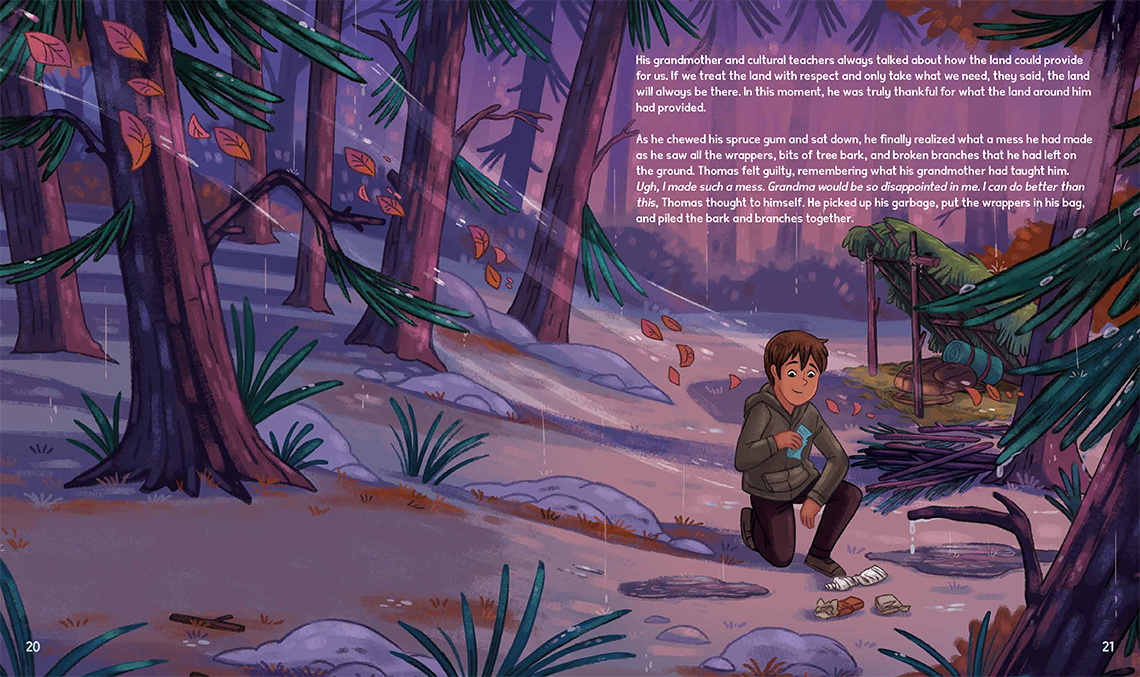
His grandmother and cultural teachers always talked about how the land could provide for us. If we treat the land
with respect and only take what we need, they said, the land will always be there. In this moment, he was truly
thankful for what the land around him had provided.
As he chewed his spruce gum and sat down, he finally realized what a mess he had made as he saw all the wrappers,
bits of tree bark, and broken branches that he had left on the ground. Thomas felt guilty, remembering what his
grandmother had taught him.
Ugh, I made such a mess. Grandma would be so disappointed in me. I can do better than this, Thomas thought to
himself. He picked up his garbage, put the wrappers in his bag, and piled the bark and branches together.
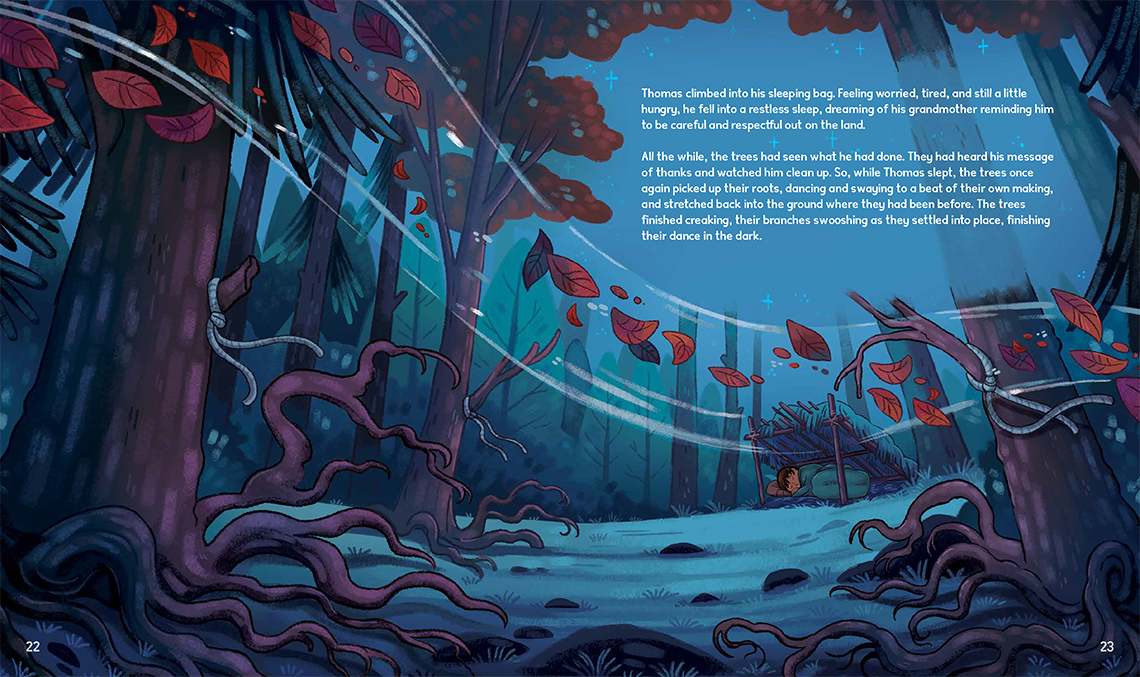
Thomas climbed into his sleeping bag. Feeling worried, tired, and still a little hungry, he fell into a restless sleep, dreaming of his grandmother reminding him to be careful and respectful out on the land.
All the while, the trees had seen what he had done. They had heard his message of thanks and watched him clean up. So, while Thomas slept, the trees once again picked up their roots, dancing and swaying to a beat of their own making, and stretched back into the ground where they had been before. The trees finished creaking, their branches swooshing as they settled into place, finishing their dance in the dark.
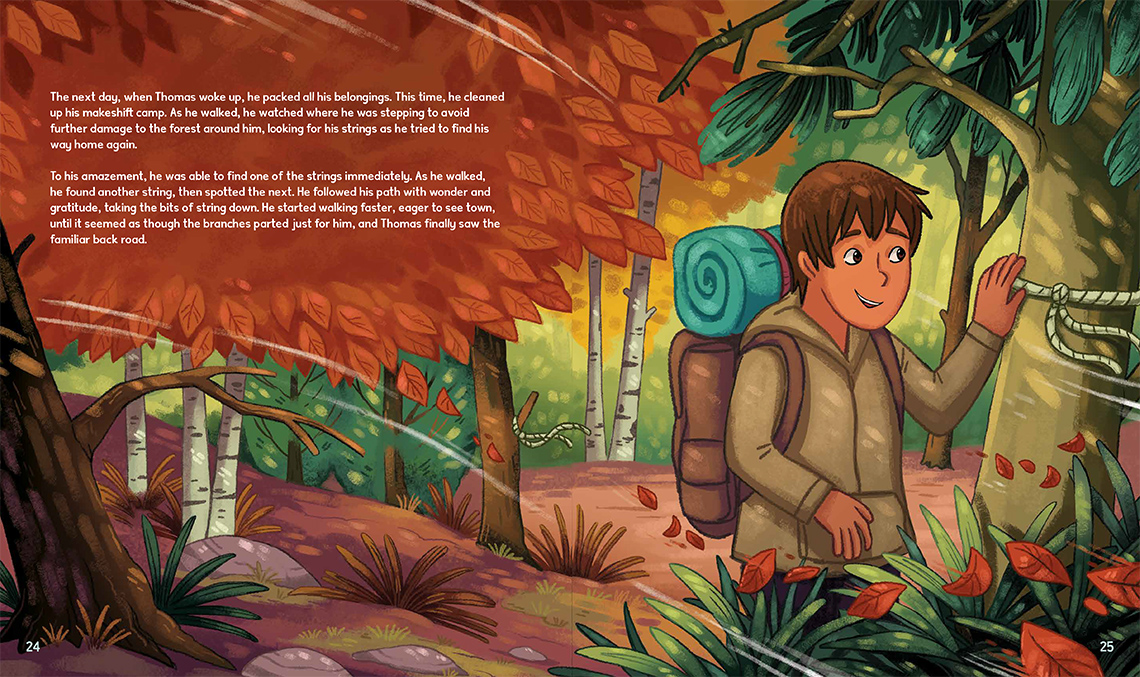
The next day, when Thomas woke up, he packed all his belongings. This time, he cleaned up his makeshift camp. As he walked, he watched where he was stepping to avoid further damage to the forest around him, looking for his strings as he tried to find his way home again.
To his amazement, he was able to find one of the strings immediately. As he walked, he found another string, then spotted the next. He followed his path with wonder and gratitude, taking the bits of string down. He started walking faster, eager to see town, until it seemed as though the branches parted just for him, and Thomas finally saw the familiar back road.
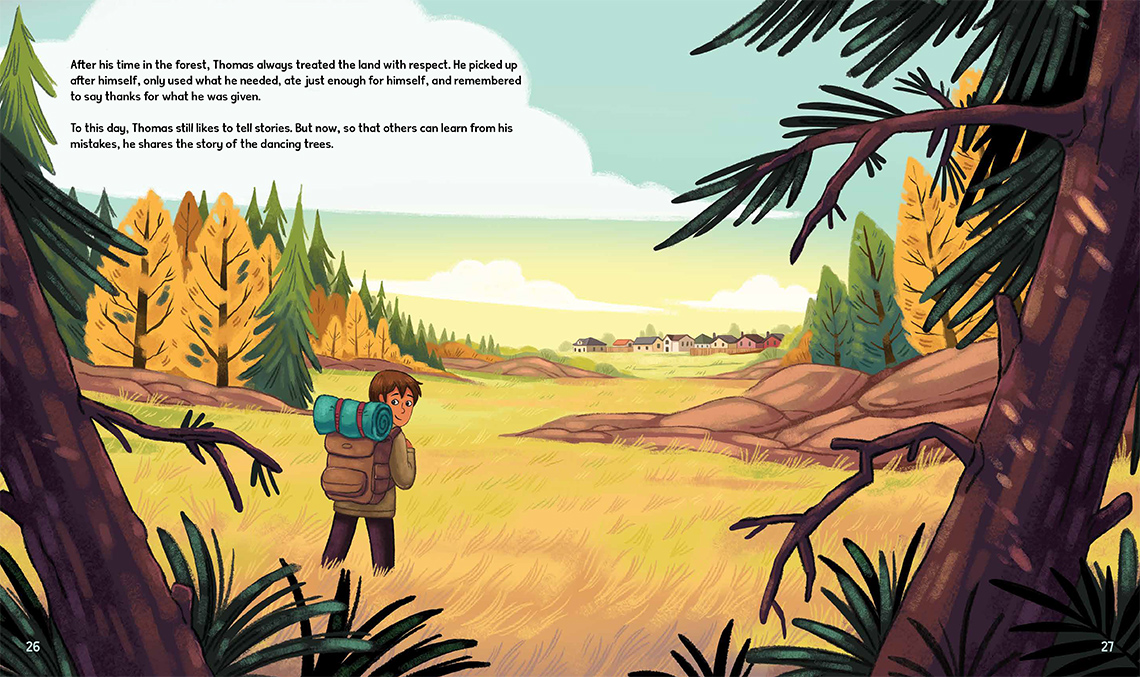
After his time in the forest, Thomas always treated the land with respect. He picked up after himself, only used what he needed, ate just enough for himself, and remembered to say thanks for what he was given.
To this day, Thomas still likes to tell stories. But now, so that others can learn from his mistakes, he shares the story of the dancing trees.
Masiana Kelly is an Inuk/Dene from Kugluktuk, Nunavut, and Fort Simpson, Northwest Territories. She carries with her the lessons her grandparents taught her. She lives in Kugluktuk with her husband, two boys, and two dogs. They enjoy spending quality time together and with their extended family.
Michelle Simpson is an illustrator and designer based out of Niagara Falls, Ontario. Michelle graduated with a BAA in illustration from Sheridan College and now works as a full-time freelance illustrator, focusing mainly on children’s book illustration. She has also worked as a concept artist for kids cartoons such as Ollie: The Boy Who Became What He Ate and Tee and Mo. You can find her work at michellescribbles.com or shop at michiscribbles.etsy.com.
Post-reading: Making connections
Let’s make some connections to the text.
Choose one question or sentence stem for each kind of connection. Respond in a notebook or using another method of your choice.
Press the following tabs to learn more.
Respond to one of the following questions/sentence stems:
- How does the book remind me of myself, of people I know, or of something that happened in my life?
- Could I create a Venn diagram that compares the setting of this story with the area where I live?
- How have I changed after reading this book?
- I can understand how (Blank) felt because…
- I am like/different from the character because…
- If I were (Blank) , I would…
Respond to one of the following questions/sentence stems:
- How does the book remind me of other books, especially the characters, events, or setting?
- This part about (Blank) reminds me of a song/episode/book called…
- This character is similar to the character of…
- The setting of this book is similar to…
- I read about (Blank) in another book, which is similar to this book because…
Respond to one of the following questions/sentence stems:
- What does this remind me of in the world around me?
- How is this text like events that are happening, or have happened, in the world?
- How is this text different from events that are happening, or have happened, in the world?
- How did my knowledge of an issue or event in the world around me help me understand this text better?
- This story makes me think about something I learned…
- The theme in this story relates to…
- This story relates to the real-life issue of…
Why make connections?
Making connections can enrich the reading experience. Student Gabby explains…
Making connections to texts helps us build our knowledge and understanding of a topic, the world around us, and the experiences and perspectives of other people. This is what global citizenship is all about!
What lessons about ourselves, the world, or the experiences and perspectives of other people can we learn from the book The Dancing Trees?
Building reading fluency by analyzing texts
Let’s re-examine the first page of the book.
Pages 2-3 of The Dancing Trees.

Reading out loud!
Read this page out loud. Change your intonationto communicate the difference between the text that belongs to the narration and the text that belongs to the different characters. How do the emotions of the characters change the way you say their lines?
Punctuating dialogue
The first page of the book contains dialogue between two characters. Let’s take a moment to think about how the dialogue appears in the text. Check out how teacher Wilfred explains "direct speech" and "dialogue tags."
Also known as “direct speech,” dialogue is punctuated in a very particular way. Quotation marks are placed around the words that are actually spoken. Words like he said, she said, and they said are called “dialogue tags” (or just “tags”).

Let’s examine some of the dialogue on the first page of The Dancing Trees.
Pay attention to the punctuation used within the quotation marks.
“Tom, pick up your garbage,” said Avery…
“Why? Someone else will pick it up anyway,” said Thomas…
“Yeah, well, go tell Grandma then,” said Thomas…
Did you notice the comma at the end of the words in quotation marks?
When quotation marks are used to show someone is speaking, we always add a comma before the dialogue tag. The comma reminds the reader to pause before stating who the speaker is. The comma always goes inside the quotation marks.
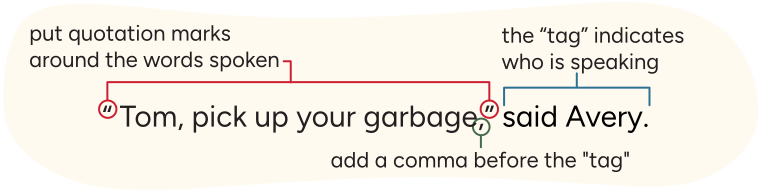
The sentence "'Tom, pick up your garbage,' said Avery," with the words spoken and tag indicated. Quotation marks are put around the spoken words "Tom, pick up your garbage," with a comma added before those closing quotation mark, followed by the tag "said Avery," which indicates who is speaking.
A note about capital letters
The first word in quotation marks starts with a capital letter. This applies whether the first word starts the sentence or not. Examine these sentences:
- “Pick up your garbage,” said Avery.
- Avery said, “Pick up your garbage.”
Your turn!
In the following multiple-choice question, you will look for the sentence that correctly punctuates direct speech.
Select the correct answer, then press Check Answer to see how you did.
Getting ready to write: Considering perspectives
The book The Dancing Trees is an example of a narrative text.
What is a narrative text? Answer the following multiple-choice question to check your understanding.
Select the correct answer, then press Check Answer to see how you did.
Narrative texts (texts that tell a story) can be told from different points of view or perspectives. Choosing which perspective to use is an important decision for the writer. The perspective impacts the message and tone of their writing.
Texts are often told from one of three perspectives:
- first person
- second person
- third person
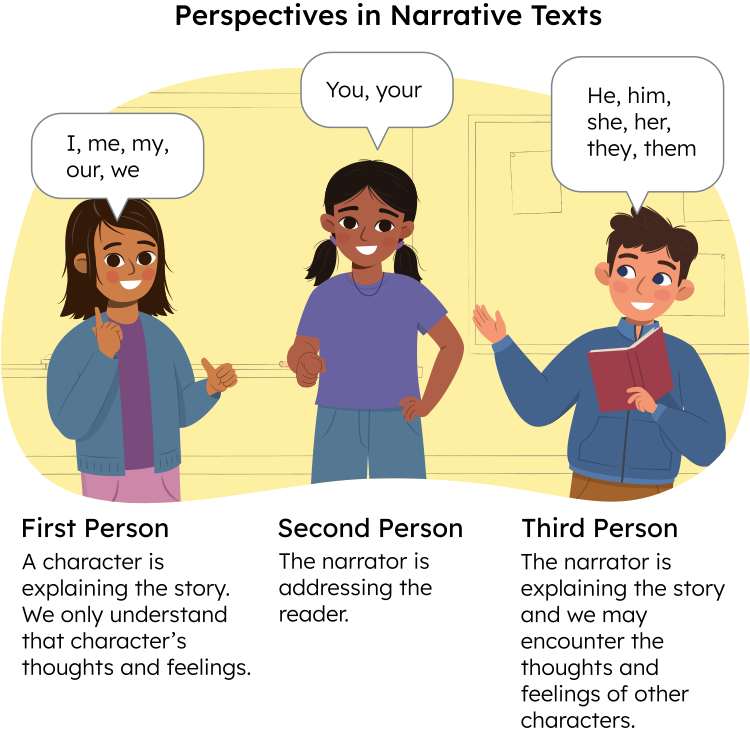
In the same way that we can use context clues to figure out a word’s meaning, we can use context clues to determine a text’s perspective. Examine the following image to learn more about the three different perspectives used in narrative texts.
 Description
Neebin, Mehar, and Oliver saying pronouns that can be used as context clues to determine a text's perspective.
Neebin is saying: "I, me, my, our, we," which show that a text is written in the first-person perspective. In first-person narrative texts, a character is explaining the story, and we only understand that character's thoughts and feelings.
Mahar is saying: "You, your," which show that a text is written in the second-person perspective. In second-person narrative texts, the narrator is addressing the reader.
Oliver is saying: "He, him, she, her, they, them," which show that a text is written in the third-person perspective. In third-person narrative texts, the narrator is explaining the story, and we may encounter the thoughts and feelings of other characters. Neebin, Mehar, and Oliver saying pronouns that can be used as context clues to determine a text's perspective.
Neebin is saying: "I, me, my, our, we," which show that a text is written in the first-person perspective. In first-person narrative texts, a character is explaining the story, and we only understand that character's thoughts and feelings.
Mahar is saying: "You, your," which show that a text is written in the second-person perspective. In second-person narrative texts, the narrator is addressing the reader.
Oliver is saying: "He, him, she, her, they, them," which show that a text is written in the third-person perspective. In third-person narrative texts, the narrator is explaining the story, and we may encounter the thoughts and feelings of other characters.
Your turn!
For each point of view, select the corresponding example.
The Dancing Trees: Perspective
Consider the book The Dancing Trees. Is it written in the first-, second-, or third-person perspective? How do you know?
When you’re ready, press Answer to check your answer.
The Dancing Trees is written in the third person. We know this because it’s as if someone on the outside is looking in on Thomas’s story and retelling it to the reader. Third-person pronouns (he, him) are used to describe what Thomas is feeling and doing.
How might a different perspective change your experience of the story?
Reread page 12 and page 23 of The Dancing Trees.
Pages 12-13 of The Dancing Trees.
Pages 22-23 of The Dancing Trees.
Use one of these scenes to write a draft of a first-person narrative told from the perspective of the trees. (That means the trees will use pronouns such as “I,” “we,” and “us.”) Your draft should be one to two paragraphs long. When writing from the perspective of the trees, try and make connections to your personal experiences with nature and the environment and what you know about the topic in a general way.
Add some dialogue between the trees. Make sure to use quotation marks and commas correctly, just as you learned earlier in this learning activity!

Pause and Reflect
Reflecting on perspective
Answer the following questions in a notebook or using another method of your choice. If possible, share your thinking with a partner.
- Did experiencing the story from the perspective of the trees change the tone or feeling of the story for you?
- Did it impact the message of the story?
- How might the story change if the whole thing was written from Thomas’s first-person perspective?
Getting ready to write: Finding your story
Now that you’ve had some practice making connections to a text and using it as inspiration for writing, let’s brainstorm some ideas to write our own stories.
As a global citizen, use your critical thinking skills to identify a significant moment or event that has had a positive impact on your life. This should be something that has shaped the person you are or helped you learn a valuable lesson about yourself, others, or the world around you.

Brainstorm
Exploring a moment or event
Jot down some ideas in a notebook, or record them using another method of your choice.
Consider the following questions to help you brainstorm:
- Where did the moment or event take place?
- What happened?
- Who were you with?
- Why do you think it still impacts you today?
- How has it changed the way you view the world?
Now think about perspective. If you write a story about this event, what narrative perspective would you use?
Press the Review button to refresh your memory about the three narrative perspectives.
Description
Neebin, Mehar, and Oliver saying pronouns that can be used as context clues to determine a text's perspective.
Neebin is saying: "I, me, my, our, we," which show that a text is written in the first-person perspective. In first-person narrative texts, a character is explaining the story, and we only understand that character's thoughts and feelings.
Mahar is saying: "You, your," which show that a text is written in the second-person perspective. In second-person narrative texts, the narrator is addressing the reader.
Oliver is saying: "He, him, she, her, they, them," which show that a text is written in the third-person perspective. In third-person narrative texts, the narrator is explaining the story, and we may encounter the thoughts and feelings of other characters. Neebin, Mehar, and Oliver saying pronouns that can be used as context clues to determine a text's perspective.
Neebin is saying: "I, me, my, our, we," which show that a text is written in the first-person perspective. In first-person narrative texts, a character is explaining the story, and we only understand that character's thoughts and feelings.
Mahar is saying: "You, your," which show that a text is written in the second-person perspective. In second-person narrative texts, the narrator is addressing the reader.
Oliver is saying: "He, him, she, her, they, them," which show that a text is written in the third-person perspective. In third-person narrative texts, the narrator is explaining the story, and we may encounter the thoughts and feelings of other characters.
What impact would the different perspectives have on your reader?
Putting it all together
Let’s review the different types of text connections. For each type, select the corresponding example.
Getting ready to write: Organizing and outlining a story
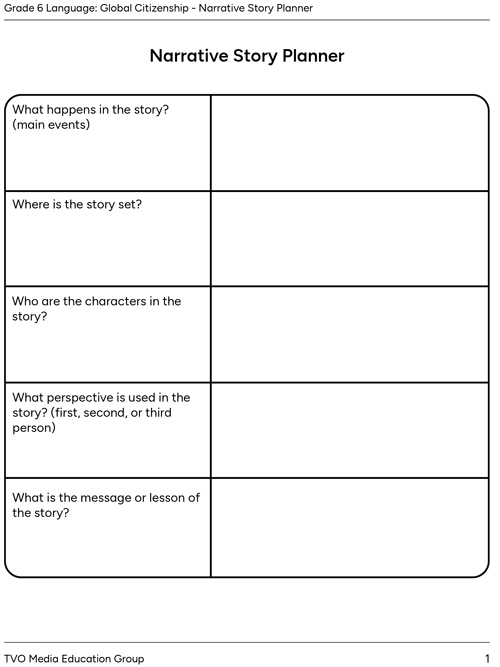
Now that you’ve brainstormed and jotted down some ideas, it’s time to organize them and outline a story. Using a tool like a graphic organizer is a great way to sort through your ideas and start bringing a story to life!
Complete the fillable and printable Narrative Story Planner in your notebook or using the following document. If you would like, you can use speech-to-text or audio recording tools to record your thoughts.
Self-assessment: Story planner
Review your story planner. Does it include all of the necessary pieces?
Now think about the following questions:
- What were your successes in creating your story planner?
- What is something you might want to work on if you create a final draft?
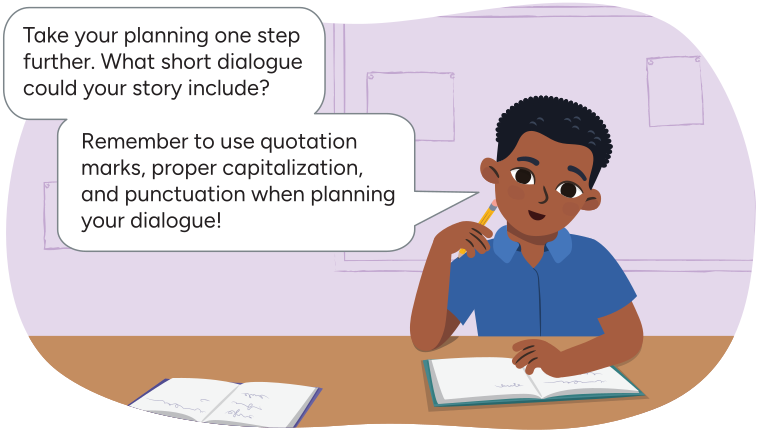
Arthur saying: Take your planning one step further. What short dialogue could your story include? Remember to use quotation marks, proper capitalization, and punctuation when planning your dialogue!
Reflection
As you read through these descriptions, which sentence best describes how you are feeling about your understanding of this learning activity? Press the button that is beside this sentence.

I feel...
Now, record your ideas using a voice recorder, speech-to-text, or writing tool.