Learning goals
We are learning to…
- understand the experiences and perspectives of diverse groups of Canadians
- gather, evaluate, and organize information, considering credibility, accuracy, and perspectives, to create and present texts
- demonstrate an understanding of a variety of words and use explicitly taught vocabulary in various contexts
- analyze various texts and summarize and record the main idea
Success criteria
I am able to…
- identify and research groups of Canadian settlers/newcomers, their histories, lived experiences, and contributions to Canadian identity
- use featured vocabulary in sentences to deepen and show my understanding of the terms
- read different types of texts (including graphs), analyze them, and summarize the main points
- reflect on the tools and forms of text that I chose to critically analyze their effectiveness and areas for future improvement in my work

People on the move
Being a global citizen requires us to have an understanding of historical events. We need to see how they shaped the world today, and how they impacted different groups of people. To begin, it is helpful to try to understand reasons why people might move from one location in the world to another.

Brainstorm
Why move to a different country?
What are some reasons why people might leave their home and move elsewhere in the world?
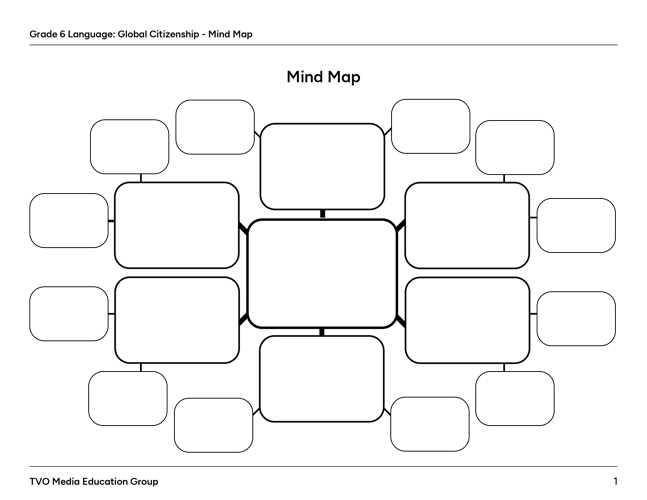
Record your ideas orally, digitally, in print, or using another method of your choice. To brainstorm your ideas, consider creating a mind map in your notebook, or completing this fillable and printable Mind Map.
Vocabulary preview

Before we continue, let’s preview some terms that we will come across in this learning activity. Explore the following flashcards. Do you know any of these terms already? Do any of them remind you of other words? Do any of these terms help you add new ideas to your brainstorm list of reasons why people might move from one country to another?
If you are familiar with these terms, you will have an easier time understanding texts about immigration and related topics. You will also be better able to express your own ideas and opinions.

Student Tips
Vocab tip!

Record these terms in your vocabulary notebook to help your brain understand and recognize them the next time you come across them! To really get to know their meaning, record definitions in your own words, find synonyms, or use them in sentences.

Exploring early settler communities
People move to new countries for lots of different reasons. These reasons fall into two categories: push and pull factors.
Press the following tabs to learn more.

Push factors are reasons that cause people to leave their home country. In other words, these factors “push” them out of their home country. For example, a family might move to a safer place if their home country is experiencing violence, war, or political upheaval.
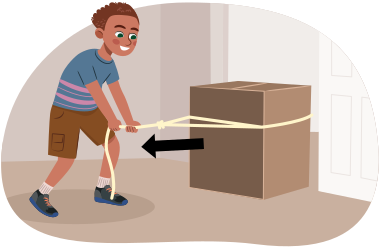
Pull factors are reasons that make a new country appealing. In other words, these factors “pull” people towards a new country. For example, some people might move to be closer to family, or to seek opportunities for work or school.
Waves of immigration

People often talk about “waves of immigration.” In a wave, a large number of newcomers arrive from the same region of the world.
Every year, Canada welcomes people from countries around the world. Sometimes this happens in waves, with many newcomers arriving from a particular region. Sometimes these large waves are the result of people being forced to leave their home countries because of violence, war, or persecution. These individuals are known as refugees.
Canada has a long history of different groups settling and establishing new lives across its lands. Many of Canada’s early settler communities were created by refugees who escaped violence, war, or persecution.
A note from Teacher Wilfred

It’s important to note that Indigenous Peoples have lived on Turtle Island, the land that is now Canada, since time immemorial. Only in the last 500 years did a large population of settlers from other continents come to live on this land, often displacing Indigenous Peoples and impacting their way of life.
As more settlers arrived in Canada (then called British North America), more Indigenous Peoples were forced from their lands. Their traditional activities – such as hunting, fishing, and trapping – were severely impacted. Before European contact, there were hundreds of Indigenous nations.
Summarizing and organizing information
As we continue to learn more about our topic, let’s work on the skill of summarizing and organizing information.
You will explore information about some early settler/newcomer communities that came to the land we now call Canada in large waves. As you read, use a tool, such as the following graphic organizer or another method of your choice, to help you summarize and organize the main points for three or four of the groups of settlers. (You can also choose to do all six groups.)
Complete the fillable and printable table called Canada’s Earliest Settler/Newcomer Communities, or copy it into your notebook. If you would like, you can use speech-to-text or audio recording tools to record your thoughts.
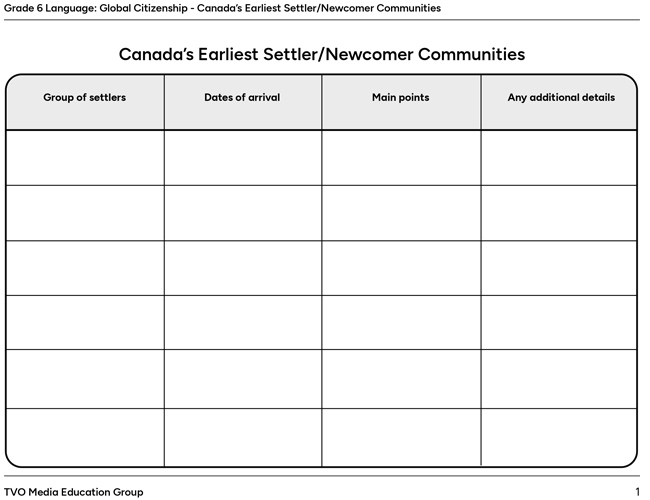
Press the Activity button to access the Canada’s Earliest Settler/Newcomer Communities.
Activity(Opens in a new tab)Let’s explore some of the early settler/newcomer communities that came to Canada in large waves. Press the following tabs to learn more.
From 1770 to 1815, about 15,000 Scottish farmers came to Canada after their landlords (the people that owned the lands they farmed) kicked them out of the farmlands they had lived on for generations to make room for more farm animals. In Canada, they had the opportunity to own their own farmland. This meant they would never have to worry about being displaced.
The Selkirk Settlers were one of the first groups of Scottish settlers that bought and farmed the land in the area now known as Red River, Manitoba. This group influenced many of the farming practices used to this day in Manitoba and other prairie provinces.
Before the United States of America was established as a country, Britain ruled and controlled the “American colonies.” Beginning in 1775, settlers in the American colonies began fighting the British rule and trying to establish America as an independent country. This fight was called the American Revolutionary War.
Loyalists were settlers in the American colonies who wanted to stay under British rule and did not want America to become an independent nation. They fought for the British army as it tried to keep control of the American colonies. Canada was also a British colony at the time. To motivate the Loyalists, the British government offered them land in Canada after the war was over as a reward for their loyalty. About 30,000 Loyalists came to Canada during this period. This group played a significant role in establishing many of Canada’s political, educational, social, and religious institutions.
Before the American Revolutionary War (the war that made America an independent country) began in 1775, Black people were enslaved in the American colonies. British officials offered many Black people their freedom and the promise of land in one of their colonies if they fought for the British Army. These individuals became known as Black Loyalists.
When Britain lost the war, many Black Loyalists were recaptured into slavery. Others were resettled into British colonies. The largest group of Black Loyalists, with just over 3,500 people, were resettled in Nova Scotia and New Brunswick, with the majority arriving in Birchtown, Nova Scotia. Unfortunately, the Black Loyalists did not get the same supports as white Loyalists. If they received land, the soil quality was poor. They were the last people to be given supplies and tools, if they received any at all. Many became labourers on farms or indentured servants, which meant they were under contract to work for someone else for a certain amount of time without getting paid.
Birchtown, Nova Scotia, became the largest Black settlement in North America. Black Loyalists built a community with their own schools and churches, and became shoemakers, teachers, woodcutters, and ministers. However, one third of the Black Loyalists decided to move to Sierra Leone in Africa after many experiences of discrimination.
Between 1810 and 1850, the Underground Railroad helped many Black American slaves escape from the American South. The Underground Railroad was not an actual railroad, but rather a complex network of people, hiding spaces, and safehouses that helped Black people escape slavery and make their way to freedom. About 30,000 to 40,000 Black Freedom Seekers came to Canada through the Underground Railroad. Many of these individuals settled in what is now known as Ontario, in regions such as Buxton, Chatham, Hamilton, Oakville, and Toronto. They helped build strong communities and shaped the identities of the regions where they lived.
In the 1840s, disease and pests destroyed farm crops in Ireland, causing a famine that killed over a million people. This famine is known as the Irish Potato Famine, The Great Famine, or The Great Hunger. Hundreds of thousands of people had to leave Ireland for their health and survival.
More than 100,000 Irish came to Canada. Because so many Irish people came to Canada during the Irish Potato Famine, many people mistakenly think this is when Irish immigrants established themselves in Canada. In fact, beginning in the 17th century, there were already many long-established Irish settler communities who had made significant contributions to Canadian identity. In the 1820s, Irish immigrants were one of the main groups who built the Lachine Canal in Montréal, Québec. Without the Lachine Canal, Montréal wouldn’t have been able to establish itself as a manufacturing hub.
Throughout the late 19th century, Britain faced poverty, pollution, and social inequality. Thousands of people – including children – lived in terrible conditions. Organizations in Britain and Canada, as well as other British colonies, worked together to relocate thousands of British children outside of the United Kingdom in the hopes of giving them a better life. These children were known as British Home Children.
Between 1869 and 1948, over 100,000 British Home Children came to Canada. They were adopted or placed in Canadian farm homes to start a new life. Some were treated very well and found loving families. However, others were put to work as unpaid workers on farms. Despite hardships, many British Home Children volunteered to fight with the Canadian military alongside Britain in the First World War and helped them win the war.

Pause and Reflect
Why is it important?
In your notebook or using another method of your choice, answer the following questions:
- Why is it important to learn about the experiences of different peoples and communities?
- What connections or conclusions can you make about the arrival of early settler/newcomer groups to modern ideas of Canadian identity?
Immigration in the 21st century
Many of Canada’s early settler communities immigrated in the hopes of finding a better life. These diverse cultural groups have contributed to the creation of Canada as we know it today. Canada is still a country with a high rate of immigration and many newcomers. Sometimes groups still arrive in large waves.
The power of graphs
Let’s explore a different kind of text that can help us understand information and draw conclusions about what we read – graphs!
Graphs communicate information. They can provide answers to research questions and help us understand information. They can also help us come up with new inquiry questions.

Practise reading a graph!
Let’s examine a graph from the United Nations Refugee Agency Canada that shows how many refugees arrived in Canada from 1980 to 2017. As you explore the graph, try to answer the following questions:
- What year(s) had the highest numbers of refugee arrivals?
- What year(s) had the lowest numbers of refugee arrivals?
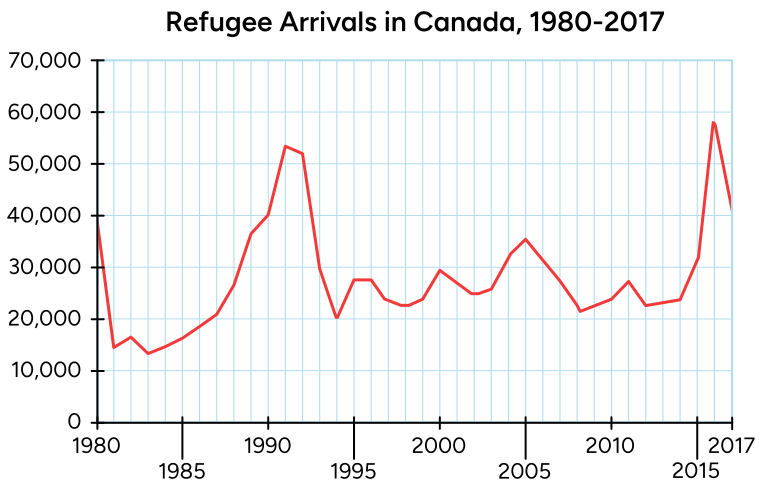
This graph was published by the United Nations Refugee Agency in January 2024.
Refugees in Canada – United Nations Refugee Agency | UNHCR Canada. (2024, January 2). UNHCR Canada. https://www.unhcr.ca/in-canada/refugees-in-canada/
An area graph showing refugee arrivals in Canada from 1980 to 2017. The horizontal axis indicates the year, while the vertical axis indicates the number of people. The year 2016 has the highest number of refugee arrivals with just under 60,000, followed by 1991 with just under 55,000 refugee arrivals. The year 1983 has the lowest number of refugee arrivals with just over 10,000, followed by 1981 with about 15,000 refugee arrivals.
Press the Answer button to check your answers.
What year(s) had the highest numbers of refugee arrivals?
- 2016 had the highest number of refugee arrivals with just under 60,000, followed by 1991 with just under 55,000 refugee arrivals.
What year(s) had the lowest numbers of refugee arrivals?
- 1983 had the lowest number of refugee arrivals with just over 10,000, followed by 1981 with about 15,000 refugee arrivals.

Student Success
Reflecting on the graph

What questions do you have after looking at this graph?
Student Ava’s questions
Ava wondered how many refugees Canada welcomed during this period (from 1980 to 2017). The answer is just over 1 million. Roughly adding all the values on the graph gives us this information.
The graph also tells a story about the number of refugee arrivals in certain years that can then lead to more inquiry questions.
Read Ava’s conversation with Teacher Wilfred:
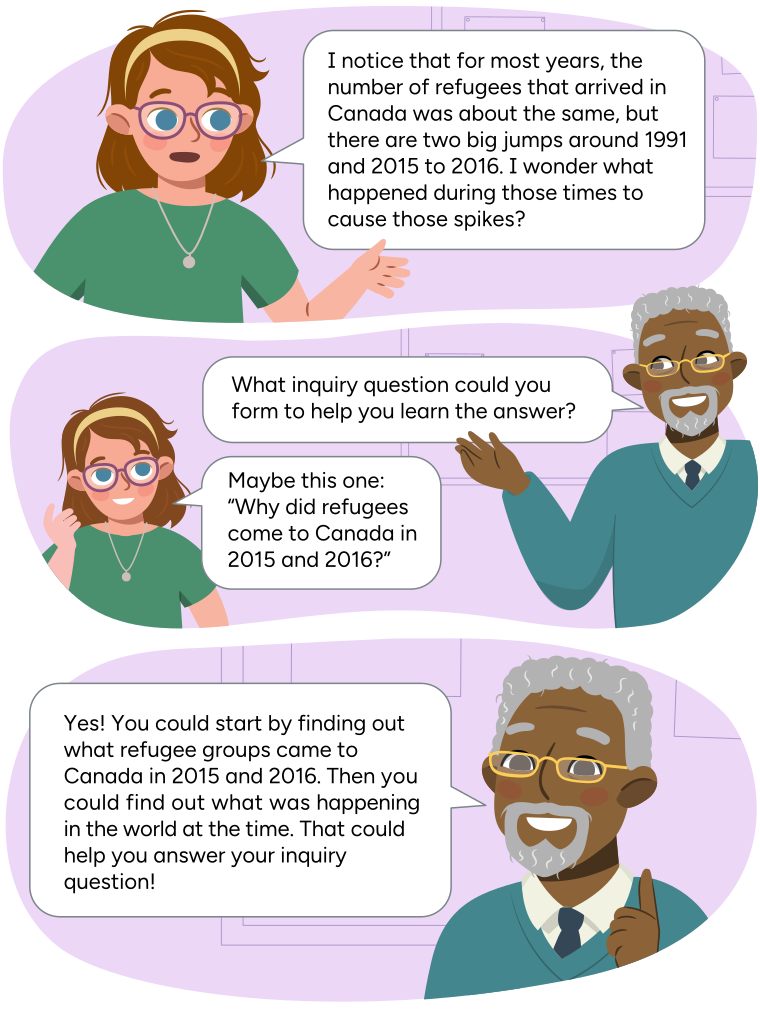 Description
Ava and Teacher Wilfred talking.
Ava says: I notice that for most years, the number of refugees that arrived in Canada was about the same, but there are two big jumps around 1991 and 2015 to 2016. I wonder what happened during those times to cause those spikes?
Teacher Wilfred asks: What inquiry question could you form to help you learn the answer?
Ava responds: Maybe this one: "Why did refugees come to Canada in 2015 and 2016?"
Teacher Wilfred says: Yes! You could start by finding out what refugee groups came to Canada in 2015 and 2016. Then you could find out what was happening in the world at the time. That could help you answer your inquiry question!
War in Syria leads to a wave
If we were to research this inquiry question, we would find that starting in 2011 and lasting nearly ten years, the country of Syria experienced a civil war that displaced more than five and a half million people outside of their country. Another seven million people were displaced inside their country.
As with many world crises, neighbouring countries have provided refuge for millions of displaced Syrians. A small number have found new homes in North America. The graph you examined reflects the arrival of over 50,000 Syrian refugees to Canada from 2015 on.
A significant number of people move to Canada for various reasons; refugee status is only one of them. Newcomers greatly impact and influence Canada’s infrastructure, cultural landscape, and Canadian identity, as you learned when reading about early settler groups.
Researching settler and newcomer groups
Now it’s time for you to conduct some research on a settler/newcomer group that has come to Canada.
Before you begin, let’s review some information to build our critical thinking skills and help us conduct research in a safe and responsible way.
Research safety
When doing research on the Internet, it is important to stay safe and stay focused. You can use the acronym TRUST to help guide you as you do your research.
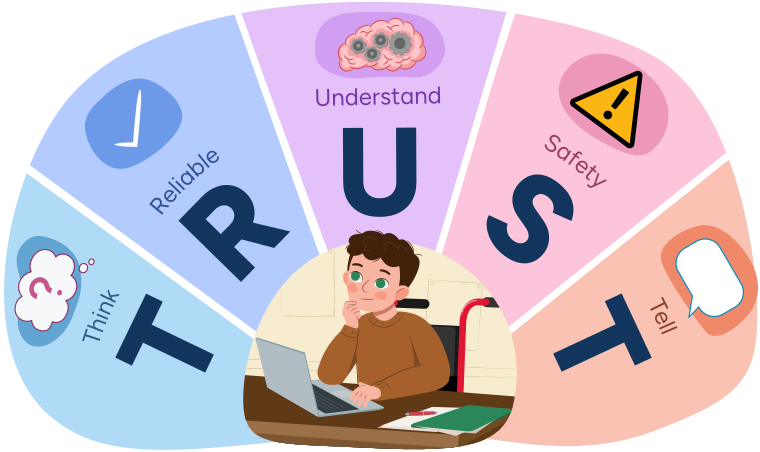 Description
Press the following tabs to learn more.
Think about your topic and develop specific questions to get better research results.
For example, if you’re working on the topic of recycling, you might start with a general question and make it more specific before beginning your research.
- General question: Why is recycling good for the environment?
- Specific question: How does recycling help protect marine wildlife?
Be patient while doing your research. Go through each website carefully, and take notes using a graphic organizer or notebook. Record the websites used for specific information – it’s important to give credit to the creator of the content.
Consult more than one resource to help you determine if the information you gather is accurate and true.
Remember, research can take time. It helps to be focused and calm! Taking a break can refresh our thinking and help us process new information.
It’s important to use reliable sources so that you can put together accurate and up-to-date information about your topic.
Websites ending with .com, .org, and .net can be purchased and used by anyone.
The ending .org is usually used by non-profit organizations, which may be trying to persuade rather than educate.
Websites ending in .edu are reserved for colleges and universities. Canadian websites have a .ca ending.
Consider the following questions when you are doing your reliability check. You might also ask a trusted adult or a peer for help if you are uncertain about a website.
- When was the resource published? (This might help you determine if the information is current.)
- Who created the resource/website? What is their educational background or work experience?
- Who is the intended audience?
- Who benefits from this information being shared?
- Whose perspectives are represented? Whose perspectives are missing?
Do you understand all the words on the site? Can you decode their meaning?
Does what you’re reading make sense?
If not, it’s okay. Consider trying a different source. It’s important for you to understand the information that you read so that you can put it in your own words.
It’s important to stay safe while doing online research. If a website asks you for any personal information, close it and try a different website.
Personal information could include asking for your full name, email address, phone number, home address, photos, or school name. Do not provide any personal information and close the website.
Does the site have pop-up windows? These windows usually ask the user to click to “win a prize” or “check out information.” Do not click on the pop-ups and close the website.
Throughout the research process, feel free to check in with a peer or trusted adult.
If there is anything specific that makes you feel uncomfortable or worried while you are doing your research…
- pause and take a break
- speak to a trusted adult
Your research activity

For this research activity, you will choose a settler/newcomer community and investigate why they came to Canada and how they contributed to Canadian identity.
Press the following tabs to see how to get started.
Pick one of the following groups:
- Jewish immigrants
- Chinese immigrants
- Japanese immigrants
- Ukrainian immigrants
- Syrian immigrants
- another group of people of your choice
Once you have chosen the community, you will research the following about them:
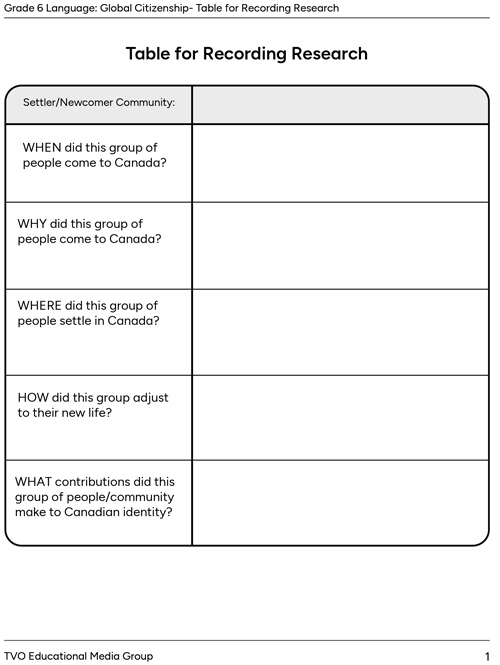
- WHEN did this group of people come to Canada?
- WHY did this group of people come to Canada?
- WHERE did this group of people settle in Canada?
- HOW did they adjust to their new life?
- WHAT contributions did this group of people/community make to Canadian identity?
Recording your research
How will you collect and organize the information that you research? You may wish to use a graphic organizer such as a mind map or a table with the research questions. Using tools like these not only helps you organize your information, but also ensures that you cover all the material that is asked of you.
Record your research using the method of your choice. Consider using one of the following graphic organizers.
Graphic organizer 1: Mind map
Create a mind map in your notebook, or complete this fillable and printable Mind Map for Recording Research.
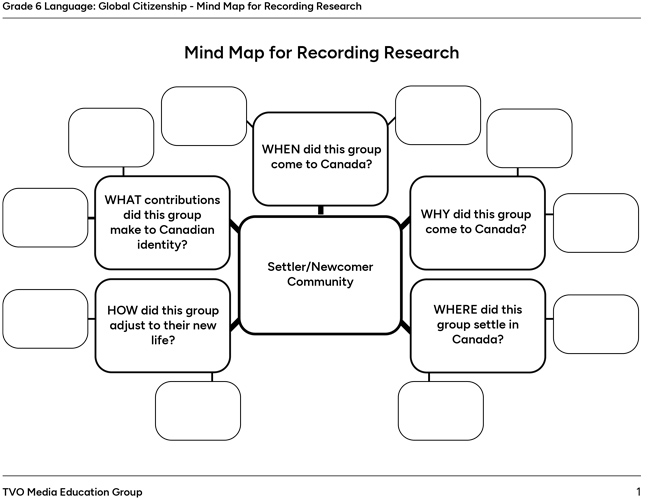
Press the Activity button to access the Mind Map for Recording Research.
Activity(Opens in a new tab)Graphic organizer 2: Table
Create a table in your notebook, or complete this fillable and printable Table for Recording Research.

Working with vocabulary

Now that you’ve explored the content of this learning activity, let’s take our understanding of the vocabulary terms introduced in our Minds On section to a deeper level.
First, let’s review the terms. For each term, select the corresponding definition.
In a notebook, or using another method of your choice, use each vocabulary term in a sentence that summarizes something that you learned throughout this learning activity. Here is an example:
| Term | Sentence |
|---|---|
| refugee |
The Selkirk Settlers are an example of an early refugee group: they had to flee Scotland because they were evicted from their homes and farmlands. |
Putting it all together
Now that you have completed your investigation into a settler/newcomer community, how will you share the results to educate others on their history, experiences, and contributions to Canadian identity?
Here is a list of formats to consider:
- video presentation
- poster
- podcast episode
- infographic
- another format of your choice
Choose the format that you feel will most effectively share this important information. Who do you want to communicate with? Make sure your format is a good fit for your intended audience.
Pause and Reflect
Reflecting on your work
Think about the following questions:
- Why did you choose the format that you did?
- How did the format you chose help to communicate your information to your intended audience?
- What changes or improvements could you make to your work the next time that you need to create a text to communicate your learning and understanding?
Reflection
As you read through these descriptions, which sentence best describes how you are feeling about your understanding of this learning activity? Press the button that is beside this sentence.

I feel...
Now, record your ideas using a voice recorder, speech-to-text, or writing tool.