Learning goals
We are learning to…
- evaluate and explain how transferable skills can help them express their voice, be engaged in learning, and implement a plan to develop their capabilities and potential
- analyze text features in various texts and explain how they help readers, listeners, and viewers understand meaning
- generate and develop ideas and details about various topics, using various strategies, various resources, and your own experiences
Success criteria
I am able to…
- use generalized morphological knowledge to analyze and understand new words
- make connections between sustainable development goals and global citizenship, and evaluate important criticisms of the SDGs
- analyze text features and explain how they help a reader or viewer to better understand texts and media, and help to communicate meaning
- write a paragraph about how understanding global challenges influences action and perspectives as global citizens, and reflect on how they can take action

Interconnectedness
What does it mean to be “interconnected” in a globalized world? What is “interconnectedness”?
As we have begun to discuss in this unit, it can be difficult to define this concept in our complex modern world. Not everyone’s experience of living on Earth is the same, and having privilege means that some people are in a better situation than others to participate and contribute to work on global issues.
 Description
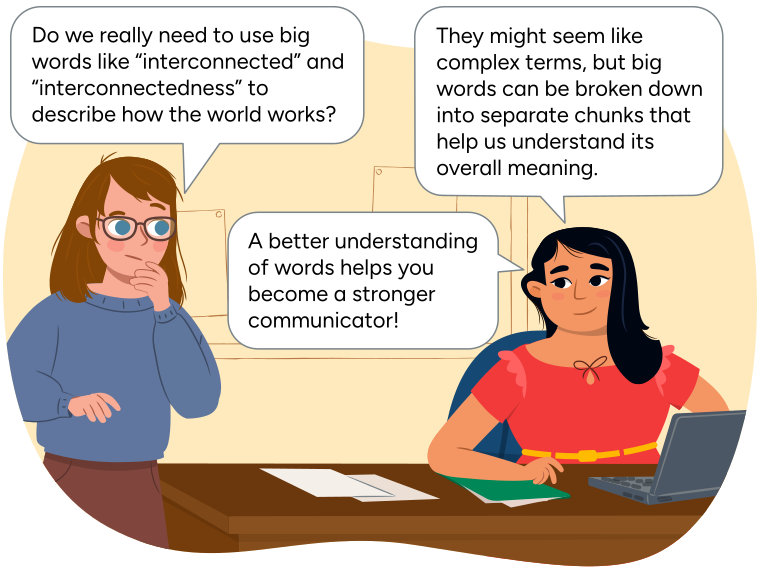
Ava and Teacher Chiara talking.
Ava asks: Do we really need to use big words like "interconnected" and "interconnectedness" to describe how the world works?
Teacher Chiara responds: They might seem like complex terms, but big words can be broken down into separate chunks that help us understand its overall meaning. A better understanding of words helps you become a stronger communicator!
Morphemes
A morpheme is the smallest segment of a word that holds meaning on its own. All words have at least one morpheme, but more complex words will have two or more.
More specifically, a base word forms the foundation of any word. A prefix is a morpheme that attaches to the front of the base word, and a suffix is added to the end of a base. Both of these will change the meaning of the base word!
Explore the following interactive entitled Interconnectedness to learn more about breaking down words into morphemes.
After you have explored the “interconnectedness” word breakdown, record your own explanation of the term in your notebook or another method of your choice. Try to include examples in your definition.
Press Answer button to learn more about the word's definition and compare the definition you created with the one provided.
Interconnectedness means “the state of being connected with each other”.
Examples:
- Organisms in a food web are all connected to each other.
- Computer networks include sets of computers that are connected together.
In this learning activity, we will be discussing the impact of our interconnectedness and the idea that everyone on Earth has a shared responsibility to take care of the planet.
We will also explore how different global organizations emerged to support relations between different nations, and we will assess different perspectives on their effectiveness.

United Nations
It is a fact that communities of the world interact with each other. Historically, these interactions have been both peaceful and vicious, in some cases leading to wars involving multiple countries.
In the mid-1940s, following the end of the Second World War, there were widespread concerns about how to maintain a sense of international peace. The most far-reaching global conflict had just taken place, and many countries feared the risk of a reoccurrence.
In 1945, the United Nations (UN) was founded as an international organization to promote peace, security, and cooperation across the world. Countries participate as members of the UN.
In 2015, the UN produced the 17 interconnected Sustainable Development Goals (SDGs) as a universal call to action to protect people and the planet. The goals were set to be met by the year 2030.

Student Success
Let’s think
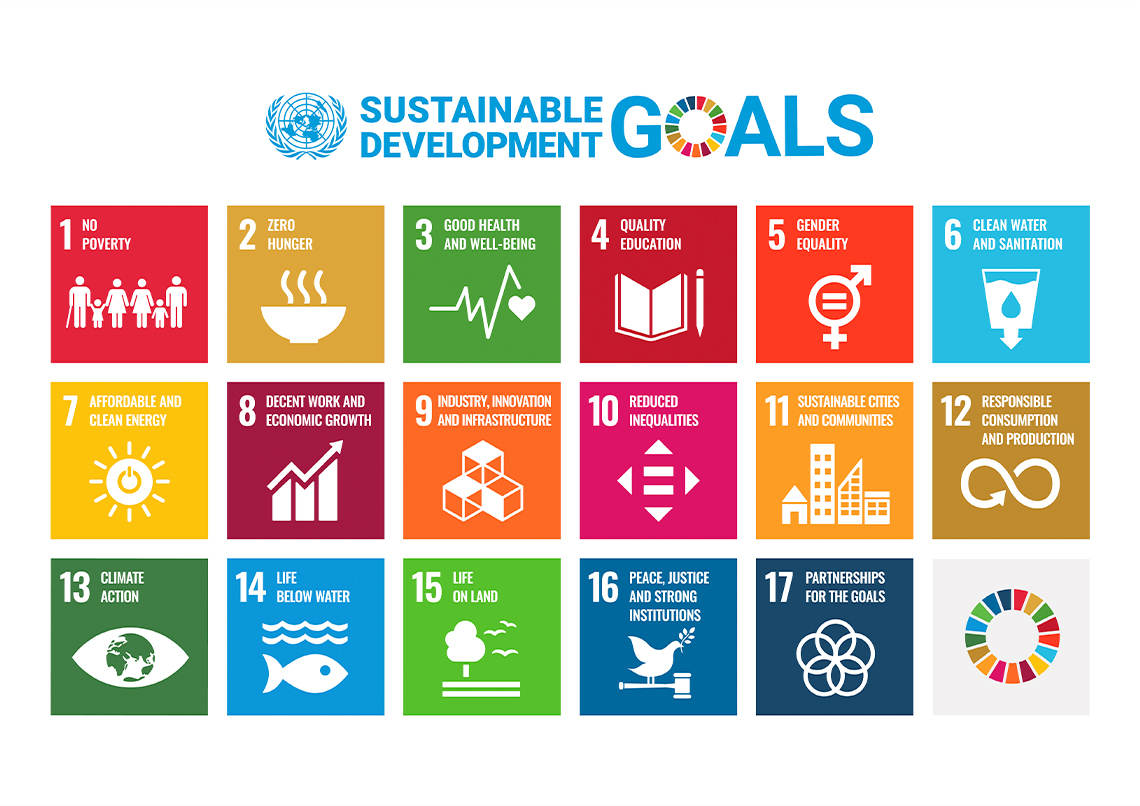
Begin by exploring the following image that outlines 17 sustainable development goals. In a method of your choice, record:
- What do you notice about the goals? What do you wonder?
- Are there any goals that stand out to you? Why?
- How do you think the goals are connected? Provide examples.
 Description
These 17 goals were selected based on issues that impact all people and communities around the world, and the individual goals also connect to each other. For example, Goal #8 (Decent Work and Economic Growth) is supported through making progress on Goal #4 (Quality Education), and Goal #3 (Good Health and Well-Being) has direct links to whether Goal #6 (Clean Water and Sanitation) is being adequately met.
Analyzing text features in infographics
When we learn about complex global issues – such as the themes of the 17 SDGs – we often encounter infographics as a way of presenting information like statistics.
An infographic is a “visual representation of data that is intended to make the data easy to understand and typically includes a combination of charts, diagrams, illustrations, and text, along with graphic design elements".
Infographics contain several different text features to help viewers understand and find important information.
Explore the following interactive entitled Infographic Sample to learn more about the text features in an infographic.
Zero Hunger
Examine the following Zero Hunger Infographic to learn more about the UN goal of Zero Hunger in a Canadian context.

Investigate
Investigate
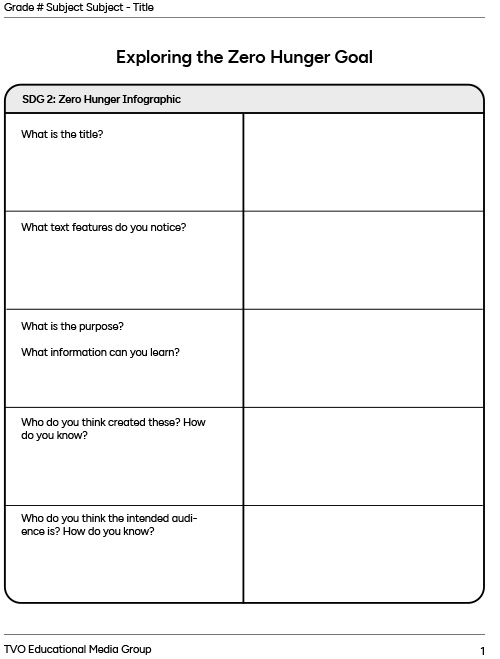
In the upcoming task, you will examine the infographic for Goal #2 – Zero Hunger. After exploring the infographic, respond to the following questions. You can use the following fillable, printable document, or record your answers in another method of your choice.
- What is the title of the media?
- What text features do you notice?
- What is the purpose of the media? What information does it provide? Record at least two pieces of information.
- Who do you think created it? How do you know?
- Who was the intended audience ? How do you know?
Complete the fillable and printable Exploring the Zero Hunger Goal in your notebook or using the following document. If you would like, you can use speech-to-text or audio recording tools to record your thoughts.
Press the Answer button to learn more.
| SDG 2: Zero Hunger | Infographic |
|---|---|
|
What is the title? |
End Hunger, Achieve Food Security and Improved Nutrition and Promote Sustainable Agriculture |
| What text features do you notice? |
Title Subheadings Bold Font Illustrations Maps Graphics |
|
What is the purpose? What information can you learn? |
To learn more about SDG 2 – Zero Hunger. This infographic explains where people are suffering from food insecurity and how this affects their health. It also highlights sustainable agriculture and food banks in Canada. |
| Who do you think created these? How do you know? | This was created by Statistics Canada and I know this because I checked the source at the bottom. |
| Who do you think the intended audience is? | I think the intended audience was people looking to learn more about zero hunger and collected quick data about it. |
Connecting the goals

Pause and Reflect
Pause and reflect
Consider the earlier discussion on how the topics of the SDGs are intended to be interconnected. Which other goals connect to Goal #2 – Zero Hunger? Describe how with specific examples.
There is immense responsibility placed on individual countries to address the SDGs, and each country is given a rating based on their progress in these specific areas of concern.
The UN has different agencies and sub-groups that can support their efforts, too. For example, in Canada, UN-managed initiatives like the Canadian Agricultural Youth Council and the World Food Programme are actively participating in helping to find a solution for the global crisis of hunger.

Sustainable development goals vocabulary
In discussing the United Nations and Sustainable Development Goals, you have explored new and complex vocabulary. Check your understanding using the matching activity. You may wish to record new vocabulary words in your vocabulary notebook, personal dictionary, or portfolio.
Match the vocabulary term to the definition.
Criticisms of the UN SDGs
Description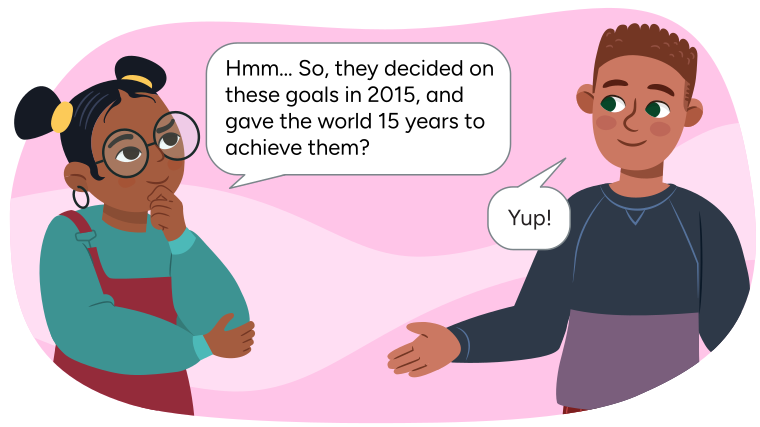
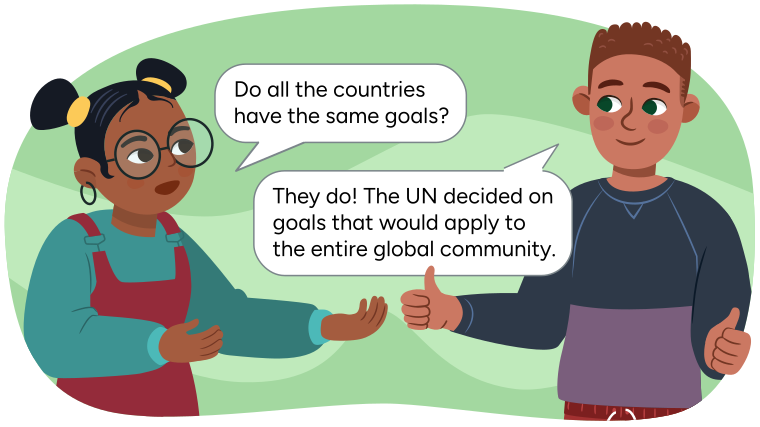
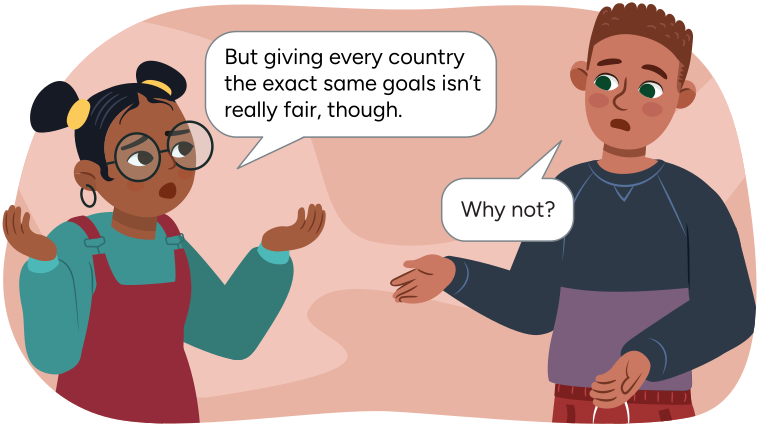
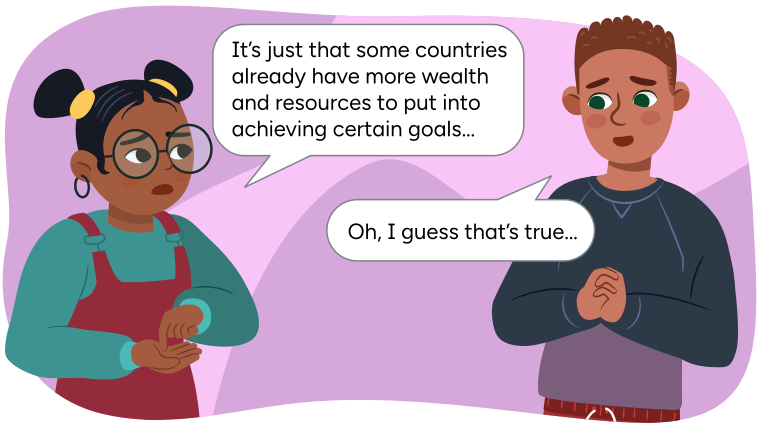
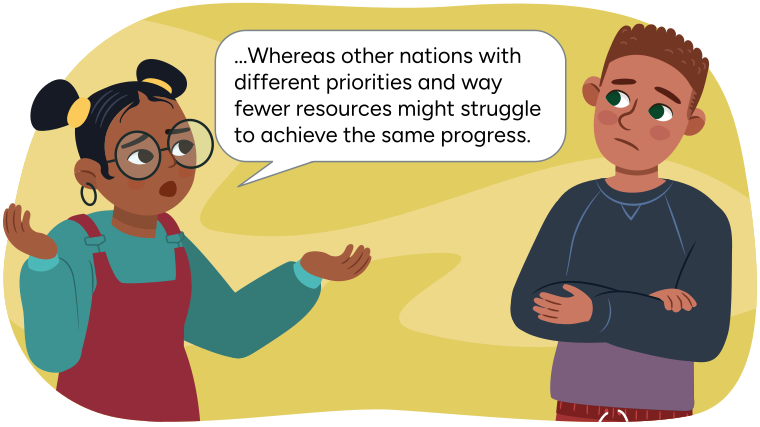
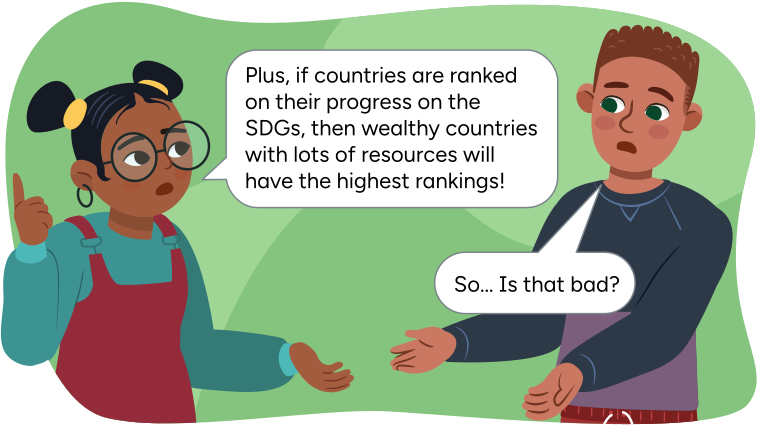
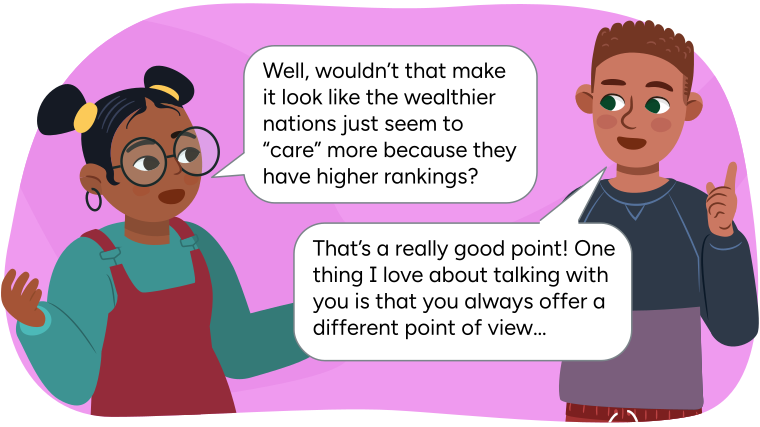
Tiara and William talking.
Image 1:
Tiara asks: Hmm…So, they decided on these goals in 2015, and gave the world 15 years to achieve them?
William responds: Yup!
Image 2:
Tiara asks: Do all countries have the same goals?
William responds: They do! The UN decided on goals that would apply to the entire global community.
Image 3:
Tiara says: But giving every country the exact same goals isn't really fair, though.
William asks: Why not?
Image 4:
Tiara says: It's just that some countries already have more wealth and resources to put into achieving certain goals…
William responds: Oh, I guess that's true…
Image 5:
Tiara says: …Whereas other nations with different priorities and way fewer resources might struggle to achieve the same progress.
William has a pensive expression
Image 6:
Tiara says: Plus, if countries are ranked on their progress on the SDGs, then wealthy countries with lots of resources will have the highest rankings!
William asks: So…Is that bad?
Image 7:
Tiara asks: Well, wouldn't that make it look like the wealthier nations just seem to "care" more because they have higher rankings?
William responds: That's a really good point! One thing I love about talking with you is that you always offer a different point of view…
As Tiara and William just demonstrated, not all perspectives on the Sustainable Development Goals are optimistic. Because not all countries have equal access to resources like updated technologies, or the same economic privileges and advantages, then not all countries are able to contribute to global actions to the same degree. As a result, certain nations’ rankings on SDG progress will inevitably fall below others, which could suggest that climate action is not considered as high a priority by that national government.
In an article published in 2023, the Paris-based, English-language quarterly magazine Africa Report released a critical review of the SDG process. In his analysis, author Julian Pecquet states the following issues with the United Nation’s goal-driven approach to sustainability.
Press the following tabs to learn more about some of these criticisms:
This means that there is no official tool or evaluation system to hold individual countries responsible for implementing plans to meet the SDGs by 2030. Towards the end of 2023, only 13/74 countries had integrated the SDGs into their nation’s official budgets.
Because there were so many compromises made during the development of the SDGs, it was not possible to make the resulting goals very specific. Therefore, several goals could be interpreted as too broad. For example, in their fast facts article on Goal #2 – Zero Hunger, the UN explains that this goal is “about creating a world free of hunger by 2030” – which might be considered too open-ended and difficult to accurately measure.
You may have noticed in the poster and fast facts articles that you explored previously that the 17 SDGs are accompanied by 169 “targets.” While it helps to have specific targets to clarify more details about each of the overall goals, the number of points to keep track of becomes difficult to manage – especially for individual countries facing a wide range of additional challenges of national importance.
By choosing the word “goals” instead of “rights”, many believe that the UN allows for countries to claim they have made progress in certain areas – rather than addressing some of the systemic issues and challenging conditions that people live under. The term “goal” may distract from the fact that people’s fundamental human rights are being threatened if these objectives are not met.
While Goal #10 (Reduce Inequalities) is aimed at improving equality both between and within individual countries, many feel that the fact that all nations are held to the same standards makes the SDGs unfair. Meeting these goals puts a heavier burden on countries who lack adequate funds for sustainable development, and as a result, this may allow wealthier nations to appear to be more invested in sustainability.
Student Success
Let’s think
After you have read the five examples of how the SDGs can be critiqued, identify which reason you find the most valid. Next, prepare a short response and describe the reasoning for your selection. If you disagree with all the points presented from the article, then explain why in your response. Record your ideas in a notebook or another method of your choice.

Coordinating and subordinating conjunctions
In addition to new concepts and vocabulary, this learning activity contains a grammar concept
that may be new to you, too!
Coordinating and subordinating conjunctions are two different conjunctions used to connect words, phrases, or clauses within sentences. Let's explore both conjunction types in more detail!
Press the following tabs to learn more about coordinating and subordinating conjunctions.
Coordinating conjunctions connect two independent clauses (simple sentences), words, or phrases. When you are connecting two independent clauses with a coordinating conjunction, a comma is placed before the conjunction.
Explore examples of coordinating conjunctions in the following visual. Make note of the comma used when a conjunction is used to separate two independent clauses.
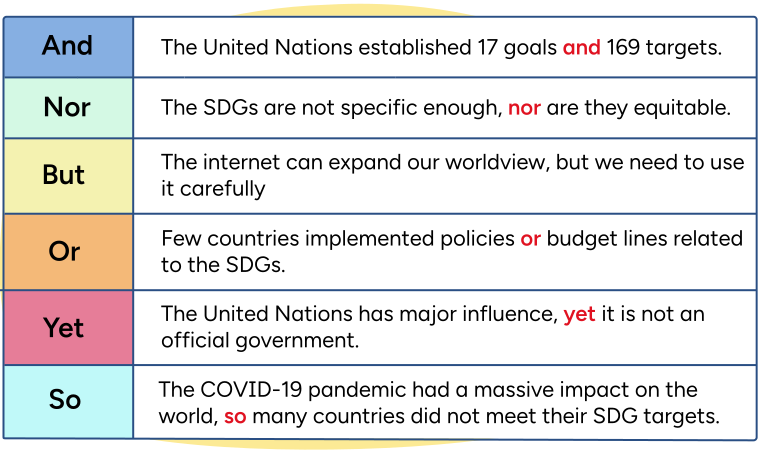
An example of using "and" in a sentence is: The United Nations established 17 goals and 169 targets. There is no comma before "and." An example of using "nor" in a sentence is: The SDGs are not specific enough, nor are they equitable. There is a comma before "nor." An example of using "but" in a sentence is: The Internet can expand our worldview, but we need to use it carefully. There is a comma before "but." An example of using "or" in a sentence is: Few countries implemented policies or budget lines related to the SDGs. There is no comma before "or." An example of using "yet" in a sentence is: The United Nations has major influence, yet it is not an official government. There is a comma before "yet." An example of using "so" in a sentence is: The COVID-19 pandemic has a massive impact on the world, so many countries did not meet their SDG targets. There is a comma before "so."
A subordinating conjunction is used at the beginning of a subordinating clause (dependent clause) which is a clause that does not make sense on its own. It connects the dependent clause to the independent clause.
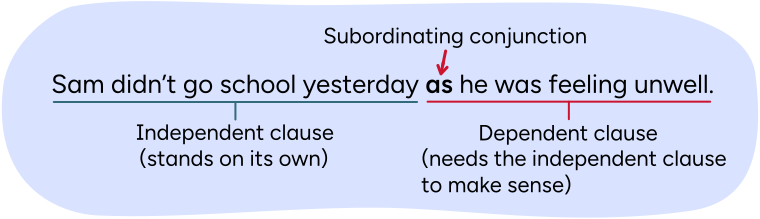
The sentence "Sam didn't go to school yesterday as he was feeling unwell," with the clauses and conjunction indicated. The independent clause "Sam didn't go to school yesterday" is connected by the subordinating conjunction "as" to the dependent clause "as he was feeling unwell." The independent clause stands on its own, while the dependent clause needs the independent clause to make sense.
Other examples of subordinating conjunctions include: if, since, as, when, although, while, after, before, until, because, and much more.
Check your understanding of conjunctions by completing the following fill-in-the-blank activity.
For each sentence, select the appropriate conjunction from the drop-down menu. If possible, record the sentences in your notebook and identify them as coordinating or subordinating. Press Check Answer to see how you did.

Putting it all together
In this learning activity you have explored Sustainable Development Goals, specifically goal number 2, Zero Hunger. Respond to the following reflection question using a paragraph format, in a method of your choice. As you write your paragraph, look for opportunities to add coordinating and subordinating conjunctions to create complex sentences in your response.
How does understanding global challenges influence your actions and perspectives as global citizens? How can you take action?
Use the following checklist to review success criteria for your written response.
Success criteria
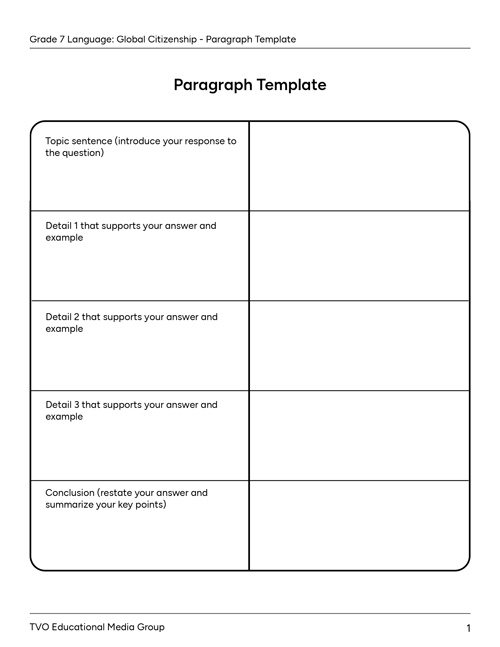
Complete the fillable and printable Paragraph Template in your notebook or using the following document. If you would like, you can use speech-to-text or audio recording tools to record your thoughts.
Coordinating and subordinating conjunctions review
Select the correct answer, then press Check Answer to see how you did.
Reflection
As you read the following descriptions, select the one that best describes your current understanding of the learning in this activity. Press the corresponding button once you have made your choice.

I feel...
Now, expand on your ideas by recording your thoughts using a voice recorder, speech-to-text, or writing tool.
When you review your notes on this learning activity later, reflect on whether you would select a different description based on your further review of the material in this learning activity.