Learning goals
We are learning to…
- explore and analyze themes in First Nations, Métis, and Inuit cultures and demonstrate an understanding of various identities, perspectives, and ways of knowing and being
- read, listen to, and view various forms of texts by diverse First Nations, Métis, and Inuit creators to make meaning about relationships and lived experiences
- describe literary devices in poetry and explain how they help create meaning
- establish a personal voice in texts, using elements of style to express thoughts, feelings, and opinions about a topic
Success criteria
I am able to…
- identify and explain connections between Indigenous ways of knowing, connecting to the land, and global citizenship
- explore poetic devices (literary and sound) and explain how they convey meaning within a poem
- annotate poems for style, rhythm, rhyme, poetic devices, etc. to understand overall mood, meaning, and theme of a poem
- write a poem about connecting to the land and global citizenship and practice for fluency
Interconnectedness with the land

As humans living in a fast-paced, rapidly globalizing world, it is important to recognize our interconnectedness with Earth and appreciate what the land provides. This relationship should be mutual. The well-being and health of humans is intertwined with the well-being and health of the land.
Indigenous Peoples have always believed that everything is grounded in relationships and connections with the land. Indigenous Knowledge contains the importance of upholding our responsibilities to the land and responding in ways that will take care of, and protect, the local environment for future generations.
Begin by exploring the following video Natural Law by the Anishinabek Nation. Isaac Murdoch from Serpent River First Nation, an Ojibway First Nation reserve located between Sudbury and Sault Ste. Marie, Ontario speaks about the Anishinaabeg having roles and responsibilities to care for each other as well as the lands, waters and all of creation.
As you explore, consider how Indigenous Peoples in Canada explain connections to the land and think about your own personal connections with the land.
You may wish to record key ideas, quotes, or words that stand out to you either orally, digitally, in print, or in another method of your choice.
Once you have watched the video, check your understanding with the following True/False questions.
Select the correct answer, then press Check Answer to see how you did.

Elements of a poem

A poem is a type of literature or piece of writing that contains different features, such as rhythm, rhyme, or repetition, of carefully chosen words that evoke imagination and emotion. A person who writes a poem is called a poet.
Poems are written in stanzas which is like a paragraph. It consists of lines that are grouped together and set apart from different stanzas with spacing. Stanzas are an important tool used by poets to convey meaning. The number of lines in a stanza can vary and the number of lines determines what the stanza is called.
Explore the names of the following stanzas. You may wish to record this information in your notebook.
Types of Stanzas
- Couplet: 2-line stanza
- Tercet: 3-line stanza
- Quatrain: 4-line stanza
- Cinquain: 5-line stanza
- Sestet: 6-line stanza
- Septet: 7-line stanza
- Octave: 8-line stanza
Did you know that the word stanza comes from the Latin word "room"?
In a sense, stanzas are ‘rooms’ used to divide and organize similar parts of writing in a poem or song (just like rooms in a house or building). The names of the stanzas are derived from the Latin roots of the number of lines. For example, “cinque” is the Latin root meaning “five.” Therefore, a five-line stanza is called a “cinquain.”
There are many different types of poems and they all follow a different structure. Most poems fall into one of three categories: lyric, narrative, and descriptive.
Press the following tabs to learn more about lyric, narrative, and descriptive poems. Press the audio button to hear the poem being read.
I Wandered Lonely as a Cloud
By William Wordsworth
I wondered lonely as a cloud
That floats on high o’er vales and hills,
When all at once I saw a crowd,
A host, of golden daffodils;
Beside the lake, beneath the trees,
Fluttering and dancing in the breeze.
Continuous as the stars that shine
And twinkle on the milky way,
They stretched in never-end line
Along the margin of a bay;
Then thousand saw I at a glance,
Tossing their heads in sprightly dance.
I Wandered Lonely as a Cloud
A lyric poem is written from the perspective of a poet, generally personal, and expresses strong emotions and thoughts.
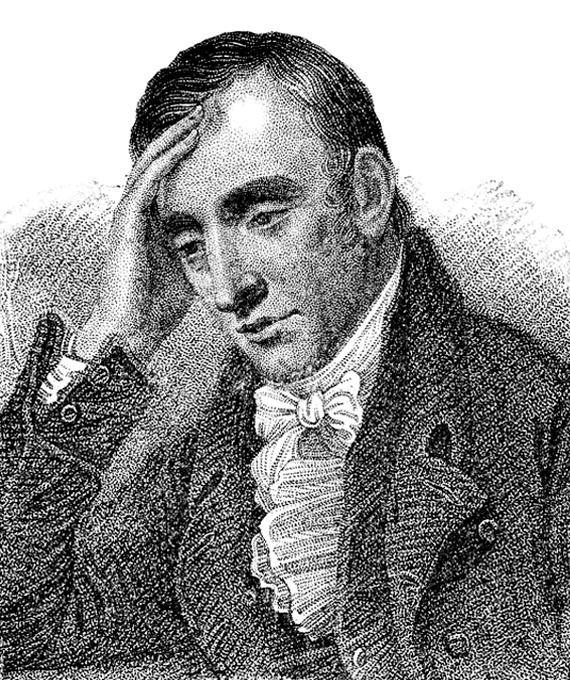
William Wordsworth (1770-1850)
A Bird, came down the Walk
By Emily Dickinson
A Bird, came down the Walk -
He did not know I saw -
He bit an Angle Worm in halves
And ate the fellow, raw,
And then, he drank a Dew
From a convenient Grass -
And then hopped sidewise to the Wall
To let a Beetle pass -
A Bird, came down the Walk
A narrative poem follows the structure of, and tells, a story, and usually contains a plot, setting, characters, conflict, and resolution.
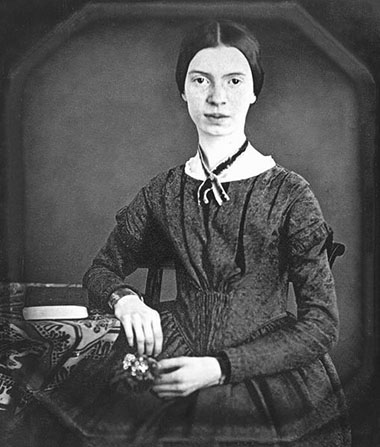
Emily Dickinson (1830-1886)
Nothing Gold Can Stay
By Robert Frost
Nature’s first green is gold,
Her hardest hue to hold.
Her early leaf’s a flower;
But only so an hour.
Then leaf subsides to leaf.
So Eden sank to grief,
So dawn goes down to day.
Nothing gold can stay.
Nothing Gold Can Stay
A descriptive poem uses imagery to describe the world and usually focuses on a bigger picture rather than something personal.
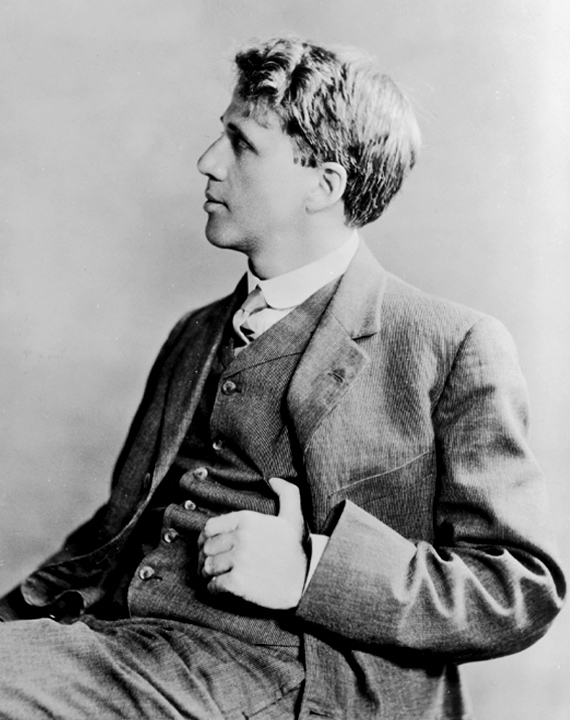
Robert Frost (1874-1963)
After browsing the poems and images, was there anything you noticed about the poets themselves? Did that affect how you interpreted the poems?
Press Possible Answer button to read on perspective.

Ava: I noticed that all the poets lived during the 19th century, and I liked how the different poems all expressed something about nature! I also noticed that all the poets were White, so I wonder if they got to spend time relaxing in nature because they had more privileges and rights than other people in society? It also makes me wonder how a more diverse group of poets might describe their experiences with nature during the same time period, or even today!
Poetry subtypes and poetic devices
Within these types of poems, there are also subtypes of poetry that have their own distinct styles, features, and characteristics. These subtypes include, but are not limited to:
- ode: poetic form of celebration used to honour a person, idea, or thing.
- limerick: a 5-line poem that follows the rhyme form AABBA.
- haiku: 3 lines with a specific number of syllables (line one and three has 5 syllables and line two has 7 syllables).
- ballad: 4-line stanzas with a rhyme scheme of ABCB (originally meant to be set to music).
- epic: grand story written in verse.
- sonnet: consists of 14 lines with a specific rhyming scheme.
- free verse: no set rhyme or structure.
Poets often use poetic devices to enhance their poetry. This is a particular pattern of words, figure of speech, or technique used in the poem to produce a specific effect. There are two types of poetic devices – literary and sound.
Let's learn more about specific poetic devices. If possible, record the poetic device and definition in your notebook or another method of your choice.
Press the following tabs to explore each poetic device.
A rhyme consists of identical or similar final syllables to create sound patterns.
For example:
she examined the beautiful twilight,
as the group looked through the skylight
Alliteration is a sound device that has the same letter or sound at the beginning of words.
For example: large leaping lizards laid lazily
Rhythm involves creating patterns with sounds by stressing or un-stressing specific syllables in words.
For example:
“two households, both alike in dignity,
in fair Verona, where we lay our scene,”
– Romeo & Juliet, William Shakespeare
Onomatopoeia is a word that sounds like what it is referring to.
For example: sizzle, thud, flip flop, zonk
Imagery is a type of figurative language that stimulates the sense and creates creative vivid mental pictures in the mind.
For example: the crisp autumn leaves fell from the browning trees on that chilly October day
Personification is when an idea or thing is given human attributes and/or feelings, or is treated as though it was human.
For example: it was early in the morning and he awoke to his alarm clock yelling at him
A metaphor compares two things that not similar (does not use like or as)
For example: laughter is the best medicine
A simile compares two things that are not similar using like or as
For example:
her eyes sparkled like diamonds; he moved through the space slow as a turtle

Pause and Reflect
Pause and reflect
Reflect on the three poems that you explored previously. Can you find any of the sounds or literary devices in those poems? Record your ideas in a method of your choice.
Analyzing a poem

Understanding both the technical aspects of poetry, such as literary or sound devices, as well as the cultural and historical contexts, such as the time period and background of the poets themselves, enhances our understanding of a poem.
As we explore more pieces of work, we can use the technique of annotation to help us achieve a deeper understanding of the poems.
Annotation, or “to annotate” a piece of writing, is the process of adding notes and ideas to the piece to clarify meaning and unpack the deeper message or theme. It is important to re-read the poem several times as you annotate it.
Start by exploring the following information that outlines the steps to annotating a poem.
- Step 1: Reflect on the poem’s title and what it may mean.
- Step 2: Identify and clarify things that you don’t understand by highlighting, circling, and underlining words or lines and clarifying meaning.
- Step 3: Summarize the main pieces of the poem – who, what, where, when, why? Who is speaking? To whom? About what?
- Step 4: Look for poetic devices (sound and literary) and consider how this device enhancing the poem.
- Step 5: Try to determine the poetic form or structure by labelling the rhyme scheme, rhythm or point of view.
- Step 6: Interpret what you think the theme or message of the poem could be.
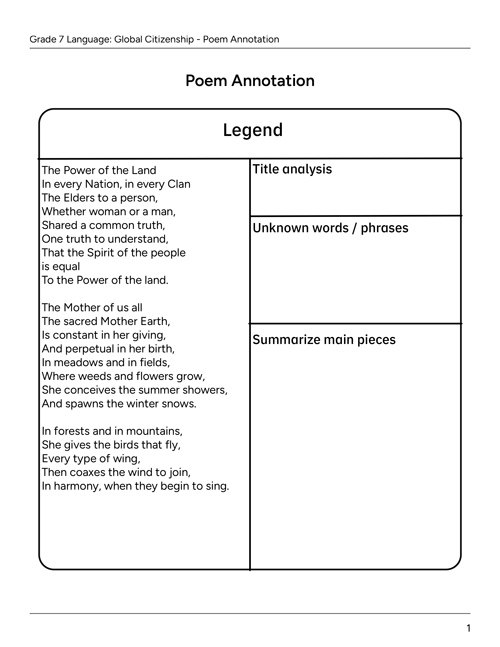
Now, your task is to annotate the following poem The Power of the Land by Elder Duke Redbird. Elder Duke Redbird is an Anishinaabe poet, journalist, activist, and actor from the Saugeen First Nation in Southwest Ontario.
Follow the steps to annotating when exploring the poem. You may wish to use the fillable, printable organizer provided. Use the checklist provided to guide your annotation. Create a legend at the top to indicate any highlights, underlining, circling, etc. that you may do.
Annotating a poem
- Examine the title – what do you think the poem is about?
- Highlight, circle, or underline words or phrases that you don’t understand – can you find the definition or meaning?
- Summarize the main pieces of the poem – who is speaking? To whom? About what?
- Look for poetic devices (sound and literary) – how does this contribute to the meaning?
- Do you notice a rhyme scheme or rhythm? Point of view?
- What is the overall message?
Press the The Power of the Land button to access the poem by Elder Duke Redbird.
The Power of the Land
In every Nation, in every Clan
The Elders to a person,
Whether woman or a man,
Shared a common truth,
One truth to understand,
That the Spirit of the people
is equal
To the Power of the land.
The Mother of us all
The sacred Mother Earth,
Is constant in her giving,
And perpetual in her birth,
In meadows and in fields,
Where weeds and flowers grow,
She conceives the summer showers,
And spawns the winter snows.
In forests and in mountains,
She gives the birds that fly,
Every type of wing,
Then coaxes the wind to join,
In harmony, when they begin to sing.
In brooks and streams
And rivers as they flow,
She generates the dreams,
And makes the fires glow.
And in every creature
Whether large or small,
She buries gems,
Of wisdom in them all.
And in every grain of sand,
She plants the knowledge,
Of the Power of the Land.
And those that honour,
her creations
and acknowledge her grand design,
she gives the templates,
Of the sacred
And the patterns of the divine.
And then with certain knowledge,
This to understand
That the spirit of the people
is equal
to the Power of the Land.
Complete the fillable and printable Poem Annotation document in your notebook or using the following document. If you would like, you can use speech-to-text or audio recording tools to record your thoughts.
Before you compare your thinking to the ideas provided, listen to the poem one last time, as it is read by Elder Duke Redbird himself.
Check out the following video of Elder Duke Redbird reciting “Power of the Land”, accompanied by Canadian instrumental group Sultans of String and folk musicians Twin Flames.
Access the following Annotation of “The Power of Land” to compare your answer.
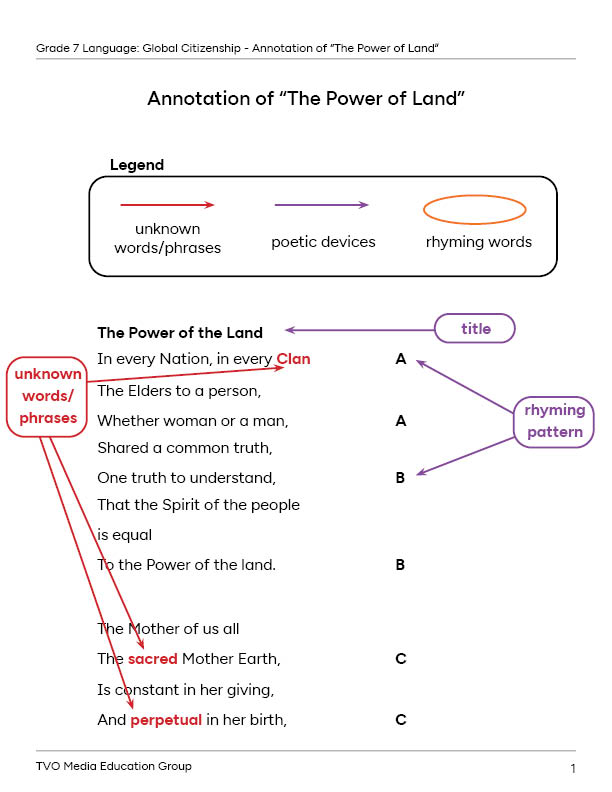
Press the Activity button to access the Annotation of “The Power of Land”.
Activity(Opens in a new tab)Read the following Analysis of The Power of the Land for a deeper look into the poem.
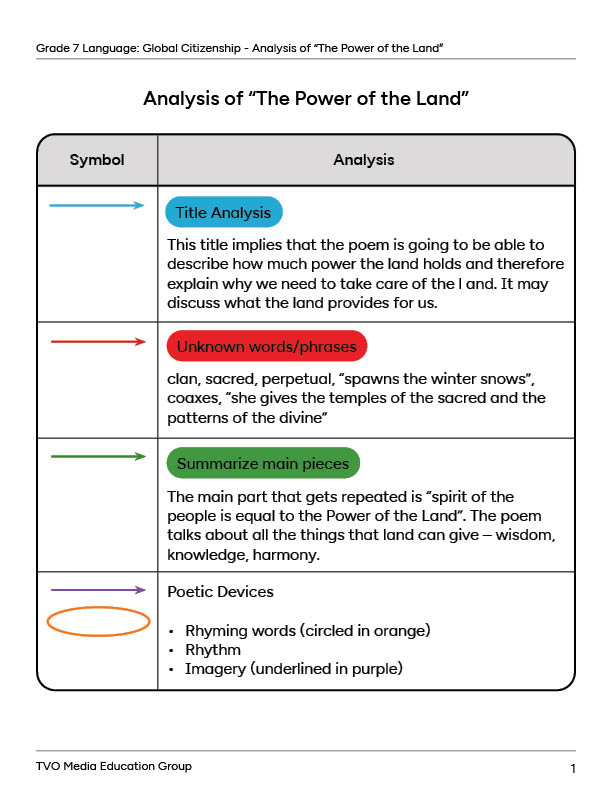
Press the Activity button to access the Analysis of “The Power of the Land”.
Activity (Open PDF in a new tab)
Pause and Reflect
Pause and reflect
- What does this poem tell us about how people and the land are connected?
- How does this poem connect to the video you explored in the Minds On section of this activity?
Relationships with, and respect for, the land are at the heart of Indigenous ways of knowing and being. Showing gratitude and reciprocity are values and practices embedded as it is important to give thanks or give back to the land for what it provides for humans. Connecting to the land deepens our relationship with it and our understanding of the roles and responsibilities while we live on Earth.
FNMIEAO. (2023, January 4). Learning from the land - FNMIEAO. https://fnmieao.com/public-resources/learning-from-the-land/
Composing a poem
Given what you’ve learned so far, consider your own connection to the land. Using the prompts to help guide your thinking, brainstorm how you connect with the land around you and why it is important to connect with the land.
Prompts
- Where do you enjoy spending time outside? Why?
- Why is the land important to you? What does it provide for you?
- How can you protect the land around you?
- What have you learned about Indigenous ways of knowing? Are there ways you show mutual respect and giving thanks to the land?
- Why is it important to take care of Earth?
- Consider your five senses (sight, touch, smell, taste, hear) – what do you think of in nature when you think about your five senses?
Using the information that you brainstormed, your task is to write a poem in a format of your choice about the importance of land, your connection to land, and how you, as an individual, can protect the land.
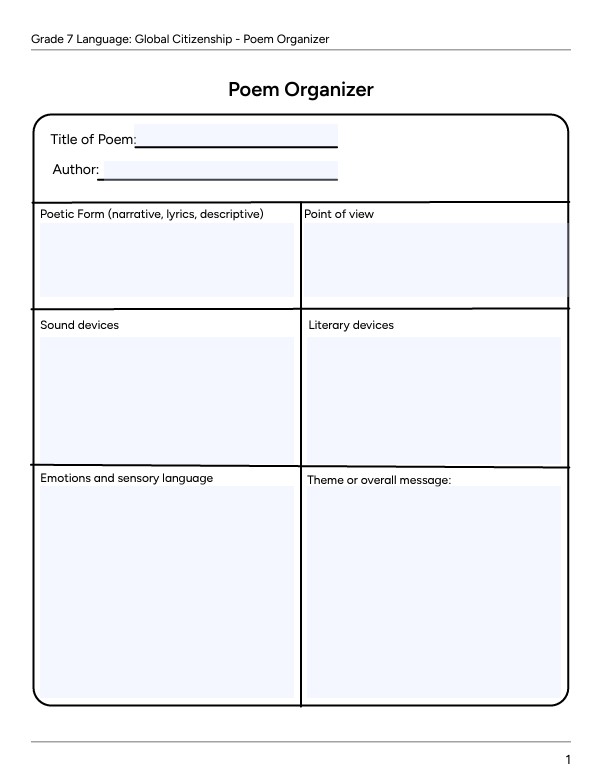
Complete the fillable and printable Poem Organizer in your notebook or using the following document. If you would like, you can use speech-to-text or audio recording tools to record your thoughts.
|
Title of Poem: (Blank) Author: (Blank) |
|
|---|---|
| Poetic form (narrative, lyrics, descriptive) | Point of view |
| Sound devices | Literary devices |
| Emotions and sensory language | Theme or overall message |

Fluency while reading
Now that you’ve created a poem, practice reading it with a focus on fluency.
Fluency is the ability to identify words correctly and read a text at an appropriate rate with ease, pace, automaticity, and expression. With proper phrasing and a focus on punctuation the reader will gain more meaning from the text.
Re-read your poem several times, focusing on the criteria outlined below. Alternatively, you could also choose one of the stanzas you explored in this learning activity.
Use the checklist provided to self-assess your own fluency. If possible, share your poem with someone else and ask them to provide feedback on your fluency.
Based on the checklist, choose one area of fluency to focus on and set a goal for yourself. What strategies could you use to help you achieve this goal?

Vocabulary
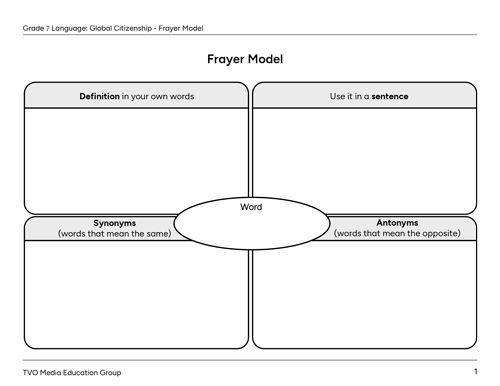
Explore the following words that are connected to land and the environment. Using the Frayer model, pick two words and provide the definition plus any synonyms and antonyms. Also create a sentence with that word.
- responsible
- adventure
- activism
- peaceful
- fossilize
You may have already learned that synonyms are words that have the same meaning and antonyms are words with opposite meanings.
Complete the fillable and printable Frayer Model in your notebook or using the following document. If you would like, you can use speech-to-text or audio recording tools to record your thoughts.

Grammar glimpses: colon and semi-colon
The colon (:) and semi-colon (;) are both punctuation marks that can separate two independent clauses.
Press the following tabs to learn more.
The colon (:) is used to introduce something described in the first part of the sentence, usually a list, but it can also introduce another independent clause.
For example:
- She loved to travel: exploring new cultures and experiencing new cuisines were her passions.
- The concert was unforgettable: the music was mesmerizing and the atmosphere was electric.
The semi-colon (;) can also be used, similar to a colon, but only if the two independent clauses are closely related.
For example:
- I went to the market; I forgot to buy corn soup.
- The marathon was grueling; runners pushed themselves beyond their limits.

Try It
Try it
Check out the following sentences:
- He lives near the beach. The salty air is making his car rust.
- It was a very hot day. I have to use a fan to keep cool.
- We did an experiment in class. All the students participated.
Then, rewrite the sentences using semi-colons in a notebook or another method of your choice.
When you’re ready, press Let’s Check! to explore the re-written sentences.
- He lives near the beach; the salty air is making his car rust.
- It was a very hot day; I have to use a fan to keep cool.
- We did an experiment in class; all the students participated.
Let’s check!
Match the following literary devices with their meaning. Once finished, choose one of the literary devices from the activity and explain how it can be used to help create meaning within a text, specifically a poem. Use an example from one of the poems you explored, or wrote, to explain your thinking.
For each literary device, select the corresponding definition.
Pause and Reflect
Pause and reflect
Reflect on the videos and poem, Power of the Land, using the following questions to guide you.
- What have you learned about Indigenous perspectives of the land?
- Why is it important that we, as humans, take care of the land?
- How might you support Indigenous Peoples who are advocating for the land to be protected?

Putting it all together
Begin by checking your comprehension about what you’ve learned about poetry through the interactive multiple-choice activity.
Select the correct answer, then press Check Answer to see how you did.
In this learning activity, you learned how to annotate a poem.
Using your own poem, or another poem of your choice, follow the steps of annotating a poem to analyze it.
The steps are provided in the following checklist:
Pause and Reflect
Pause and reflect
As a final reflection, consider everything you have learned about connecting to the land, global citizenship, and poetry. Respond to the following questions in a method of your choice:
- How is global citizenship and taking care of the land connected? Use specific examples from your learning to support your answer.
- How can poetry be used to convey a message about taking care of the land? Use specific examples from your learning to support your answer.
Reflection
As you read the following descriptions, select the one that best describes your current understanding of the learning in this activity. Press the corresponding button once you have made your choice.

I feel...
Now, expand on your ideas by recording your thoughts using a voice recorder, speech-to-text, or writing tool.
When you review your notes on this learning activity later, reflect on whether you would select a different description based on your further review of the material in this learning activity.