Learning goals
We are learning to…
- analyze and explain how knowledge and skills developed in this grade, support learning in various subject areas and everyday life, and how they enhance understanding and communication
- analyze a variety of text forms and explain how their characteristics communicate meaning
- identify the topic, purpose, and audience for a piece they plan to create, and analyze how this helps them generate, develop, and communicate ideas about their topic related to equity and inclusion
Success criteria
I am able to…
- explore and comprehend various text forms (memoir, podcast, cartoons) and record how they address equality, and identify the purpose of each text form
- use syllable knowledge to encode multi-syllabic words and define them
- identify and write sentences based on verb tense
- create a piece of my choice that highlights equality, human rights, or social justice, and why it is important for all citizens to stand up for equality and reflect on how the text form and characteristics chosen help to communicate my message
The pursuit of equality
When we discuss what it means to live in a globalized world, and how all humans on Earth are interconnected, it can be hard to ignore the issue of inequality. Different levels of privilege in society means that some individuals or groups have access to rights and resources that others do not, and this is the source of many global inequalities.
Inequality exists everywhere, and it is often based on some of the following qualities:
- physical ability
- nationality or ethnic heritage
- language spoken
- level of education
- family status
- religion or spiritual belief
- gender identity
- political belief
It is natural to feel upset when learning about inequality and injustice around the world - both as it occurred in the past and continues to this day.
It is that upset feeling, however, that often motivates people to create meaningful change in society.
Explore the following flashcards to learn about four individuals in Canada committed to achieving meaningful changes in society to improve the state of equality.

Brainstorm
Brainstorm
After exploring these individuals, brainstorm a list of fundamental rights that you think all humans should have access to. Then, brainstorm ideas, initiatives, or actions that you believe individuals can take to promote equal access to these rights on a global scale. Record your ideas in a method of your choice.
Exploring advocacy through texts
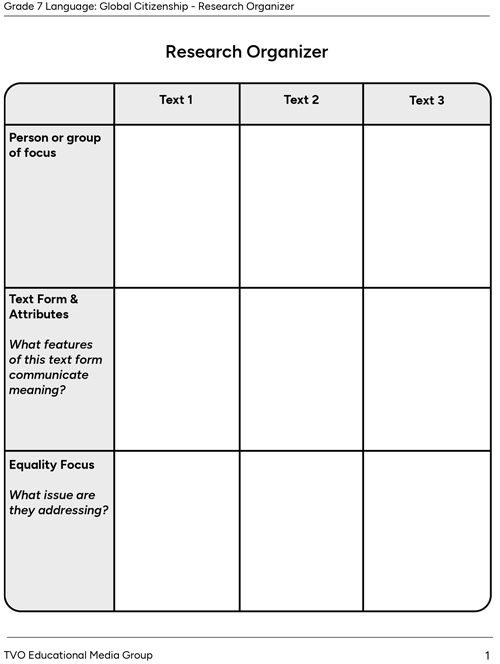
In this learning activity, you will be exploring three different text forms as you examine the ways that different people have advocated for equal rights. As you explore these various individuals and text forms, your task is to collect research notes about both the text form and the information it is providing.
Use the following checklist to collect research notes.
Tips for collecting research notes
One component of collecting research and taking notes is to record information about the sources. This information will help you to write a bibliographyto give credit to the sources that provided you with the information.
A bibliography is a comprehensive list of sources (books, journals, websites, newspapers, interviews, and so on) that a person consulted, referenced, or cited when writing or producing a creation of work. It is typically included at the end or bottom of the creative piece of work and provides the reader with information about the sources used by the author, allowing them to locate and verify information presented in the work.
Complete the fillable and printable Research Organizer to collect notes in your notebook or using the following document. If you would like, you can use speech-to-text or audio recording tools to record your thoughts.
Text 1: Memoir
Memoir – “It Stops Here: Standing Up for Our Lands, Our Water, and Our People” by Chief Rueben George
A memoir is a form of writing that focuses on the author’s personal experiences, memories, and reflections about a specific event or period in their life.
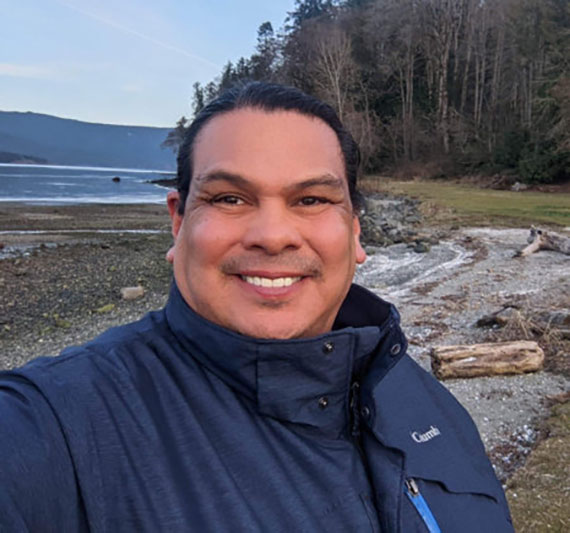
Author, Sundance Chief, and member of the Tsleil-Waututh First Nation (TWN), Rueben George wrote a memoir in 2023 about his life of activism. After working as a family outreach counsellor for twenty years, George decided to commit his life to opposing the development of the Trans Mountain Pipeline on his community’s traditional territory. George is a well-known advocate for the equal land rights of Indigenous Peoples in Canada.
As you read, consider the idea of “global citizenship” that you learned about in the Minds On section. How does Rueben George describe the work of making a difference in the world?
Let’s explore an excerpt from his memoir:
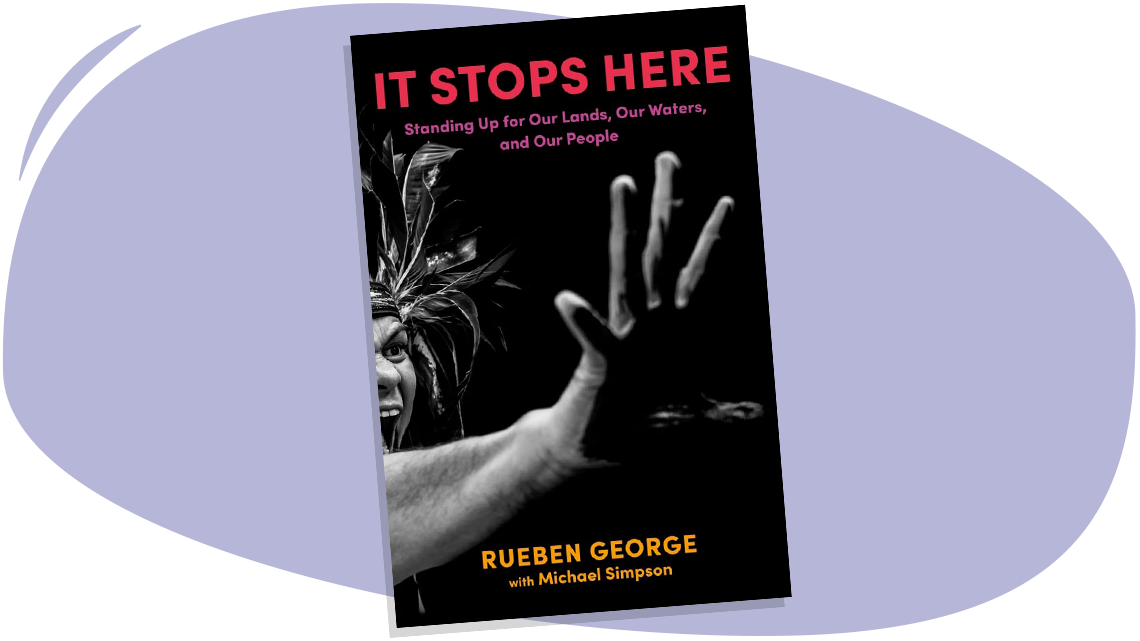
Chapter 6
We Will Take You with Us
My grandfather said that like the Thunderbird of old, our people would rise up and build ourselves into the proudest and strongest segment of society, and that’s exactly what’s happening. He said that our lands would be governed by our own people again, and that’s happening too.
Not long ago, there tended to be two types of people in Indigenous leadership: those who were cultural and spiritual leaders, and those who were well educated. What I see now is a new generation of Indigenous leaders who are cultural, spiritual, and also very well educated, and that’s significant. We all need the different skill sets within our communities if we want to build our communities up. Jewell James says, “Go get an education, then come back and I will decolonize you.”
Well that’s happening now too. People are getting educated and decolonizing themselves by learning the tools and teachings that have worked for our ancestors for millennia. That’s how we flip things. We can’t live exactly how we used to, but we still have to remember where we come from. We have to remember both the good things about where we came from and the hard times that we’ve lived through. We draw on all of this to find the fundamentals of our being; our law; our medicine wheel of truth, family, health, culture; and everything that encompasses the past, present, and future generations. That’s our way. That’s our teaching. That’s what Grandpa spoke of.
After reading the excerpt, check your comprehension in the following true or false activity.
Select the correct answer, then press Check Answer to see how you did.

Pause and Reflect
Pause and reflect
Rueben George describes how his Uncle Len, former Chief of the Tsleil-Waututh Nation, viewed “financial independence” – as the key to winning back the community’s stolen land.
Why might it be important for members of a community to feel financially independent from the government?
Press Possible Answer button to check your answer.
For members of a First Nations community, perhaps it would be important to have financial independence so that their rights are being respected and honoured. In other communities in Canada, land most likely can’t be developed without the permission of the people who live there, so it only feels fair and equal to grant that level of independence and authority to First Nations communities, too.
Text 2: Podcast
Podcast – “Baking Up Activism with Michaels Desserts”
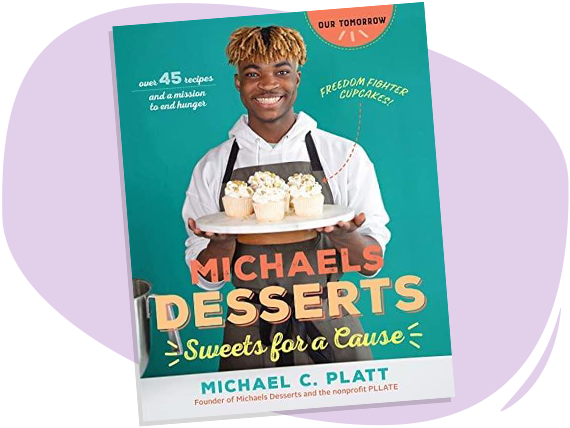
A podcast is a digital audio or video file that is usually streamed or downloaded from the Internet. Podcasts are typically shared in episodes and can cover a wide range of topics, such as news, storytelling, interviews, entertainment, and more.
The podcast series Activist You! is a kids and family podcast that focuses on social justice by interviewing kid activists and learning about various ways they are promoting equality. In the episode "Baking Up Activism with Michaels Desserts", host Lindz Amer, interviews 15-year-old Michael Platt, who is advocating for food equality through his cupcake business. He began by baking a few cupcakes for those in need and expanded his activism into much more.
Let’s explore an excerpt from this episode.
Explore the following audio excerpt from this episode to find out more.
Excerpt from Podcast Baking Up Activism with Michaels Desserts
Check your comprehension of the podcast by answering the following true or false questions then press Check Answer to see how you did.
Since beginning, Michael has now distributed thousands of healthy non-perishable snacks to kids in need and encourages donations to organizations that promote food equality. In addition, he has released a dessert cookbook and started a non-profit organization called “PLLATE”. His organization has a mission to create a “pay what you can” grocery store and provide food and gardening resources.
Pause and Reflect
Pause and reflect
How did Michael start and where is he now? Why do you think this is important? Where do you think he will take things next?
Press Possible Answer button to check your answer.
Michael began by simply baking a few cupcakes to distribute to those in need, all from his own home. Eventually he was able to release his own cookbook. Lastly, he started a non-profit organization to help people afford groceries and provide them with food and gardening resources. This is important, because it demonstrates that one small act of kindness can grow into something bigger, contributing to a more just and inclusive world. Next, Michael might be able to open his grocery store to help ensure everyone has access to food.
Before you move on, be sure to check that you have completed all components of the research organizer.
Text 3: Cartoon

Did You Know?
Did you know?
An inference is a logical conclusion drawn from contextual clues (in the text or image) and background knowledge that you already have. An inference is a conclusion or prediction based on evidence, about something that is not explicitly stated.
In 2021, a subgroup of the United Nations dedicated to gender equality, known as UN Women, held a competition in which participants used cartoons to share their vision of equality.
Explore the cartoons in the following flashcards and record your inferences in a method of your choice. Once finished, press the flip button learn more about the cartoon and its creator. Use the arrow keys to navigate between cards.
Pause and Reflect
Pause and reflect
How can cartoons be a powerful tool for promoting equality?
Press the Possible Answer button to check your answer.
Cartoons can be a powerful tool for promoting equality because of the ability for storytelling and opportunities for representing different ideas and people. Cartoons can bring awareness to social issues, challenge ideas, promote diversity and inclusion, and inspire others. Due to the artistic format, cartoons are often accessible to a diverse audience.
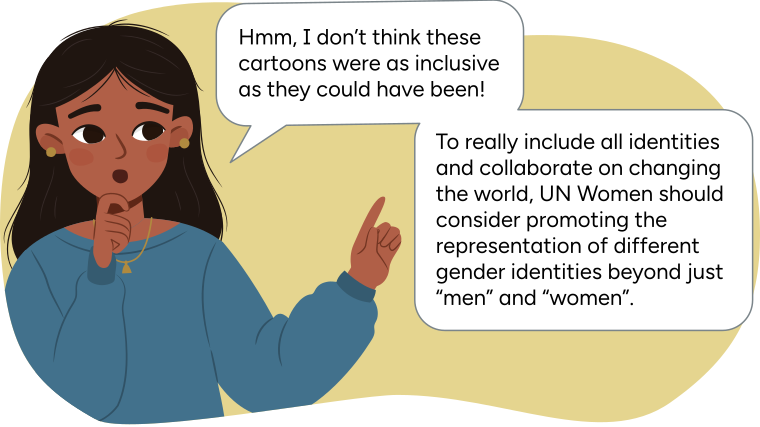
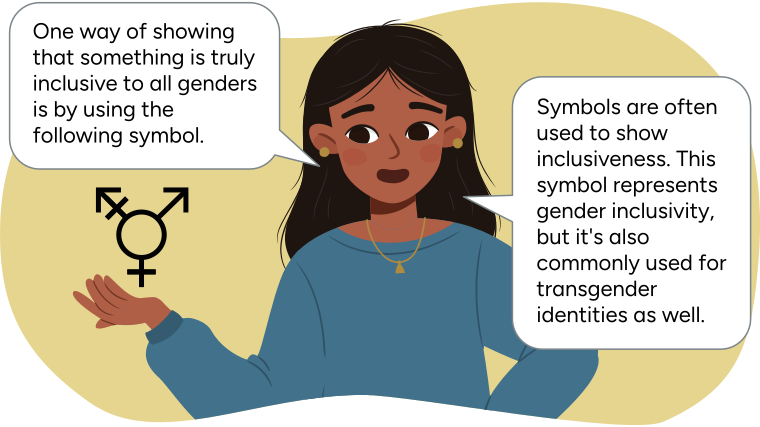
Image 1:
Mehar saying: Hmm, I don't think these cartoons were as inclusive as they could have been! To really include all identities and collaborate on changing the world, UN Women should consider promoting the representation of different gender identities beyond just "men" and "women".
Image 2:
Mehar saying: One way of showing that something is truly inclusive to all genders is by using the following symbol.Mehar is gesturing toward a symbol representing gender inclusivity. It is a circle with an arrow attached on its upper right, a cross attached on its bottom, and a combined arrow and cross on its upper left.
Mehar continues saying: Symbols are often used to show inclusiveness. This symbol represents gender inclusivity, but it's also commonly used for transgender identities as well.
Now that you have explored all three sources and recorded your research notes, take a moment to compare your findings with the ones provided.
Press the Answer button to access the example answers.
| Text 1 | Text 2 | Text 3 | |
|---|---|---|---|
| Person or group of focus | Rueben George | Michael Platt | UN Women |
|
Text form and attributes What features of this text form communicate meaning? |
Memoir
|
Podcast
|
Cartoons
|
|
Equality focus What issue are they addressing? |
Indigenous Peoples’ equal land rights | Food equality | Gender Equality |
|
Promoting change How are they advocating for and prompting change? |
Rueben George not only discusses the successes and pitfalls in his own personal history, but he also provides specific examples to the reader of how they can participate in the cause for change. | Baking cupcakes and distributing to those in need, writing a cookbook, and raise money to open “pay what you can” grocery store and distribute food and garden resources. | Creating cartoons that promote equality and sharing them to advocate and raise awareness |
|
Bibliography information Explore the source and record the:
|
“It Stops Here: Standing Up for Our Lands, Our Waters, and Our People” (book) Author: Rueben George Published in 2023 |
“Baking up activism with Michael’s Desserts” (Episode title) Activist YOU! (podcast title) URL: Activist You Baking Up Activism with Michaels Desserts | Episode | Smalltalk.fm Published in 2020 |
“Generation Equality: Picture It!” Competition URL: Winners of the comic and cartoon competition, “Generation Equality: Picture It!” | News and events: News | UN Women – Headquarters Published in 2021 |

Social Emotional Learning
Social emotional learning

You’ve just explored a variety of text forms. Take a break before continuing onto the next part!

Multi-syllabic words
Throughout this learning activity there have been several “multi-syllabic” words. A multi-syllabic word is a word that consists of more than one syllable. A syllable is a unit of sound that typically contains a vowel sound and is usually surrounded by consonant sounds. Sometimes a syllable will be a vowel sound on its own.
Explore the following words, how many syllables do they have? Record your ideas in a method of your choice.
- community
- activist
- cartoon
Press Answer button to check your answers.
- community = 4 syllables (com – mu -nit – y)
- activist = 3 syllables (act – iv- ist)
- cartoon = 2 syllables (car – toon)
Explore the following video entitled Multi-syllabic Word Strategies to learn more about how to sound out longer multi-syllabic words.
Using this strategy can help you to sound out longer, multi-syllabic words.
In this learning activity, you came across several multi-syllabic words. Listen to the audio recording of the words and try to spell them independently using the multi-syllabic word strategy that you just learned. You can record your ideas in your vocabulary notebook, personal dictionary, portfolio, or another method of your choice.
When you are finished, use the interactive matching activity to check the definition of each word and record it.
Equality vocabulary
Match the vocabulary term to the definition.

Verb tense
A verb tense is a grammar category that tells the time or state of an action. There are three main tenses:
- past – actions that happened previously
- present – actions happening now
- future – actions that will happen later
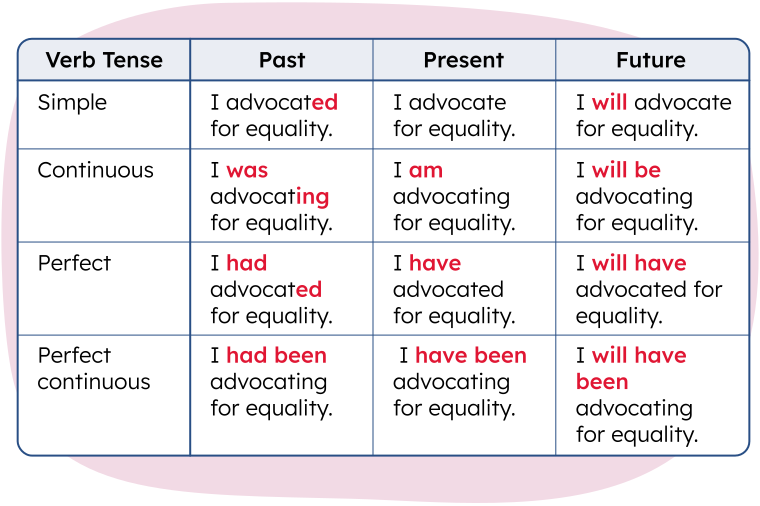
Explore the following visual of the 12 different verb tenses. You may consider recording the types of verb tenses in your notebook, or another method of your choice.
 Description

Try It
Try it
In a method of your choice, choose a subject (noun) and a predicate (verb) and write three sentences that demonstrate past, present, and future tense. Use the table to help you write your sentences.
Punctuation in dialogues
An important aspect of promoting equality, as well as an important grammar concept, is dialogue between people. In fictional writing, dialogue refers to “a conversation between two or more characters in a story, or by two actors in a play or film.”
There are a few rules to remember when adding dialogue to a story. Check out the following video to learn more.
Try It
Try it
Using the rules provided, fix any mistakes that are made in the dialogue below.
- Hiro exclaimed be careful! “That street is very busy”.
- “Did you want to go to the dance with me?, asked Jennifer”
- The room was dark, shared Mohammad “, and I was scared to go inside.”
- We needed a flashlight! “Exclaimed Lucas”
Press Answers button to learn more.
-
Hiro exclaimed, “Be careful! That street is very
busy.”
- All spoken words and punctuation need to be inside the quotation marks.
-
“Did you want to go to the dance with me?” asked
Jennifer.
- Closing quotation mark needs to be where the spoken words end, and a comma is not required when the dialogue ends with a question mark.
- “The room was dark,” shared Mohammad, “and I was scared to go inside.”
-
“We needed a flashlight!” exclaimed Lucas.
- All spoken words need to be in quotations and the comma falls after Mohammad, before the opening quotation mark.
Let’s Check!
In this learning activity you explored three different text forms as you learned about efforts to promote human rights. Each of these text forms has a unique purpose. Check your understanding of this in the following fill-in-the-blanks activity.
Choose the correct answer, then press Check Answer to see how you did.
Pause and Reflect
Pause and reflect
Choose two of the text forms explored and explain how their characteristics help to communicate their meaning and convey their message. Record your reflection in your notebook or in another method of your choice.
Verb tense review
Social Emotional Learning
Social emotional learning
You’re doing great! It’s time for a short break!
Begin by checking your understanding of verb tenses by completing the following sorting activity. Sort the sentences into past, present, or future tense.
Place the cards into categories that best match. Use the arrow buttons to navigate between cards.
Now, using the sentences, identify them as simple, continuous, perfect, or perfect continuous in the multiple-choice activity.
Select the correct answer, then press Check Answer to see how you did.
Putting it all together
Consider the different equality movements and trailblazers we learned about earlier, as well as the different forms of texts that were explored today. Imagine you are creating one of those materials about an issue of your choice that highlights equality, human rights, or social justice, and why it is important for all citizens to stand up for equality.
You may wish to create something about an issue that you explored today, such as land rights, accessibility, or food quality. However, you may also choose another topic that you are passionate about.
Press the following tabs to explore your choices.
Write a personal story about a connection you have with equality and what you have done, or want to do, to promote it.
Create an audio clip or interview someone about equality.
Create a cartoon that promotes equality.
Begin by identifying your topic, purpose, and audience for the text you plan to create.
- Topic: What specific topic will you be focusing on?
- Purpose: What is the goal you want to achieve with your creation?
- Audience: What audience do you hope to share your creation with?
Use the following checklist to guide your creation.
Equality creation checklist
Pause and Reflect
Pause and reflect
How does the form you chose for your creation suit the intended topic, purpose, and audience? What specific characteristics did you add to communicate your message effectively?
Reflection
As you read the following descriptions, select the one that best describes your current understanding of the learning in this activity. Press the corresponding button once you have made your choice.

I feel...
Now, expand on your ideas by recording your thoughts using a voice recorder, speech-to-text, or writing tool.
When you review your notes on this learning activity later, reflect on whether you would select a different description based on your further review of the material in this learning activity.