Learning goals
We are learning to…
- analyze and explain how transferable skills can be used to support communication, and apply them when reading, viewing, listening to, and creating texts of various forms
- identify and use oral and non-verbal communication strategies and analyze the ways in which these strategies support understanding or communication
- gather and synthesize information and content relevant to a topic, using a variety of textual sources and appropriate strategies
- evaluate the quality, bias, and accuracy of information verify the reliability of sources; and record the creator and source of all content created by others
Success criteria
I am able to…
- identify and explain the shared values of global citizens and why these are important
- follow the research process to collect information about a shared value of choice
- create a presentation, using oral and non-verbal communication strategies, to teach others about the shared value that was researched
- develop a global action plan that addresses a shared value of global citizenship

A path to problem-solving
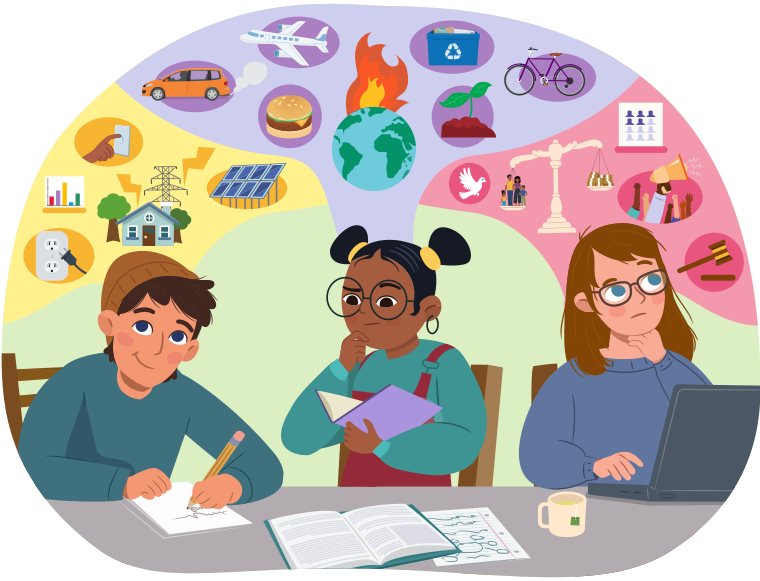
Oliver, Tiara, and Ava thinking critically. Oliver is thinking about a light switch, a graph, power lines, solar panels, and an electrical outlet. Tiara is thinking about a car, an airplane, a recycling bin, a bicycle, a hamburger, a seedling, and the Earth with a flame on top. Ava is thinking about a dove, scales with people on one side and coins on the other side, an infographic, protestors with a megaphone, and a gavel.
The process of critical thinking is directly linked to the action of problem solving. Once you have considered, analyzed, and interpreted an issue, you develop a more informed opinion. Once you have an informed opinion, you naturally have a better sense of how to approach resolving or improving the issue.

Try It
Try it
Choose one of the following issues. Orally, digitally, in a notebook, or in another method of your choice, create a brainstorm web to come up with possible solutions to the following questions.
- How could my classmates and I teach a younger grade about the UN Declaration of Human Rights?
- How can I address a situation where a classmate is not treated fairly?
- What creative ways can we promote water or electricity conservation at school or home?
- How can my class learn more about the history of peacekeeping in Canada?
- How does our community benefit from celebrated the diversity of its students?
- How might I connect with students my age who live around the world?
If possible, discuss and share your ideas with someone else.
Global citizenship

Throughout this unit, we have explored the theme of global citizenship, as well as the ways that many individuals and communities may not find this concept equitable or accessible.
We have used a critical lens to examine how inequality and privilege impact someone’s ability to act effectively as a “global citizen” and have even investigated how it can be difficult to both define and measure global citizenship in the real world.
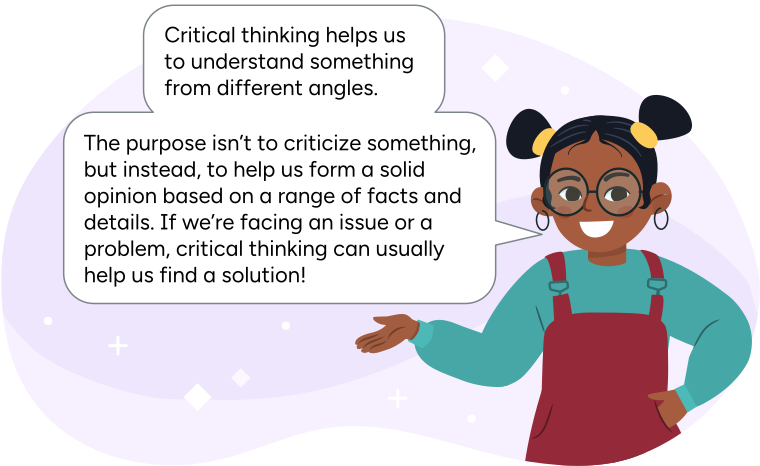
Tiara saying: Critical thinking helps us to understand something from different angles. The purpose isn't to criticize something, but instead, to help us form a solid opinion based on a range of facts and details. If we're facing an issue or a problem, critical thinking can usually help us find a solution!
The idea of global citizenship is intended as a positive, inclusive philosophy, and it can be useful to consider the original intentions of a concept or text in order to fully understand and appreciate it.
In theory, global citizenship encompasses the “shared values” of all humans on Earth.
In this learning activity, you will complete a research task based on one aspect of global citizenship.
Aspect 1: human rights
The concept of global citizenship is intended to represent advocacy for the protection and promotion of human rights for all individuals. The Universal Declaration of Human Rights is a document that was created in 1948 by the United Nations following the end of the Second World War, and it outlines more than 70 rights and freedoms that every human on Earth should be entitled to.
Explore the following video entitled Declaration of Human Rights to learn more.

Pause and Reflect
Pause and reflect
The video stated that the Universal Declaration of Human Rights is a “call to action that transcends borders, cultures, and beliefs”. What does this mean?
Press the Answer button to learn more.
Aspect 2: social justice
One of the goals of global citizenship as a theory is to address social injustices on a global scale. Social justice means making sure that everyone is treated fairly and has the same access to resources and opportunities. In theory, adopting this value would ensure that everyone is treated with respect in society.
Aspect 3: environmental sustainability
In addition to human rights and social justice, global citizenship is also intended to be rooted in environmental sustainability. In theory, the global citizen recognizes that everything on Earth is connected, and that it is crucial to protect the environment now and for the future. The idea is that this value would encourage all people around the world to make an effort to protect nature and use resources sustainably.
Explore the following image. What ideas for environmental sustainability do you notice in the image?
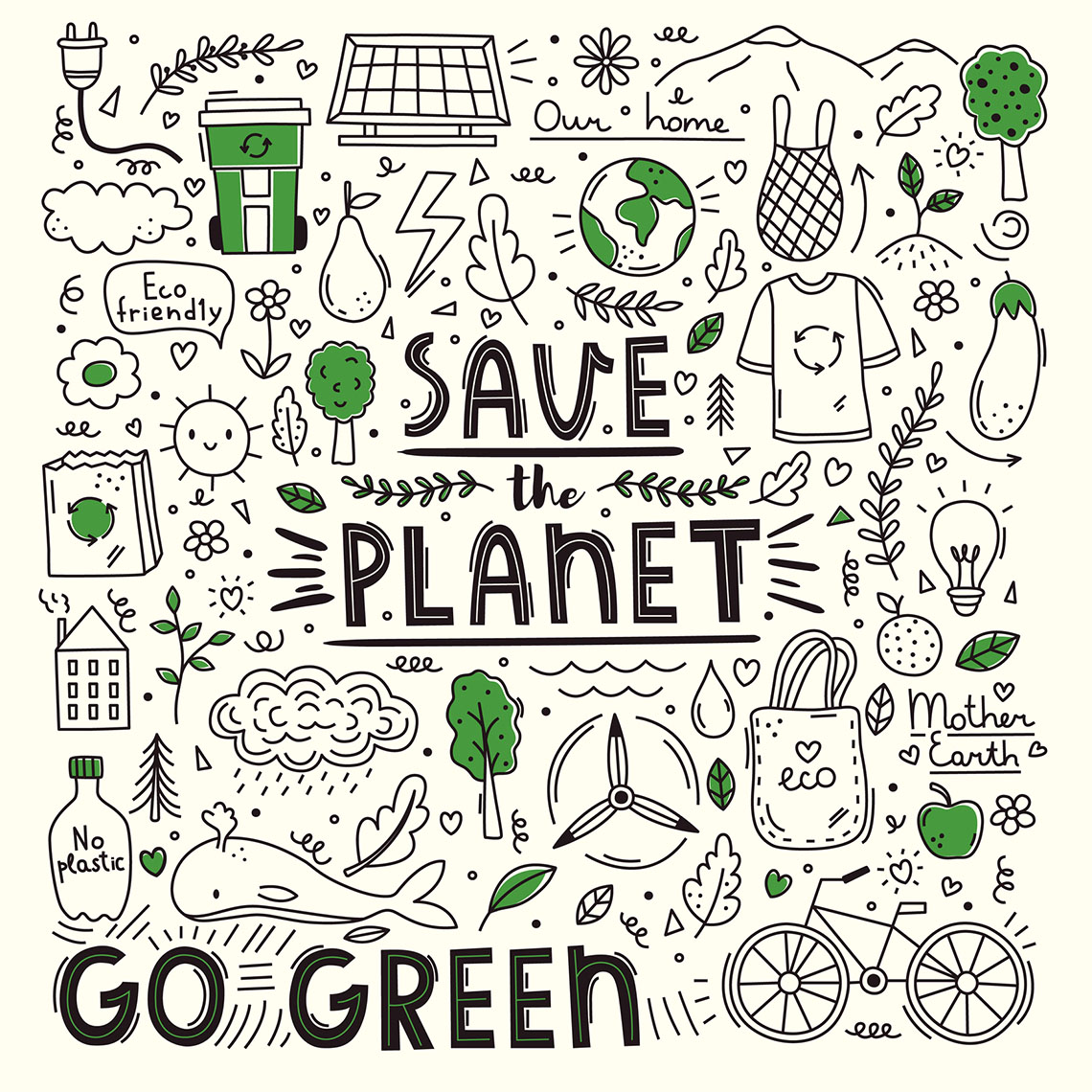
A poster with the words "Save the Planet" and "Go Green" in large text, and "Our home," "Eco friendly," "Mother Earth," and "No plastic" in smaller text. It has a collage of illustrations that includes an electrical cord, a recycling bin, solar panels, plants and trees, mountains, fruits and vegetables, a lightning bolt, planet Earth, reusable bags, the sun, a t-shirt, a lightbulb, a building, a rain cloud, a wind turbine, a reuseable bottle, a whale, and a bicycle.
Press the Answer button to learn more.
- renewable energy icons (solar panels, wind turbines)
- reusable and recyclable grocery bags
- recycling symbols and bins
- recyclable fashion
- reduce the use of plastics
- consider alternative transportation methods
- eat more vegetables and fruits
- tree and plant growth
Aspect 4: peace and conflict resolution
Another one of the ideals of global citizenship is fostering a commitment to living together peacefully, resolving conflicts, and understanding all diverse communities. In theory, it aims to create a more peaceful world by addressing the root causes of conflict, and promoting tolerance, empathy, and cooperation.
Pause and Reflect
Pause and reflect
What does empathy mean? Give an example of a time you’ve shown, or someone has shown you, empathy.
Press the Answer button to learn more.
Empathy means understanding and sharing feelings, thoughts, and experiences of others. It’s when you can “put yourself in someone else’s shoes” and imagine how they may be feeling or what they may be going through. It helps us to connect with each other and show kindness and support to each other.
Aspect 5: cultural diversity and inclusivity
The concept of global citizenship is also based on celebration of cultural diversity; the global citizen includes, respects, and appreciates all cultural traditions, beliefs, and perspectives. It is important to learn about and celebrate other people’s traditions, beliefs, and ways of seeing the world in order to build an informed worldview.

Brainstorm
Brainstorm
In your own words, explain the terms “diversity” and “inclusion”. Why are they important?
Aspect 6: global solidarity and cooperation
In theory, global citizenship emphasizes the idea that all people and countries must work together to solve global challenges, such as poverty, inequality, disease, and humanitarian crises. This encourages collaboration among individuals, countries, and even nations to achieve common goals and promote global well-being, making the world a better place for everyone.
Let’s check!
Check your understanding of these values of global citizenship in the following fill-in-the-blanks activity.
For each sentence, select the missing words from the drop-down menu. Press Check Answer to see how you did.
For each sentence, select the missing words from the drop-down menu. Press Check Answer to see how you did.
Spotlight: Enaya Amir
Enaya Amir began her journey of activism when she was only 10 years old. She was curious about the world, and began to wonder what she could do to help.
Explore the following video, Environmental Sustainability, to learn more about Enaya’s journey, particularly about how her school is advocating for environmental sustainability.
Pause and Reflect
Pause and reflect
What were some of the ways that Enaya’s school was promoting environmental sustainability?
Press the Answer button to learn more.
- many students and staff can walk or bike to school
- banned single use plastic water bottles
- building materials are sustainable
- learn about environmental sustainability in the classroom (walk for water, plant trees, plant gardens, consume less, clean up after ourselves)
Spotlight: Kelvin Doe
Next, let’s meet Kelvin Doe. Kelvin Doe was born in Sierra Leone in 1996. Around the age of 10, Kelvin began to collect electronic parts that had been thrown away and would spend his time taking apart and re-purposing these parts. He began by building his own battery, and the required technology to DJ and host a radio station. The more he built, the more he wanted to help his community.
Explore the following video entitled Kelvin Doe Wows MIT to learn more about Kelvin Doe.
Pause and Reflect
Pause and reflect
-
What inspired Kevlin to create devices? What
value do you think he is promoting?
Press the Answer button to learn more.
Kelvin Doe was inspired by his home country, Sierra Leone. One thing that inspired him was the lack of electricity. He invented a battery to provide lights in houses. Additionally, he wanted to give voice to the youth of Sierra Leone through a radio station. Kevlin was promoting social justice by addressing social inequalities and advocating to fair access to resources and opportunities.
- Can you think of any other people or organizations that are promoting the values of global citizenship? Record them in a method of your choice.

Social Emotional Learning
Social emotional learning

Take a break before continuing on to learn about research skills!
Developing research skills
Teacher Wilfred and Gabby talking.
Teacher Wilfred says: In this part of the learning activity, you are going to be researching about one of the shared values of global citizenship.
Gabby responds: I have some experience researching, but I'm not an expert.
Teacher Wilfred replies: That's okay! You'll begin by choosing the topic you want to research, and then you'll work through the research steps below as you go.
Begin by choosing one from the following list of shared values that you’d like to research further. As a reminder, those values are:
- human rights
- social justice
- environmental sustainability
- peace and conflict resolution
- cultural diversity and inclusion
- global solidarity and cooperation
Researching follows a certain process. By following this process, you will be able to collect valuable and reliable information that you can use. While linear, you may need to circle back to certain parts of the process as you go.
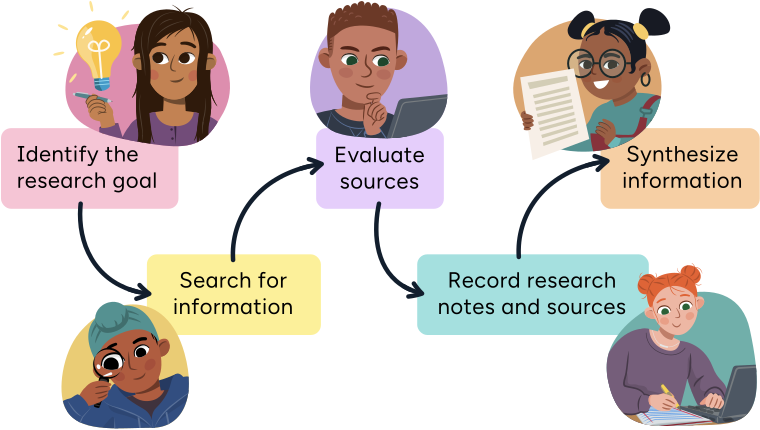
Neebin, William, Tiara, Savinder, and Hannah completing the steps of the research process. The first step is "Identify the research goal," represented by Neebin thinking of ideas. The second step is "Search for information," represented by Savinder using a magnifying glass. The third step is "Evaluate sources," represented by William doing research. The fourth step is "Record research notes and sources," represented by Hannah taking notes. The fifth and final step is "Synthesize information," represented by Tiara holding their completed research paper.
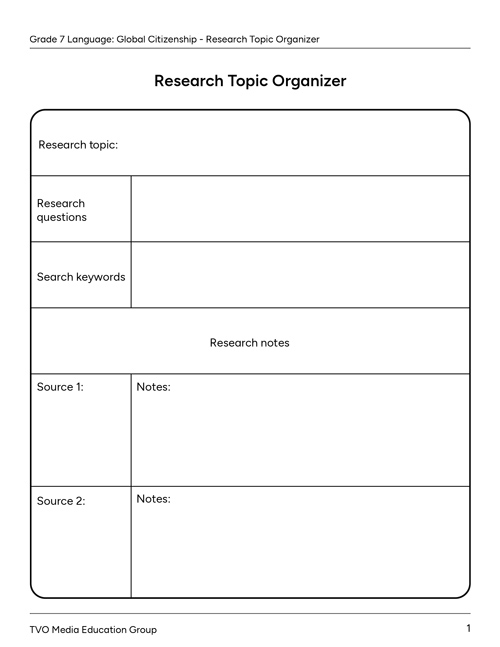
Now you are going to explore each step in detail. As you work through each step, follow the research process and use the graphic organizer provided, or another method of your choice, to record information.
Complete the fillable and printable Research Topic Organizer in your notebook or using the following document. If you would like, you can use speech-to-text or audio recording tools to record your thoughts.
Step 1: clarify your research goal
The first step is to clarify your research goal. Begin by clearly defining what your research topic is going to be. Then, develop questions you want answers to. Think critically about what you want to learn and why it is important.
One way to generate questions is to consider the inquiry model. The inquiry model often uses a questioning grid to help formulate questions before conducting research.
Explore the following graphic of the inquiry questioning grid and look at the example of how it can help you develop research questions. Try to brainstorm at least one question from each section of the inquiry questioning grid.
Press the Inquiry Questions button to review strategies for asking great questions.
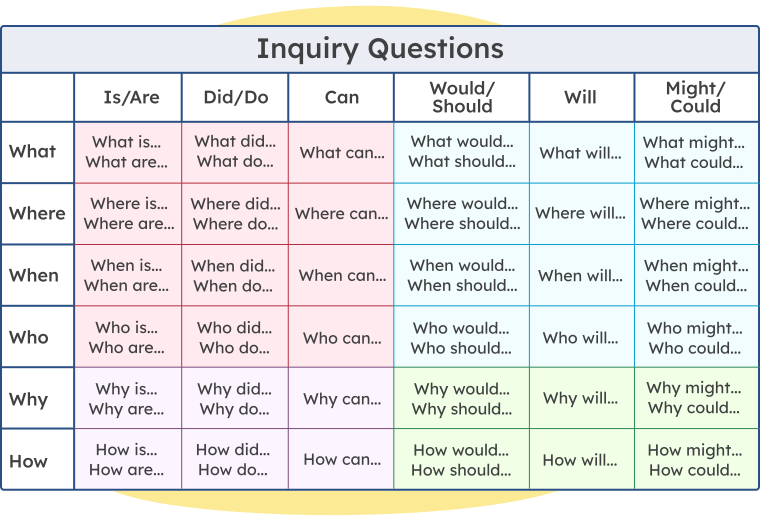
A table of inquiry question starters.
Factual inquiry questions start with: what is, what are, what did, what do, what can, where is, where are, where did, where do, where can, when is, when are, when did, when do, when can, who is, who are, who did, who do, or who can.
Predictive inquiry questions start with: What would, what should, what will, what might, what could, where would, where should, where will, where might, where could, when would, when should, when will, when might, when could, who would, who should, who will, who might, or who could.
Analytical inquiry questions start with: Why is, why are, why did, why do, why can, how is, how are, how did, how do, or how can.
Application/synthesis inquiry questions start with: Why would, why should, why will, why might, why could, how would, how should, how will, how might, or how could.
Develop at least 5 research questions and record them in your fillable organizer, or another method of your choice. If you’d like, begin by exploring the following example.
Press the Example button to learn more.
Research Topic: Environmental Sustainability
Possible research questions:
- Why do we need to focus on environmental sustainability?
- How will promoting environmental sustainability impact the world positively?
- How can renewable resources help?
- What should everyday citizens do to help? What items are sustainable?
- Why should we care about environmental sustainability?
Step 2: searching for information
Now that you have a clear research goal and questions, brainstorm keywords that you might want to use when you are searching for information. Record these ideas on your fillable organizer, or in another method of your choice.
Press the Possible Keywords button to learn more.
Possible keywords based on the previously identified topic of environmental sustainability are:
- environment
- sustainable
- renewable
- non-renewable
- resources
- climate change
- sustainable citizens
Before you begin searching for information, take a look at the tabs below that highlight research tips you can use for more effective researching.
Boolean operator words: AND, OR, NOT can be used in all capitals to enhance search.
AND = two concepts together, OR = you want at least one concept included, NOT = filters out concepts you don’t need.

Put at the end of a word to find forms of the same word.
Example: environment* = environment, environments, environmental, environmentalist.
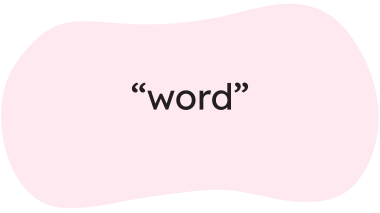
Groups words together in your search.
Example: “heart rate” will show you results with these words together, and not results that only mentions “heart” or only mention “rate” on their own.
Using these tips and tricks, try searching for information about your topics. Open up a few sources that you can evaluate in the next step.
Explore the following example of what could have been searched on the topic of environmental sustainability to answer the research questions created.
Press the Example button to learn more.
- sustainable solutions
- positive impacts of environment *sustain*
- renewable resources AND sustainability
Step 3: evaluate sources
An important step in researching is to evaluate the sources you plan to use. It is important that you can trust the information you are collecting is reliable and accurate, and you should consider any possible bias.
Credible sources are usually published by reputable publishers, academic institutions, or experts in the field.
Use the following checklist to evaluate the sources you’ve found.
Evaluating sources
Step 4: record information
Now that you’ve found several sources that you feel are of good quality, reliable, accurate, and you’ve considered the bias, it’s time to record information.
It is important when recording information that you use “point form” notes and convert ideas into your own words. This will avoid plagiarism.
Plagiarism is when someone uses another person’s words, ideas, or work without giving them proper credit. Plagiarism can occur in many forms, such as copying text directly, paraphrasing without sourcing the information, or using someone else's ideas without acknowledgement.
As you take notes, you should summarize key points, record relevant quotes, and cite sources properly. On your fillable organizer, or another method of your choice, record the website or book, creator/author, link to the source, and date on the left side and the notes that you’ve taken from that would on the right.
Press the Example button to learn more.
| Research Notes | |
|---|---|
|
Source 1: “Green Coast” Author: Renee Picard Source: Why Should We Care for the Environment? - Green Coast Date: April, 2023 |
Notes: (related to “Why care?” question)
We need to take care of the land for future generation |
Continue to research, trying to answer all your research questions. Once you’ve recorded all your research notes and source information, move forward to step 5, synthesize the information.
Step 5: synthesize information and compare
Once you’ve collected all your information from multiple sources, you should analyze, compare, and contrast different perspectives about your topic.
Use the following checklist to help you synthesize your research notes.
Synthesizing research notes
Social Emotional Learning
Social emotional learning

You’ve just explored the steps of the research process. Take a break before continuing onto exploring vocabulary words!

Vocabulary
Throughout this learning activity, you have come across new vocabulary words! Using some of the following suggested vocabulary words, create a complex word map.
Begin by putting the phrase “global citizenship values” in the middle of your word map and then branch out from there. Consider how the values of global citizenship are connected.
To begin, explore the following vocabulary words:
- global citizenship: understanding and embracing the interconnectedness of the world and recognizing your role as a member of the global community
- empathy: the ability to understand and share the feelings of another
- sustainability: the ability to maintain a certain level or rate; avoid the depletion of natural resources
- injustice: lack of fairness or justice
- interconnectedness: that state of being connected with each other
- inequalities: difference in size, degree, circumstance, and so on
Once you are finished your word map, compare it with the following example. As you move into the next step of creating a presentation, try to use as many vocabulary words as possible.
Press the Word Mind Map button to learn more.
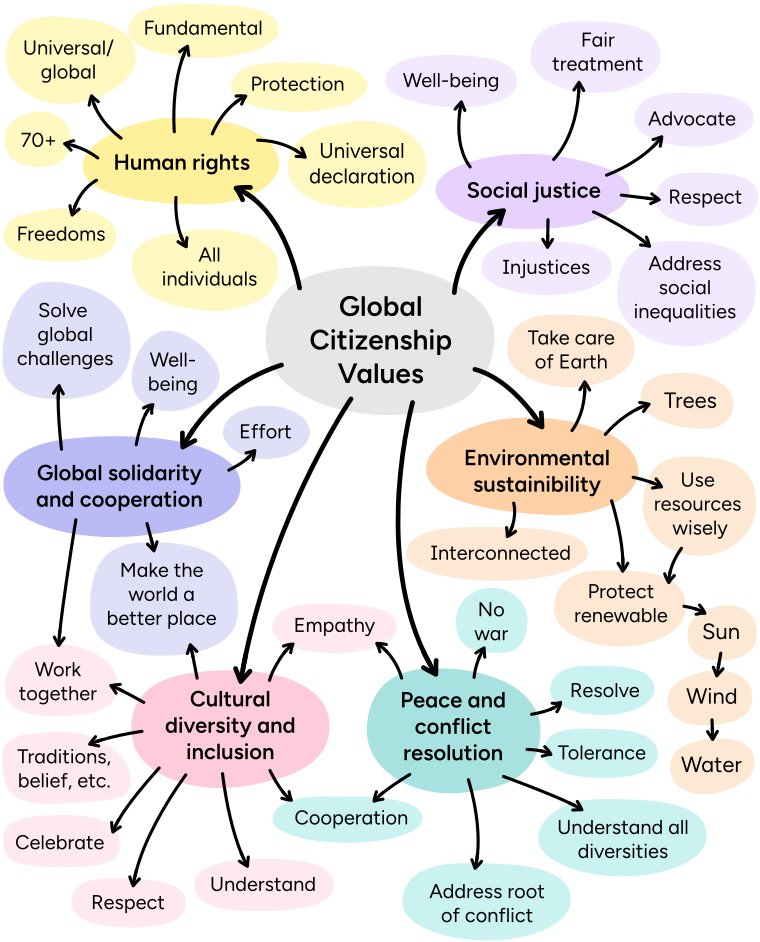
A mind map for "Global Citizenship Values," which branches out to the following 6 values: Human rights, Social justice, Global solidarity and cooperation, Environmental sustainability, Cultural diversity and inclusion, and Peace and conflict resolution.
"Human rights" branches out to the following 7 concepts: All individuals, Freedoms, 70 plus, Universal/global, Fundamental, Protection, and Universal Declaration.
"Social justice" branches out to the following 6 concepts: Well-being, Fair treatment, Advocate, Respect, Address social inequalities, and Injustices.
"Global solidarity and cooperation" branches out to the following 5 concepts: Effort, Make the world a better place, Work together, Solve global challenges, and Well-being.
"Environmental sustainability" branches out to the following 8 concepts: Take care of Earth, Trees, Use resources wisely, Protect renewable, Sun, Wind, Water, and Interconnected.
"Cultural diversity and inclusion" branches out to the following 8 concepts: Empathy, Cooperation, Understand, Respect, Celebrate, Traditions, beliefs, etcetera, Work together, and Make the world a better place.
"Peace and conflict resolution" branches out to the following 7 concepts: No war, Resolve, Tolerance, Understand all diversities, Address root of conflict, Cooperation, and Empathy.
Oral and non-verbal communication
You have been asked to give a short, 3-5-minute presentation about how “global citizenship” as an idea emphasizes shared global values by promoting common ideals that spread across the world. Your presentation should follow this format:
- Introduce the term global citizenship and highlight the shared global value that you conducted research on.
- Highlight why this shared value is important to different communities.
- Explain how citizens around the world are working towards achieving this value.
- Make a personal connection to the shared value.
When speaking in front of an audience you should consider both your oral and your non-verbal communication skills.
- Oral communication refers to the expression of thoughts, ideas, and feelings through spoken or written language.
- Non-verbal communication refers to other methods, such as body language including facial expressions, gestures, and other body movements.
Once your presentation is ready, practise it several times using the speaking strategies that you just explored and the reading fluency routine.

Fluency

Fluency is the ability to identify words correctly and read a text at an appropriate rate with ease, pace, automaticity, and expression. With proper phrasing and a focus on punctuation the reader will gain more meaning from the text.
Use the following checklist to self-assess your own fluency. If possible, share your poem with someone else and ask them to provide feedback on your fluency.
Fluency checklist
Pause and Reflect
Pause and reflect
Based on the checklist, choose one area of fluency to focus on and set a goal for yourself. What strategies could you use to help you achieve this goal?
Let’s check!
In this learning activity you conducted research following the research process. Check your understanding of the process by completing the following flowchart. Order the steps of the research process from start to finish.
Putting it all together
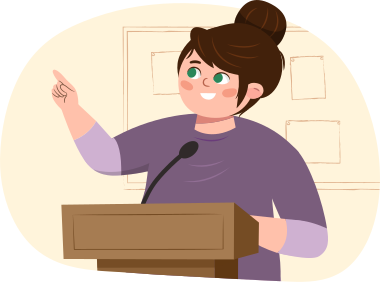
Reflect on the speaking that you did about global citizenship and the “shared value” you researched. When presenting, you used various oral and non-verbal communication skills.
Of the following skills, choose one oral and one non-verbal communication strategy that you used and explain how these strategies can:
- help an audience to better understand your presentation
- help you communicate
Press the Example button to learn more.
| Oral | Non-verbal |
|---|---|
|
|
I used facial expressions during my presentation which might help an audience to understand the emotional tone and attitude I had, and it enhanced some of the words that I was saying orally.
Reflection
As you read the following descriptions, select the one that best describes your current understanding of the learning in this activity. Press the corresponding button once you have made your choice.

I feel...
Now, expand on your ideas by recording your thoughts using a voice recorder, speech-to-text, or writing tool.
When you review your notes on this learning activity later, reflect on whether you would select a different description based on your further review of the material in this learning activity.