Learning goals
We are learning to…
- generate and develop ideas and details about challenging topics, related to diversity, equity, and inclusion and to other subject areas, using a variety of strategies, and drawing on various resources, including their own lived experiences
- analyze how global citizenship and critical thinking can be used to support comprehension and communication, and apply it when exploring new texts and concepts
- compare the critical thinking skills they used when analyzing and evaluating different definitions of global citizenship
Success criteria
I am able to…
- use various strategies to comprehend content and accurately respond to comprehension questions
- use my understanding of the different applications of commas to build clear, coherent sentences
- explain if and how the concept of privilege has informed my understanding of global citizenship
Thinking about global citizenship
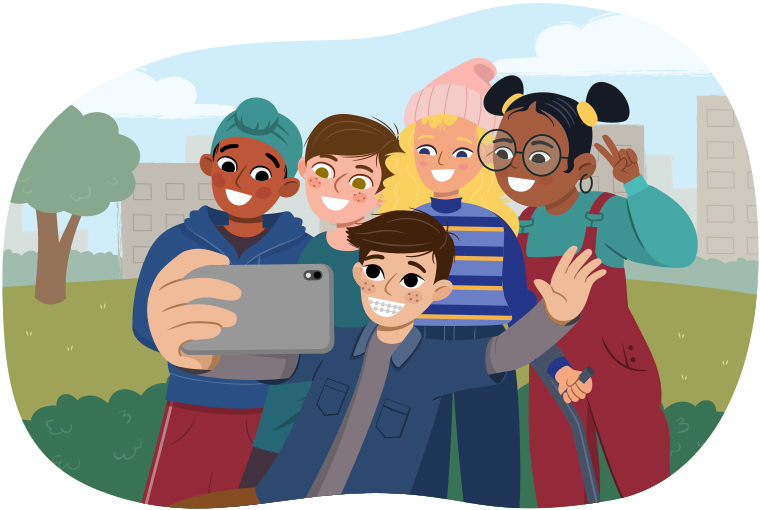
You have probably been introduced to the term “global citizenship” or “global citizen”. The meaning of the individual words “global”, “citizenship”, and “citizen” may be clear as separate words, but when they are placed together, they take on new significance.
In Ontario schools, the meaning of global citizenship is about being able to understand diverse world views in order to address issues that we face in today’s interconnected world. We focus on how to make a positive difference in the world by promoting equity and human rights, and how to make responsible decisions as an active citizen.
So, what does it mean to be actively practicing “global citizenship”? If you’re not completely sure what it means, no problem; the concept of global citizenship can be difficult to define!
Check out the following explanations of global citizenship from organizations Oxfam Great Britain, the United Nations, and UNICEF Canada.
Global citizenship is the idea that all humans living on Earth are connected to each other by their humanity and are all part of one global community. The idea is that members of the global community hold equal responsibility with the rest of society for taking care of the natural environment and contributing positively towards the benefit of everyone. Global citizenship also means having an awareness of global issues, as well as a willingness and ability to take action.

Student Success
Try it!
Once you have reviewed the quotation flashcards again, respond to the following questions in a method of your choice:
1) How might you describe the term “global citizenship” or “global citizen” if you had to explain it to a friend?
Press the Possible Answer button to learn more.
Global citizenship is all about having awareness of different world issues and a willingness to help improve those situations, no matter where in the world you live. Global citizenship has to do with feeling a sense of “belonging” to the world, rather than to just a specific region, nation, or city. In the same way that we as national citizens have a responsibility to protect and defend our country, global citizens feel a similar duty to protect and defend the Earth.
2) What are some similar keywords that are used by Oxfam, the United Nations, and UNICEF Canada in their descriptions of global citizenship?
Press the Possible Answer button to learn more.
Some keywords related to global citizenship that appeared in the descriptions were:
- community
- responsible
- individual
- globally-minded
- active
- sustainability
- educate
3) Do you think everyone experiences global citizenship in the same way? Why or why not?
Press the Possible Answer button to learn more.
I agree that people are born with some responsibility for the land that they live their lives on. However, there is so much inequality and unearned privilege in the world, I can’t imagine that all humans share the same experience of being on Earth today.
For example, if a person or group lives in an area where public education isn’t accessible to them, they may not have the context to understand major world issues such as political strife or extreme changes in weather. Without understanding or even knowing about issues in the world, it’s much less likely for people to be inspired to take action in real life.
Universal or vague?
No matter how it is defined, the idea of global citizenship is meant to be universal – in other words, all humans currently living on Earth are part of one global community, connected through their humanity and shared values, and all people should be capable of acting as global citizens.
In the Minds On section, the United Nations’ quotation describes global citizenship as an “umbrella term” for different social, political, environmental, and economic actions of globally-minded individuals and communities on a worldwide scale. While this quotation may seem short and unclear, the ambiguity of this definition is most likely on purpose.
The idea is presented as an umbrella term and applied to different social, economic, environmental, and political contexts. For example, a global citizen could be concerned with taking action on:
- Social issues such as the impact of digital media on youth mental health or child welfare.
- Economic issues such as the global impact of inflation or the rising cost of housing.
- Environmental issues such as urban farming solutions or food waste reduction.
- Political issues such as voting rights and government corruption.
In these examples it is clear that global citizenship can apply to all kinds of contexts – from mental health to urban farms to national elections. When you are defining a topic or idea that has broad relevance, it is important to provide a broad definition. By including “social, economic, environmental, and political actions” in their definition of global citizenship, the UN presents this concept as expansive and universal.
Description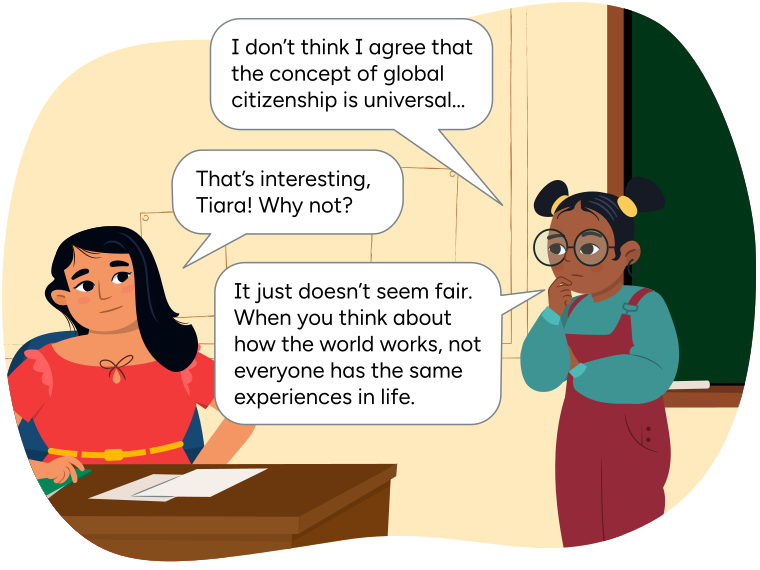
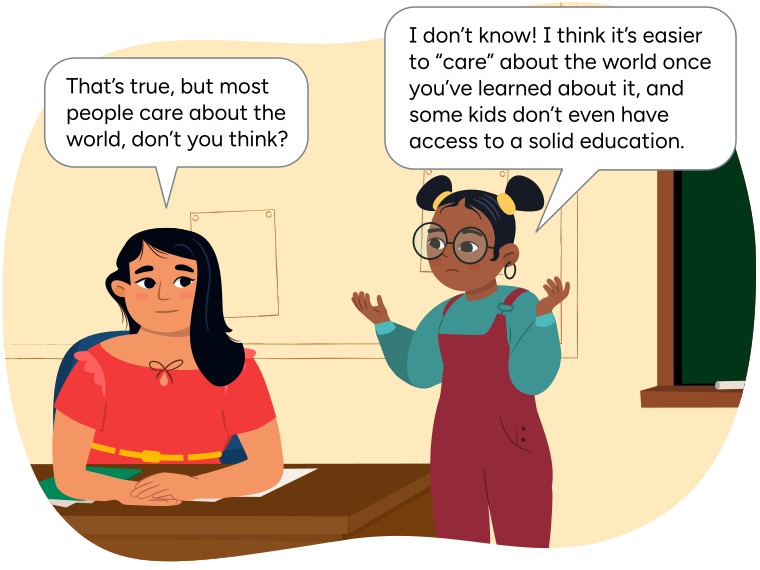
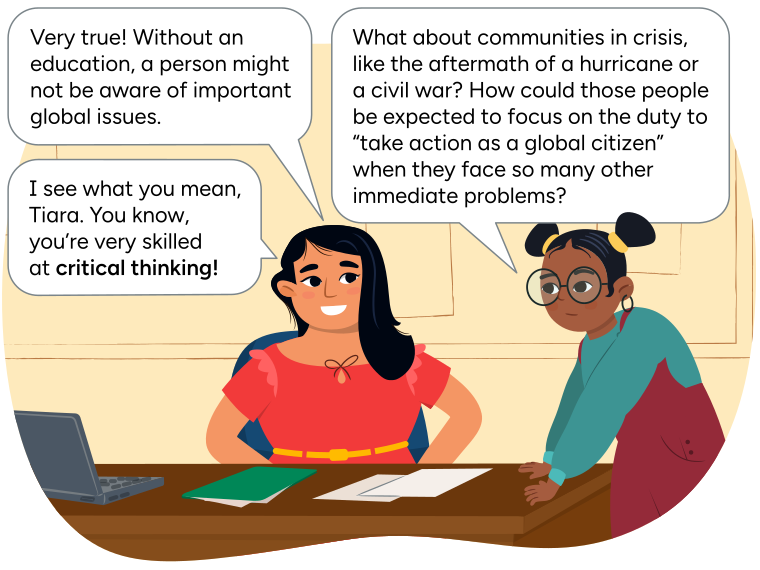
Image 1: Teacher Chiara and Tiara talking.
Tiara says: I don't think I agree that the concept of global citizenship is universal…
Teacher Chiara replies: That's interesting, Tiara! Why not?
Tiara responds: It just doesn't seem fair. When you think about how the world works, not everyone has the same experiences in life.
Image 2: Teacher Chiara asks: That's true, but most people care about the world, don't you think?
Tiara responds: I don't know! I think it's easier to "care" about the world once you've learned about it, and some kids don't even have access to a solid education.
Image 3: Teacher Chiara says: Very true! Without an education, a person might not be aware of important global issues.
Tiara asks: What about communities in crisis, like the aftermath of a hurricane or a civil war? How could those people be expected to focus on the duty to "take action as a global citizen" when they face so many other immediate problems?
Teacher Chiara responds: I see what you mean, Tiara. You know, you're very skilled at critical thinking!
Critical thinking
As you might have noticed in the previous dialogue between student character Tiara and her teacher Chiara, global citizenship can be examined through a critical lens.
Critical thinking is about processing, questioning, and interpreting reliable information in order to come up with an informed opinion.
When we use critical thinking skills in the discussion of global citizenship, we might notice that having access to privileges like education, health, financial security, and mobility (to name a few) will put certain individuals in a much better position to:
- understand the political, economic and social forces in the world
- engage in global and local initiatives to create change
- develop cross-cultural understanding and make responsible decisions
So, in order to expand our worldview and consider other perspectives, we engage in the critical thinking process.
Critical thinking process
To express an informed opinion on a text, a work of art, or even a concept like global citizenship, it is important to follow the steps of the critical thinking process. You may have already encountered this concept in other classes like Visual Arts, Drama or Dance!
In the critical thinking process, other perspectives on a topic or a text are studied in order to help add meaning and depth to your own interpretation.
Check out the following interactive image to learn about the five overall steps of the critical thinking process and what each stage involves.
You may have also noticed the Consideration of Cultural Context section in the critical thinking process diagram. This step should be revisited several times throughout the process. Considering cultural context is important because it helps us to recognize our own biases and engage with worldviews that may differ from our own. It allows us to think more deeply about the topic we are exploring.
Engaging in the critical thinking process is an important part of your Intermediate Language Arts journey. Critical thinking skills not only help you to understand and respond to new concepts, but they also support your ability to make meaning from written texts, media, art, and more.
Check your understanding!
For each stage of the critical thinking process select the corresponding description.

Did You Know?
Did you know?
You have already been engaging with parts of the critical thinking process in this learning activity!
- Initial Reaction: In the Minds On section, you expressed your initial impression of the concept of global citizenship.
- Describe: After exploring a few different examples of definitions, you attempted to describe the concept of global citizenship.
- Analysis and Interpretation: You had this step partly modelled for you when student character Tiara critiqued the definition of global citizenship for not representing inequality in the world.
- Expression of an Informed Opinion: We will arrive at this stage soon!
Inequality and global citizenship
Defining “global citizenship” in general terms makes the idea more widely applicable to different countries and communities (consider the fact that the United Nations has 193 members). By including the word “actions” in their definition, the UN suggests people have a responsibility to act on global issues.
Aspects of global citizenship are universal, and this idea is usually presented as positive, optimistic, and inclusive. What Tiara identified in the previous section was something that Oxfam, UNICEF Canada, and the UN didn’t include in their description of global citizenship: inequality. This observation was an example of Tiara engaging with the “Analyze and Interpret” stage of the critical thinking process!
Inequality, meaning the state of not being equal, has a massive impact on how people experience life on Earth. It can be hard to have one clear definition of what it means to be a global citizen because not all individuals share the same life experiences, access to resources and wealth, or privileges.
Did You Know?
Did you know?
A person or a group’s level of advantage in society can be measured by their privilege.
Privilege is an unearned benefit or advantage that one receives in society based on factors beyond their control, such as ethnicity, physical appearance or ability, socioeconomic background, gender identity, faith, or sexual orientation.
Something important to remember about privilege in society is that, very often, it is not earned (no one “deserves” the level of privilege they are born with), which can cause tension between those who have special advantages and those who don’t.
Privilege even plays a role in global citizenship: those with access to an education and the resources to travel will have more opportunities to learn more about and experience the rest of the world. This allows them to contribute more as a global citizen.
Issues in the “global village”
The experience of global citizenship is often referred to as being part of a “global village”. The idea that the Earth’s current population is its own unique “community” of individuals who share values and can work together for the common good combines the bigger world with living in a small village community.
Explore the following video entitled The Global Village to examine how such a global community might look if it represented the world’s population.
Even in the “global village” that connects all people on Earth, you may have noticed in the previous video that not all individuals share the same experience.
In a method of your choice, write down three examples of inequality that you observed in the video.
Press the Hint button to learn more.
- unequal access to shelter means part of the community lives in low quality housing
- 30% of the community would not have access to drinking water or electricity
- limited access to education some places means many people cannot read or write

Social Emotional Learning
Social emotional

You’ve just explored issues of inequality and global citizenship. Take a break before continuing onto the next part!

Commas and transition words
So far in this learning activity, you have been using the critical thinking process to unpack the concept of global citizenship. When describing and defining its meaning, you have seen that there are many points to consider including inequality, access to education and resources, and more.
In reading and speaking, pauses can be used to help you to process and emphasize important information. This can be done in writing, too! Commas add slight pauses to our sentences to make the overall message clearer.
Press the following tabs to learn more about different ways to use commas in writing.
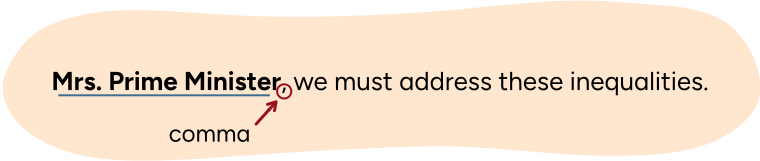
The Prime Minister of a country is being addressed in this sentence. Always use a comma to set off nouns of address (such as first names or official titles).
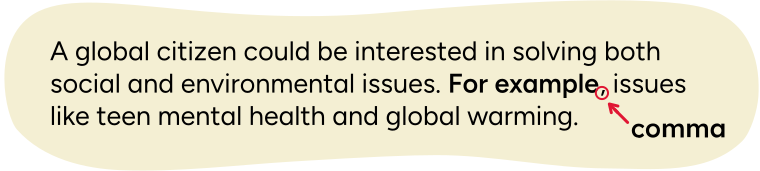
The words "for example" in this sentence are transition words or phrases. Commas are used after transition words that connect words in a sentence and provide more information. In this case, examples of social and environmental issues are being provided.
Some other transition words or phrases that give further details about something in a sentence are:
- specifically,
- for instance,
- including,
- in fact,
- however,
- therefore,
Let’s build sentences using commas!
In a notebook or another method of your choice, create more complex sentences by following the instructions. Include commas where necessary.
1. Make one sentence from the two below.
The United Nations is an international organization. The United Nations has 193 members.
Press the Answer button to check your answer.
The United Nations, an international organization, has 193 members.
2. Create a sentence using the transition phrase "for instance" that would follow the sentence below:
Our classmates practise kindness.
Press the Answer button to check your answer.
Our classmates practise kindness. For instance, yesterday we helped the kindergarten class get ready for recess.
3. Create a sentence addressing a fictional person.
Press the Answer button to check your answer.
Officer, I have the right to defend my rights.
Putting it all together

Throughout this unit, we will be using the critical thinking process to explore different ideas and texts. We will continue to examine the concept of global citizenship from different points of view, and also keep track of the ways that our own opinions on the topic might change.
In a written reflection of 3-5 sentences, respond to the following prompts. Make sure to include transition words and commas in your response.
- Describe your first reaction to the term “global citizenship.” Was it clear? Hard to define? Why or why not?
- Did the discussion of privilege affect your interpretation of “global citizenship”? How?
Use the following checklist to complete your reflection.
Global citizenship reflection
Reflection
As you read the following descriptions, select the one that best describes your current understanding of the learning in this activity. Press the corresponding button once you have made your choice.

I feel...
Now, expand on your ideas by recording your thoughts using a voice recorder, speech-to-text, or writing tool.
When you review your notes on this learning activity later, reflect on whether you would select a different description based on your further review of the material in this learning activity.