Learning goals
We are learning to…
- analyze complex texts, including informational texts, by evaluating the information they provide and formulating conclusion about missing perspectives
- assess how applying critical thinking skills can further engage us with our learning about the concept of global citizenship
- analyze how diversity, inclusion, and accessibility are addressed in texts, respond to the insights and messages conveyed, and identify different positions presented
Success criteria
I am able to…
- identify a purpose for reading a government report
- use strategies, (such as rereading, asking questions, visualizing, making connections, taking notes, and consulting references and other resources) to help comprehend a government report, and set goals for future improvement
- analyze how diversity, inclusion, and accessibility are addressed in the report and respond to the messages conveyed

Exploring interconnectedness
When we encounter definitions of global citizenship, a term that is often used is the adjective “interconnected” or the noun “interconnectedness.” These terms describe the state of being connected with each other.
Let’s break this term down into its morphemes to get a better understanding.
Explore the following interactive entitled Interconnectedness to learn more about breaking down words into morphemes.
After you have explored the “interconnectedness” word breakdown, record your own explanation of the term in a method of your choice. Consider the meaning of each individual morpheme from the diagram.
Then, brainstorm a list of words you know that contain the prefix “inter”. As you think of examples, consider how each term might express a relation between two or more things.
Press the Possible Answer button to learn more.
- interaction (noun) – an exchange between people.
- international (adjective) – relations between countries.
- intermediate (adjective) – between two stages of something.
- interfere (verb) – to become involved, to get “in between”.
- interrupt (verb) – to abruptly come between things.
Perhaps one of the terms you brainstormed was “interdependence” or “interdependent”. Based on what you know about the prefix “inter”, what do you think the noun “interdependence” or the adjective “interdependent” mean?
Press the Hint button to learn more.
The term “interdependence” is very similar to “interconnectedness” because they both express a relationship between two things (based off the prefix “inter”).
While they are similar, the difference between “interconnectedness” and “interdependence” is that interconnectedness suggests connections between things, while the noun interdependence suggests that there is not just a connection but also a dependency or reliance on each other.
For example, when we discuss natural habitats, we often use visuals likes food chains or food webs to express interdependence because of the way that all members of the habitat depend on other organisms in the environment for either food or shelter.
As you explore the following examples of a food chain and food web, consider how this helps you better understand the idea of interdependence.
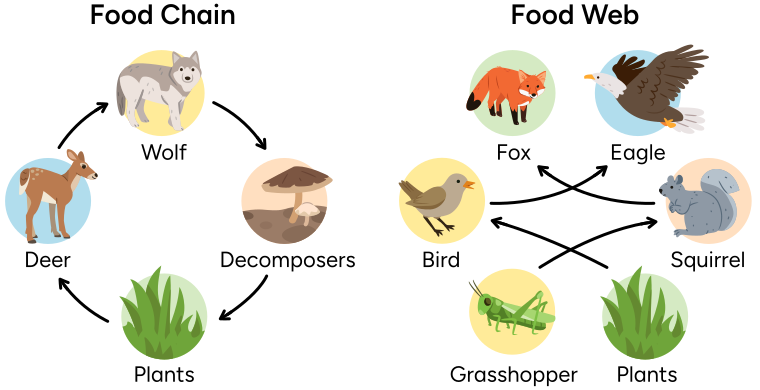
An example of a food chain is plants (like grass) are eaten by a deer, then the deer is eaten by a wolf, then when the wolf dies it is broken down by decomposers (like mushrooms), then the nutrients from decomposers help plants grow again.
An example of a food web is a grasshopper is eaten by a squirrel and plants (like grass) are eaten by a bird, then the bird is eaten by an eagle and the squirrel is eaten by a fox.
Let’s return to the idea of interconnectedness and interdependence in connection to global citizenship.

Pause and Reflect
Pause and reflect
Having explored the meaning of interdependence, do you think that all humans living on Earth right now are interconnected, or are we interdependent? Are we both, or maybe neither?
Record your thinking in a method of your choice.
United Nations and the SDGs
Whether all people are interconnected, or interdependent, it is a fact that communities of the world interact with each other. Historically, these interactions have been both peaceful and vicious, in some cases leading to wars involving multiple countries.
In the mid-1940s, following the end of the Second World War and the large scale of global destruction, there were concerns about how to maintain an international peace. The most far-reaching global conflict had just taken place, and many countries were afraid of it happening again.
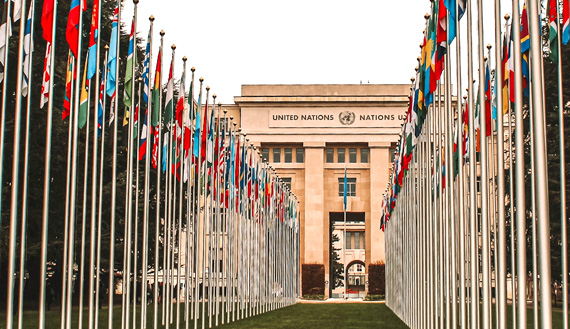
As a response to this concern, the United Nations (UN) was founded in 1945 as an international organization to promote peace, security, and cooperation across the world. Individual countries participate as “members” of the UN, including Canada (which was a founding member).
In 2015, the UN produced 17 interconnected Sustainable Development Goals (SDGs) as a universal call to action to protect people and the planet. The goals were set to be met by the year 2030.

Student Success
Let's Think!
Begin by exploring the following image that outlines all 17 SDGs. In a method of your choice, record:
- What do you notice about the goals? What do you wonder?
- Are there any goals that stand out to you? Why?
- How do you think the goals are connected? Provide examples.
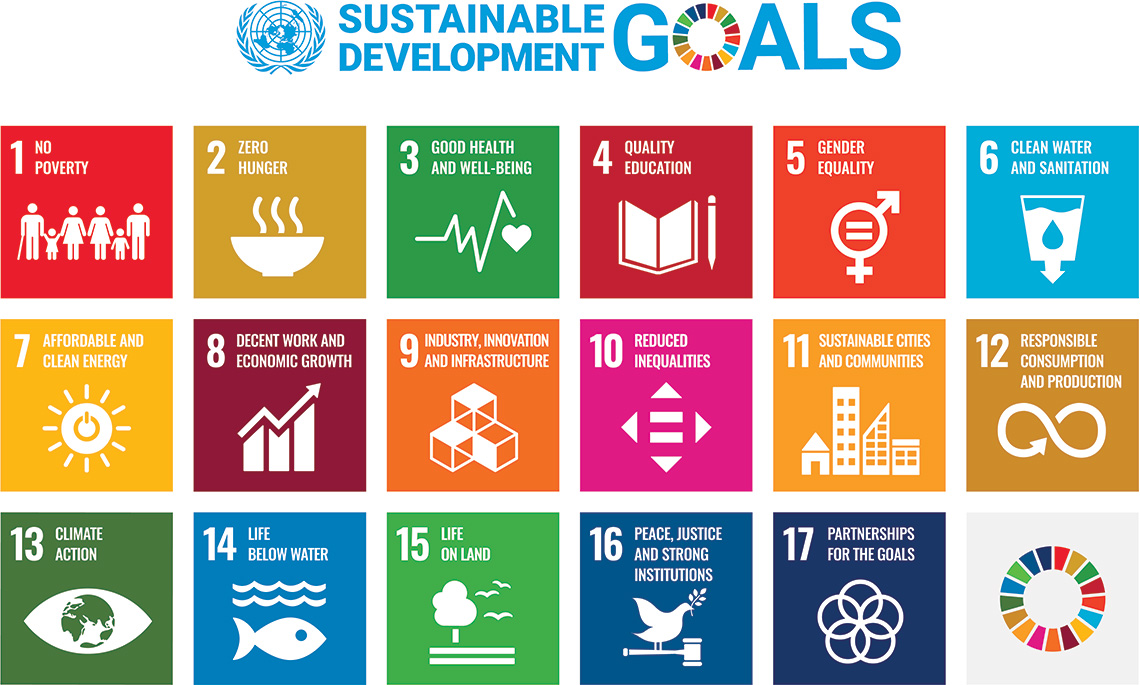
The United Nations created 17 goals, called the Sustainable Development Goals. The goals are:
- No poverty
- Zero hunger
- Good health and well-being
- Quality education
- Gender equality
- Clean water and sanitation
- Affordable and clean energy
- Decent work and economic growth
- Industry innovation and infrastructure
- Reduced inequalities
- Sustainable cities and communities
- Responsible consumption and production
- Climate action
- Life below water
- Life on land
- Peace, justice, and strong institutions
- Partnerships for the goals
These 17 goals were selected based on issues that impact all people and communities around the world, and the individual goals also connect to each other. For example, Goal #8 (Decent Work and Economic Growth) is supported by progress on Goal #4 (Quality Education), and Goal #3 (Good Health and Well-Being) has direct links to whether Goal #6 (Clean Water and Sanitation) is being adequately met.
Explore the following video to learn more about the Sustainable Development Goals.
Pause and Reflect
Pause and reflect
After viewing the video, which SDGs do you think are more urgent? In your opinion, should any SDGs be considered a higher or lower priority?
Explain your reasoning in 3-4 sentences. Record your response in writing or orally.
Remy saying: Sometimes when I'm exploring really big topics, I like to take some time to mull things over and brainstorm ideas on my own. When I come up with responses to guiding questions, it really helps me to process what I've learned! It also helps me to see if anything doesn't make sense.
Goal #15 – life on land
For all of the 17 goals, the UN produced separate informational posters to explain each objective further. Additionally, Statistics Canada – an agency of the Federal Government of Canada – created a series of UN SDG infographics that explore the goals within the Canadian context.
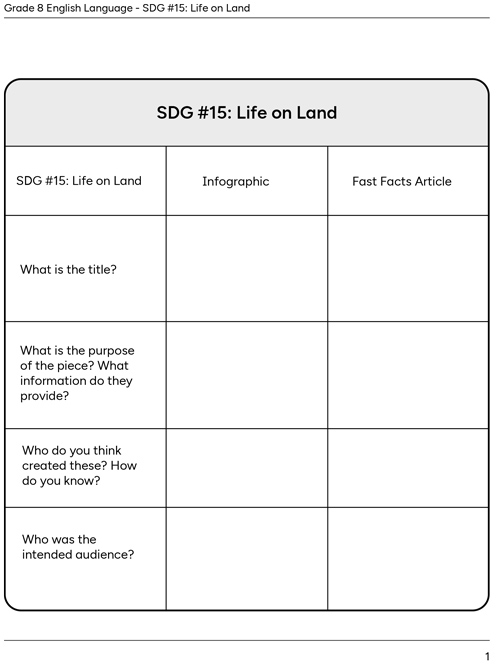
You will be examining both of these resources for Goal #15 – Life on Land. As you explore, respond to the following questions about both pieces of media.
- What is the title of both pieces of media?
- What is the purpose of each piece of media? What information do they provide? Record at least two pieces of information.
- Who do you think created these? How do you know?
- Who was the intended audience of them? How do you know?
Complete the fillable and printable SDG #15: Life on Land document in your notebook or using the following document. If you would like, you can use speech-to-text or audio recording tools to record your thoughts.
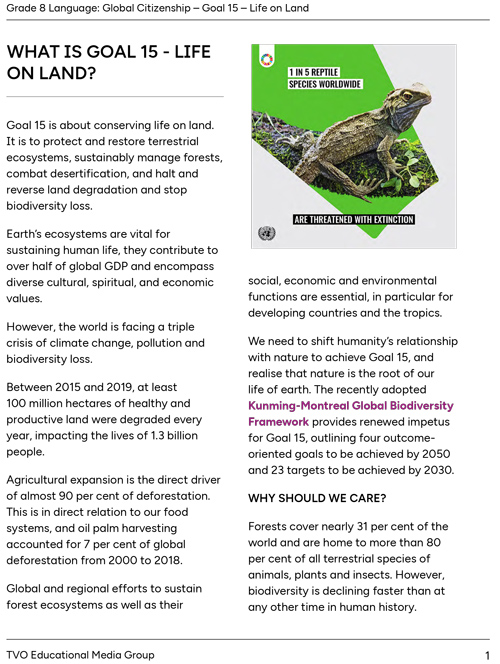
Read the following article "Goal 15 – Life on Land" to learn more.
Explore the following interactive entitled Life on Land Infographic to learn more.
Once you have completed the previous task, check your overall understanding of SDG #15 by engaging in the following true or false activity. Select the correct answer, then press Check Answer to see how you did.

Social Emotional Learning
Social emotional

You’ve just explored a variety of text forms. Take a break before continuing onto the next part!
Identifying perspectives in texts
There is a lot of important information – especially “hard data” like dates and statistics – that you can gain from reading fast facts articles and infographics. However, even when a text is fact-based and does not appear to reflect a personal point of view or perspective, it is always important to consider the source of the text, and how the politics, culture, and history around it might influence how the text was written.
Description
Image 1:
Ava saying: We can always use the Critical Thinking Process to get to the bottom of this! There's an ongoing step where we consider the cultural context of certain texts or concepts to get a better understanding of their meaning and purpose.
Image 2:
William saying: I've learned this step is super important when learning about global citizenship in general! It will help to ask questions about the text, such as "what political or cultural beliefs are being represented?" or, "who was the work being created for?" or even, "why might different communities interpret the message differently from how the author intended?"
Image 3:
Both students saying: Let's give it a try!
Considering cultural context
Knowing something about the background of a text can help us understand the meaning of language and symbols used. When it comes to official documents, such as articles or infographics released to the public by institutions like the UN or the Government of Canada, considering the cultural, political, and historical context can reveal important information.
Let’s consider the context of the two pieces you explored:
- both documents were prepared by official governing bodies: the United Nations and Statistics Canada, which is an agency of the Government of Canada.
- the UN is the creator and founder of the Sustainable Development Goals, and Canada is a member nation of the UN who is expected to meet these goals, so in both cases the SDG mandate is presented in a favourable, optimistic light.
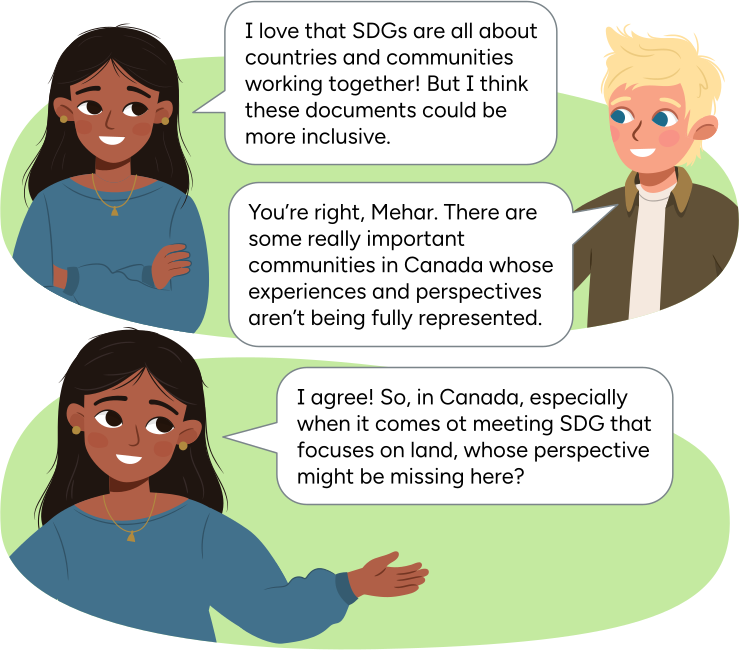
Mehar and Devon talking.
Mehar says: I love that SDGs are all about countries and communities working together! But I think these documents could be more inclusive.
Devon says: You're right, Mehar. There are some really important communities in Canada whose experiences and perspectives aren't being fully represented.
Mehar responds: I agree! So, in Canada, especially when it comes to meeting the SDG that focuses on land, whose perspective might be missing here?
Indigenous land rights in Canada
Land is at the centre of how many Indigenous communities experience their culture and the world around them. There is a deep responsibility and reciprocity experienced with the land within different First Nations, Métis, and Inuit communities across the territory that we now know as Canada.
For many Indigenous Peoples, land means more than property – it encompasses culture, knowledge systems, governance, connections, family, and relationships. It includes Earth, the water, the air, and all that live within. Indigenous Peoples understand themselves as the rights holders, not the landowners, to their traditional territories.
To get you thinking about respect and reciprocity further, start by learning from Peguis First Nation Elder Douglas Sinclair and Sandra Indian of the Ojibways of Onigaming about their perspectives on land. The first video is titled Everything Around You Is Ceremony and shows Douglas Sinclair's perspectives. The second video is titled Connection to the Land and shows Sandra Indian's perspectives.
Explore the following video entitled Everything around You is Ceremony to learn more.
Explore the following video entitled Connection to the Land to learn more.

Try It
Try it
After watching both videos, respond to the following questions in your notebook or another method of your choice.
- How does the land shape the actions and interactions of Douglas Sinclair and Sandra Indian?
- How do they show respect and reciprocity for the land?
Press the Possible Answer button to learn more.
Sinclair refers to how we are connected to the land in our heart, spirit, and in your mind and everything around you is ceremony because of that connection. He refers to how important it is to give thanks for everything in life including the circle of life. He shows respect for the land not just by giving thanks, but also acknowledging that we are not separate or superior to the land. He mentions how all of us are part of the land including the water, the trees, and the rocks (grandfathers).
Both Sandra Indian and Douglas Sinclair mention how their names connect them to spirit, the land, and the water. Sandra mentions how the horses remind her of the oldest language – the Earth language – how she must honour and respect the Earth. She considers how we are all people of the land, but she worries that future generations will not be as connected.
While land is essential to the traditions and customs of the communities that existed on this territory since time immemorial , the infographic made by Statistics Canada about Goal #15: Life on Land does not mention this deep understanding of land, or the ongoing struggle over Indigenous land rights in Canada.
Historically, Indigenous groups lost their “title” to traditional lands in exchange for certain “benefits” granted by the federal government. However, not all lands in Canada are covered by historic treaties:
- The Inuit never entered into historic treaties, instead their modern land claims allowed them to have title to certain blocks of land in their four respective regions.
- Métis Peoples are still negotiating to have their title recognized in the Red River area, and certain provincial territories and the majority of British Columbia have never been ceded under a treaty by First Nations.
Who has the right to jurisdiction over these territories is still to be determined. Many of these issues have not been resolved and are still outstanding.
Try It
Try it
The United Nations’ Sustainable Development Goals are intended to unite the countries of the world in an effort to enact “peace and prosperity for people and the planet.”
With some additional critical thinking, however, you may have noticed some challenges with implementing these goals when specific communities in certain countries – such as the First Nations, Métis, and Inuit Peoples in Canada – have separate goals for sustainability that do not seem to have been considered or directly represented in the UN’s SDG mandate.
Respond to the following questions in a method of your choice.
- How might your interpretation of the UN “fast facts” article and the infographic by Statistics Canada be changed if the goals and values of Indigenous Peoples had been directly represented?
- How might these documents have better incorporated the perspectives of Indigenous Peoples in Canada?

Vocabulary
Let’s take a minute and review some of the vocabulary that has come up so far.
Match the term to the definition.

Putting it all together
Let’s return to the concept of interconnectedness that we explored earlier in this learning activity. At the end of the Minds On section, you were asked to consider if people and communities on Earth are interconnected or interdependent.
Having learned about the United Nations and their development of 17 Sustainable Development Goals to improve the quality of life on Earth by the year 2030, as well as the specific Goal #15: Life on Land, and Indigenous perspectives on how human connect to and are responsible for the caretaking of the land, let’s revisit the question.
In a method of your choice, respond to the following prompts in one paragraph (4-5 sentences):
- The prefix “inter” indicates a relationship between things. Is the term “interconnected” sufficient in describing the relationships between United Nations member countries and communities around the world? What about the term “interdependent”? Explain your thinking.
- If the term "interdependent” is used to describe humans’ relationship to land, would that influence the way that SDGs, or sustainability in general, is portrayed?
- How might this change the way that publications or documents issued by official agencies like the UN or Statistics Canada represent sustainability goals?
Reflection
As you read the following descriptions, select the one that best describes your current understanding of the learning in this activity. Press the corresponding button once you have made your choice.

I feel...
Now, expand on your ideas by recording your thoughts using a voice recorder, speech-to-text, or writing tool.
When you review your notes on this learning activity later, reflect on whether you would select a different description based on your further review of the material in this learning activity.