Learning goals
We are learning to…
- analyze themes explored in First Nations, Métis, and Inuit cultures to show an understanding of the many identities and perspectives and ways of knowing, being, and doing
- select and use a variety of listening strategies before, during, and after listening to analyze and comprehend information communicated orally and identify relevant evidence to support a response appropriate to the context
- connect, compare, and contrast the ideas expressed in texts and their knowledges and lived experiences, the ideas in other texts, and the world around them
Success criteria
I am able to…
- analyze themes explored in First Nations cultures to show an understanding of the perspectives and ways of knowing, being, and doing
- use a variety of listening strategies before, during, and after listening to analyze and comprehend information communicated orally
- connect, compare, and contrast the ideas expressed in texts with my knowledge and lived experiences and the world around me
What is your relationship with water?
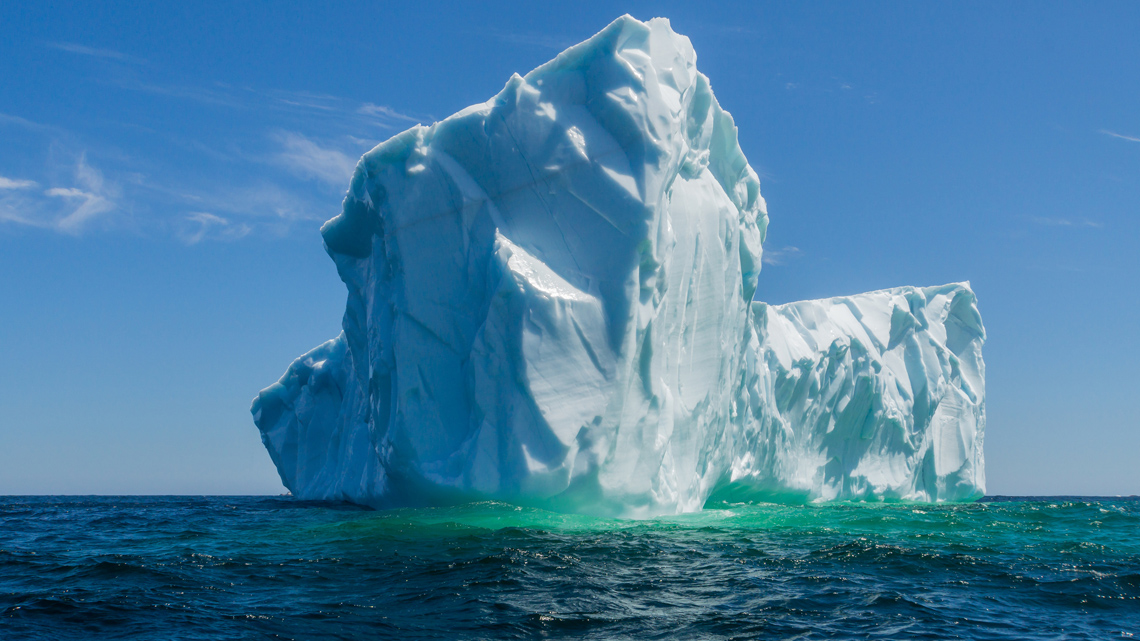

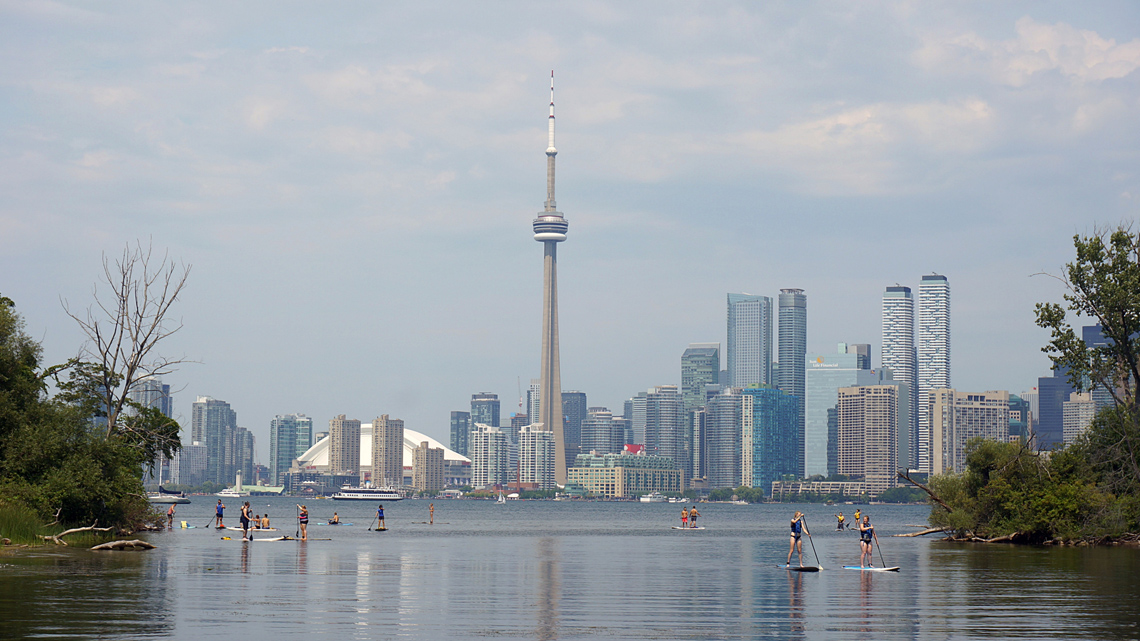
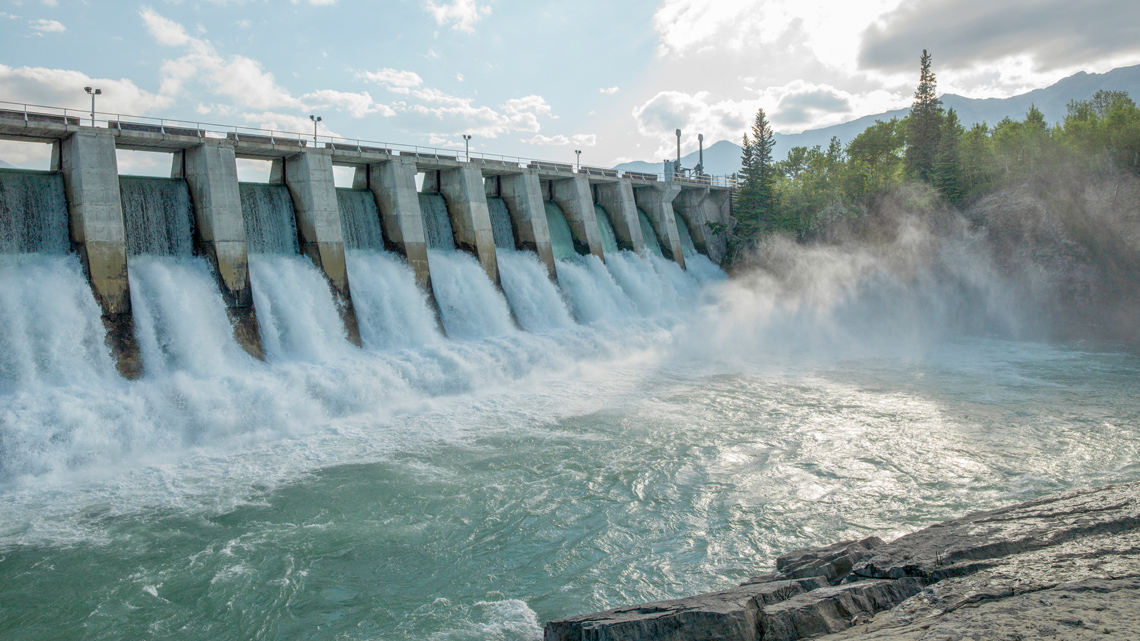
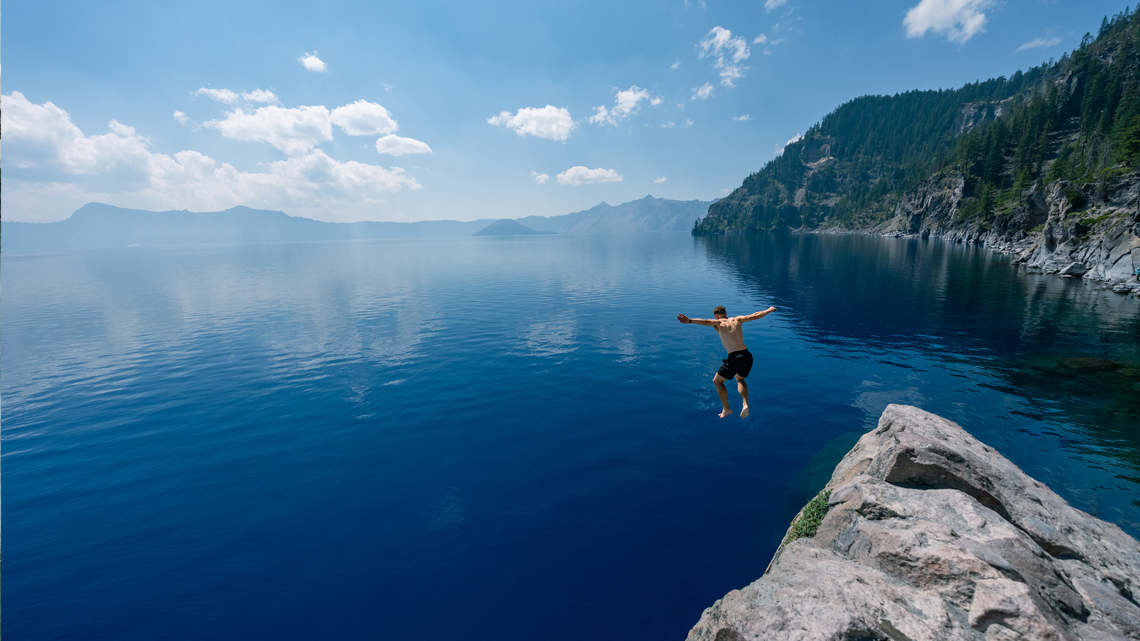
Examine each of the photos and think about the importance of the water from the standpoint of the following:
- human health and the health of all living things
- the wealth of a country
- the availability of food
- the tourism industry
- the manufacturing industry
Record your thoughts in your notebook or using another method of your choice.
Exploring water relationships
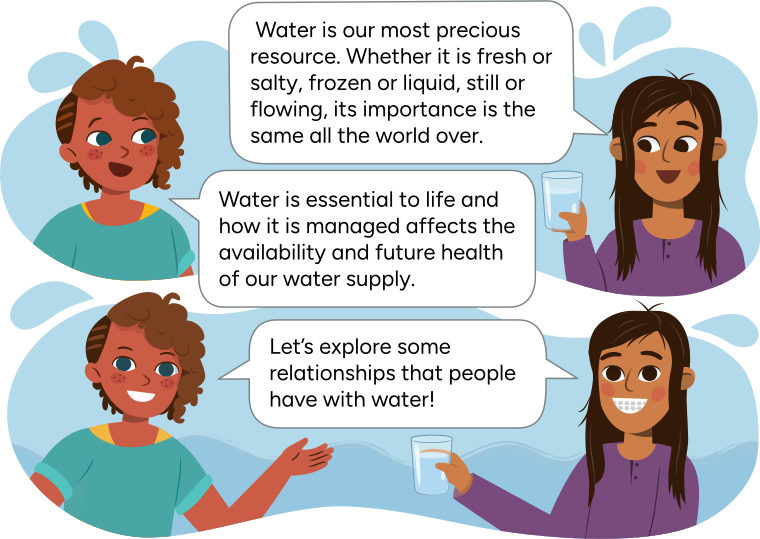 Description
Gabby and Neebin talking.
Neebin says: Water is our most precious resource. Whether it is fresh or salty, frozen or liquid, still or flowing, its importance is the same all the world over.
Gabby says: Water is essential to life and how it is managed affects the availability and future health of our water supply.
Gabby and Neebin both say: Let's explore some relationships that people have with water!
Before and during listening strategies
You are going to listen to some audio clips about water shared by different Indigenous Peoples of Canada. Each one provides information about the relationship the person or the people have with water.
Use the following strategies before and during listening to aid you in comprehending the information you hear. You will explore additional strategies after listening.
Press the following tabs to find out more.
- Focus on what you are about to do. Engage your mind.
-
Think about your own personal experiences
with water.
- How do you use water in your daily life?
- Are there particular water activities you enjoy?
- Has there ever been a time when you had to conserve drinking water?
- If you were to write a song or a poem about water, what would you write?
While you are listening, jot down prominent words in your notebook, or in another method of your choice. Concentrate on the emotions in the voices that you are hearing. Is there an underlying emotion that stands out?
Explore the following audio clip entitled “Sacred Relationship” to learn about perspectives on water from Narcisse Blood of Kainai First Nation, who is a Blackfoot Studies Professor at Red Crow College, Leo Pard, Blackfoot Elder of Piikani Nation, and Violet Poitras, Cree/Nakota Elder of Paul First Nation.
Sacred Relationship
Explore the following audio clip entitled “Isaac Murdoch on Water” to learn about perspectives on water from Anishinaabe Knowledge Keeper Isaac Murdoch, Ojibwe of Serpent River First Nation.
Isaac Murdoch on Water
Explore the following audio clip entitled “Kahnekarónnyon - Water Is Everywhere” to learn about perspectives on water from Tehahenteh Miller, Mohawk Turtle Clan.
Kahnekarónnyon - Water Is Everywhere
After listening
In a notebook or using another method of your choice, write three sentences that summarize the perspectives on water that were shared in the audio clips.
- Did summarizing help you better understand the content?
- How did the strategy of summarizing help?
In the second audio clip, Anishinaabe Knowledge Keeper Isaac Murdoch said the following:
“They said your first teacher was water and that your whole life is gonna be based on that water. And that water is our most sacred thing.”
Let’s use this quote to explore some grammar!

Linking verbs
Linking verbs are verbs that connect the subject of a sentence with an adjective, noun, or descriptive phrase. Unlike action verbs (that show an action), linking verbs describe a state of being or a relationship between the subject and the verb.
Examples of linking verbs are:
- appear
- look
- seem
- indicates
- go
- stay
- remain
- smell
- taste
- feel
- sound
- get
- come
- act
- is/was/will/would be
The linking verb falls between the subject, which is the person or object (thing) that the sentence is about, and the subject complement which is the word or phrase that identifies or describes the subject.
Check out the following video entitled Linking Verb Examples to explore examples of linking verbs.
Read the following sentences, then identify the subject, linking verb, and subject complement in each sentence.
- Your first teacher was water.
- Water conservation seems more important than ever.
- Indigenous communities would be able to control their water usage through self-governance.
Indigenous perspectives
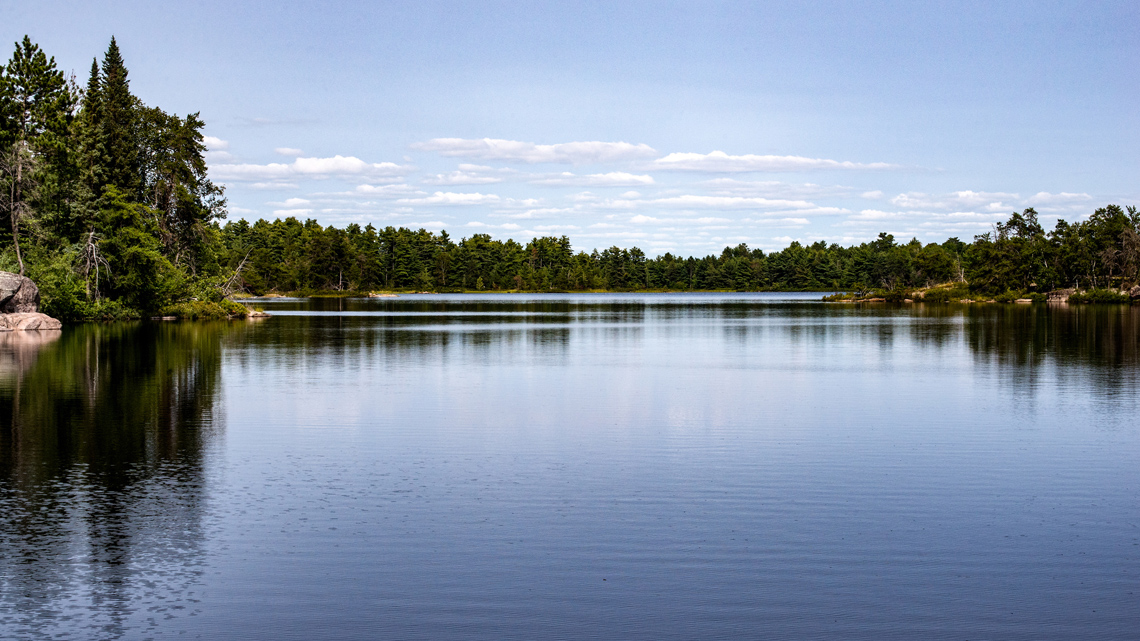
French River, Ontario Canada
The themes of respect and responsibility are central to the worldviews of Indigenous Peoples throughout the world. But not everyone in the world views water the same way, and it is not universally respected. Indigenous Knowledge teaches us to be mindful of our relationships with the Earth and that all life is dependent upon a healthy supply of water. It is our responsibility to treat water with respect.
Indigenous Peoples traditionally are caretakers of Mother Earth. They believe that the Earth gives the world the gifts of water, fire, and air – the necessities for life and survival. Thus, Indigenous Knowledges are grounded in the belief that humans must have a reciprocal relationship with the Earth and all living things on it.
Indigenous Peoples have always practised sustainability in their traditional territories.
For example, they carefully harvest and only take what they need, so that the resource can continue to regenerate itself. This harvesting protected the health and well-being of the community and the health of the environment for future generations.
Though each nation and community have their own teachings around Traditional Ecological Knowledge, it is commonly understood that all of the elements in the universe are connected and are all dependent on one another for life.
Humans are not superior to any other living part of the Earth. And as humans, we have a role and responsibility to take care of the Earth, not just for this generation, but also future generations as well.
Let’s examine some perspectives on water, specifically the Great Lakes, from Indigenous Peoples from diverse First Nations communities.
Check out the following clip from the video entitled Understanding the Great Lakes Through Indigenous Knowledge to learn more.

Try It
Try it
Using the ideas shared in the video and the words on your listening organizer, answer the following questions in a method of your choice.
- How is Indigenous Knowledge transmitted?
- In what ways have the Great Lakes been important to the Anishinaabe and the Haudenosaunee respectively?
- In what ways was responsibility present within each person’s perspective?
- How is responsibility to the water connected to the past, present and the future?
The Haudenosaunee include the Mohawk, Oneida, Onondaga, Cayuga, Seneca and Tuscarora nations. The Anishinaabe include the Odawa, Chippewa (Ojibwe and Saulteaux respectively), Oji-Cree, Mississaugas, Algonquin, Nipissing, and Potawatomi nations.

Pause and Reflect
Pause and reflect
Some people do not see water as a relative, rather they refer to water as a resource, and only in terms of its chemical and physical properties. It is often called a "universal solvent" because of its ability to dissolve more substances than any other fluid. In contrast, Indigenous Peoples view water as a relationship with specific responsibilities.
- How do the Indigenous perspectives of water shared compare to your relationship with water?
- How could your community benefit from considering some of the perspectives Indigenous Peoples have with water?
Two-eyed seeing
“Etuaptmumk is the Mi’kmaw word for Two-Eyed Seeing. We often explain Etuaptmumk - Two-Eyed Seeing by saying it refers to learning to see from one eye with the strengths of Indigenous knowledges and ways of knowing, and from the other eye with the strengths of Western knowledges and ways of knowing … and learning to use both these eyes together, for the benefit of all.”
- Mi’kmaw Elder Albert Marshall
Mi’kmaw Elder Albert Marshall developed the guiding principle of Two-Eyed Seeing to describe how Western and Indigenous knowledges and perspectives can work together to explore a bigger picture and create innovative solutions.
By considering multiple perspectives, we not only help solve issues in our individual lives, but it can also improve our collective relationship to the Earth. Indigenous Knowledges, perspectives, and innovations can create a more sustainable future for all!
Let’s explore with Melanie Goodchild, a research fellow and a member of Biigtigong Nishnaabeg First Nation in Northern Ontario, about various perspectives on climate change.
Check out the following video entitled “Can Indigenous Knowing Help Solve Climate Change” to learn more about different perspectives on climate change.
After exploring the video, consider the Indigenous Knowledges and perspectives shared, as well as the knowledge and perspectives shared by Western science.
Complete the fillable and printable Comparing Indigenous and Western Perspectives on Climate Change template in your notebook or using the following document. If you would like, you can use speech-to-text or audio recording tools to record your thoughts.
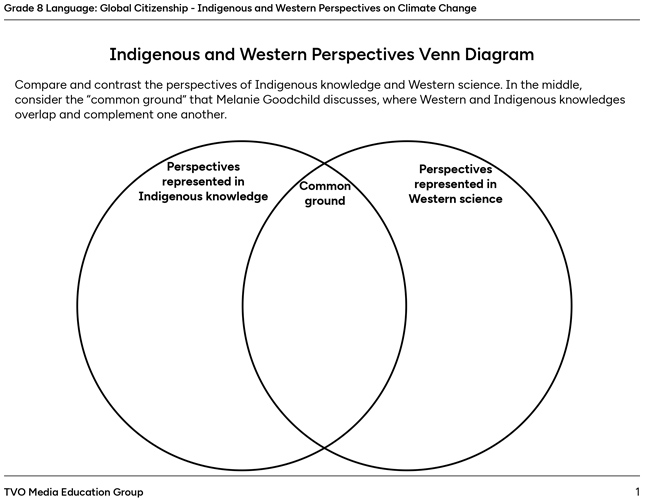
Press the Activity button to access the Comparing Indigenous and Western Perspectives on Climate Change.
Activity(Opens in a new tab)“Water protectors talk about the spirit of water and that you need to protect that spirit. And it’s because we believe that those are a gift and that we need to have a reciprocal relationship with those gifts and appreciate them, instead of looking at them purely as ecological services.”
- Melanie Goodchild, research fellow and member of Biigtigong Nishnaabeg First Nation in Northern Ontario
After completing a compare and contrast on the various perspectives, consider how Two-Eyed Seeing can help solve world issues, such as climate change.
What benefits can come from Indigenous and Western knowledges and scientists working together?
Record your ideas in a notebook or another method of your choice.

Social Emotional Learning
Social emotional learning

You’ve just explored Indigenous perspectives. Take a break before exploring some vocabulary!

Vocabulary
In this learning activity so far, we have explored the importance of water to communities, and in particular, how various Indigenous Peoples have considered the human relationship to water. Throughout this learning, you have encountered some terms that may be new or unfamiliar.
Match the following vocabulary words in the first column with their definition in the second column.
For each vocabulary term select the corresponding definition.
For each vocabulary term select the corresponding definition.
Let’s explore vocabulary from this learning activity by identifying the synonym or antonym .
Select the correct answer, then press Check Answer to see how you did.

Fluency
Examine the following excerpt from Dawn Martin-Hill’s interview on The Agenda.
- Read it out loud. If possible, record yourself using an audio recorder.
- Listen to the audio recording of the same passage.
- Identify any words that you mispronounced or words that made you stumble. Practise saying them again. Listen to the recording a second time if necessary.
- Read the passage out loud again. If possible, read it to another person.
“Indigenous people have their own epistemologies and pedagogies , methodologies that have been accumulated for thousands of years based on their observations of the world around them as well as keeping that information alive through stories, through transmission, through ceremony. So it is a way of being, it’s not a religion nor is it just an education academic exercise, it's literally who they are as human beings and the knowledge they possess has often been transmitted for a very long time and we need access to that information because of the current situation or in with climate change.”
Check out the following audio clip of the excerpt from Dawn Martin-Hill’s interview on The Agenda
Excerpt from Dawn Martin-Hill’s interview on The Agenda
Putting it all together

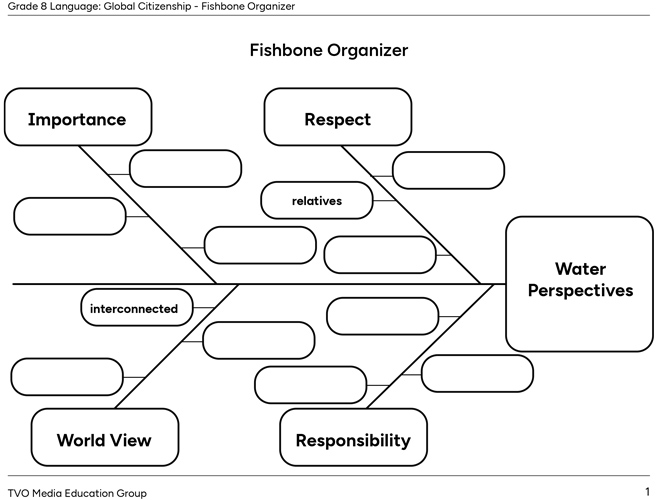
In the organizer below, add a word or a phrase to the lines under the sub-headings that give more detail about the perspectives and relationships associated with water.
Use words from this learning activity, your notes on the audio presentations, from the perspectives of Indigenous Peoples, and from your own relationship with water. Two examples have been done for you.
Complete the fillable and printable Fishbone Organizer in your notebook or using the following document. If you would like, you can use speech-to-text or audio recording tools to record your thoughts.
Reflection
As you read the following descriptions, select the one that best describes your current understanding of the learning in this activity. Press the corresponding button once you have made your choice.

I feel...
Now, expand on your ideas by recording your thoughts using a voice recorder, speech-to-text, or writing tool.
When you review your notes on this learning activity later, reflect on whether you would select a different description based on your further review of the material in this learning activity.