Learning goals
We are learning to…
- select and use suitable strategies, such as visualizing and making predictions, to monitor and confirm our understanding of various texts and solve comprehension problems
- conduct research to construct knowledge and create texts that are appropriate for our intended audience and purpose
- explain and compare how various strategies, have helped us comprehend various texts, and set goals to improve our comprehension
Success criteria
I am able to…
- use reading strategies (such as previewing, predicting, and visualizing) to answer questions, make connections, and show my understanding of different texts
- create detailed and organized research notes on a water technology/initiative of my choice
- publish the findings of my research using a format that is appropriate for my intended audience and purpose
- critically analyze and communicate how the strategies I used throughout this learning activity impacted my work and could be applied in other subject areas
Understanding the goal
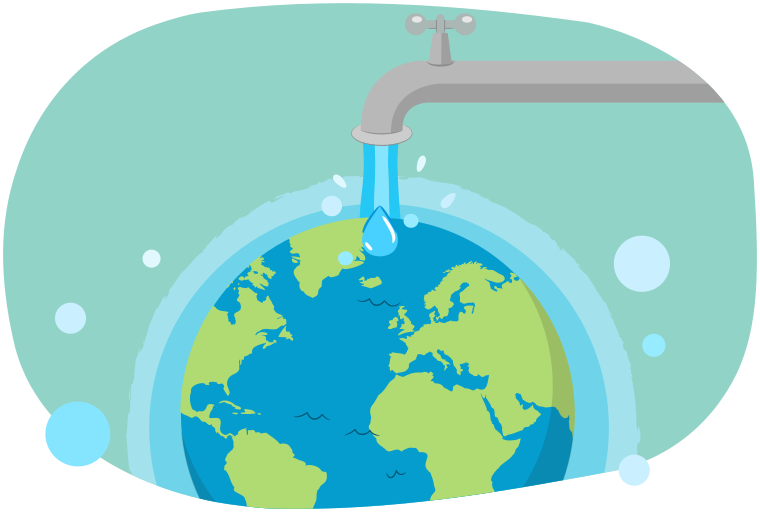
The United Nations Sustainable Development Goals (SDGs) were developed in 2015 as a “call to action” for all countries to address issues that are believed to be faced by the whole world’s population.
One of the 17 goals is focused on providing access to safe water, sanitation, and hygiene as a basic human need for health and well-being.
 Description
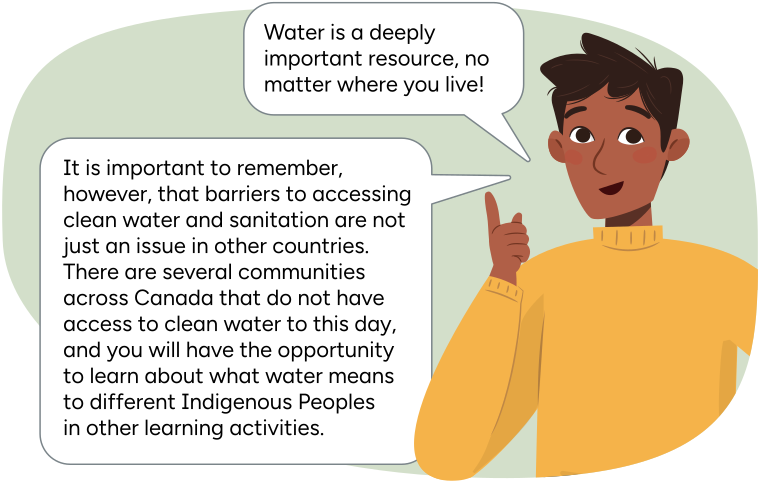
Teacher Ravi saying: Water is a deeply important resource, no matter where you live! It is important to remember, however, that barriers to accessing clean water and sanitation are not just an issue in other countries. There are several communities across Canada that do not have access to clean water to this day, and you will have the opportunity to learn about what water means to different Indigenous Peoples in other learning activities.
Explore the following statistics about global access to water. As you are exploring, think about which statistics surprise you the most and why.
- Less than 5% of the world water is drinkable without being treated.
- There are 2 billion people in the world who do not have access to safe water.
- To gain access to water, some people are required to carry a 40-pound jug of water for long distances.
- Heavy precipitation events can cause floods that damage water sanitation and infrastructure.
- Rising temperatures are drying up freshwater sources.
Source: United Nations. (n.d.). Water and sanitation - united nations sustainable development. United Nations. https://www.un.org/sustainabledevelopment/water-and-sanitation/
Access to safe water, sanitation, and hygiene is a global challenge that requires a global solution, if possible.
Addressing global challenges often requires collaboration among individuals, communities, organizations, and even nations. If individuals see themselves as part of a larger community, they can work together to solve global problems.

Brainstorm
Brainstorm
Brainstorm ideas on how people, regardless of their location or background, can collaborate as global citizens to address global challenges, such as access to clean water, sanitation, and hygiene. No idea is too small! Consider the following:
- How can individuals support global initiatives from their local communities?
- What role could technology play in connecting people globally for positive change?
- How might countries collaborate to share resources and expertise?
- What role can you play as a global citizen in addressing global challenges?
Create a list in a notebook, orally, digitally, or in another method of your choice.
Once you’ve created your list, categorize your ideas into themes. For example, you could have the themes:
- technology
- local community
- education
The importance of clean water
Clean water and sanitation are a human right. As discussed in the Minds On, they are the focus of one of the UN’s Sustainable Development Goals (SDGs) because, for different people and communities around the world, there are many inequalities when it comes to access to water and sanitation services. In many places there exists violence and discrimination around access to washrooms and sanitary products, and clean water is an issue for many countries and communities for a variety of reasons.
Lack of access to clean water and sanitation is an example of a human rights violation.
Brainstorm
Brainstorm
Consider what you already know about water and answer the following questions:
- Why is clean water so important?
- What is clean water needed for?
- How do communities rely on clean water?
Record your ideas in a notebook or using another method of your choice. If possible, share your thoughts with a partner.
Barriers to accessing clean water
In many global communities, there are unique barriers to accessing clean water and sanitation. Extreme weather like droughts, political unrest/issues or shortcomings, or waterway contamination are some contributing factors to clean water scarcity and a lack of proper sanitation options.
In this learning activity, you will consider the importance of water as a resource by analyzing some different forms of text and conducting your own research.
Let’s begin by previewing a text.
A Long Walk to Water
The book A Long Walk to Water by Linda Sue Park, is categorized as historical fiction.
Historical fiction is a genre of stories that take place in the past in real settings or involving real events, but blended with fictional (made up) elements, retellings, or character perspectives.

Examine the cover of the book A Long Walk to Water by Linda Sue Park and the publisher’s summary. What do you notice? What do you wonder?
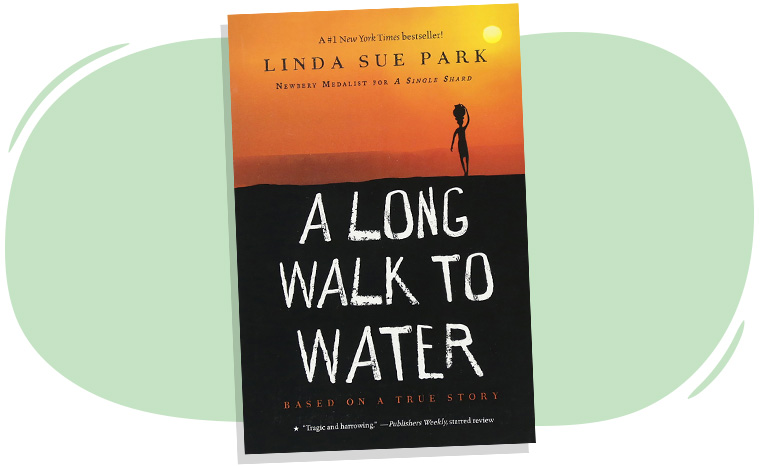
A Long Walk to Water begins as two stories, told in alternating sections, about two eleven-year-olds in Sudan, a girl in 2008 and a boy in 1985. The girl, Nya, is fetching water from a pond that is two hours’ walk from her home: she makes two trips to the pond every day. The boy, Salva, becomes one of the “lost boys” of Sudan, refugees who cover the African continent on foot as they search for their families and for a safe place to stay.
Enduring every hardship from loneliness to attack by armed rebels to contact with killer lions and crocodiles, Salva is a survivor, and his story goes on to intersect with Nya’s in an astonishing and moving way. Includes an afterword by author Linda Sue Park and the real-life Salva Dut, on whom the novel is based, and who went on to found Water for South Sudan.

After examining the book cover and the publisher’s summary, make three predictions about what you think will happen in the text and how you think this text connects to the content/topic you have explored in this learning activity so far.
Use the following checklist to explore how to make predictions.
Making predictions
Record your predictions in a notebook or using another method of your choice. If possible, share your thoughts with a partner.
Next, let’s read a short excerpt from Chapter 3 of the book A Long Walk to Water by Linda Sue Park. As you read, try to visualize the text.
To preview some tips for visualization before reading, press the Tips button.
Tips for visualization
- Visualize the scene, characters, and events.
- Allow your imagination to paint a vivid picture of the text in your mind.
- Incorporate sensory details into your mental images (sights, sounds, smells, textures).
- Pay attention to how the author uses descriptive language to evoke sensations.
- Adjust your mental image as new information is revealed or as the character develops.
Let’s read!
Access the following Excerpt from A Long Walk to Water to read a section of the book.
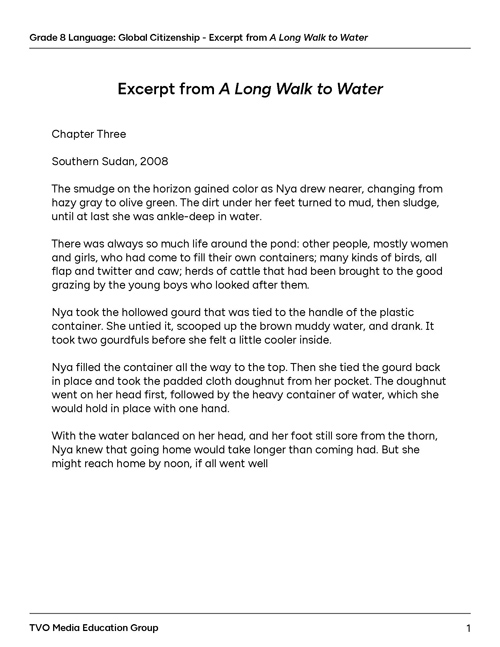
Press the Activity button to access the Excerpt from A Long Walk to Water.
Activity(Opens in a new tab)Check your comprehension using the following true or false questions. Select the correct answer, then press Check Answer to see how you did.
Making connections between texts
It is a traditional practice of certain communities around the world for the female members to be responsible for collecting the shared water supply. Communities in certain regions of Kenya and Tanzania, for example, lead this gendered water collection practice, and there is additional labour for the water carriers during seasonal drought when access to water becomes extremely limited.
Explore the following video clip from The Water Brothers episode titled “No Woman, No Water” as they travel to a water-scarce African region near Tanzania and Kenya.

Pause and Reflect
Pause and reflect
Compare and contrast the information you learned in The Water Brothers video clip and what you read and analyzed about the text A Long Walk to Water.
What connections can you make between the ideas expressed in each?
Record your thinking in a notebook or using another method of your choice.
When you are finished, press the Possible Answers button to explore some possible connections.
- The book A Long Walk to Water is set in Sudan and the video clip is set in a region near Tanzania and Kenya. Both are in Africa.
- Both texts have females being responsible for collecting the water.
- Both texts highlight the lack of clean water access and the need to travel long distances to get any form of water.
While both the book and the video clip involve communities in Africa, it is important to note that there are various groups who lack access to clean water and sanitation all around the world, and it is not an issue exclusive to people in countries in the Global South.
There are many Indigenous communities in Canada that do not have access to safe, clean drinking water. Indigenous peoples have been advocating for change to ensure their communities have their basic human rights fulfilled. They have also started initiatives and partnerships to help continue their tradition of protecting the water for future generations.
Innovating for change
Given that access to clean water and sanitation services are a global concern and a human rights violation, there are many groups and organizations that are working to find innovative solutions to this on-going problem.
In this section of the learning activity, you will conduct research to explore some of the innovative water technologies and initiatives that currently exist around the world.
Before you begin, review the following information about how to conduct research in a safe and responsible way.
Research safety
When doing research on the Internet, it is important to stay safe and stay focused. You can use the acronym TRUST to guide you as you do your research.
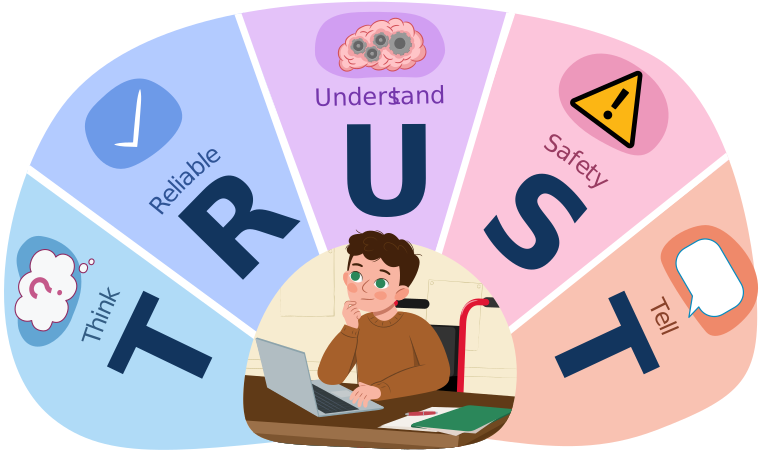
Press the following tabs to learn more.
Think about your topic and develop specific questions to get better research results.
For example, if you’re working on the topic of recycling, you might start with a general question and make it more specific before beginning your research.
- General question: Why is recycling good for the environment?
- Specific question: How does recycling help protect marine wildlife?
Be patient while doing your research. Go through each website carefully and take notes using a graphic organizer or notebook. Record the websites used for specific information – it’s important to give credit to the creator of the content.
Consult more than one resource to help you determine if the information you gather is accurate and true.
Remember, research can take time. It helps to be focused and calm! Taking a break can refresh our thinking and help us process new information.
It’s important to use reliable sources so that you can put together accurate and up-to-date information about your topic.
Websites ending with .com, .org, and .net can be purchased and used by anyone.
The ending .org is usually used by non-profit organizations, which may be trying to persuade rather than educate.
Websites ending in .edu are reserved for colleges and universities. Canadian websites have a .ca ending.
Consider the following questions when you are doing your reliability check. You might also ask a trusted adult or a peer for help if you are uncertain about a website.
- When was the resource published? (This might help you determine if the information is current.)
- Who created the resource/website? What is their educational background or work experience?
- Who is the intended audience?
- Who benefits from this information being shared?
- Whose perspectives are represented? Whose perspectives are missing?
Do you understand all the words on the site? Can you decode their meaning?
Does what you’re reading make sense?
If not, it’s okay. Consider trying a different source. It’s important for you to understand the information that you read so that you can put it in your own words.
It’s important to stay safe while doing online research. If a website asks you for any personal information, close it and try a different website.
Personal information could include asking for your full name, email address, phone number, home address, photos, or school name. Do not provide any personal information and close the website.
Does the site have pop-up windows? These windows usually ask the user to click to “win a prize” or “check out information.” Do not click on the pop-ups and close the website.
Throughout the research process, feel free to check in with a peer or trusted adult.
If there is anything specific that makes you feel uncomfortable or worried while you are doing your research…
- pause and take a break
- speak to a trusted adult
Researching innovative water technologies/initiatives
Choose one of the following water technologies/initiatives to research, or you may choose another option not listed. If you choose your own option, check in with your teacher or a trusted adult about your choice.
- WaterSeer
- Flowered Project
- Hippo Roller
In a notebook, or using another method of your choice, record your findings about what the technology/initiative is, how it works, the community or group of people it impacts, how it is helping, and the importance of such a technology.
Consider using the following graphic organizer to help organize your research.
Complete the Innovative Water Technology/Initiatives Notes in your notebook or using the following fillable and printable document. If you would like, you can use speech-to-text or audio recording tools to record your thoughts.
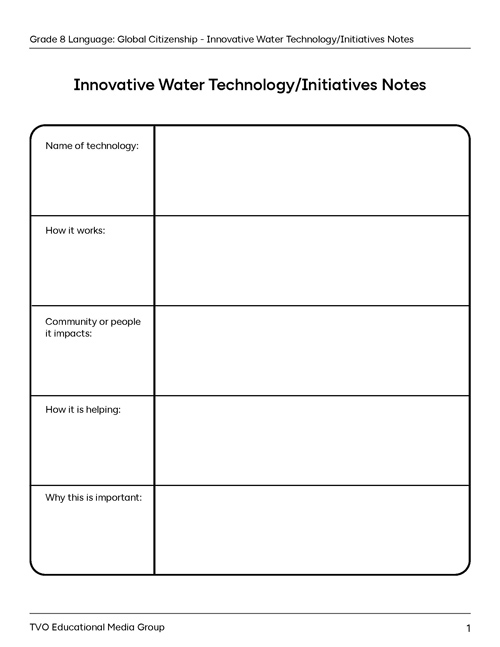
Press the Activity button to access the Innovative Water Technology/Initiatives Notes.
Activity(Opens in a new tab)To get you started on your research, press the following tabs to access some information on each water technology/initiative.
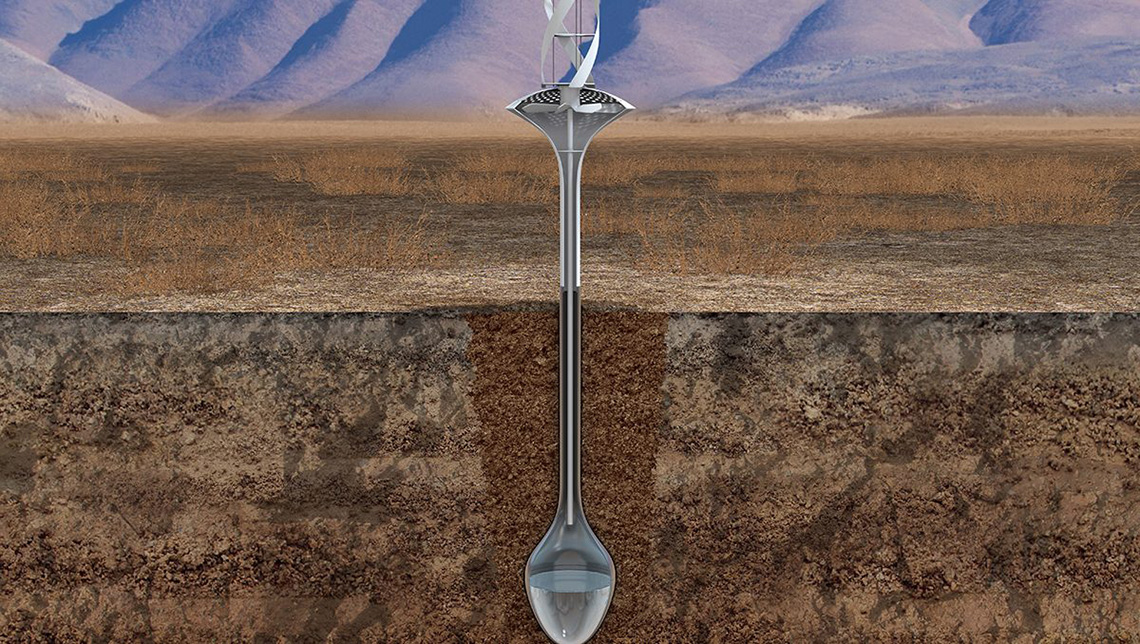
VICI Labs has invented the WaterSeer. A WaterSeer is a wind turbine, and a tube planted several metres into the Earth’s surface where it is surrounded by cool earth. It uses the surrounding environment to extract water from the atmosphere. Above ground, a small wind turbine spins which turns fan blades inside the device. These fan blades send the air into a condensation chamber and as the warm air cools, it creates condensation that flows down to the lower chamber and can be extracted with a simple pump. In ideal conditions, it can collect 37 litres of water per day. However, in some areas, there is concern that this device is too fragile and would not withstand the environmental conditions. A WaterSeer would be expensive to install for communities. A non-profit company is stepping up by providing one WaterSeer in an area in the world that lacks access to safe water for every one that is bought in the United States.
The Flowered Project has developed a battery operated, portable device for decontaminating water. Groundwater is a main water source in many countries, but much of this water is contaminated with dangerous levels of fluoride making it unsafe to consume. The developed device has a 20-litre tank and recirculating pump that is powered by a car battery. The prototype was recently tested in Tanzania and showed a decrease in contamination within two hours and only cost around $250 to use. The project will hold in high regard gender equality because women will be involved directly in the training activities to use the device so that they can safeguard their family’s health.
African engineers have designed the Hippo Roller water wheelbarrow. It was developed in response to women and children carrying buckets of water that are extremely heavy on their backs and heads multiple times a day. The Hippo Roller can carry more than 90 litres of water and can be rolled rather than carried. This would mean fewer trips to collect water and more time for women and children to attend school or work. The durable wheel has a lifespan of five to seven years. The company who produces the Hippo Roller is insistent that communities be provided with access to safe water directly in their community, however, is attempting to provide something that can be used until this goal is achieved.
Putting it all together
To consolidate your learning, you will now choose a format you think is most appropriate to present the findings of your research on the water technology/initiative that you selected.
Before you select your format, consider the following:
- Who is the audience you will be presenting your information to?
- What is the purpose behind communicating these research findings? What do you hope your audience will take away from reading about this technology/initiative?
- What materials or digital design tools do you have available to you to create your published product?
When you have finished and published your final product, don’t forget to share it with others to spread awareness of global water and sanitation issues and advocate for change.
Pause and Reflect
Reflecting on learning
How did exploring different types of texts connected to a theme help your understanding and engagement with the topic?
What skills, tools, or strategies that you used throughout this learning activity could help you in other subject areas?
Record your thinking in a notebook or using another method of your choice. If possible, share your thinking with a partner.
Reflection
As you read the following descriptions, select the one that best describes your current understanding of the learning in this activity. Press the corresponding button once you have made your choice.

I feel...
Now, expand on your ideas by recording your thoughts using a voice recorder, speech-to-text, or writing tool.
When you review your notes on this learning activity later, reflect on whether you would select a different description based on your further review of the material in this learning activity.